
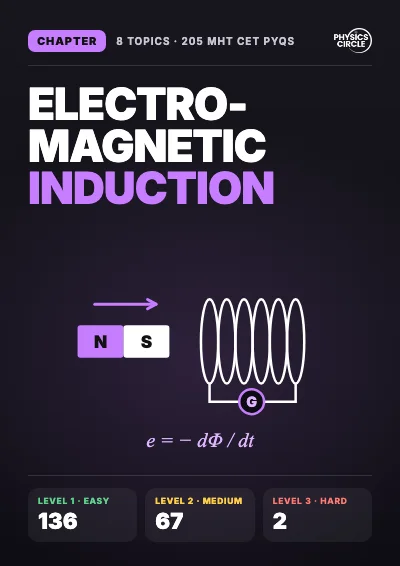
Electromagnetic Induction Formula Book
53 formulas in 6 topics, in the same order as the PYQ topics.
Only formulas used in the solutions of 205 MHT CET PYQs (Level 1, 2, 3)Magnetic Flux & Faraday's Law
10 formulas · from 40 MHT CET PYQs
- Magnetic flux through a coil of N turns
- Flux as a dot product
- Faraday's law: induced emf
- Emf for N turns when flux changes from phi1 to phi2
- Emf when only the field B changes
- Coil removed from the field / field switched off
- Coil turned through 180 degrees
- Induced current
- Induced charge (independent of time taken)
- Coil with an external resistance in the circuit
Motional EMF
7 formulas · from 21 MHT CET PYQs
- Motional emf of a rod moving perpendicular to B
- Current in the circuit
- Magnetic (retarding) force on the rod
- Terminal velocity of a rod falling on rails
- Power needed to move the rod (Joule heat)
- Rod falling freely through height h
- Swinging rod (pendulum): speed at the lowest point
🔒 For Vajra 2.0 Pro studentsTopic 1 is free. Log in with your Vajra 2.0 Pro number to see every formula.
Rotating Conductors & AC Generator
7 formulas · from 12 MHT CET PYQs
- Emf across a rod rotating about one end
- Same, in terms of revolutions per second n
- Rod rotating about a point O inside it
- Flux through a rotating coil (AC generator)
- Emf of an AC generator
- Peak emf of an AC generator
- Average power in a resistor R
🔒 For Vajra 2.0 Pro studentsTopic 1 is free. Log in with your Vajra 2.0 Pro number to see every formula.
Self-Inductance & Energy
14 formulas · from 60 MHT CET PYQs
- Self-inductance from flux linkage
- Self-induced emf
- Self-inductance of a solenoid
- Solenoid of radius r
- Solenoid with a core of relative permeability
- Dependence on number of turns
- Field inside a solenoid
- Self-inductance of a flat circular coil
- Solenoid wound from a wire of length w
- Energy stored in an inductor
- Energy in terms of flux linkage
- Rate of energy storage
- Same flux linkage in two inductors
- Unit of inductance
🔒 For Vajra 2.0 Pro studentsTopic 1 is free. Log in with your Vajra 2.0 Pro number to see every formula.
Mutual Inductance
9 formulas · from 41 MHT CET PYQs
- Mutual inductance from flux linkage
- Mutually induced emf
- Time for a current change to induce emf e
- Peak emf for an AC current in the primary
- Field at the centre of a large loop
- Small loop r at the centre of a large loop R
- Perfectly coupled coils
- Coefficient of coupling
- Transformer voltage ratio
🔒 For Vajra 2.0 Pro studentsTopic 1 is free. Log in with your Vajra 2.0 Pro number to see every formula.
Combination of Inductors, LR & LC Circuits
6 formulas · from 15 MHT CET PYQs
- Inductors in series
- Inductors in parallel
- Series, coupled coils opposing each other
- Current sharing in parallel inductors
- Potential drop across an R-L branch
- LC circuit: energy exchange
🔒 For Vajra 2.0 Pro studentsTopic 1 is free. Log in with your Vajra 2.0 Pro number to see every formula.