Physics Circle home Student Login

Home›HSC Board Guide›Kinetic Theory of Gases and Radiation

Dark Horse HSC Board 2027 Guide · Chapter 3 · Physics Circle

Kinetic Theory of Gases and Radiation

HSC Board questions with line-by-line solutions · Std XII Physics, Maharashtra Board

★
CHAPTER

Chapter 3 at a glance

HSC BOARD

Marks in every paper

HSC Board7 marksin every paper
1 mark9MCQ / one line
2 marks10short answer
3 marks5short answer
4 marks3derivation
TOPIC-WISE

What each exam asks

TopicHSC Board marks MHT CET share JEE Main share
01Ideal Gas, Mean Free Path
1
15%
32%
02Pressure of a Gas
12
4%
2%
03RMS Speed, Temperature
10
23%
32%
04Specific Heats
6
16%
33%
05Absorption, Blackbody
9
4%
0%
06Kirchhoff’s Law
6
2%
0%
07Wien’s, Stefan’s Laws
12
37%
1%
Based on8 board papers
2022–2026
226 PYQs
2019–2026
152 PYQs
2019–2026
MOST ASKED

Most asked in HSC Board · 2022–2026

QuestionMarksAsked inTimes
Pressure of a gas by kinetic theory (derive)4Mar 2022 · Feb 2023 · Jun 20263×
Stefan’s law numericals (energy radiated, filament, heat loss)2–3Jul 2022 · Feb 2023 · Jul 2023 · Feb 20254×
Mean KE / rms speed and temperature1–2Mar 2022 · Jul 2022 · Feb 2025 · Feb 20264×
Perfect blackbody · Ferry’s blackbody1–3Jul 2022 · Jul 2023 · Feb 20243×
Compare rms speeds of H₂ and O₂2Feb 2024 · Feb 20262×
Kirchhoff’s law (name / state and prove)1–3Jul 2023 · Feb 20252×
Specific heats: Mayer’s relation, CP and CV2–3Mar 2022 · Feb 20242×
Coefficients a, r, t (diathermanous, a + r + t = 1)1–2Feb 2025 · Feb 20262×
01
TOPIC

Ideal Gas and Mean Free Path

In this topic
  • Gas laws and the ideal gas equation
  • Ideal gas and real gas
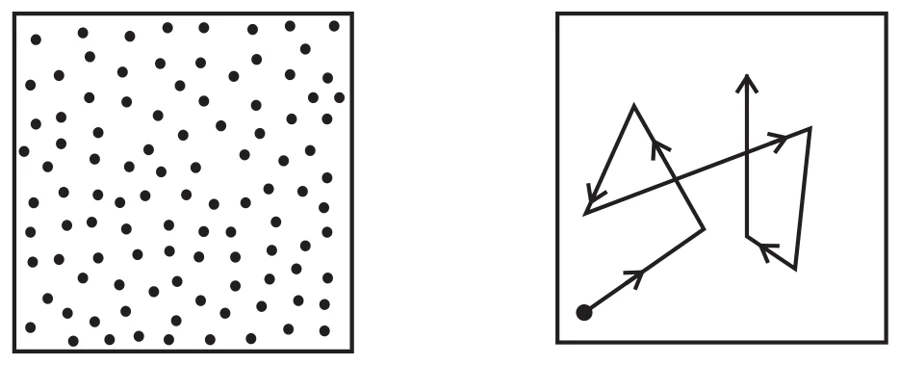
  • Random motion of molecules
  • Mean free path
Fig. 3.1 · HSC Textbook · (a) Molecules dispersed in a gas (b) Random motion of a molecule
TOPIC 01

Concept in brief

  • Gas laws (fixed mass of gas): Boyle’s law V ∝ 1P (T constant), Charles’ law V ∝ T (P constant), Gay-Lussac’s law P ∝ T (V constant).
  • Combining them gives the ideal gas equation PV = nRT, where n = NNA = MM₀ and R = 8.314 J mol⁻¹ K⁻¹. Also PV = NkBT, with R = NAkB.
  • An ideal gas obeys PV = nRT at all pressures and temperatures; its molecules do not interact. No real gas is truly ideal.
  • A real gas behaves like an ideal gas at low pressure (low density) and high temperature, well above its liquefaction temperature, because the molecules are then far apart.
  • Gas molecules are in continuous random motion. They behave like small hard spheres, make elastic collisions and move in straight lines with constant velocity between two collisions.
  • Mean free path λ = average distance travelled by a molecule with constant velocity between two successive collisions: λ = 12πd²(N/V). Larger density or bigger molecules ⇒ smaller λ.
FORMULAS

Formulas

Ideal gas equation

PV = nRT

In terms of molecules

PV = NkBT

Gas constant

R = NAkB

Mean free path

λ = 12πd²(N/V)

KEY WORDS

Key words

WordMeaning
ideal gasobeys PV = nRT at all P and T
real gasits molecules attract each other
equation of staterelation between P, V, T of a gas
moleNA = 6.02 × 10²³ particles
Boltzmann constantkB = 1.38 × 10⁻²³ J/K
elastic collisionkinetic energy is conserved
random motionmotion in all directions, no order
mean free pathaverage distance between two collisions

Board questions

12 questions · HSC papers 2022–2026, SCERT Question Bank, HSC Textbook
Q11 mark · HSC Feb 2023 · HSC Textbook Ex. 1(ii)
The mean free path λ of molecules is given by (n = number of molecules per unit volume, d = diameter of the molecules)
(a) 2πnd²(b) 1πnd²(c) 12 πnd²(d) 12πnd
Solution
→Mean free path varies inversely with the number density and with the cross section (d²) of a molecule:
λ = 12 πnd²
→Answer: (c) 12 πnd²
Q21 mark · HSC Textbook Ex. 1(iii)
If pressure of an ideal gas is decreased by 10% isothermally, then its volume will
(a) decrease by 9%(b) increase by 9%(c) decrease by 10%(d) increase by 11.11%
Solution
→Boyle’s law (T constant): P₁V₁ = P₂V₂ with P₂ = 0.9 P₁
V₂ = P₁V₁0.9 P₁ = 1.111 V₁
→The volume increases by 11.11%.
→Answer: (d) increase by 11.11%
Q31 mark · HSC Textbook Ex. 2(iii)
Write ideal gas equation for a mass of 7 g of nitrogen gas.
Solution
→Molar mass of N₂ = 28 g/mol
n = 728 = 14 mol
PV = nRT
⇒ PV = RT4
→Answer: PV = 14RT
Q41 mark · HSC Textbook Ex. 2(iv)
What is an ideal gas? Does an ideal gas exist in practice?
Solution
→A gas that obeys the equation of state PV = nRT at all pressures and temperatures is an ideal gas; its molecules do not interact.
→No, a real gas is never truly ideal; it only comes close at low pressure and high temperature.
Q51 mark · SCERT Question Bank · VSA 1
Under which condition are the laws of Boyle, Charles and Gay-Lussac valid?
Solution
→They are valid for real gases only if the pressure is not too high and the temperature is not close to the liquefaction temperature of the gas.
Q61 mark · Expected question · based on HSC Textbook 3.4
Define mean free path of a gas molecule.
Solution
→Mean free path (λ) is the average distance traversed by a molecule with constant velocity between two successive collisions.
Q72 marks · HSC Textbook Ex. 5
Mention the conditions under which a real gas obeys ideal gas equation.
Solution
→Low pressure (low density): the molecules are far apart, so intermolecular interaction is negligible.
→High temperature: the temperature must be well above the liquefaction temperature of the gas.
→Under these conditions the real gas is in the ideal state and obeys PV = nRT.
Q82 marks · HSC Textbook Example 3.1
Obtain the mean free path of nitrogen molecule at 0 °C and 1.0 atm pressure. The molecular diameter of nitrogen is 324 pm (assume that the gas is ideal).
Solution
→Given: T = 273 K
P = 1.01 × 10⁵ Pa
d = 324 × 10⁻¹² m
→For an ideal gas PV = NkBT
⇒ NV = PkBT
λ = 12πd²(N/V) = kBT2πd²P
λ = 1.38 × 10⁻²³ × 2732 × 3.14 × (324 × 10⁻¹²)² × 1.01 × 10⁵
λ = 0.8 × 10⁻⁷ m
→This is about 247 times the molecular diameter.
→Answer: 0.8 × 10⁻⁷ m
Q92 marks · HSC Textbook Ex. 12
Two vessels A and B are filled with same gas where volume, temperature and pressure in vessel A is twice the volume, temperature and pressure in vessel B. Calculate the ratio of number of molecules of gas in vessel A to that in vessel B.
Solution
→PV = NkBT
⇒ N = PVkBT
NANB = PAVAPBVB × TBTA = 2 × 2 × 12
= 2
→Answer: 2 : 1
Q102 marks · Expected question · based on HSC Textbook 3.4
On what factors does the mean free path of gas molecules depend? Write its expression.
Solution
→Density: λ ∝ 1N/V; more molecules per unit volume
⇒ more collisions
⇒ smaller λ.
→Size: λ ∝ 1d², because it depends on the cross section of a molecule.
λ = 12πd²(N/V)
→Reducing the pressure (evacuating) increases λ; this is used when articles are coated with metal films.
Q112 marks · Expected question · based on HSC Textbook 3.1
Obtain the ideal gas equation from the gas laws and show that R = NAkB.
Solution
→Boyle’s law: V ∝ 1P (T constant); Charles’ law: V ∝ T (P constant); Gay-Lussac’s law: P ∝ T (V constant).
→Combining for a fixed mass of gas: PV ∝ T
⇒ P₁V₁T₁ = P₂V₂T₂
→In terms of the number of moles n: PV = nRT
where n = NNA
PV = N RNA T = NkBT
kB = RNA
⇒ R = NAkB
Q123 marks · Expected question · based on HSC Textbook 3.3
Distinguish between an ideal gas and a real gas. Why do real gases deviate from ideal behaviour at high pressure and low temperature?
Solution
→Ideal gas:
obeys PV = nRT at all pressures and temperatures; no intermolecular interaction; molecules are point particles.
→Real gas:
its atoms / molecules interact with each other and have a finite size, so it obeys PV = nRT only approximately.
→Ideal state: at low pressure or high temperature the molecules are far apart, interactions are negligible and a real gas behaves like an ideal gas.
→Deviation:
at high pressure the molecules come close, so their size and mutual attraction matter; at low temperature (near liquefaction) attraction becomes important. Hence the gas deviates from PV = nRT.

MHT CET corner

4 MHT CET questions on the same formulas
C1MHT CET 2024
A real gas behaves as an ideal gas at
(a) low pressure and low temperature(b) low pressure and high temperature(c) high pressure and low temperature(d) high pressure and high temperature
Solution
→At low pressure and high temperature the molecules are far apart, so intermolecular interaction is negligible
→Answer: (b) low pressure and high temperature
C2MHT CET 2023
According to kinetic theory of gases, which one of the following statements is wrong?
(a) All the molecules of a gas are identical.(b) Collisions between the molecules and with the walls of the container are perfectly elastic.(c) The molecules do not exert appreciable force on one another except during collision.(d) The pressure exerted by a gas is due to the collision between the molecules of the gas.
Solution
→Pressure is due to the collisions of the molecules with the walls of the container, not with each other
→Answer: (d) The pressure exerted by a gas is due to the collision between the molecules of the gas.
C3MHT CET 2026
At a pressure P and temperature T, 7 gram of oxygen occupies a volume V. The equation of state will be (molecular weight of oxygen = 32)
(a) PV = 27RT(b) PV = 72RT(c) PV = 716RT(d) PV = 732RT
Solution
→n = 732 mol
→PV = nRT
⇒ PV = 732RT
→Answer: (d) PV = 732RT
C4MHT CET 2026
Gas at pressure P, temperature T and volume V is filled in jar A. Another jar B is filled with gas having parameters 2P, V4, 2T. The ratio of number of molecules of jar B to those of jar A is
(a) 1 : 2(b) 1 : 4(c) 2 : 1(d) 4 : 1
Solution
→N = PVkBT. NBNA = 2P × V/42T × TPV
= 14
→Answer: (b) 1 : 4
Practise more MHT CET PYQsIdeal Gas and Mean Free Path · topic-wise, with step-by-step solutions
02
TOPIC

Pressure of an Ideal Gas

In this topic
  • Elastic collision of a molecule with the wall
  • Change in momentum and average force
  • Pressure P = 13(N/V)mv²
  • Pressure and kinetic energy per unit volume
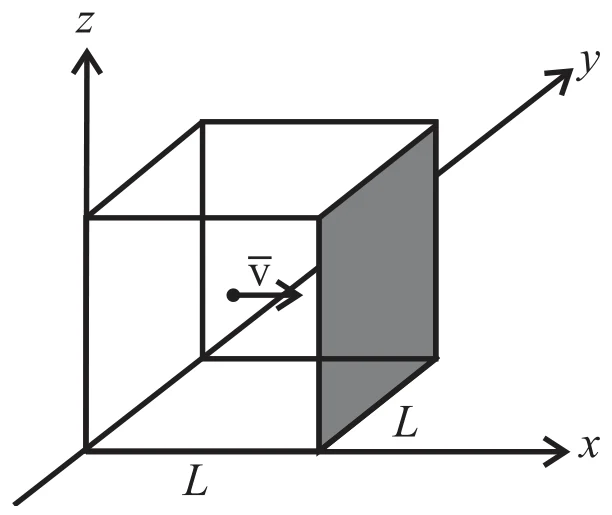
Fig. 3.2 · HSC Textbook · Cubical box of side L with n moles of an ideal gas
TOPIC 02

Concept in brief

  • Take N molecules of an ideal gas, each of mass m, in a cubical box of side L (V = L³) whose walls are at a constant temperature T.
  • A molecule hits the wall parallel to the yz-plane elastically: only vx is reversed. Change in momentum = −2mvx, so the wall receives 2mvx.
  • The molecule hits the same wall again after travelling 2L, i.e. after Δt = 2Lvx. Average force of one molecule = mvx²L.
  • Adding the forces of all molecules and dividing by the area L² gives P = mNVvx².
  • Molecules have no preferred direction, so vx² = 13v². Hence P = 13NVmv² = 13ρv².
  • The result holds for a container of any shape, and collisions between molecules do not change it. Since PV = 23E, pressure = 23 × kinetic energy per unit volume.
FORMULAS

Formulas

Momentum to the wall

Δp = 2mvx

Pressure of a gas

P = 13NVmv²

In terms of density

P = 13ρv²

Pressure and energy

P = 23EV

KEY WORDS

Key words

WordMeaning
kinetic theoryexplains gas behaviour from molecular motion
macroscopiclarge-scale: P, V, T, E
molecular speedmagnitude of molecular velocity
momentummass × velocity
impulse on the wallmomentum given to the wall
mean square speedaverage of v² over all molecules
number densityN/V, molecules per unit volume
pressureaverage force per unit area of wall

Board questions

7 questions · HSC papers 2022–2026, SCERT Question Bank, HSC Textbook
Q11 mark · SCERT Question Bank · VSA 7
Determine the pressure of nitrogen at 0 °C if the density of nitrogen at N.T.P. is 1.25 kg/m³ and R.M.S. speed of the molecules at N.T.P. is 489 m/s.
Solution
P = 13ρv² = 13 × 1.25 × (489)²
P = 99633.75 N/m² ≈ 9.96 × 10⁴ N/m²
→Answer: 99633.75 N/m²
Q21 mark · Expected question · based on HSC Textbook 3.5
A molecule of mass m with velocity component vx collides elastically with a wall perpendicular to the x-axis. What momentum is transferred to the wall?
Solution
→Δpx = (−mvx) − (mvx) = −2mvx for the molecule, so the momentum transferred to the wall is +2mvx.
Q32 marks · HSC Textbook Ex. 4
Explain, on the basis of kinetic theory, how the pressure of gas changes if its volume is reduced at constant temperature.
Solution
→P = 13NVmv²; at constant temperature v² (and the KE of the molecules) does not change.
→When V decreases, the number of molecules per unit volume NV increases.
→So more molecules hit unit area of the wall per second; the momentum delivered per second increases.
→Hence the pressure increases: P ∝ 1V (Boyle’s law).
Q42 marks · HSC Textbook Ex. 13
A gas in a cylinder is at pressure P. If the masses of all the molecules are made one third of their original value and their speeds are doubled, then find the resultant pressure.
Solution
P = 13NVmv²
⇒ P ∝ mv²
→New mass m3, new speed 2v
⇒ new v² = 4v²
P′ = 13 × 4 × P = 43P
→Answer: 43 P
Q52 marks · Expected question · based on HSC Textbook 3.7
Show that the pressure exerted by an ideal gas is two-thirds of the kinetic energy per unit volume of the gas.
Solution
P = 13NVmv²
⇒ PV = 23N(12mv²)
→Total kinetic energy of the gas E = N · 12mv² (no potential energy in an ideal gas)
PV = 23E
⇒ P = 23EV
Q62 marks · Expected question · based on HSC Textbook 3.3 – 3.5
State the assumptions of the kinetic theory used to obtain the pressure of an ideal gas.
Solution
→A gas has a very large number of identical molecules (≈ 10²³ per m³) in continuous random motion.
→Molecules behave as small hard spheres; their collisions with each other and with the walls are perfectly elastic.
→Molecules exert no force on each other except during collisions, so they move in straight lines with constant velocity in between.
→Molecules have no preferred direction of motion; the gas is in a steady state at constant temperature.
Q74 marks · HSC Mar 2022 · HSC Feb 2023 · HSC Jun 2026 · SCERT Question Bank · LA 2
On the basis of kinetic theory of gases, obtain an expression for the pressure exerted by a gas on the walls of the container.
Solution
Fig. 3.2 · HSC Textbook · Cubical box of side L with an ideal gas
→Set-up:
n moles (N molecules, each of mass m) of an ideal gas in a cubical box of side L, V = L³, walls at constant temperature T.
→A molecule with velocity v (components vx, vy, vz) hits the shaded wall parallel to the yz-plane elastically; only vx is reversed.
Δpx = (−mvx) − (mvx) = −2mvx
→Momentum given to the wall = 2mvx. Between two hits on the same wall the molecule travels 2L:
Δt = 2Lvx
→Average force by molecule 1:
f₁ = 2mvx₁2L/vx₁ = mvx₁²L
→Total force on the wall by all N molecules:
F = mL(vx₁² + vx₂² + … + vxN²)
→Pressure = force / area L²:
P = mL³(vx₁² + vx₂² + …) = mNVvx²
→No preferred direction
⇒ vx² = vy² = vz²
and v² = vx² + vy² + vz²
vx² = 13v²
P = 13NVmv²
→This holds for a container of any shape, and collisions between molecules do not change it.

MHT CET corner

4 MHT CET questions on the same formulas
C1MHT CET 2026
The average force applied on the walls of a closed container depends on temperature T as (T is the temperature of an ideal gas)
(a) T²(b) T³(c) T¹(d) T⁻¹
Solution
→Force ∝ pressure = 13NVmv² and v² ∝ T
⇒ F ∝ T¹
→Answer: (c) T¹
C2MHT CET 2026
Energy of a gas per litre is 600 joule, then what will be its pressure?
(a) 4 × 10⁵ N/m²(b) 10⁵ N/m²(c) 6 × 10⁵ N/m²(d) 3 × 10⁵ N/m²
Solution
→P = 23EV = 23 × 60010⁻³
= 4 × 10⁵ N/m²
→Answer: (a) 4 × 10⁵ N/m²
C3MHT CET 2024
What is the pressure of hydrogen in a cylinder of volume 10 litre if its total energy of translation is 7.5 × 10³ J?
(a) 5 × 10⁵ N m⁻²(b) 10⁶ N m⁻²(c) 0.5 × 10⁵ N m⁻²(d) 5 × 10⁶ N m⁻²
Solution
→P = 2E3V = 2 × 7.5 × 10³3 × 10⁻²
= 5 × 10⁵ N m⁻²
→Answer: (a) 5 × 10⁵ N m⁻²
C4MHT CET 2023
A gas at pressure p₀ is contained in a vessel. If the masses of all the molecules are halved and their velocities are doubled, then the resulting pressure would be equal to
(a) 4p₀(b) 2p₀(c) p₀(d) p₀2
Solution
→P ∝ mv²
→New P = 12 × 4 × p₀ = 2p₀
→Answer: (b) 2p₀
Practise more MHT CET PYQsPressure of an Ideal Gas · topic-wise, with step-by-step solutions
03
TOPIC

RMS Speed and Temperature

In this topic
  • Root mean square speed vrms = √(3RT/M₀)
  • Average kinetic energy per molecule = (3/2)kBT
  • Kinetic energy of a gas
TOPIC 03

Concept in brief

  • From P = 13NVmv² and PV = nRT: v² = 3RTM₀, where M₀ = NAm is the molar mass.
  • Root mean square speed vrms = v² = 3RTM₀ = 3kBTm. So vrms ∝ T and ∝ 1M₀. Also vrms = 3Pρ.
  • At 300 K, vrms of nitrogen is 517 m/s and of oxygen is 483 m/s. The speed of sound in a gas is of the same order but smaller.
  • In an ideal gas there is no potential energy (no intermolecular force); the internal energy is purely kinetic: E = N · 12mv².
  • PV = 23E and PV = NkBT give E = 32NkBT. Average kinetic energy per molecule EN = 32kBT ∝ absolute temperature.
  • Temperature of a gas is a measure of the average translational kinetic energy of its molecules. Kinetic energy of a gas: E = 32PV = 32nRT.
FORMULAS

Formulas

RMS speed

vrms = 3RTM₀

From pressure and density

vrms = 3Pρ

KE per molecule

32kBT

KE of a gas

E = 32PV = 32nRT

KEY WORDS

Key words

WordMeaning
rms speedsquare root of mean square speed
molar mass M₀mass of one mole of the gas
absolute temperaturetemperature in kelvin (K)
translational KEenergy of motion from place to place
internal energytotal energy of all molecules
STP273 K and 1.013 × 10⁵ N/m²
Maxwell distributionnumber of molecules vs speed
electron volt1 eV = 1.6 × 10⁻¹⁹ J

Board questions

22 questions · HSC papers 2022–2026, SCERT Question Bank, HSC Textbook
Q11 mark · HSC Mar 2022
RMS speed of gas molecules is proportional to
(a) T(b) 1T(c) T(d) 1T
Solution
vrms = 3RTM₀
⇒ vrms ∝ T
→Answer: (a) T
Q21 mark · HSC Jul 2022
Average kinetic energy of a gas molecule is proportional to
(a) T(b) T²(c) T(d) 1T
Solution
EN = 32kBT
⇒ average KE ∝ T
→Answer: (a) T
Q31 mark · SCERT Question Bank · MCQ 1
The average energy per molecule is proportional to
(a) the pressure of the gas(b) the volume of the gas(c) the absolute temperature of the gas(d) the mass of the gas
Solution
EN = 32kBT: it depends only on the absolute temperature.
→Answer: (c) the absolute temperature of the gas
Q41 mark · HSC Feb 2026 · HSC Textbook Ex. 1(i)
In an ideal gas, the molecules possess
(a) only kinetic energy(b) both kinetic energy and potential energy(c) only potential energy(d) neither kinetic energy nor potential energy
Solution
→Molecules of an ideal gas do not interact, so there is no potential energy; the internal energy is purely kinetic.
→Answer: (a) only kinetic energy
Q51 mark · HSC Textbook Ex. 2(i)
What will happen to the mean square speed of the molecules of a gas if the temperature of the gas increases?
Solution
v² = 3kBTm
⇒ v² ∝ T
→The mean square speed increases in the same ratio as the absolute temperature.
Q61 mark · HSC Feb 2025
Find the kinetic energy of 1 litre of an ideal gas at S.T.P. (standard pressure = 1.013 × 10⁵ N/m²)
Solution
E = 32PV = 32 × 1.013 × 10⁵ × 10⁻³
E = 151.95 J
→Answer: 151.95 J ≈ 152 J
Q71 mark · SCERT Question Bank · VSA 6
Find kinetic energy of 3 litre of a gas at S.T.P. given standard pressure is 1.013 × 10⁵ N/m².
Solution
E = 32PV = 32 × 1.013 × 10⁵ × 3 × 10⁻³
E = 455.85 J
→Answer: 455.85 J
Q81 mark · SCERT Question Bank · VSA 5
If the density of nitrogen is 1.25 kg/m³ at a pressure of 10⁵ Pa, find the root mean square velocity of nitrogen molecules.
Note: The SCERT Question Bank says “oxygen molecules” here; the data (density 1.25 kg/m³) are for nitrogen.
Solution
vrms = 3Pρ = 3 × 10⁵1.25
vrms = 2.4 × 10⁵ = 489.9 m/s
→Answer: 489.9 m/s
Note: The SCERT Question Bank says “oxygen molecules” here; the data (density 1.25 kg/m³) are for nitrogen.
Q92 marks · HSC Feb 2024
Compare the rms speed of hydrogen molecules at 227 °C with the rms speed of oxygen molecules at 127 °C. (Molecular masses of hydrogen and oxygen are 2 and 32)
Solution
→Given: TH = 500 K
TO = 400 K
MH = 2
MO = 32
→vrms = 3RTM₀
⇒ vrms ∝ TM₀
vHvO = THMH × MOTO = 5002 × 32400
vHvO = 20 = 4.47
→Answer: 25 : 1 ≈ 4.47 : 1
Q102 marks · HSC Feb 2026 · HSC Textbook Ex. 16
Compare the rms speed of hydrogen molecules at 127 °C with rms speed of oxygen molecules at 27 °C given that molecular masses of hydrogen and oxygen are 2 and 32 respectively.
Solution
→Given: TH = 400 K
TO = 300 K
MH = 2
MO = 32
vHvO = THMH × MOTO = 4002 × 32300
vHvO = 643 = 83
= 4.62
→Answer: 8 : 3 ≈ 4.62 : 1
Q112 marks · HSC Feb 2026
At what temperature will the mean kinetic energy of a gas molecule be equal to the kinetic energy of an electron accelerated through a potential difference of 1 V? (kB = 1.38 × 10⁻²³ J/K, e = 1.6 × 10⁻¹⁹ C)
Solution
→KE of the electron = eV = 1.6 × 10⁻¹⁹ × 1
= 1.6 × 10⁻¹⁹ J
32kBT = eV
⇒ T = 2eV3kB
T = 2 × 1.6 × 10⁻¹⁹3 × 1.38 × 10⁻²³ = 7729 K
→Answer: 7729 K ≈ 7.73 × 10³ K
Q122 marks · HSC Textbook Ex. 11
Calculate the ratio of mean square speeds of molecules of a gas at 30 K and 120 K.
Solution
v² = 3RTM₀
⇒ v² ∝ T
v²₁v²₂ = T₁T₂ = 30120
= 14
→Answer: 1 : 4
Q132 marks · HSC Textbook Ex. 14
Show that rms velocity of an oxygen molecule is √2 times that of a sulfur dioxide molecule at S.T.P.
Solution
→At the same temperature vrms ∝ 1M₀; M(O₂) = 32, M(SO₂) = 64
vO₂vSO₂ = 6432 = 2
→Hence vrms(O₂) = 2 × vrms(SO₂).
Q142 marks · HSC Textbook Ex. 15
At what temperature will oxygen molecules have same rms speed as helium molecules at S.T.P.? (Molecular masses of oxygen and helium are 32 and 4 respectively)
Solution
→Same vrms
⇒ TOMO = THeMHe
TO = 273 × 324 = 2184 K
→Answer: 2184 K
Q152 marks · HSC Textbook Example 3.2
At 300 K, what is the rms speed of Helium atom? [mass of He atom is 4u, 1u = 1.66 × 10⁻²⁷ kg; kB = 1.38 × 10⁻²³ J/K]
Solution
→Given: T = 300 K
m = 4 × 1.66 × 10⁻²⁷ kg
12mv² = 32kBT
⇒ v² = 3kBTm
v² = 3 × 1.38 × 10⁻²³ × 3004 × 1.66 × 10⁻²⁷ = 187.05 × 10⁴ m²/s²
vrms = v² = 13.68 × 10² m/s
→Answer: 1368 m/s
Q162 marks · HSC Textbook Ex. 17
Find kinetic energy of 5000 cc of a gas at S.T.P. given standard pressure is 1.013 × 10⁵ N/m².
Solution
→Given: V = 5000 cc = 5 × 10⁻³ m³
P = 1.013 × 10⁵ N/m²
E = 32PV = 32 × 1.013 × 10⁵ × 5 × 10⁻³
E = 759.75 J ≈ 7.598 × 10² J
→Answer: 7.598 × 10² J
Q172 marks · HSC Textbook Ex. 3
When a gas is heated its temperature increases. Explain this phenomenon based on kinetic theory of gases.
Solution
→The heat given to the gas increases the kinetic energy of its molecules (an ideal gas has only kinetic energy).
→So the molecules move faster: v² and vrms increase.
→Average kinetic energy per molecule = 32kBT, so higher average kinetic energy means higher absolute temperature.
Q183 marks · SCERT Question Bank · SA-II 1
Show that the root mean square speed of the molecules of gas is directly proportional to the square root of the absolute temperature of the gas.
Solution
→Pressure of an ideal gas: P = 13NVmv²
⇒ v² = 3PVNm
→Ideal gas equation: PV = nRT
with n = NNA
v² = 3nRTNm = 3RTNAm
= 3RTM₀
vrms = v² = 3RTM₀
→For a given gas R and M₀ are constant
⇒ vrms ∝ T.
Q193 marks · SCERT Question Bank · SA-II 2
Show that the average energy of the molecules of gas is directly proportional to the absolute temperature of gas.
Solution
P = 13NVmv²
⇒ PV = 23N(12mv²)
→In an ideal gas the energy is purely kinetic: E = N · 12mv²
⇒ PV = 23E
PV = NkBT
⇒ 23E = NkBT
EN = 32kBT
→Average energy per molecule ∝ absolute temperature T.
Q203 marks · SCERT Question Bank · SA-II 7
The velocity of three molecules are 2 km s⁻¹, 4 km s⁻¹, 6 km s⁻¹. Find (i) mean square velocity (ii) root mean square velocity.
Solution
v² = 2² + 4² + 6²3 = 563
= 18.67 km² s⁻²
vrms = 18.67 = 4.32 km s⁻¹
→Answer: (i) 18.67 km² s⁻² (ii) 4.32 km s⁻¹
Q213 marks · HSC Textbook Ex. 18
Calculate the average molecular kinetic energy (i) per kmol (ii) per kg (iii) per molecule of oxygen at 127 °C, given that molecular weight of oxygen is 32, R is 8.31 J mol⁻¹ K⁻¹ and Avogadro’s number NA is 6.02 × 10²³ molecules mol⁻¹.
Note: The HSC Textbook prints 1.558 × 10² J for (ii); that is the value per gram. Per kilogram it is 1.558 × 10⁵ J.
Solution
→Given: T = 400 K
M₀ = 32 kg/kmol
→(i) per kmol: E = 32RT × 1000
E = 32 × 8.31 × 400 × 1000 = 4.986 × 10⁶ J
→(ii) per kg:
4.986 × 10⁶32 = 1.558 × 10⁵ J
→(iii) per molecule:
32RNAT = 1.5 × 8.31 × 4006.02 × 10²³ = 8.282 × 10⁻²¹ J
→Answer: 4.986 × 10⁶ J, 1.558 × 10⁵ J, 8.282 × 10⁻²¹ J
Note: The HSC Textbook prints 1.558 × 10² J for (ii); that is the value per gram. Per kilogram it is 1.558 × 10⁵ J.
Q223 marks · SCERT Question Bank · SA-II 6
Determine the molecular kinetic energy (i) per mole (ii) per gram (iii) per molecule of nitrogen molecules at 227 °C. R = 8.310 J mole⁻¹ K⁻¹, N₀ = 6.03 × 10²⁶ molecules kmole⁻¹, molecular weight of nitrogen = 28.
Note: The SCERT Question Bank prints 0.225 × 10³ (labelled per kilogram) and 1.048 × 10⁻²³ J per molecule; the working gives 222.6 J per gram and 1.034 × 10⁻²⁰ J per molecule.
Solution
→Given: T = 500 K
M₀ = 28 g/mol
→(i) per mole:
32RT = 32 × 8.31 × 500 = 6232.5 J
→(ii) per gram:
6232.528 = 222.6 J
→(iii) per molecule:
6232.5 × 10³ J/kmol6.03 × 10²⁶ = 1.034 × 10⁻²⁰ J
→Answer: 6.232 × 10³ J, 222.6 J, 1.034 × 10⁻²⁰ J
Note: The SCERT Question Bank prints 0.225 × 10³ (labelled per kilogram) and 1.048 × 10⁻²³ J per molecule; the working gives 222.6 J per gram and 1.034 × 10⁻²⁰ J per molecule.

MHT CET corner

4 MHT CET questions on the same formulas
C1MHT CET 2026
If m represents the mass of each molecule of a gas and T its absolute temperature, then the root mean square velocity of the gaseous molecule is proportional to
(a) m−1/2T−1/2(b) m−1/2T1/2(c) m1/2T−1/2(d) mT
Solution
→vrms = 3kBTm
⇒ vrms ∝ m−1/2T1/2
→Answer: (b) m−1/2T1/2
C2MHT CET 2026
The temperature at which r.m.s. velocity of hydrogen molecules is 4.5 times that of an oxygen molecule at 47 °C is (molecular weights of hydrogen and oxygen are 2 and 32)
(a) 47 °C(b) 132 °C(c) 320 °C(d) 405 °C
Solution
→(4.5)² = TH/2320/32
⇒ 20.25 = TH20
⇒ TH = 405 K = 132 °C
→Answer: (b) 132 °C
C3MHT CET 2025
Six molecules of a gas in a container have speeds 2 m/s, 5 m/s, 3 m/s, 6 m/s, 3 m/s and 5 m/s. The r.m.s. speed is
(a) 4 m/s(b) 1.7 m/s(c) 4.24 m/s(d) 5 m/s
Solution
→v² = 4 + 25 + 9 + 36 + 9 + 256 = 1086
= 18. vrms = 18
= 4.24 m/s
→Answer: (c) 4.24 m/s
C4MHT CET 2026
The average translational kinetic energy of a molecule in a gas is E₁. The kinetic energy of an electron (charge e) accelerated from rest through a potential difference V volt is E₂. The temperature at which E₁ = E₂ is (N = Avogadro number, R = gas constant)
(a) 2VNe3R(b) VNe2R(c) 3NeV2R(d) 5NeV3R
Solution
→32kBT = eV with kB = RN
⇒ T = 2eVN3R
→Answer: (a) 2VNe3R
Practise more MHT CET PYQsRMS Speed and Temperature · topic-wise, with step-by-step solutions
04
TOPIC

Equipartition and Specific Heats

In this topic
  • Degrees of freedom
  • Law of equipartition of energy
  • Mayer’s relation CP − CV = R/J
  • CV, CP and γ for mono-, di- and polyatomic gases
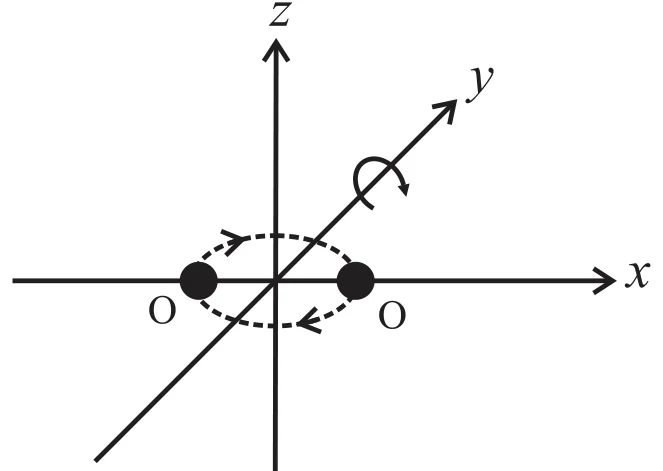
Fig. 3.3 · HSC Textbook · Rotation of a diatomic molecule about the z and y axes
TOPIC 04

Concept in brief

  • Degrees of freedom = total number of coordinates or independent quantities needed to describe the position and configuration of a system completely.
  • A monatomic molecule (He) has 3 translational dof. A diatomic molecule (O₂, N₂) has 3 translational + 2 rotational dof; if it vibrates, one vibrational mode adds 2 more terms (KE + PE).
  • Law of equipartition of energy: for a gas in thermal equilibrium at temperature T, the average energy per molecule associated with each quadratic term is 12kBT. It holds at high temperatures, not at very low ones.
  • Two specific heats: CV (constant volume) and CP (constant pressure). At constant pressure, heat also does work P dV, so CP > CV.
  • Mayer’s relation: CP − CV = R, or RJ when heat is in calories (J = mechanical equivalent of heat). For principal specific heats SP − SV = RM₀J.
  • Monatomic: CV = 32R, γ = 53. Rigid diatomic: CV = 52R, γ = 75. Vibrating diatomic: CV = 72R, γ = 97. Polyatomic: CV = (3 + f)R, γ = 4 + f3 + f.
FORMULAS

Formulas

Energy per quadratic term

12kBT

Mayer’s relation

CP − CV = RJ

Ratio of specific heats

γ = CPCV

Monatomic / diatomic γ

53  /  75

KEY WORDS

Key words

WordMeaning
degree of freedomindependent way a molecule can move or store energy
quadratic termenergy term like 12mv² or 12Iω²
rigid rotatormolecule that rotates but does not vibrate
molar specific heatheat to raise 1 mole by 1 K
principal specific heatheat to raise 1 kg by 1 K
CVmolar specific heat at constant volume
CPmolar specific heat at constant pressure
Jmechanical equivalent of heat, 4.18 J/cal

Board questions

14 questions · HSC papers 2022–2026, SCERT Question Bank, HSC Textbook
Q11 mark · HSC Jun 2026
What are the degrees of freedom of a monatomic gas enclosed in a container at constant temperature?
Solution
→A monatomic molecule (e.g. He) can only move along x, y and z: 3 translational degrees of freedom (no rotation or vibration).
→Answer: 3
Q21 mark · SCERT Question Bank · MCQ 2
The number of degrees of freedom, for the vibrational motion of a polyatomic molecule depends on the
(a) geometric structure of the molecule(b) mass of the molecule(c) energy of the molecule(d) absolute temperature of the molecule
Solution
→The number of vibrational modes depends on the arrangement of atoms in the molecule, i.e. its geometric structure.
→Answer: (a) geometric structure of the molecule
Q31 mark · SCERT Question Bank · MCQ 6
The molar specific heat of a gas at constant volume is 12307.69 J kg⁻¹ K⁻¹. If the ratio of the two specific heats is 1.65, calculate the difference between the two molar specific heats of gas.
(a) 7999 J kg⁻¹ K⁻¹(b) 7245 J kg⁻¹ K⁻¹(c) 6890 J kg⁻¹ K⁻¹(d) 4067 J kg⁻¹ K⁻¹
Solution
CP = 1.65 × 12307.69 = 20307.69
CP − CV = 20307.69 − 12307.69 = 8000 J kg⁻¹ K⁻¹
→Answer: (a) 7999 J kg⁻¹ K⁻¹ (≈ 8000)
Q41 mark · HSC Textbook Ex. 2(ii)
On what factors do the degrees of freedom depend?
Solution
→They depend on the number of atoms in the molecule (monatomic, diatomic, polyatomic) and on their geometric arrangement (linear or not), which decides the possible translations, rotations and vibrations.
Q51 mark · Expected question · based on HSC Textbook 3.8.1
Define degrees of freedom of a system.
Solution
→Degrees of freedom are the total number of coordinates or independent quantities required to describe the position and configuration of the system completely.
Q62 marks · HSC Mar 2022
The difference between the two molar specific heats of a gas is 9000 J kg⁻¹ K⁻¹. If the ratio of the two specific heats is 1.5, calculate the two molar specific heats.
Solution
→Given: CP − CV = 9000
CPCV = 1.5
1.5CV − CV = 9000
⇒ CV = 90000.5
CV = 1.8 × 10⁴ J kg⁻¹ K⁻¹
CP = 9000 + 18000 = 2.7 × 10⁴ J kg⁻¹ K⁻¹
→Answer: CV = 1.8 × 10⁴, CP = 2.7 × 10⁴ J kg⁻¹ K⁻¹
Q72 marks · HSC Textbook Example 3.4
The difference between the two molar specific heats of a gas is 8000 J kg⁻¹ K⁻¹. If the ratio of the two specific heats is 1.65, calculate the two molar specific heats.
Solution
→Given: CP − CV = 8000
CP = 1.65CV
0.65CV = 8000
⇒ CV = 1.231 × 10⁴ J kg⁻¹ K⁻¹
CP = 8000 + CV = 2.031 × 10⁴ J kg⁻¹ K⁻¹
→Answer: CV = 1.231 × 10⁴, CP = 2.031 × 10⁴ J kg⁻¹ K⁻¹
Q82 marks · HSC Textbook Example 3.3
Given the values of the two principal specific heats, SP = 3400 cal kg⁻¹ K⁻¹ and SV = 2400 cal kg⁻¹ K⁻¹ for the hydrogen gas, find the value of J if the universal gas constant R = 8300 J kg⁻¹ K⁻¹.
Solution
SP − SV = RM₀J
M₀ = 2 for H₂
3400 − 2400 = 83002J
J = 83002 × 1000 = 4.15 J/cal
→Answer: 4.15 J/cal
Q92 marks · SCERT Question Bank · SA-I 2
Show that for monoatomic gas the ratio of the two specific heats is 5 : 3.
Solution
→A monatomic molecule has 3 translational dof, each with 12kBT
⇒ energy per molecule = 32kBT.
E = 32NAkBT = 32RT (per mole)
CV = dEdT = 32R
CP = CV + R = 52R
γ = CPCV = 53
Q102 marks · SCERT Question Bank · SA-I 3
Show that for diatomic gas the ratio of the two specific heats is 7 : 5.
Solution
→A rigid diatomic molecule has 3 translational + 2 rotational dof
⇒ energy per molecule = 5 × 12kBT.
E = 52NAkBT = 52RT (per mole)
CV = 52R
CP = CV + R = 72R
γ = CPCV = 75
Q112 marks · Expected question · based on HSC Textbook 3.9 (b)
Find CV, CP and γ for a diatomic gas whose molecules also vibrate (non-rigid).
Solution
→3 translational + 2 rotational dof give 52kBT; one vibrational mode adds kBT (KE + PE terms).
E = 72NAkBT = 72RT
CV = 72R
CP = 92R
γ = 97
Q123 marks · HSC Feb 2024 · SCERT Question Bank · LA 3
Derive Mayer’s relation CP − CV = R/J.
Solution
→Set-up: one mole of an ideal gas in a cylinder with a light, frictionless, airtight piston; pressure P, volume V, temperature T.
→Constant volume: heat supplied raises only the internal energy (no work):
dQ₁ = dE = CV dT
→Constant pressure: the gas also pushes the piston back by dV:
dQ₂ = dE + P dV = CP dT
→The internal energy of an ideal gas depends only on T, so dE = CV dT in both cases:
CP dT = CV dT + P dV
⇒ (CP − CV) dT = P dV
→For one mole PV = RT
at constant pressure P dV = R dT:
CP − CV = R
→Heat is measured in calories and work in joules (J = mechanical equivalent of heat):
CP − CV = RJ
Q133 marks · SCERT Question Bank · SA-II 3
Calculate the ratio of two specific heats of polyatomic gas molecule.
Solution
→A non-linear polyatomic molecule: 3 translational dof (32kBT), 3 rotational dof (32kBT) and f vibrational dof (each 2 × 12kBT).
E = 32NAkBT + 32NAkBT + fNAkBT
E = (3 + f)NAkBT = (3 + f)RT
CV = (3 + f)R
CP = CV + R = (4 + f)R
γ = CPCV = 4 + f3 + f
Q144 marks · HSC Textbook Ex. 6
State the law of equipartition of energy and hence calculate molar specific heat of mono- and di-atomic gases at constant volume and constant pressure.
Solution
Fig. 3.3 · HSC Textbook · Rotation of a diatomic molecule
→Law: for a gas in thermal equilibrium at temperature T, the average energy per molecule associated with each quadratic term is 12kBT.
→Monatomic gas (He): 3 translational dof
⇒ energy per molecule 32kBT.
E = 32NAkBT = 32RT
⇒ CV = dEdT = 32R
CP = CV + R = 52R
γ = 53
→Diatomic gas (O₂, N₂, rigid rotator): 3 translational + 2 rotational dof.
E = 32NAkBT + 22NAkBT = 52RT
CV = 52R
CP = 72R
γ = 75
→If the molecules also vibrate: CV = 72R
CP = 92R
γ = 97.

MHT CET corner

4 MHT CET questions on the same formulas
C1MHT CET 2026
The molar specific heat at constant pressure of an ideal gas is 72R. The gas is made up of molecules which are
(a) polyatomic(b) non-rigid diatomic(c) rigid diatomic(d) monoatomic
Solution
→CP = 72R
⇒ CV = 52R
⇒ 5 degrees of freedom: rigid diatomic
→Answer: (c) rigid diatomic
C2MHT CET 2026
The ratio of Cp to Cv for a non-rigid diatomic gas is
(a) 53(b) 75(c) 43(d) 97
Solution
→Non-rigid diatomic: CV = 72R
CP = 92R
⇒ γ = 97
→Answer: (d) 97
C3MHT CET 2026
For a gas, if the ratio of specific heats at constant pressure and volume is γ, then the value of degrees of freedom is
(a) 3γ − 12γ − 1(b) 2γ − 1(c) 9(γ − 1)2(d) 25(γ − 1)2
Solution
→CV = f2R
CP = (f2 + 1)R
⇒ γ = 1 + 2f
⇒ f = 2γ − 1
→Answer: (b) 2γ − 1
C4MHT CET 2026
The internal energy of a diatomic gas (air) in a 4 m × 4 m × 3 m room at 10⁵ N/m² atmospheric pressure will be x × 10⁶ J. The value of x is
(a) 6(b) 12(c) 4(d) 16
Solution
→U = 52nRT = 52PV
= 2.5 × 10⁵ × 48 = 12 × 10⁶ J
→Answer: (b) 12
Practise more MHT CET PYQsEquipartition and Specific Heats · topic-wise, with step-by-step solutions
05
TOPIC

Absorption, Reflection and Blackbody

In this topic
  • Thermal radiation
  • Coefficients of absorption, reflection and transmission, a + r + t = 1
  • Diathermanous and athermanous substances
  • Perfect blackbody and Ferry’s blackbody
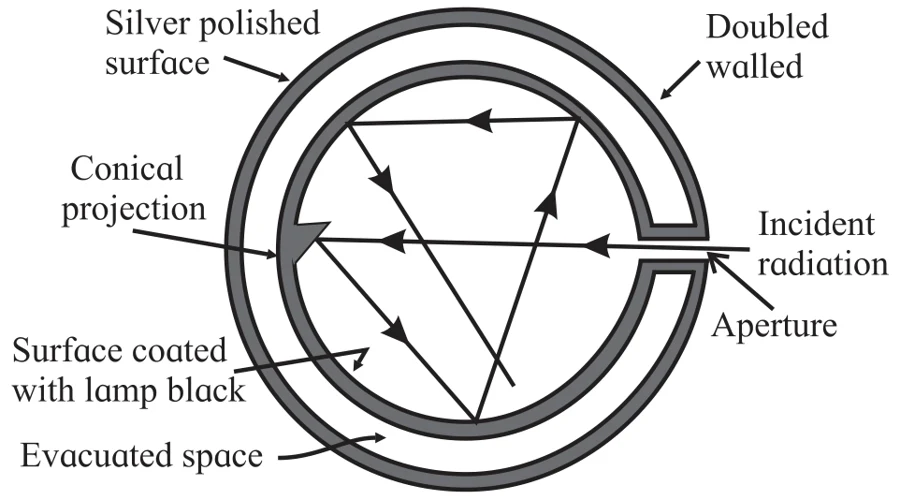
Fig. 3.4 · HSC Textbook · Ferry’s blackbody
TOPIC 05

Concept in brief

  • Radiation transfers heat as electromagnetic waves; it needs no material medium and is the fastest mode of heat transfer. Radiation emitted by bodies hotter than the surroundings is thermal radiation.
  • Of the heat Q falling on a body, Qa is absorbed, Qr reflected and Qt transmitted: a + r + t = 1, where a = QaQ, r = QrQ, t = QtQ (dimensionless).
  • Diathermanous substances let heat radiation pass (t ≠ 0): glass, quartz, rock salt, hydrogen, dry air. Athermanous substances are opaque to it (t = 0): water, wood, iron, copper, moist air.
  • a = 1 (r = t = 0): perfect blackbody. r = 1: perfect reflector. t = 1: perfectly transparent. a, r and t also depend on the wavelength of the radiation.
  • Perfect blackbody absorbs the entire radiant energy incident on it (a = 1). Lamp black or platinum black absorb about 97% and come close.
  • Ferry’s blackbody: double-walled hollow sphere, evacuated space between the walls, outer surface silvered, inner surface lamp-blacked, a tiny hole and a conical projection opposite it. Radiation entering the hole is reflected many times and absorbed, so the hole acts as a perfect blackbody.
FORMULAS

Formulas

Energy balance

Q = Qa + Qr + Qt

Coefficients

a + r + t = 1

Opaque body

t = 0, a + r = 1

Perfect blackbody

a = 1, r = t = 0

KEY WORDS

Key words

WordMeaning
thermal radiationEM radiation from a hot body
coefficient of absorptionheat absorbed / heat incident
coefficient of reflectionheat reflected / heat incident
coefficient of transmissionheat transmitted / heat incident
diathermanousallows heat radiation to pass
athermanousopaque to heat radiation
perfect blackbodyabsorbs all radiation falling on it
lamp blacksoot coating, absorbs about 97%

Board questions

9 questions · HSC papers 2022–2026, SCERT Question Bank, HSC Textbook
Q11 mark · HSC Feb 2025
Which of the following materials is diathermanous?
(a) wood(b) iron(c) glass(d) copper
Solution
→A diathermanous substance lets heat radiation pass through it: glass, quartz, rock salt, dry air. Wood, iron and copper are athermanous.
→Answer: (c) glass
Q21 mark · HSC Jul 2022
What is a perfectly black body?
Solution
→A body which absorbs the entire radiant energy incident on it is a perfectly black body: a = 1
r = 0
t = 0.
Q31 mark · HSC Textbook Ex. 1(iv)
If a = 0.72 and r = 0.24, then the value of t is
(a) 0.02(b) 0.04(c) 0.4(d) 0.2
Solution
a + r + t = 1
⇒ t = 1 − 0.72 − 0.24 = 0.04
→Answer: (b) 0.04
Q41 mark · SCERT Question Bank · VSA 2
On what, the values of absorption coefficient, reflection coefficient and transmission coefficient depend, in addition to the material of the object on which the radiation is incident?
Solution
→They also depend on the wavelength of the incident radiation.
Q52 marks · HSC Feb 2026
Derive the relation between the coefficients of absorption, reflection and transmission.
Solution
→Let Q = heat incident on a surface; Qa, Qr, Qt = heat absorbed, reflected and transmitted.
Q = Qa + Qr + Qt
→Dividing by Q:
1 = QaQ + QrQ + QtQ
a + r + t = 1
→a, r, t are the coefficients of absorption, reflection and transmission; they are dimensionless.
Q62 marks · HSC Textbook Ex. 2(v)
Define athermanous substances and diathermanous substances.
Solution
→Diathermanous: substances through which heat radiation can pass (t ≠ 0), e.g. glass, quartz, sodium chloride, hydrogen, dry air.
→Athermanous: substances largely opaque to heat radiation (t = 0), e.g. water, wood, iron, copper, moist air, benzene.
Q72 marks · HSC Feb 2024 · SCERT Question Bank · SA-I 5
Draw a neat labelled diagram of Ferry’s perfectly black body.
Solution
Fig. 3.4 · HSC Textbook · Ferry’s blackbody
→Labels to show: double walled hollow sphere · evacuated space · silver polished outer surface · inner surface coated with lamp black · conical projection opposite the aperture · aperture (tiny hole) with incident radiation.
→Show a ray entering the aperture and being reflected many times inside.
Q82 marks · Expected question · based on HSC Textbook 3.11
Explain why good absorbers of heat radiation are good emitters. Why are the walls of a thermos flask silvered?
Solution
→Take two opaque bodies at the same temperature: one polished, one painted black. The black one absorbs more radiation.
→To keep its temperature constant, a body must emit at the same rate as it absorbs, so the black body must also emit more.
→Hence good absorbers are good emitters; a good reflector is a poor absorber and so a poor emitter.
→The silvered walls of a thermos flask are poor emitters and poor absorbers, so little heat is lost or gained by radiation.
Q93 marks · HSC Jul 2023 · SCERT Question Bank · SA-II 4 · HSC Textbook Ex. 7
What is a perfect blackbody? Explain the construction and working of Ferry’s black body.
Solution
Fig. 3.4 · HSC Textbook · Ferry’s blackbody
→Perfect blackbody: a body that absorbs the entire radiant energy incident on it (a = 1). Lamp black / platinum black absorb about 97%.
→Construction: a double walled hollow sphere with a tiny hole (aperture); the space between the walls is evacuated; the outer surface is silvered; the inner surface is coated with lamp black.
→A conical projection on the inner surface opposite the aperture stops a ray along the axis from being reflected straight back.
→Working: radiation entering the hole suffers multiple reflections inside and is almost completely absorbed; it has a negligible chance of escaping through the small hole.
→Thus the aperture acts as a perfect blackbody. (Wien used a cylinder with a vertical slit for a larger effective area.)

MHT CET corner

4 MHT CET questions on the same formulas
C1MHT CET 2026
If 150 J of energy is incident on an area of 2 m² and the amount of heat reflected is 15 J, coefficient of absorption is 0.6, the amount of energy transmitted is
(a) 50 J(b) 45 J(c) 40 J(d) 30 J
Solution
→Qa = 0.6 × 150 = 90 J
→Qt = 150 − 90 − 15 = 45 J
→Answer: (b) 45 J
C2MHT CET 2025
The coefficient of absorption and the coefficient of reflection of a thin uniform plate are 0.77 and 0.17 respectively. If 250 kcal of heat is incident on the surface of the plate, the quantity of heat transmitted is
(a) 7 kcal(b) 12 kcal(c) 15 kcal(d) 22 kcal
Solution
→t = 1 − 0.77 − 0.17 = 0.06
→Qt = 0.06 × 250 = 15 kcal
→Answer: (c) 15 kcal
C3MHT CET 2023
A body is said to be opaque to the radiation if (a, r and t are coefficients of absorption, reflection and transmission)
(a) t = 0 and a + r = 1(b) a = r = t(c) t ≠ 0(d) a = 0, r = 1, t = 1
Solution
→An opaque (athermanous) body transmits nothing: t = 0
so a + r = 1
→Answer: (a) t = 0 and a + r = 1
C4MHT CET 2026
x joule of heat is incident on a body. Out of it, the total heat reflected and transmitted by it is y joule. The absorption coefficient of the body is
(a) xy(b) x − yx(c) yx − y(d) xy − x
Solution
→Heat absorbed = x − y. a = x − yx
→Answer: (b) x − yx
Practise more MHT CET PYQsAbsorption, Reflection and Blackbody · topic-wise, with step-by-step solutions
06
TOPIC

Emission and Kirchhoff’s Law

In this topic
  • Prevost’s theory of exchange of heat
  • Emissive power and emissivity
  • Good absorbers are good emitters
  • Kirchhoff’s law and its proof
TOPIC 06

Concept in brief

  • Prevost’s theory: every body above 0 K radiates thermal energy and at the same time absorbs radiation from the surroundings. If emission = absorption, its temperature stays constant (thermal equilibrium).
  • Heat radiated depends on the absolute temperature, the nature of the surface, the surface area and the time. A body looks red near 800 °C and white hot near 3000 °C.
  • Emissive power R = heat radiated per unit area per unit time: R = QAt. SI unit W/m² (J m⁻² s⁻¹), dimensions [L⁰M¹T⁻³].
  • Emissivity e = emissive power of a surface / emissive power of a perfect blackbody at the same temperature: e = RRB. e = 1 for a perfect blackbody, 0 for a perfect reflector; copper ≈ 0.3.
  • Good absorbers are good emitters, and good reflectors are poor emitters. That is why thermos flask walls are silvered and cooking utensils have blackened bottoms.
  • Kirchhoff’s law: at a given temperature, the ratio of emissive power to coefficient of absorption of a body equals the emissive power of a perfect blackbody, Ra = RB, i.e. a = e.
FORMULAS

Formulas

Emissive power

R = QAt

Emissivity

e = RRB

Kirchhoff’s law

Ra = RB

Hence

a = e

KEY WORDS

Key words

WordMeaning
emissiongiving out radiant energy
emissive powerheat radiated per unit area per second
emissivityR of a surface / R of a blackbody
thermal equilibriumemission rate = absorption rate
Prevost’s theoryall bodies above 0 K radiate and absorb
perfect reflectorr = 1, e = 0
absorptivityanother name for coefficient of absorption
enclosureclosed space at uniform temperature

Board questions

11 questions · HSC papers 2022–2026, SCERT Question Bank, HSC Textbook
Q11 mark · HSC Jul 2023
Name the law: at a given temperature, the coefficient of absorption of a body is equal to its coefficient of emission.
Solution
→For a body in thermal equilibrium the emissivity equals the absorptivity, a = e: this is Kirchhoff’s law of heat radiation.
→Answer: Kirchhoff’s law of heat radiation
Q21 mark · SCERT Question Bank · VSA 3
Why does the temperature of all bodies remain constant at room temperature?
Solution
→At room temperature every body emits and absorbs radiation at the same rate, so it is in thermal equilibrium with the surroundings.
Q31 mark · SCERT Question Bank · VSA 4
Above what temperature do all bodies radiate electromagnetic radiation?
Solution
→All bodies radiate when their temperature is above the absolute zero (0 K).
Q41 mark · Expected question · based on HSC Textbook 3.12
State the SI unit and dimensions of emissive power.
Solution
→SI unit: J m⁻² s⁻¹ = W/m²; dimensions [L⁰M¹T⁻³].
Q52 marks · HSC Jul 2022
Define (i) emissive power (ii) coefficient of emission.
Solution
→Emissive power (R):
the quantity of heat radiated per unit area per unit time by a body at a given temperature, R = QAt (unit W/m²).
→Coefficient of emission (e):
the ratio of the emissive power of a surface to the emissive power of a perfect blackbody at the same temperature, e = RRB.
Q62 marks · SCERT Question Bank · SA-I 1
State factors on which the amount of heat radiated by a body depends.
Solution
→The absolute temperature of the body (T).
→The nature of the body: its material and surface (polished or not).
→The surface area of the body (A).
→The time for which it radiates (t).
Q72 marks · SCERT Question Bank · SA-I 7
1000 calories of radiant heat is incident on a body. If the body absorbs 400 calories of heat, find the coefficient of emission of the body.
Solution
a = QaQ = 4001000
= 0.4
→By Kirchhoff’s law e = a = 0.4
→Answer: e = 0.4
Q82 marks · SCERT Question Bank · SA-I 8
A metal cube of length 4 cm radiates heat at the rate of 10 J/s. Find its emissive power at given temperature.
Solution
→Surface area of the cube A = 6l² = 6 × (0.04)²
= 9.6 × 10⁻³ m²
R = Q/tA = 109.6 × 10⁻³
= 1041.67 W/m²
→Answer: 1041.67 J s⁻¹ m⁻²
Q92 marks · HSC Textbook Ex. 21
The emissive power of a sphere of area 0.02 m² is 0.5 kcal s⁻¹ m⁻². What is the amount of heat radiated by the spherical surface in 20 second?
Solution
Q = RAt = 0.5 × 0.02 × 20
= 0.2 kcal
→Answer: 0.2 kcal
Q102 marks · Expected question · based on HSC Textbook 3.13
Why are the bottoms of cooking utensils blackened and their tops polished?
Solution
→A black surface is a good absorber, so the blackened bottom absorbs more heat from the flame.
→A polished surface is a poor emitter (good reflector), so the polished top loses little heat by radiation. Food cooks faster with less fuel.
Q113 marks · HSC Feb 2025 · HSC Textbook Ex. 10
State and prove Kirchhoff’s law of heat radiation.
Solution
→Statement:
at a given temperature, the ratio of emissive power to coefficient of absorption of a body is equal to the emissive power of a perfect blackbody at the same temperature (for all wavelengths); i.e. a = e.
→Proof: an ordinary body A and a perfect blackbody B of identical shape are placed in an enclosure; in thermal equilibrium both are at the enclosure’s temperature.
→Let Q = radiant heat incident on each body per unit time; R, RB = emissive powers of A and B; a
= coefficient of absorption of A.
→Temperature stays constant, so heat absorbed = heat emitted per unit time:
Body A: aQ = R
Blackbody B: Q = RB
→Dividing:
a = RRB
⇒ Ra = RB
→But RRB = e
⇒ a = e. Hence Kirchhoff’s law is proved.

MHT CET corner

4 MHT CET questions on the same formulas
C1MHT CET 2025
For a perfectly black body, coefficient of emission is
(a) zero(b) unity(c) less than one (non-zero)(d) infinity
Solution
→e = RRB
for the blackbody itself R = RB
⇒ e = 1
→Answer: (b) unity
C2MHT CET 2024
Three identical metal spheres (of same surface area) have red, black and white colours and they are heated up to the same temperature. They are allowed to cool. Arrange them from maximum rate of cooling to minimum rate of cooling.
(a) black, red, white(b) white, red, black(c) red, black, white(d) red, white, black
Solution
→Good absorbers are good emitters (Kirchhoff’s law): black emits most, white (good reflector) least
→Answer: (a) black, red, white
C3MHT CET 2024
Two spheres S₁ and S₂ have same radii but temperatures T₁ and T₂ respectively. Their emissive power is same and emissivity in the ratio 1 : 4. Then the ratio T₁ : T₂ is
(a) 2 : 1(b) 2 : 1(c) 1 : 2(d) 1 : 2
Solution
→e₁T₁⁴ = e₂T₂⁴
⇒ (T₁T₂)⁴ = e₂e₁ = 4
⇒ T₁T₂ = 2
→Answer: (b) 2 : 1
C4MHT CET 2023
Two bodies A and B at temperatures T₁ K and T₂ K respectively have the same dimensions. Their emissivities are in the ratio 1 : 3. If they radiate the same amount of heat per unit area per unit time, then the ratio of their temperatures (T₁ : T₂) is
(a) 1 : 3(b) 31/4 : 1(c) 91/4 : 1(d) 81 : 1
Solution
→e₁σT₁⁴ = e₂σT₂⁴
⇒ (T₁T₂)⁴ = 3
⇒ T₁ : T₂ = 31/4 : 1
→Answer: (b) 31/4 : 1
Practise more MHT CET PYQsEmission and Kirchhoff’s Law · topic-wise, with step-by-step solutions
07
TOPIC

Wien’s and Stefan’s Laws

In this topic
  • Spectral distribution of blackbody radiation
  • Wien’s displacement law λmaxT = b
  • Stefan–Boltzmann law R = σT⁴
  • Net loss of heat eσA(T⁴ − T₀⁴)
Fig. 3.5 · HSC Textbook · Radiant power of a blackbody as a function of wavelength
TOPIC 07

Concept in brief

  • Spectral distribution (Lummer and Pringsheim): at a given temperature the energy is not uniformly distributed; radiant power rises with wavelength, reaches a maximum at λmax, then falls.
  • The area under the curve = total energy emitted per unit area per unit time. As T rises, the area increases and the peak shifts to shorter wavelengths. The curves depend only on T, not on the material.
  • Wien’s displacement law: λmax ∝ 1T, i.e. λmaxT = b, b = 2.897 × 10⁻³ m K. It gives the temperature of the Sun and stars (white dwarfs ≈ 10000 K, red giants ≈ 3000 K).
  • Stefan–Boltzmann law: power radiated per unit area of a perfect blackbody is directly proportional to the fourth power of its absolute temperature: R = σT⁴, σ = 5.67 × 10⁻⁸ W m⁻² K⁻⁴.
  • Energy radiated in time t: Q = σAtT⁴. For an ordinary body R = eσT⁴. Doubling T makes the power 2⁴ = 16 times.
  • A body at T in surroundings at T₀ loses energy at the net rate eσA(T⁴ − T₀⁴) (it gains energy if T < T₀).
FORMULAS

Formulas

Wien’s law

λmaxT = b

Stefan–Boltzmann law

R = σT⁴

Energy radiated

Q = eσAtT⁴

Net loss of heat

dQdt = eσA(T⁴ − T₀⁴)

KEY WORDS

Key words

WordMeaning
spectral distributionradiant power at each wavelength
λmaxwavelength of maximum intensity
Wien’s constant b2.897 × 10⁻³ m K
Stefan’s constant σ5.67 × 10⁻⁸ W m⁻² K⁻⁴
radiant powerenergy emitted per second
infraredlonger than red light, felt as heat
cavity radiatorhollow block with a hole, acts as a blackbody
surroundingsenclosure around the body at T₀

Board questions

23 questions · HSC papers 2022–2026, SCERT Question Bank, HSC Textbook
Q11 mark · SCERT Question Bank · MCQ 3
The power radiated by a perfect blackbody depends only on its
(a) material(b) nature of surface(c) colour(d) temperature
Solution
→R = σT⁴: it depends only on the temperature, not on colour, material or nature of the surface.
→Answer: (d) temperature
Q21 mark · SCERT Question Bank · MCQ 4
If the absolute temperature of a body is doubled, the power radiated will increase by a factor of
(a) 2(b) 4(c) 8(d) 16
Solution
R ∝ T⁴
⇒ R₂R₁ = 2⁴ = 16
→Answer: (d) 16
Q31 mark · HSC Textbook Ex. 1(v)
The ratio of emissive power of a perfect blackbody at 1327 °C and 527 °C is
(a) 4 : 1(b) 16 : 1(c) 2 : 1(d) 8 : 1
Solution
→T₁ = 1600 K
T₂ = 800 K
R₁R₂ = (1600800)⁴ = 16
→Answer: (b) 16 : 1
Q41 mark · SCERT Question Bank · MCQ 5
Calculate the value of λmax for radiation from a body having surface temperature 3000 K. (b = 2.897 × 10⁻³ m K)
(a) 9935 Å(b) 9656 Å(c) 9421 Å(d) 9178 Å
Solution
λmax = bT = 2.897 × 10⁻³3000
= 9.657 × 10⁻⁷ m ≈ 9656 Å
→Answer: (b) 9656 Å
Q51 mark · SCERT Question Bank · MCQ 7
Calculate the energy radiated in one minute by a blackbody of surface area 200 cm² at 127 °C (σ = 5.7 × 10⁻⁸ J m⁻² s⁻¹ K⁻⁴)
(a) 1367.04 J(b) 1698.04 J(c) 1751.04 J(d) 1856.04 J
Solution
Q = σAtT⁴ = 5.7 × 10⁻⁸ × 200 × 10⁻⁴ × 60 × (400)⁴
Q = 5.7 × 1.2 × 256 = 1751.04 J
→Answer: (c) 1751.04 J
Q62 marks · HSC Jun 2026 · HSC Textbook Example 3.5
Calculate the value of λmax for solar radiation assuming that surface temperature of Sun is 5800 K (b = 2.897 × 10⁻³ m K). In which part of the electromagnetic spectrum does this value lie?
Solution
→Wien’s displacement law: λmaxT = b
λmax = 2.897 × 10⁻³5800 = 4.995 × 10⁻⁷ m
= 4995 Å
→This value lies in the visible region of the electromagnetic spectrum.
→Answer: 4995 Å, visible region
Q72 marks · HSC Feb 2025 · HSC Textbook Example 3.6
Calculate the energy radiated in one minute by a blackbody of surface area 200 cm² at 127 °C (σ = 5.67 × 10⁻⁸ J m⁻² s⁻¹ K⁻⁴).
Solution
→Given: A = 200 × 10⁻⁴ m²
T = 400 K
t = 60 s
Q = σAtT⁴ = 5.67 × 10⁻⁸ × 200 × 10⁻⁴ × 60 × (400)⁴
Q = 5.67 × 1.2 × 256 = 1742 J
→Answer: 1742 J
Q82 marks · HSC Feb 2023 · HSC Textbook Example 3.8
Compare the rate of loss of heat from a metal sphere at 827 °C with the rate of loss of heat from the same sphere at 427 °C, if the temperature of the surrounding is 27 °C.
Solution
→Given: T₁ = 1100 K
T₂ = 700 K
T₀ = 300 K
→Rate of loss of heat: dQdt = eσA(T⁴ − T₀⁴)
R₁R₂ = T₁⁴ − T₀⁴T₂⁴ − T₀⁴ = 1100⁴ − 300⁴700⁴ − 300⁴
R₁R₂ = 145602320 = 18229
→Answer: 182 : 29 ≈ 6.28 : 1
Q92 marks · HSC Textbook Ex. 8
State (i) Stefan-Boltzmann law and (ii) Wien’s displacement law.
Solution
→Stefan–Boltzmann law:
the rate of emission of radiant energy per unit area of a perfect blackbody is directly proportional to the fourth power of its absolute temperature; R = σT⁴.
→Wien’s displacement law:
the wavelength for which the emissive power of a blackbody is maximum is inversely proportional to its absolute temperature; λmaxT = b.
Q102 marks · SCERT Question Bank · SA-I 4
Show the graphical representation of radiant power of a black body per unit range of wavelength as a function of wavelength.
Solution
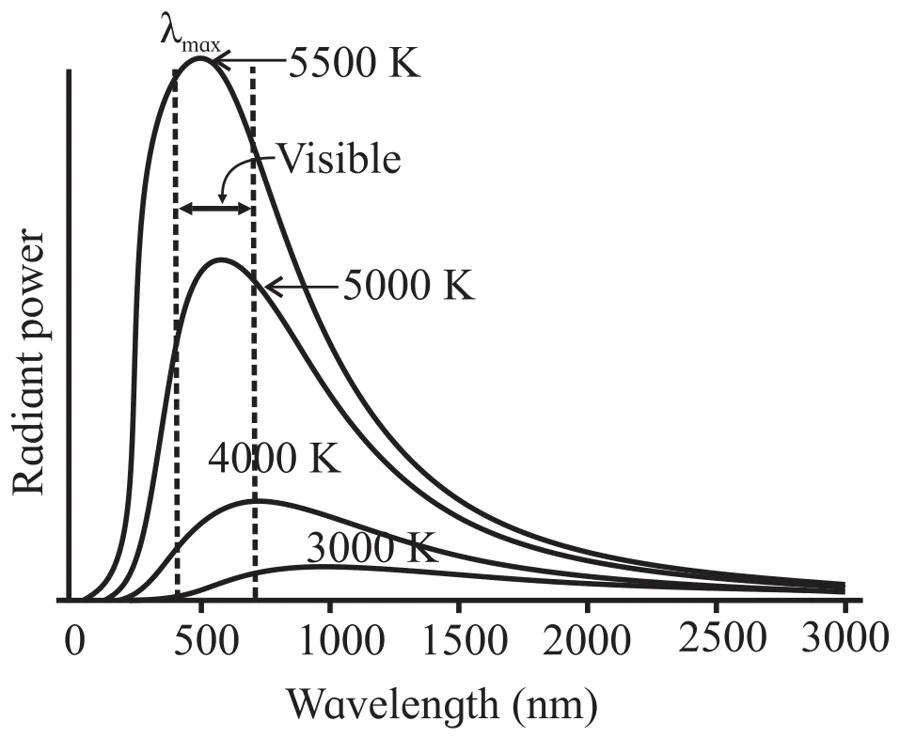
Fig. 3.5 · HSC Textbook · Radiant power of a blackbody vs wavelength
→Draw radiant power (y-axis) against wavelength (x-axis) for, e.g., 3000 K, 4000 K, 5000 K and 5500 K.
→Each curve rises, reaches a peak at λmax and falls; hotter curves are higher and peak at shorter wavelengths.
Q112 marks · SCERT Question Bank · SA-I 6
Compare the rate of radiation of metal body at 727 °C and 227 °C.
Solution
→T₁ = 1000 K, T₂ = 500 K; R ∝ T⁴
R₁R₂ = (1000500)⁴ = 16
→Answer: 16 : 1
Q122 marks · HSC Textbook Ex. 19
Calculate the energy radiated in one minute by a blackbody of surface area 100 cm² when it is maintained at 227 °C. (Take Stefan’s constant σ = 5.67 × 10⁻⁸ J m⁻² s⁻¹ K⁻⁴)
Solution
→Given: A = 10⁻² m²
T = 500 K
t = 60 s
Q = σAtT⁴ = 5.67 × 10⁻⁸ × 10⁻² × 60 × (500)⁴
Q = 5.67 × 10⁻⁸ × 0.6 × 6.25 × 10¹⁰ = 2126.25 J
→Answer: 2126.25 J
Q132 marks · HSC Textbook Ex. 20
Energy is emitted from a hole in an electric furnace at the rate of 20 W, when the temperature of the furnace is 727 °C. What is the area of the hole? (Take Stefan’s constant σ to be 5.7 × 10⁻⁸ J s⁻¹ m⁻² K⁻⁴)
Solution
→The hole acts as a blackbody: P = σAT⁴
T = 1000 K
A = PσT⁴ = 205.7 × 10⁻⁸ × 10¹²
= 3.509 × 10⁻⁴ m²
→Answer: 3.509 × 10⁻⁴ m²
Q142 marks · HSC Textbook Ex. 23
Earth’s mean temperature can be assumed to be 280 K. How will the curve of blackbody radiation look like for this temperature? Find out λmax. In which part of the electromagnetic spectrum does this value lie? (Take Wien’s constant b = 2.897 × 10⁻³ m K)
Solution
λmax = bT = 2.897 × 10⁻³280
= 1.035 × 10⁻⁵ m
→This lies in the infrared region.
→The curve is very low (small area, little power) with its peak far to the right of the visible region, near 10 μm.
→Answer: 1.035 × 10⁻⁵ m, infrared
Q152 marks · HSC Textbook Ex. 25
Find the temperature of a blackbody if its spectrum has a peak at (a) λmax = 700 nm (visible), (b) λmax = 3 cm (microwave region) and (c) λmax = 3 m (short radio waves). (Take Wien’s constant b = 2.897 × 10⁻³ m K)
Solution
→T = bλmax
(a) T = 2.897 × 10⁻³700 × 10⁻⁹ = 4138 K
(b) T = 2.897 × 10⁻³3 × 10⁻² = 0.09657 K
(c) T = 2.897 × 10⁻³3 = 0.9657 × 10⁻³ K
→Answer: 4138 K, 0.09657 K, 0.9657 × 10⁻³ K
Q163 marks · HSC Jul 2022
Calculate the energy radiated in half a minute by a blackbody of surface area 200 cm² at 127 °C. (σ = 5.67 × 10⁻⁸ J m⁻² s⁻¹ K⁻⁴)
Solution
→Given: A = 200 cm² = 2 × 10⁻² m²
T = 127 + 273 = 400 K
t = 30 s
→Stefan–Boltzmann law: Q = σAtT⁴
Q = 5.67 × 10⁻⁸ × 2 × 10⁻² × 30 × (400)⁴
Q = 5.67 × 0.6 × 256 = 870.9 J
→Answer: 870.9 J
Q173 marks · HSC Jul 2023 · HSC Textbook Example 3.7
A 60 watt filament lamp loses all its energy by radiation from its surface. The emissivity of the surface is 0.5. The area of the surface is 5 × 10⁻⁵ m². Find the temperature of the filament (σ = 5.67 × 10⁻⁸ J m⁻² s⁻¹ K⁻⁴).
Solution
→Given: dQdt = 60 W
e = 0.5
A = 5 × 10⁻⁵ m²
dQdt = eσAT⁴
⇒ T⁴ = 600.5 × 5.67 × 10⁻⁸ × 5 × 10⁻⁵
T⁴ = 4.23 × 10¹³ = 42.3 × 10¹²
T = 2.55 × 10³ K = 2550 K
→Answer: 2550 K
Q183 marks · HSC Textbook Example 3.9
Assuming that the temperature at the surface of the Sun is 6000 K, find out the size of a virtual star (in terms of the size of Sun) whose surface temperature is 3000 K and the power radiated by the virtual star is 25 times the power radiated by the Sun. Treat both as blackbodies.
Solution
→Power radiated by a spherical blackbody: P = σ(4πr²)T⁴
PstarPSun = rstar²rSun² × Tstar⁴TSun⁴ = 25
rstar²rSun² = 25 × (60003000)⁴ = 400
rstar = 20 rSun
→Answer: 20 times the radius of the Sun
Q193 marks · HSC Textbook Ex. 22
Compare the rates of emission of heat by a blackbody maintained at 727 °C and at 227 °C, if the blackbodies are surrounded by an enclosure (black) at 27 °C. What would be the ratio of their rates of loss of heat?
Solution
→T₁ = 1000 K
T₂ = 500 K
T₀ = 300 K
→Emission (R ∝ T⁴):
R₁R₂ = (1000500)⁴ = 16
→Loss of heat (∝ T⁴ − T₀⁴):
1000⁴ − 300⁴500⁴ − 300⁴ = 0.9919 × 10¹²0.0544 × 10¹² = 18.23
→Answer: 16 : 1 and 18.23 : 1
Q203 marks · SCERT Question Bank · SA-II 5
Compare the rates of emission of heat by a blackbody maintained at 627 °C and at 127 °C, if the blackbodies are surrounded by an enclosure at 27 °C. What would be the ratio of their rates of loss of heat?
Note: The SCERT Question Bank prints the answer as 10.28 : 1; the working gives 25.63 : 1 for emission and 37.03 : 1 for loss of heat.
Solution
→T₁ = 900 K
T₂ = 400 K
T₀ = 300 K
→Emission (R ∝ T⁴):
R₁R₂ = (900400)⁴ = (2.25)⁴
= 25.63
→Loss of heat (∝ T⁴ − T₀⁴):
900⁴ − 300⁴400⁴ − 300⁴ = 6561 − 81256 − 81 = 6480175
= 37.03
→Answer: 25.63 : 1 and 37.03 : 1
Note: The SCERT Question Bank prints the answer as 10.28 : 1; the working gives 25.63 : 1 for emission and 37.03 : 1 for loss of heat.
Q213 marks · HSC Textbook Ex. 24
A small blackened solid copper sphere of radius 2.5 cm is placed in an evacuated chamber. The temperature of the chamber is maintained at 100 °C. At what rate energy must be supplied to the copper sphere to maintain its temperature at 110 °C? (σ = 5.670 × 10⁻⁸ J s⁻¹ m⁻² K⁻⁴, π = 3.1416, treat the sphere as a blackbody)
Solution
→Given: r = 0.025 m
T = 383 K
T₀ = 373 K
→Energy must be supplied at the rate of the net loss: P = σA(T⁴ − T₀⁴)
A = 4πr²
A = 4 × 3.1416 × (0.025)² = 7.854 × 10⁻³ m²
T⁴ − T₀⁴ = 2.1518 × 10¹⁰ − 1.9357 × 10¹⁰ = 2.161 × 10⁹ K⁴
P = 5.67 × 10⁻⁸ × 7.854 × 10⁻³ × 2.161 × 10⁹ = 0.962 W
→Answer: 0.962 W (HSC Textbook: 0.9624 W)
Q223 marks · Expected question · based on HSC Textbook 3.15
State Stefan–Boltzmann law. Obtain the net rate of loss of energy of a body at temperature T kept in surroundings at temperature T₀.
Solution
→Law:
the power radiated per unit area of a perfect blackbody is directly proportional to the fourth power of its absolute temperature: R = σT⁴
σ = 5.67 × 10⁻⁸ W m⁻² K⁻⁴.
→Energy radiated by a blackbody per unit area per unit time = σT⁴
energy absorbed from the surroundings = σT₀⁴.
Net loss per unit area per unit time = σ(T⁴ − T₀⁴)
→For an ordinary body of emissivity e and area A:
dQdt = eσA(T⁴ − T₀⁴)
→If T < T₀, this is the net gain of energy.
Q234 marks · SCERT Question Bank · LA 1 · HSC Textbook Ex. 9
Explain spectral distribution of blackbody radiation.
Solution
Fig. 3.5 · HSC Textbook · Radiant power of a blackbody vs wavelength
→Lummer and Pringsheim kept a cavity radiator at different temperatures and measured the radiant power at different wavelengths; they plotted radiant power per unit area against λ (Fig. 3.5).
→At a given temperature the energy is not uniformly distributed over the spectrum.
→The radiant power first increases with wavelength, reaches a maximum at λmax and then decreases; λmax is characteristic of the temperature.
→The area under the curve is the total energy emitted per unit time per unit area at all wavelengths.
→The peak shifts to shorter wavelengths as T increases (λmax decreases: Wien’s law).
→At higher temperatures the area under the curve (total power) increases (Stefan’s law).
→At 300 K the most intense wavelength is about 5 × 10⁻⁵ m; practically all energy is in the infrared.
→The distribution depends only on the absolute temperature, not on the material. Planck explained it by quantisation of energy, E = nhν.

MHT CET corner

4 MHT CET questions on the same formulas
C1MHT CET 2026
A perfectly black body radiates power at temperature T₁ K. If it is to radiate 16 times this power, its temperature should be increased by
(a) 16T₁ K(b) 4T₁ K(c) 2T₁ K(d) T₁ K
Solution
→P ∝ T⁴
⇒ T₂ = 161/4T₁ = 2T₁
→Increase = 2T₁ − T₁ = T₁
→Answer: (d) T₁ K
C2MHT CET 2026
Two stars A and B radiate maximum energy at wavelengths 3.9 × 10⁻⁷ m and 5.2 × 10⁻⁷ m respectively. The ratio of the temperature of star A to that of star B will be
(a) 2 : 3(b) 3 : 2(c) 3 : 4(d) 4 : 3
Solution
→λmaxT = b
⇒ TATB = 5.23.9 = 43
→Answer: (d) 4 : 3
C3MHT CET 2026
Identify the INCORRECT statement about the black body radiation.
(a) Intensity is same for all wavelengths.(b) Intensity is maximum for a particular wavelength.(c) Intensity is less for longer wavelengths.(d) A black body emits all wavelengths.
Solution
→The energy is not uniformly distributed: radiant power has a peak at λmax
→Answer: (a) Intensity is same for all wavelengths.
C4MHT CET 2023
A black sphere has radius R whose rate of radiation is E at temperature T. If radius is made R/3 and temperature 3T, the rate of radiation will be
(a) E(b) 3E(c) 6E(d) 9E
Solution
→E ∝ R²T⁴
⇒ E′ = 19 × 81 × E = 9E
→Answer: (d) 9E
Practise more MHT CET PYQsWien’s and Stefan’s Laws · topic-wise, with step-by-step solutions