Q11 mark · SCERT Question Bank · MCQ 3
The power radiated by a perfect blackbody depends only on its
(a) material(b) nature of surface(c) colour(d) temperature
Solution
→R = σT⁴: it depends only on the temperature, not on colour, material or nature of the surface.
→Answer: (d) temperature
Q21 mark · SCERT Question Bank · MCQ 4
If the absolute temperature of a body is doubled, the power radiated will increase by a factor of
(a) 2(b) 4(c) 8(d) 16
Solution
R ∝ T⁴
⇒ R₂R₁ = 2⁴ = 16
→Answer: (d) 16
Q31 mark · HSC Textbook Ex. 1(v)
The ratio of emissive power of a perfect blackbody at 1327 °C and 527 °C is
(a) 4 : 1(b) 16 : 1(c) 2 : 1(d) 8 : 1
Solution
→T₁ = 1600 K
T₂ = 800 K
R₁R₂ = (1600800)⁴ = 16
→Answer: (b) 16 : 1
Q41 mark · SCERT Question Bank · MCQ 5
Calculate the value of λmax for radiation from a body having surface temperature 3000 K. (b = 2.897 × 10⁻³ m K)
(a) 9935 Å(b) 9656 Å(c) 9421 Å(d) 9178 Å
Solution
λmax = bT = 2.897 × 10⁻³3000
= 9.657 × 10⁻⁷ m ≈ 9656 Å
→Answer: (b) 9656 Å
Q51 mark · SCERT Question Bank · MCQ 7
Calculate the energy radiated in one minute by a blackbody of surface area 200 cm² at 127 °C (σ = 5.7 × 10⁻⁸ J m⁻² s⁻¹ K⁻⁴)
(a) 1367.04 J(b) 1698.04 J(c) 1751.04 J(d) 1856.04 J
Solution
Q = σAtT⁴ = 5.7 × 10⁻⁸ × 200 × 10⁻⁴ × 60 × (400)⁴
Q = 5.7 × 1.2 × 256 = 1751.04 J
→Answer: (c) 1751.04 J
Q62 marks · HSC Jun 2026 · HSC Textbook Example 3.5
Calculate the value of λmax for solar radiation assuming that surface temperature of Sun is 5800 K (b = 2.897 × 10⁻³ m K). In which part of the electromagnetic spectrum does this value lie?
Solution
→Wien’s displacement law: λmaxT = b
λmax = 2.897 × 10⁻³5800 = 4.995 × 10⁻⁷ m
= 4995 Å
→This value lies in the visible region of the electromagnetic spectrum.
→Answer: 4995 Å, visible region
Q72 marks · HSC Feb 2025 · HSC Textbook Example 3.6
Calculate the energy radiated in one minute by a blackbody of surface area 200 cm² at 127 °C (σ = 5.67 × 10⁻⁸ J m⁻² s⁻¹ K⁻⁴).
Solution
→Given: A = 200 × 10⁻⁴ m²
T = 400 K
t = 60 s
Q = σAtT⁴ = 5.67 × 10⁻⁸ × 200 × 10⁻⁴ × 60 × (400)⁴
Q = 5.67 × 1.2 × 256 = 1742 J
→Answer: 1742 J
Q82 marks · HSC Feb 2023 · HSC Textbook Example 3.8
Compare the rate of loss of heat from a metal sphere at 827 °C with the rate of loss of heat from the same sphere at 427 °C, if the temperature of the surrounding is 27 °C.
Solution
→Given: T₁ = 1100 K
T₂ = 700 K
T₀ = 300 K
→Rate of loss of heat: dQdt = eσA(T⁴ − T₀⁴)
R₁R₂ = T₁⁴ − T₀⁴T₂⁴ − T₀⁴ = 1100⁴ − 300⁴700⁴ − 300⁴
R₁R₂ = 145602320 = 18229
→Answer: 182 : 29 ≈ 6.28 : 1
Q92 marks · HSC Textbook Ex. 8
State (i) Stefan-Boltzmann law and (ii) Wien’s displacement law.
Solution
→Stefan–Boltzmann law:
the rate of emission of radiant energy per unit area of a perfect blackbody is directly proportional to the fourth power of its absolute temperature; R = σT⁴.
→Wien’s displacement law:
the wavelength for which the emissive power of a blackbody is maximum is inversely proportional to its absolute temperature; λmaxT = b.
Q102 marks · SCERT Question Bank · SA-I 4
Show the graphical representation of radiant power of a black body per unit range of wavelength as a function of wavelength.
Solution
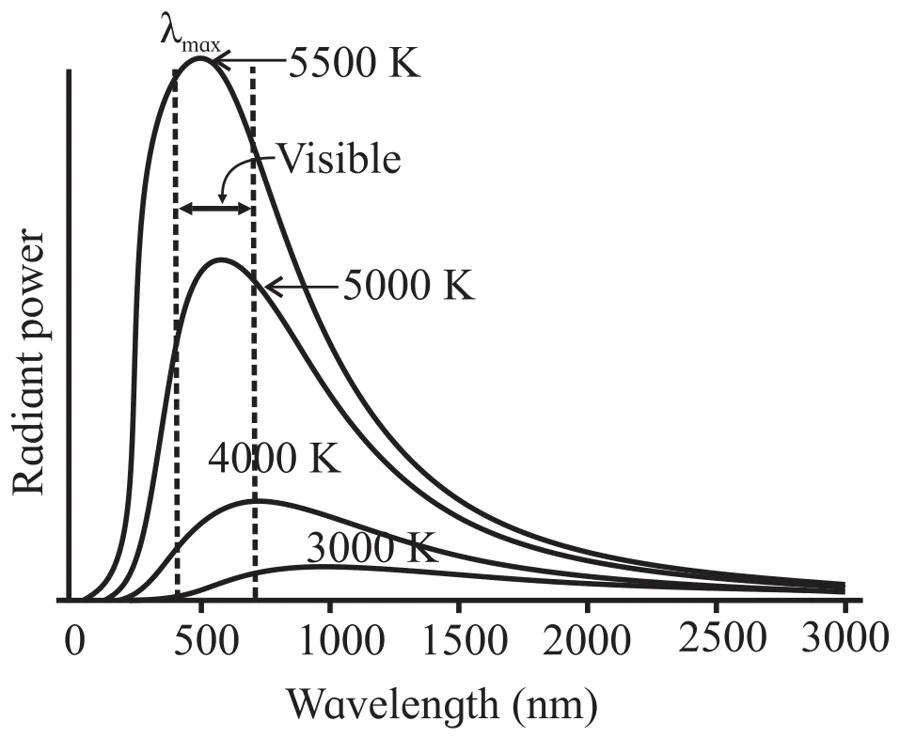
Fig. 3.5 · HSC Textbook · Radiant power of a blackbody vs wavelength
→Draw radiant power (y-axis) against wavelength (x-axis) for, e.g., 3000 K, 4000 K, 5000 K and 5500 K.
→Each curve rises, reaches a peak at λmax and falls; hotter curves are higher and peak at shorter wavelengths.
Q112 marks · SCERT Question Bank · SA-I 6
Compare the rate of radiation of metal body at 727 °C and 227 °C.
Solution
→T₁ = 1000 K, T₂ = 500 K; R ∝ T⁴
R₁R₂ = (1000500)⁴ = 16
→Answer: 16 : 1
Q122 marks · HSC Textbook Ex. 19
Calculate the energy radiated in one minute by a blackbody of surface area 100 cm² when it is maintained at 227 °C. (Take Stefan’s constant σ = 5.67 × 10⁻⁸ J m⁻² s⁻¹ K⁻⁴)
Solution
→Given: A = 10⁻² m²
T = 500 K
t = 60 s
Q = σAtT⁴ = 5.67 × 10⁻⁸ × 10⁻² × 60 × (500)⁴
Q = 5.67 × 10⁻⁸ × 0.6 × 6.25 × 10¹⁰ = 2126.25 J
→Answer: 2126.25 J
Q132 marks · HSC Textbook Ex. 20
Energy is emitted from a hole in an electric furnace at the rate of 20 W, when the temperature of the furnace is 727 °C. What is the area of the hole? (Take Stefan’s constant σ to be 5.7 × 10⁻⁸ J s⁻¹ m⁻² K⁻⁴)
Solution
→The hole acts as a blackbody: P = σAT⁴
T = 1000 K
A = PσT⁴ = 205.7 × 10⁻⁸ × 10¹²
= 3.509 × 10⁻⁴ m²
→Answer: 3.509 × 10⁻⁴ m²
Q142 marks · HSC Textbook Ex. 23
Earth’s mean temperature can be assumed to be 280 K. How will the curve of blackbody radiation look like for this temperature? Find out λmax. In which part of the electromagnetic spectrum does this value lie? (Take Wien’s constant b = 2.897 × 10⁻³ m K)
Solution
λmax = bT = 2.897 × 10⁻³280
= 1.035 × 10⁻⁵ m
→This lies in the infrared region.
→The curve is very low (small area, little power) with its peak far to the right of the visible region, near 10 μm.
→Answer: 1.035 × 10⁻⁵ m, infrared
Q152 marks · HSC Textbook Ex. 25
Find the temperature of a blackbody if its spectrum has a peak at (a) λmax = 700 nm (visible), (b) λmax = 3 cm (microwave region) and (c) λmax = 3 m (short radio waves). (Take Wien’s constant b = 2.897 × 10⁻³ m K)
Solution
→T = bλmax
(a) T = 2.897 × 10⁻³700 × 10⁻⁹ = 4138 K
(b) T = 2.897 × 10⁻³3 × 10⁻² = 0.09657 K
(c) T = 2.897 × 10⁻³3 = 0.9657 × 10⁻³ K
→Answer: 4138 K, 0.09657 K, 0.9657 × 10⁻³ K
Q163 marks · HSC Jul 2022
Calculate the energy radiated in half a minute by a blackbody of surface area 200 cm² at 127 °C. (σ = 5.67 × 10⁻⁸ J m⁻² s⁻¹ K⁻⁴)
Solution
→Given: A = 200 cm² = 2 × 10⁻² m²
T = 127 + 273 = 400 K
t = 30 s
→Stefan–Boltzmann law: Q = σAtT⁴
Q = 5.67 × 10⁻⁸ × 2 × 10⁻² × 30 × (400)⁴
Q = 5.67 × 0.6 × 256 = 870.9 J
→Answer: 870.9 J
Q173 marks · HSC Jul 2023 · HSC Textbook Example 3.7
A 60 watt filament lamp loses all its energy by radiation from its surface. The emissivity of the surface is 0.5. The area of the surface is 5 × 10⁻⁵ m². Find the temperature of the filament (σ = 5.67 × 10⁻⁸ J m⁻² s⁻¹ K⁻⁴).
Solution
→Given: dQdt = 60 W
e = 0.5
A = 5 × 10⁻⁵ m²
dQdt = eσAT⁴
⇒ T⁴ = 600.5 × 5.67 × 10⁻⁸ × 5 × 10⁻⁵
T⁴ = 4.23 × 10¹³ = 42.3 × 10¹²
T = 2.55 × 10³ K = 2550 K
→Answer: 2550 K
Q183 marks · HSC Textbook Example 3.9
Assuming that the temperature at the surface of the Sun is 6000 K, find out the size of a virtual star (in terms of the size of Sun) whose surface temperature is 3000 K and the power radiated by the virtual star is 25 times the power radiated by the Sun. Treat both as blackbodies.
Solution
→Power radiated by a spherical blackbody: P = σ(4πr²)T⁴
PstarPSun = rstar²rSun² × Tstar⁴TSun⁴ = 25
rstar²rSun² = 25 × (60003000)⁴ = 400
rstar = 20 rSun
→Answer: 20 times the radius of the Sun
Q193 marks · HSC Textbook Ex. 22
Compare the rates of emission of heat by a blackbody maintained at 727 °C and at 227 °C, if the blackbodies are surrounded by an enclosure (black) at 27 °C. What would be the ratio of their rates of loss of heat?
Solution
→T₁ = 1000 K
T₂ = 500 K
T₀ = 300 K
→Emission (R ∝ T⁴):
R₁R₂ = (1000500)⁴ = 16
→Loss of heat (∝ T⁴ − T₀⁴):
1000⁴ − 300⁴500⁴ − 300⁴ = 0.9919 × 10¹²0.0544 × 10¹² = 18.23
→Answer: 16 : 1 and 18.23 : 1
Q203 marks · SCERT Question Bank · SA-II 5
Compare the rates of emission of heat by a blackbody maintained at 627 °C and at 127 °C, if the blackbodies are surrounded by an enclosure at 27 °C. What would be the ratio of their rates of loss of heat?
Note: The SCERT Question Bank prints the answer as 10.28 : 1; the working gives 25.63 : 1 for emission and 37.03 : 1 for loss of heat.
Solution
→T₁ = 900 K
T₂ = 400 K
T₀ = 300 K
→Emission (R ∝ T⁴):
R₁R₂ = (900400)⁴ = (2.25)⁴
= 25.63
→Loss of heat (∝ T⁴ − T₀⁴):
900⁴ − 300⁴400⁴ − 300⁴ = 6561 − 81256 − 81 = 6480175
= 37.03
→Answer: 25.63 : 1 and 37.03 : 1
Note: The SCERT Question Bank prints the answer as 10.28 : 1; the working gives 25.63 : 1 for emission and 37.03 : 1 for loss of heat.
Q213 marks · HSC Textbook Ex. 24
A small blackened solid copper sphere of radius 2.5 cm is placed in an evacuated chamber. The temperature of the chamber is maintained at 100 °C. At what rate energy must be supplied to the copper sphere to maintain its temperature at 110 °C? (σ = 5.670 × 10⁻⁸ J s⁻¹ m⁻² K⁻⁴, π = 3.1416, treat the sphere as a blackbody)
Solution
→Given: r = 0.025 m
T = 383 K
T₀ = 373 K
→Energy must be supplied at the rate of the net loss: P = σA(T⁴ − T₀⁴)
A = 4πr²
A = 4 × 3.1416 × (0.025)² = 7.854 × 10⁻³ m²
T⁴ − T₀⁴ = 2.1518 × 10¹⁰ − 1.9357 × 10¹⁰ = 2.161 × 10⁹ K⁴
P = 5.67 × 10⁻⁸ × 7.854 × 10⁻³ × 2.161 × 10⁹ = 0.962 W
→Answer: 0.962 W (HSC Textbook: 0.9624 W)
Q223 marks · Expected question · based on HSC Textbook 3.15
State Stefan–Boltzmann law. Obtain the net rate of loss of energy of a body at temperature T kept in surroundings at temperature T₀.
Solution
→Law:
the power radiated per unit area of a perfect blackbody is directly proportional to the fourth power of its absolute temperature: R = σT⁴
σ = 5.67 × 10⁻⁸ W m⁻² K⁻⁴.
→Energy radiated by a blackbody per unit area per unit time = σT⁴
energy absorbed from the surroundings = σT₀⁴.
Net loss per unit area per unit time = σ(T⁴ − T₀⁴)
→For an ordinary body of emissivity e and area A:
dQdt = eσA(T⁴ − T₀⁴)
→If T < T₀, this is the net gain of energy.
Q234 marks · SCERT Question Bank · LA 1 · HSC Textbook Ex. 9
Explain spectral distribution of blackbody radiation.
Solution
Fig. 3.5 · HSC Textbook · Radiant power of a blackbody vs wavelength
→Lummer and Pringsheim kept a cavity radiator at different temperatures and measured the radiant power at different wavelengths; they plotted radiant power per unit area against λ (Fig. 3.5).
→At a given temperature the energy is not uniformly distributed over the spectrum.
→The radiant power first increases with wavelength, reaches a maximum at λmax and then decreases; λmax is characteristic of the temperature.
→The area under the curve is the total energy emitted per unit time per unit area at all wavelengths.
→The peak shifts to shorter wavelengths as T increases (λmax decreases: Wien’s law).
→At higher temperatures the area under the curve (total power) increases (Stefan’s law).
→At 300 K the most intense wavelength is about 5 × 10⁻⁵ m; practically all energy is in the infrared.
→The distribution depends only on the absolute temperature, not on the material. Planck explained it by quantisation of energy, E = nhν.