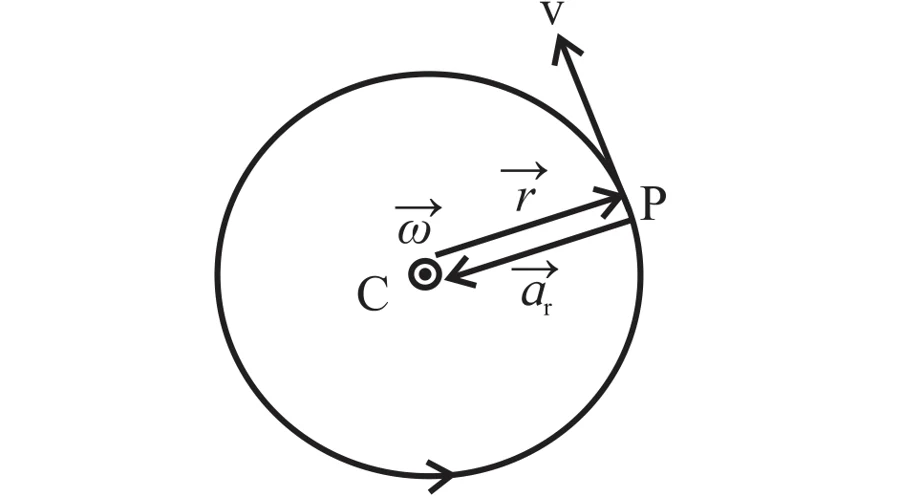
Fig. 1.2 · HSC Textbook · Directions of linear velocity and acceleration
TOPIC 01
Concept in brief
Circular motion is an accelerated motion: the direction of velocity changes at every instant. It is also a periodic motion.
Angular displacement θ, angular velocity ω = dθdt and angular acceleration α = dωdt are analogous to s, v and a.
Tangential velocity v = ωr. The direction of ω is along the axis of rotation, given by the right-hand thumb rule.
Uniform circular motion (UCM): speed is constant; only the direction of velocity changes. The centripetal accelerationar = ω²r = v²r is directed towards the centre.
Non-uniform circular motion: the speed also changes, so there is a tangential acceleration aT as well.
Centripetal force is the resultant of all real forces, directed towards the centre. Centrifugal force is a pseudo force mω²r, directed away from the centre, felt in a rotating frame.
→UCM: speed constant, direction of velocity and acceleration changes.
→KE = 12mv² depends only on speed
⇒ constant.
→Answer: (b) kinetic energy
Q21 mark · SCERT Question Bank · MCQ 3
A stone tied to one end of a string is whirled in a horizontal plane with progressively increasing speed. It breaks at some speed because _____.
(a) gravitational force of the earth is greater than the tension in the string(b) the required centripetal force is greater than the tension sustained by the string(c) the required centripetal force is less than the tension in the string(d) the centripetal force is greater than the weight of the stone
Solution
→Tension supplies the centripetal force mv²/r, which increases with speed.
→String breaks when the required force exceeds the tension it can bear.
→Answer: (b)
Q31 mark · SCERT Question Bank · MCQ 5
A 500 kg car takes a round turn of radius 50 m with a velocity of 36 km/hr. The centripetal force is _____.
(a) 250 N(b) 750 N(c) 1000 N(d) 1200 N
Solution
→v = 36 km/h = 10 m/s
F = mv²r = 500 × 10²50
= 1000 N
→Answer: (c) 1000 N
Q41 mark · HSC Textbook Ex. 1(i)
When seen from below, the blades of a ceiling fan are seen to be revolving anticlockwise and their speed is decreasing. Select the correct statement about the directions of its angular velocity and angular acceleration.
(a) ω upwards, α downwards(b) ω downwards, α upwards(c) both ω and α upwards(d) both ω and α downwards
Solution
→Anticlockwise as seen by the observer
⇒ ω points towards the observer = downwards (right-hand thumb rule).
→Speed decreasing
⇒ α opposite to ω = upwards.
→Answer: (b)
Q51 mark · HSC Feb 2024
Define centripetal force.
Solution
→The force acting on a body in circular motion, directed along the radius towards the centre of the circle, is called centripetal force.
→Formula: F = mv²r = mω²r.
Q61 mark · Expected question · based on HSC Textbook 1.2.2
Is centrifugal force a real force? Justify in one line.
Solution
→No. It is a pseudo force (non-real but not imaginary), felt only in a rotating frame, directed away from the centre: magnitude mω²r.
Q72 marks · Expected question · based on HSC Textbook 1.2.2
Distinguish between centripetal force and centrifugal force.
Solution
→Nature: centripetal – real force (resultant of real forces); centrifugal – pseudo force.
→Direction: centripetal – towards the centre; centrifugal – away from the centre.
→Example: tension in a whirled string; outward push felt on a merry-go-round.
Q82 marks · Expected question · based on HSC Textbook 1.2.1
What is uniform circular motion? Why is it called an accelerated motion?
Solution
→Circular motion with constant speed is uniform circular motion (UCM).
→Velocity is always tangential, so its direction changes at every instant.
→Change in velocity
⇒ acceleration ar = v²r = ω²r towards the centre; hence UCM is accelerated.
Q92 marks · HSC Textbook Example 1.1
A fan is rotating at 90 rpm. It is then switched OFF. It stops after 21 rotations. Calculate the time taken by it to stop assuming that the frictional torque is constant.
Solution
→Given: ω₀ = 90 rpm = 1.5 rps
ω = 0
θ = 21 rev.
→Formula: θ = (ω₀ + ω2) t
→Substitution: 21 = (1.5 + 02) t
⇒ t = 21 × 21.5
→Answer: t = 28 s
Q103 marks · HSC Textbook Ex. 12
Somehow, an ant is stuck to the rim of a bicycle wheel of diameter 1 m. While the bicycle is on a central stand, the wheel is set into rotation and it attains the frequency of 2 rev/s in 10 seconds, with uniform angular acceleration. Calculate (i) number of revolutions completed by the ant in these 10 seconds (ii) time taken by it for first complete revolution and the last complete revolution.
Solution
→Given: n₀ = 0
n = 2 rev/s
t = 10 s
⇒ α = 2 − 010 = 0.2 rev/s².
→(i) θ = 12αt² = 12 × 0.2 × 10²
= 10 rev.
→(ii) First revolution: 1 = 12(0.2)t₁²
⇒ t₁ = 10 = 3.16 s.
→Last revolution: 9 rev take t = 90.1 = 9.487 s
⇒ tlast = 10 − 9.487 = 0.513 s.
→Answer: 10 rev; √10 s; 0.513 s
Q113 marks · HSC Textbook Ex. 13
Coefficient of static friction between a coin and a gramophone disc is 0.5. Radius of the disc is 8 cm. Initially the centre of the coin is 2 cm away from the centre of the disc. At what minimum frequency will it start slipping from there? By what factor will the answer change if the coin is almost at the rim? (use g = π² m/s²)
Solution
→Concept:
friction gives the centripetal force; slipping starts when μmg = mω²r.
→Formula: ω = μgr
n = ω2π
→Substitution: ω = 0.5 × π²0.02 = 5π rad/s
⇒ n = 5π2π = 2.5 rev/s.
→At the rim: n ∝ 1√r; r becomes 4 times
⇒ n becomes half: n₂ = 12n₁ = 1.25 rev/s.
→Answer: 2.5 rev/s; n₂ = 12 n₁
MHT CET corner
4 MHT CET questions on the same formulas
C1MHT CET 2026
A body moves along a circular path of diameter 30 cm. It starts from one end of a diameter and reaches the other end of the diameter in 3 s. Its angular speed in rad/s is
(a)π5(b)π4(c)π3(d)π2
Solution
→Half a circle = π rad in 3 s
⇒ ω = π3 rad/s
→Answer: (c) π3
C2MHT CET 2026
The angular velocity of the hour hand of a watch is (in rad/s)
(a)π43200(b)π30(c)π21600(d)π1800
Solution
→Hour hand: T = 12 h = 43200 s
⇒ ω = 2π43200 = π21600 rad/s
→Answer: (c) π21600
C3MHT CET 2025
For a particle moving in a circle with constant angular speed, which statement is false?
(a) The velocity vector is tangent to the circle.(b) The acceleration vector is tangent to the circle.(c) The velocity and acceleration vectors are perpendicular.(d) The acceleration vector points to the centre.
Solution
→In UCM the acceleration is centripetal (towards the centre), not tangential
→Answer: (b) The acceleration vector is tangent to the circle.
C4MHT CET 2025
Two bodies of mass 10 kg and 5 kg move in concentric circles of radii R and r with the same period. The ratio of their centripetal accelerations is
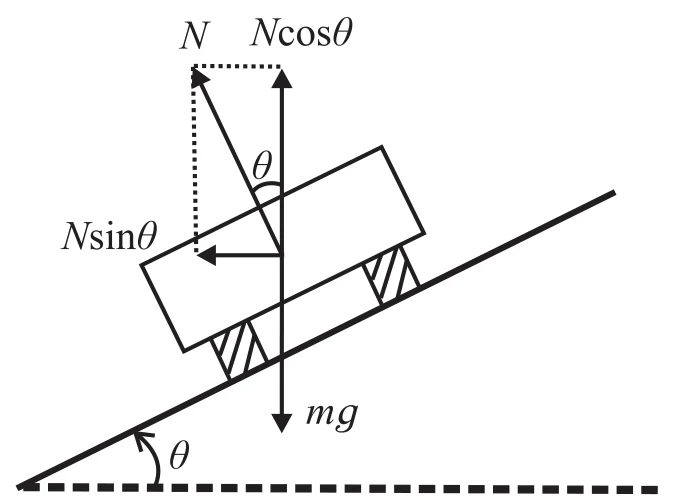
Fig. 1.6 · HSC Textbook · Vehicle on a banked road
TOPIC 02
Concept in brief
In circular motion, the resultant of all real forces is directed towards the centre. It is the centripetal force: F = mv²r.
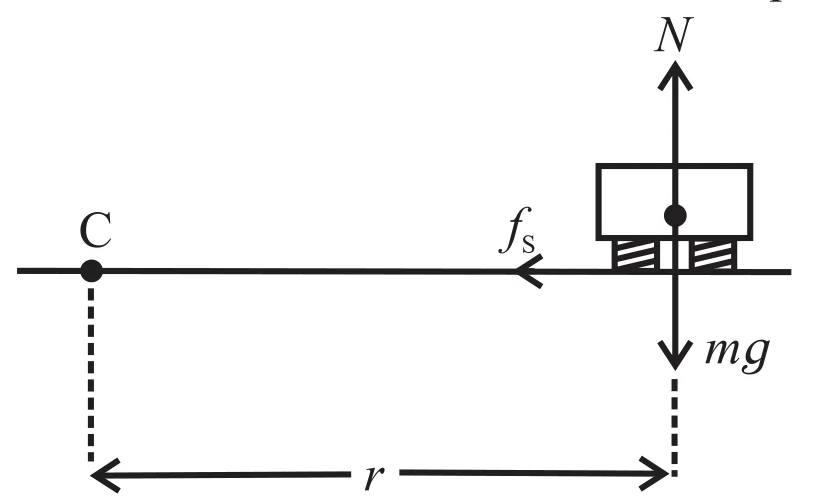
Vehicle along a horizontal circular track: the force of static friction between road and tyres provides the centripetal force.
Friction has an upper limit μsN. This imposes an upper limit on the speed: vmax = μsrg.
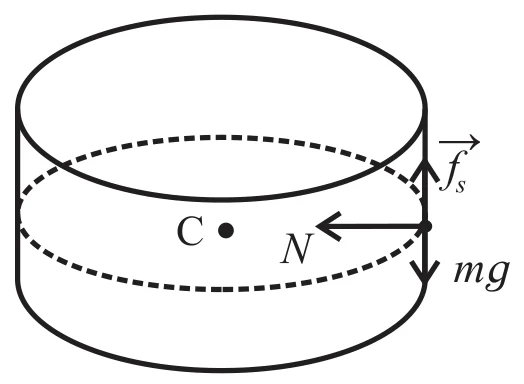
Well of death: the normal reaction N provides the centripetal force and friction balances the weight. This gives a lower limit on the speed.
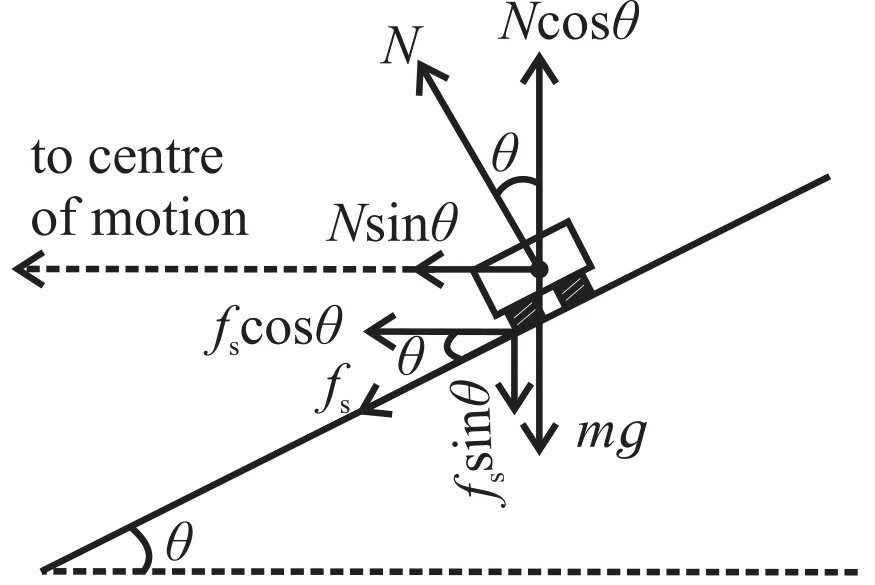
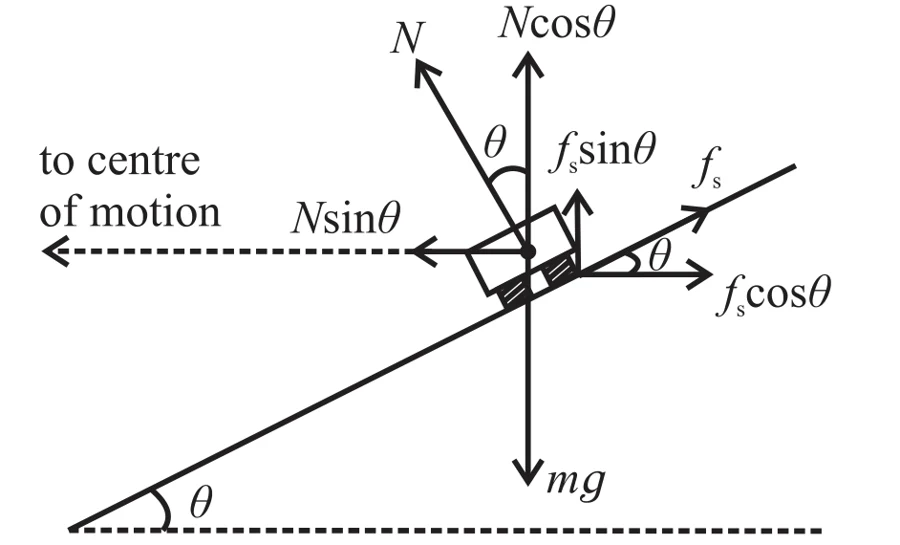
Banking of a road: the surface of a curved road is tilted with the horizontal by an angle θ (the angle of banking). N cos θ balances mg and N sin θ provides the centripetal force.
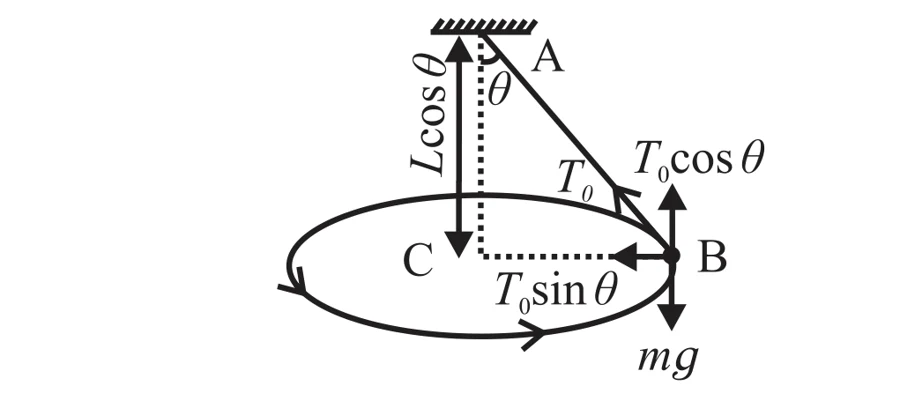
Conical pendulum: a bob revolves in a horizontal circle; T₀ cos θ balances mg and T₀ sin θ provides the centripetal force.
The period of conical pendulum in terms of its length (l), semi-vertical angle (θ) and acceleration due to gravity (g) is _____.
(a)12πl cos θg(b)12πl sin θg(c) 4πl cos θ4g(d) 4πl tan θg
Solution
→T = 2πl cos θg.
→4πl cos θ4g = 4π × 12l cos θg = 2πl cos θg.
→Answer: (c)
Q21 mark · SCERT Question Bank · MCQ 6
A cyclist riding a bicycle at a speed of 14√3 m/s takes a turn around a circular road of radius 20√3 m without skidding. Given g = 9.8 m/s², what is his inclination to the vertical?
(a) 30°(b) 45°(c) 60°(d) 90°
Solution
tan θ = v²rg = 58820√3 × 9.8
= √3
→θ = 60°
→Answer: (c) 60°
Q31 mark · SCERT Question Bank · MCQ 7
A string of length l fixed at one end carries a mass m at the other. The string makes 2/π revolutions per second around the vertical axis through the fixed end. The tension in the string is _____.
(a) 2 ml(b) 4 ml(c) 8 ml(d) 16 ml
Solution
→T sin θ = mω²(l sin θ)
⇒ T = mω²l.
→ω = 2πn = 2π × 2π
= 4 rad/s
⇒ T = 16 ml.
→Answer: (d) 16 ml
Q41 mark · HSC Feb 2025
State the formula for angle of banking.
Solution
→tan θ = v²rg (v = speed, r = radius of the curve, g = acceleration due to gravity).
Q51 mark · HSC Feb 2023
If friction is made zero for a road, can a vehicle move safely on this road?
Solution
→On a level road: no – friction provides the centripetal force, so the vehicle skids on the turn.
→On a banked road: yes, but only at v = rg tan θ (N sin θ gives the centripetal force).
Q61 mark · SCERT Question Bank · VSA 2
Does the angle of banking depend on the mass of the vehicle?
Solution
→No. tan θ = v²rg does not contain mass.
Q71 mark · HSC Jun 2026
A motorcyclist performs horizontal circular motion inside a well of inner radius 3 m. Calculate the minimum speed to perform the stunt if coefficient of static friction is 0.3. [g = 10 m/s²]
Solution
vmin = rgμs = 3 × 100.3
= 100
→Answer: 10 m/s
Q81 mark · SCERT Question Bank · VSA 7
A bend in a level road has a radius of 100 m. Find the maximum speed which a car turning this bend may have without skidding, if the coefficient of friction between the tyres and road is 0.8.
Solution
vmax = μrg = 0.8 × 100 × 9.8
= 784
→Answer: 28 m/s
Q92 marks · HSC Jun 2026 · HSC Feb 2024 · HSC Feb 2026 · SCERT Question Bank · SA-I 3
Obtain (derive) an expression for the maximum (safety) speed of a vehicle moving along a horizontal circular curved road. State its significance.
Solution
Fig. 1.4 · HSC Textbook · Vehicle on a horizontal road
→Diagram + forces: weight mg down, normal reaction N up, static friction fs towards the centre.
N = mg
fs = mv²r
→fs ≤ μsN; at maximum speed friction is limiting:
mvmax²r = μsmg
⇒ vmax = μsrg
→Significance: vmax is independent of mass; it increases with μs and r.
Q102 marks · HSC Textbook Ex. 2(i)
Why are curved roads banked?
Solution
→On a level road only friction provides the centripetal force.
→Friction is unreliable (wet, sandy, uneven road) and has an upper limit μsN.
→On a banked road the horizontal component N sin θ of the normal reaction provides the centripetal force, so vehicles can turn safely with less dependence on friction.
Q112 marks · HSC Textbook Ex. 2(ii)
Do we need a banked road for a two-wheeler? Explain.
Solution
→Yes. A two-wheeler also needs a centripetal force mv²/r on a curve.
→On a level road this comes only from friction and the rider has to lean inward by θ = tan⁻¹(v²rg).
→On a banked road N sin θ supplies it; at the designed speed the rider stays perpendicular to the road, and the risk of skidding is reduced.
Q122 marks · HSC Textbook Ex. 2(iii)
On what factors does the frequency of a conical pendulum depend? Is it independent of some factors?
Solution
n = 12πgL cos θ
→Depends on: length L of the string, semi-vertical angle θ and g (L cos θ = height of the cone).
→Independent of: the mass of the bob.
Q132 marks · HSC Jul 2023
A motorcyclist performs stunt along the cylindrical wall of a ‘Well of Death’ of inner radius 4 m. Coefficient of static friction between the tyres and the wall is 0.4. Calculate the maximum period of revolution. [Use g = 10 m/s²]
Solution
Fig. 1.5 · HSC Textbook · Well of death
→Given: r = 4 m
μs = 0.4
g = 10 m/s².
→Formula: vmin = rgμs
Tmax = 2πrvmin
→Substitution: vmin = 4 × 100.4 = 10 m/s
⇒ Tmax = 2 × 3.142 × 410
→Answer: Tmax = 2.51 s
Q142 marks · HSC Textbook Example 1.2
A motor cyclist (to be treated as a point mass) is to undertake horizontal circles inside the cylindrical wall of a well of inner radius 4 m. Coefficient of static friction between the tyres and the wall is 0.4. Calculate the minimum speed and frequency necessary to perform this stunt. (Use g = 10 m/s²)
Solution
→Formula: vmin = rgμs
nmin = vmin2πr
→Substitution: vmin = 4 × 100.4 = 10 m/s
→nmin = 102π × 4 = 0.398 ≈ 0.4 rev/s
→Answer: 10 m/s; 0.4 rev/s
Q153 marks · HSC Feb 2024
The radius of a circular track is 200 m. Find the angle of banking of the track, if the maximum speed at which a car can be driven safely along it is 25 m/s.
Solution
→Given: r = 200 m
v = 25 m/s
g = 9.8 m/s² (from the paper’s constants).
→Formula: tan θ = v²rg
→Substitution: tan θ = 625200 × 9.8 = 0.3189
→Answer:
θ = tan⁻¹(0.3189), from the trigonometric table
→Answer: θ ≈ 17° 41′
Q163 marks · SCERT Question Bank · SA-II 5
A railway track goes around a curve having a radius of curvature of 1 km. The distance between the rails is 1 m. Find the elevation of the outer rail above the inner rail so that there is no side pressure against the rails when a train goes round the curve at 36 km/hr.
Solution
→Given: r = 1000 m
l = 1 m
v = 36 km/h = 10 m/s.
→Formula:
tan θ = v²rg; for small θ, h = l sin θ ≈ l tan θ
→Substitution: tan θ = 1001000 × 9.8 = 0.0102
→h = 1 × 0.0102 m
→Answer: h = 1.02 cm
Q173 marks · HSC Textbook Ex. 3
While driving along an unbanked circular road, a two-wheeler rider has to lean with the vertical. Why is it so? With what angle the rider has to lean? Derive the relevant expression. Why such a leaning is not necessary for a four wheeler?
Solution
Fig. 1.4 · HSC Textbook · Vehicle on a horizontal road
→Why: friction fs at the tyres and the centrifugal force mv²/r (through the CM, above the road) form a couple that would topple the rider outward; leaning inward lets the torque of the weight balance it.
→Derivation: rider leans at θ; N (= mg) and fs act at the road. Their resultant must pass through the CM:
N = mg
fs = mv²r
⇒ tan θ = fsN = v²rg
→Four-wheeler: it has a wide base; the larger normal reaction on the outer wheels gives a balancing torque, so no leaning is needed.
Q183 marks · HSC Textbook Ex. 14
Part of a racing track is to be designed for a radius of curvature of 72 m. We are not recommending the vehicles to drive faster than 216 kmph. With what angle should the road be tilted? At what height will its outer edge be, with respect to the inner edge if the track is 10 m wide?
Solution
→Given: r = 72 m
v = 216 km/h = 60 m/s
width l = 10 m.
→Formula: tan θ = v²rg
h = l sin θ
→Substitution: tan θ = 360072 × 10 = 5
⇒ θ = tan⁻¹(5) = 78.69°
→h = 10 × sin 78.69° = 10 × 0.9806
→Answer: θ = 78.69°, h = 9.8 m
Q193 marks · HSC Textbook Ex. 15
The road in the Ex. 14 above is constructed as per the requirements. The coefficient of static friction between the tyres of a vehicle on this road is 0.8. Will there be any lower speed limit? By how much can the upper speed limit exceed in this case?
Solution
→Lower limit: μs = 0.8 < tan θ = 5, so vmin exists.
vmin = rg(tan θ − μs1 + μs tan θ) = 720 × 4.25
= 24.6 m/s ≈ 88 km/h
→Upper limit: μs tan θ = 4 > 1 (μs > cot θ)
⇒ denominator of vmax is negative
⇒ no upper limit (road banked at more than 45°).
→Answer: vmin ≈ 88 km/h; no upper limit
Q203 marks · HSC Textbook Ex. 16
During a stunt, a cyclist (considered to be a particle) is undertaking horizontal circles inside a cylindrical well of radius 6.05 m. If the necessary friction coefficient is 0.5, how much minimum speed should the stunt artist maintain? Mass of the artist is 50 kg. If she/he increases the speed by 20%, how much will the force of friction be?
Solution
Fig. 1.5 · HSC Textbook · Well of death
→Formula: vmin = rgμs
→Substitution: vmin = 6.05 × 100.5 = 121
= 11 m/s
→Friction: friction is the only upward force, so it always equals the weight, whatever the speed:
fs = mg = 50 × 10
= 500 N
→Answer: 11 m/s; 500 N
Q213 marks · HSC Textbook Ex. 17
A pendulum consisting of a massless string of length 20 cm and a tiny bob of mass 100 g is set up as a conical pendulum. Its bob now performs 75 rpm. Calculate kinetic energy and increase in the gravitational potential energy of the bob. (Use π² = 10)
Note: The textbook answer key prints KE = 0.45 J; working it out gives 0.045 J.
Solution
→Given: L = 0.2 m
m = 0.1 kg
n = 75 rpm = 1.25 rps
⇒ ω = 2.5π
ω² = 62.5 s⁻².
→Angle: cos θ = gLω² = 100.2 × 62.5
= 0.8
⇒ sin θ = 0.6
r = L sin θ = 0.12 m
→KE = 12mω²r² = 12 × 0.1 × 62.5 × 0.0144
= 0.045 J
→Rise in PE = mgL(1 − cos θ) = 0.1 × 10 × 0.2 × 0.2
= 0.04 J
→Answer: KE = 0.045 J, ΔPE = 0.04 J
Note: The textbook answer key prints KE = 0.45 J; working it out gives 0.045 J.
Q223 marks · HSC Textbook Example 1.4
In a merry-go-round, the ‘initially vertical’ rods (length 1.5 m) hang from horizontal rods (length 2.1 m) and incline at θ = 37° with the vertical during rotation. Calculate the frequency of revolution of the merry-go-round. (Use g = π² m/s² and sin 37° = 0.6)
Solution
→Radius:
r = H + V sin 37° = 2.1 + 1.5 × 0.6
= 3.0 m
→Forces: T cos θ = mg
T sin θ = mω²r = 4π²mrn²
tan θ = 4π²rn²g = 4rn² (g = π²)
→Substitution: 0.75 = 4 × 3 × n²
⇒ n² = 116
→Answer: n = 0.25 rev/s
Q233 marks · HSC Textbook Example 1.5
Semi-vertical angle of the conical section of a funnel is 37°. There is a small ball kept inside the funnel. On rotating the funnel, the maximum speed that the ball can have in order to remain in the funnel is 2 m/s. Calculate inner radius of the brim of the funnel. Is there any limit upon the frequency of rotation? (g = 10 m/s², sin 37° = 0.6)
Solution
→Forces: N sin θ = mg
N cos θ = mv²r
⇒ tan θ = rgv²
→Brim radius:
rmax = vmax² tan θg = 4 × 0.7510
= 0.3 m
→Frequency:
going down, v and r → 0 but n = v2πr increases, so there is only a lower limit:
nmin = vmax2πrmax = 22π × 0.3 ≈ 1.06 rev/s
→Answer: 0.3 m; lower limit ≈ 1 rev/s
Q244 marks · SCERT Question Bank · LA 3
Obtain an expression for maximum safety speed with which a vehicle can be safely driven along a curved banked road. OR Show that the angle of banking is independent of mass of vehicle.
→Diagram: road banked at θ, radius r; forces mg, N (⟂ road), fs down the slope (maximum speed).
→Resolve: vertical and horizontal components:
N cos θ = mg + fs sin θ
mv²r = N sin θ + fs cos θ
→Put fs = μsN and divide:
vmax = rg (tan θ + μs1 − μs tan θ)
→Without friction (μs = 0): N cos θ = mg
N sin θ = mv²r
⇒ tan θ = v²rg
v = rg tan θ
→Conclusion: m cancels
⇒ the angle of banking is independent of the mass of the vehicle.
Q254 marks · SCERT Question Bank · LA 2
What is a conical pendulum? Obtain an expression for its time period.
Solution
Fig. 1.9 (a) · HSC Textbook · Conical pendulum
→Definition: a point mass tied to a light inextensible string, revolving in a horizontal circle so that the string traces the surface of a cone with a vertical axis.
→Diagram + forces:
weight mg; tension T₀ along the string at θ to the vertical; r = L sin θ.
T₀ cos θ = mg ···(1)
T₀ sin θ = mrω² ···(2)
→Divide (2) by (1): tan θ = rω²g = L sin θ ω²g
ω = gL cos θ
⇒ T = 2πω = 2πL cos θg
→Conclusion: T depends on L, θ, g; independent of the mass of the bob.
Q264 marks · HSC Textbook Example 1.3
A racing track of radius of curvature 9.9 m is banked at tan⁻¹(0.5). Coefficient of static friction between the track and the tyres of a vehicle is 0.2. Determine the speed limits with 10% margin. (Take g = 10 m/s²)
A vehicle moves at a constant speed of 10 m/s on a horizontal circular track of radius 20 m. A bob hangs from the roof by a massless string. The angle made by the string with the vertical is (g = 10 m/s²)
→The string tilts like a banked road: tan θ = v²rg = 10 × 1020 × 10
= 0.5
→Answer: (a) tan⁻¹(0.5)
C2MHT CET 2025
A motorcyclist rotates in horizontal circles inside a cylindrical wall of inner radius R. If the coefficient of friction between the wall and the tyres is μs, the minimum speed required is
(a)μsRg(b)Rgμs(c)μsRg(d)R²gμs
Solution
→Friction holds the weight
→Well-of-death formula: vmin = Rgμs
→Answer: (b) Rgμs
C3MHT CET 2026
On a dry level curved road the maximum safe speed is v. After heavy rain the maximum safe speed is reduced by 60%. The ratio of the coefficient of friction for the dry road to that of the wet road is
(a) 25 : 9(b) 24 : 5(c) 24 : 9(d) 25 : 4
Solution
→v = μrg
⇒ μ ∝ v²
→New speed = 0.4v
⇒ μdryμwet = 10.16 = 25 : 4
→Answer: (d) 25 : 4
C4MHT CET 2023
In a conical pendulum the bob of mass m moves in a horizontal circle of radius r. The string of length L describes a cone of semi-vertical angle θ. The centripetal force on the bob is
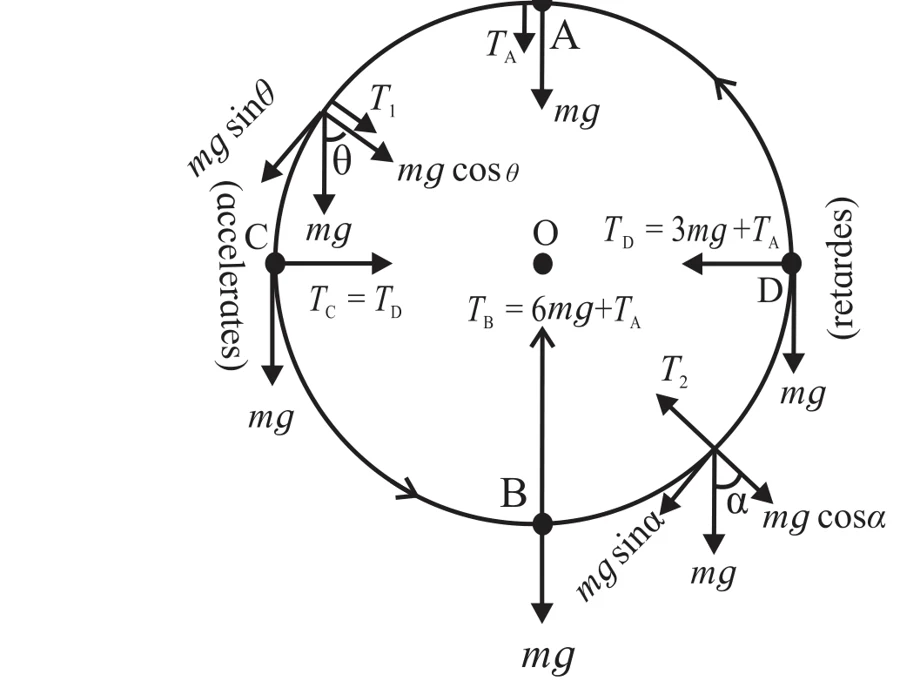
In a vertical circle controlled by gravity, the speed keeps changing: kinetic energy and gravitational potential energy keep interconverting.
At the uppermost point A, weight and tension both act towards the centre: mg + TA = mvA²r.
At the lowermost point B: TB − mg = mvB²r. Between A and B the body falls 2r, so vB² = vA² + 4rg.
For a string, the tension cannot be zero for long, so a minimum speedrg is needed at the top. For a rod, (practically) zero speed at the top is possible.
The difference of extreme tensions TB − TA = 6mg is independent of v and r.
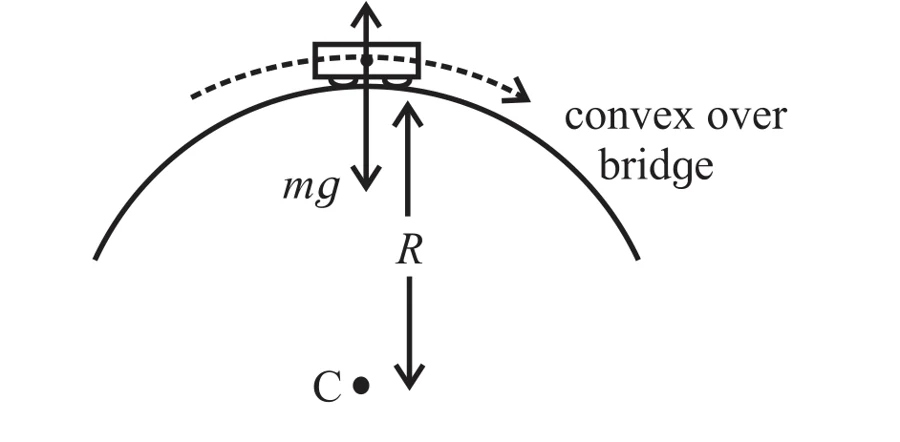
Convex over-bridge:mg − N = mv²r; contact is lost when N = 0, so vmax = rg.
When the bob performs a vertical circular motion and the string rotates in a vertical plane, the difference in the tension in the string at horizontal position and uppermost position is _____.
(a) mg(b) 2 mg(c) 3 mg(d) 6 mg
Solution
→Thorizontal − Ttop = 3mg.
→Answer: (c) 3 mg
Q21 mark · HSC Textbook Ex. 1(ii)
A particle of mass 1 kg, tied to a 1.2 m long string is whirled to perform vertical circular motion, under gravity. Minimum speed of the particle is 5 m/s. (P) Maximum speed must be 5√5 m/s. (Q) Difference between maximum and minimum tensions along the string is 60 N. Select the correct option.
(a) only P is correct(b) only Q is correct(c) both are correct(d) both are incorrect
Solution
→vmax² = vmin² + 4rg = 25 + 48
= 73
⇒ vmax = 8.54 m/s
⇒ P is wrong.
→Tmax − Tmin = 6mg = 60 N
⇒ Q is correct.
→Answer: (b)
Q31 mark · SCERT Question Bank · VSA 6
A hollow sphere has radius 6.4 m. What is the minimum velocity required by a motor cyclist at bottom to complete the circle?
Solution
vmin = 5rg = 5 × 6.4 × 9.8
= 313.6
→Answer: 17.7 m/s
Q41 mark · Expected question · based on HSC Textbook 1.4.3
What is the maximum speed with which a vehicle can cross the top of a convex over-bridge of radius r without losing contact?
Solution
Fig. 1.11 · HSC Textbook · Vehicle on a convex over-bridge
→At the top: mg − N = mv²r
contact is just lost when N = 0
⇒ vmax = rg.
Q52 marks · SCERT Question Bank · SA-I 5
A bucket containing water is tied to one end of a rope 5 m long and it is rotated in a vertical circle about the other end. Find the number of rotations per minute in order that the water in the bucket may not spill.
Solution
→Condition: at the top, speed ≥ rg.
→Formula: v = rg
n = v2πr
→Substitution: v = 5 × 9.8 = 7 m/s
⇒ n = 72 × 3.142 × 5 = 0.2228 rps
→Answer: n = 13.37 rpm
Q62 marks · SCERT Question Bank · SA-I 6
A body weighing 0.5 kg tied to a string is projected with a velocity of 10 m/s. The body starts whirling in a vertical circle. If the radius of the circle is 0.8 m, find the tension in the string when the body is at the top of the circle.
Note: The SCERT key prints 3.8 N; working it out gives 38 N.
Solution
→Speed at top:
vA² = vB² − 4rg = 100 − 4(0.8)(9.8)
= 68.64 m²/s²
→Formula: TA = mvA²r − mg
→Substitution:
TA = 0.5 × 68.640.8 − 0.5 × 9.8 = 42.9 − 4.9
→Answer: T = 38 N
Note: The SCERT key prints 3.8 N; working it out gives 38 N.
Q73 marks · SCERT Question Bank · SA-II 3
Derive an expression for the difference in tensions at highest and lowest point for a particle performing vertical circular motion.
→Diagram: vertical circle, top A, bottom B, forces at both points.
→Top A: TA + mg = mvA²r ···(1)
bottom B: TB − mg = mvB²r ···(2)
→(2) − (1): TB − TA = 2mg + mr(vB² − vA²)
→Energy (fall of 2r): 12mvB² − 12mvA² = 2mgr
⇒ vB² − vA² = 4rg
TB − TA = 2mg + 4mg = 6mg
Q83 marks · HSC Textbook Ex. 18
A motorcyclist (as a particle) is undergoing vertical circles inside a sphere of death. The speed of the motorcycle varies between 6 m/s and 10 m/s. Calculate diameter of the sphere of death. What are the minimum values possible for these two speeds?
Solution
→Formula: vB² − vA² = 4rg
→Substitution: 100 − 36 = 4r(10)
⇒ r = 1.6 m
⇒ diameter = 3.2 m
→Minimum speeds: top rg = 16 = 4 m/s
bottom 5rg = 80 = 4√5 m/s
→Answer: 3.2 m; 4 m/s and 4√5 m/s
Q94 marks · HSC Feb 2023
Derive expressions for linear velocity at lowest position, mid-way position and the top-most position for a particle revolving in a vertical circle, if it has to just complete circular motion without string slackening at top.
→Diagram: vertical circle of radius r; A top, C mid-way (string horizontal), B bottom.
→Top A:
mg + TA = mvA²r; just completing the circle
⇒ TA = 0
vA = rg
→A → C (fall r): 12mvC² = 12mvA² + mgr
vC = rg + 2rg = 3rg
→A → B (fall 2r): 12mvB² = 12mvA² + 2mgr
vB = rg + 4rg = 5rg
Q104 marks · HSC Textbook Ex. 4
Using the energy conservation, derive the expressions for the minimum speeds at different locations along a vertical circular motion controlled by gravity. Is zero speed possible at the uppermost point? Under what condition/s? Also prove that the difference between the extreme tensions (or normal forces) depends only upon the weight of the object.
bottom vB = 5rg (write the three energy steps as in the derivation box).
→Zero speed at top:
possible only if the mass is on a rigid rod (a rod can push, it need not be taut). Then vbottom = 4rg
vside = 2rg.
→Tensions: TB − mg = mvB²r
TA + mg = mvA²r
TB − TA = 2mg + mr(4rg) = 6mg
→Conclusion: 6mg contains neither v nor r
⇒ depends only on the weight.
Q114 marks · HSC Textbook Example 1.6
A tiny stone of mass 20 g is tied to a massless, inextensible, flexible string (length 1.8 m) and whirled along vertical circles. Its speed is 8 m/s when the centripetal force is exactly equal to the force due to the tension. Calculate minimum and maximum kinetic energies of the stone. Taking θ = 0 at the lowermost position, find the angular position of the string when the tension is numerically equal to the weight. (g = 10 m/s²)
Solution
→Tension = centripetal force only when the string is horizontal (mg ⟂ string): v = 8 m/s there
KE = 12(0.02)(64) = 0.64 J
mgr = 0.02 × 10 × 1.8 = 0.36 J.
KEmin (top) = 0.64 − 0.36 = 0.28 J
KEmax (bottom) = 0.64 + 0.36 = 1 J
→T = mg at angle θ: T − mg cos θ = mv²r
⇒ v² = rg(1 − cos θ)
→Energy from the bottom (vB² = 100): v² = 100 − 2gr(1 − cos θ)
⇒ 18(1 − cos θ) = 100 − 36(1 − cos θ)
1 − cos θ = 10054
⇒ cos θ = −2327
⇒ θ ≈ 148° 25′
→Answer: 0.28 J, 1 J; θ ≈ 148°25′
MHT CET corner
4 MHT CET questions on the same formulas
C1MHT CET 2023
A body of mass m tied to a string is just completing the loop in a vertical circle. The tension (apparent weight) at the lowest point is
(a) zero(b) mg(c) 3 mg(d) 6 mg
Solution
→Just completing
⇒ vB² = 5rg
⇒ TB = mg + m(5rg)r = 6mg
→Answer: (d) 6 mg
C2MHT CET 2026
A bucket of water is revolved in a vertical circle of radius r. To prevent the water from falling, the period of revolution required is
(a) 2πgr(b) 2πrg(c) 2πrg(d)rg2π
Solution
→At the top v = rg
⇒ T = 2πrv = 2πrg
→Answer: (b) 2πrg
C3MHT CET 2026
A stone of mass 40 g tied to a light string of length 50 cm is whirled in a vertical circle at 30 rpm. The tension at the lowest point is (g = 10 m/s², π² = 10)
(a) 0.4 N(b) 0.5 N(c) 0.6 N(d) 0.7 N
Solution
→ω = 2π × 0.5 = π
⇒ ω² = 10
→T = m(g + ω²r) = 0.04 × (10 + 5)
= 0.6 N
→Answer: (c) 0.6 N
C4MHT CET 2024
A pendulum of length L is displaced through 90° from the vertical and released. The minimum strength of the string, to withstand the tension as the bob passes the mean position, is
The moment of inertia (MI) of a disc of radius R and mass M about its central axis is _____.
(a)MR²4(b)MR²2(c) MR²(d)3MR²2
Solution
→Disc about its own axis: I = 12MR².
→Answer: (b)
Q21 mark · HSC Jun 2026
The MI of ring of radius R and mass M about its central axis is _____.
(a) 2MR²(b)MR²2(c) MR²(d)32MR²
Solution
→Whole mass at distance R: I = MR².
→Answer: (c)
Q31 mark · HSC Textbook Ex. 1(iii)
Select the correct statement about the formula (expression) of moment of inertia (M.I.) in terms of mass M of the object and some of its distance parameter/s, such as R, L, etc.
(a) Different objects must have different expressions for their M.I.(b) When rotating about their central axis, a hollow right circular cone and a disc have the same expression for the M.I.(c) Expression for the M.I. for a parallelepiped rotating about the transverse axis passing through its centre includes its depth.(d) Expression for M.I. of a rod and that of a plane sheet is the same about a transverse axis.
Solution
→A hollow right circular cone and a disc, about their central axes, both have I = 12MR² (same mass distribution about the axis).
→Answer: (b)
Q41 mark · HSC Mar 2022
Calculate the moment of inertia of a uniform disc of mass 10 kg and radius 60 cm about an axis perpendicular to its length and passing through its centre.
Solution
I = 12MR² = 12 × 10 × (0.6)²
→Answer: 1.8 kg m²
Q51 mark · SCERT Question Bank · VSA 1
Find the radius of gyration of a uniform disc about an axis perpendicular to its plane and passing through its center.
Solution
→MK² = 12MR²
⇒ K = R√2 = 0.707 R
→Answer: K = R/√2
Q61 mark · SCERT Question Bank · VSA 5
Two bodies have their moments of inertia I and 2I respectively about their axis of rotation. If their kinetic energies of rotation are equal, then what is the ratio of their angular velocity?
Solution
→12Iω₁² = 12(2I)ω₂²
⇒ ω₁ω₂ = 2
→Answer: √2 : 1
Q72 marks · HSC Mar 2022
Define moment of inertia of a rotating rigid body. State its SI unit and dimensions.
Solution
→Definition: the moment of inertia of a rigid body about an axis is the sum of the products of the mass of each particle and the square of its perpendicular distance from the axis.
→Formula: I = Σ miri²
→SI unit kg m²; dimensions [M¹L²T⁰].
Q82 marks · HSC Jul 2022
The surface density of a uniform disc of radius 10 cm is 2 kg/m². Find its MI about an axis passing through its centre and perpendicular to its plane.
Solution
→Given: σ = 2 kg/m²
R = 0.1 m.
→Mass: M = σπR² = 2 × 3.142 × 0.01
= 0.0628 kg
→Formula: I = 12MR² = 12 × 0.0628 × 0.01
→Answer: I = 3.14 × 10⁻⁴ kg m²
Q92 marks · SCERT Question Bank · SA-I 4
The moment of inertia of a body about a given axis is 1.2 kg m². Initially the body is at rest. For what duration an angular acceleration of 25 rad/s² must be applied about that axis in order to produce a rotational kinetic energy of 1500 J?
Solution
→Formula: KE = 12Iω²
ω = αt
→Substitution: ω² = 2 × 15001.2 = 2500
⇒ ω = 50 rad/s
→t = ωα = 5025
→Answer: t = 2 s
Q102 marks · HSC Textbook Ex. 2(iv)
Why is it useful to define radius of gyration?
Solution
→M.I. can be calculated only for regular (integrable) shapes; for others it is found by experiment.
→Writing I = MK² separates the mass from its distribution about the axis.
→K alone tells how far the mass is effectively spread from the axis, so bodies of any mass can be compared (ring K = R, disc K = R/√2).
Q112 marks · HSC Textbook Ex. 2(v)
A uniform disc and a hollow right circular cone have the same formula for their M.I., when rotating about their central axes. Why is it so?
Solution
→M.I. depends only on how the mass is distributed at different perpendicular distances from the axis.
→Slicing the hollow cone into thin rings: ring radii run from 0 (apex) to R (base), and the mass of each ring grows in proportion to its radius – exactly as in a disc.
→Same distribution about the axis
⇒ same I = 12MR² (the height of the cone does not matter).
Q122 marks · HSC Textbook Ex. 19
A metallic ring of mass 1 kg has moment of inertia 1 kg m² when rotating about one of its diameters. It is molten and remoulded into a thin uniform disc of the same radius. How much will its moment of inertia be, when rotated about its own axis?
Solution
→Ring, diameter:12MR² = 1
⇒ MR² = 2 kg m²
→Disc, own axis: I = 12MR² = 12 × 2
→Answer: 1 kg m²
Q133 marks · HSC Mar 2022 · HSC Jul 2022 · SCERT Question Bank · SA-II 1
Derive an expression for the kinetic energy of a body rotating with a uniform angular speed.
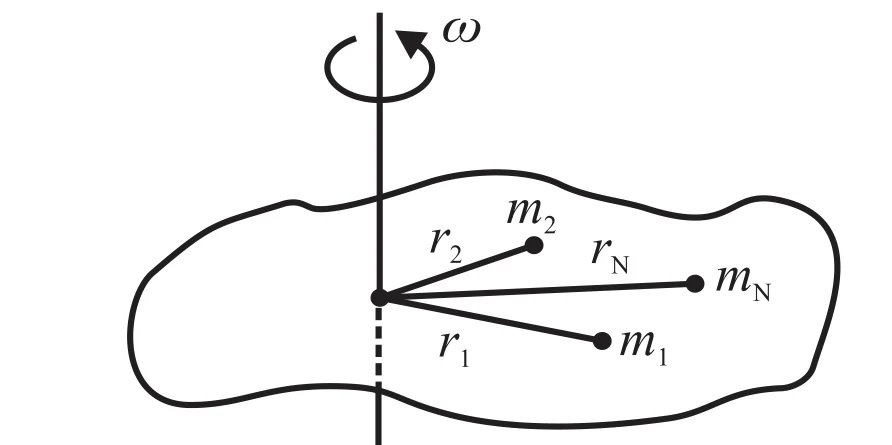
→all particles have the same ω; linear speeds v₁ = r₁ω, v₂ = r₂ω, …
KE₁ = 12m₁v₁² = 12m₁r₁²ω²
→rotational KE = sum of KE of all particles:
KErot = 12(m₁r₁² + m₂r₂² + … + mNrN²)ω² = 12Iω²
→I = Σ miri² is the moment of inertia; it replaces m in 12mv².
Q143 marks · HSC Textbook Ex. 5
Discuss the necessity of radius of gyration. Define it. On what factors does it depend and it does not depend? Can you locate some similarity between the centre of mass and radius of gyration? What can you infer if a uniform ring and a uniform disc have the same radius of gyration?
Solution
→Necessity:
I = MK² separates mass from its distribution; useful when I is found experimentally.
→Definition:
K is the distance from the axis at which the whole mass may be assumed to be concentrated so that I = MK².
→Depends on: shape, size and distribution of mass about the axis, and the choice of axis. Not on: the total mass.
→Similarity with CM: both replace the whole body by its mass at one place – CM for translation, K for rotation.
→Ring and disc with the same K:
Rring = Rdisc√2, i.e. the disc must be √2 times larger in radius.
Q153 marks · Expected question · based on HSC Textbook 1.5.2
Derive an expression for the moment of inertia of a uniform disc about an axis through its centre and perpendicular to its plane.
Solution
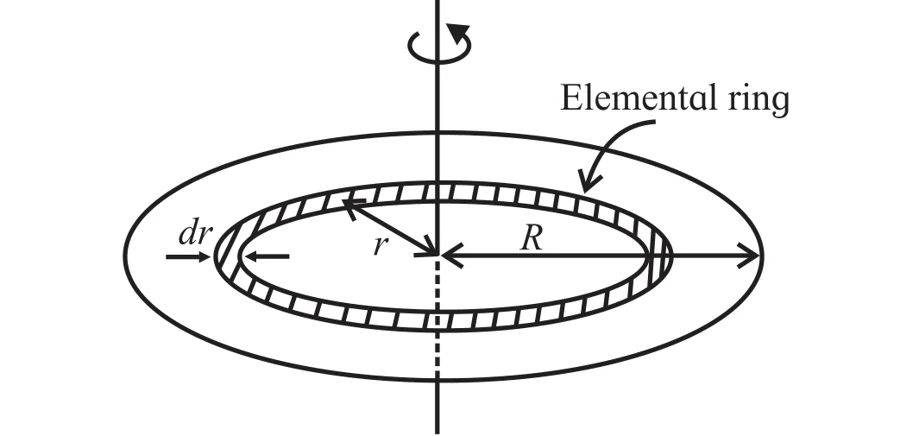
Fig. 1.14 · HSC Textbook · Disc made of thin rings
→Diagram: disc of mass M, radius R, with a thin ring of radius r and width dr.
→Surface density: σ = MπR²
mass of the ring dm = σ(2πr dr)
→M.I. of the ring: dI = dm · r² = 2πσ r³ dr
I = ∫₀R 2πσ r³ dr = 2πσR⁴4
= 2π(MπR²)R⁴4 = 12MR²
MHT CET corner
4 MHT CET questions on the same formulas
C1MHT CET 2026
A thin uniform rod of mass M and length L rotates (i) about an axis through its centre, (ii) about an axis through one end, both perpendicular to its length. The ratio of the radius of gyration in case (i) to case (ii) is
(a)14(b)12(c)18(d)16
Solution
→K₁² = L²12
K₂² = L²3
⇒ K₁K₂ = 312 = 12
→Answer: (b) 12
C2MHT CET 2026
Two equal masses m are connected by a rod of mass M and length L. The moment of inertia about an axis through the centre perpendicular to the rod is
(a)(M + 3m)L²12(b)(M + 6m)L²12(c)ML²4(d)ML²12
Solution
→I = ML²12 + 2m(L2)² = (M + 6m)L²12
→Answer: (b) (M + 6m)L²12
C3MHT CET 2026
A flywheel rotating about a fixed axis has kinetic energy 500 J. If its frequency is 5 Hz, its moment of inertia about the axis is (π² = 10)
(a) 0.6 kg m²(b) 1 kg m²(c) 0.75 kg m²(d) 0.15 kg m²
Solution
→ω = 2π × 5 = 10π
⇒ ω² = 1000. 12Iω² = 500
⇒ I = 10001000 = 1 kg m²
→Answer: (b) 1 kg m²
C4MHT CET 2026
A body rotates about its own axis. Its rotational kinetic energy is x and its angular momentum is y. Its moment of inertia about the axis is
The moment of inertia of a circular loop of radius R, at a distance of R/2 around a rotating axis parallel to horizontal diameter of the loop is _____.
(a)12MR²(b)34MR²(c) MR²(d) 2MR²
Solution
→I = 12MR² + M(R2)² = 34MR²
→Answer: (b)
Q21 mark · HSC Textbook Ex. 1(iv)
In a certain unit, the radius of gyration of a uniform disc about its central and transverse axis is √2.5. Its radius of gyration about a tangent in its plane (in the same unit) must be _____.
(a) √5(b) 2.5(c) 2√2.5(d) √12.5
Solution
→K² (central) = R²2 = 2.5
⇒ R² = 5
→Tangent in plane: I = 54MR²
⇒ K² = 54 × 5 = 6.25
⇒ K = 2.5
→Answer: (b) 2.5
Q32 marks · HSC Feb 2026
Moment of inertia of a solid sphere about its diameter is 25 kg m². Calculate its moment of inertia about a tangent.
Solution
→Given: IC = ⅖MR² = 25 kg m²
⇒ MR² = 62.5 kg m²
→Formula (parallel axes): IT = IC + MR²
→Substitution: IT = 25 + 62.5
→Answer: 87.5 kg m²
Q42 marks · SCERT Question Bank · SA-I 2
The moment of inertia of a uniform circular disc about a tangent in its own plane is 5/4 MR². Find its moment of inertia about an axis through its centre and perpendicular to its plane.
Solution
→Parallel axes: Itangent = Id + MR²
⇒ Id = 54MR² − MR² = 14MR²
→Perpendicular axes: Iz = Id + Id = 2 × 14MR²
→Answer:12MR²
Q52 marks · HSC Textbook Ex. 6
State the conditions under which the theorems of parallel axes and perpendicular axes are applicable. State the respective mathematical expressions.
Solution
→Parallel axes: any body; two parallel axes, one of which passes through the centre of mass.
IO = IC + Mh²
→Perpendicular axes: only a laminar body; x and y in its plane, z perpendicular to it, all three concurrent.
Iz = Ix + Iy
Q63 marks · HSC Jun 2026
State and prove perpendicular axes theorem.
Solution
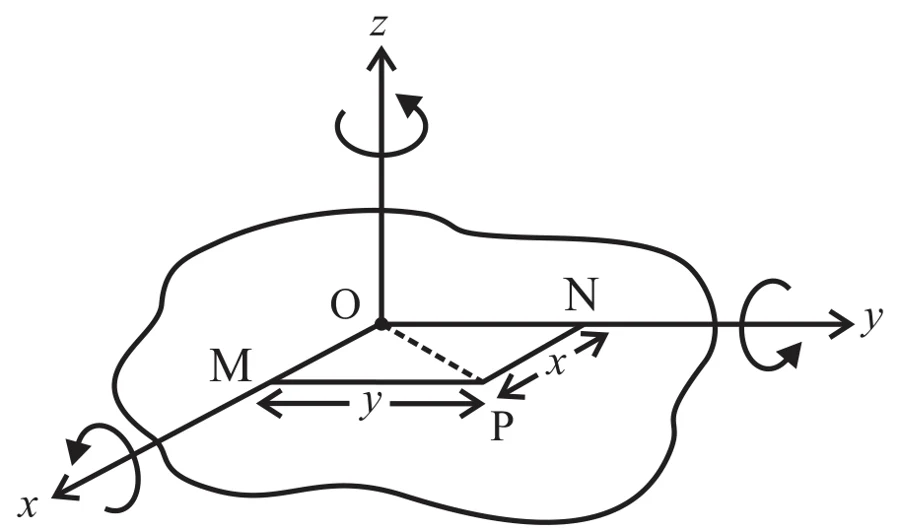
Fig. 1.16 · HSC Textbook · Theorem of perpendicular axes
→Statement: the M.I. of a laminar object about an axis perpendicular to its plane equals the sum of its M.I.s about two mutually perpendicular axes in its plane, all three axes being concurrent.
→Diagram: lamina, x and y axes in its plane, z axis ⟂, element dm at P(x, y).
→Distances of P from x, y, z axes: y, x, x² + y²
Ix = ∫y² dm
Iy = ∫x² dm
Iz = ∫(x² + y²) dm = ∫x² dm + ∫y² dm
= Ix + Iy
Q73 marks · HSC Textbook Example 1.7
A flywheel is in the form of a uniform 20 kg disc of diameter 50 cm, able to rotate about its own axis. Calculate its kinetic energy when rotating at 1200 rpm (use π² = 10). Calculate its moment of inertia, in case it is rotated about a tangent in its plane.
Solution
→Given: M = 20 kg
R = 0.25 m
n = 20 rps.
KE = 12Iω² = 12(12MR²)(4π²n²)
= π²MR²n² = 10 × 20 × 0.0625 × 400
= 5000 J
→Tangent in its plane (perpendicular + parallel axes): Id = 14MR²
IT = 14MR² + MR²
IT = 54 × 20 × 0.0625 = 1.5625 kg m²
→Answer: 5000 J; 1.5625 kg m²
Q83 marks · HSC Textbook Ex. 20
A big dumb-bell is prepared by using a uniform rod of mass 60 g and length 20 cm. Two identical solid thermocol spheres of mass 25 g and radius 10 cm each are at the two ends of the rod. Calculate moment of inertia of the dumb-bell when rotated about an axis passing through its centre and perpendicular to the length.
Solution
→Rod: I = ML²12 = 60 × 20²12
= 2000 g cm²
→Each sphere (centre 10 + 10 = 20 cm from the axis), parallel axes:
⅖mr² + md² = ⅖(25)(100) + 25(400) = 1000 + 10000
= 11000 g cm²
→Total: I = 2000 + 2 × 11000
→Answer: 24000 g cm²
Q94 marks · HSC Jul 2023 · SCERT Question Bank · LA 1
State and prove (explain) the theorem of parallel axes.
Solution
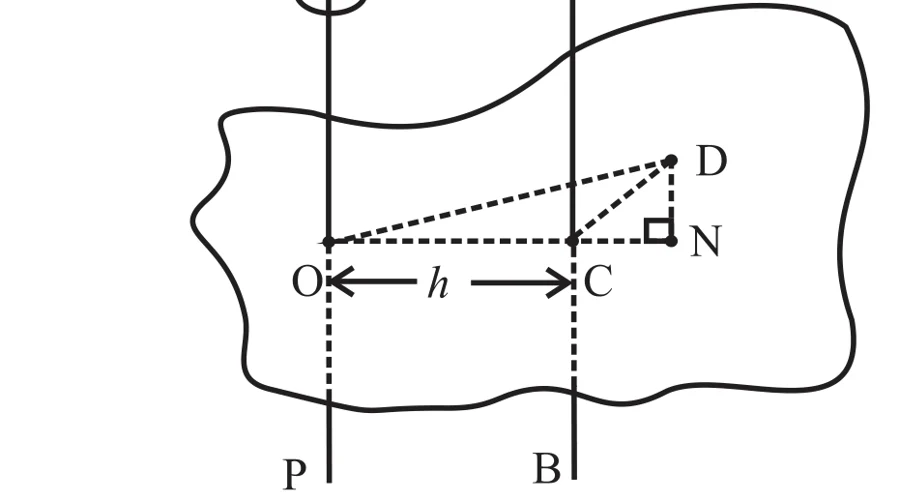
Fig. 1.15 · HSC Textbook · Theorem of parallel axes
→Statement: the M.I. of a body about any axis equals its M.I. about a parallel axis through its centre of mass plus the product of its mass and the square of the distance between the two axes.
→Diagram:
body with C (CM), parallel axis through O, CO = h; element dm at D, DN ⟂ OC produced.
IC = ∫(DC)² dm
IO = ∫(DO)² dm
(DO)² = (DN)² + (NC + CO)² = (DC)² + 2 NC·h + h²
IO = ∫(DC)² dm + 2h∫NC dm + h²∫dm
→Since C is the centre of mass, ∫NC dm = 0; ∫dm = M
IO = IC + Mh²
MHT CET corner
4 MHT CET questions on the same formulas
C1MHT CET 2026
The M.I. of a disc of mass m and radius R about an axis through its centre perpendicular to its plane is I₁; about a parallel axis at a distance 2R/3 from the centre it is I₂. Then I₁/I₂ is
(a)617(b)917(c)89(d)57
Solution
→I₂ = 12mR² + m4R²9 = 1718mR²
⇒ I₁I₂ = 917
→Answer: (b) 917
C2MHT CET 2026
The M.I. of a solid sphere about an axis through its centre is ⅖MR². Its radius of gyration about a parallel axis at a distance 2R from the first axis is
(a) 5R(b)225 R(c)5R2(d)125 R
Solution
→I = ⅖MR² + M(2R)² = 225MR²
= MK²
⇒ K = 225 R
→Answer: (b) 225 R
C3MHT CET 2026
The M.I. of a disc about any diameter is MR²/4. Its M.I. about an axis normal to the disc through a point on its edge is (x/2)MR². The value of x is
A diver in a swimming pool bends his head before diving. It _____.
(a) increases his linear velocity(b) decreases his angular velocity(c) increases his moment of inertia(d) decreases his moment of inertia
Solution
→Folding brings mass closer to the axis
⇒ I decreases (ω increases).
→Answer: (d)
Q21 mark · SCERT Question Bank · MCQ 2
The angular momentum of a system of particles is conserved _____.
(a) when no external force acts upon the system(b) when no external torque acts upon the system(c) when no external impulse acts upon the system(d) when axis of rotation remains the same
Solution
→dLdt = τext
L is constant when τext = 0.
→Answer: (b)
Q31 mark · HSC Feb 2025
The power rating of a ceiling fan rotating with a constant torque of 2 Nm with an angular speed of 2π rad/s will be _____.
(a) π W(b) 2π W(c) 3π W(d) 4π W
Solution
→P = τω = 2 × 2π
= 4π W
→Answer: (d)
Q41 mark · HSC Textbook Ex. 1(v)
Consider: (P) a planet revolving in an elliptical orbit, (Q) a planet revolving in a circular orbit. Principle of conservation of angular momentum comes in force in which of these?
(a) only for (P)(b) only for (Q)(c) for both (P) and (Q)(d) neither for (P) nor for (Q)
Solution
→Gravity on a planet acts along the line to the sun
⇒ torque about the sun is zero in both cases
⇒ L conserved for both.
→Answer: (c)
Q51 mark · HSC Jul 2022 · SCERT Question Bank · VSA 4
State the law (principle) of conservation of angular momentum.
Solution
→The angular momentum of a body (or system) remains constant if no external unbalanced torque acts on it.
Q61 mark · SCERT Question Bank · VSA 3
During ice ballet, while in the outer rounds, why do the dancers outstretch their arms and legs?
Solution
→Outstretching increases I; as Iω is constant, ω (and linear speed) decreases, which prevents slipping in the larger outer rounds.
Q71 mark · HSC Jul 2022
An automobile engine develops 62.84 kW while rotating at a speed of 1200 rpm. What torque does it deliver?
Solution
→ω = 2π × 20 = 125.68 rad/s
τ = Pω = 62840125.68
→Answer: 500 N m
Q82 marks · HSC Feb 2025 · HSC Feb 2023
State and prove the law (principle) of conservation of angular momentum.
Solution
→Statement: angular momentum of a body is conserved if no external unbalanced torque acts on it.
→Proof:L = r × p; differentiate:
dLdt = r × dpdt + drdt × p = r × F + v × mv
→v × v = 0 and r × F = τ
⇒ dLdt = τ
→If τ = 0
⇒ dLdt = 0
⇒ L = constant (I₁ω₁ = I₂ω₂).
Q92 marks · HSC Feb 2026 · HSC Textbook Example 1.9
A ceiling fan has moment of inertia of 2 kg m². It attains maximum frequency of 60 r.p.m. in 2π seconds. Calculate its power rating.
Note: HSC Textbook Example 1.9 takes 60 rpm as 2 rps and prints 16π W ≈ 50 W; 60 rpm is 1 rps, so the power is 4π W.
Solution
→Given: I = 2 kg m²
n = 60 rpm = 1 rps
⇒ ω = 2π rad/s
t = 2π s.
→Formula: α = ω − ω₀t
τ = Iα
P = τω
→Substitution: α = 2π2π = 1 rad/s²
⇒ τ = 2 N m
⇒ P = 2 × 2π
→Answer: P = 4π W ≈ 12.6 W
Note: HSC Textbook Example 1.9 takes 60 rpm as 2 rps and prints 16π W ≈ 50 W; 60 rpm is 1 rps, so the power is 4π W.
Q102 marks · SCERT Question Bank · SA-I 1
A flywheel is revolving with a constant angular velocity. A chip of its rim breaks and flies away. What will be the effect on its angular velocity?
Solution
→no external torque acts, so the angular momentum of (wheel + chip) is conserved.
→the chip leaves tangentially carrying its own angular momentum (mr²ω) with it; the force at breaking is internal and gives no torque on the rest of the wheel.
→the remaining wheel keeps L′ = I′ω, so its angular velocity remains the same (its M.I. and L both decrease).
Q113 marks · SCERT Question Bank · SA-II 4 · HSC Textbook Ex. 7
Obtain (derive) an expression for the angular momentum of a body rotating with uniform angular velocity (relating angular momentum with angular velocity).
Solution
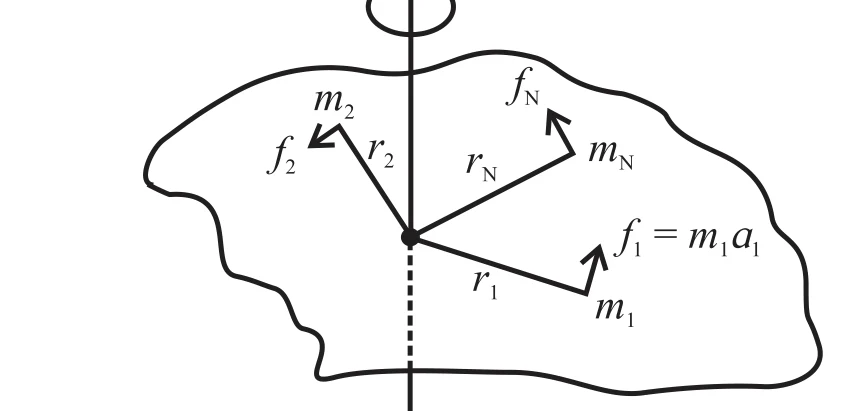
Fig. 1.12 · HSC Textbook · A body of N particles
→Diagram: rigid body; particles m₁, m₂, … at r₁, r₂, … from the axis; same ω.
→linear momentum of particle 1: p₁ = m₁v₁ = m₁r₁ω, perpendicular to r₁
L₁ = p₁r₁ = m₁r₁²ω
→all L’s are along the axis (right-hand rule)
⇒ add:
L = (m₁r₁² + m₂r₂² + … + mNrN²)ω = Iω
→L = Iω is like p = mv; I plays the role of mass.
Q123 marks · SCERT Question Bank · SA-II 2 · HSC Textbook Ex. 8
Obtain an expression for the torque acting on a rotating body with constant angular acceleration (relating torque with angular acceleration).
Solution
Fig. 1.17 · HSC Textbook · Rigid rotating object
→Diagram: rigid body rotating with constant α; particle m₁ at r₁.
→tangential acceleration a₁ = r₁α
⇒ force f₁ = m₁r₁α
τ₁ = f₁r₁ = m₁r₁²α
→all torques are along the axis
⇒ add:
τ = (m₁r₁² + m₂r₂² + … + mNrN²)α = Iα
→τ = Iα is like F = ma.
Q133 marks · HSC Textbook Ex. 9
State and explain the principle of conservation of angular momentum. Use a suitable illustration. Do we use it in our daily life? When?
Solution
→Statement: L of a body is conserved if no external unbalanced torque acts on it.
→Explanation:dLdt = τ
τ = 0
⇒ L = Iω = constant
⇒ if I increases, ω decreases and vice versa (I₁ω₁ = I₂ω₂).
→Illustration: a diver folds the body after leaving the board (I ↓, ω ↑, more somersaults) and stretches before entering the water; ballet dancers pull arms in to spin faster.
→Daily life: yes – a person on a rotating stool or chair spins faster on pulling the arms in; a cyclist/skater uses it while turning.
Q143 marks · HSC Feb 2025
A flywheel of a motor has mass 100 kg and radius 1.5 m. The motor develops a constant torque of 2000 Nm. The flywheel starts rotating from rest. Calculate the work done during the first 4 revolutions.
Solution
→Given: τ = 2000 N m
θ = 4 rev = 8π rad.
→Formula: W = τθ
→Substitution:
W = 2000 × 8π = 16000π J (mass and radius are not needed)
→Answer: W = 5.03 × 10⁴ J
Q153 marks · SCERT Question Bank · SA-II 6
A flywheel of mass 8 kg and radius 10 cm rotating with a uniform angular speed of 5 rad/s about its axis of rotation, is subjected to an accelerating torque of 0.01 Nm for 10 seconds. Calculate the change in its angular momentum and change in its kinetic energy.
Solution
→Change in L: ΔL = τt = 0.01 × 10
= 0.1 kg m²/s
→M.I. (disc): I = 12MR² = 12 × 8 × 0.01
= 0.04 kg m²
ω₂ = ω₁ + ΔLI = 5 + 2.5
= 7.5 rad/s
ΔKE = 12I(ω₂² − ω₁²) = 12 × 0.04 × (56.25 − 25)
= 0.625 J
→Answer: 0.1 kg m²/s; 0.625 J
Q163 marks · SCERT Question Bank · SA-II 7
Two wheels of moment of inertia 4 kg m² rotate side by side at the rate of 120 rev/min and 240 rev/min respectively in the opposite directions. If now both the wheels are coupled by means of a weightless shaft so that both the wheels rotate with a common angular speed, calculate the new speed of rotation.
Solution
→Principle: no external torque
⇒ total angular momentum conserved (take the 240 rpm sense positive).
I(240) − I(120) = (I + I) n
→n = 4(240 − 120)8
→Answer: n = 60 rpm (in the sense of the faster wheel)
Q173 marks · HSC Textbook Ex. 21
A flywheel used to prepare earthenware pots is set into rotation at 100 rpm. It is in the form of a disc of mass 10 kg and radius 0.4 m. A lump of clay (to be taken equivalent to a particle) of mass 1.6 kg falls on it and adheres to it at a certain distance x from the centre. Calculate x if the wheel now rotates at 80 rpm.
Solution
→M.I.: I₁ = 12 × 10 × 0.16 = 0.8 kg m²
I₂ = 0.8 + 1.6x²
→Conservation: I₁n₁ = I₂n₂
0.8 × 100 = (0.8 + 1.6x²) × 80
⇒ 1.6x² = 0.2
⇒ x² = 18
→Answer: x = 1/√8 m = 0.35 m
Q183 marks · HSC Textbook Example 1.8
A spherical water balloon is rotating at 60 rpm. In the course of time, 48.8% of its water leaks out. With what frequency will the remaining balloon rotate now? Neglect all non-conservative forces.
Solution
→Mass ratio:m₁m₂ = 10051.2
⇒ R₁R₂ = (m₁m₂)1/3 = 10.8
= 1.25
→M.I. (sphere, I ∝ mR²): I₁I₂ = (m₁m₂)(R₁R₂)² = (1.25)⁵
→Conservation: I₁n₁ = I₂n₂
⇒ n₂ = (1.25)⁵ × 1 rps
→Answer: n₂ = 3.052 rps
MHT CET corner
4 MHT CET questions on the same formulas
C1MHT CET 2026
A solid sphere rotates about a diameter with angular velocity ω. If it cools so that its radius becomes 1/n of its original value, its angular velocity becomes
(a)ωn(b)ωn²(c) nω(d) n²ω
Solution
→No external torque
⇒ Iω constant
→I ∝ R² falls by n²
⇒ ω becomes n²ω
→Answer: (d) n²ω
C2MHT CET 2026
A kathak dancer rotating with folded hands has kinetic energy K. She stretches her arms so that her M.I. becomes three times and her angular velocity one-third. Her kinetic energy now is
(a)K6(b)K3(c) K(d) 3K
Solution
→KE = 12Iω²
⇒ new KE = 12(3I)(ω3)² = K3
→Answer: (b) K3
C3MHT CET 2026
A disc of radius 0.4 m and mass 1 kg rotates about an axis through its centre perpendicular to its plane with angular acceleration 10 rad/s². The tangential force applied at the rim is
(a) 1 N(b) 2 N(c) 3 N(d) 4 N
Solution
→I = 12MR² = 0.08 kg m²
τ = Iα = 0.8 N m;
→F = τR = 0.80.4
= 2 N
→Answer: (b) 2 N
C4MHT CET 2025
The same torque is applied to a disc and a ring of equal mass and radius. Then
(a) the ring rotates with greater angular frequency(b) both rotate with the same angular frequency(c) the disc rotates with greater angular frequency(d) both rotate with the same angular velocity
Solution
→α = τI and Idisc = 12MR² <
→Iring = MR²
⇒ the disc gains angular speed faster
→Answer: (c) the disc rotates with greater angular frequency
A thin walled hollow cylinder is rolling down an incline, without slipping. At any instant, the ratio “Rotational K.E. : Translational K.E. : Total K.E.” is _____.
Q21 mark · Expected question · based on HSC Textbook 1.11
What percentage of the kinetic energy of a rolling solid sphere is translational?
Solution
→K²R² = ⅖
⇒ trans : total = 1 : 75
⇒ 57 × 100
→Answer: ≈ 71.4%
Q32 marks · Expected question · based on HSC Textbook 1.11.1
A ring, a disc and a solid sphere of the same mass and radius roll down the same incline from rest. Which reaches the bottom first? Why?
Solution
→a = g sin θ1 + K²/R² – smaller K²R² gives larger acceleration.
→K²R² = ⅖ (sphere), 12 (disc), 1 (ring).
→order: solid sphere, then disc, then ring – independent of mass and radius.
→Answer: solid sphere
Q43 marks · HSC Textbook Ex. 10
Discuss the interlink between translational, rotational and total kinetic energies of a rigid object that rolls without slipping.
Solution
→rolling = translation of the CM with speed v + rotation about the CM with ω = vR.
KEtrans = 12Mv²
KErot = 12Iω² = 12MK²v²R²
KEtotal = 12Mv²(1 + K²R²)
→trans : rot : total = 1 : K²R² : (1 + K²R²)
→Example: hollow sphere (K²/R² = 23)
⇒ 3 : 2 : 5
⇒ 60% translational, 40% rotational.
Q53 marks · HSC Textbook Ex. 22
Starting from rest, an object rolls down along an incline that rises by 3 units in every 5 units (along it). The object gains a speed of √10 m/s as it travels a distance of 5/3 m along the incline. What can be the possible shape(s) of the object?
Solution
→Height fallen: sin θ = 35
⇒ h = s sin θ = 53 × 35
= 1 m
→Formula: v² = 2gh1 + K²/R²
→Substitution: 10 = 2 × 10 × 11 + K²/R²
⇒ 1 + K²R² = 2
⇒ K²R² = 1
→Answer: a ring or a hollow cylinder
Q64 marks · HSC Textbook Ex. 11
A rigid object is rolling down an inclined plane. Derive expressions for the acceleration along the track and the speed after falling through a certain vertical distance.
Solution
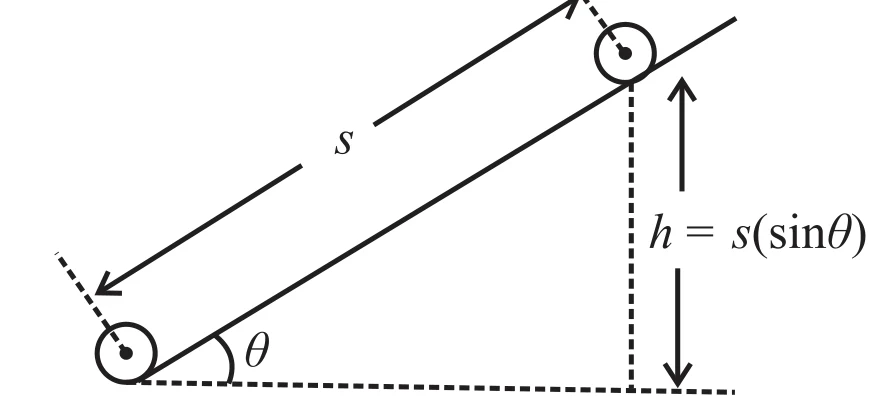
Fig. 1.18 · HSC Textbook · Rolling along an incline
→Diagram: body of mass M, radius R (I = MK²) on an incline of angle θ; it falls through height h.
→Energy: loss of PE = gain in rolling KE
Mgh = 12Mv²(1 + K²R²)
⇒ v = 2gh1 + K²/R²
→Acceleration:
distance along the incline s = hsin θ
v² = 2as
a = v²2s = g sin θ1 + K²/R²
→Conclusion:
without rolling (frictionless sliding) a = g sin θ, v = 2gh; rolling reduces both by the factor (1 + K²/R²).
MHT CET corner
4 MHT CET questions on the same formulas
C1MHT CET 2026
A solid sphere rolls without slipping on an inclined plane. The ratio of its total kinetic energy to its rotational kinetic energy is
(a)52(b)72(c)54(d)57
Solution
→Solid sphere: trans : rot : total = 5 : 2 : 7
⇒ totalrot = 72
→Answer: (b) 72
C2MHT CET 2025
A solid sphere at rest rolls down an incline of vertical height h without sliding. Its speed at the bottom is
A solid sphere reaches the bottom of an incline with speed V₁ when rolling, and V₂ when sliding (no friction) from the same height. The ratio V₁ : V₂ is
(a)7 : 5(b)7 : 3(c)3 : 5(d)5 : 7
Solution
→V₁ = 10gh7
V₂ = 2gh
⇒ V₁V₂ = 57
→Answer: (d) 5 : 7
C4MHT CET 2026
A solid cylinder and a solid sphere of the same mass and radius roll down the same incline. The ratio of the acceleration of the cylinder to that of the sphere is