0 of 37 attemptedPick an answer to see the solution
Q1MHT CET 2026 · 14 MAY · SHIFT 2Easy
Charge Sharing & Loss of Energy · Common potential
A capacitor of 20μF is charged up to 500 V is connected in parallel with another capacitor of 10μF which is charged up to 200 V. Then, the common potential will be
Charge Sharing & Loss of Energy · Common potential
A condenser of capacity C1 is charged to potential V1 and then disconnected. Uncharged capacitor of capacity C2 is connected in parallel with C1. The resultant potential V2 is
Charge Sharing & Loss of Energy · Common potential
A capacitor P with capacitance 10×10−6 F is fully charged with a potential difference of 6.0 V and disconnected from the battery. The charged capacitor P is connected across another capacitor Q with capacitance 20×10−6 F. The charge on capacitor Q when equilibrium is established will be α×10−5 C (assume capacitor Q does not have any charge initially), the value of α is ______.
Numerical answer type. Work it out, then open the answer.
Charge Sharing & Loss of Energy · Energy loss on sharing
Consider two uncharged capacitors of equal capacitance 200 pF. One of them is charged by a 100 V supply and disconnected. Now this capacitor is connected to the uncharged capacitor. The amount of electrostatic energy lost in the process is:
Charge Sharing & Loss of Energy · Energy loss on sharing
A sphere of capacitance 100 pF is charged to a potential of 100 V. Another identical uncharged metal sphere is brought in contact with the charged sphere, then the change in the total energy stored on these spheres, when they touch is α×10−7 J. The value of α is ______. (combined capacitance of spheres is 200 pF)
Charge Sharing & Loss of Energy · Reverse-polarity joining
A parallel plate capacitor of capacitance 'C' is connected to a battery and charged to a potential 'V'. Another capacitor of capacitance '3C' is charged to a potential '3V'. The charging battery is then disconnected and both the capacitors are connected in parallel to each other such that positive terminal of one is connected to negative terminal of the other. The final energy of the configuration is
Charge Sharing & Loss of Energy · Common potential
Two capacitors of 100μF and 50μF are connected in parallel. If the potential difference across 100μF is 20 V and across 50μF is 40 V, then the common potential of the parallel combination will be (same polarities of the capacitor connected together)
Charge Sharing & Loss of Energy · Common potential
Using a battery, a 100 pF capacitor is charged to 60 V and then the battery is removed. After that, a second uncharged capacitor is connected to the first capacitor in parallel. If the final voltage across the second capacitor is 20 V, its capacitance is: (in pF)
Charge Sharing & Loss of Energy · Common potential
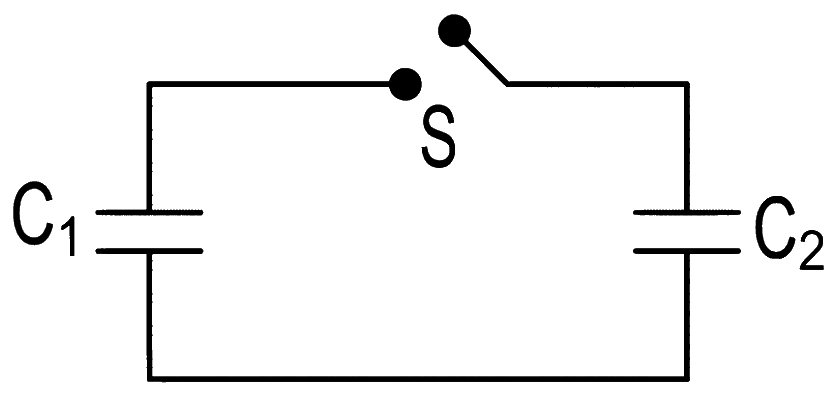
A capacitor, C1=6μF is charged to a potential difference of V0=5 V using a 5V battery. The battery is removed and another capacitor, C2=12μF is inserted in place of the battery. When the switch 'S' is closed, the charge flows between the capacitors for some time until equilibrium condition is reached. What are the charges (q1 and q2) on the capacitors C1 and C2 when equilibrium condition is reached.
Charge Sharing & Loss of Energy · Energy loss on sharing
A capacitor of capacitance C and potential V has energy E. It is connected to another capacitor of capacitance 2C and potential 2V. Then the loss of energy is 3xE, where x is _______.
Numerical answer type. Work it out, then open the answer.
Charge Sharing & Loss of Energy · Reverse-polarity joining
Two identical capacitors have the same capacitance ' C '. One of them is charged to potential V1 and other to V2. The negative ends of capacitors are connected together. When positive ends are also connected, the decrease in energy of the combined system is
Charge Sharing & Loss of Energy · Reverse-polarity joining
A parallel plate capacitor of capacitance ' C ' is connected to a battery and charged to a potential difference ' V '. Another capacitor of capacitance 3 C is similarly charged to a potential difference 3 V. The charging battery is then disconnected and capacitors are connected in parallel to each other in such a way that positive terminal of one is connected to the negative terminal of the other. The final energy of the configuration is
Charge Sharing & Loss of Energy · Reverse-polarity joining
Two identical capacitors have same capacitance C. One of them is charged to the potential V and other to the potential 2 V. The negative ends of both are connected together. When the positive ends are also joined together, the decrease in energy of the combined system is:
Charge Sharing & Loss of Energy · Energy loss on sharing
A parallel plate capacitor of capacitance 2 F is charged to a potential V, The energy stored in the capacitor is E1. The capacitor is now connected to another uncharged identical capacitor in parallel combination. The energy stored in the combination is E2. The ratio E2/E1 is:
Charge Sharing & Loss of Energy · Energy loss on sharing
A 600 pF capacitor is charged by 200 V supply. It is then disconnected from the supply and is connected to another uncharged 600 pF capacitor. Electrostatic energy lost in the process is ____________ μJ
Numerical answer type. Work it out, then open the answer.
Charge Sharing & Loss of Energy · Reverse-polarity joining
Two identical capacitors have the same capacitance 'C'. One of them is charged to a potential V1 and the other to V2. The negative ends of the capacitors are connected together. When the positive ends are also connected, the decrease in energy of the combined system is
Charge Sharing & Loss of Energy · Reverse-polarity joining
A capacitor of capacitance 900μF is charged by a 100 V battery. The capacitor is disconnected from the battery and connected to another uncharged identical capacitor such that one plate of uncharged capacitor connected to positive plate and another plate of uncharged capacitor connected to negative plate of the charged capacitor. The loss of energy in this process is measured as x×10−2 J. The value of x is _____________.
Numerical answer type. Work it out, then open the answer.
Charge Sharing & Loss of Energy · Common potential
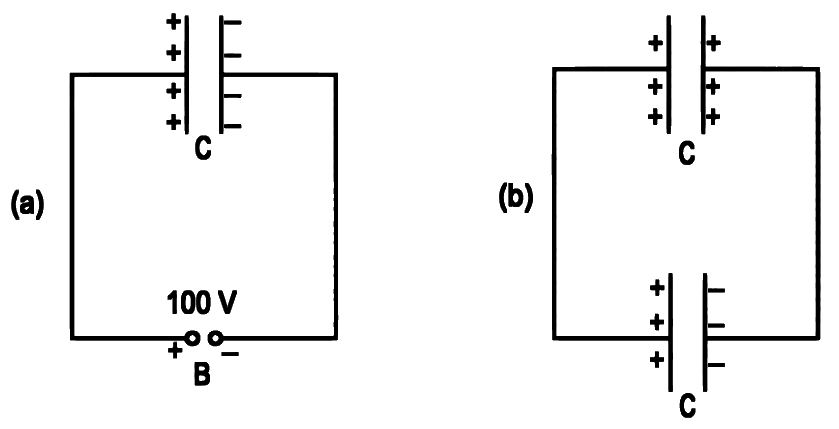
A capacitor of capacitance C = 900 pF is charged fully by 100 V battery B as shown in figure (a). Then it is disconnected from the battery and connected to another uncharged capacitor of capacitance C = 900 pF as shown in figure (b). The electrostatic energy stored by the system (b) is
Charge Sharing & Loss of Energy · Energy loss on sharing
A capacitor of capacitance 50 pF is charged by 100 V source. It is then connected to another uncharged identical capacitor. Electrostatic energy loss in the process is ___________ nJ.
Numerical answer type. Work it out, then open the answer.
Charge Sharing & Loss of Energy · Common potential
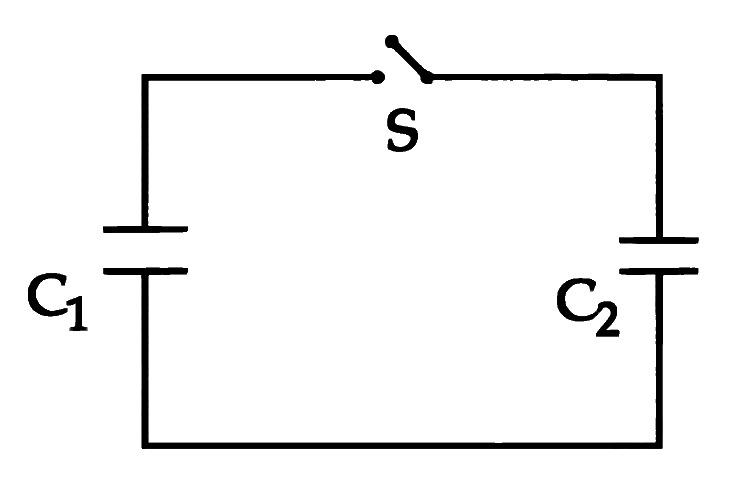
Two capacitors having capacitance C1 and C2 respectively are connected as shown in figure. Initially, capacitor C1 is charged to a potential difference V volt by a battery. The battery is then removed and the charged capacitor C1 is now connected to uncharged capacitor C2 by closing the switch S. The amount of charge on the capacitor C2, after equilibrium, is:
Charge Sharing & Loss of Energy · Common potential
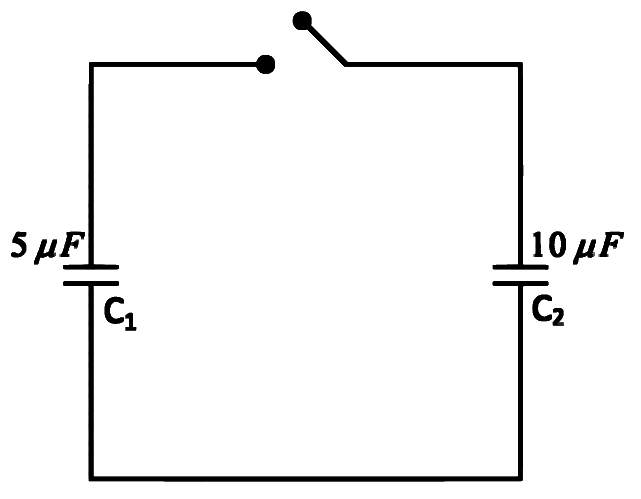
A capacitor C1 of capacitance 5 μF is charged to a potential of 30 V using a battery. The battery is then removed and the charged capacitor is connected to an uncharged capacitor C2 of capacitance 10 μF as shown in figure. When the switch is closed charge flows between the capacitors. At equilibrium, the charge on the capacitor C2 is __________ μC.
Numerical answer type. Work it out, then open the answer.
Charge Sharing & Loss of Energy · Common potential
A condenser of capacity 'C1' is charged to potential 'V1 ' and then disconnected. Uncharged capacitor of capacity 'C2' is connected in parallel with 'C1'. The resultant potential 'V2' is
Charge Sharing & Loss of Energy · Common potential
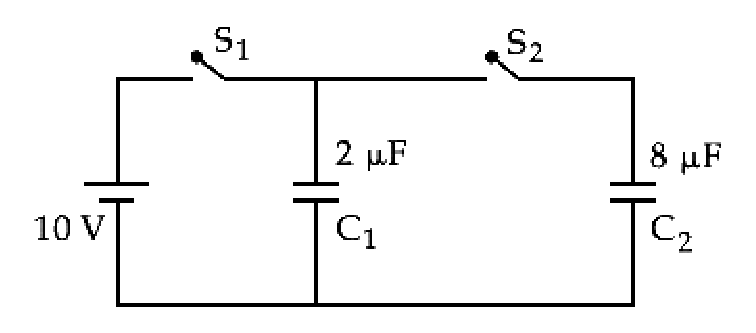
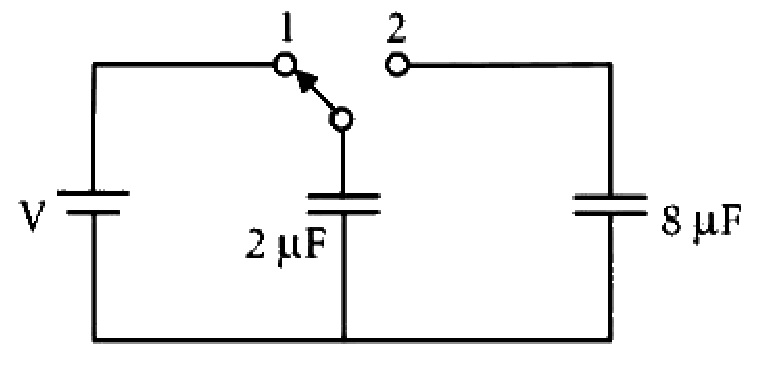
A 2μF capacitor C1 is first charged to a potential difference of 10V using a battery. Then the battery is removed and the capacitor is connected to an uncharged capacitor C2 of 8 μF. The charge in C2 on equilibrium condition is ____________ μC. (Round off to the Nearest Integer)
Numerical answer type. Work it out, then open the answer.
Charge Sharing & Loss of Energy · Reverse-polarity joining
Two identical capacitors have the same capacitance 'C'. One of them is charged to potential 'V1' and the other to V2. The negative ends of the capacitors are connected together. When positive ends are also connected, the decrease in energy of the combined system is
Charge Sharing & Loss of Energy · Common potential
A 10 μF capacitor is fully charged to a potential difference of 50 V. After removing the source voltage it is connected to an uncharged capacitor in parallel. Now the potential difference across them becomes 20 V. The capacitance of the second capacitor is:
Charge Sharing & Loss of Energy · Energy loss on sharing
A capacitor C is fully charged with voltage V0. After disconnecting the voltage source, it is connected in parallel with another uncharged capacitor of capacitance 2C. The energy loss in the process after the charge is distributed between the two capacitors is:
Charge Sharing & Loss of Energy · Energy loss on sharing
A 60 pF capacitor is fully charged by a 20 V supply. It is then disconnected from the supply and is conneced to another uncharged 60 pF capacitor in parallel. The electrostatic energy that is lost in this process by the time the charge is redistributed between them is (in nJ) _____
Numerical answer type. Work it out, then open the answer.
Charge Sharing & Loss of Energy · Energy loss on sharing
A 5 μF capacitor is charged fully by a 220 V supply. It is then disconnected from the supply and is connected in series to another uncharged 2.5 μF capacitor. If the energy change during the charge redistribution is 100X J then value of X to the nearest integer is _____.
Numerical answer type. Work it out, then open the answer.
Charge Sharing & Loss of Energy · Reverse-polarity joining
Two capacitors of capacitances C and 2C are charged to potential differences V and 2V, respectively. These are then connected in parallel in such a manner that the positive terminal of one is connected to the negative terminal of the other. The final energy of this configuration is:
Charge Sharing & Loss of Energy · Energy loss on sharing
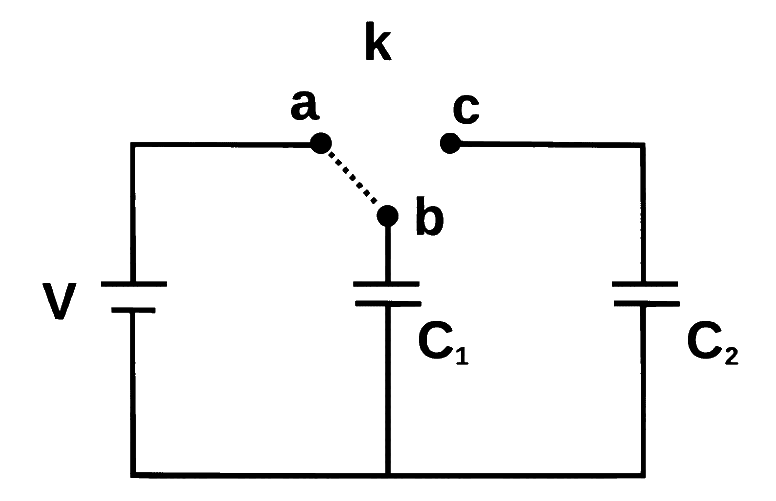
Two identical capacitors C1 and C2 of equal capacitance are connected as shown in the circuit. Terminals a and b of the key k are connected to charge capacitor C1 using battery of emf V volt. Now disconnecting a and b the terminals b and c are connected. Due to this, what will be the percentage loss of energy?
Charge Sharing & Loss of Energy · Energy loss on sharing
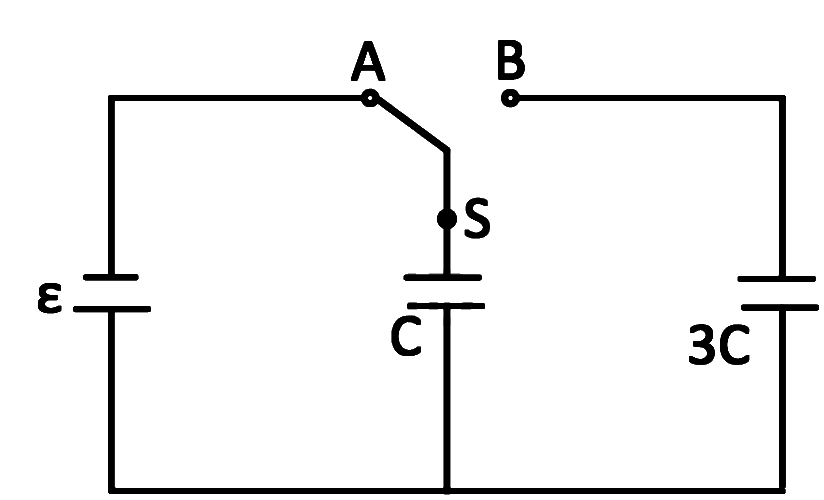
In the figure shown, after the switch 'S' is turned from position 'A' to position 'B', the energy dissipated in the circuit in terms of capacitance 'C' and total charge 'Q' is:
Charge Sharing & Loss of Energy · Common potential
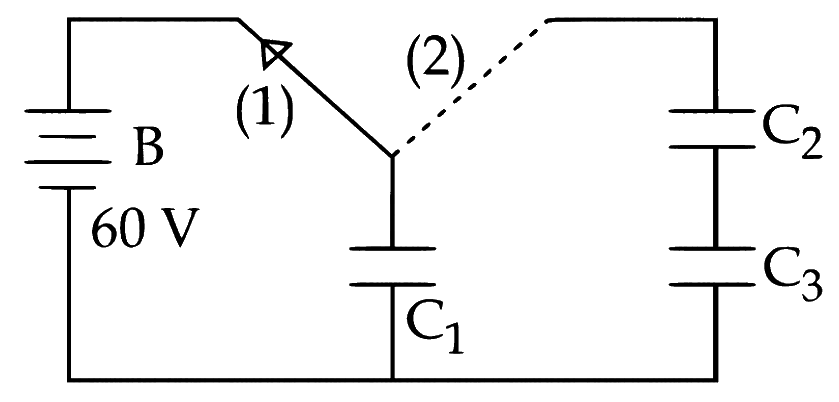
A capacitor C1 = 1.0 μF is charged up to a voltage V = 60 V by connecting it to battery B through switch (1). Now C1 is disconnected from battery and connected to a circuit consisting of two uncharged capacitors C2=3.0μF and C3 = 6.0 μF through switch (2), as shown in the figure. The sum of final charges on C2 and C3 is:
Charge Sharing & Loss of Energy · Energy loss on sharing
A capacitor is charged by a battery. The battery is removed and another identical uncharged capacitor is connected in parallel. The total electrostatic energy of resulting system
Charge Sharing & Loss of Energy · Reverse-polarity joining
Two capacitors C1 and C2 are charged to 120 V and 200 V respectively. It is found that connecting them together the potential on each one can be made zero. Then
Charge Sharing & Loss of Energy · Common potential
A capacitor of capacity C1 charged upto V volt and then connected to an uncharged capacitor of capacity C2. The final potential difference across each will be
Charge Sharing & Loss of Energy · Energy loss on sharing
A capacitor is charged with a battery and energy stored is U. After disconnecting battery another capacitor of same capacity is connected in parallel to the first capacitor. Then energy stored in each capacitor is