
Types of Flow, Reynolds Number & Continuity
In case of liquid, if Reynold's number '' is , then the flow of liquid will
Show answer and solution
Answer: (c)
Loading the solution…
Home›Practice Hub›Chapters›Fluid Dynamics›Types of Flow, Reynolds Number & Continuity
Fluid Dynamics PYQs · MHT CET · JEE Main · NEET
Types of Flow, Reynolds Number & Continuity
In case of liquid, if Reynold's number '' is , then the flow of liquid will
Answer: (c)
Types of Flow, Reynolds Number & Continuity
In case of fluid flowing on horizontal surface the flow of fluid becomes unsteady when Reynolds number (Rn) is
Answer: (d)
Types of Flow, Reynolds Number & Continuity
An in-compressible fluid flows steadily through a horizontal cylindrical pipe. The pipe has radius '' at point A and '' at point B, further along the flow direction at the same level. If the velocity at point A is '', then that at point B is
Answer: (d)
Types of Flow, Reynolds Number & Continuity
Water flows through a horizontal pipe at a speed 'V'. Internal diameter of the pipe is 'd'. If the water is emerging at a speed ' ' then the diameter of the nozzle is
______
Answer: (a)
Types of Flow, Reynolds Number & Continuity
A water spray gun is attached to a hose of cross sectional area . The gun comprises of 10 perforations each of cross sectional area of . If the water flows in the hose with the speed of , calculate the speed at which the water flows out from each perforation. (Neglect any edge effects)
Answer: (b)
Types of Flow, Reynolds Number & Continuity
Water flows through a horizontal pipe of varying cross-section at the rate of . The velocity of water at a point where the radius of the pipe is 10 cm is
Answer: (c)
Types of Flow, Reynolds Number & Continuity
An incompressible fluid flows steadily through a cylindrical pipe having radius R at point A and at point B further along the direction of flow of liquid. If the velocity at point A is ' V ' then that at point B is
Answer: (d)
Types of Flow, Reynolds Number & Continuity
Select the WRONG statement from the following. In a streamline flow
Answer: (a)
Types of Flow, Reynolds Number & Continuity
A fluid of density '' is flowing through a uniform tube of diameter ''. The coefficient of viscosity of the fluid is '', then critical velocity of the fluid is
Answer: (b)
Types of Flow, Reynolds Number & Continuity
A fluid of density '' and viscosity '' is flowing through a pipe of diameter '', with a velocity ''. Reynold number is
Answer: (b)
Types of Flow, Reynolds Number & Continuity
Water flows through a horizontal pipe at a speed ''. Internal diameter of the pipe is ''. If the water is coming out at a speed '' then the diameter of the nozzle is
Answer: (b)
Types of Flow, Reynolds Number & Continuity
If is the density and is coefficient of viscosity of fluid which flows with a speed v in the pipe of diameter d, the correct formula for Reynolds number Re is:
Answer: (c)
Types of Flow, Reynolds Number & Continuity
A pressure-pump has a horizontal tube of cross sectional area for the outflow of water at a speed of . The force exerted on the vertical wall just in front of the tube which stops water horizontally flowing out of the tube, is:
[given: density of water ]
Answer: (d)
Types of Flow, Reynolds Number & Continuity
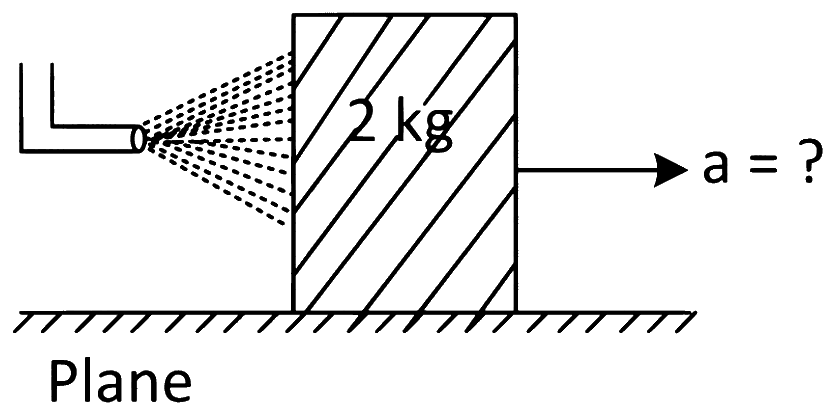
A block of metal weighing 2 kg is resting on a frictionless plane (as shown in figure). It is struck by a jet releasing water at a rate of 1 kgs and at a speed of 10 ms. Then, the initial acceleration of the block, in ms, will be:
Answer: (c)
Types of Flow, Reynolds Number & Continuity
A glass tube of uniform cross-section is connected to a tap with a rubber tube. The tap is opened slowly. Initially the flow of water in the tube is streamline. The speed of flow of water to convert it into a turbulent flow is [radius of tube and density of water ]
Answer: (b)
Types of Flow, Reynolds Number & Continuity
What will be the nature of flow of water from a circular tap, when its flow rate increased from 0.18 L/min to 0.48 L/min? The radius of the tap and viscosity of water are 0.5 cm and 103 Pa s, respectively. (Density of water: 103 kg/m3)
Answer: (a)
Types of Flow, Reynolds Number & Continuity
An ideal fluid flows (laminar flow) through a pipe of non-uniform diameter. The maximum and minimum diameters of the pipes are 6.4 cm and 4.8 cm, respectively. The ratio of the minimum and the maximum velocities of fluid in this pipe is:
Answer: (b)
Types of Flow, Reynolds Number & Continuity
Water from a pipe is coming at a rate of 100 litres per minute. If the radius of the pipe is 5 cm, the Reynolds number for the flow is of the order of: (density of water = 1000 kg/m3, coefficient of viscosity of water = 1mPas)
Answer: (b)
Types of Flow, Reynolds Number & Continuity
Water from a tap emerges vertically downwards with an initial speed of 1.0 ms–1. The cross- sectional area of the tap is 10–4 m2. Assume that the pressure is constant throughout the stream of water and that the flow is streamlined. The cross-sectional area of the stream, 0.15 m below the tap would be: (Take g = 10 ms–2)
Answer: (c)
Types of Flow, Reynolds Number & Continuity
A liquid of density is coming out of a hose pipe of radius a with horizontal speed and hits a mesh. 50% of the liquid passes through the mesh unaffected. 25% looses all of its momentum and 25% comes back with the same speed. The resultant pressure on the mesh will be:
Answer: (a)
Types of Flow, Reynolds Number & Continuity
If it takes 5 minutes to fill a 15 litre bucket from a water tap of diameter cm then the Reynolds number for the flow is (density of water = 103 kg/m3 and viscosity of water = 103 Pa.s) close to:
Answer: (a)
Types of Flow, Reynolds Number & Continuity
Water is flowing continuously from a tap having an internal diameter The water velocity as it leaves the tap is . The diameter of the water stream at a distance below the tap is close to:
Answer: (c)
No questions match these filters.