A water tank of height ’h’ has a hole at the bottom. It is completely filled with water. The total pressure at the bottom is 4H and atmospheric pressure is H. The velocity of water flowing out of the hole is (ρ = density of water)
The surface of water in a water tank of cross-section area 750 cm2 on the top of a house is h m above the tap level. The speed of water coming out through the tap of cross-section area 500 mm2 is 30 cm/s. At that instant, dh/dt is y×10−3 m/s. The value of y will be
A cylindrical vessel of 40 cm radius is completely filled with water and its capacity is 528 dm3 (dm: decimeter) The vessel is placed on a solid block of exactly same height as vessel. If a small hole is made at 70 cm below the top of water level, then horizontal range of water falling on the ground in the beginning is ______ cm.
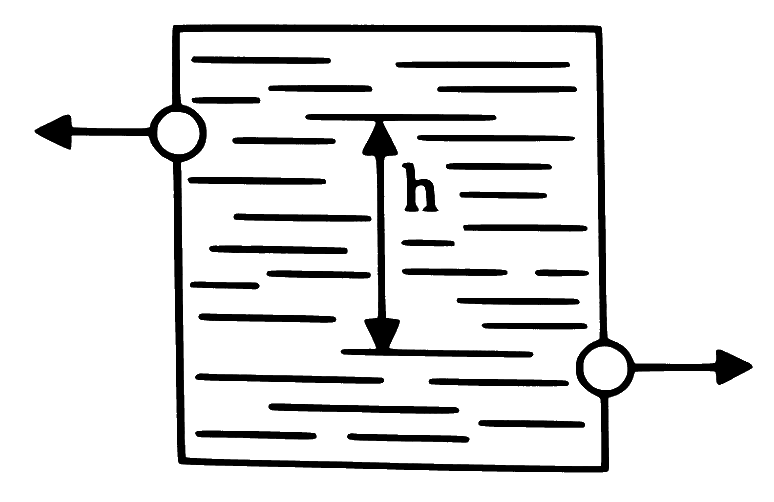
On opposite sides of a wide vertical vessel filled with water (density ρ), two identical holes are drilled, each having cross-section area A. The height difference between holes is x. The resultant force of reaction of water flowing out of vessel is (g = acceleration due to gravity)
A vessel completely filled with water has two holes ' P ' and ' Q ' at depths ' 2 h ' and ' 8 h ' from the top respectively. Hole ' P ' is square of side ' a ' and hole ' Q ' is a circle of radius ' r '. The water flowing out per second from both the holes is same, then side ' a ' of hole ' P ' is
There are two identical small holes on the opposite side of a tank containing full of a liquid. The tank is open at the top. The difference in height between the two holes is ' h '. As the liquid comes out of the two holes, the tank will experience a net horizontal force proportional to
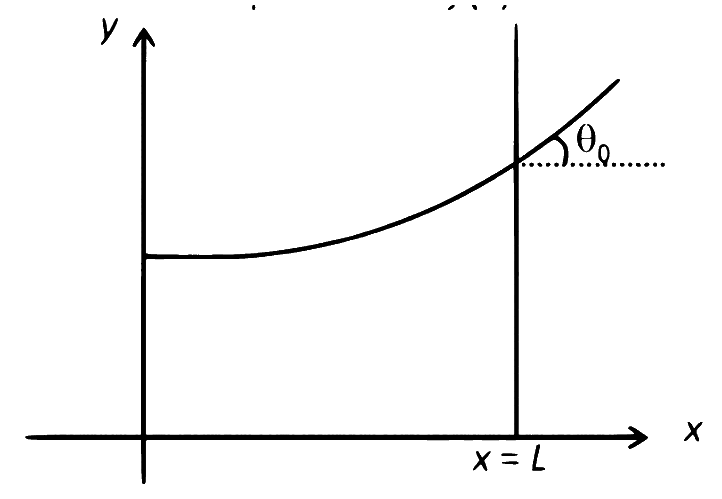
Consider a water tank shown in the figure. It has one wall at x=L and can be taken to be very wide in the z direction. When filled with a liquid of surface tension S and density ρ, the liquid surface makes angle θ0(θ0≪1) with the x-axis at x=L. If y(x) is the height of the surface then the equation for y(x) is:
(take θ(x)=sinθ(x)=tanθ(x)=dxdy,g is the acceleration due to gravity)
Consider a completely full cylindrical water tank of height 1.6 m and of cross-sectional area 0.5 m2. It has a small hole in its side at a height 90 cm from the bottom. Assume, the cross-sectional area of the hole to be negligibly small as compared to that of the water tank. If a load 50 kg is applied at the top surface of the water in the tank then the velocity of the water coming out at the instant when the hole is opened is:
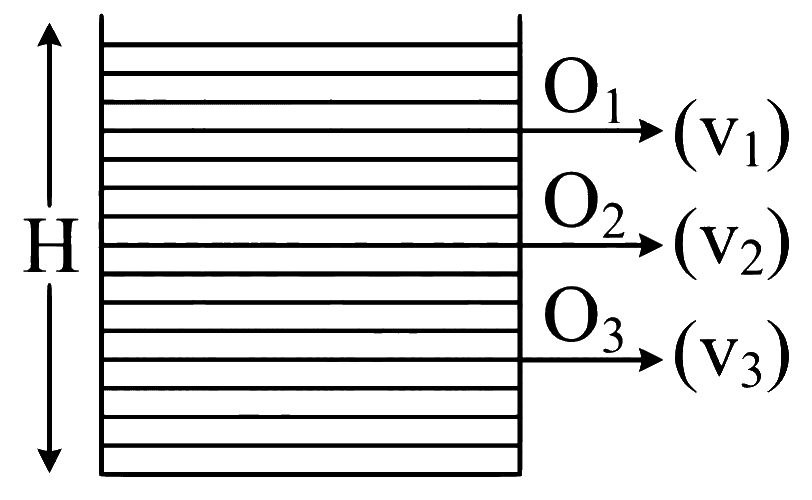
A cylinder contains water upto a height ' H '. It has three orifices O1,O2,O3 as shown in the figure. Let V1,V2,V3 be the speed of efflux of water from the three orifices. Then
A completely filled water tank of height ' h ' has a hole at the bottom. The total pressure of the bottom is 4 H and atmospheric pressure is H. The velocity of water flowing out of the hole is ( ρ= density of water)
The surface of water in a water tank of cross section area 750 cm2 on the top of a house is ' h ' m above the tap level. The speed of water coming out through the tap of cross section area 500 mm2 is 30 cm/s. At that instant dtdh is x×10−3 m/s. The value of ' x ' will be
A gardening pipe having an internal radius ' R ' is connected to a water sprinkler having ' n ' holes each of radius ' r '. The water in the pipe has a speed ' v '. The speed of water leaving the sprinkler is
The reading of pressure metre attached with a closed pipe is 4.5×10⁴ N/m2. On opening the valve, water starts flowing and the reading of pressure metre falls to 2.0×10⁴ N/m2. The velocity of water is found to be V m/s. The value of V is _________.
Numerical answer type. Work it out, then open the answer.
There is hole of area A at the bottom of a cylindrical vessel. Water is filled to a height h and water flows out in t second. If water is filled to a height 4h, it will flow out in time (in second)
The surface of water in a water tank of cross section area 750 cm2 on the top of a house is h m above the tap level. The speed of water coming out through the tap of cross section area 500 mm2 is 30 cm/s. At that instant, dtdh is x×10−3 m/s. The value of x will be ____________.
Numerical answer type. Work it out, then open the answer.
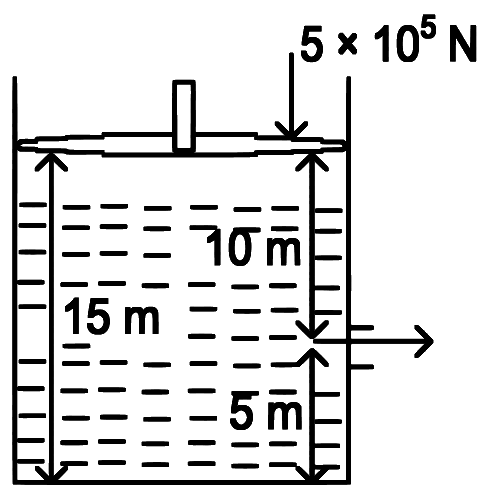
Consider a cylindrical tank of radius 1 m is filled with water. The top surface of water is at 15 m from the bottom of the cylinder. There is a hole on the wall of cylinder at a height of 5 m from the bottom. A force of 5×10⁵ N is applied on the top surface of water using a piston. The speed of efflux from the hole will be: (given atmospheric pressure PA=1.01×10⁵ Pa, density of water ρW=1000 kg/m3 and gravitational acceleration g=10 m/s2)
The area of cross-section of a large tank is 0.5 m2. It has a narrow opening near the bottom having area of cross-section 1 cm2. A load of 25 kg is applied on the water at the top in the tank. Neglecting the speed of water in the tank, the velocity of the water, coming out of the opening at the time when the height of water level in the tank is 40 cm above the bottom, will be ___________ cms−1. [Take g = 10 ms−2]
Numerical answer type. Work it out, then open the answer.
The water is filled upto height of 12 m in a tank having vertical sidewalls. A hole is made in one of the walls at a depth 'h' below the water level. The value of 'h' for which the emerging steam of water strikes the ground at the maximum range is ________ m.
Numerical answer type. Work it out, then open the answer.
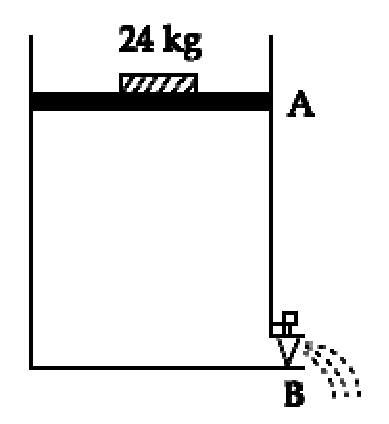
Consider a water tank as shown in the figure. It's cross-sectional area is 0.4 m2. The tank has an opening B near the bottom whose cross-section area is 1 cm2. A load of 24 kg is applied on the water at the top when the height of the water level is 40 cm above the bottom, the velocity of water coming out the opening B is v ms-1.
The value of v, to the nearest integer, is ___________. [Take value of g to be 10 ms-2]
Numerical answer type. Work it out, then open the answer.
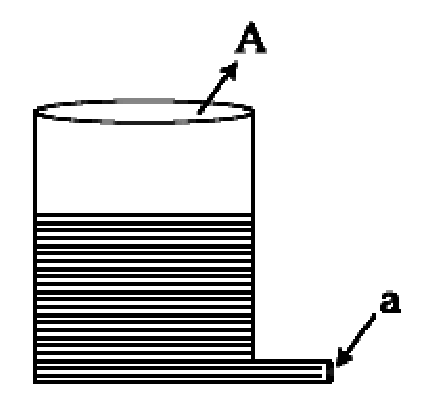
A light cylindrical vessel is kept on a horizontal surface. Area of base is A. A hole of cross-sectional area 'a' is made just at its bottom side. The minimum coefficient of friction necessary to prevent sliding the vessel due to the impact force of the emerging liquid is (a < < A):
A large open tank containing water has two holes to its wall. A square hole of side a is made at a depth y and a circular hole of radius r is made at a depth 16y from the surface of water. If equal amount of water comes out through both the holes per second, then the relation between r and a will be
A small hole of area of cross-section 2 mm2 present near the bottom of a fully filled open tank of height 2 m. Taking g = 10 m/s2, the rate of flow of water through the open hole would be nearly:
Water flows into a large tank with flat bottom at the rate of 10–4m3s–1. Water is also leaking out of a hole ofarea 1 cm2 at its bottom. If the height of the water in the tank remains steady, then this height is -
The top of a water tank is open to air and its water level is mainted. It is giving out 0.74 m3 water per minute through a circular opening of 2 cm radius in its wall. The depth of the center of the opening from the level of water in the tank is close to:
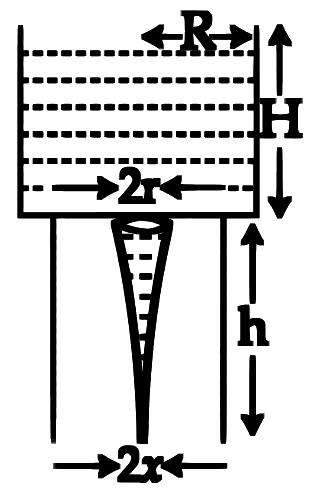
Consider a water jar of radius R that has water filled up to height H and is kept on astand of height h (see figure). Through a hole of radius r (r << R) at its bottom, the water leaks out and the stream of water coming down towards the ground has a shape like a funnel as shown in the figure. If the radius of the cross-section of water stream when it hits the ground is x. Then:
The cylindrical tube of a spray pump has radius R, one end of which has n fine holes, each of radius r. If the speed of the liquid in the tube is V, the speed of the ejection of the liquid through the holes is
A cylindrical vessel of cross-section A contains water to a height h. There is a hole in the bottom of radius 'a'. The time in which it will be emptied is:
A tank with a small hole at the bottom has been filled with water and kerosene (specific gravity 0.8). The height of water is 3 m and that of kerosene 2 m. When the hole is opened the velocity of fluid coming out from it is nearly: (take g = 10 ms−2 and density of water = 103 kg m−3)
A cylinder of height 20 m is completely filled with water. The velocity of efflux of water (in ms−1) through a small hole on the side wall of the cylinder near its bottom is