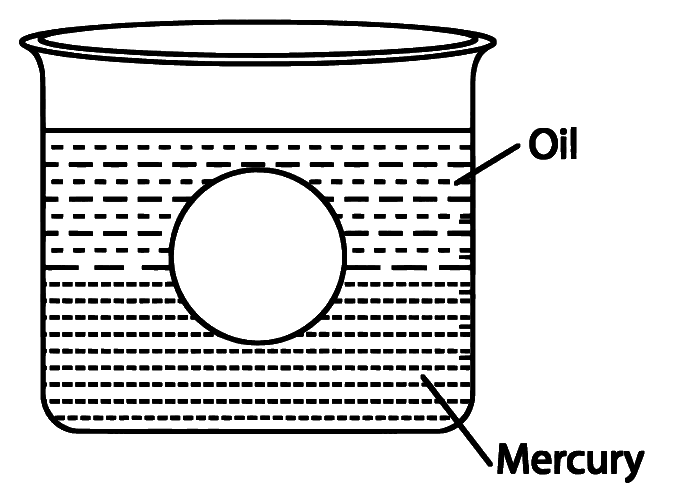
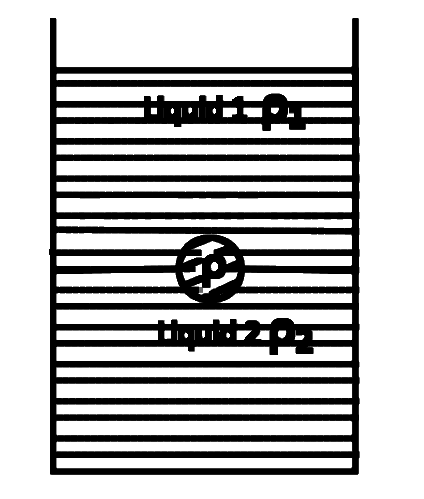
A vessel contains oil (density=0.6 g/cm3) over mercury (density=13.6 g/cm3). A homogeneous sphere floats with half its volume immersed in mercury and the remaining half in oil. The density of the material of the sphere in g/cm3 is
A vessel contains oil (density =0.8 gm/cm3) over mercury (density =13.6 gm/cm3). A homogeneous sphere floats with half of its volume immersed in mercury and the other half in oil. The density of the material of the sphere in gm/cm3 is
A cubical block of density ρb=600 kg/m3 floats in a liquid of density ρe=900 kg/m3. If the height of block is H=8.0 cm then height of the submerged part is
A tub is filled with water and a wooden cube 10 cm ×10 cm ×10 cm is placed in the water. The wooden cube is found to float on the water with a part of it submerged in water. When a metal coin is placed on the wooden cube, the submerged part is increased by 3.87 cm. The mass of the metal coin is ________ gram.
(Take water density as 1 g/cm3 and density of wood as 0.4 g/cm3)
Numerical answer type. Work it out, then open the answer.
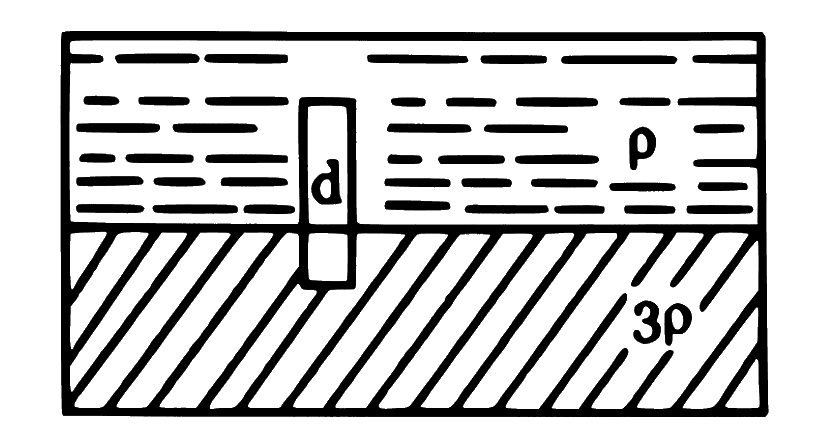
A solid cylinder of length l and cross-sectional area 5a is immersed such that it floats with its axis vertical at the liquid-liquid interface with length l/4 in the denser liquid as shown in figure. The lower density liquid ( ρ) is open to atmosphere having pressure P0. The density d of solid cylinder is
A small metal sphere of density ρ is dropped from height h into a jar containing liquid of density σ(σ>ρ). The maximum depth up to which the sphere sinks is (Neglect damping forces)
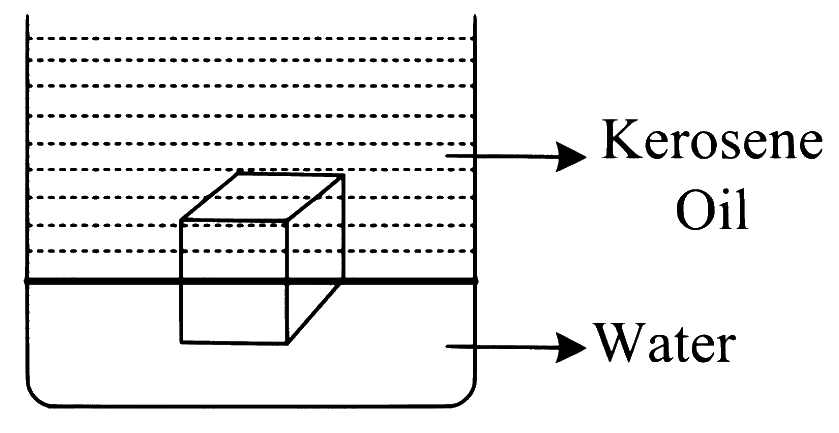
A cube of ice floats partly in water and partly in kerosene oil. The ratio of volume of ice immersed in water to that in kerosene oil (specific gravity of Kerosene oil = 0.8, specific gravity of ice = 0.9):
A hemispherical portion of radius ' R ' is removed from the bottom of a cylinder of radius ' R '. The volume of the remaining cylinder is ' V ' and its mass is ' M '. It is suspended by a string in a liquid of density ' ρ ', where it stays vertical. The upper surface of the cylinder is at a depth ' h ' below the liquid surface. The force on the bottom of the cylinder by the liquid is
The fundamental frequency of a sonometer wire carrying a block of mass 'M' and density 'ρ' is 'n' Hz. When the block is completely immersed in a liquid of density 'σ' then the new frequency will be
A body of density 'ρ' is dropped from rest at a height 'h' into a lake of density 'σ(σ>ρ). The maximum depth to which the body sinks before returning to float on the surface is (neglect air dissipative forces)
A body of density V is dropped from (at rest) height 'h' into a lake of density 'δ' (δ>ρ). The maximum depth to which the body sinks before returning to float on the surface is [Neglect all dissipative forces]
A hollow spherical shell of outer radius R floats just submerged under the water surface. The inner radius of the shell is r. If the specific gravity of the shell material is 827 w.r.t water, the value of r is:
A leak proof cylinder of length 1m, made of a metal which has very low coefficient of expansion is floating vertically in water at 0°C such that its height above the water surface is 20 cm. When the temperature of water is increased to 4°C, the height of the cylinder above the water surface becomes 21 cm. The density of water at T = 4°C, relative to the density at T = 0°C is close to:
A air bubble of radius 1 cm in water has an upward acceleration 9.8 cm s–2. The density of water is 1 gm cm–3 and water offers negligible drag force on the bubble. The mass of the bubble is (g = 980 cm/s2).
A cubical block of side 0.5 m floats on water with 30% of its volume under water. What is the maximum weight that can be put on the block without fully submerging it under water? [Take, density of water = 103 kg/m3]
A wooden block floating in a bucket of water has 4/5 of its volume submerged. When certain amount of an oil is poured into the bucket, it is found that the block is just under the oil surface with half of its volume under water and half in oil. The density of oil relative to that of water is :-
A thin uniform tube is bent into a circle of radius r in the vertical plane. Equal volumes of two immiscible liquids, whose densities are ρ1 and ρ2(ρ1>ρ2), fill half the circle. The angle θ between the radius vector passing through the common interface and the vertical is:
Two non-mixing liquids of densities ρ and nρ (n > 1) are put in a container. The height of each liquid is h. A solid cylinder of length L and density d is put in this container. The cylinder floats with its axis vertical and length pL (p < 1) in the denser liquid. The density d is equal to
An open glass tube is immersed in mercury in such a way that a length of 8 cm extends above the mercury level. The open end of the tube is then closed and sealed and the tube is raised vertically up by additional 46 cm. What will be length of the air column above mercury in the tube now? (Atmospheric pressure =76 cm of Hg)
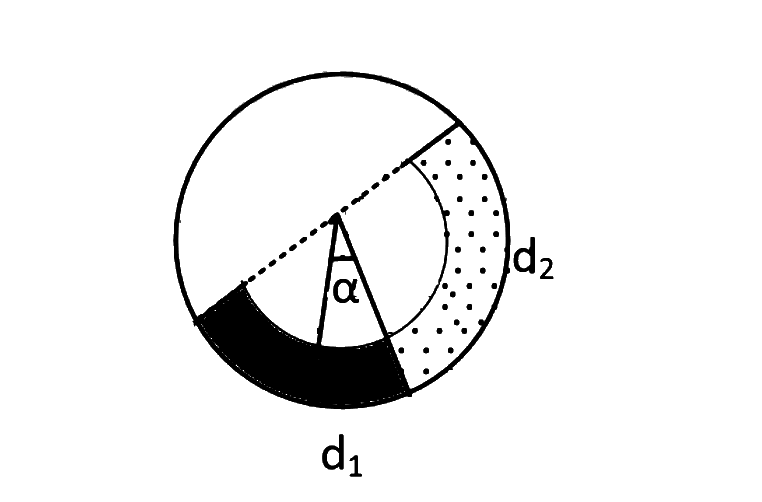
There is a circular tube in a vertical plane. Two liquids which do not mix and of densities d1 and d2 are filled in the tube. Each liquid subtends 90∘ angle at center. Radius joining their interface makes an angle α with vertical. Ratio d2d1 is:
A jar is filled with two non-mixing liquids 1 and 2 having densities ρ1 and ρ2 respectively. A solid ball, made of a material of density ρ3, is dropped in the jar. It comes to equilibrium in the position shown in the figure. Which of the following is true for ρ1,ρ1 and ρ3?