Q1 MHT CET 2026 · 19 APR · SHIFT 1 Easy ☆
Magnetic Materials & Curie Law · Dia, para & ferromagnetic properties
A diamagnetic liquid is filled in a U-tube. One arm of a U-tube is placed in an external magnetic field with the meniscus in line with the field. The level of the liquid in that arm will
(a) rise. (b) fall. (c) oscillate slowly. (d) remains as it is. Show answer and solution
Answer: (b)
Loading the solution…
Report a mistake Q2 MHT CET 2026 · 15 APR · SHIFT 1 Easy ☆
Magnetic Materials & Curie Law · Curie law, χ–T graphs & Curie temperature
The product of magnetic susceptibility (χ \chi χ
(a) diamagnetic substance. (b) paramagnetic substance. (c) ferromagnetic substance. (d) paramagnetic as well as ferromagnetic substance. Show answer and solution
Answer: (b)
Loading the solution…
Report a mistake Q3 MHT CET 2026 · 11 APR · SHIFT 1 Easy ☆
Magnetic Materials & Curie Law · Curie law, χ–T graphs & Curie temperature
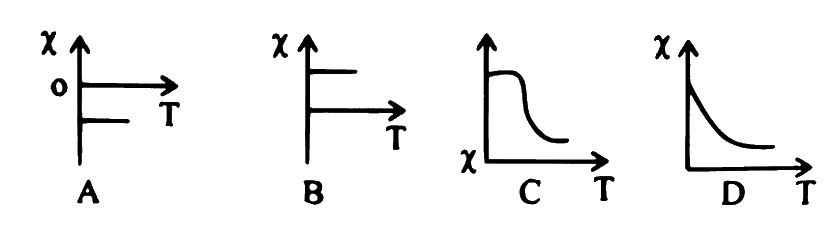
Which of the following figure best represents the variation of magnetic susceptibility (χ \chi χ
Show answer and solution
Answer: (c)
Loading the solution…
Report a mistake Q4 JEE Main 2026 · 23 JAN · SHIFT 1 Medium ☆
Magnetic Materials & Curie Law · Domains
Given below are two statements: one is labelled as Assertion (A) and the other is labelled as Reason (R).
Consider a ferromagnetic material:
Assertion (A): The individual atoms in a ferromagnetic material possess a magnetic dipole moment and interact with one another in such a way that they spontaneously align themselves forming domains.
Reason (R): At high enough temperature, the domain structure of ferromagnetic material disintegrates. Thus, magnetization will disappear at high enough temperature known as Curie temperature.
In the light of the above statements, choose the correct answer from the options given below:
(a) (A) is true but (R) is false (b) Both (A) and (R) are true and (R) is the correct explanation of (A) (c) (A) is false but (R) is true (d) Both (A) and (R) are true but (R) is not the correct explanation of (A) Show answer and solution
Answer: (d)
Loading the solution…
Report a mistake Q5 MHT CET 2025 · 22 APR · SHIFT 1 Easy ☆
Magnetic Materials & Curie Law · Dia, para & ferromagnetic properties
Susceptibility of a paramagnetic substance is
(a) negative and large. (b) negative and small. (c) positive and large. (d) positive and small. Show answer and solution
Answer: (d)
Loading the solution…
Report a mistake Q6 MHT CET 2025 · 21 APR · SHIFT 1 Easy ☆
Magnetic Materials & Curie Law · Curie law, χ–T graphs & Curie temperature
The variation of magnetic susceptibility ( χ ) (\chi) ( χ )
Show answer and solution
Answer: (c)
Loading the solution…
Report a mistake Q7 MHT CET 2024 · 16 MAY · SHIFT 1 Easy ☆
Magnetic Materials & Curie Law · Dia, para & ferromagnetic properties
The materials having negative magnetic susceptibility are
(a) both paramagnetic and ferromagnetic. (b) paramagnetic. (c) diamagnetic. (d) ferromagnetic. Show answer and solution
Answer: (c)
Loading the solution…
Report a mistake Q8 NEET 2024 Easy ☆
Magnetic Materials & Curie Law · Dia, para & ferromagnetic properties
The incorrect relation for a diamagnetic material (all the symbols carry their usual meaning and ε \varepsilon ε
(a) μ < μ 0 \mu < \mu_0 μ < μ 0 (b) 0 ≤ μ r < 1 0 \le \mu_r < 1 0 ≤ μ r < 1 (c) − 1 ≤ χ < 0 -1 \le \chi < 0 − 1 ≤ χ < 0 (d) 1 < μ r < 1 + ε 1 < \mu_r < 1 + \varepsilon 1 < μ r < 1 + ε Show answer and solution
Answer: (d)
Loading the solution…
Report a mistake Q9 NEET 2024 Easy ☆
Magnetic Materials & Curie Law · Dia, para & ferromagnetic properties
Match List I with List II
Choose the correct answer from the options given below.
List I (Material) List II (Susceptibility ($$\chi)) A. Diamagnetic I. χ = 0 \chi = 0 χ = 0 B. Ferromagnetic II. 0 > χ ≥ − 1 0 > \chi \geq -1 0 > χ ≥ − 1 C. Paramagnetic III. χ ≫ 1 \chi \gg 1 χ ≫ 1 D. Non-magnetic IV. 0 < χ < ε 0 < \chi < \varepsilon 0 < χ < ε
(a) A-II, B-III, C-IV, D-I (b) A-II, B-I, C-III, D-IV (c) A-III, B-II, C-I, D-IV (d) A-IV, B-III, C-II, D-I Show answer and solution
Answer: (a)
Loading the solution…
Report a mistake Q10 JEE Main 2024 · 8 APR · SHIFT 1 Easy ☆
Magnetic Materials & Curie Law · Dia, para & ferromagnetic properties
Paramagnetic substances:
A. align themselves along the directions of external magnetic field.
B. attract strongly towards external magnetic field.
C. has susceptibility little more than zero.
D. move from a region of strong magnetic field to weak magnetic field.
Choose the most appropriate answer from the options given below:
(a) A, B, C Only (b) A, C Only (c) A, B, C, D (d) B, D Only Show answer and solution
Answer: (b)
Loading the solution…
Report a mistake Q11 MHT CET 2024 · 2 MAY · SHIFT 2 Easy ☆
Magnetic Materials & Curie Law · Curie law, χ–T graphs & Curie temperature
A ferromagnetic material is heated above its curie temperature. The correct statement from the following is that
(a) ferromagnetic domains are perfectly arranged. (b) ferromagnetic domains become random. (c) ferromagnetic domains are not influenced. (d) ferromagnetic material changes itself into diamagnetic material. Show answer and solution
Answer: (b)
Loading the solution…
Report a mistake Q12 JEE Main 2023 · 12 APR · SHIFT 1 Easy ☆
Magnetic Materials & Curie Law · Dia, para & ferromagnetic properties
Given below are two statements:
Statement I: The diamagnetic property depends on temperature.
Statement II: The induced magnetic dipole moment in a diamagnetic sample is always opposite to the magnetizing field.
In the light of given statements, choose the correct answer from the options given below.
(a) Statement I is incorrect but Statement II is true. (b) Statement I is correct but Statement II is false. (c) Both Statement I and Statement II are False. (d) Both Statement I and Statement II are true. Show answer and solution
Answer: (a)
Loading the solution…
Report a mistake Q13 JEE Main 2023 · 10 APR · SHIFT 2 Easy ☆
Magnetic Materials & Curie Law · Dia, para & ferromagnetic properties
Given below are two statements:
Statement I: For diamagnetic substance, − 1 ≤ χ < 0 -1 \le \chi < 0 − 1 ≤ χ < 0 χ \chi χ
In the light of the above statements, choose the correct answer from the options given below
(a) Both Statement I and Statement II are true (b) Statement I is correct but Statement II is false (c) Both Statement I and Statement II are False (d) Statement I is incorrect but Statement II is true. Show answer and solution
Answer: (a)
Loading the solution…
Report a mistake Q14 MHT CET 2023 · 13 MAY · SHIFT 1 Easy ☆
Magnetic Materials & Curie Law · Curie law, χ–T graphs & Curie temperature
For which of the following substances, the magnetic susceptibility is independent of temperature?
(a) Diamagnetic only. (b) Paramagnetic only. (c) Ferromagnetic only. (d) Diamagnetic and paramagnetic both. Show answer and solution
Answer: (a)
Loading the solution…
Report a mistake Q15 MHT CET 2023 · 10 MAY · SHIFT 1 Easy ☆
Magnetic Materials & Curie Law · Curie law, χ–T graphs & Curie temperature
According to Curie's law in magnetism, the correct relation is ( M = \mathrm{M} = M = B = \mathrm{B} = B = T = \mathrm{T} = T = C = \mathrm{C} = C =
(a) M = T C B \mathrm{M} = \frac{\mathrm{T}}{\mathrm{CB}} M = CB T (b) M = C B T \mathrm{M} = \frac{\mathrm{CB}}{\mathrm{T}} M = T CB (c) C = M B T \mathrm{C} = \frac{\mathrm{MB}}{\mathrm{T}} C = T MB (d) C = T 2 M B \mathrm{C} = \frac{\mathrm{T}^{2}}{\mathrm{MB}} C = MB T 2 Show answer and solution
Answer: (b)
Loading the solution…
Report a mistake Q16 NEET 2023 Easy ☆
Magnetic Materials & Curie Law · Curie law, χ–T graphs & Curie temperature
The variation of susceptibility ( χ ) (\chi) ( χ ) T \mathrm{T} T
Show answer and solution
Answer: (a)
Loading the solution…
Report a mistake Q17 JEE Main 2022 · 25 JUN · SHIFT 2 Medium ☆
Magnetic Materials & Curie Law · Curie law, χ–T graphs & Curie temperature
Given below are two statements:
Statement I: Susceptibilities of paramagnetic and ferromagnetic substances increase with decrease in temperature.
Statement II: Diamagnetism is a result of orbital motions of electrons developing magnetic moments opposite to the applied magnetic field.
Choose the correct answer from the options given below:
(a) Both Statement I and Statement II are true. (b) Both Statement I and Statement II are false. (c) Statement I is true but Statement II is false. (d) Statement I is false but Statement II is true. Show answer and solution
Answer: (a)
Loading the solution…
Report a mistake Q18 JEE Main 2021 · 25 FEB · SHIFT 2 Easy ☆
Magnetic Materials & Curie Law · Domains
In a ferromagnetic material, below the curie temperature, a domain is defined as:
(a) a macroscopic region with zero magnetization. (b) a macroscopic region with saturation magnetization. (c) a macroscopic region with randomly oriented magnetic dipoles. (d) a macroscopic region with consecutive magnetic dipoles oriented in opposite direction. Show answer and solution
Answer: (b)
Loading the solution…
Report a mistake Q19 JEE Main 2021 · 24 FEB · SHIFT 2 Easy ☆
Magnetic Materials & Curie Law · Domains
A soft ferromagnetic material is placed in an external magnetic field. The magnetic domains:
(a) may increase or decrease in size and change its orientation. (b) increase in size but no change in orientation. (c) decrease in size and changes orientation. (d) have no relation with external magnetic field. Show answer and solution
Answer: (a)
Loading the solution…
Report a mistake Q20 JEE Main 2021 · 1 SEP · SHIFT 2 Medium ☆
Magnetic Materials & Curie Law · Dia, para & ferromagnetic properties
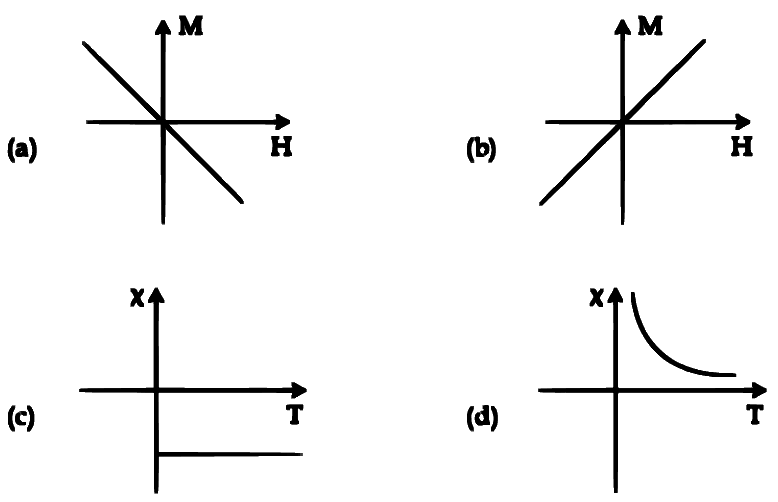
Following plots show magnetization (M) vs magnetizing field (H) and magnetic susceptibility (χ \chi χ
Which of the following combination will be represented by a diamagnetic material?
(a) (a), (c) (b) (a), (d) (c) (b), (d) (d) (b), (c) Show answer and solution
Answer: (a)
Loading the solution…
Report a mistake Q21 JEE Main 2021 · 22 JUL · SHIFT 2 Medium ☆
Magnetic Materials & Curie Law · Curie law, χ–T graphs & Curie temperature
Statement I: The ferromagnetic property depends on temperature. At high temperature, ferromagnet becomes paramagnet.
Statement II: At high temperature, the domain wall area of a ferromagnetic substance increases. In the light of the above statements, choose the most appropriate answer from the options given below:
(a) Statement I is false but Statement II is true (b) Statement I is true but Statement II is false (c) Both Statement I and Statement II are false (d) Both Statement I and Statement II are true Show answer and solution
Answer: (b)
Loading the solution…
Report a mistake Q22 MHT CET 2020 · 19 OCT · SHIFT 2 Easy ☆
Magnetic Materials & Curie Law · Dia, para & ferromagnetic properties
For a paramagnetic substance, the magnetic susceptibility is
(a) large and negative (b) small and positive (c) large and positive (d) small and negative Show answer and solution
Answer: (b)
Loading the solution…
Report a mistake Q23 MHT CET 2020 · 16 OCT · SHIFT 2 Easy ☆
Magnetic Materials & Curie Law · Dia, para & ferromagnetic properties
A thin light weight rod of diamagnetic substance such as silver is suspended in uniform external magnetic field. It will align itself with its length
(a) parallel to magnetic field (b) perpendicular to magnetic field (c) inclined at an angle 4 5 ∘ 45^\circ 4 5 ∘ (d) inclined at an angle 12 0 ∘ 120^\circ 12 0 ∘ Show answer and solution
Answer: (b)
Loading the solution…
Report a mistake Q24 JEE Main 2020 · 3 SEP · SHIFT 2 Medium ☆
Magnetic Materials & Curie Law · Dia, para & ferromagnetic properties
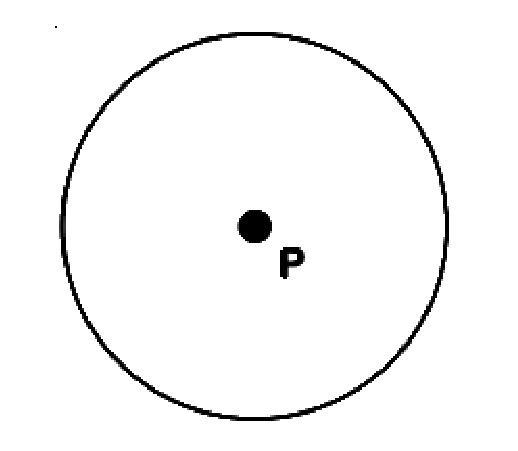
A perfectly diamagnetic sphere has a small spherical cavity at its centre, which is filled with a paramagnetic substance. The whole system is placed in a uniform magnetic field B ⃗ \vec{B} B
(a) B ⃗ \vec{B} B (b) zero (c) much large than ∣ B ⃗ ∣ \left|\vec{B}\right| B B ⃗ \vec{B} B (d) much large than ∣ B ⃗ ∣ \left|\vec{B}\right| B B ⃗ \vec{B} B Show answer and solution
Answer: (b)
Loading the solution…
Report a mistake Q25 MHT CET 2020 · 16 OCT · SHIFT 2 Medium ☆
Magnetic Materials & Curie Law · Curie law, χ–T graphs & Curie temperature
The magnetic susceptibility of a paramagnetic material at − 7 3 ∘ C -73^\circ\text{C} − 7 3 ∘ C − 17 3 ∘ C -173^\circ\text{C} − 17 3 ∘ C
(a) 0.0150 (b) 0.0075 (c) 0.0030 (d) 0.0045 Show answer and solution
Answer: (a)
Loading the solution…
Report a mistake Q26 JEE Main 2020 · 4 SEP · SHIFT 2 Medium ☆
Magnetic Materials & Curie Law · Curie law, χ–T graphs & Curie temperature
A paramagnetic sample shows a net magnetisation of 6 A/m when it is placed in an external magnetic field of 0.4 T at a temperature of 4 K. When the sample is placed in an external magnetic field of 0.3 T at a temperature of 24 K, then the magnetisation will be:
(a) 4 A/m (b) 1 A/m (c) 0.75 A/m (d) 2.25 A/m Show answer and solution
Answer: (c)
Loading the solution…
Report a mistake Q27 MHT CET 2019 · 2 MAY · SHIFT 2 Easy ☆
Magnetic Materials & Curie Law · Dia, para & ferromagnetic properties
Magnetic susceptibility of a paramagnetic substance is
(a) large and positive (b) small and positive (c) small and negative (d) large and negative Show answer and solution
Answer: (b)
Loading the solution…
Report a mistake Q28 JEE Main 2019 · 12 JAN · SHIFT 2 Medium ☆
Magnetic Materials & Curie Law · Curie law, χ–T graphs & Curie temperature
A paramagnetic material has 1028 atoms/m3. Its magnetic susceptibility at temperature 350 K is 2.8 × \times ×
(a) 3.726 × \times × (b) 2.672 × \times × (c) 3.672 × \times × (d) 3.267 × \times × − - − Show answer and solution
Answer: (d)
Loading the solution…
Report a mistake Q29 NEET 2018 Medium ☆
Magnetic Materials & Curie Law · Dia, para & ferromagnetic properties
A thin diamagnetic rod is placed vertically between the poles of an electromagnet. When the current in the electromagnet is switched on, then the diamagnetic rod is pushed up, out of the horizontal magnetic field. Hence the rod gains gravitational potential energy. The work required to do this comes from
(a) The current source (b) The magnetic field (c) The lattice structure of the material of the rod (d) The induced electric field due to the changing magnetic field Show answer and solution
Answer: (a)
Loading the solution…
Report a mistake Q30 NEET 2016 · PHASE 1 Easy ☆
Magnetic Materials & Curie Law · Dia, para & ferromagnetic properties
The magnetic susceptibility is negative for
(a) ferromagnetic material only (b) paramagnetic and ferromagnetic materials (c) diamagnetic material only (d) paramagnetic material only Show answer and solution
Answer: (c)
Loading the solution…
Report a mistake Q31 JEE Main 2014 · 19 APR · SHIFT 1 Easy ☆
Magnetic Materials & Curie Law · Dia, para & ferromagnetic properties
An example of a perfect diamagnet is a superconductor. This implies that when a superconductor is put in a magnetic field of intensity B, the magnetic field Bs inside the superconductor will be such that:
(a) Bs = − - − (b) Bs = 0 (c) Bs = B (d) Bs < B but Bs ≠ \neq = Show answer and solution
Answer: (b)
Loading the solution…
Report a mistake Q32 JEE Main 2014 · 11 APR · SHIFT 1 Easy ☆
Magnetic Materials & Curie Law · Dia, para & ferromagnetic properties
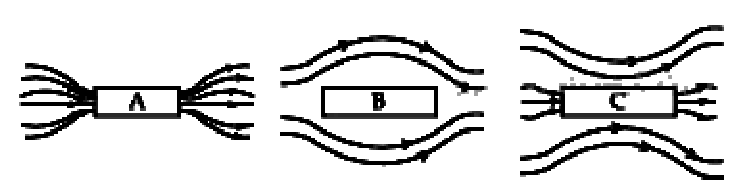
Three identical bars A, B and C are made of different magnetic materials. When kept in a uniform magnetic field, the field lines around them look as follows:
Make the correspondence of these bars with their material being diamagnetic (D), ferromagnetic (F) and paramagnetic (P):
(a) A ↔ \leftrightarrow ↔ ↔ \leftrightarrow ↔ ↔ \leftrightarrow ↔ (b) A ↔ \leftrightarrow ↔ ↔ \leftrightarrow ↔ ↔ \leftrightarrow ↔ (c) A ↔ \leftrightarrow ↔ ↔ \leftrightarrow ↔ ↔ \leftrightarrow ↔ (d) A ↔ \leftrightarrow ↔ ↔ \leftrightarrow ↔ ↔ \leftrightarrow ↔ Show answer and solution
Answer: (b)
Loading the solution…
Report a mistake Q33 NEET 2011 · AIPMT · PRELIMS Easy ☆
Magnetic Materials & Curie Law · Dia, para & ferromagnetic properties
There are four light-weight-rod samples A, B, C, D separately suspended by threads. A bar magnet is slowly brought near each sample and the following observations are noted
(i) A is feebly repelled
(ii) B is feebly attracted
(iii) C is strongly attracted
(iv) D remains unaffected
Which one of the following is true?
(a) B is of a paramagnetic material (b) C is of a diamagnetic material (c) D is of a ferromagnetic material (d) A is of a non-magnetic material Show answer and solution
Answer: (a)
Loading the solution…
Report a mistake Q34 NEET 2010 · AIPMT · MAINS Easy ☆
Magnetic Materials & Curie Law · Dia, para & ferromagnetic properties
The magnetic moment of a diamagnetic atom is
(a) much greater than one (b) 1 (c) between zero and one (d) equal to zero Show answer and solution
Answer: (d)
Loading the solution…
Report a mistake Q35 NEET 2009 · AIPMT Easy ☆
Magnetic Materials & Curie Law · Dia, para & ferromagnetic properties
If a diamagnetic substance is brought near the north or the south pole of a bar magnet, it is
(a) repelled by the north pole and attracted by the south pole (b) attracted by the north pole and repelled by the south pole (c) attracted by both the poles (d) repelled by both the poles Show answer and solution
Answer: (d)
Loading the solution…
Report a mistake Q36 JEE Main 2008 · AIEEE Easy ☆
Magnetic Materials & Curie Law · Dia, para & ferromagnetic properties
Relative permittivity and permeability of a material ε r \varepsilon_r ε r μ r , \mu_r, μ r ,
(a) ε r = 0.5 , μ r = 1.5 \varepsilon_r = 0.5,\ \mu_r = 1.5 ε r = 0.5 , μ r = 1.5 (b) ε r = 1.5 , μ r = 0.5 \varepsilon_r = 1.5,\ \mu_r = 0.5 ε r = 1.5 , μ r = 0.5 (c) ε r = 0.5 , μ r = 0.5 \varepsilon_r = 0.5,\ \mu_r = 0.5 ε r = 0.5 , μ r = 0.5 (d) ε r = 1.5 , μ r = 1.5 \varepsilon_r = 1.5,\ \mu_r = 1.5 ε r = 1.5 , μ r = 1.5 Show answer and solution
Answer: (b)
Loading the solution…
Report a mistake Q37 NEET 2008 · AIPMT Easy ☆
Magnetic Materials & Curie Law · Curie law, χ–T graphs & Curie temperature
Curie temperature above which
(a) paramagnetic material becomes ferromagnetic material (b) ferromagnetic material becomes diamagnetic material (c) ferromagnetic material becomes paramagnetic material (d) paramagnetic material becomes diamagnetic material Show answer and solution
Answer: (c)
Loading the solution…
Report a mistake Q38 NEET 2007 · AIPMT Easy ☆
Magnetic Materials & Curie Law · Curie law, χ–T graphs & Curie temperature
Nickel shows ferromagnetic property at room temperature. If the temperature is increased beyond Curie temperature, then it will show
(a) anti ferromagnetism (b) no magnetic property (c) diamagnetism (d) paramagnetism. Show answer and solution
Answer: (d)
Loading the solution…
Report a mistake Q39 JEE Main 2006 · AIEEE Easy ☆
Magnetic Materials & Curie Law · Dia, para & ferromagnetic properties
Needles N 1 , N 2 N_1, N_2 N 1 , N 2 N 3 N_3 N 3
(a) attract N 1 N_1 N 1 N 2 N_2 N 2 N 3 N_3 N 3 (b) attract N 1 N_1 N 1 N 2 N_2 N 2 N 3 N_3 N 3 (c) attract N 1 N_1 N 1 N 2 N_2 N 2 N 3 N_3 N 3 (d) attract all three of them Show answer and solution
Answer: (b)
Loading the solution…
Report a mistake Q40 NEET 2006 · AIPMT Easy ☆
Magnetic Materials & Curie Law · Curie law, χ–T graphs & Curie temperature
Curie temperature above which
(a) paramagnetic material becomes ferromagnetic material (b) ferromagnetic material becomes diamagnetic material (c) ferromagnetic material becomes paramagnetic material (d) paramagnetic material becomes diamagnetic material Show answer and solution
Answer: (c)
Loading the solution…
Report a mistake Q41 NEET 2005 · AIPMT Easy ☆
Magnetic Materials & Curie Law · Dia, para & ferromagnetic properties
If the magnetic dipole moment of an atom of diamagnetic material, paramagnetic material and ferromagnetic material are denoted by μ \mu μ μ \mu μ μ \mu μ
(a) μ d = 0 \mu_d = 0 μ d = 0 μ \mu μ ≠ \neq = (b) μ \mu μ ≠ \neq = μ \mu μ (c) μ \mu μ μ \mu μ ≠ \neq = (d) μ \mu μ ≠ \neq = μ \mu μ ≠ \neq = Show answer and solution
Answer: (a)
Loading the solution…
Report a mistake Q42 JEE Main 2004 · AIEEE Easy ☆
Magnetic Materials & Curie Law · Curie law, χ–T graphs & Curie temperature
Curie temperature is the temperature above which
(a) a ferromagnetic material becomes paramagnetic (b) a paramagnetic material becomes diamagnetic (c) a ferromagnetic material becomes diamagnetic (d) a paramagnetic material becomes ferromagnetic Show answer and solution
Answer: (a)
Loading the solution…
Report a mistake Q43 NEET 2003 · AIPMT Easy ☆
Magnetic Materials & Curie Law · Dia, para & ferromagnetic properties
A diamagnetic material in a magnetic field moves
(a) from stronger to the weaker parts of the field (b) from weaker to the stronger parts of the field (c) perpendicular to the field (d) in none of the above directions Show answer and solution
Answer: (a)
Loading the solution…
Report a mistake Q44 NEET 2003 · AIPMT Easy ☆
Magnetic Materials & Curie Law · Curie law, χ–T graphs & Curie temperature
According to Curie's law, the magnetic susceptibility of a substance at an absolute temperature T T T
(a) 1 / T 1/T 1/ T (b) T T T (c) 1 / T 1/T 1/ T (d) T T T Show answer and solution
Answer: (a)
Loading the solution…
Report a mistake Q45 NEET 2001 · AIPMT Easy ☆
Magnetic Materials & Curie Law · Curie law, χ–T graphs & Curie temperature
Among which the magnetic susceptibility does not depend on the temperature?
(a) diamagnetism (b) paramagnetism (c) ferromagnetism (d) ferrite. Show answer and solution
Answer: (a)
Loading the solution…
Report a mistake Q46 NEET 1999 · AIPMT Easy ☆
Magnetic Materials & Curie Law · Dia, para & ferromagnetic properties
A diamagnetic substance is brought near a strong magnet, then it is
(a) attracted by a magnet (b) repelled by a magnet (c) repelled by north pole and attracted by south pole (d) attracted by north pole and repelled by south pole Show answer and solution
Answer: (b)
Loading the solution…
Report a mistake
No questions match these filters.