Mechanical Properties of Solids PYQs · MHT CET · JEE Main · NEET
Thermal Stress & Breaking Stress
Questions
16
MHT CET
1
JEE Main
14
NEET
1
0 of 16 attempted
Q1JEE Main 2026 · 6 APR · SHIFT 1Medium
Thermal Stress & Breaking Stress
A lift of mass 1600 kg is supported by thick iron wire. If the maximum stress which the wire can withstand is 4×10⁸ N/m2 and its radius is 4 mm, then maximum acceleration the lift can take is m/s2.
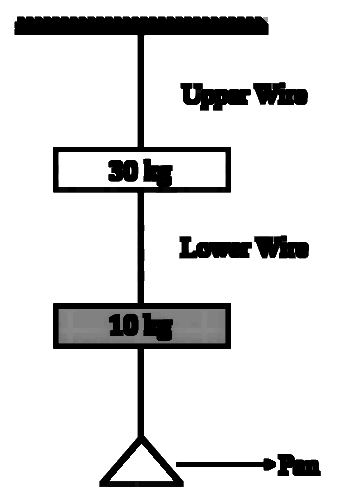
Two wires as shown in the figure below, made of steel and have breaking stress of 12×108 N/m2. Area of cross-section of upper wire is 0.008 cm2 and of lower wire is 0.004 cm2. The maximum mass that can be added to pan without breaking any wire is ______ kg.
A brass wire of length 2 m and radius 1 mm at 27∘C is held taut between two rigid supports. Initially it was cooled to a temperature of −43∘C creating a tension T in the wire. The temperature to which the wire has to be cooled in order to increase the tension in it to 1.4T, is ∘C.
A metallic bar of Young's modulus, 0.5×10¹¹ N m−2 and coefficient of linear thermal expansion 10−5∘C−1, length 1 m and area of cross-section 10−3 m2 is heated from 0∘C to 100∘C without expansion or bending. The compressive force developed in it is:
The density and breaking stress of a wire are 6×10⁴ kg/m3 and 1.2×10⁸ N/m2 respectively. The wire is suspended from a rigid support on a planet where acceleration due to gravity is 31rd of the value on the surface of earth. The maximum length of the wire without breaking is _______ m (take, g=10 m/s2 ).
Numerical answer type. Work it out, then open the answer.
A thin rod having a length of 1 m and area of cross-section 3×10⁻⁶ m2 is suspended vertically from one end. The rod is cooled from 210∘C to 160∘C. After cooling, a mass M is attached at the lower end of the rod such that the length of rod again becomes 1 m. Young's modulus and coefficient of linear expansion of the rod are 2×10¹¹ N m−2 and 2×10⁻⁵ K−1, respectively. The value of M is __________ kg.
(Take g=10 m s−2)
Numerical answer type. Work it out, then open the answer.
The area of cross section of the rope used to lift a load by a crane is 2.5×10⁻⁴ m2. The maximum lifting capacity of the crane is 10 metric tons. To increase the lifting capacity of the crane to 25 metric tons, the required area of cross section of the rope should be:
A metal wire of length 0.5 m and cross-sectional area 10−4 m2 has breaking stress 5×10⁸ Nm−2. A block of 10 kg is attached at one end of the string and is rotating in a horizontal circle. The maximum linear velocity of block will be _________ ms−1.
Numerical answer type. Work it out, then open the answer.
A steel rod with y = 2.0 × 10¹¹ Nm−2 and α = 10−5 ∘C−1 of length 4 m and area of cross-section 10 cm2 is heated from 0∘ C to 400∘C without being allowed to extend. The tension produced in the rod is x × 105 N where the value of x is ____________.
Numerical answer type. Work it out, then open the answer.
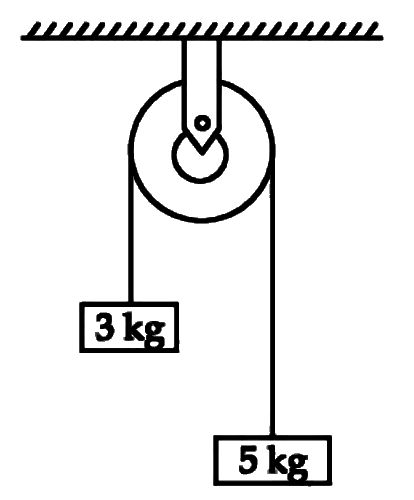
Two blocks of masses 3 kg and 5 kg are connected by a metal wire going over a smooth pulley. The breaking stress of the metal is π24×102 Nm-2. What is the minimum radius of the wire? (Take g = 10 ms-2)
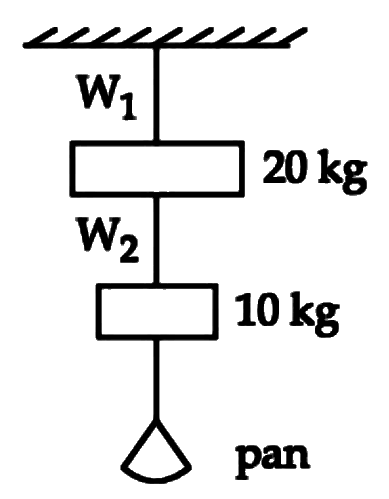
Wires W1 and W2 are made of same material having the breaking stress of 1.25 × 10⁹ N/m2. W1 and W2 have cross-sectional area of 8 × 10⁻⁷ m2 and 4 × 10⁻⁷ m2, respectively. Masses of 20 kg and 10 kg hang from them as shown in the figure. The maximum mass that can be placed in the pan without breaking the wires is ____________ kg. (Use g = 10 m/s2)
Numerical answer type. Work it out, then open the answer.
A body of mass m = 10 kg is attached to one end of a wire of length 0.3 m. The maximum angular speed (in rad s–1) with which it can be rotated about its other end in space station is: (Breaking stress of wire = 4.8 × 10⁷ Nm–2 and
area of cross-section of the wire = 10–2 cm2) is:
Numerical answer type. Work it out, then open the answer.
The elastic limit of brass is 379 MPa. What should be the minimum diameter of a brass rod if it is to support a 400 N load without exceeding its elastic limit?
A uniform cylindrical rod of length L and radius r, is made from a material whose Young’s modulus of Elasticity equals Y. When this rod is heated by temperature T and simultaneously subjected to a net longitudinal compressional force F, its length remains unchanged. The coefficient of volume expansion, of the material of the rod, is (nearly) equal to:
A lift is tied with thick iron ropes having mass ' M '. The maximum acceleration of the lift is ' a ' m/s2 and maximum safe stress is ' S ' N/m2. The minimum diameter of the rope is
The pressure that has to be applied to the ends of a steel wire of length 10 cm to keep its length constant when its temperature is raised by 100∘C is: (For steel Young's modulus is 2×10¹¹ Nm−2 and coefficient of thermal expansion is 1.1×10⁻⁵ K−1)