Q1 MHT CET 2026 · 17 APR · SHIFT 1 Easy ☆
Addition & Subtraction of Vectors
Resultant of two vectors P ⃗ \vec{P} P Q ⃗ \vec{Q} Q Q ⃗ \vec{Q} Q A 2 + B 2 A^2 + B^2 A 2 + B 2
(a) P 2 + Q 2 P^2 + Q^2 P 2 + Q 2 (b) P 2 − Q 2 P^2 - Q^2 P 2 − Q 2 (c) 2 ( P 2 + Q 2 ) 2(P^2 + Q^2) 2 ( P 2 + Q 2 ) (d) 2 ( P 2 − Q 2 ) 2(P^2 - Q^2) 2 ( P 2 − Q 2 ) Show answer and solution
Answer: (c)
Loading the solution…
Report a mistake Q2 MHT CET 2026 · 20 MAY · SHIFT 1 Easy ☆
Addition & Subtraction of Vectors
Let P ⃗ = i ^ + j ^ + k ^ \vec{P} = \hat{i} + \hat{j} + \hat{k} P = i ^ + j ^ + k ^ Q ⃗ = − i ^ − j ^ − k ^ \vec{Q} = -\hat{i} - \hat{j} - \hat{k} Q = − i ^ − j ^ − k ^ ( P ⃗ − Q ⃗ ) (\vec{P} - \vec{Q}) ( P − Q ) P ⃗ \vec{P} P
(a) 9 0 ∘ 90^\circ 9 0 ∘ (b) 3 0 ∘ 30^\circ 3 0 ∘ (c) 6 0 ∘ 60^\circ 6 0 ∘ (d) 0 ∘ 0^\circ 0 ∘ Show answer and solution
Answer: (d)
Loading the solution…
Report a mistake Q3 MHT CET 2026 · 16 APR · SHIFT 1 Easy ☆
Addition & Subtraction of Vectors
Let P ⃗ = i ^ + j ^ + k ^ \vec{P} = \hat{i} + \hat{j} + \hat{k} P = i ^ + j ^ + k ^ Q ⃗ = − ( i ^ + j ^ + k ^ ) \vec{Q} = -(\hat{i} + \hat{j} + \hat{k}) Q = − ( i ^ + j ^ + k ^ ) ( P ⃗ − Q ⃗ ) (\vec{P} - \vec{Q}) ( P − Q ) P ⃗ \vec{P} P
(a) 9 0 ∘ 90^\circ 9 0 ∘ (b) 6 0 ∘ 60^\circ 6 0 ∘ (c) 0 ∘ 0^\circ 0 ∘ (d) 3 0 ∘ 30^\circ 3 0 ∘ Show answer and solution
Answer: (c)
Loading the solution…
Report a mistake Q4 MHT CET 2026 · 14 MAY · SHIFT 2 Medium ☆
Addition & Subtraction of Vectors
The resultant R ⃗ \vec{R} R P ⃗ \vec{P} P Q ⃗ \vec{Q} Q P ⃗ \vec{P} P ∣ P ⃗ ∣ = ∣ R ⃗ ∣ |\vec{P}| = |\vec{R}| ∣ P ∣ = ∣ R ∣ P ⃗ \vec{P} P Q ⃗ \vec{Q} Q tan 4 5 ∘ = 1 \tan 45^\circ = 1 tan 4 5 ∘ = 1
(a) π 4 \frac{\pi}{4} 4 π (b) 3 π 4 \frac{3\pi}{4} 4 3 π (c) 5 π 4 \frac{5\pi}{4} 4 5 π (d) 7 π 4 \frac{7\pi}{4} 4 7 π Show answer and solution
Answer: (b)
Loading the solution…
Report a mistake Q5 MHT CET 2026 · 14 MAY · SHIFT 1 Medium ☆
Addition & Subtraction of Vectors
A vector A ⃗ \vec{A} A 6 6 6 B ⃗ \vec{B} B x x x A ⃗ \vec{A} A B ⃗ \vec{B} B y y y A ⃗ \vec{A} A B ⃗ \vec{B} B 3 3 3 B ⃗ \vec{B} B B ⃗ \vec{B} B
(a) 3 3 3 (b) 3.6 \sqrt{3.6} 3.6 (c) 6 6 6 (d) 4 4 4 Show answer and solution
Answer: (b)
Loading the solution…
Report a mistake Q6 MHT CET 2026 · 12 MAY · SHIFT 2 Medium ☆
Addition & Subtraction of Vectors
The resultant of two vectors A ⃗ \vec{A} A B ⃗ \vec{B} B C ⃗ \vec{C} C B ⃗ \vec{B} B A ⃗ \vec{A} A C ⃗ \vec{C} C
(a) B B B (b) 2 B 2B 2 B (c) 3 B 3B 3 B (d) 4 B 4B 4 B Show answer and solution
Answer: (a)
Loading the solution…
Report a mistake Q7 MHT CET 2025 · 19 APR · SHIFT 2 Medium ☆
Addition & Subtraction of Vectors
The resultant of two vectors A ⃗ \vec{A} A B ⃗ \vec{B} B C ⃗ \vec{C} C B ⃗ \vec{B} B A ⃗ \vec{A} A C ⃗ \vec{C} C
Show answer and solution
Answer: (c)
Loading the solution…
Report a mistake Q8 MHT CET 2025 · 21 APR · SHIFT 1 Medium ☆
Addition & Subtraction of Vectors
The three vector A ⃗ = 3 i ^ − 2 j ^ + k ^ , B ⃗ = i ^ − 3 j ^ + 5 k ^ \vec{A} = 3\hat{i} - 2\hat{j} + \hat{k}, \vec{B} = \hat{i} - 3\hat{j} + 5\hat{k} A = 3 i ^ − 2 j ^ + k ^ , B = i ^ − 3 j ^ + 5 k ^ C ⃗ = 2 i ^ − j ^ + 4 k ^ \vec{C} = 2\hat{i} - \hat{j} + 4\hat{k} C = 2 i ^ − j ^ + 4 k ^
(a) isosceles triangle. (b) equilateral triangle. (c) no triangle. (d) right angled triangle. Show answer and solution
Answer: (c)
Loading the solution…
Report a mistake Q9 JEE Main 2024 · 5 APR · SHIFT 1 Easy ☆
Addition & Subtraction of Vectors
The angle between vector Q ⃗ \vec{Q} Q ( 2 Q ⃗ + 2 P ⃗ ) (2\vec{Q} + 2\vec{P}) ( 2 Q + 2 P ) ( 2 Q ⃗ − 2 P ⃗ ) (2\vec{Q} - 2\vec{P}) ( 2 Q − 2 P )
(a) tan − 1 ( P / Q ) \tan^{-1}(P/Q) tan − 1 ( P / Q ) (b) 0∘ {}^\circ ∘ (c) tan − 1 ( 2 Q ⃗ − 2 P ⃗ ) 2 Q ⃗ + 2 P ⃗ \tan^{-1}\frac{(2\vec{Q} - 2\vec{P})}{2\vec{Q} + 2\vec{P}} tan − 1 2 Q + 2 P ( 2 Q − 2 P ) (d) tan − 1 ( 2 Q / P ) \tan^{-1}(2Q/P) tan − 1 ( 2 Q / P ) Show answer and solution
Answer: (b)
Loading the solution…
Report a mistake Q10 JEE Main 2024 · 31 JAN · SHIFT 2 Easy ☆
Addition & Subtraction of Vectors
If two vectors A ⃗ \vec{A} A B ⃗ \vec{B} B R R R θ \theta θ
(a) ∣ A ⃗ + B ⃗ ∣ = 2 R cos ( θ 2 ) |\vec{A} + \vec{B}| = 2R\cos\left(\frac{\theta}{2}\right) ∣ A + B ∣ = 2 R cos ( 2 θ ) (b) ∣ A ⃗ − B ⃗ ∣ = 2 R cos ( θ 2 ) |\vec{A} - \vec{B}| = 2R\cos\left(\frac{\theta}{2}\right) ∣ A − B ∣ = 2 R cos ( 2 θ ) (c) ∣ A ⃗ − B ⃗ ∣ = 2 R sin ( θ 2 ) |\vec{A} - \vec{B}| = \sqrt{2}R\sin\left(\frac{\theta}{2}\right) ∣ A − B ∣ = 2 R sin ( 2 θ ) (d) ∣ A ⃗ + B ⃗ ∣ = 2 R sin ( θ 2 ) |\vec{A} + \vec{B}| = 2R\sin\left(\frac{\theta}{2}\right) ∣ A + B ∣ = 2 R sin ( 2 θ ) Show answer and solution
Answer: (a)
Loading the solution…
Report a mistake Q11 JEE Main 2024 · 9 APR · SHIFT 2 Medium ☆
Addition & Subtraction of Vectors
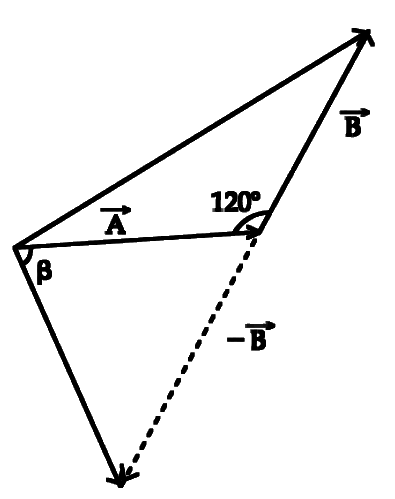
The resultant of two vectors A ⃗ \vec{A} A B ⃗ \vec{B} B A ⃗ \vec{A} A B ⃗ \vec{B} B A ⃗ \vec{A} A B ⃗ \vec{B} B ∘ {}^\circ ∘
Numerical answer type. Work it out, then open the answer.
Show answer and solution
Answer: 150
Loading the solution…
Report a mistake Q12 JEE Main 2024 · 9 APR · SHIFT 1 Medium ☆
Addition & Subtraction of Vectors
If a ⃗ \vec{a} a b ⃗ \vec{b} b cos − 1 ( 5 9 ) \cos^{-1}\left(\frac{5}{9}\right) cos − 1 ( 9 5 ) ∣ a ⃗ + b ⃗ ∣ = 2 ∣ a ⃗ − b ⃗ ∣ |\vec{a} + \vec{b}| = \sqrt{2}|\vec{a} - \vec{b}| ∣ a + b ∣ = 2 ∣ a − b ∣ ∣ a ⃗ ∣ = n ∣ b ⃗ ∣ |\vec{a}| = n|\vec{b}| ∣ a ∣ = n ∣ b ∣ n n n
Numerical answer type. Work it out, then open the answer.
Show answer and solution
Answer: 3
Loading the solution…
Report a mistake Q13 JEE Main 2024 · 4 APR · SHIFT 1 Medium ☆
Addition & Subtraction of Vectors
Two forcesF ‾ 1 \overline{F}_1 F 1 F ‾ 2 \overline{F}_2 F 2 F ⃗ 1 \vec{F}_1 F 1 F ⃗ 2 \vec{F}_2 F 2 cos − 1 ( 1 n ) \cos^{-1}\left(\frac{1}{n}\right) cos − 1 ( n 1 ) ∣ n ∣ |n| ∣ n ∣
Numerical answer type. Work it out, then open the answer.
Show answer and solution
Answer: 6
Loading the solution…
Report a mistake Q14 JEE Main 2023 · 8 APR · SHIFT 1 Easy ☆
Addition & Subtraction of Vectors
Two forces having magnitude A A A A 2 \frac{A}{2} 2 A
(a) 5 A 2 \frac{5A}{2} 2 5 A (b) 5 A 4 \frac{\sqrt{5}A}{4} 4 5 A (c) 5 A 2 \frac{\sqrt{5}A}{2} 2 5 A (d) 5 A 2 2 \frac{\sqrt{5}A^2}{2} 2 5 A 2 Show answer and solution
Answer: (c)
Loading the solution…
Report a mistake Q15 JEE Main 2022 · 29 JUN · SHIFT 1 Medium ☆
Addition & Subtraction of Vectors
Two vectors A ⃗ \vec{A} A B ⃗ \vec{B} B A ⃗ + B ⃗ \vec{A} + \vec{B} A + B A ⃗ − B ⃗ \vec{A} - \vec{B} A − B A ⃗ \vec{A} A B ⃗ \vec{B} B
(a) sin − 1 ( 3 5 ) \sin^{-1}\left(\frac{3}{5}\right) sin − 1 ( 5 3 ) (b) sin − 1 ( 1 3 ) \sin^{-1}\left(\frac{1}{3}\right) sin − 1 ( 3 1 ) (c) cos − 1 ( 3 5 ) \cos^{-1}\left(\frac{3}{5}\right) cos − 1 ( 5 3 ) (d) cos − 1 ( 1 3 ) \cos^{-1}\left(\frac{1}{3}\right) cos − 1 ( 3 1 ) Show answer and solution
Answer: (c)
Loading the solution…
Report a mistake Q16 JEE Main 2022 · 25 JUN · SHIFT 1 Medium ☆
Addition & Subtraction of Vectors
Which of the following relations is true for two unit vectors A ^ \hat{A} A ^ B ^ \hat{B} B ^ θ \theta θ
(a) ∣ A ^ + B ^ ∣ = ∣ A ^ − B ^ ∣ tan θ 2 |\hat{A} + \hat{B}| = |\hat{A} - \hat{B}| \tan\frac{\theta}{2} ∣ A ^ + B ^ ∣ = ∣ A ^ − B ^ ∣ tan 2 θ (b) ∣ A ^ − B ^ ∣ = ∣ A ^ + B ^ ∣ tan θ 2 |\hat{A} - \hat{B}| = |\hat{A} + \hat{B}| \tan\frac{\theta}{2} ∣ A ^ − B ^ ∣ = ∣ A ^ + B ^ ∣ tan 2 θ (c) ∣ A ^ + B ^ ∣ = ∣ A ^ − B ^ ∣ cos θ 2 |\hat{A} + \hat{B}| = |\hat{A} - \hat{B}| \cos\frac{\theta}{2} ∣ A ^ + B ^ ∣ = ∣ A ^ − B ^ ∣ cos 2 θ (d) ∣ A ^ − B ^ ∣ = ∣ A ^ + B ^ ∣ cos θ 2 |\hat{A} - \hat{B}| = |\hat{A} + \hat{B}| \cos\frac{\theta}{2} ∣ A ^ − B ^ ∣ = ∣ A ^ + B ^ ∣ cos 2 θ Show answer and solution
Answer: (b)
Loading the solution…
Report a mistake Q17 JEE Main 2021 · 25 JUL · SHIFT 1 Easy ☆
Addition & Subtraction of Vectors
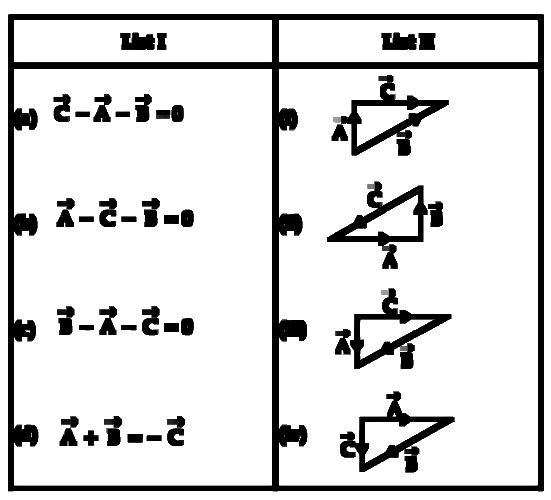
Match List - I with List - II
Choose the correct answer from the options given below:
(a) (a) → \rightarrow → → \rightarrow → → \rightarrow → → \rightarrow → (b) (a) → \rightarrow → → \rightarrow → → \rightarrow → → \rightarrow → (c) (a) → \rightarrow → → \rightarrow → → \rightarrow → → \rightarrow → (d) (a) → \rightarrow → → \rightarrow → → \rightarrow → → \rightarrow → Show answer and solution
Answer: (b)
Loading the solution…
Report a mistake Q18 JEE Main 2021 · 25 JUL · SHIFT 2 Medium ☆
Addition & Subtraction of Vectors
Two vectors X ⃗ \vec{X} X Y ⃗ \vec{Y} Y X ⃗ − Y ⃗ \vec{X} - \vec{Y} X − Y X ⃗ + Y ⃗ \vec{X} + \vec{Y} X + Y X ⃗ \vec{X} X Y ⃗ \vec{Y} Y
(a) cos − 1 ( − n 2 − 1 n 2 − 1 ) \cos^{-1}\left(\frac{-n^2 - 1}{n^2 - 1}\right) cos − 1 ( n 2 − 1 − n 2 − 1 ) (b) cos − 1 ( n 2 − 1 − n 2 − 1 ) \cos^{-1}\left(\frac{n^2 - 1}{-n^2 - 1}\right) cos − 1 ( − n 2 − 1 n 2 − 1 ) (c) cos − 1 ( n 2 + 1 − n 2 − 1 ) \cos^{-1}\left(\frac{n^2 + 1}{-n^2 - 1}\right) cos − 1 ( − n 2 − 1 n 2 + 1 ) (d) cos − 1 ( n 2 + 1 n 2 − 1 ) \cos^{-1}\left(\frac{n^2 + 1}{n^2 - 1}\right) cos − 1 ( n 2 − 1 n 2 + 1 ) Show answer and solution
Answer: (b)
Loading the solution…
Report a mistake Q19 JEE Main 2021 · 20 JUL · SHIFT 2 Medium ☆
Addition & Subtraction of Vectors
Two vectors P ⃗ \vec{P} P Q ⃗ \vec{Q} Q P ⃗ + Q ⃗ \vec{P} + \vec{Q} P + Q P ⃗ − Q ⃗ \vec{P} - \vec{Q} P − Q P ⃗ \vec{P} P Q ⃗ \vec{Q} Q
(a) sin − 1 ( n − 1 n + 1 ) \sin^{-1}\left(\frac{n-1}{n+1}\right) sin − 1 ( n + 1 n − 1 ) (b) cos − 1 ( n − 1 n + 1 ) \cos^{-1}\left(\frac{n-1}{n+1}\right) cos − 1 ( n + 1 n − 1 ) (c) sin − 1 ( n 2 − 1 n 2 + 1 ) \sin^{-1}\left(\frac{n^2-1}{n^2+1}\right) sin − 1 ( n 2 + 1 n 2 − 1 ) (d) cos − 1 ( n 2 − 1 n 2 + 1 ) \cos^{-1}\left(\frac{n^2-1}{n^2+1}\right) cos − 1 ( n 2 + 1 n 2 − 1 ) Show answer and solution
Answer: (d)
Loading the solution…
Report a mistake Q20 JEE Main 2021 · 26 AUG · SHIFT 2 Medium ☆
Addition & Subtraction of Vectors
The angle between vector ( A ⃗ ) \left(\vec{A}\right) ( A ) ( A ⃗ − B ⃗ ) \left(\vec{A} - \vec{B}\right) ( A − B )
(a) tan − 1 ( − B 2 A − B 3 2 ) \tan^{-1}\left(\frac{-\frac{B}{2}}{A - B\frac{\sqrt{3}}{2}}\right) tan − 1 ( A − B 2 3 − 2 B ) (b) tan − 1 ( A 0.7 B ) \tan^{-1}\left(\frac{A}{0.7B}\right) tan − 1 ( 0.7 B A ) (c) tan − 1 ( 3 B 2 A − B ) \tan^{-1}\left(\frac{\sqrt{3}B}{2A - B}\right) tan − 1 ( 2 A − B 3 B ) (d) tan − 1 ( B cos θ A − B sin θ ) \tan^{-1}\left(\frac{B\cos\theta}{A - B\sin\theta}\right) tan − 1 ( A − B s i n θ B c o s θ ) Show answer and solution
Answer: (c)
Loading the solution…
Report a mistake Q21 JEE Main 2021 · 31 AUG · SHIFT 2 Difficult ☆
Addition & Subtraction of Vectors
Statement I:
Two forces ( P ⃗ + Q ⃗ ) \left(\vec{P} + \vec{Q}\right) ( P + Q ) ( P ⃗ − Q ⃗ ) \left(\vec{P} - \vec{Q}\right) ( P − Q ) P ⃗ ⊥ Q ⃗ \vec{P} \perp \vec{Q} P ⊥ Q θ \theta θ 3 ( P 2 + Q 2 ) \sqrt{3(P^2 + Q^2)} 3 ( P 2 + Q 2 ) θ \theta θ 2 ( P 2 + Q 2 ) \sqrt{2(P^2 + Q^2)} 2 ( P 2 + Q 2 ) θ 1 < θ 2 \theta_1 < \theta_2 θ 1 < θ 2
Statement II:
In the situation given above.
θ \theta θ ∘ {}^\circ ∘ θ \theta θ ∘ {}^\circ ∘
In the light of the above statements, choose the most appropriate answer from the options given below :-
(a) Statement I is false but Statement II is true (b) Both Statement I and Statement II are true (c) Statement I is true but Statement II is false (d) Both Statement I and Statement II are false. Show answer and solution
Answer: (b)
Loading the solution…
Report a mistake Q22 JEE Main 2021 · 27 JUL · SHIFT 1 Difficult ☆
Addition & Subtraction of Vectors
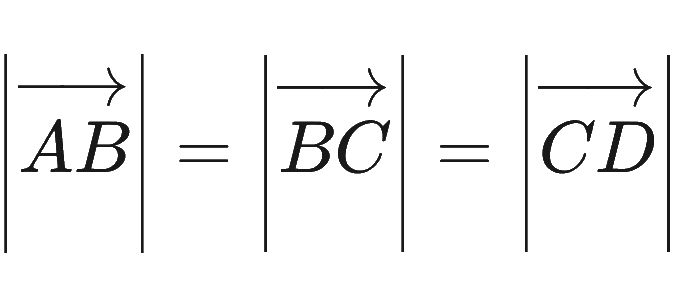
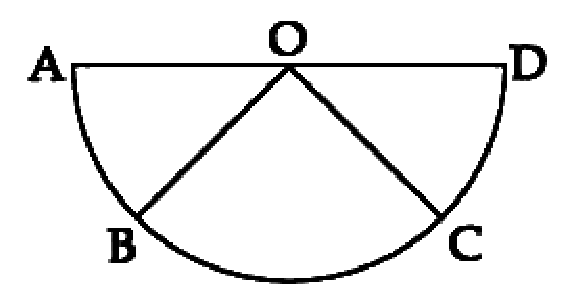
Assertion A: If A, B, C, D are four points on a semi-circular arc with centre at 'O' such that A B → + A C → + A D → = 4 A O → + O B → + O C → \overrightarrow{AB} + \overrightarrow{AC} + \overrightarrow{AD} = 4\overrightarrow{AO} + \overrightarrow{OB} + \overrightarrow{OC} A B + A C + A D = 4 A O + OB + OC
Reason R: Polygon law of vector addition yields A B → + B C → + C D → + A D → = 2 A O → \overrightarrow{AB} + \overrightarrow{BC} + \overrightarrow{CD} + \overrightarrow{AD} = 2\overrightarrow{AO} A B + BC + C D + A D = 2 A O
In the light of the above statements, choose the most appropriate answer from the options given below:
(a) A is correct but R is not correct. (b) A is not correct but R is correct. (c) Both A and R are correct and R is the correct explanation of A. (d) Both A and R are correct but R is not the correct explanation of A. Show answer and solution
Answer: (a)
Loading the solution…
Report a mistake Q23 JEE Main 2021 · 25 FEB · SHIFT 1 Difficult ☆
Addition & Subtraction of Vectors
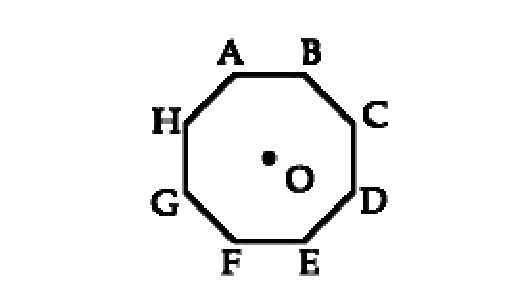
In an octagon ABCDEFGH of equal side, what is the sum of
A B → + A C → + A D → + A E → + A F → + A G → + A H → \overrightarrow{AB} + \overrightarrow{AC} + \overrightarrow{AD} + \overrightarrow{AE} + \overrightarrow{AF} + \overrightarrow{AG} + \overrightarrow{AH} A B + A C + A D + A E + A F + A G + A H
if, A O → = 2 i ^ + 3 j ^ − 4 k ^ \overrightarrow{AO} = 2\hat{i} + 3\hat{j} - 4\hat{k} A O = 2 i ^ + 3 j ^ − 4 k ^
(a) − 16 i ^ − 24 j ^ + 32 k ^ -16\hat{i} - 24\hat{j} + 32\hat{k} − 16 i ^ − 24 j ^ + 32 k ^ (b) 16 i ^ + 24 j ^ − 32 k ^ 16\hat{i} + 24\hat{j} - 32\hat{k} 16 i ^ + 24 j ^ − 32 k ^ (c) 16 i ^ + 24 j ^ + 32 k ^ 16\hat{i} + 24\hat{j} + 32\hat{k} 16 i ^ + 24 j ^ + 32 k ^ (d) 16 i ^ − 24 j ^ + 32 k ^ 16\hat{i} - 24\hat{j} + 32\hat{k} 16 i ^ − 24 j ^ + 32 k ^ Show answer and solution
Answer: (b)
Loading the solution…
Report a mistake Q24 MHT CET 2020 · 16 OCT · SHIFT 1 Easy ☆
Addition & Subtraction of Vectors
Two vectors of same magnitude have a resultant equal to either of the two vectors. The angle between two vectors is
(a) cos − 1 ( − 0.5 ) \cos^{-1}(-0.5) cos − 1 ( − 0.5 ) (b) cos − 1 ( − 0.4 ) \cos^{-1}(-0.4) cos − 1 ( − 0.4 ) (c) cos − 1 ( − 0.3 ) \cos^{-1}(-0.3) cos − 1 ( − 0.3 ) (d) cos − 1 ( − 0.6 ) \cos^{-1}(-0.6) cos − 1 ( − 0.6 ) Show answer and solution
Answer: (a)
Loading the solution…
Report a mistake Q25 MHT CET 2020 · 16 OCT · SHIFT 2 Medium ☆
Addition & Subtraction of Vectors
The resultant of two vector A \mathbf{A} A B \mathbf{B} B C \mathbf{C} C B \mathbf{B} B C \mathbf{C} C
Show answer and solution
Answer: (b)
Loading the solution…
Report a mistake Q26 JEE Main 2020 · 7 JAN · SHIFT 2 Difficult ☆
Addition & Subtraction of Vectors
The sum of two forces P ⃗ \vec{P} P Q ⃗ \vec{Q} Q R ⃗ \vec{R} R ∣ R ⃗ ∣ = ∣ P ⃗ ∣ \left|\vec{R}\right| = \left|\vec{P}\right| R = P θ \theta θ P ⃗ \vec{P} P Q ⃗ \vec{Q} Q Q ⃗ \vec{Q} Q
Numerical answer type. Work it out, then open the answer.
Show answer and solution
Answer: 90
Loading the solution…
Report a mistake Q27 MHT CET 2019 · 2 MAY · SHIFT 1 Medium ☆
Addition & Subtraction of Vectors
The resultant R \mathbf{R} R P \mathbf{P} P Q \mathbf{Q} Q P \mathbf{P} P ∣ P ∣ = ∣ R ∣ |\mathbf{P}| = |\mathbf{R}| ∣ P ∣ = ∣ R ∣ P \mathbf{P} P Q \mathbf{Q} Q [ tan 4 5 ∘ = 1 ] \left[\tan 45^\circ = 1\right] [ tan 4 5 ∘ = 1 ]
(a) 5 π 4 \frac{5\pi}{4} 4 5 π (b) 7 π 4 \frac{7\pi}{4} 4 7 π (c) π 4 \frac{\pi}{4} 4 π (d) 3 π 4 \frac{3\pi}{4} 4 3 π Show answer and solution
Answer: (d)
Loading the solution…
Report a mistake Q28 MHT CET 2019 · 2 MAY · SHIFT 1 Medium ☆
Addition & Subtraction of Vectors
If A 2 + B 2 \sqrt{A^2 + B^2} A 2 + B 2 ( A + B ) (\mathbf{A} + \mathbf{B}) ( A + B ) ( A − B ) (\mathbf{A} - \mathbf{B}) ( A − B )
(a) cos − 1 [ − 2 ( A 2 − B 2 ) ( A 2 + B 2 ) ] \cos^{-1}\left[-\frac{2(A^2 - B^2)}{(A^2 + B^2)}\right] cos − 1 [ − ( A 2 + B 2 ) 2 ( A 2 − B 2 ) ] (b) cos − 1 [ − A 2 − B 2 A 2 B 2 ] \cos^{-1}\left[-\frac{A^2 - B^2}{A^2 B^2}\right] cos − 1 [ − A 2 B 2 A 2 − B 2 ] (c) cos − 1 [ − ( A 2 + B 2 ) 2 ( A 2 − B 2 ) ] \cos^{-1}\left[-\frac{(A^2 + B^2)}{2(A^2 - B^2)}\right] cos − 1 [ − 2 ( A 2 − B 2 ) ( A 2 + B 2 ) ] (d) cos − 1 [ − ( A 2 − B 2 ) A 2 + B 2 ] \cos^{-1}\left[-\frac{(A^2 - B^2)}{A^2 + B^2}\right] cos − 1 [ − A 2 + B 2 ( A 2 − B 2 ) ] Show answer and solution
Answer: (c)
Loading the solution…
Report a mistake Q29 JEE Main 2019 · 10 JAN · SHIFT 2 Medium ☆
Addition & Subtraction of Vectors
Two vectors A ⃗ \vec{A} A B ⃗ \vec{B} B ( A ⃗ + B ⃗ ) \left(\vec{A} + \vec{B}\right) ( A + B ) ( A ⃗ − B ⃗ ) \left(\vec{A} - \vec{B}\right) ( A − B ) A ⃗ \vec{A} A B ⃗ \vec{B} B
(a) sin − 1 [ n − 1 n + 1 ] \sin^{-1}\left[\frac{n-1}{n+1}\right] sin − 1 [ n + 1 n − 1 ] (b) sin − 1 [ n 2 − 1 n 2 + 1 ] \sin^{-1}\left[\frac{n^2-1}{n^2+1}\right] sin − 1 [ n 2 + 1 n 2 − 1 ] (c) cos − 1 [ n 2 − 1 n 2 + 1 ] \cos^{-1}\left[\frac{n^2-1}{n^2+1}\right] cos − 1 [ n 2 + 1 n 2 − 1 ] (d) cos − 1 [ n − 1 n + 1 ] \cos^{-1}\left[\frac{n-1}{n+1}\right] cos − 1 [ n + 1 n − 1 ] Show answer and solution
Answer: (c)
Loading the solution…
Report a mistake Q30 JEE Main 2019 · 10 JAN · SHIFT 2 Medium ☆
Addition & Subtraction of Vectors
Two forces P and Q, of magnitude 2F and 3F, respectively, are at an angle θ \theta θ θ \theta θ
(a) 90o (b) 60o (c) 30o (d) 120o Show answer and solution
Answer: (d)
Loading the solution…
Report a mistake Q31 JEE Main 2015 · 11 APR · SHIFT 1 Medium ☆
Addition & Subtraction of Vectors
A vector A ⃗ \vec{A} A Δ θ \Delta\theta Δ θ Δ θ \Delta\theta Δ θ B ⃗ \vec{B} B
Show answer and solution
Answer: (c)
Loading the solution…
Report a mistake
No questions match these filters.

 , then
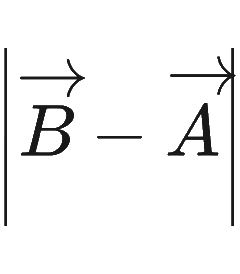 is: