Q1 MHT CET 2026 · 20 APR · SHIFT 1 Medium ☆
Vector (Cross) Product · Cross product & area
The area of parallelogram formed by vectors P ⃗ = 2 i ^ − j ^ + 5 k ^ \vec{P} = 2\hat{i} - \hat{j} + 5\hat{k} P = 2 i ^ − j ^ + 5 k ^ Q ⃗ = 3 i ^ − 2 j ^ + 4 k ^ \vec{Q} = 3\hat{i} - 2\hat{j} + 4\hat{k} Q = 3 i ^ − 2 j ^ + 4 k ^
(a) 72 \sqrt{72} 72 (b) 86 \sqrt{86} 86 (c) 104 \sqrt{104} 104 (d) 240 \sqrt{240} 240 Show answer and solution
Answer: (b)
Loading the solution…
Report a mistake Q2 MHT CET 2026 · 15 MAY · SHIFT 1 Medium ☆
Vector (Cross) Product · Dot–cross relations
If ∣ A ⃗ × B ⃗ ∣ = 3 ( A ⃗ ⋅ B ⃗ ) |\vec{A} \times \vec{B}| = \sqrt{3}(\vec{A} \cdot \vec{B}) ∣ A × B ∣ = 3 ( A ⋅ B ) ∣ A ⃗ + B ⃗ ∣ |\vec{A} + \vec{B}| ∣ A + B ∣ tan 6 0 ∘ = 3 cos 6 0 ∘ = 1 2 \tan 60^\circ = \sqrt{3} \quad \cos 60^\circ = \frac{1}{2} tan 6 0 ∘ = 3 cos 6 0 ∘ = 2 1
(a) [ A 2 + B 2 + A B 3 ] 1 2 \left[A^2 + B^2 + \frac{AB}{\sqrt{3}}\right]^{\frac{1}{2}} [ A 2 + B 2 + 3 A B ] 2 1 (b) A + B A + B A + B (c) ( A 2 + B 2 + 3 A B ) 1 2 (A^2 + B^2 + \sqrt{3}AB)^{\frac{1}{2}} ( A 2 + B 2 + 3 A B ) 2 1 (d) ( A 2 + B 2 + A B ) 1 2 (A^2 + B^2 + AB)^{\frac{1}{2}} ( A 2 + B 2 + A B ) 2 1 Show answer and solution
Answer: (d)
Loading the solution…
Report a mistake Q3 MHT CET 2026 · 19 APR · SHIFT 1 Medium ☆
Vector (Cross) Product · Dot–cross relations
For two vectors P ⃗ \vec{P} P Q ⃗ P ⃗ ⋅ Q ⃗ = ∣ P ⃗ × Q ⃗ ∣ \vec{Q} \quad \vec{P} \cdot \vec{Q} = |\vec{P} \times \vec{Q}| Q P ⋅ Q = ∣ P × Q ∣
The magnitude of R ⃗ = P ⃗ + Q ⃗ \vec{R} = \vec{P} + \vec{Q} R = P + Q cos 4 5 ∘ = 1 2 \cos 45^\circ = \frac{1}{\sqrt{2}} cos 4 5 ∘ = 2 1
(a) P 2 + Q 2 \sqrt{P^2 + Q^2} P 2 + Q 2 (b) P 2 + Q 2 2 \frac{\sqrt{P^2 + Q^2}}{\sqrt{2}} 2 P 2 + Q 2 (c) P 2 + Q 2 + P Q 2 \sqrt{P^2 + Q^2 + \frac{PQ}{\sqrt{2}}} P 2 + Q 2 + 2 PQ (d) P 2 + Q 2 + 2 P Q \sqrt{P^2 + Q^2 + \sqrt{2}\,PQ} P 2 + Q 2 + 2 PQ Show answer and solution
Answer: (d)
Loading the solution…
Report a mistake Q4 MHT CET 2025 · 26 APR · SHIFT 1 Easy ☆
Vector (Cross) Product · Cross product & area
If ∣ a ⃗ ∣ = 26 , ∣ b ⃗ ∣ = 7 |\vec{a}| = \sqrt{26}, \ |\vec{b}| = 7 ∣ a ∣ = 26 , ∣ b ∣ = 7
∣ a ⃗ × b ⃗ ∣ = 35 |\vec{a} \times \vec{b}| = 35 ∣ a × b ∣ = 35 a ⃗ ⋅ b ⃗ \vec{a} \cdot \vec{b} a ⋅ b
Show answer and solution
Answer: (d)
Loading the solution…
Report a mistake Q5 MHT CET 2025 · 25 APR · SHIFT 1 Easy ☆
Vector (Cross) Product · Cross product & area
Vector A ⃗ \vec{A} A 5 3 5\sqrt{3} 5 3 B ⃗ \vec{B} B 3 0 ∘ 30^\circ 3 0 ∘ [ sin 3 0 ∘ = 1 2 ] \left[\sin 30^\circ = \frac{1}{2}\right] [ sin 3 0 ∘ = 2 1 ]
(a) 5 3 5\sqrt{3} 5 3 (b) 10 units (c) 25 3 25\sqrt{3} 25 3 (d) 75 units Show answer and solution
Answer: (c)
Loading the solution…
Report a mistake Q6 MHT CET 2025 · 20 APR · SHIFT 1 Medium ☆
Vector (Cross) Product · Direction & triple product
If A ⃗ = i ^ + j ^ + 3 k ^ , B ⃗ = − i ^ + j ^ + 4 k ^ \vec{A} = \hat{i} + \hat{j} + 3\hat{k}, \ \vec{B} = -\hat{i} + \hat{j} + 4\hat{k} A = i ^ + j ^ + 3 k ^ , B = − i ^ + j ^ + 4 k ^ C ⃗ = 2 i ^ − 2 j ^ − 8 k ^ \vec{C} = 2\hat{i} - 2\hat{j} - 8\hat{k} C = 2 i ^ − 2 j ^ − 8 k ^ P ⃗ = A ⃗ + B ⃗ + C ⃗ \vec{P} = \vec{A} + \vec{B} + \vec{C} P = A + B + C Q ⃗ = ( A ⃗ × B ⃗ ) \vec{Q} = (\vec{A} \times \vec{B}) Q = ( A × B )
(a) 0 ∘ 0^\circ 0 ∘ (b) 4 5 ∘ 45^\circ 4 5 ∘ (c) 9 0 ∘ 90^\circ 9 0 ∘ (d) 6 0 ∘ 60^\circ 6 0 ∘ Show answer and solution
Answer: (c)
Loading the solution…
Report a mistake Q7 JEE Main 2024 · 6 APR · SHIFT 1 Medium ☆
Vector (Cross) Product · Direction & triple product
For three vectors A ⃗ = ( − x i ^ − 6 j ^ − 2 k ^ ) , B ⃗ = ( − i ^ + 4 j ^ + 3 k ^ ) \vec{A} = (-x\hat{i} - 6\hat{j} - 2\hat{k}), \ \vec{B} = (-\hat{i} + 4\hat{j} + 3\hat{k}) A = ( − x i ^ − 6 j ^ − 2 k ^ ) , B = ( − i ^ + 4 j ^ + 3 k ^ ) C ⃗ = ( − 8 i ^ − j ^ + 3 k ^ ) \vec{C} = (-8\hat{i} - \hat{j} + 3\hat{k}) C = ( − 8 i ^ − j ^ + 3 k ^ ) A ⃗ ⋅ ( B ⃗ × C ⃗ ) = 0 \vec{A} \cdot (\vec{B} \times \vec{C}) = 0 A ⋅ ( B × C ) = 0 x x x
Numerical answer type. Work it out, then open the answer.
Show answer and solution
Answer: 4
Loading the solution…
Report a mistake Q8 JEE Main 2023 · 25 JAN · SHIFT 1 Medium ☆
Vector (Cross) Product · Direction & triple product
If P ⃗ = 3 i ^ + 3 j ^ + 2 k ^ \vec{P} = 3\hat{i} + \sqrt{3}\hat{j} + 2\hat{k} P = 3 i ^ + 3 j ^ + 2 k ^ Q ⃗ = 4 i ^ + 3 j ^ + 2.5 k ^ \vec{Q} = 4\hat{i} + \sqrt{3}\hat{j} + 2.5\hat{k} Q = 4 i ^ + 3 j ^ + 2.5 k ^ P ⃗ × Q ⃗ \vec{P} \times \vec{Q} P × Q 1 x ( 3 i ^ + j ^ − 2 3 k ^ ) \frac{1}{x}\left(\sqrt{3}\hat{i} + \hat{j} - 2\sqrt{3}\hat{k}\right) x 1 ( 3 i ^ + j ^ − 2 3 k ^ ) x x x
Numerical answer type. Work it out, then open the answer.
Show answer and solution
Answer: 4
Loading the solution…
Report a mistake Q9 NEET 2022 · PHASE 2 Easy ☆
Vector (Cross) Product · Cross product & area
If F ⃗ = 2 i ^ + j ^ − k ^ \vec{F} = 2\hat{i} + \hat{j} - \hat{k} F = 2 i ^ + j ^ − k ^ r ⃗ = 3 i ^ + 2 j ^ − 2 k ^ \vec{r} = 3\hat{i} + 2\hat{j} - 2\hat{k} r = 3 i ^ + 2 j ^ − 2 k ^ F ⃗ \vec{F} F r ⃗ \vec{r} r
(a) 10, 2 (b) 5, 3 \sqrt{3} 3 (c) 4, 5 \sqrt{5} 5 (d) 10, 2 \sqrt{2} 2 Show answer and solution
Answer: (d)
Loading the solution…
Report a mistake Q10 JEE Main 2022 · 25 JUN · SHIFT 1 Easy ☆
Vector (Cross) Product · Cross product & area
A ⃗ \vec{A} A ∣ A ⃗ ∣ |\vec{A}| ∣ A ∣ A ⃗ \vec{A} A
(a) A ⃗ ⋅ A ⃗ = 0 \vec{A} \cdot \vec{A} = 0 A ⋅ A = 0 (b) A ⃗ × A ⃗ < 0 \vec{A} \times \vec{A} < 0 A × A < 0 (c) A ⃗ × A ⃗ = 0 \vec{A} \times \vec{A} = 0 A × A = 0 (d) A ⃗ × A ⃗ > 0 \vec{A} \times \vec{A} > 0 A × A > 0 Show answer and solution
Answer: (c)
Loading the solution…
Report a mistake Q11 JEE Main 2021 · 25 FEB · SHIFT 2 Easy ☆
Vector (Cross) Product · Cross product & area
If P ⃗ × Q ⃗ = Q ⃗ × P ⃗ \vec{P} \times \vec{Q} = \vec{Q} \times \vec{P} P × Q = Q × P P ⃗ \vec{P} P Q ⃗ \vec{Q} Q θ ( 0 ∘ \theta(0^\circ θ ( 0 ∘ θ \theta θ ∘ ^\circ ∘ θ \theta θ ∘ ^\circ ∘
Numerical answer type. Work it out, then open the answer.
Show answer and solution
Answer: 180
Loading the solution…
Report a mistake Q12 JEE Main 2021 · 20 JUL · SHIFT 1 Medium ☆
Vector (Cross) Product · Dot–cross relations
If A ⃗ \vec{A} A B ⃗ \vec{B} B A ⃗ B ⃗ \vec{A} \quad \vec{B} A B
(a) A 2 + B 2 + 2 A B \sqrt{A^2 + B^2 + \sqrt{2}AB} A 2 + B 2 + 2 A B (b) A 2 + B 2 \sqrt{A^2 + B^2} A 2 + B 2 (c) A 2 + B 2 − 2 A B \sqrt{A^2 + B^2 - \sqrt{2}AB} A 2 + B 2 − 2 A B (d) A 2 + B 2 + 2 A B \sqrt{A^2 + B^2 + 2AB} A 2 + B 2 + 2 A B Show answer and solution
Answer: (c)
Loading the solution…
Report a mistake Q13 JEE Main 2021 · 22 JUL · SHIFT 2 Difficult ☆
Vector (Cross) Product · Direction & triple product
Three particles P, Q and R are moving along the vectors A ⃗ = i ^ + j ^ B ⃗ = j ^ + k ^ \vec{A} = \hat{i} + \hat{j} \quad \vec{B} = \hat{j} + \hat{k} A = i ^ + j ^ B = j ^ + k ^ C ⃗ = − i ^ + j ^ \vec{C} = -\hat{i} + \hat{j} C = − i ^ + j ^ A ⃗ \vec{A} A B ⃗ \vec{B} B A ⃗ \vec{A} A C ⃗ \vec{C} C cos − 1 ( 1 x ) \cos^{-1}\left(\frac{1}{\sqrt{x}}\right) cos − 1 ( x 1 )
Numerical answer type. Work it out, then open the answer.
Show answer and solution
Answer: 3
Loading the solution…
Report a mistake Q14 MHT CET 2020 · 19 OCT · SHIFT 2 Easy ☆
Vector (Cross) Product · Cross product & area
What is the angle between resultant of A + B A + B A + B A × B \mathbf{A} \times \mathbf{B} A × B
(a) π rad \pi\text{ rad} π rad (b) 0 ∘ 0^\circ 0 ∘ (c) π 4 rad \frac{\pi}{4}\text{ rad} 4 π rad (d) π 2 rad \frac{\pi}{2}\text{ rad} 2 π rad Show answer and solution
Answer: (d)
Loading the solution…
Report a mistake Q15 JEE Main 2004 · AIEEE Easy ☆
Vector (Cross) Product · Cross product & area
If A ⃗ × B ⃗ = B ⃗ × A ⃗ \vec{A} \times \vec{B} = \vec{B} \times \vec{A} A × B = B × A
(a) π 2 \frac{\pi}{2} 2 π (b) π 3 \frac{\pi}{3} 3 π (c) π \pi π (d) π 4 \frac{\pi}{4} 4 π Show answer and solution
Answer: (c)
Loading the solution…
Report a mistake Q16 NEET 1999 · AIPMT Medium ☆
Vector (Cross) Product · Direction & triple product
What is the linear velocity if angular velocity vector ω ⃗ = 3 i ^ − 4 j ^ + k ^ \vec{\omega} = 3\hat{i} - 4\hat{j} + \hat{k} ω = 3 i ^ − 4 j ^ + k ^ r ⃗ = 5 i ^ − 6 j ^ + 6 k ^ \vec{r} = 5\hat{i} - 6\hat{j} + 6\hat{k} r = 5 i ^ − 6 j ^ + 6 k ^
(a) 6 i ^ + 2 j ^ − 3 k ^ 6\hat{i} + 2\hat{j} - 3\hat{k} 6 i ^ + 2 j ^ − 3 k ^ (b) − 18 i ^ − 13 j ^ + 2 k ^ -18\hat{i} - 13\hat{j} + 2\hat{k} − 18 i ^ − 13 j ^ + 2 k ^ (c) 18 i ^ + 13 j ^ − 2 k ^ 18\hat{i} + 13\hat{j} - 2\hat{k} 18 i ^ + 13 j ^ − 2 k ^ (d) 6 i ^ − 2 j ^ + 8 k ^ 6\hat{i} - 2\hat{j} + 8\hat{k} 6 i ^ − 2 j ^ + 8 k ^ Show answer and solution
Answer: (b)
Loading the solution…
Report a mistake
No questions match these filters.
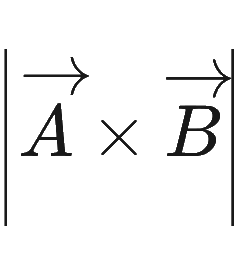 . Then the value of
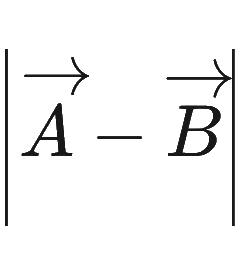 will be: