0 of 83 attemptedPick an answer to see the solution
Q1MHT CET 2026 · 13 MAY · SHIFT 1Easy
Doppler Effect · Moving source
A whistle sends out 256 waves in a second. If the whistle approaches the observer with velocity (31)rd of the velocity of sound in air. The number of waves per second observer will receive is
A whistle giving out 400 Hz approaches a stationary observer at a speed of 34 m/s. The frequency heard by the observer (in Hz) is nearly (speed of sound=340 m/s)
A train is moving towards a stationary observer with speed 34 m/s. A train sounds a whistle of frequency 450 Hz. If the speed of sound is 340 m/s, the frequency heard by the observer in Hz is
An observer moves towards a stationary source of sound with a velocity (51)th of the velocity of sound. The percentage increase in the apparent frequency is
A person observes two moving trains. 'A' reaching the station and 'B' leaving the station with equal speed of 30m/s. If both trains emit sounds with frequency 300 Hz, (speed of sound = 330 m/s) difference of frequencies heard by the person will be
A source of sound is moving towards a stationary observer with velocity 'VS' and then moves away with velocity 'VS'. Assume that medium through which the sound waves travel is at rest. If 'V' is the velocity of sound and 'n' is the frequency emitted by the source then the difference between the apparent frequencies heard by the observer is
When the observer moves towards a stationary source with velocity 'V1 ', the apparent frequency of the emitted note is 'F1 '. When the observer moves away from the source with velocity 'V1', the apparent frequency is 'F2'. If 'V' is the speed of sound in air and F1/F2=2, then V/V1=
Two sirens situated one km apart are producing sound of frequency 330 Hz. The observer starts moving from one siren to the other with a speed of 2 m/s. If the speed of sound is 330 m/s, What will be the beat frequency heard by the observer?
An observer moves towards a stationary source of sound with a velocity of one fifth of the velocity of sound. The percentage increase in the apparent frequency is
A person observes two moving trains. First reaching the station and another leaves the station with equal speed of 30 m/s. If both trains emit sounds of frequency 300 Hz, difference of frequencies heard by the person will be (speed of sound in air 330 m/s)
When the observer moves towards a stationary source with velocity V1, the apparent frequency of emitted note is F1. When observer moves away from the source with velocity V1, the apparent frequency is F2. If V is the velocity of sound in air and F1/F2=2 then V/V1 is equal to
When an observer moves towards a stationary source with velocity ' V1 ', the apparent frequency of emitted note is ' F1 '. When observer moves away from stationary source with velocity ' V1 ' the apparent frequency is ' F2 '. If ' v ' is velocity of sound in air and F2F1=2, then V1V is equal to
A source of sound emits sound wave of frequency ' f ' and moves towards an observer with a velocity 3V where V is the velocity of sound. If the observer moves away from the source with a velocity 5V the apparent frequency heard by him will be
If a source emitting waves of frequency ' F ' moves towards an observer with a velocity 3V and the observer moves away from the source with a velocity 4V, the apparent frequency as heard by the observer will be ( V= velocity of sound)
A vehicle starts from rest and accelerates along straight path at 2 m/s2. At the starting point of the vehicle, there is a stationary electric siren. How far has the vehicle nearly gone when the driver hears the siren at 94% of its value when the vehicle was at rest?
An observer moves towards a stationary source of sound with a velocity of one-fifth of the velocity of sound. The percentage increase in the apparent frequency is
A train sounding a whistle of frequency 510 Hz approaches a station at 72 km/hr. The frequency of the note heard by an observer on the platform as the train (1) approaches the station and then (2) recedes the station are respectively (in hertz) (velocity of sound in air =320 m/s)
When the listener moves towards stationary source with velocity ' V1 ', the apparent frequency of emitted note is ' F1 '. When observer moves away from the source with velocity ' V1 ', apparent frequency is ' F2 '. If V is the velocity of sound in air and F2F1=2 then V1V is
A source and listener are both moving towards each other with speed 10V. (where V is speed of sound) If the frequency of sound note emitted by the source is ' n ', then the frequency heard by the listener would be nearly
The pitch of a whistle of an engine appears to drop by 30% of original value when it passes a stationary observer. If the speed of sound in air is 350 ms−1, then the speed of engine in ms−1 is
Doppler Effect · Reflection from a wall or moving obstacle
The driver of a car travelling with a speed ' V1 ' m/s towards a wall sounds a siren of frequency ' n ' Hz. If the velocity of sound in air is V m/s, then the frequency of sound reflected from the wall and as heard by the driver, in Hz, is
Doppler Effect · Reflection from a wall or moving obstacle
The driver of a car travelling with a speed ' V1 ' m/s towards a wall sounds a siren of frequency ' n ' Hz. If the velocity of sound in air is ' V ' m/s, then the frequency of the sound reflected from the wall and as heard by the driver in Hz is
Q29JEE Main 2023 · 25 JAN · SHIFT 2EasyOld syllabus
Doppler Effect · Moving source
A train blowing a whistle of frequency 320 Hz approaches an observer standing on the platform at a speed of 66 m/s. The frequency observed by the observer will be (given speed of sound = 330 ms −1) __________ Hz.
Numerical answer type. Work it out, then open the answer.
A passenger is sitting in a train which is moving fast. The engine of the train blows a whistle of frequency 'n'. If the apparent frequency of sound heard by the passenger is 'f' then
When both source and listener are approaching each other the observed frequency of sound is given by (VL and VS is the velocity of listener and source respectively, n0= radiated frequency)
Q32JEE Main 2023 · 11 APR · SHIFT 2EasyOld syllabus
Doppler Effect · Source and observer both moving
A car P travelling at 20 ms−1 sounds its horn at a frequency of400 Hz. Another car Q is travelling behind the first car in the same direction with a velocity 40 ms−1. The frequency heard by the passenger of the car Q is approximately [Take, velocity of sound =360 ms−1 ]
Q33JEE Main 2023 · 8 APR · SHIFT 1EasyOld syllabus
Doppler Effect · Source and observer both moving
The engine of a train moving with speed 10 ms−1 towards a platform sounds a whistle at frequency 400 Hz. The frequency heard by a passenger inside the train is: (neglect air speed. Speed of sound in air =330 ms−1)
Q34JEE Main 2023 · 29 JAN · SHIFT 1EasyOld syllabus
Doppler Effect · Source and observer both moving
A person observes two moving trains, 'A' reaching the station and 'B' leaving the station with equal speed of 30 m/s. If both trains emit sounds with frequency 300 Hz, (Speed of sound: 330 m/s) approximate difference of frequencies heard by the person will be:
A car sounding a horn of frequency 1000 Hz passes a stationary observer. The ratio of frequencies of the horn noted by the observer before and after passing the car is 11:9. If the speed of sound is 'v', the speed of the car is
Consider the Doppler effect in two cases. In the first case, an observer moves towards a stationary source of sound with a speed of 50 m/s. In the second case, the observer is at rest and the source moves towards the observer with the same speed of 50 m/s. Then the frequency heard by the observer will be
Q37JEE Main 2023 · 6 APR · SHIFT 1MediumOld syllabus
Doppler Effect · Reflection from a wall or moving obstacle
A person driving car at a constant speed of 15 m/s is approaching a vertical wall. The person notices a change of 40 Hz in the frequency of his car's horn upon reflection from the wall. The frequency of horn is _______________ Hz.
(Given: Speed of sound: 330 m/s)
Numerical answer type. Work it out, then open the answer.
Q38JEE Main 2022 · 27 JUN · SHIFT 1EasyOld syllabus
Doppler Effect · Moving observer
An observer moves towards a stationary source of sound with a velocity equal to one-fifth of the velocity of sound. The percentage change in the frequency will be:
Q39JEE Main 2022 · 28 JUL · SHIFT 1EasyOld syllabus
Doppler Effect · Reflection from a wall or moving obstacle
The frequency of echo will be __________ Hz if the train blowing a whistle of frequency 320 Hz is moving with a velocity of 36 km/h towards a hill from which an echo is heard by the train driver. Velocity of sound in air is 330 m/s.
Numerical answer type. Work it out, then open the answer.
Q40JEE Main 2022 · 26 JUL · SHIFT 1MediumOld syllabus
Doppler Effect · Source and observer both moving
When a car is approaching the observer, the frequency of horn is 100 Hz. After passing the observer, it is 50 Hz. If the observer moves with the car, the frequency will be 3x Hz where x= ________________.
Numerical answer type. Work it out, then open the answer.
Q41JEE Main 2022 · 30 JUN · SHIFT 1DifficultOld syllabus
Doppler Effect · Source and observer both moving
An employee of a factory moving away from his workplace by a car listens to the siren of the factory. He drives the car at the speed of 72 kmh−1 in the direction of wind which is blowing at 72 kmh−1 speed. Frequency of siren is 720 Hz. The employee hears an apparent frequency of ____________ Hz.
(Assume speed of sound to be 340 ms−1)
Numerical answer type. Work it out, then open the answer.
Q42JEE Main 2022 · 25 JUL · SHIFT 1DifficultOld syllabus
Doppler Effect · Beats from the Doppler effect
An observer is riding on a bicycle and moving towards a hill at 18 kmh−1. He hears a sound from a source at some distance behind him directly as well as after its reflection from the hill. If the original frequency of the sound as emitted by source is 640 Hz and velocity of the sound in air is 320 m/s, the beat frequency between the two sounds heard by observer will be _____________ Hz.
Numerical answer type. Work it out, then open the answer.
Q43JEE Main 2021 · 27 AUG · SHIFT 1EasyOld syllabus
Doppler Effect · Source and observer both moving
Two cars X and Y are approaching each other with velocities 36 km/h and 72 km/h respectively. The frequency of a whistle sound as emitted by a passenger in car X, heard by the passenger in car Y is 1320 Hz. If the velocity of sound in air is 340 m/s, the actual frequency of the whistle sound produced is .................. Hz.
Numerical answer type. Work it out, then open the answer.
Q44JEE Main 2021 · 26 AUG · SHIFT 1EasyOld syllabus
Doppler Effect · Source and observer both moving
A source and a detector move away from each other in absence of wind with a speed of 20 m/s with respect to the ground. If the detector detects a frequency of 1800 Hz of the sound coming from the source, then the original frequency of source considering speed of sound in air 340 m/s will be ............... Hz.
Numerical answer type. Work it out, then open the answer.
Q45JEE Main 2021 · 20 JUL · SHIFT 1MediumOld syllabus
Doppler Effect · Reflection from a wall or moving obstacle
The frequency of a car horn encountered a change from 400 Hz to 500 Hz, when the car approaches a vertical wall. If the speed of sound is 330 m/s. Then the speed of car is ___________ km/h.
Numerical answer type. Work it out, then open the answer.
Q46JEE Main 2021 · 24 FEB · SHIFT 2MediumOld syllabus
Doppler Effect · Beats from the Doppler effect
Two cars are approaching each other at an equal speed of 7.2 km/hr. When they see each other, both blow horns having frequency of 676 Hz. The beat frequency heard by each driver will be ___________ Hz. [Velocity of sound in air is 340 m/s.]
Numerical answer type. Work it out, then open the answer.
Doppler Effect · Reflection from a wall or moving obstacle
An obstacle is moving towards the source with velocity v. The sound is reflected from the obstacle. If c is the speed of sound and λ is the wavelength, then the wavelength of the reflected wave λr is
Q48JEE Main 2020 · 5 SEP · SHIFT 2MediumOld syllabus
Doppler Effect · Reflection from a wall or moving obstacle
A driver in a car, approaching a vertical wall notices that the frequency of his car horn, has changed from 440 Hz to 480 Hz, when it gets reflected from the wall. If the speed of sound in air is 345 m/s, then the speed of the car is:
Q49JEE Main 2020 · 4 SEP · SHIFT 2MediumOld syllabus
Doppler Effect · Reflection from a wall or moving obstacle
The driver of a bus approaching a big wall notices that the frequency of his bus's horn changes from 420 Hz to 490 Hz when he hears it after it gets reflected from the wall. Find the speed of the bus if speed of the sound is 330 ms–1.
Q50JEE Main 2020 · 6 SEP · SHIFT 1DifficultOld syllabus
Doppler Effect · Moving source
A sound source S is moving along a straight track with speed v, and is emitting, sound of frequency v0 (see figure). An observer is standing at a finite distance, at the point O, from the track. The time variation of frequency heard by the observer is best represented by:
(t0 represents the instant when the distance between the source and observer is minimum)
Q51JEE Main 2020 · 7 JAN · SHIFT 2DifficultOld syllabus
Doppler Effect · Beats from the Doppler effect
A stationary observer receives sound from two identical tuning forks, one of which approaches and the other one recedes with the same speed (much less than the speed of sound). The observer hears 2 beats/sec. The oscillation frequency of each tuning fork is v0 = 1400 Hz and the velocity of sound in air is 350 m/s. The speed of each tuning fork is close to:
Q52JEE Main 2019 · 9 APR · SHIFT 2EasyOld syllabus
Doppler Effect · Source and observer both moving
Two cars A and B are moving away from each other in opposite directions. Both the cars are moving with a speed of 20 ms–1 with respect to the ground. If an observer in car A detects a frequency 2000 Hz of the sound coming from car B, what is the natural frequency of the sound source in car B?
Q53JEE Main 2019 · 10 APR · SHIFT 2MediumOld syllabus
Doppler Effect · Moving source
A source of sound S is moving with a velocity of 50 m/s towards a stationary observer. The observer measures the frequency of the source as 1000 Hz. What will be the apparent frequency of the source when it is moving away from the observer after crossing him? (Take velocity of sound in air is 350 m/s)
Q54JEE Main 2019 · 10 JAN · SHIFT 1MediumOld syllabus
Doppler Effect · Moving source
A train moves towards a stationary observer with speed 34 m/s. The train sounds a whistle and its frequency registered by the observer is ƒ1. If the speed of the train is reduced to 17 m/s, the frequency registered is ƒ2. If speed of sound is 340 m/s, then the ratio ƒ1/ƒ2 is -
Q55JEE Main 2019 · 10 APR · SHIFT 1MediumOld syllabus
Doppler Effect · Moving observer
A stationary source emits sound waves of frequency 500 Hz. Two observers moving along a line passing through the source detect sound to be of frequencies 480 Hz and 530 Hz. Their respective speeds are, in ms–1, (Given speed of sound = 300 m/s)
Q56JEE Main 2019 · 9 JAN · SHIFT 2MediumOld syllabus
Doppler Effect · Moving observer
A musician using an open flute of length 50 cm producess second harmonic sound waves. A person runs towards the musician from another end of hall at a speed of 10 km/h. If the wave speed is 330 m/s, the frequency heard by the running person shall be close to:
Q57JEE Main 2019 · 12 APR · SHIFT 1MediumOld syllabus
Doppler Effect · Reflection from a wall or moving obstacle
A submarine (A) travelling at 18 km/hr is being chased along the line of its velocity by another submarine (B) travelling at 27 km/hr. B sends a sonar signal of 500 Hz to detect A and receives a reflected sound of frequency v. The value of v is close to: (Speed of sound in water =1500 ms–1)
Q58JEE Main 2019 · 12 APR · SHIFT 2MediumOld syllabus
Doppler Effect · Beats from the Doppler effect
Two sources of sound S1 and S2 produce sound waves of same frequency 660 Hz. A listener is moving from source S1 towards S2 with a constant speed u m/s and he hears 10 beats/s. The velocity of sound is 330 m/s. Then, u equals:
Two cars moving in opposite directions approach each other with speed of 22 ms−1 and 16.5 m s−1 respectively. The driver of the first car blows a horn having a frequency 400 Hz. The frequency heard by the driver of the second car is (velocity of sound is 340 m s−1)
An observer is moving with half the speed of light towards a stationary microwave source emitting waves at frequency 10 GHz. What is the frequency of the microwave measured by the observer? (speed of light = 3 ×10⁸ ms–1)
Q61JEE Main 2016 · 9 APR · SHIFT 1MediumOld syllabus
Doppler Effect · Source and observer both moving
Two engines pass each other moving in opposite directions with uniform speed of 30 m/s. One of them is blowing a whistle of frequency 540 Hz. Calculate the frequency heard by driver of second engine before they pass each other. Speed of sound is 330 m/sec:
Doppler Effect · Reflection from a wall or moving obstacle
A siren emitting a sound of frequency 800 Hz moves away from an observer towards a cliff at a speed of 15 m s−1. Then, the frequency of sound that the observer hears in the echo reflected from the cliff is
Q63JEE Main 2016 · 10 APR · SHIFT 1DifficultOld syllabus
Doppler Effect · Beats from the Doppler effect
A toy-car, blowing its horn, is moving with a steady speed of 5 m/s, away from a wall. An observer, towards whom the toy car is moving, is able to hear 5 beats per second. If the velocity of sound in air is 340 m/s, the frequency of the horn of the toy car is close to:
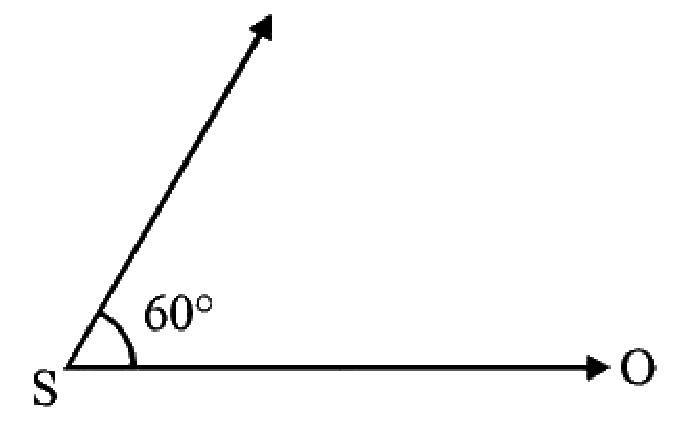
A source of sound S emitting waves of frequency 100 Hz and an observer O are located at some distance from each other. The source is moving with a speed of 19.4 m s−1 at an angle of 60° with the source observer line as shown in the figure. The observer is at rest. The apparent frequency observed by the observer (velocity of sound in air 330 m s−1), is
Q65JEE Main 2015 · 10 APR · SHIFT 1MediumOld syllabus
Doppler Effect · Reflection from a wall or moving obstacle
A bat moving at 10 ms−1 towards a wall sends a sound signal of 8000 Hz towards it. On reflection it hears a sound of frequency f. The value of f in Hz is close to (speed of sound = 320 ms−1)
Q66JEE Main 2015 · 11 APR · SHIFT 1DifficultOld syllabus
Doppler Effect · Source and observer both moving
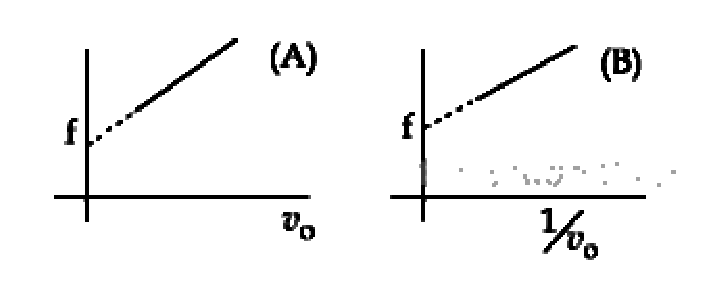
A source of sound emits sound waves at frequency f0. It is moving towards an observer with fixed speed vs (vs < v, where v is the speed of the sound in air). If the observer were to move towards the source with speed v0, one of the following two graphs (A and B) will give the correct variation of the frequency f heard by the observer as v0 is changed.
A train is moving on a straight track with speed 20 ms−1. It is blowing its whistle at the frequency of 1000 Hz. The percentage change in the frequency heard by a person standing near the track as the train passes him is (speed of sound =320 ms−1) close to:
Q68JEE Main 2014 · 11 APR · SHIFT 1EasyOld syllabus
Doppler Effect · Beats from the Doppler effect
Two factories are sounding their sirens at 800 Hz. A man goes from one factory to other at a speed of 2 m/s. The velocity of sound is 320 m/s. The number of beats heard by the person in one second will be:
A speeding motorcyclist sees traffic jam ahead him. He slows down to 36 km hour−1. He finds that traffic has eased and a car moving ahead of him at 18 km hour−1 is honking at a frequency of 1392 Hz. If the speed of sound is 343 m s−1, the frequency of the honk as heard by him will be
Q70JEE Main 2014 · 12 APR · SHIFT 1DifficultOld syllabus
Doppler Effect · Moving source
A source of sound A emitting waves of frequency 1800 Hz is falling towards ground with a terminal speed v. The observer B on the ground directly beneath the source receives waves of frequency 2150 Hz, The source A receives waves, reflected from ground, of frequency nearly: (Speed of sound = 343 m/s)
Two sources P and Q produce notes of frequency 660 Hz. each. A listener moves from P to Q with a speed of 1 ms−1. If the speed of sound is 330 m/s, then the number of beats heard by the listener per second will be
Q72JEE Main 2013 · 22 APR · SHIFT 1MediumOld syllabus
Doppler Effect · Beats from the Doppler effect
A and B are two sources generating sound waves. A listener is situated at C. The frequency of the source at A is 500 Hz. A, now, moves towards C with a speed 4 m/s. The number of beats heard at C is 6. When A moves away from C with speed 4 m/s, the number of beats heard at C is 18. The speed of sound is 340 m/s. The frequency of the source at B is:
Doppler Effect · Reflection from a wall or moving obstacle
A train moving at a speed of 220 m s−1 towards a stationary object, emits a sound of frequency 1000 Hz. Some of the sound reaching the object gets reflected back to the train as echo. The frequency of the echo as detected by the driver of the train is
Doppler Effect · Reflection from a wall or moving obstacle
The driver of a car travelling with speed 30 m/s towards a hill sounds a horn of frequency 600 Hz. If the velocity of sound in air is 330 m/s, the frequency of reflected sound as heard by driver is
A motor cycle starts from rest and accelerates along a straight path at 2 m/s2. At the starting point of the motor cycle there is a stationary electric siren. How far has the motor cycle gone when the driver hears the frequency of the siren at 94% of its value when the motor cycle was at rest? (Speed of sound =330 ms−1)
A whistle producing sound waves of frequencies 9500 Hz and above is approaching a stationary person with speed v ms−1. The velocity of sound in air is 300 ms−1. If the person can hear frequencies upto a maximum of 10,000 Hz, the maximum value of v upto which he can hear whistle is
An observer moves towards a stationary source of sound, with a velocity one-fifth of the velocity of sound. What is the percentage increase in the apparent frequency?
Doppler Effect · Reflection from a wall or moving obstacle
A car is moving towards a high cliff. The driver sounds a horn of frequency f. The reflected sound heard by the driver has frequency 2f. If v is the velocity of sound, then the velocity of the car, in the same velocity units, will be
An observer moves towards a stationary source of sound with a speed 1/5th of the speed of sound. The wavelength and frequency of the source emitted are λ and f respectively. The apparent frequency and wavelength recorded by the observer are respectively
A whistle revolves in a circle with angular speed ω = 20 rad/s using a string of length 50 cm. If the frequency of sound from the whistle is 385 Hz, then what is the minimum frequency heard by an observer which is far away from the centre (velocity of sound = 340 m/s)
Two stationary sources each emitting waves of wavelength λ, an observer moves from one source to another with velocity u. Then number of beats heard by him
A vehicle, with a horn of frequency n is moving with a velocity of 30 m/s in a direction perpendicular to the straight line joining the observer and the vehicle. The observer perceives the sound to have a frequency n+n1. Then (if the sound velocity in air is 300 m/s)
Two trains move towards each other with the same speed. The speed of sound is 340 m/s. If the height of the tone of the whistle of one of them heard on the other changes to 9/8 times, then the speed of each train should be