A man standing between two parallel cliffs fires a gun. He hear two echos one after 3 second and the other after 5 second. The separation between the two cliffs is 1360 m, the speed of sound is
A person standing between two parallel cliffs fires a gun and hears two echoes, first echo after 1 second and second echo after 3 second. The distance between the two cliffs is (The velocity of sound =330 m/s)
Two sound waves each of wavelength λ and same amplitude A interfere at point Q. If the path difference is 4λ, the amplitude of the resultant wave at point Q is [sin2π=1,cos2π=0]
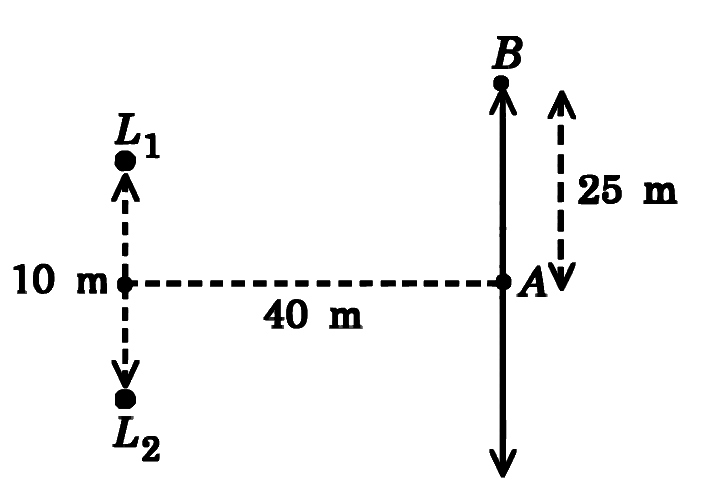
Two loudspeakers (L1 and L2) are placed with a separation of 10 m, as shown in figure. Both speakers are fed with an audio input signal of same frequency with constant volume. A voice recorder, initially at point A, at equidistant to both loudspeakers, is moved by 25 m along the line AB while monitoring the audio signal. The measured signal was found to undergo 10 cycles of minima and maxima during the movement. The frequency of the input signal is ______ Hz (Speed of sound in air is 324 m/s and 5=2.23)
Numerical answer type. Work it out, then open the answer.
A person standing between two parallel cliffs fires a gun and hears two echoes, first echo after 1 second and the second echo after 3 second. The distance between the two cliffs is (Velocity of sound =340 m/s)
The amplitude and phase of a wave that is formed by the superposition of two harmonic travelling waves, y1(x,t)=4sin(kx−ωt) and y2(x,t)=2sin(kx−ωt+32π), are:
(Take the angular frequency of initial waves same as ω)
Two sound waves having same amplitude ' A ' and angular frequency ' ω ' but having a phase difference of (2π)c are superimposed then the maximum amplitude of the resultant wave is
Two simple harmonic waves having equal amplitudes of 8 cm and equal frequency of 10 Hz are moving along the same direction. The resultant amplitude is also 8 cm. The phase difference between the individual waves is _________ degree.
Numerical answer type. Work it out, then open the answer.
Q13JEE Main 2022 · 25 JUL · SHIFT 2EasyOld syllabus
Reflection, Superposition & Interference
Two waves executing simple harmonic motions travelling in the same direction with same amplitude and frequency are superimposed. The resultant amplitude is equal to the 3 times of amplitude of individual motions. The phase difference between the two motions is ___________ (degree).
Numerical answer type. Work it out, then open the answer.
Two waves are simultaneously passing through a string and their equations are: y1 = A1 sin k(x − vt), y2 = A2 sin k(x − vt + x0). Given amplitudes A1 = 12 mm and A2 = 5 mm, x0 = 3.5 cm and wave number k = 6.28 cm−1. The amplitude of resulting wave will be ................ mm.
Numerical answer type. Work it out, then open the answer.
Three harmonic waves having equal frequency ν and same intensity I0, have phase angles 0, 4π and −4π respectively. When they are superimposed the intensity of the resultant wave is close to:
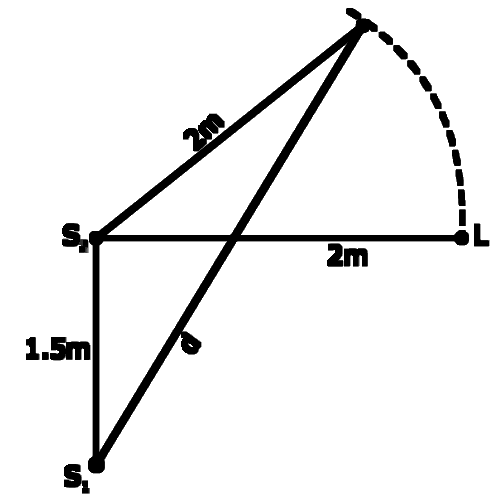
Two coherent sources of sound, S1 and S2, produce sound waves of the same wavelength, λ = 1 m, in phase. S1 and S2 are placed 1.5 m apart (see fig). A listener, located at L, directly in front of S2 finds that the intensity is at a minimum
when he is 2 m away from S2. The listener moves away from S1, keeping his distance from S2 fixed. The adjacent maximum of intensity is observed when the listener is at a distance d from S1. Then, d is:
An engine approaches a hill with a constant speed. When it is at a distance of 0.9 km, it blows a whistle whose echo is heard by the driver after 5 seconds. If the speed of sound in air is 330 m/s, then the speed of the engine is:
Two periodic waves of intensities I1 and I2 pass through a region at the same time in the same direction. The sum of the maximum and minimum intensities is
Two waves having equation x1 = asin(ωt − kx + ϕ1), x2 = asin(ωt −kx + ϕ2). If in the resultant wave the frequency and amplitude remain equal to amplitude of superimposing waves, the phase difference between them is
Wave has simple harmonic motion whose period is 4 seconds while another wave which also possesses simple harmonic motion has its period 3 second. If both are combined, then the resultant wave will have the period equal to