
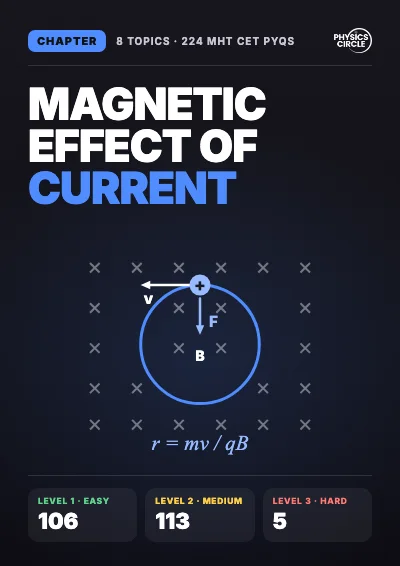
Moving Charges and Magnetism Formula Book
66 formulas in 8 topics, in the same order as the PYQ topics.
Only formulas used in the solutions of 224 MHT CET PYQs (Level 1, 2, 3)Biot-Savart Law & Circular Coils
12 formulas · from 53 MHT CET PYQs
- Biot-Savart law
- Field at the centre of a coil of n turns
- Field at the centre of an arc of angle theta
- Field on the axis of a coil
- Centre vs axis
- Far point on the axis
- Charge going round f times per second
- Electron in a circular orbit
- Same wire wound into n turns
- Two concentric coils, opposite currents
- Two coils at right angles, same centre
- Field at the nucleus in Bohr's nth orbit
Magnetic Field of Straight Wires
5 formulas · from 31 MHT CET PYQs
- Field of a long straight wire
- Semi-infinite wire, point opposite its end
- Semi-infinite wire + semicircle
- Circular loop with straight wire
- Coil and wire give equal fields
🔒 For Vajra 2.0 Pro studentsTopic 1 is free. Log in with your Vajra 2.0 Pro number to see every formula.
Ampere's Law, Cylinders, Solenoid & Toroid
7 formulas · from 23 MHT CET PYQs
- Ampere's circuital law
- Inside a long solid cylinder (r < R)
- Outside a long cylinder
- Long solenoid
- Solenoid with a core
- Magnetic intensity
- Toroid
🔒 For Vajra 2.0 Pro studentsTopic 1 is free. Log in with your Vajra 2.0 Pro number to see every formula.
Moving Charge in a Magnetic Field
9 formulas · from 26 MHT CET PYQs
- Magnetic force on a moving charge
- Lorentz force
- Magnetic force does no work
- Radius of the circular path
- Accelerated through V
- Time period and angular frequency
- Mass from radius (mass spectrometer)
- KE for a given radius
- Cyclotron: maximum speed and KE
🔒 For Vajra 2.0 Pro studentsTopic 1 is free. Log in with your Vajra 2.0 Pro number to see every formula.
Force on Current-Carrying Conductors
6 formulas · from 24 MHT CET PYQs
- Force on a current-carrying conductor
- Force per length between parallel wires
- Equal currents
- Wire held up by magnetic force
- Wire floating above another wire
- Third law: equal and opposite forces
🔒 For Vajra 2.0 Pro studentsTopic 1 is free. Log in with your Vajra 2.0 Pro number to see every formula.
Current Loop as a Magnetic Dipole
13 formulas · from 46 MHT CET PYQs
- Magnetic moment of a coil
- Torque on a coil
- Maximum torque
- Wire of length L as a circle / square
- Fixed wire of length L wound into N turns
- Orbiting electron
- Gyromagnetic ratio
- Electron: moment opposite to L
- Bohr orbit: moment in nth orbit
- Charge rotating with angular speed omega
- Moment from field at centre
- Ratio B/M for a circular loop
- Moment of a solenoid from its flux
🔒 For Vajra 2.0 Pro studentsTopic 1 is free. Log in with your Vajra 2.0 Pro number to see every formula.
Moving Coil Galvanometer, Ammeter & Voltmeter
7 formulas · from 14 MHT CET PYQs
- Moving coil galvanometer
- Shunt to make an ammeter
- Shunt for n times the range
- Fraction of current through the galvanometer
- Series resistance to make a voltmeter
- Series resistance in terms of V_g = I_g G
- Resistance of a wire
🔒 For Vajra 2.0 Pro studentsTopic 1 is free. Log in with your Vajra 2.0 Pro number to see every formula.
Other: Induction & Displacement Current
7 formulas · from 7 MHT CET PYQs
- Magnetic flux
- Motional emf
- Magnetic force on the moving rod
- Terminal velocity of a falling rod
- Rod rotating about one end
- Energy stored in an inductor
- Magnetic moment of a bar magnet
🔒 For Vajra 2.0 Pro studentsTopic 1 is free. Log in with your Vajra 2.0 Pro number to see every formula.