
Moving Charge in a Magnetic Field
When an electron is kept in a strong magnetic field, then
Show answer and solution
Answer: (d)
Loading the solution…
Home›Practice Hub›Chapters›Moving Charges and Magnetism›Moving Charge in a Magnetic Field
Moving Charges and Magnetism PYQs · MHT CET · JEE Main · NEET
 Magnetic Effect of Current (One Shot) · Most Repeated PYQs1:10:06All 2 Moving Charges and Magnetism videos →
Moving Charge in a Magnetic Field
When an electron is kept in a strong magnetic field, then
Answer: (d)
Moving Charge in a Magnetic Field
Lorentz magnetic force is acting on a particle of charge moving with velocity in magnetic field . The work done by this force on the charged particle is
Answer: (a)
Moving Charge in a Magnetic Field
A current carrying solenoid is placed vertically and a particle of mass with charge is released from rest. The particle moves along the axis of solenoid. If is acceleration due to gravity then the acceleration (a) of the charged particle will satisfy:
Answer: (d)
Moving Charge in a Magnetic Field
The charged particle moving in a uniform magnetic field of has an acceleration . The value of is
Numerical answer type. Work it out, then open the answer.
Answer: 12
Moving Charge in a Magnetic Field
A charged particle of mass and charge travels on a circular path, (of radius unit) is perpendicular to a magnetic field . The time taken by a particle to complete revolutions is
Answer: (b)
Moving Charge in a Magnetic Field
A charge moves in a circular path perpendicular to a magnetic field. The time period of revolution is independent of
Answer: (b)
Moving Charge in a Magnetic Field
In the cyclotron, as radius of the circular path of the charged particle increases, ( = angular velocity, V = linear velocity)
Answer: (b)
Moving Charge in a Magnetic Field
1 μC charge moving with velocity m/s in the region of magnetic field T. The magnitude of force acting on it is N. The value of is _______.
Numerical answer type. Work it out, then open the answer.
Answer: 171
Moving Charge in a Magnetic Field
Two particles X and Y of masses '' and '' respectively, having equal charges after being accelerated through the same potential difference enter a region of uniform magnetic field and describe circular paths of radii ' ' and '' respectively. The ratio of '' and '' is
Answer: (c)
Moving Charge in a Magnetic Field
A charged particle is moving in a uniform magnetic field in a circular path of radius 'R'. When the energy of the particle becomes 3 times the original, the new radius will be
Answer: (c)
Moving Charge in a Magnetic Field
A charged particle is accelerated by a potential difference of enters a region of uniform magnetic field of induction at right angles to the direction of the field. The charged particle completes semi circle of the radius inside the magnetic field. The mass of the charged particle is (all quantities are in SI units)
Answer: (b)
Moving Charge in a Magnetic Field
A 5 mg particle carrying a charge of is moving with velocity of in a region having magnetic field . It moves a distance of meter along when it completes 5 revolutions. The value of is ______。
Numerical answer type. Work it out, then open the answer.
Answer: 2
Moving Charge in a Magnetic Field
A particle having charge C moving in plane in fields of N/C and T experiences a force of N. The velocity of the particle at that instant is _________ m/s.
Answer: (a)
Moving Charge in a Magnetic Field
A particle of charge and mass is projected from origin with an initial velocity . There exists a uniform magnetic field and a space varying electric field within the region . After travelling a distance such that -coordinate has changed from to , the change in the kinetic energy is ______.
Answer: (a)
Moving Charge in a Magnetic Field
Lorentz magnetic force is acting on a particle of charge q moving with velocity in a magnetic field . The work done by this force on the charged particle is
Answer: (a)
Moving Charge in a Magnetic Field
Given below are two statements. One is labelled as Assertion (A) and the other is labelled as Reason (R).
Assertion (A): An electron in a certain region of uniform magnetic field is moving with constant velocity in a straight line path.
Reason (R): The magnetic field in that region is along the direction of velocity of the electron. In the light of the above statements, choose the correct answer from the options given below:
Answer: (b)
Moving Charge in a Magnetic Field
A particle of charge and mass is present in a strong magnetic field of 6.28 T. The particle is then fired perpendicular to magnetic field. The time required for the particle to return to original location for the first time is _________ s.
Numerical answer type. Work it out, then open the answer.
Answer: 0
Moving Charge in a Magnetic Field
A particle of charge moves with a velocity in a magnetic field , where ' ', ' b ' and ' c ' are constants. The magnitude of force experienced by particle is
Answer: (a)
Moving Charge in a Magnetic Field
A particle of charge , mass and kinetic energy enters in magnetic field perpendicular to its velocity and undergoes a circular arc of radius (r). Which of the following curves represents the variation of with ?
Answer: (a)
Moving Charge in a Magnetic Field
Given below are two statements: one is labelled as Assertion A and the other is labelled as Reason
Assertion A: If Oxygen ion and Hydrogen ion enter normal to the magnetic field with equal momentum, then the path of ion has a smaller curvature than that of . Reason R: A proton with same linear momentum as an electron will form a path of smaller radius of curvature on entering a uniform magnetic field perpendicularly.
In the light of the above statements, choose the correct answer from the options given below
Answer: (c)
Moving Charge in a Magnetic Field
An electron (mass and charge ) moving with speed speed of light) is injected into a magnetic field of magnitude perpendicular to its direction of motion. We wish to apply a uniform electric field together with the magnetic field so that the electron does not deflect from its path. Then (speed of light )
Answer: (d)
Moving Charge in a Magnetic Field
A proton is moving undeflected in a region of crossed electric and magnetic fields at a constant speed of . When the electric field is switched off, the proton moves along a circular path of radius 2 cm. The magnitude of electric field is . The value of is _________. Take the mass of the proton .
Numerical answer type. Work it out, then open the answer.
Answer: 2
Moving Charge in a Magnetic Field
Consider a long thin conducting wire carrying a uniform current I. A particle having mass " " and charge " " is released at a distance " " from the wire with a speed along the direction of current in the wire. The particle gets attracted to the wire due to magnetic force. The particle turns round when it is at distance from the wire. The value of is [ is vacuum permeability]
Answer: (b)
Moving Charge in a Magnetic Field
Bohr model is applied to a particle of mass m and charge is moving in a plane under the influence of a transverse magnetic field (B). The energy of the charged particle in the second level will be ( Planck's constant)
Answer: (c)
Moving Charge in a Magnetic Field
Uniform magnetic fields of different strengths and , both normal to the plane of the paper exist as shown in the figure. A charged particle of mass and charge , at the interface at an instant, moves into the region 2 with velocity and returns to the interface. It continues to move into region 1 and finally reaches the interface. What is the displacement of the particle during this movement along the interface?
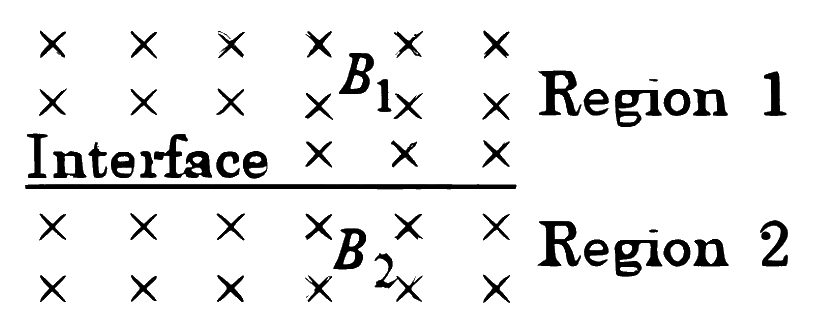
(Consider the velocity of the particle to be normal to the magnetic field and )
Answer: (a)
Moving Charge in a Magnetic Field
An electron projected perpendicular to a uniform magnetic field B moves in a circle. If Bohr's quantization is applicable, then the radius of the electronic orbit in the first excited state is:
Answer: (a)
Moving Charge in a Magnetic Field
A charged particle is moving along a magnetic field line. What is the magnetic force acting on the particle?
Answer: (c)
Moving Charge in a Magnetic Field
The electrostatic force and magnetic force acting on a charge moving with velocity can be written:
Answer: (c)
Moving Charge in a Magnetic Field
An electron is projected with uniform velocity along the axis inside a current carrying long solenoid. Then:
Answer: (d)
Moving Charge in a Magnetic Field
A charge of is moving with a velocity of along the positive axis under a magnetic field of strength . The force acting on the charge is . The value of is __________.
Numerical answer type. Work it out, then open the answer.
Answer: 32
Moving Charge in a Magnetic Field
Cyclotron is used to
Answer: (b)
Moving Charge in a Magnetic Field
An electron moves through a uniform magnetic field . At a particular instant of time, the velocity of electron is . If the magnetic force acting on electron is , where is the charge of electron, then the value of is _________ .
Numerical answer type. Work it out, then open the answer.
Answer: 5
Moving Charge in a Magnetic Field
A charged particle is moving in a uniform magnetic field in a circular path of radius ' '. When the kinetic energy of the particle is increased to three times, then the new radius will be
Answer: (c)
Moving Charge in a Magnetic Field
Electron of mass ' ' and charge ' ' is travelling with speed ' ' along a circular path of radius ' ' at right angles to a uniform magnetic field of intensity ' B '. If the speed of the electron is halved and the magnetic field is doubled, the resulting path would have radius
Answer: (b)
Moving Charge in a Magnetic Field
A charged particle of charge ' ' is accelerated by a potential difference ' ' enters a region of uniform magnetic field ' ' at right angles to the direction of field. The charged particle completes semicircle of radius ' ' inside magnetic field. The mass of the charged particle is
Answer: (a)
Moving Charge in a Magnetic Field
A charged particle is moving in a uniform magnetic field in a circular path with radius ' '. When the energy of the particle is doubled, then the new radius will be
Answer: (d)
Moving Charge in a Magnetic Field
A proton and a deuteron having same kinetic energies enter a region of uniform magnetic field , moving perpendicular to . The ratio of the radius of deuteron path to the radius of the proton path is:
Answer: (c)
Moving Charge in a Magnetic Field
Two particles and having equal charges are being accelerated through the same potential difference. Thereafter they enter normally in a region of uniform magnetic field and describe circular paths of radii and respectively. The mass ratio of and is:
Answer: (d)
Moving Charge in a Magnetic Field
A proton moving with a constant velocity passes through a region of space without any change in its velocity. If and represent the electric and magnetic fields respectively, then the region of space may have:
(A)
(B)
(C)
(D)
Choose the most appropriate answer from the options given below:
Answer: (c)
Moving Charge in a Magnetic Field
An electron with kinetic energy enters a region of uniform magnetic field of 3 perpendicular to its direction. An electric field is applied perpendicular to the direction of velocity and magnetic field. The value of E, so that electron moves along the same path, is __________ . (Given, mass of electron , electric charge )
Numerical answer type. Work it out, then open the answer.
Answer: 4
Moving Charge in a Magnetic Field
An electron is projected along the axis of circular conductor carrying current I. Electron will experience
Answer: (a)
Moving Charge in a Magnetic Field
An electron is moving along the positive -axis. If the uniform magnetic field is applied parallel to the negative z-axis, then
A. The electron will experience magnetic force along positive y-axis
B. The electron will experience magnetic force along negative y-axis
C. The electron will not experience any force in magnetic field
D. The electron will continue to move along the positive -axis
E. The electron will move along circular path in magnetic field
Choose the correct answer from the options given below:
Answer: (c)
Moving Charge in a Magnetic Field
An electron is allowed to move with constant velocity along the axis of current carrying straight solenoid.
A. The electron will experience magnetic force along the axis of the solenoid.
B. The electron will not experience magnetic force.
C. The electron will continue to move along the axis of the solenoid.
D. The electron will be accelerated along the axis of the solenoid.
E. The electron will follow parabolic path-inside the solenoid.
Choose the correct answer from the options given below:
Answer: (b)
Moving Charge in a Magnetic Field
A charge particle moving in magnetic field B, has the components of velocity along B as well as perpendicular to B. The path of the charge particle will be
Answer: (a)
Moving Charge in a Magnetic Field
A uniform electric field and a uniform magnetic field are acting along the same direction in a certain region. If an electron is projected in the region such that its velocity is pointed along the direction of fields, then the electron:
Answer: (c)
Moving Charge in a Magnetic Field
Electron of mass '' and charge '' is travelling with speed '' along a circular path of radius '', at right angles to a uniform magnetic field of intensity ''. If the speed of the electron is halved and the magnetic field is doubled, the resulting path would have radius
Answer: (d)
Moving Charge in a Magnetic Field
A charge particle of accelerated by a potential difference of enters a region of uniform magnetic field of magnitude at right angle to the direction of field. The charge particle completes semicircle of radius inside magnetic field. The mass of the charge particle is __________
Numerical answer type. Work it out, then open the answer.
Answer: 144
Moving Charge in a Magnetic Field
A proton with a kinetic energy of moves into a region of uniform magnetic field of magnitude . The angle between the direction of magnetic field and velocity of proton is . The pitch of the helical path taken by the proton is __________ . (Take, mass of proton and Charge on proton ).
Numerical answer type. Work it out, then open the answer.
Answer: 40
Moving Charge in a Magnetic Field
Given below are two statements:
Statement I: The electric force changes the speed of the charged particle and hence changes its kinetic energy; whereas the magnetic force does not change the kinetic energy of the charged particle.
Statement II: The electric force accelerates the positively charged particle perpendicular to the direction of electric field. The magnetic force accelerates the moving charged particle along the direction of magnetic field.
In the light of the above statements, choose the most appropriate answer from the options given below:
Answer: (c)
Moving Charge in a Magnetic Field
Given below are two statements: One is labelled as Assertion (A) and the other is labelled as Reason (R).
Assertion (A): In an uniform magnetic field, speed and energy remains the same for a moving charged particle.
Reason (R): Moving charged particle experiences magnetic force perpendicular to its direction of motion.
Answer: (a)
Moving Charge in a Magnetic Field
An electron and a proton having the same momenta enter perpendicularly into a magnetic field. What are their trajectories in the field?
Answer: (d)
Moving Charge in a Magnetic Field
A charge particle moves along circular path in a uniform magnetic field in a cyclotron. The kinetic energy of the charge particle increases to 4 times its initial value. What will be the ratio of new radius to the original radius of circular path of the charge particle:
Answer: (c)
Moving Charge in a Magnetic Field
A proton and an alpha particle of the same velocity enter in a uniform magnetic field which is acting perpendicular to their direction of motion. The ratio of the radii of the circular paths described by the alpha particle and proton is:
Answer: (c)
Moving Charge in a Magnetic Field
A deuteron and a proton moving with equal kinetic energy enter into a uniform magnetic field at right angle to the field. If rd and rp are the radii of their circular paths respectively, then the ratio will be : 1 where x is __________.
Numerical answer type. Work it out, then open the answer.
Answer: 2
Moving Charge in a Magnetic Field
A charge particle is moving in a uniform magnetic field . If it has an acceleration of , then the value of will be:
Answer: (b)
Moving Charge in a Magnetic Field
Two charged particles, having same kinetic energy, are allowed to pass through a uniform magnetic field perpendicular to the direction of motion. If the ratio of radii of their circular paths is and their respective masses ratio is . Then, the ratio of their charges will be:
Answer: (b)
Moving Charge in a Magnetic Field
A proton, a deuteron and an -particle with same kinetic energy enter into a uniform magnetic field at right angle to magnetic field. The ratio of the radii of their respective circular paths is:
Answer: (d)
Moving Charge in a Magnetic Field
A singly ionized magnesium atom (A = 24) ion is accelerated to kinetic energy 5 keV, and is projected perpendicularly into a magnetic field B of the magnitude 0.5 T. The radius of path formed will be _____________ cm.
Numerical answer type. Work it out, then open the answer.
Answer: 10
Moving Charge in a Magnetic Field
A velocity selector consists of electric field and magnetic field with . The value of required for an electron of energy moving along the positive -axis to pass undeflected is:
(Given, mass of electron )
Answer: (a)
Moving Charge in a Magnetic Field
A cyclotron is used to accelerate protons. If the operating magnetic field is and the radius of the cyclotron 'dees' is , the kinetic energy of the accelerated protons in MeV will be: ]
Answer: (b)
Moving Charge in a Magnetic Field
A cyclotron is working at a frequency of 10 MHz. If the radius of its dees is 60 cm. The maximum kinetic energy of accelerated proton will be:
(Take: e = 1.6 1019 C, mp = 1.67 1027 kg)
Answer: (a)
Moving Charge in a Magnetic Field
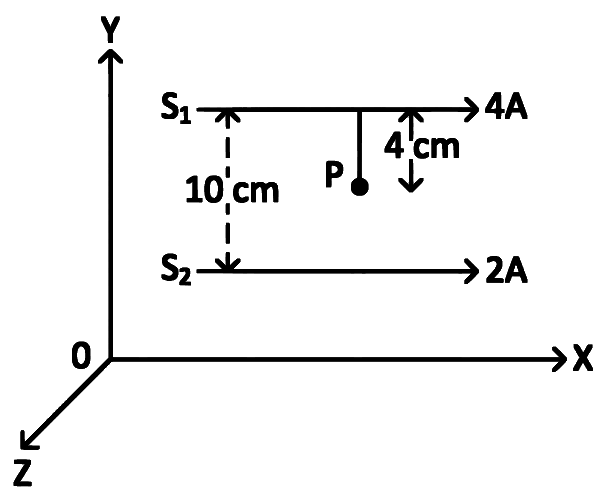
Two long parallel conductors S1 and S2 are separated by a distance 10 cm and carrying currents of 4A and 2A respectively. The conductors are placed along x-axis in X-Y plane. There is a point P located between the conductors (as shown in figure).
A charged particle of 3 coulomb is passing through the point P with velocity m/s; where and represents unit vector along x & y axis respectively.
The force acting on the charged particle is N. The value of x is:
Answer: (c)
Moving Charge in a Magnetic Field
An electron is projected along the axis of circular conductor carrying current '' The electron will experience
Answer: (d)
Moving Charge in a Magnetic Field
A charge Q is moving distance in the magnetic field . Find the value of work done by .
Answer: (a)
Moving Charge in a Magnetic Field
Two ions having same mass have charges in the ratio 1: 2. They are projected normally in a uniform magnetic field with their speeds in the ratio 2: 3. The ratio of the radii of their circular trajectories is:
Answer: (b)
Moving Charge in a Magnetic Field
A charge moves with velocity '' through electric field as well as magnetic field (B). then the force acting on it is
Answer: (c)
Moving Charge in a Magnetic Field
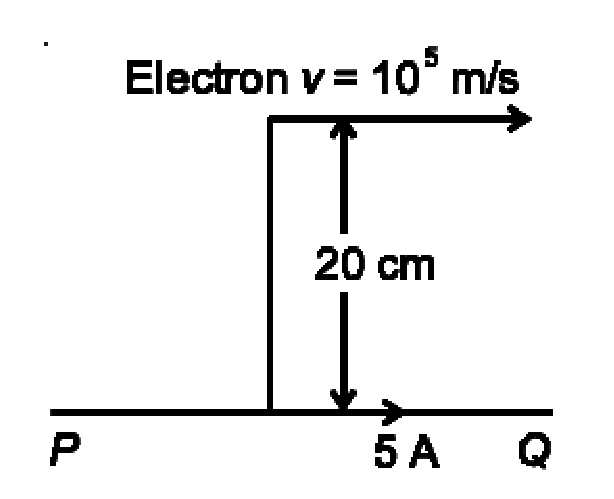
An infinitely long straight conductor carries a current of 5A as shown. An electron is moving with a speed of 105 m/s parallel to the conductor. The perpendicular distance between the electron and the conductor is 20cm at an instant. Calculate the magnitude of the force experienced by the electron at that instant.
Answer: (a)
Moving Charge in a Magnetic Field
Two ions of masses 4 amu and 16 amu have charges +2e and +3e respectively. These ions pass through the region of constant perpendicular magnetic field. The kinetic energy of both ions is same. Then:
Answer: (b)
Moving Charge in a Magnetic Field
A deuteron and an alpha particle having equal kinetic energy enter perpendicularly into a magnetic field. Let rd and r be their respective radii of circular path. The value of is equal to:
Answer: (c)
Moving Charge in a Magnetic Field
A proton and an -particle, having kinetic energies Kp and K respectively, enter into a magnetic field at right angles.
The ratio of the radii of trajectory of proton to that of -particle is 2: 1. The ratio of Kp: K is:
Answer: (b)
Moving Charge in a Magnetic Field
A proton, a deuteron and an particle are moving with same momentum in a uniform magnetic field. The ratio of magnetic forces acting on them is _________ and their speed is _______, in the ratio.
Answer: (a)
Moving Charge in a Magnetic Field
If the maximum value of accelerating potential provided by a radio frequency oscillator is 12 kV. The number of revolutions made by a proton in a cyclotron to achieve one sixth of the speed of light is ...............
[mp = 1.67 1027 kg, e = 1.6 1019 C, Speed of light = 3 108 m/s]
Numerical answer type. Work it out, then open the answer.
Answer: 543
Moving Charge in a Magnetic Field
A charge moves with velocity through electric field as well as magnetic field (B). Then, the force acting on it is
Answer: (c)
Moving Charge in a Magnetic Field
A charged particle carrying charge 1 C is moving
with velocity ms–1. If an external
magnetic field of × 10–3 T exists in the region where the particle is moving then the force on the particle is × 10–9 N. The vector is:
Answer: (c)
Moving Charge in a Magnetic Field
Proton with kinetic energy of 1MeV moves from south to north. It gets an acceleration of 1012 m/s2 by an applied magnetic field (west to east). The value of magnetic field: (Rest mass of proton is 1.6 × 10⁻²⁷ kg):
Answer: (a)
Moving Charge in a Magnetic Field
An -particle of energy 10 eV is moving in a circular path in uniform magnetic field. The energy of proton moving in the same path and same magnetic field will be [mass of -particle times mass of proton]
Answer: (d)
Moving Charge in a Magnetic Field
A charged particle is moving in a uniform magnetic field in a circular path of radius . When the energy of the particle becomes three times the original, the new radius will be
Answer: (b)
Moving Charge in a Magnetic Field
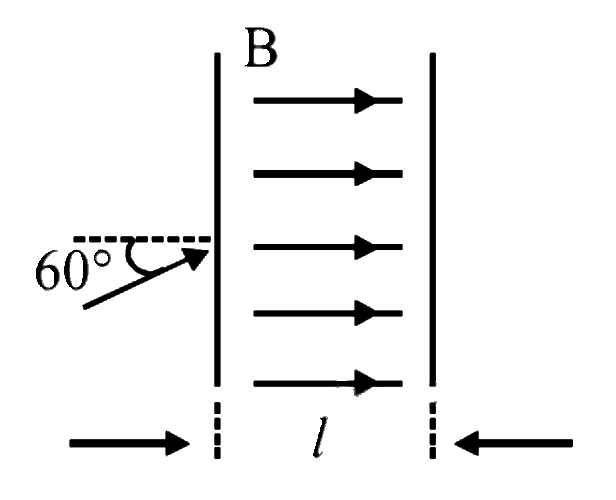
The figure shows a region of length ‘l’ with a uniform magnetic field of 0.3 T in it and a proton entering the region with velocity 4 105 ms–1 making an angle 60° with the field. If the proton completes 10 revolution by the time it cross the region shown, ‘l’ is close to
(mass of proton = 1.67 10–27 kg, charge of the proton = 1.6 10–19 C)
Answer: (d)
Moving Charge in a Magnetic Field
A beam of protons with speed 4 × 10⁵ ms–1 enters a uniform magnetic field of 0.3 T at an angle of 60° to the magnetic field. The pitch of the resulting helical path of protons is close to: (Mass of the proton = 1.67 10–27 kg, charge
of the proton = 1.69 10–19 C)
Answer: (d)
Moving Charge in a Magnetic Field
An electron is moving along +x direction with a velocity of 6 106 ms–1. It enters a region of uniform electric field of 300 V/cm pointing along +y direction. The magnitude and direction of the magnetic field set up in this region such that the electron keeps moving along the x direction will be:
Answer: (c)
Moving Charge in a Magnetic Field
A particle of charge q and mass m is moving with a velocity (v 0) towards a large screen placed in the Y - Z plane at a distance d. If there is a magnetic field , the maximum value of v for which the particle will not hit the screen is:
Answer: (d)
Moving Charge in a Magnetic Field
An electron gun is placed inside a long solenoid of radius R on its axis. The solenoid has n turns/length and carries a current I. The electron gun shoots an electron along the radius of the solenoid with speed v. If the electron does not hit the surface of the solenoid, maximum possible value of v is (all symbols have their standard meaning):
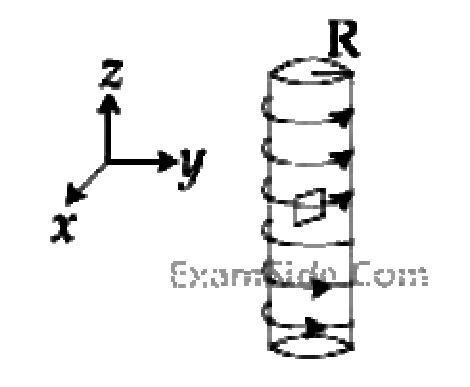
Answer: (c)
Moving Charge in a Magnetic Field
A charged particle of mass 'm' and charge 'q' moving under the influence of uniform electric field and a uniform magnetic field follows a trajectory from point P to Q as shown in figure. The velocities at P and Q are respectively, and . Then which of the following statements (A, B, C, D) are correct?
(Trajectory shown is schematic and not to scale):
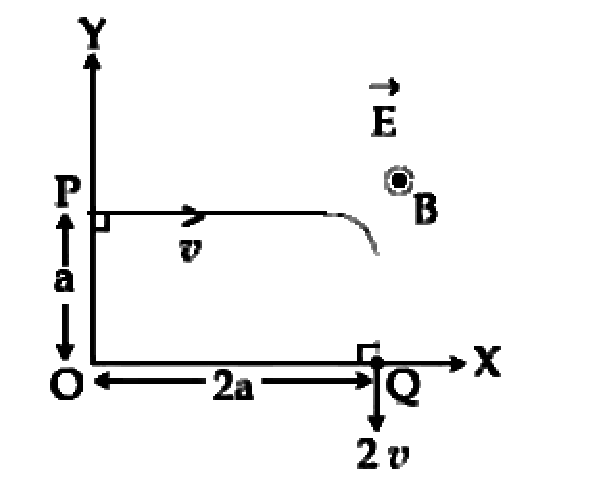
(A) E =
(B) Rate of work done by the electric field at P is
(C) Rate of work done by both the fields at Q is zero
(D) The difference between the magnitude of angular momentum of the particle at P and Q is 2mav.
Answer: (b)
Moving Charge in a Magnetic Field
A particle of mass m and charge q has an initial velocity. If an electric field and magnetic field act on the particle, its speed will double after a time:
Answer: (c)
Moving Charge in a Magnetic Field
Ionized hydrogen atoms and -particles with same momenta enters perpendicular to a constant magnetic field, B. The ratio of their radii of their paths rH: r will be:
Answer: (d)
Moving Charge in a Magnetic Field
Maximum kinetic energy gained by the charged particle in the cyclotron is independent of
Answer: (d)
Moving Charge in a Magnetic Field
A proton, an electron, and a Helium nucleus, have the same energy. They are in circular orbits in a plane due to magnetic field perpendicualr to the plane. Let rp, re and rHe be their respective radii, then
Answer: (b)
Moving Charge in a Magnetic Field
A proton and an -particle (with their masses in the ratio of 1: 4 and charges in the ratio of 1: 2) are accelerated from rest through a potential difference V. If a uniform magnetic field (B) is set up perpendicular to their velocities, the ratio of the radii rp: r of the circular paths described by them will be;
Answer: (c)
Moving Charge in a Magnetic Field
In an experiment, electrons are accelerated, from rest, by applying a voltage of 500 V. Calculate the radius of the path if a magnetic field 100 mT is then applied. [Charge of the electron = 1.6 10–19 C Mass of the electron = 9.1 10–31 kg]
Answer: (a)
Moving Charge in a Magnetic Field
A particle of mass m and charge q is in an electric and magnetic field given by
The charged particle is shifted from the origin to the point P(x = 1; y = 1) along a straight path. The magnitude of the total work done is:
Answer: (d)
Moving Charge in a Magnetic Field
A particle having the same charge as of electron moves in a circular path of radius 0.5 cm under the influence of a magnetic field of 0.5 T. If an electric field of 100 V/m makes it to move in a straight path, then the mass of the particle is (Given charge of electron = 1.6 1019 C)
Answer: (d)
Moving Charge in a Magnetic Field
An electron, moving along the x-axis with an initial energy of 100 eV, enters a region of magnetic field at S (See figure). The field extends between x = 0 and x = 2 cm. The electron is detected at the point Q on a screen placed 8 cm away from the point S. The distance d between P and Q (on the screen) is: (electron’s charge = 1.6 × 10⁻¹⁹ C, mass of electron = 9.1 × 10⁻³¹ kg)
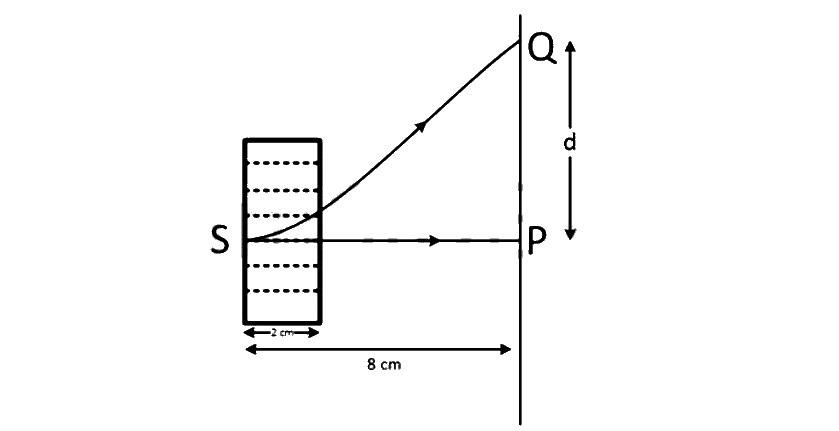
Answer: (b)
Moving Charge in a Magnetic Field
The region between y = 0 and y = d contains a magnetic field . A particle of mass m and charge q enters the region with a velocity If d the acceleration of the charged particle at the point of its emergence at the other side is:
Answer: (a)
Moving Charge in a Magnetic Field
An electron, a proton and an alpha particle having the same kinetic energy are moving in circular orbits of radii re, rp, r respectively in a uniform magnetic field B. The relation between re, rp, r is:
Answer: (c)
Moving Charge in a Magnetic Field
A negative test charge is moving near a long straight wire carrying a current. The force acting on the test charge is parallel to the direction of the current. The motion of the charge is:
Answer: (b)
Moving Charge in a Magnetic Field
In a certain region static electric and magnetic fields exist. The magnetic field is given by . If a test charge moving with a velocity experiences no force in that region, then the electric field in the region, in SI units, is:
Answer: (d)
Moving Charge in a Magnetic Field
An electron is moving in a circular path under the influence of a transverse magnetic field of 3.57 10-2 T. If the value of e/m is 1.76 1011 C kg, the frequency of revolution of the electron is
Answer: (a)
Moving Charge in a Magnetic Field
A proton and an alpha particle both enter a region of uniform magnetic field B, moving at right angles to the field B. If the radius of circular orbits for both the particles is equal and the kinetic energy acquired by proton is 1 MeV, the energy acquired by the alpha particle will be
Answer: (b)
Moving Charge in a Magnetic Field
A proton (mass m) accelerated by a potential difference V flies through a uniform transverse magnetic field B. The field occupies a region of space by width 'd'. If '' be the angle of deviation of proton from initial direction of motion (see figure), the value of sin will be:
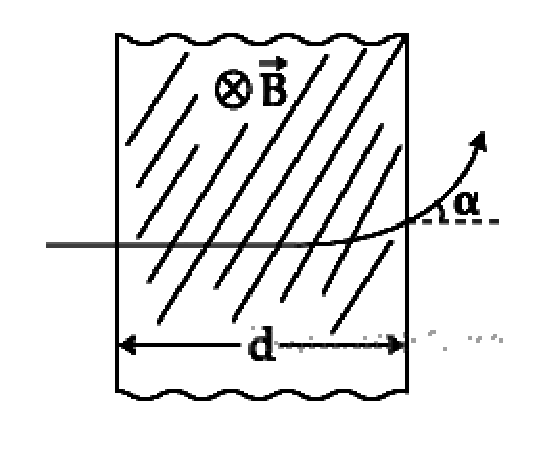
Answer: (c)
Moving Charge in a Magnetic Field
A positive charge 'q' of mass 'm' is moving along the + x axis. We wish to apply a uniform magnetic field B for time t so that the charge reverses its direction crossing the y axis at a distance d. Then:
Answer: (c)
Moving Charge in a Magnetic Field
A particle of charge C moving with velocity 10 ms along x-axis enters a region where magnetic field of induction is along the y-axis and an electric field of magnitude Vm is along the negative z-axis. If the charged particle continues moving along x-axis, the magnitude of is:
Answer: (c)
Moving Charge in a Magnetic Field
A long straight wire carries a certain current and produces a magnetic field 2 104 Wb m at a perpendicular distance of 5 cm from the wire. An electron situated at 5 cm from the wire moves with a velocity 107 m/s towards the wire along perpendicular to it. The force experienced by the electron will be (charge on electron 1.6 1019 C)
Answer: (b)
Moving Charge in a Magnetic Field
When a proton is released from rest in a room, it starts with an initial acceleration 0 towards west. When it is projected towards north with a speed 0 it moves with an initial acceleration 30 towards west. The electric and magnetic fields in the room are
Answer: (d)
Moving Charge in a Magnetic Field
A proton carrying 1 MeV kinetic energy is moving in a circular path of radius R in uniform magnetic field. What should be the energy of an -particle to describe a circle of same radius in the same field?
Answer: (b)
Moving Charge in a Magnetic Field
Proton, deuteron and alpha particle of same kinetic energy are moving in circular trajectories in a constant magnetic field. The radii of proton, deuteron and alpha particle are respectively and . Which one of the following relations is correct?
Answer: (b)
Moving Charge in a Magnetic Field
An alternating electric field, of frequency , is applied across the dees (radius = R) of a cyclotron that is being used to accelerate protons (mass = m). The operating magnetic field (B) used in the cyclotron and the kinetic energy (K) of the proton beam, produced by it, are given by
Answer: (c)
Moving Charge in a Magnetic Field
A uniform electric field and a uniform magnetic field are acting along the same direction in a certain region. If an electron is projected in the region such that its velocity is pointed along the direction of fields, then the electron
Answer: (b)
Moving Charge in a Magnetic Field
A particle having a mass of 102 kg carries a charge of 5 108 C. The particle is given an initial horizontal velocity of 105 m s in the presence of electric field and magnetic field . To keep the particle moving in a horizontal direction, it is necessary that
(1) should be perpendicular to the direction of velocity and should be along the direction of velocity
(2) Both and should be along the direction of velocity
(3) Both and are mutually perpendicular and perpendicular to the direction of velocity. (4) should be along the direction of velocity and should be perpendicular to the direction of velocity
Which one of the following pairs of statements is possible?
Answer: (c)
Moving Charge in a Magnetic Field
The magnetic force acting on a charged particle of charge 2 C in a magnetic field of 2 T acting in y direction, when the particle velocity is , is
Answer: (d)
Moving Charge in a Magnetic Field
Under the influence of a uniform magnetic field, a charged particle moves with constant speed v in a circle of radius R. The time period of rotation of the particle
Answer: (b)
Moving Charge in a Magnetic Field
A particle of mass m, charge Q and kinetic energy T enters a transverse uniform magnetic field of induction . After 3 seconds the kinetic energy of the particle will be
Answer: (a)
Moving Charge in a Magnetic Field
A charged particle moves through a magnetic field perpendicular to its direction. Then
Answer: (b)
Moving Charge in a Magnetic Field
Under the influence of a uniform magnetic field, a charged particle moves with constant speed v in a circle of radius R. The time period of rotation of the particle
Answer: (b)
Moving Charge in a Magnetic Field
A charged particle with charge enters a region of constant, uniform and mutually orthogonal fields and with a velocityperpendicular to both and and comes out without any change in magnitude or direction of. Then
Answer: (b)
Moving Charge in a Magnetic Field
When a charged particle moving with velocityis subjected to a magnetic field of induction , the force on it is non-zero. This implies that
Answer: (d)
Moving Charge in a Magnetic Field
In a region, steady and uniform electric and magnetic fields are present. These two fields are parallel to each other. A charged particle is released from rest in this region. The path of the particle will be a
Answer: (b)
Moving Charge in a Magnetic Field
A charged particle of mass and charge travels on a circular path of radius that is perpendicular to a magnetic field The time taken by the particle to complete one revolution is
Answer: (c)
Moving Charge in a Magnetic Field
A uniform electric field and a uniform magnetic field are acting along the same direction in a certain region. If an electron is projected along the direction of the fields with a certain velocity then
Answer: (b)
Moving Charge in a Magnetic Field
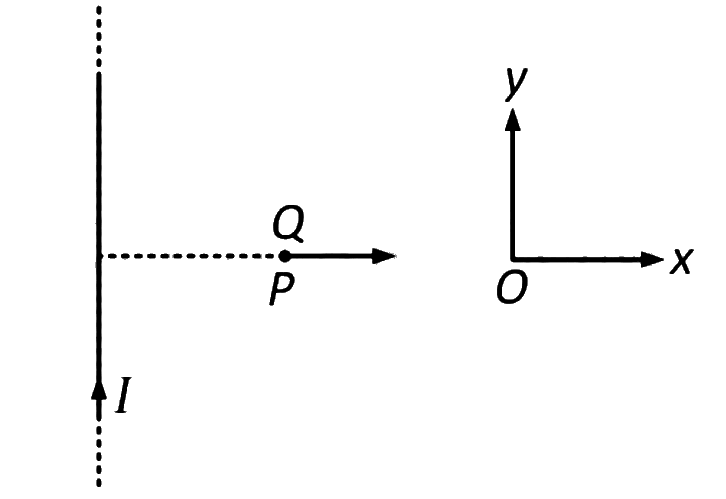
A very long straight wire carries a current . At the instant when a charge +Q at point P has velocity , as shown, the force on the charge is
Answer: (a)
Moving Charge in a Magnetic Field
A charged particle moves through a magnetic field in a direction perpendicular to it. Then the
Answer: (a)
Moving Charge in a Magnetic Field
A particle of mass and charge moving with velocitydescribes a circular path of radius when subjected to a uniform transverse magnetic field of induction The net work done by the field when the particle completes one full circle is
Answer: (b)
Moving Charge in a Magnetic Field
A particle of charge coulomb moving with velocity along the -axis enters a region where a magnetic field of induction is along the -axis, and an electric field of magnitude is along the negative -axis. If the charged particle continues moving along the -axis, the magnitude of is
Answer: (a)
Moving Charge in a Magnetic Field
If an electron and a proton having same momentum enter perpendicular to a magnetic field, then
Answer: (a)
Moving Charge in a Magnetic Field
The time period of a charged particle undergoing a circular motion in a uniform magnetic field is independent of its
Answer: (a)
Moving Charge in a Magnetic Field
A charge q moves in a region where electric field and magnetic field both exist, then force on it is
Answer: (b)
Moving Charge in a Magnetic Field
An electron having mass m and kinetic energy E enters a uniform magnetic field B perpendicularly, then its frequency will be
Answer: (c)
Moving Charge in a Magnetic Field
An electron moves with a velocity in a magnetic field of induction at an angle . If of electron is , the radius of the path is nearly
Answer: (a)
Moving Charge in a Magnetic Field
Due to earth's magnetic field, the charged cosmic rays particles
Answer: (c)
Moving Charge in a Magnetic Field
A positively charged particle moving due East enters a region of uniform magnetic field directed vertically upwards. This particle will
Answer: (b)
Moving Charge in a Magnetic Field
A electron is circulating in a plane at right angles to a uniform field at magnetic induction (= 1.0 gauss), the orbital radius of electron is
Answer: (a)
Moving Charge in a Magnetic Field
A beam of electrons is moving with constant velocity in a region having electric and magnetic fields of strength and at right angles to the direction of motion of the electrons. What is the velocity of the electrons?
Answer: (d)
Moving Charge in a Magnetic Field
A charge moving with velocity in -direction is subjected to a field of magnetic induction in negative -direction. As a result, the charge will
Answer: (a)
Moving Charge in a Magnetic Field
A uniform magnetic field acts right angles to the direction of motion of electrons. As a result, the electron moves in a circular path of radius . If the speed of electrons is doubled, then the radius of the circular path will be
Answer: (c)
Moving Charge in a Magnetic Field
A deuteron of kinetic energy is describing a circular orbit of radius metre in a plane perpendicular to magnetic field . The kinetic energy of the proton that describes a circular orbit of radius metre in the same plane with the same is
Answer: (d)
Moving Charge in a Magnetic Field
What will happen if a collection of positive and negative charges are passed at a high speed through a magnetic field which is perpendicular to the direction of motion of the charges? (Assume that both kind of charges are NOT going to recombine)
Answer: (b)
Step-by-step solution coming soon.
Moving Charge in a Magnetic Field
A positive charge is moving towards south in a space where magnetic field is pointing in the north direction. The moving charge will experience:
Answer: (d)
Step-by-step solution coming soon.
Moving Charge in a Magnetic Field
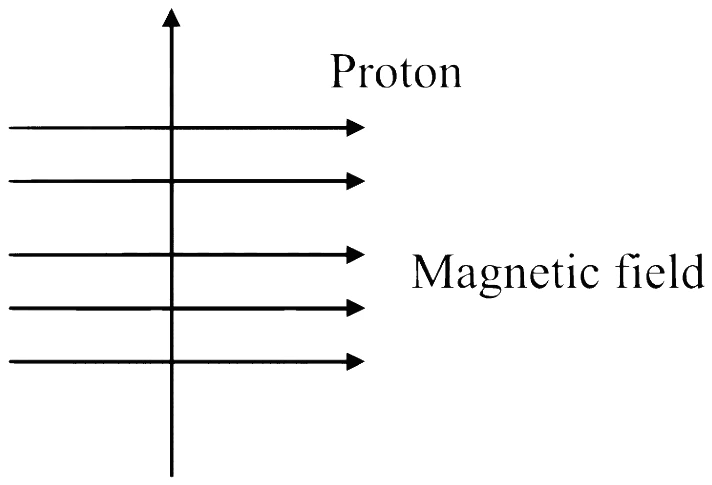
A proton enters a magnetic field at right angles to it, as shown above. The direction of force acting on the proton will be
Answer: (d)
Step-by-step solution coming soon.
Moving Charge in a Magnetic Field
If a charged particle () is projected with certain velocity parallel to the magnetic field, then it will
Answer: (c)
Step-by-step solution coming soon.
Moving Charge in a Magnetic Field
A force , acting on an electric charge , in presence of an electro-magnetic field, moves the charge parallel to the magnetic field with velocity . Then is equal to (where and are electric field and magnetic field respectively)
Answer: (a)
Step-by-step solution coming soon.
Moving Charge in a Magnetic Field
A cyclotron accelerates particles of mass and charge . The energy of particles emerging is proportional to
Answer: (a)
Step-by-step solution coming soon.
Moving Charge in a Magnetic Field
Which one among the following properties of a proton may change while it moves freely in a magnetic field?
Answer: (d)
Step-by-step solution coming soon.
Moving Charge in a Magnetic Field
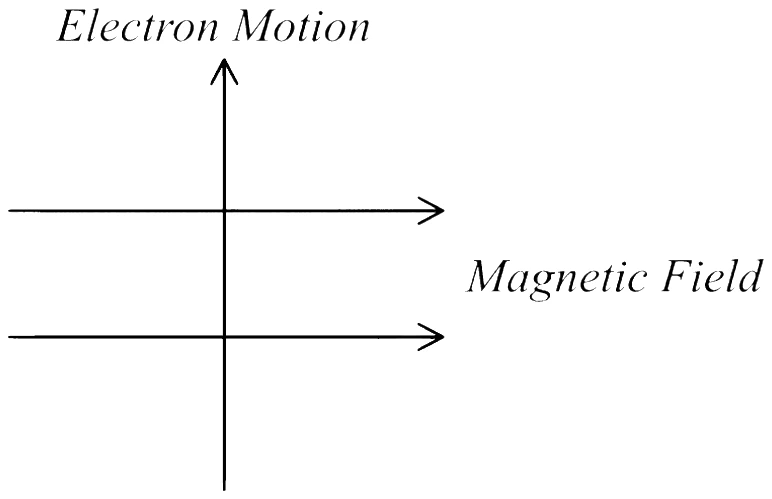
The motion of an electron in presence of a magnetic field is depicted in the figure given above. The force acting on the electron will be directed
Answer: (b)
Step-by-step solution coming soon.
Moving Charge in a Magnetic Field
A positively charged particle projected towards west is deflected towards north by a magnetic field. The direction of the magnetic field is
Answer: (d)
Step-by-step solution coming soon.
Moving Charge in a Magnetic Field
If an -particle is projected normally through a uniform magnetic field, then the path of the -particle inside the field will be
Answer: (a)
Step-by-step solution coming soon.
Moving Charge in a Magnetic Field
In a vacuum chamber, a particle of charge and mass is projected with a velocity from the plane at time in an electric field of . At , the electric field is switched off and a magnetic field of is switched on. The acceleration due to gravity is . Correct option(s) is/are :
More than one option can be correct. Tap every correct option, then tap Check.
Answer: (a), (c)
Step-by-step solution coming soon.
Moving Charge in a Magnetic Field
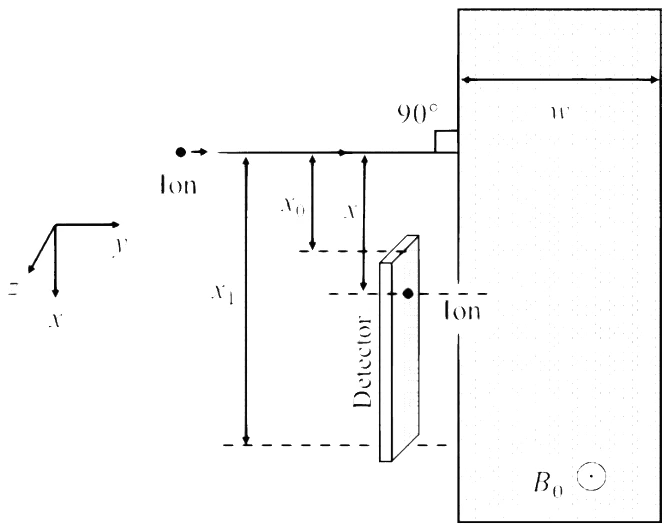
A positive, singly ionized atom of mass number is accelerated from rest by the voltage . Thereafter, it enters a rectangular region of width with magnetic field Tesla, as shown in the figure. The ion finally hits a detector at the distance below its starting trajectory.
[Given: Mass of neutron/proton , charge of the electron .]
Which of the following option(s) is(are) correct?
More than one option can be correct. Tap every correct option, then tap Check.
Answer: (a), (b)
Step-by-step solution coming soon.
Moving Charge in a Magnetic Field
An -particle (mass ) and a singly charged sulphur ion (mass ) are initially at rest. They are accelerated through a potential and then allowed to pass into a region of uniform magnetic field which is normal to the velocities of the particles. Within this region, the -particle and the sulfur ion move in circular orbits of radii and , respectively. The ratio is ______.
Numerical answer type. Work it out, then open the answer.
Answer: 4
Step-by-step solution coming soon.
Moving Charge in a Magnetic Field
A charged particle (electron or proton) is introduced at the origin () with a given initial velocity . A uniform electric field and a uniform magnetic field exist everywhere. The velocity , electric field and magnetic field are given in column 1, 2 and 3, respectively. The quantities are positive in magnitude.
| Column 1 | Column 2 | Column 3 |
| (I) Electron with | (i) | (P) |
| (II) Electron with | (ii) | (Q) |
| (III) Proton with | (iii) | (R) |
| (IV) Proton with | (iv) | (S) |
In which case will the particle move in a straight line with constant velocity?
Answer: (d)
Step-by-step solution coming soon.
Moving Charge in a Magnetic Field
Refer to the passage above (Column 1, 2, 3 of the previous question).
In which case will the particle describe a helical path with axis along the positive direction?
Answer: (a)
Step-by-step solution coming soon.
Moving Charge in a Magnetic Field
Refer to the passage above (Column 1, 2, 3 of the earlier question).
In which case would the particle move in a straight line along the negative direction of -axis (i.e., move along )?
Answer: (b)
Step-by-step solution coming soon.
Moving Charge in a Magnetic Field
A uniform magnetic field exists in the region between and (region 2 in the figure) pointing normally into the plane of the paper. A particle with charge and momentum directed along -axis enters region 2 from region 1 at point (). Which of the following option(s) is/are correct?
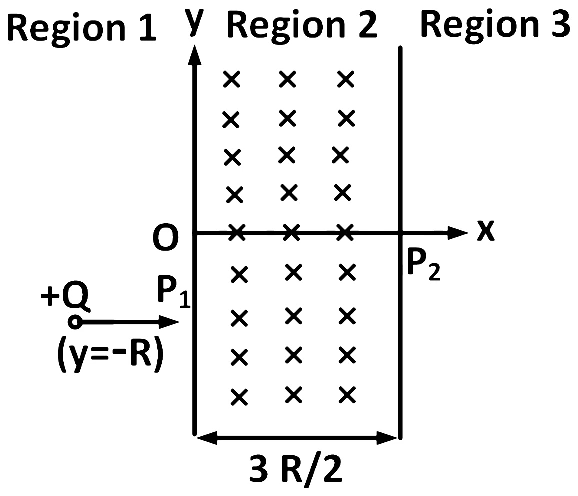
More than one option can be correct. Tap every correct option, then tap Check.
Answer: (a), (b)
Step-by-step solution coming soon.
Moving Charge in a Magnetic Field
In a thin rectangular metallic strip a constant current flows along the positive -direction, as shown in the figure. The length, width and thickness of the strip are , and , respectively.
A uniform magnetic field is applied on the strip along the positive -direction. Due to this, the charge carriers experience a net deflection along the -direction. This results in accumulation of charge carriers on the surface PQRS and appearance of equal and opposite charges on the face opposite PQRS. A potential difference along the -direction is thus developed. Charge accumulation continues until the magnetic force is balanced by the electric force. The current is assumed to be uniformly distributed on the cross section of the strip and carried by electrons.
Consider two different metallic strips (1 and 2) of the same material. Their lengths are the same, widths are and and thickness are and , respectively. Two points K and M are symmetrically located on the opposite faces parallel to the - plane (see figure). and are the potential differences between K and M in strips 1 and 2, respectively. Then, for a given current flowing through them in a given magnetic field strength , the correct statements is/are
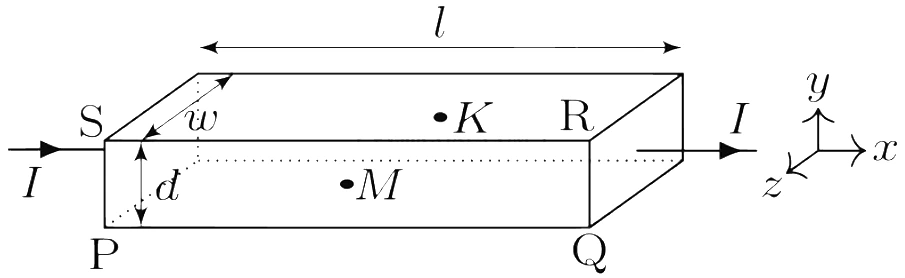
More than one option can be correct. Tap every correct option, then tap Check.
Answer: (a), (d)
Step-by-step solution coming soon.
Moving Charge in a Magnetic Field
In a thin rectangular metallic strip a constant current flows along the positive -direction, as shown in the figure. The length, width and thickness of the strip are , and , respectively.
A uniform magnetic field is applied on the strip along the positive -direction. Due to this, the charge carriers experience a net deflection along the -direction. This results in accumulation of charge carriers on the surface PQRS and appearance of equal and opposite charges on the face opposite PQRS. A potential difference along the -direction is thus developed. Charge accumulation continues until the magnetic force is balanced by the electric force. The current is assumed to be uniformly distributed on the cross section of the strip and carried by electrons.
Consider two different metallic strips (1 and 2) of same dimensions (length , width and thickness ) with carrier densities and , respectively. Strip 1 is placed in magnetic field and strip 2 is placed in magnetic field , both along positive -directions. Then and are the potential differences developed between K and M in strips 1 and 2, respectively. Assuming that the current is the same for both the strips, the correct options is/are :
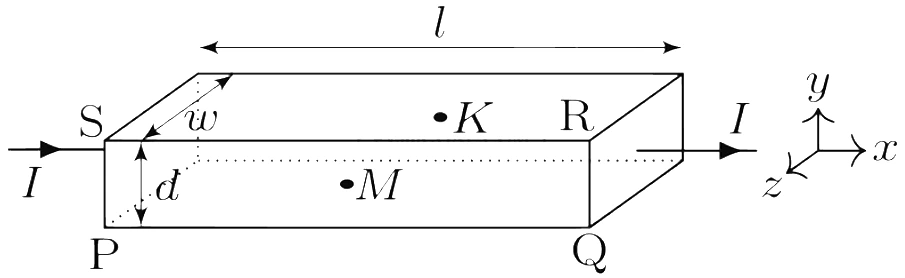
More than one option can be correct. Tap every correct option, then tap Check.
Answer: (a), (c)
Step-by-step solution coming soon.
Moving Charge in a Magnetic Field
A particle of mass and positive charge , moving with a constant velocity enters a region of uniform static magnetic field, normal to the plane. The region of the magnetic field extends from to for all values of . After passing through this region, the particle emerges on the other side after with a velocity . The correct statement(s) is(are)
More than one option can be correct. Tap every correct option, then tap Check.
Answer: (a), (c)
Step-by-step solution coming soon.
Moving Charge in a Magnetic Field
Consider the motion of a positive point charge in a region, there are simultaneous uniform electric and magnetic fields and . At time , this charge has velocity in the -plane, making an angle with the -axis. Which of the following option(s) is(are) correct for time ?
More than one option can be correct. Tap every correct option, then tap Check.
Answer: (c), (d)
Step-by-step solution coming soon.
Moving Charge in a Magnetic Field
An electron and a proton are moving on straight parallel paths with same velocity. They enter a semi-infinite region of uniform magnetic field perpendicular to the velocity. Which of the following statement(s) is/are true?
More than one option can be correct. Tap every correct option, then tap Check.
Answer: (b), (d)
Step-by-step solution coming soon.
Moving Charge in a Magnetic Field
A particle of mass and charge , moving with velocity enters Region II normal to the boundary as shown in the figure. Region II has a uniform magnetic field perpendicular to the plane of the paper. The length of the Region II is . Choose the correct choice(s).
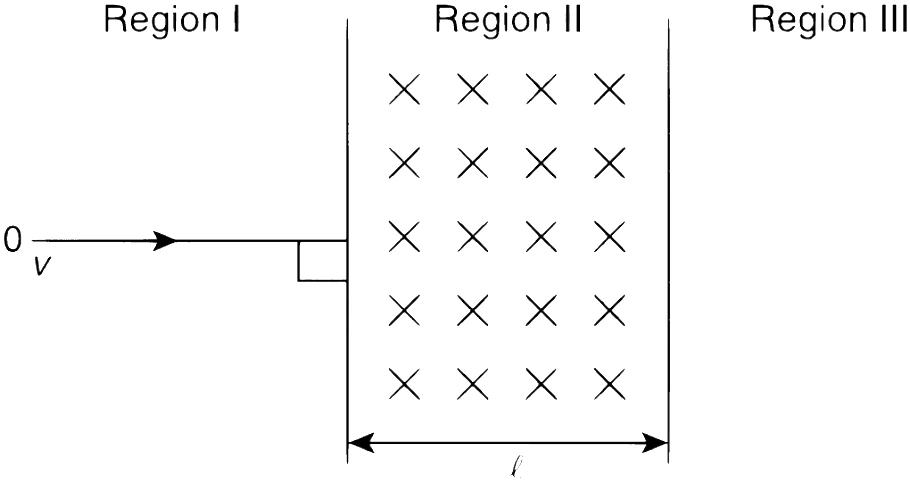
More than one option can be correct. Tap every correct option, then tap Check.
Answer: (a), (c), (d)
Step-by-step solution coming soon.
Moving Charge in a Magnetic Field
A magnetic field exists in the region and , in the region , where is a positive constant. A positive point charge moving with a velocity , where is a positive constant, enters the magnetic field at . The trajectory of the charge in this region can be like,
Answer: (a)
Step-by-step solution coming soon.
Moving Charge in a Magnetic Field
Assertion : Electron moving perpendicular to will perform circular motion.
Reason : Force by magnetic field is perpendicular to velocity.
Answer: (a)
Step-by-step solution coming soon.
Moving Charge in a Magnetic Field
Assertion : A charge particle is released from rest in magnetic field then it will move in a circular path.
Reason : Work done by magnetic field is non zero.
Answer: (d)
Step-by-step solution coming soon.
Moving Charge in a Magnetic Field
A proton is projected with velocity in a region where magnetic field and electric field . Then find out the net acceleration of proton
Answer: (a)
Step-by-step solution coming soon.
Moving Charge in a Magnetic Field
If two protons are moving with speed parallel to each other then find the ratio of electrostatic and magnetic force between them
Answer: (a)
Step-by-step solution coming soon.
Moving Charge in a Magnetic Field
Assertion : A magnetic field interacts with a moving charge and not with a stationary charge.
Reason : A moving charge produce a magnetic field.
Answer: (a)
Step-by-step solution coming soon.
Moving Charge in a Magnetic Field
Assertion: Cyclotron does not accelerate electron.
Reason: Mass of the electron is very small.
Answer: (a)
Step-by-step solution coming soon.
Moving Charge in a Magnetic Field
Assertion: If a proton and an -particle enter a uniform magnetic field perpendicularly with the same speed, then the time period of revolution of the -particle is double than that of proton.
Reason: In a magnetic field, the time period of revolution of a charged particle is directly proportional to mass.
Answer: (b)
Step-by-step solution coming soon.
Moving Charge in a Magnetic Field
Assertion: Magnetic field interacts with a moving charge and not with a stationary charge.
Reason: A moving charge produces a magnetic field.
Answer: (a)
Step-by-step solution coming soon.
Moving Charge in a Magnetic Field
Assertion: If an electron and proton enter a perpendicular magnetic field with equal momentum, then radius of curve for electron is more than that of proton.
Reason: Electron has less mass than proton.
Answer: (d)
Step-by-step solution coming soon.
Moving Charge in a Magnetic Field
A charged particle travels along a straight line with a speed in a region where both electric field and magnetic field are present. It follows that
Answer: (b)
Step-by-step solution coming soon.
Moving Charge in a Magnetic Field
Assertion: A proton and an alpha particle having the same kinetic energy are moving in circular paths in a uniform magnetic field. The radii of their circular paths will be equal.
Reason: Any two charged particles having equal kinetic energies and entering a region of uniform magnetic field in a direction perpendicular to , will describe circular trajectories of equal radii.
Answer: (c)
Step-by-step solution coming soon.
Moving Charge in a Magnetic Field
In a mass spectrometer used for measuring the masses of ions, the ions are initially accelerated by an electric potential and then made to describe semicircular paths of radius using a magnetic field . If and are kept constant, the ratio will be proportional to
Answer: (b)
Step-by-step solution coming soon.
Moving Charge in a Magnetic Field
A beam of electrons passes undeflected through mutually perpendicular electric and magnetic fields. If the electric field is switched off, and the same magnetic field is maintained, the electrons move
Answer: (b)
Step-by-step solution coming soon.
Moving Charge in a Magnetic Field
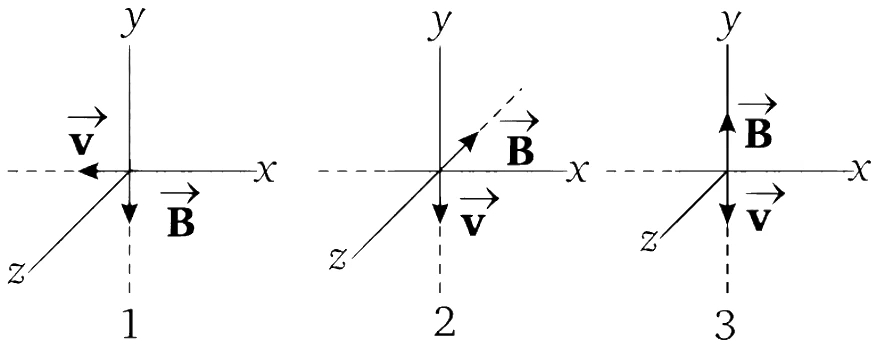
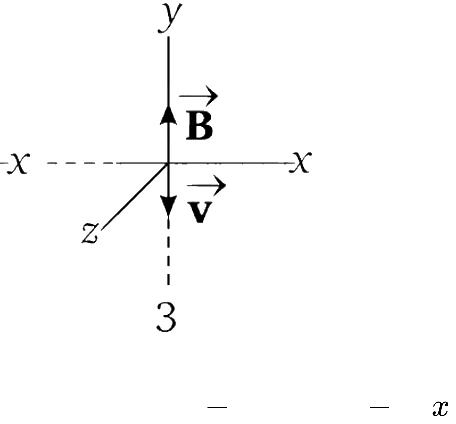
The figure shows three situations when an electron with velocity travels through a uniform magnetic field . In each case, what is the direction of magnetic force on the electron?
Answer: (b)
Step-by-step solution coming soon.
Moving Charge in a Magnetic Field
The cyclotron frequency of an electron gyrating in a magnetic field of is approximately :
Answer: (d)
Step-by-step solution coming soon.
Moving Charge in a Magnetic Field
A proton and an -particle, moving with the same velocity, enter a uniform magnetic field perpendicular to the direction of their motion. The ratio of the radii of the circular paths described by the proton and -particle is :
Answer: (a)
Step-by-step solution coming soon.
Moving Charge in a Magnetic Field
An electron () is accelerated by volts and experiences a force when it enters a uniform magnetic field. What will be the force experienced when it is accelerated by ?
Answer: (a)
Step-by-step solution coming soon.
Moving Charge in a Magnetic Field
A uniform electric field and a uniform magnetic field acting along the same direction in a certain region. If an electron is projected along the direction of the fields with a certain velocity, then
Answer: (d)
Step-by-step solution coming soon.
Moving Charge in a Magnetic Field
A particle of mass and charge moving with velocity describes a circular path of radius when subjected to a uniform transverse magnetic field of induction . The work done by the field, when the particle completes one full circle, is
Answer: (b)
Step-by-step solution coming soon.
Moving Charge in a Magnetic Field
A magnetic field exerts no force on
Answer: (d)
Step-by-step solution coming soon.
Moving Charge in a Magnetic Field
A proton moving vertically downward enters a magnetic field pointing towards north. In which direction proton will deflect?
Answer: (a)
Step-by-step solution coming soon.
Moving Charge in a Magnetic Field
An electron of mass and charge is travelling with a speed along a circular path of radius at right angles to a uniform magnetic field . If speed of the electron is doubled and the magnetic field is halved, then resulting path would have a radius of
Answer: (d)
Step-by-step solution coming soon.
Moving Charge in a Magnetic Field
Under the influence of a uniform magnetic field a charged particle is moving in a circle of radius with constant speed . The time period of the motion
Answer: (c)
Step-by-step solution coming soon.
Moving Charge in a Magnetic Field
In a mass spectrometer used for measuring the masses of ions, the ions are initially accelerated by an electric potential and then made to describe semicircular paths of radius using a magnetic field . If and are kept constant, the ratio will be proportional to
Answer: (b)
Step-by-step solution coming soon.
Moving Charge in a Magnetic Field
When a charged particle moving with velocity is subjected to a magnetic field of induction , the force on it is non-zero. This implies that
Answer: (c)
Step-by-step solution coming soon.
Moving Charge in a Magnetic Field
If a charged particle enters perpendicularly in the uniform magnetic field, then:
Answer: (b)
Step-by-step solution coming soon.
Moving Charge in a Magnetic Field
An electron moves at right angle to a magnetic field of with a speed of . If the specific charge of the electron is . The radius of the circular path will be
Answer: (c)
Step-by-step solution coming soon.
Moving Charge in a Magnetic Field
A proton enters a magnetic field of intensity with a velocity in a direction at an angle with the field. The force on the proton will be (charge on proton is )
Answer: (a)
Step-by-step solution coming soon.
Moving Charge in a Magnetic Field
A charged particle of charge and mass enters a uniform magnetic field with a velocity at an angle of with the direction of the field. The pitch of the helical path followed by the particle is
Answer: (c)
Step-by-step solution coming soon.
Moving Charge in a Magnetic Field
A charged particle moving in a uniform magnetic field loses of its kinetic energy. The radius of curvature of its path changes by
Answer: (a)
Step-by-step solution coming soon.
Moving Charge in a Magnetic Field
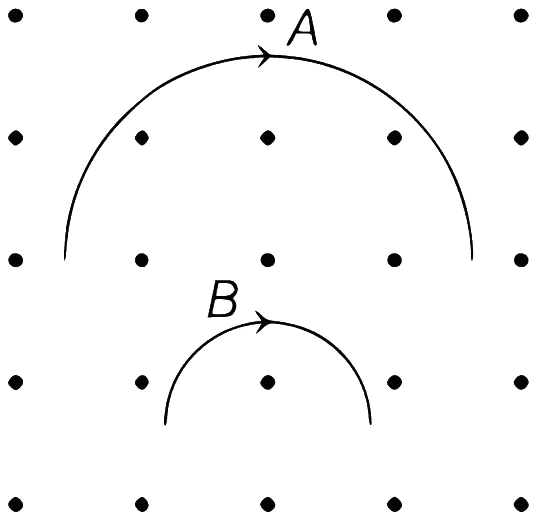
Two particles and of masses and respectively, are having the same charge and moving in the same plane. A uniform magnetic field exists perpendicular to this plane. The speeds of the particles are and respectively and the trajectories are as shown in the figure. Then,
Answer: (b)
Step-by-step solution coming soon.
Moving Charge in a Magnetic Field
Which of the following is deflected by the magnetic field?
Answer: (c)
Step-by-step solution coming soon.
Moving Charge in a Magnetic Field
In a cathode ray tube, a potential difference of is maintained between the deflector plates whose separation is . A magnetic field of at right angles to the electric field gives no deflection of the electron beam, which received an initial acceleration by a potential difference of . Calculate of an electron.
Answer: (a)
Step-by-step solution coming soon.
Moving Charge in a Magnetic Field
The work done by a uniform magnetic field on a moving charge is
Answer: (c)
Step-by-step solution coming soon.
Moving Charge in a Magnetic Field
A positively charged particle is placed near an infinitely long straight conductor where there is zero gravity. Then
Answer: (a)
Step-by-step solution coming soon.
Moving Charge in a Magnetic Field
An electron of mass under the action of a magnetic field moves in a circle of radius at a speed of . If a proton of mass was to move in a circle of the same radius in the same magnetic field, then its speed will become
Answer: (a)
Step-by-step solution coming soon.
Moving Charge in a Magnetic Field
An electron moves at right angle to a magnetic field of with a speed of . If the specific charge of the electron is , the radius of the circular path will be
Answer: (c)
Step-by-step solution coming soon.
Moving Charge in a Magnetic Field
A proton and an -particle, accelerated through the same potential difference, enter a region of uniform magnetic field normally. If the radius of the proton orbit is , then the radius of the -particle orbit is
Answer: (b)
Step-by-step solution coming soon.
Moving Charge in a Magnetic Field
A uniform electric field and a uniform magnetic field are acting along the same direction in a certain region. If an electron is projected in the region such that its velocity is pointed along the direction of the fields, then the electron
Answer: (a)
Step-by-step solution coming soon.
Moving Charge in a Magnetic Field
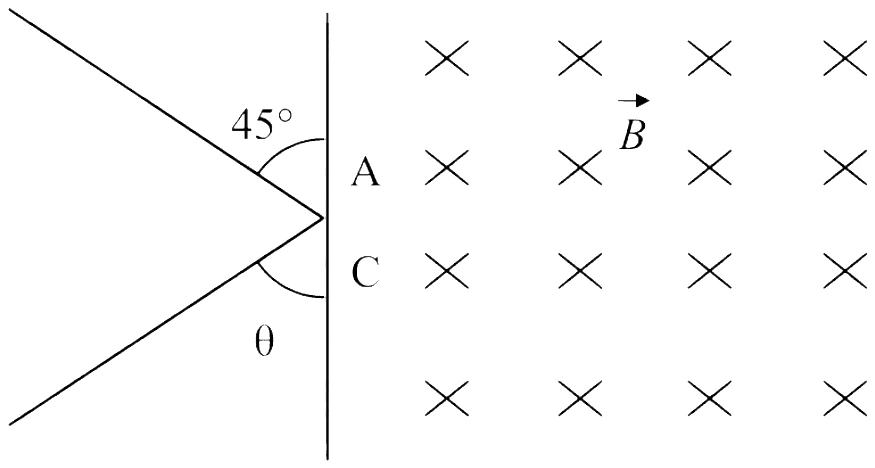
A proton of mass enters a uniform magnetic field of at point shown in the figure with a speed of . The magnetic field is directed normal to the plane of paper downwards. The proton emerges out of the magnetic field at point , then the distance and the value of angle will respectively be
Answer: (d)
Step-by-step solution coming soon.
Moving Charge in a Magnetic Field
Two particles and having equal charges, after being accelerated through the same potential difference, enter a region of uniform magnetic field and describe circular paths of radii and respectively. The ratio of masses of and is
Answer: (c)
Step-by-step solution coming soon.
Moving Charge in a Magnetic Field
A proton of energy describes a circular path in a plane at right angles to a uniform magnetic field of . The mass of the proton is . The cyclotron frequency of the proton is very nearly equal to
Answer: (d)
Step-by-step solution coming soon.
Moving Charge in a Magnetic Field
In the presence of magnetic field and electric field , the total force on a moving charged particle is
Answer: (c)
Step-by-step solution coming soon.
Moving Charge in a Magnetic Field
An electric field and magnetic field and respectively are applied simultaneously on an electron beam such that path of the beam remains undeviated, then the speed of the electron will be:
Answer: (c)
Step-by-step solution coming soon.
Moving Charge in a Magnetic Field
A proton is moving along negative axis. If a uniform magnetic field is applied parallel to the positive axis, then choose the correct answer from the following options;
1. The proton will experience magnetic force along positive Y direction and will move along a circular path in the XY plane
2. The proton will experience magnetic force along negative Y direction and will move along a circular path in the XY plane
3. The proton will experience magnetic force along positive Y direction and will move along a circular path in the XZ plane
4. The proton will experience magnetic force along negative Y direction and will move along a circular path in the XZ plane
Answer: (c)
Step-by-step solution coming soon.
Moving Charge in a Magnetic Field
Into a uniform transverse magnetic field, two charged particles having the same mass and charge enter and move in two different circular paths. The ratio of the radii of curvature of the circular paths is . What would be the ratio of their respective velocities?
Answer: (d)
Step-by-step solution coming soon.
Moving Charge in a Magnetic Field
A charged particle is released from rest in a region of space in which steady and uniform electric and magnetic fields are parallel to each other. The particle will move in a
Answer: (b)
Step-by-step solution coming soon.
Moving Charge in a Magnetic Field
What is the kinetic energy of the electron in the th level, moving in a plane under the influence of a magnetic field ? [ - mass of electron; - Planck's constant; - electronic charge]
Answer: (b)
Step-by-step solution coming soon.
Moving Charge in a Magnetic Field
A negative charge particle is moving upward in a magnetic field which is towards north. The particle is deflected towards
Answer: (c)
Step-by-step solution coming soon.
Moving Charge in a Magnetic Field
A charge of is moving with velocity through a region in which electric field and magnetic field are present. The force experienced by the charge is
Answer: (b)
Step-by-step solution coming soon.
Moving Charge in a Magnetic Field
A magnetic field does not interact with:
Answer: (a)
Step-by-step solution coming soon.
Moving Charge in a Magnetic Field
A circular coil of turns and radius is placed in a uniform magnetic field of normal to the plane of the coil. If the current in the coil is , then the average force on each electron in the coil due to the magnetic field is
Answer: (c)
Step-by-step solution coming soon.
Moving Charge in a Magnetic Field
The particle that cannot be accelerated by a cyclotron is
Answer: (c)
Step-by-step solution coming soon.
Moving Charge in a Magnetic Field
An electron moves with speed of along the positive x-direction in a magnetic field . The magnitude of the force (in N) experienced by the electron is
Answer: (c)
Step-by-step solution coming soon.
Moving Charge in a Magnetic Field
A point charge is placed in a moving train. A passenger sitting in the train and person on the ground observe the fields due to this charge. Then
Answer: (b)
Step-by-step solution coming soon.
Moving Charge in a Magnetic Field
A proton, an electron and an -particle enter at right angles to a uniform magnetic field with the same velocity. If , and are the radii of circular paths of these particles, then
Answer: (b)
Step-by-step solution coming soon.
Moving Charge in a Magnetic Field
A particle of specific charge is projected from the origin towards positive -axis with the velocity in a uniform magnetic field . The velocity of particle after time will be (in )
Answer: (d)
Step-by-step solution coming soon.
Moving Charge in a Magnetic Field
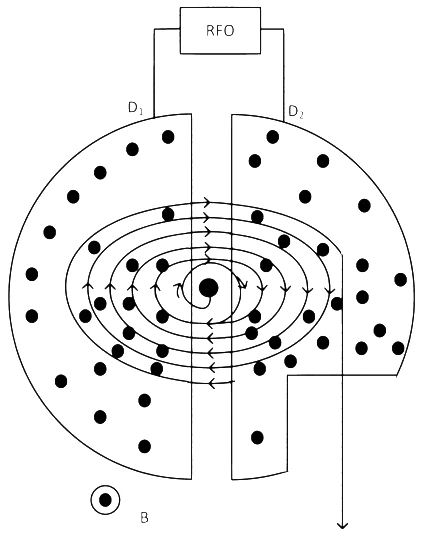
A charged particle is subjected to acceleration in a cyclotron as shown. The charged particle undergoes increase in its speed
Answer: (a)
Step-by-step solution coming soon.
Moving Charge in a Magnetic Field
A proton and an alpha-particle moving with the same velocity enter a uniform magnetic field with their velocities perpendicular to the magnetic field. The ratio of radii of their circular paths is
Answer: (d)
Step-by-step solution coming soon.
Moving Charge in a Magnetic Field
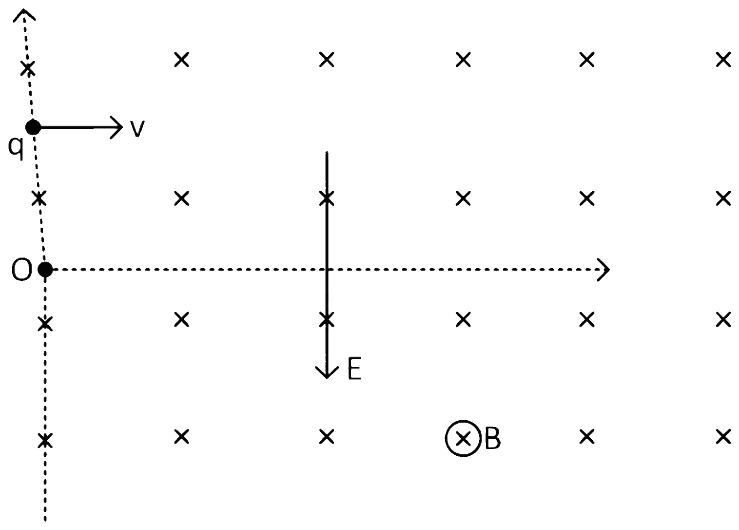
A positively charged particle of mass is passed through a velocity selector. It moves horizontally rightward without deviation along the line with a speed . The electric field is vertically downwards and magnetic field is into the plane of paper. Now, the electric field is switched off at . The angular momentum of the charged particle about origin at is
Answer: (a)
Step-by-step solution coming soon.
Moving Charge in a Magnetic Field
A strong magnetic field is applied on a stationary electron. Then, the electron
Answer: (c)
Step-by-step solution coming soon.
Moving Charge in a Magnetic Field
A cyclotron is used to accelerate protons (), deuterons () and -particles (). While exiting under similar conditions, the minimum KE is gained by
Answer: (c)
Step-by-step solution coming soon.
Moving Charge in a Magnetic Field
In a cyclotron a charged particle
Answer: (a)
Step-by-step solution coming soon.
Moving Charge in a Magnetic Field
An electron is moving in a circle of radius in a uniform magnetic field . Suddenly, the field is reduced to . The radius of the circular path now becomes
Answer: (b)
Step-by-step solution coming soon.
Moving Charge in a Magnetic Field
A charge is accelerated through a potential difference . It is then passed normally through a uniform magnetic field, where it moves in a circle of radius . The potential difference required to move it in a circle of radius is
Answer: (b)
Step-by-step solution coming soon.
Moving Charge in a Magnetic Field
A cyclotron's oscillator frequency is and the operating magnetic field is . If the radius of its dees is , then the kinetic energy of the proton beam produced by the accelerator is
Answer: (c)
Step-by-step solution coming soon.
Moving Charge in a Magnetic Field
A proton, a deuteron and an -particle are projected perpendicular to the direction of a uniform magnetic field with same kinetic energy. The ratio of the radii of the circular paths described by them is
Answer: (a)
Step-by-step solution coming soon.
Moving Charge in a Magnetic Field
A charged particle is moving parallel to a uniform magnetic field. Then the force on the charged particle
Answer: (d)
Step-by-step solution coming soon.
Moving Charge in a Magnetic Field
A proton and a deuteron, both having the same kinetic energy, enter perpendicularly into a uniform magnetic field . For motion of proton and deuteron on circular path of radius and respectively, the correct statement is
Answer: (a)
Step-by-step solution coming soon.
Moving Charge in a Magnetic Field
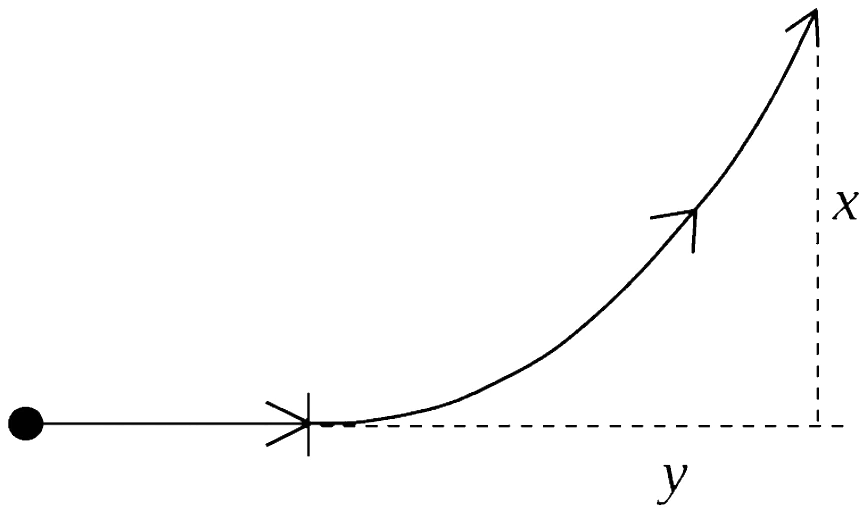
A particle having charge enters a uniform transverse magnetic field . It is deflected through a distance while travelling a distance as shown in figure. The magnitude of the momentum of the particle is
Answer: (c)
Step-by-step solution coming soon.
Moving Charge in a Magnetic Field
A charged particle moves in a region where there is a uniform electric field and a uniform magnetic field . The velocity of the particle (in ), if the particle moves without any acceleration.
Answer: (c)
Step-by-step solution coming soon.
Moving Charge in a Magnetic Field
A proton with energy is moving perpendicular to a uniform magnetic field of tesla. The force on the proton is
(mass of proton is )
Answer: (d)
Step-by-step solution coming soon.
Moving Charge in a Magnetic Field
If a charged particle enters a uniform magnetic field normally with certain velocity, then the time period of revolution of the particle
Answer: (d)
Step-by-step solution coming soon.
Moving Charge in a Magnetic Field
A velocity selector is to be constructed to select ions with a velocity of . If the electric field used is , then the magnetic field to be used is
Answer: (c)
Step-by-step solution coming soon.
Moving Charge in a Magnetic Field
If a proton of kinetic energy enters a uniform magnetic field of at right angles to the direction of the field, then the force acting on the proton is
(Mass of proton and Charge of proton )
Answer: (c)
Step-by-step solution coming soon.
Moving Charge in a Magnetic Field
Two charged particles of specific charges in the ratio and masses in the ratio moving with same kinetic energy enter a uniform magnetic field at right angles to the direction of the field. The ratio of the radii of the circular paths in which the particles move under the influence of the magnetic field is
Answer: (b)
Step-by-step solution coming soon.
Moving Charge in a Magnetic Field
An alpha particle moves along a circular path of radius in a magnetic field of . The de-Broglie wavelength associated with the alpha particle is nearly (Planck's constant )
Answer: (d)
Step-by-step solution coming soon.
Moving Charge in a Magnetic Field
A charged particle moving along a straight line path enters a uniform magnetic field of at right angles to the direction of the magnetic field. If the specific charge of the charged particle is , the angular velocity of the particle in the magnetic field is
Answer: (b)
Step-by-step solution coming soon.
Moving Charge in a Magnetic Field
A proton and an alpha particle moving with energies in the ratio enter a uniform magnetic field of at right angles to the direction of the magnetic field. The ratio of the magnetic forces acting on the proton and the alpha particle is
Answer: (a)
Step-by-step solution coming soon.
Moving Charge in a Magnetic Field
When an electron placed in a uniform magnetic field is accelerated from rest through a potential difference , it experiences a force . If the potential difference is changed to , the force experienced by the electron in the same magnetic field is . Then the ratio of potential differences is
Answer: (c)
Step-by-step solution coming soon.
Moving Charge in a Magnetic Field
An electron is moving with a velocity in an electric field and a magnetic field of . Then, the magnitude and direction (with -axis) of the Lorentz force acting on the electron is
Answer: (c)
Step-by-step solution coming soon.
Moving Charge in a Magnetic Field
The magnetic force is
Answer: (c)
Step-by-step solution coming soon.
Moving Charge in a Magnetic Field
A charged particle when it enters a uniform magnetic field moves in a helical path. If its angular velocity is and its velocity in the direction of the magnetic field is , then the pitch of the helix is
Answer: (c)
Step-by-step solution coming soon.
Moving Charge in a Magnetic Field
Two electrons, and of mass and charge are injected perpendicular to the direction of the magnetic field such that the kinetic energy of is double that of . The relation of their frequencies of rotation, and is
Answer: (a)
Step-by-step solution coming soon.
Moving Charge in a Magnetic Field
An electron having kinetic energy of circulates in a path of radius in a magnetic field. The magnitude of the magnetic field is approximately [Mass of electron , where is the velocity of light]
Answer: (a)
Step-by-step solution coming soon.
Moving Charge in a Magnetic Field
A particle of mass and charge is moving at a speed of in a circular path of radius inside a solenoid. The solenoid has and its magnetic field is perpendicular to the plane of the particle's path. The current in the solenoid is
(Take )
Answer: (d)
Step-by-step solution coming soon.
Moving Charge in a Magnetic Field
Two infinitely long wires each carrying the same current and pointing in direction are placed in the -plane, at and . An electron is fired with speed from the origin making an angle of from the -axis. The force on the electron at the instant it is fired is
[ is the magnitude of the field at origin due to the wire at alone.]
Answer: (a)
Step-by-step solution coming soon.
Moving Charge in a Magnetic Field
In which of the following cases is no force exerted by a magnetic field on a charge?
Answer: (c)
Step-by-step solution coming soon.
Moving Charge in a Magnetic Field
The magnetic field required to accelerate deuterons in a cyclotron operated at a frequency of is
(Mass of proton )
Answer: (d)
Step-by-step solution coming soon.
Moving Charge in a Magnetic Field
The maximum kinetic energy of a proton ejected from a cyclotron with dees of radius and oscillating frequency (in ) is
(Mass of proton )
Answer: (a)
Step-by-step solution coming soon.
Moving Charge in a Magnetic Field
A proton and an alpha particle enter a uniform magnetic field with the same kinetic energy making the same angle of with the direction of the field. The ratio of the pitches of the paths of proton and alpha particle is
Answer: (b)
Step-by-step solution coming soon.
Moving Charge in a Magnetic Field
If an electron moving with a velocity of enters a uniform magnetic field of at an angle of with the direction of the magnetic field, then the pitch of the helical path of the electron is
(Mass of the electron )
Answer: (c)
Step-by-step solution coming soon.
Moving Charge in a Magnetic Field
A proton moving with a velocity of enters a uniform magnetic field normal to the direction of the magnetic field. If the radius of the circular path of the proton in the magnetic field is , then the magnitude of the magnetic field is
(Charge of proton and mass of the proton )
Answer: (b)
Step-by-step solution coming soon.
Moving Charge in a Magnetic Field
An alpha particle moving with certain speed towards east enters a uniform magnetic field directed vertically up. The alpha particle will then move in
Answer: (b)
Step-by-step solution coming soon.
Moving Charge in a Magnetic Field
A proton and an alpha particle moving with equal speeds enter normally into a uniform magnetic field. The ratio of times taken by the proton and the alpha particle to make one complete revolution in the magnetic field is
Answer: (b)
Step-by-step solution coming soon.
Moving Charge in a Magnetic Field
A magnetic field is applied in -direction on an -particle travelling along -direction. The motion of the -particle will be
Answer: (b)
Step-by-step solution coming soon.
Moving Charge in a Magnetic Field
An electron falling freely under the influence of gravity enters a uniform magnetic field directed towards south. The electron is initially deflected towards
Answer: (a)
Step-by-step solution coming soon.
Moving Charge in a Magnetic Field
Two charged particles and of masses and , charges and respectively moving with same velocity enter a uniform magnetic field such that both the particles make same angle () with the direction of the magnetic field. Then, the ratio of pitches of the helical paths of the particles and is
Answer: (c)
Step-by-step solution coming soon.
Moving Charge in a Magnetic Field
A particle of charge is moving with a velocity of in the presence of magnetic and electric fields. If the magnetic field is and the electric field is , then the Lorentz force on the particle is
Answer: (c)
Step-by-step solution coming soon.
Moving Charge in a Magnetic Field
A charge moves with a velocity along -axis in a uniform magnetic field , then charge will experience a force
Answer: (a)
Step-by-step solution coming soon.
Moving Charge in a Magnetic Field
Statement I: A uniform electric field and a uniform magnetic field are pointed in the same direction. If an electron is projected in the same direction, the electron velocity will decrease in magnitude.
Statement II: Two infinite long parallel wires are carrying current in the same direction. The magnetic field at a point mid-way between the wires is zero.
Statement III: No net force acts on a rectangular coil carrying a steady current, when suspended in a uniform magnetic field.
Which of the following is correct?
Answer: (a)
Step-by-step solution coming soon.
Moving Charge in a Magnetic Field
A long solenoid has turns/cm and carries current . An electron moves within the solenoid in a circle of radius perpendicular to the solenoid axis. If the speed of the electron is , then the current in the solenoid is (take SI unit, mass of electron , charge of electron )
Answer: (b)
Step-by-step solution coming soon.
Moving Charge in a Magnetic Field
A charged particle moving with a velocity in a magnetic field experiences a force . Here all are constants. Then can be
Answer: (b)
Step-by-step solution coming soon.
Moving Charge in a Magnetic Field
A charged particle moves with constant velocity in a region, where no effect of gravity is felt but an electrostatic field together with a magnetic field may be present. Then, which of the following cases are possible?
More than one option can be correct. Tap every correct option, then tap Check.
Answer: (a), (c), (d)
Step-by-step solution coming soon.
Moving Charge in a Magnetic Field
To which of the following quantities, the radius of the circular path of a charged particle moving at right angles to a uniform magnetic field is directly proportional?
Answer: (d)
Step-by-step solution coming soon.
Moving Charge in a Magnetic Field
A particle with charge moves with a velocity in a direction perpendicular to the directions of uniform electric and magnetic fields, and respectively, which are mutually perpendicular to each other. Which one of the following gives the condition for which the particle moves undeflected in its original trajectory?
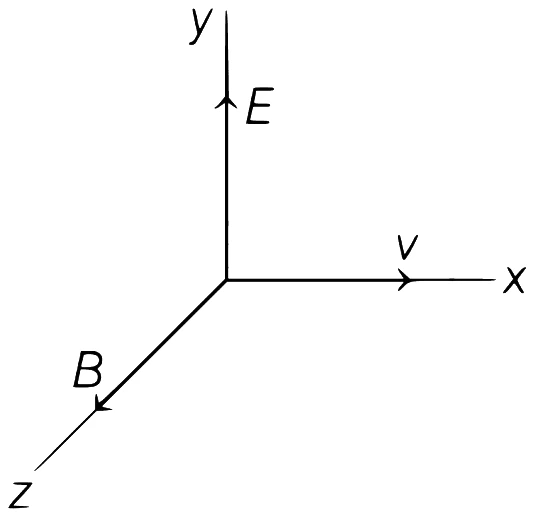
Answer: (a)
Step-by-step solution coming soon.
Moving Charge in a Magnetic Field
A proton of mass moving with a speed (, velocity of light in vacuum) completes a circular orbit in time in a uniform magnetic field. If the speed of the proton is increased to , what will be time needed to complete the circular orbit?
Answer: (b)
Step-by-step solution coming soon.
Moving Charge in a Magnetic Field
A proton is moving with a uniform velocity of along the -axis, under the joint action of a magnetic field along -axis and an electric field of magnitude along the negative -axis. If the electric field is switched off, the proton starts moving in a circle. The radius of the circle is nearly (given: ratio for proton )
Answer: (a)
Step-by-step solution coming soon.
Moving Charge in a Magnetic Field
An electron enters an electric field having intensity and magnetic field having induction with a velocity . The magnitude of the force acting on the electron is (Given, )
Answer: (a)
Step-by-step solution coming soon.
Moving Charge in a Magnetic Field
A particle of mass and charge moving with a velocity is placed in a uniform magnetic field . It executes a helical trajectory of radius and pitch . Which of the following options is correct?
Answer: (a)
Step-by-step solution coming soon.
Moving Charge in a Magnetic Field
Consider a region with uniform electric field and uniform magnetic field which are mutually perpendicular. Their magnitudes are and , respectively. A charged particle of mass enters this region with a velocity perpendicular to the electric field. The particle moves with a constant velocity making an angle of with the magnetic field. Neglecting gravity, the kinetic energy of the particle, in joules, on entering the region is
Answer: (d)
Step-by-step solution coming soon.
Moving Charge in a Magnetic Field
A particle with electric charge moves in a magnetic field with velocity . Here is a non-zero constant and . Select the correct statement(s).
More than one option can be correct. Tap every correct option, then tap Check.
Answer: (b), (c), (d)
Step-by-step solution coming soon.
Moving Charge in a Magnetic Field
An electron moving in the positive -direction, enters a region that has a constant electric field pointing in the positive -direction, and a constant magnetic field pointing in the positive -direction. Then, which of the following statements is/are true?
More than one option can be correct. Tap every correct option, then tap Check.
Answer: (d)
Step-by-step solution coming soon.
Moving Charge in a Magnetic Field
A proton moves in the direction after being accelerated from rest through a potential difference . It then passes through a region with uniform electric field in the direction and a uniform magnetic field in the direction, but the proton's trajectory is not affected. If the experiment is repeated using a potential difference of , the proton will be deflected in
Answer: (a)
Step-by-step solution coming soon.
Moving Charge in a Magnetic Field
A particle of mass and charge describes a circular path of radius in a magnetic field. If its mass and charge were and respectively, the radius of its path would be
Answer: (d)
Step-by-step solution coming soon.
Moving Charge in a Magnetic Field
Assertion (A): The energy of a charged particle moving in a magnetic field does not change.
Reason (R): It is because the work done by the magnetic force on the charge moving in a magnetic field is zero.
Answer: (a)
Step-by-step solution coming soon.
Moving Charge in a Magnetic Field
A proton and an alpha particle move in circular orbits in a uniform magnetic field. Their speeds are in the ratio of . The ratio of radii of their circular orbits is
Answer: (d)
Step-by-step solution coming soon.
No questions match these filters.