Physics Circle home Student Login

Home›HSC Board Guide›Mechanical Properties of Fluids

Dark Horse HSC Board 2027 Guide · Chapter 2 · Physics Circle

Mechanical Properties of Fluids

HSC Board questions with line-by-line solutions · Std XII Physics, Maharashtra Board

★
CHAPTER

Chapter 2 at a glance

HSC BOARD

Marks in every paper

HSC Board7 marksin every paper
1 mark12MCQ / one line
2 marks14short answer
3 marks4short answer
4 marks1derivation
TOPIC-WISE

What each exam asks

TopicHSC Board marks MHT CET share JEE Main share
01Pressure
0
7%
25%
02Surface Tension
17
33%
16%
03Drops and Bubbles
14
15%
9%
04Capillarity
7
18%
8%
05Flow and Continuity
3
4%
5%
06Viscosity
14
14%
21%
07Bernoulli’s Equation
1
9%
16%
Based on8 board papers
2022–2026
258 PYQs
2019–2026
167 PYQs
2019–2026
MOST ASKED

Most asked in HSC Board · 2022–2026

QuestionMarksAsked inTimes
Excess pressure inside a drop · Laplace’s law2–4Jul 2022 · Jul 2023 · Feb 2025 · Feb 2026 · Jun 20265×
Coefficient of viscosity (define, derive, numerical)1–2Feb 2023 · Feb 2024 · Feb 2025 · Jun 20264×
Impurity and temperature: effect on T1Jul 2023 · Feb 2024 · Feb 20253×
Capillarity (rise in a tube, uses)1–2Mar 2022 · Jul 2022 · Jun 20263×
Surface energy and surface tension2–3Feb 2023 · Feb 20242×
Drops coalescing: change in area1–2Mar 2022 · Feb 20262×
Terminal velocity (derive / numerical)2–3Mar 2022 · Jul 20232×
Angle of contact1–2Jul 2022 · Feb 20232×
01
TOPIC

Pressure and Pascal’s Law

In this topic
  • Ideal fluid
  • Pressure due to a liquid column
  • Absolute and gauge pressure
  • Pascal’s law, hydraulic lift and brakes
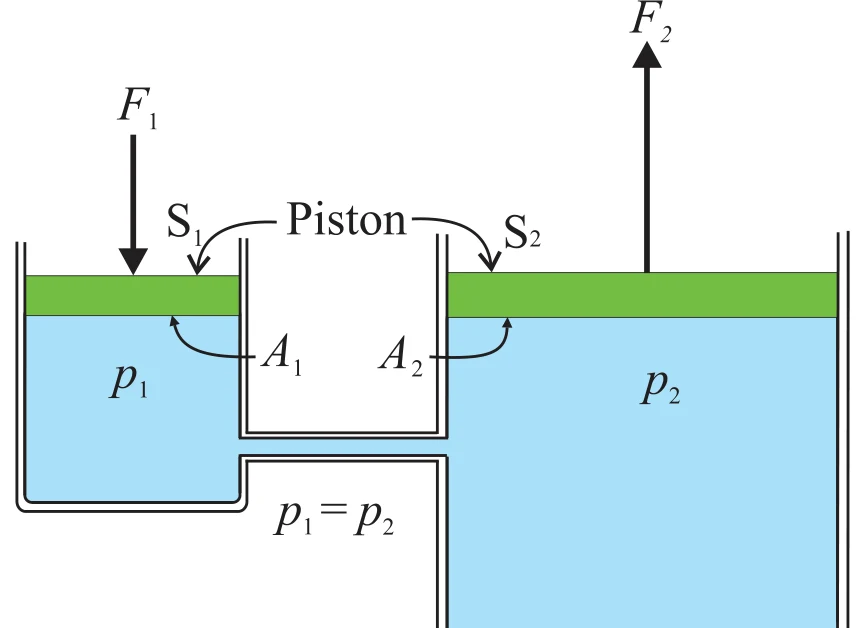
Fig. 2.11 · HSC Textbook · Hydraulic lift
TOPIC 01

Concept in brief

  • A fluid is a substance that can flow; liquids and gases are fluids. A fluid cannot resist a shear force (shear modulus zero).
  • An ideal fluid is incompressible, irrotational, non-viscous and its flow is steady.
  • Pressure is the normal force per unit area, p = FA. SI unit N/m² = Pa; it is a scalar. 1 bar = 10⁵ Pa, 1 torr = 1 mm of Hg.
  • Pressure at depth h in a liquid: p = hρg, independent of the shape of the vessel (hydrostatic paradox).
  • Absolute pressure p = p₀ + hρg; gauge pressure p − p₀ = hρg. A barometer measures p₀, a manometer measures gauge pressure.
  • Pascal’s law: pressure applied to an enclosed fluid is transmitted equally and undiminished to every point. Used in the hydraulic lift and hydraulic brakes: F₂ = A₂A₁F₁.
FORMULAS

Formulas

Pressure

p = FA

Liquid column

p = hρg

Absolute pressure

p = p₀ + hρg

Hydraulic lift

F₂A₂ = F₁A₁

KEY WORDS

Key words

WordMeaning
fluida substance that can flow
ideal fluidincompressible, non-viscous, steady flow
incompressibledensity does not change
pressurenormal force per unit area
atmospheric pressureweight of air column per unit area
gauge pressureabsolute pressure minus atmospheric
barometerinstrument that measures atmospheric pressure
manometerU-tube that measures gauge pressure

Board questions

13 questions · HSC papers 2022–2026, SCERT Question Bank, HSC Textbook
Q11 mark · HSC Textbook Ex. 1(i)
A hydraulic lift is designed to lift heavy objects of maximum mass 2000 kg. The area of cross section of piston carrying the load is 2.25 × 10⁻² m². What is the maximum pressure the piston would have to bear?
(a) 0.8711 × 10⁶ N/m²(b) 0.5862 × 10⁷ N/m²(c) 0.4869 × 10⁵ N/m²(d) 0.3271 × 10⁴ N/m²
Solution
p = FA = mgA
= 2000 × 9.82.25 × 10⁻²
p = 8.711 × 10⁵ N/m² = 0.8711 × 10⁶ N/m²
→Answer: (a) 0.8711 × 10⁶ N/m²
Q21 mark · HSC Textbook Ex. 2(v)
What is an incompressible fluid?
Solution
→A fluid whose density remains constant (its volume does not change) when pressure is applied is an incompressible fluid.
Q31 mark · HSC Textbook Ex. 2(iv)
Why is a low density liquid used as a manometric liquid in a physics laboratory?
Solution
→For a given pressure difference, h = p − p₀ρg
⇒ smaller ρ gives a larger level difference h, so the pressure can be read more accurately.
Q41 mark · Expected question · based on HSC Textbook 2.3
State the SI unit and dimensions of pressure. Is pressure a scalar or a vector?
Solution
→SI unit: N/m² = pascal (Pa) · dimensions [L⁻¹M¹T⁻²] · pressure is a scalar quantity.
Q51 mark · Expected question · based on HSC Textbook 2.3.6
What will be the normal atmospheric pressure in bar and also in torr?
Solution
→patm = 1.013 × 10⁵ N/m² = 1.013 bar (1 bar = 10⁵ N/m²)
= 76 cm of Hg = 760 torr.
Q62 marks · SCERT Question Bank · SA-I 1
State properties of an ideal fluid.
Solution
→Incompressible: its density is constant.
→Irrotational: its flow is smooth, there are no turbulences.
→Non-viscous: no internal friction, i.e. no viscosity.
→Steady: its velocity at each point is constant in time.
Q72 marks · HSC Textbook Example 2.1
Two different liquids of density ρ₁ and ρ₂ exert the same pressure at a certain point. What will be the ratio of the heights of the respective liquid columns?
Solution
→Pressure due to a liquid column: p = hρg.
p₁ = p₂
⇒ h₁ρ₁g = h₂ρ₂g
h₁h₂ = ρ₂ρ₁
→Height is inversely proportional to the density of the liquid.
→Answer: h₁ : h₂ = ρ₂ : ρ₁
Q82 marks · HSC Textbook Example 2.2
A swimmer is swimming in a swimming pool at 6 m below the surface of the water. Calculate the pressure on the swimmer due to water above. (Density of water = 1000 kg/m³, g = 9.8 m/s²)
Solution
→Given: h = 6 m
ρ = 1000 kg/m³
g = 9.8 m/s²
p = hρg = 6 × 1000 × 9.8
= 5.88 × 10⁴ N/m²
→This is nearly 0.6 times the atmospheric pressure.
→Answer: 5.88 × 10⁴ N/m²
Q92 marks · HSC Textbook Ex. 10
Find the pressure 200 m below the surface of the ocean if pressure on the free surface of liquid is one atmosphere. (Density of sea water = 1060 kg/m³)
Solution
→Given: h = 200 m
ρ = 1060 kg/m³
p₀ = 1.013 × 10⁵ N/m²
p = p₀ + hρg = 1.013 × 10⁵ + 200 × 1060 × 9.8
p = 1.013 × 10⁵ + 20.776 × 10⁵ = 21.789 × 10⁵ N/m²
→Answer: 21.789 × 10⁵ N/m²
Q102 marks · HSC Textbook Ex. 11
In a hydraulic lift, the input piston had surface area 30 cm² and the output piston has surface area of 1500 cm². If a force of 25 N is applied to the input piston, calculate weight on output piston.
Solution
→Pascal’s law: F₂A₂ = F₁A₁
F₂ = F₁ × A₂A₁ = 25 × 150030
= 1250 N
→Answer: 1250 N
Q112 marks · Expected question · based on HSC Textbook 2.3.3
Distinguish between absolute pressure and gauge pressure at a depth h below the surface of a liquid.
Solution
→Absolute pressure:
total pressure at depth h, p = p₀ + hρg (atmosphere + liquid column).
→Gauge pressure:
difference between absolute and atmospheric pressure, p − p₀ = hρg.
→Measured by: a barometer gives p₀; an open tube manometer gives the gauge pressure.
Q123 marks · Expected question · based on HSC Textbook 2.3.5
State Pascal’s law. Explain the working of a hydraulic lift.
Solution
→Pascal’s law: pressure applied at any point of an enclosed fluid at rest is transmitted equally and undiminished to every point of the fluid and the walls of the container (gravity neglected).
→Hydraulic lift: a tank of fluid with a small piston S₁ (area A₁) and a large piston S₂ (area A₂ ≫ A₁).
→Force F₁ on S₁ produces pressure p = F₁A₁, transmitted undiminished to S₂.
F₂ = pA₂ = A₂A₁ F₁
→A₂ ≫ A₁
⇒ F₂ ≫ F₁: a heavy load on S₂ is lifted by a small force on S₁.
Q133 marks · HSC Textbook Example 2.3
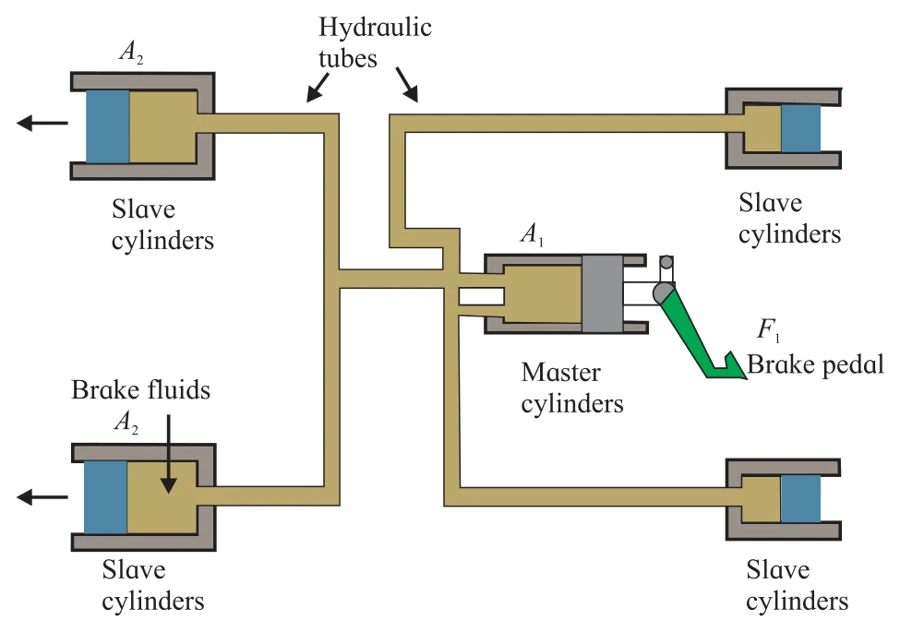
A hydraulic brake system of a car of mass 1000 kg having speed of 50 km/h, has a cylindrical piston of radius of 0.5 cm. The slave cylinder has a radius of 2.5 cm. If a constant force of 100 N is applied on the brake what distance the car will travel before coming to stop?
Solution
Fig. 2.12 · HSC Textbook · Hydraulic brake system
→Pascal’s principle: F₂A₂ = F₁A₁
F₂ = 100 × (2.5 × 10⁻²)²(0.5 × 10⁻²)² = 100 × 25
= 2500 N
a = F₂m = 25001000
= 2.5 m/s²
→Motion: v² = u² − 2as with v = 0
u = 50 km/h = 13.89 m/s
s = u²2a = (13.89)²2 × 2.5
= 38.58 m
→Answer: 38.58 m

MHT CET corner

4 MHT CET questions on the same formulas
C1MHT CET 2026
In a hydraulic press, the piston in the small cylinder has a diameter of d₁ cm, while the larger piston has a diameter of d₂ cm. If a force F₁ is applied to the small piston, then the force F₂ on the large piston is given by
(a) F₂ = d₂²d₁²F₁(b) F₂ = d₁²d₂²F₁(c) F₂ = d₂²d₁² · 1F₁(d) F₂ = d₁²d₂² · 1F₁
Solution
→Pascal’s law: F₂A₂ = F₁A₁
→Area ∝ d²
⇒ F₂ = d₂²d₁²F₁
→Answer: (a) F₂ = d₂²d₁²F₁
C2MHT CET 2026
A piston of cross-sectional area 2.5 × 10⁻² m² is used in a hydraulic lift to exert a force of 250 N on water. The cross-sectional area of the other piston which supports a car of mass 3000 kg is (g = 9.8 m/s²)
(a) 1.96 m²(b) 2.94 m²(c) 3.92 m²(d) 5.88 m²
Solution
→F₂ = 3000 × 9.8 = 29400 N
→A₂ = F₂A₁F₁ = 29400 × 2.5 × 10⁻²250
= 2.94 m²
→Answer: (b) 2.94 m²
C3MHT CET 2026
The pressure at half the depth of a lake is equal to two-third pressure at the bottom of the lake. The depth h of the lake is (ρ = density of water, g = acceleration due to gravity, P₀ = atmospheric pressure)
(a) 2P₀ρg(b) P₀ρg(c) 2P₀3ρg(d) P₀2ρg
Solution
→P₀ + ρgh2 = 23(P₀ + ρgh)
⇒ 3P₀ + 1.5ρgh = 2P₀ + 2ρgh
⇒ P₀ = 0.5ρgh
⇒ h = 2P₀ρg
→Answer: (a) 2P₀ρg
C4MHT CET 2024
When an air bubble rises from the bottom of a lake to the surface, its radius is doubled. The atmospheric pressure is equal to that of a column of water of height H. The depth of the lake is
(a) H(b) 2H(c) 7H(d) 8H
Solution
→Radius doubles
⇒ volume 8 times
→Boyle’s law: Pbottom = 8Ptop
→In water-column units: H + h = 8H
⇒ h = 7H
→Answer: (c) 7H
Practise more MHT CET PYQsPressure and Pascal’s Law · topic-wise, with step-by-step solutions
02
TOPIC

Surface Tension and Surface Energy

In this topic
  • Cohesive and adhesive forces
  • Molecular theory of surface tension
  • Surface energy and its relation with T
  • Effect of impurity and temperature
Fig. 2.15 · HSC Textbook · Sphere of influence and surface film
TOPIC 02

Concept in brief

  • Cohesive force: attraction between molecules of the same substance. Adhesive force: attraction between molecules of different substances.
  • Molecular forces act only within the sphere of influence (range ~10⁻⁹ m). The surface layer of that thickness is the surface film.
  • Every molecule in the surface film feels a net inward cohesive pull, so the film behaves like a stretched elastic membrane. This is surface tension.
  • Surface tension T = tangential force per unit length on either side of a line on the free surface: T = FL. Unit N/m (= J/m²), dimensions [L⁰M¹T⁻²].
  • Surface molecules have extra potential energy, the surface energy. Work to increase the area isothermally: W = T × ΔA. A soap film or bubble has two surfaces.
  • Drops coalesce because the total area (and energy) decreases; energy is released. Splitting a drop needs work.
  • Impurities: salt increases T; detergent or phenol decreases T. Temperature: T decreases as temperature rises and is zero at the critical temperature.
FORMULAS

Formulas

Surface tension

T = FL

Surface energy

W = T × ΔA

Soap bubble (work)

W = 8πr²T

n drops → one

R = n1/3 r

KEY WORDS

Key words

WordMeaning
cohesive forceattraction between like molecules
adhesive forceattraction between unlike molecules
sphere of influenceregion where a molecule’s force acts
surface filmtop layer, thickness = molecular range
surface tensionforce per unit length on the surface
surface energyextra PE of surface molecules
coalescejoin to form one drop
critical temperaturetemperature at which T becomes zero

Board questions

24 questions · HSC papers 2022–2026, SCERT Question Bank, HSC Textbook
Q11 mark · SCERT Question Bank · MCQ 1
Insect moves over surface of water because of _____.
(a) Elasticity(b) Surface tension(c) Friction(d) Viscosity
Solution
→The surface film behaves like a stretched elastic membrane and supports the light insect.
→Answer: (b) Surface tension
Q21 mark · HSC Feb 2024
The dimensional formula of surface tension is _____.
(a) [L⁻¹M¹T⁻²](b) [L²M¹T⁻²](c) [L¹M¹T⁻¹](d) [L⁰M¹T⁻²]
Solution
T = FL = [L¹M¹T⁻²][L¹]
= [L⁰M¹T⁻²]
→Answer: (d) [L⁰M¹T⁻²]
Q31 mark · HSC Jul 2023
When soluble substance such as common salt (i.e. sodium chloride) is dissolved in water, surface tension of water _____.
(a) decreases(b) becomes zero(c) remains the same(d) increases
Solution
→A highly soluble substance (NaCl) dissolved in water increases its surface tension.
→Answer: (d) increases
Q41 mark · HSC Feb 2026
When a number of droplets coalesce to form a single drop, the total surface area of the drop _____.
(a) decreases(b) becomes zero(c) remains same(d) increases
Solution
→Volume is conserved: R³ = nr³
⇒ R = n1/3r.
→New area 4πR² = n2/3(4πr²) is less than the old area n(4πr²)
⇒ area decreases (energy is released).
→Answer: (a) decreases
Q51 mark · SCERT Question Bank · MCQ 6 · HSC Textbook Ex. 1(iii)
The energy stored in a soap bubble of diameter 6 cm and T = 0.04 N/m is nearly _____.
(a) 0.9 × 10⁻³ J(b) 0.4 × 10⁻³ J(c) 0.7 × 10⁻³ J(d) 0.5 × 10⁻³ J
Solution
→Soap bubble has two surfaces: A = 2 × 4πr²
r = 3 cm = 0.03 m.
E = T × 8πr² = 0.04 × 8 × 3.142 × (0.03)²
E = 9.05 × 10⁻⁴ J ≈ 0.9 × 10⁻³ J
→Answer: (a) 0.9 × 10⁻³ J
Q61 mark · HSC Feb 2025 · SCERT Question Bank · MCQ 3
At what temperature does the surface tension of a liquid become zero?
Solution
→Surface tension of a liquid becomes zero at its critical temperature.
Q71 mark · HSC Feb 2024
Why is detergent powder mixed with water to wash clothes?
Solution
→Detergent (sparingly soluble) decreases the surface tension of water, so water makes good contact with the fabric and removes tough stains.
Q81 mark · SCERT Question Bank · VSA 1
What is surface film?
Solution
→The surface layer of a liquid with thickness equal to the range of intermolecular force is called the surface film.
Q91 mark · SCERT Question Bank · VSA 2
What are cohesive forces?
Solution
→The force of attraction between the molecules of the same substance is called cohesive force (e.g. between two water molecules).
Q101 mark · HSC Textbook Ex. 2(i)
Why is the surface tension of paints and lubricating oils kept low?
Solution
→Low surface tension lets paints and lubricating oils spread easily and wet the surface completely (smaller angle of contact).
Q111 mark · HSC Textbook Ex. 2(ii)
How much amount of work is done in forming a soap bubble of radius r?
Solution
→A soap bubble has two surfaces
⇒ area = 2 × 4πr².
W = T × ΔA = 8πr²T
Q121 mark · Expected question · based on HSC Textbook 2.4.2
Prove that the equivalent SI unit of surface tension is J/m².
Solution
T = FL → Nm = N × mm × m
= Jm²
Q132 marks · HSC Textbook Ex. 3
Why do two or more mercury drops form a single drop when brought in contact with each other?
Solution
→Surface molecules have extra potential energy (surface energy = T × area).
→A system tries to attain minimum potential energy, so the liquid tries to reduce its surface area.
→For the same volume, one big drop has less area than many small drops
⇒ cohesive forces make the drops coalesce (energy is released).
Q142 marks · HSC Mar 2022
Eight droplets of water each of radius 0.2 mm coalesce into a single drop. Find the decrease in the surface area.
Solution
→Volume conserved: 43πR³ = 8 × 43πr³
⇒ R = 2r = 0.4 mm
Initial area = 8 × 4πr² = 32π(0.2)²
= 1.28π mm²
Final area = 4πR² = 4π(0.4)²
= 0.64π mm²
Decrease = 0.64π = 2.011 mm²
= 2.011 × 10⁻⁶ m²
→Answer: 2.011 × 10⁻⁶ m²
Q152 marks · HSC Textbook Example 2.4
A beaker of radius 10 cm is filled with water. Calculate the force of surface tension on any diametrical line on its surface. Surface tension of water is 0.075 N/m.
Solution
→Given: L = 2 × 10 = 20 cm
= 0.2 m
T = 0.075 N/m
F = TL = 0.075 × 0.2
= 1.5 × 10⁻² N
→Answer: 1.5 × 10⁻² N
Q162 marks · HSC Feb 2023 · HSC Textbook Example 2.5
Calculate the work done in blowing a soap bubble to a radius of 1 cm. The surface tension of soap solution is 2.5 × 10⁻² N/m.
Solution
→A soap bubble has two surfaces: initial area 0, final area 2 × 4πr² = 8πr², r = 0.01 m.
ΔA = 8 × 3.142 × (0.01)² = 2.514 × 10⁻³ m²
W = TΔA = 2.5 × 10⁻² × 2.514 × 10⁻³
= 6.284 × 10⁻⁵ J
→Answer: 6.284 × 10⁻⁵ J
Q172 marks · SCERT Question Bank · SA-I 6
Two soap bubbles have radius in the ratio 2 : 3. Compare the works done in blowing these bubbles.
Solution
W = 8πr²T
⇒ W ∝ r²
W₁W₂ = (23)² = 49
→Answer: W₁ : W₂ = 4 : 9
Q182 marks · HSC Textbook Ex. 22
How much work is required to form a bubble of 2 cm radius from the soap solution having surface tension 0.07 N/m?
Solution
W = T × 8πr² = 0.07 × 8 × 3.142 × (0.02)²
W = 7.038 × 10⁻⁴ J = 0.7038 × 10⁻³ J
→Answer: 0.7038 × 10⁻³ J
Q193 marks · SCERT Question Bank · SA-II 6 · HSC Textbook Ex. 23
A rectangular wire frame of size 2 cm × 2 cm is dipped in a soap solution and taken out. A soap film is formed. If the size of the film is changed to 3 cm × 3 cm, calculate the work done in the process. The surface tension of soap film is 3 × 10⁻² N/m.
Solution
→Film has two surfaces:
ΔA = 2 × (9 − 4) cm² = 10 cm²
= 10⁻³ m²
W = TΔA = 3 × 10⁻² × 10⁻³
= 3 × 10⁻⁵ J
→Answer: 3 × 10⁻⁵ J
Q203 marks · SCERT Question Bank · SA-II 4 · HSC Textbook Ex. 20
Twenty seven droplets of water, each of radius 0.1 mm coalesce into a single drop. Find the change in surface energy. Surface tension of water is 0.072 N/m.
Solution
→Volume conserved: R³ = 27r³
⇒ R = 3r = 0.3 mm
= 3 × 10⁻⁴ m
ΔA = 27 × 4πr² − 4πR² = 4π(27 × 10⁻⁸ − 9 × 10⁻⁸)
ΔA = 4π × 18 × 10⁻⁸ = 2.262 × 10⁻⁶ m²
ΔE = TΔA = 0.072 × 2.262 × 10⁻⁶
= 1.628 × 10⁻⁷ J
→The surface energy decreases (released) by 1.628 × 10⁻⁷ J = 1.628 erg.
→Answer: 1.628 × 10⁻⁷ J (decrease)
Q213 marks · HSC Textbook Ex. 21
A drop of mercury of radius 0.2 cm is broken into 8 identical droplets. Find the work done if the surface tension of mercury is 435.5 dyne/cm.
Solution
→Volume conserved: 8r³ = R³
⇒ r = R2 = 0.1 cm
ΔA = 8 × 4πr² − 4πR² = 4π(0.08 − 0.04)
= 0.5027 cm²
W = TΔA = 435.5 × 0.5027
= 218.9 erg
W = 2.189 × 10⁻⁵ J
→Answer: 2.189 × 10⁻⁵ J
Q223 marks · HSC Jun 2026 · SCERT Question Bank · SA-II 1
Explain surface tension on the basis of molecular theory.
Solution
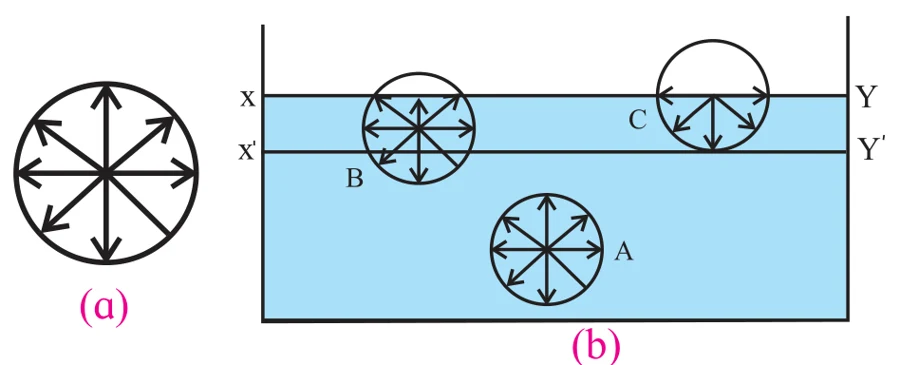
Fig. 2.15 · HSC Textbook · (a) Sphere of influence (b) Surface film
→Terms: range of molecular force (~10⁻⁹ m), sphere of influence, surface film (layer XY–X′Y′ of thickness = range).
→Molecule A deep inside: sphere of influence wholly in the liquid
⇒ equal cohesive forces in all directions
⇒ net force zero.
→Molecule B in the surface film: larger part of its sphere in the liquid
⇒ strong downward cohesive force, weak upward adhesive force of air
⇒ pulled inside.
→Molecule C on the free surface: half sphere in air (few air molecules)
⇒ net force into the liquid.
→All molecules of the surface film feel a net inward pull
⇒ the number of surface molecules is minimised.
→The surface film behaves like a stretched elastic membrane; this tension, acting tangential to the surface, is surface tension.
Q233 marks · HSC Feb 2024 · HSC Feb 2023 · SCERT Question Bank · LA 1
Define surface energy. Obtain the relation between surface energy and surface tension.
Solution
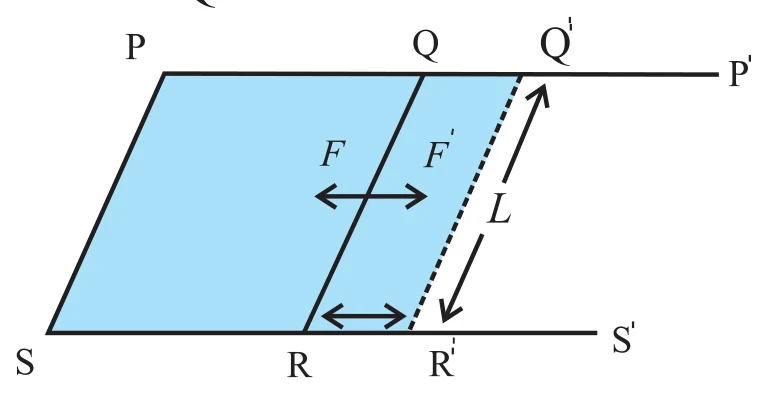
Fig. 2.17 · HSC Textbook · Surface energy of a liquid
→Surface energy: the extra potential energy of the molecules in the surface film (work done to increase the surface area isothermally is stored as surface energy).
→Set-up: C-shaped wire frame PQRS with a movable arm QR of length L, holding a soap film (two surfaces).
F = T × 2L (inward force on QR)
→Stretch: an equal force F′ moves QR isothermally to Q′R′ through dx.
dW = F dx = T(2L dx)
→Area:
2L dx = dA, the increase in area of the two surfaces.
dW = T dA
⇒ surface energy = T × dA
→Surface tension = surface energy per unit area: Surface energydA = T.
Q243 marks · Expected question · based on HSC Textbook 2.4.4
Explain the effect of impurity and temperature on surface tension of a liquid.
Solution
→Soluble impurity (common salt in water): surface tension increases.
→Sparingly soluble (phenol, detergent): surface tension decreases, so detergent water removes stains.
→Insoluble impurity (dust on mercury): surface tension decreases; dusty mercury does not form spherical droplets.
→Temperature: in most liquids surface tension decreases with rise in temperature (hot water removes stains).
→Exceptions: molten copper and cadmium (increases). Surface tension is zero at the critical temperature.

MHT CET corner

4 MHT CET questions on the same formulas
C1MHT CET 2023
The potential energy of a molecule on the surface of a liquid compared to the molecules inside the liquid is
(a) zero(b) less(c) same(d) large
Solution
→Work is done against the net inward cohesive force to bring a molecule to the surface; it is stored as extra potential energy (surface energy)
→Answer: (d) large
C2MHT CET 2026
A square frame of each side L is dipped in a soap solution and taken out. The force acting on the film formed is (T = surface tension of soap solution)
(a) 4TL(b) 8TL(c) 12TL(d) 16TL
Solution
→The film has two surfaces, so the length in contact = 2 × 4L = 8L
⇒ F = T × 8L = 8TL
→Answer: (b) 8TL
C3MHT CET 2023
Consider a soap film on a rectangular frame of wire of area 3 × 3 cm². If the area of the soap film is increased to 5 × 5 cm², the work done in the process will be (surface tension of soap is 2.5 × 10⁻² N/m)
(a) 9 × 10⁻⁶ J(b) 16 × 10⁻⁶ J(c) 40 × 10⁻⁶ J(d) 80 × 10⁻⁶ J
Solution
→Two surfaces: W = 2TΔA = 2 × 2.5 × 10⁻² × (25 − 9) × 10⁻⁴
= 80 × 10⁻⁶ J
→Answer: (d) 80 × 10⁻⁶ J
C4MHT CET 2023
1000 small water drops of equal size combine to form a big drop. The ratio of final surface energy to the total initial surface energy is
(a) 10 : 1(b) 1 : 10(c) 1000 : 1(d) 1 : 1000
Solution
→R = n1/3r = 10r
→Ef : Ei = 4πR² : n(4πr²) = 100 : 1000
= 1 : 10
→Answer: (b) 1 : 10

Practise more MHT CET PYQsSurface Tension and Surface Energy · topic-wise, with step-by-step solutions
03
TOPIC

Excess Pressure: Drops and Bubbles

In this topic
  • Pressure across plane, convex and concave surfaces
  • Why drops and bubbles are spherical
  • Laplace’s law for a drop and a soap bubble
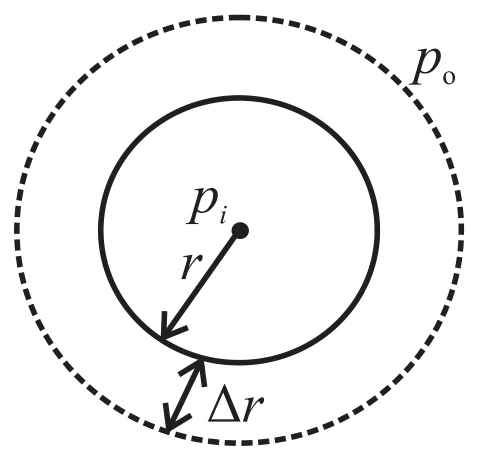
Fig. 2.22 · HSC Textbook · Excess pressure inside a liquid drop
TOPIC 03

Concept in brief

  • Across a curved liquid surface the force of surface tension adds to or opposes the atmospheric force, so the pressure just below the surface changes.
  • Plane surface: no excess pressure. Curved surface: the pressure on the concave side is always greater than that on the convex side.
  • Liquid drops and small bubbles are spherical because surface tension dominates gravity and a sphere has the least area for a given volume.
  • Laplace’s law (drop): excess pressure inside a drop of radius r is pi − p₀ = 2Tr. An air bubble inside a liquid also has one surface.
  • Soap bubble: two free surfaces, so pi − p₀ = 4Tr.
  • Excess pressure ∝ 1r: a smaller drop or bubble has a larger excess pressure.
FORMULAS

Formulas

Liquid drop

pi − p₀ = 2Tr

Soap bubble

pi − p₀ = 4Tr

Air bubble in liquid

Δp = 2Tr

Area increase

dA = 8πr Δr

KEY WORDS

Key words

WordMeaning
excess pressureinside pressure minus outside pressure
concavecurved inwards, like a bowl
convexcurved outwards, like a dome
meniscuscurved liquid surface
soap bubblethin film with two surfaces
membranethin stretched sheet
isothermalat constant temperature
Laplace’s lawΔp = 2T/r for a spherical drop

Board questions

10 questions · HSC papers 2022–2026, SCERT Question Bank, HSC Textbook
Q11 mark · HSC Jul 2022 · SCERT Question Bank · MCQ 2
Raindrops are spherical in shape because of _____.
(a) surface tension(b) capillarity(c) downward motion(d) acceleration due to gravity
Solution
→Surface tension tries to minimise the surface area; for a given volume a sphere has the least area (surface tension dominates gravity for small drops).
→Answer: (a) surface tension
Q21 mark · Expected question · based on HSC Textbook 2.4.5
For a curved liquid surface, on which side is the pressure greater?
Solution
→The pressure on the concave side is always greater than that on the convex side.
Q32 marks · HSC Jul 2022
Calculate the excess pressure inside a water drop of radius 2 mm. (Surface tension of water T = 73 × 10⁻³ N/m)
Solution
→Given: r = 2 × 10⁻³ m
T = 73 × 10⁻³ N/m
pi − p₀ = 2Tr = 2 × 73 × 10⁻³2 × 10⁻³
= 73 N/m²
→Answer: 73 N/m²
Q42 marks · HSC Jul 2023
What should be the diameter of a water drop so that the excess pressure inside it is 80 N/m²? (Surface tension of water = 7.2 × 10⁻² N/m)
Solution
pi − p₀ = 2Tr
⇒ r = 2Tpi − p₀
r = 2 × 7.2 × 10⁻²80 = 1.8 × 10⁻³ m
d = 2r = 3.6 × 10⁻³ m
= 3.6 mm
→Answer: 3.6 mm
Q52 marks · HSC Textbook Example 2.6
What should be the diameter of a water drop so that the excess pressure inside it is 80 N/m²? (Surface tension of water = 7.27 × 10⁻² N/m)
Note: The HSC Textbook prints d = 3.636 × 10⁻³ mm; the correct value is 3.636 × 10⁻³ m = 3.636 mm.
Solution
r = 2Tpi − p₀ = 2 × 7.27 × 10⁻²80
= 1.818 × 10⁻³ m
d = 2r = 3.636 × 10⁻³ m
= 3.636 mm
→Answer: 3.636 mm
Note: The HSC Textbook prints d = 3.636 × 10⁻³ mm; the correct value is 3.636 × 10⁻³ m = 3.636 mm.
Q62 marks · HSC Jun 2026
Calculate the radius of water drop, so that the excess pressure inside it is 24 N/m². (Surface tension of water = 7.2 × 10⁻² N/m)
Solution
r = 2Tpi − p₀ = 2 × 7.2 × 10⁻²24
= 6 × 10⁻³ m
→Answer: 6 × 10⁻³ m = 6 mm
Q72 marks · HSC Textbook Ex. 19
An air bubble of radius 0.2 mm is situated just below the water surface. Calculate the gauge pressure. Surface tension of water = 7.2 × 10⁻² N/m.
Solution
→An air bubble inside water has one surface
⇒ excess pressure = 2Tr.
p − p₀ = 2 × 7.2 × 10⁻²0.2 × 10⁻³ = 720 N/m²
→Answer: 720 N/m²
Q83 marks · HSC Feb 2025
Diameter of a water drop is 0.6 mm. Calculate the pressure inside a liquid drop. (T = 72 dyne/cm, atmospheric pressure = 1.013 × 10⁵ N/m²)
Solution
→Given: r = 0.3 mm = 3 × 10⁻⁴ m
T = 72 dyne/cm = 72 × 10⁻³ N/m
pi − p₀ = 2Tr = 2 × 72 × 10⁻³3 × 10⁻⁴
= 480 N/m²
pi = p₀ + 480 = 1.013 × 10⁵ + 0.0048 × 10⁵
pi = 1.0178 × 10⁵ N/m²
→Answer: 1.0178 × 10⁵ N/m² (excess 480 N/m²)
Q93 marks · HSC Textbook Ex. 6
Derive an expression of excess pressure inside a liquid drop.
Solution
Fig. 2.22 · HSC Textbook · Excess pressure inside a liquid drop
→Set-up: spherical drop of radius r; pressure inside pi, outside p₀ (pi > p₀).
→Increase radius from r to r + Δr (Δr very small, so pi stays constant):
ΔA = 4π(r + Δr)² − 4πr² ≈ 8πrΔr (Δr² neglected)
→Work stored as surface energy:
dW = TΔA = T(8πrΔr)
→Same work by excess force: F = (pi − p₀) 4πr²
dW = FΔr = (pi − p₀) 4πr²Δr
→Equate: (pi − p₀) 4πr²Δr = T(8πrΔr)
pi − p₀ = 2Tr
Q104 marks · HSC Feb 2026 · SCERT Question Bank · LA 2
Derive Laplace’s law for spherical membrane of bubble due to surface tension.
Solution
Fig. 2.22 · HSC Textbook · Excess pressure inside a liquid drop
→Set-up: spherical drop / bubble of radius r; inside pressure pi, outside p₀; excess pressure pi − p₀.
→Increase radius by a small Δr (pi almost constant):
A₁ = 4πr²
A₂ = 4π(r + Δr)² ≈ 4πr² + 8πrΔr
dA = A₂ − A₁ = 8πrΔr
→Surface energy: dW = T dA = T(8πrΔr) ···(1)
→Work by excess pressure: F = (pi − p₀) 4πr²
dW = FΔr ···(2)
→Equate (1) and (2): (pi − p₀) 4πr²Δr = T(8πrΔr)
pi − p₀ = 2Tr (liquid drop: Laplace’s law)
→Soap bubble: two free surfaces (inner and outer)
⇒ dA = 2(8πrΔr)
(pi − p₀) 4πr²Δr = T(16πrΔr)
⇒ pi − p₀ = 4Tr

MHT CET corner

4 MHT CET questions on the same formulas
C1MHT CET 2023
What should be the diameter of a soap bubble, in order that the excess pressure inside it is 25.6 N/m²? (surface tension of soap = 3.2 × 10⁻² N/m)
(a) 2 cm(b) 1.5 cm(c) 1 cm(d) 0.5 cm
Solution
→Soap bubble: Δp = 4TR
⇒ R = 4 × 3.2 × 10⁻²25.6 = 5 × 10⁻³ m
= 0.5 cm
⇒ diameter = 1 cm
→Answer: (c) 1 cm
C2MHT CET 2026
If the shape of the liquid surface is curved, then
(a) the pressure on the convex side is equal to atmospheric pressure(b) the pressure on the convex side is equal to the pressure on the concave side(c) the pressure on the concave side is greater than that on the convex side(d) the pressure on the concave side is less than that on the convex side
Solution
→Surface tension pulls a curved surface towards its concave side, so for equilibrium the pressure on the concave side is greater (by 2TR)
→Answer: (c) the pressure on the concave side is greater than that on the convex side
C3MHT CET 2026
Two soap bubbles A and B have radii in the ratio 3 : 2. The ratio of the excess pressure inside bubble A to that of B is
(a) 2 : 3(b) 3 : 2(c) 1 : 5(d) 4 : 9
Solution
→Δp = 4TR ∝ 1R
⇒ ΔpA : ΔpB = RB : RA = 2 : 3
→Answer: (a) 2 : 3
C4MHT CET 2024
The excess pressure inside a spherical drop of water A is four times that of another drop B. Then the ratio of mass of drop A to that of drop B is
(a) 1 : 4(b) 1 : 8(c) 1 : 16(d) 1 : 64
Solution
→Δp = 2Tr ∝ 1r
⇒ rA = rB4
→Mass ∝ r³
⇒ mA : mB = 1 : 64
→Answer: (d) 1 : 64
Practise more MHT CET PYQsExcess Pressure: Drops and Bubbles · topic-wise, with step-by-step solutions
04
TOPIC

Angle of Contact and Capillarity

In this topic
  • Angle of contact, concave and convex meniscus
  • Factors affecting the angle of contact
  • Capillary rise and fall
  • h = 2T cos θ / rρg
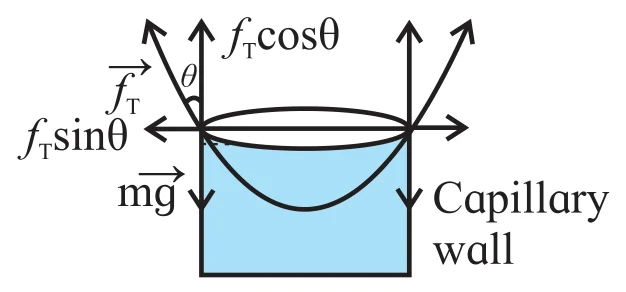
Fig. 2.25 (b) · HSC Textbook · Forces acting on liquid inside a capillary
TOPIC 04

Concept in brief

  • Angle of contact θ: angle between the tangents to the liquid surface and to the solid surface at the point of contact, measured within the liquid.
  • Acute θ (adhesion strong): concave meniscus, the liquid wets the solid (water–glass). Obtuse θ (cohesion strong): convex meniscus, does not wet (mercury–glass, 140°).
  • θ depends on the nature of the liquid and solid, impurities and temperature (θ decreases as temperature rises). Pure water–clean glass: θ ≈ 0°.
  • Capillarity: rise or fall of a liquid in a fine tube (bore ~1 mm). Examples: oil in a wick, blotting paper, sap in trees, cloth rag.
  • Capillary rise: h = 2T cos θrρg (forces method or pressure method). Narrower tube ⇒ greater rise; h ∝ 1r.
  • Obtuse θ ⇒ cos θ < 0 ⇒ capillary fall (mercury). θ = 90° ⇒ no rise or fall.
FORMULAS

Formulas

Capillary rise

h = 2T cos θrρg

Surface tension

T = rhρg2 cos θ

Meniscus radius

R = rcos θ

Same liquid

h₁r₁ = h₂r₂

KEY WORDS

Key words

WordMeaning
angle of contactangle measured inside the liquid at the wall
wetspread over and stick to a surface
capillary tubetube with a very fine bore
capillarityrise or fall of liquid in a fine tube
acuteless than 90°
obtusemore than 90°
boreinner radius of a tube
water-proofingmaking the angle of contact obtuse

Board questions

13 questions · HSC papers 2022–2026, SCERT Question Bank, HSC Textbook
Q11 mark · HSC Feb 2023
If ‘θ’ represents the angle of contact made by a liquid which completely wets the surface of the container, then _____.
(a) θ = 0(b) 0 < θ < π2(c) θ = π2(d) π2 < θ < π
Solution
→A liquid that completely wets the solid (pure water on clean glass) has angle of contact ≈ 0.
→Answer: (a) θ = 0
Q21 mark · HSC Mar 2022 · HSC Textbook Ex. 1(ii) · SCERT Question Bank · MCQ 5 · SCERT Question Bank · VSA 7
A liquid rises in a glass capillary tube up to a height of 2.5 cm at room temperature. If another glass capillary tube having radius half that of the earlier tube is immersed in the same liquid, the rise of liquid in it will be _____.
(a) 1.25 cm(b) 2.5 cm(c) 5 cm(d) 10 cm
Solution
h = 2T cos θrρg
⇒ h ∝ 1r
→Radius halved
⇒ height doubled: 2 × 2.5 = 5 cm.
→Same rule: radii 0.3 cm and 0.6 cm
⇒ h₁ : h₂ = 2 : 1; radius made 13
⇒ 20 mm becomes 60 mm.
→Answer: (c) 5 cm
Q31 mark · HSC Jun 2026
Absorption of ink by a blotting paper is an example of which phenomenon of fluids?
Solution
→Capillarity (capillary action): ink rises through the fine pores of the blotting paper.
Q41 mark · SCERT Question Bank · VSA 3
What will be the shape of liquid meniscus for obtuse angle of contact?
Solution
→For an obtuse angle of contact the meniscus is convex (e.g. mercury in glass).
Q52 marks · SCERT Question Bank · SA-I 3
Define surface tension and angle of contact.
Solution
→Surface tension:
the tangential force acting per unit length on both sides of an imaginary line drawn on the free surface of a liquid, T = FL.
→Angle of contact: the angle between the tangents drawn to the free surface of the liquid and to the surface of the solid at the point of contact, measured within the liquid.
Q62 marks · HSC Jul 2022
Define angle of contact. State any two of its properties (factors on which it depends).
Solution
→Angle of contact: the angle between the tangents drawn to the free surface of the liquid and the surface of the solid at the point of contact, measured within the liquid.
→It depends on the nature of the liquid and the solid in contact (pure water–clean glass 0°, mercury–glass 140°).
→Impurities in the liquid change the angle of contact.
→Increase in temperature decreases the angle of contact; at a given temperature it is constant for a given pair.
→Acute angle
⇒ concave meniscus (liquid wets); obtuse angle
⇒ convex meniscus (does not wet).
Q72 marks · HSC Jul 2022 · HSC Textbook Ex. 8
What is capillarity? State any two uses (examples) of capillarity.
Solution
→Capillarity: the phenomenon of rise or fall of a liquid inside a capillary tube when it is dipped in the liquid.
→Oil rises up the wick of a lamp.
→Blotting paper absorbs ink; a cloth rag sucks water.
→Sap and water rise up to the topmost leaves of a tree; water rises up the crevices in rocks.
Q82 marks · SCERT Question Bank · SA-I 4 · HSC Textbook Ex. 18
Calculate the rise of water inside a clean glass capillary tube of radius 0.1 mm, when immersed in water of surface tension 7 × 10⁻² N/m. The angle of contact between water and glass is zero, density of water = 1000 kg/m³, g = 9.8 m/s².
Solution
→Given: r = 10⁻⁴ m
T = 7 × 10⁻² N/m
θ = 0 (cos θ = 1)
h = 2T cos θrρg = 2 × 7 × 10⁻²10⁻⁴ × 1000 × 9.8
= 0.1429 m
→Answer: 0.1429 m
Q93 marks · Expected question · based on HSC Textbook 2.4.3
Explain why the meniscus of water in glass is concave and that of mercury in glass is convex.
Solution
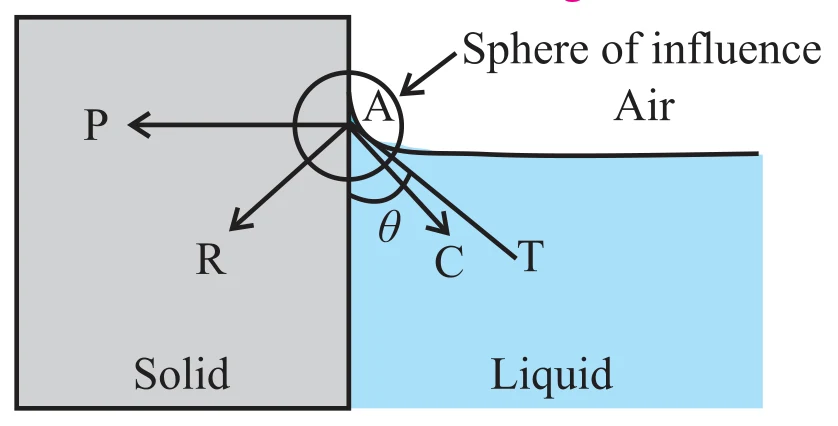
Fig. 2.19 (a) · HSC Textbook · Acute angle of contact
→Forces on surface molecule A near the wall: net adhesive force AP (horizontal, into the wall) and net cohesive force AC (at about 45°).
→Water–glass: adhesion is large
⇒ resultant AR points into the solid.
→For equilibrium the surface must be normal to AR
⇒ liquid piles up at the wall
⇒ concave meniscus, acute angle (liquid wets).
→Mercury–glass: cohesion is large
⇒ resultant AR points into the liquid.
→Liquid creeps down at the wall
⇒ convex meniscus, obtuse angle (does not wet).
→Condition: AP > AC2
⇒ acute; AP < AC2
⇒ obtuse.
Q103 marks · HSC Textbook Example 2.7
A capillary tube of radius 5 × 10⁻⁴ m is immersed in a beaker filled with mercury. The mercury level inside the tube is found to be 8 × 10⁻³ m below the level of reservoir. Determine the angle of contact between mercury and glass. Surface tension of mercury is 0.465 N/m and its density is 13.6 × 10³ kg/m³. (g = 9.8 m/s²)
Solution
→Capillary fall: h = −8 × 10⁻³ m (level drops).
cos θ = hrρg2T = −8 × 10⁻³ × 5 × 10⁻⁴ × 13.6 × 10³ × 9.82 × 0.465
cos θ = −0.5732
⇒ cos(180° − θ) = 0.5732
180° − θ = 55° 2′
⇒ θ = 124° 58′
→Answer: θ = 124° 58′
Q113 marks · SCERT Question Bank · SA-II 2 · HSC Textbook Ex. 9
Obtain an expression for the capillary rise for a liquid having a concave meniscus, using the forces method.
Solution
Fig. 2.25 (b) · HSC Textbook · Forces acting on liquid inside a capillary
→Set-up: capillary of radius r dipped in a liquid of density ρ; angle of contact θ; liquid rises to height h.
→Force of surface tension acts along the tangent, all along the circumference 2πr:
fT = T × 2πr
vertical component fv = 2πrT cos θ
→Weight of the column (meniscus ignored): V = πr²h
w = πr²hρg
→Equilibrium: πr²hρg = 2πrT cos θ
h = 2T cos θrρg
→Obtuse θ
⇒ cos θ negative
⇒ h negative: capillary fall (mercury).
Q123 marks · SCERT Question Bank · SA-II 5
A U-tube is made up of capillaries of bore 1 mm and 2 mm respectively. The tube is held vertically and partially filled with a liquid of surface tension 49 dyne/cm and zero angle of contact. Calculate the density of liquid, if the difference in the levels of the meniscus is 1.25 cm. (g = 980 cm/s²)
Solution
→Given: r₁ = 0.05 cm
r₂ = 0.1 cm
T = 49 dyne/cm
θ = 0
h₁ − h₂ = 1.25 cm
h₁ − h₂ = 2Tρg(1r₁ − 1r₂)
1.25 = 2 × 49ρ × 980(20 − 10) = 1ρ
ρ = 11.25 = 0.8 g/cm³
→Answer: 0.8 g/cm³
Q133 marks · Expected question · based on HSC Textbook 2.4.7
Obtain an expression for capillary rise using the pressure difference method.
Solution
→Set-up:
capillary of radius r, angle of contact θ; meniscus concave with radius of curvature R = rcos θ.
→Pressure on the concave side is greater by 2TR, so the liquid rises until the column balances it:
hρg = 2TR = 2T cos θr
h = 2T cos θrρg
→Narrower the tube, greater the rise (or fall).

MHT CET corner

4 MHT CET questions on the same formulas
C1MHT CET 2025
The liquid (mercury) meniscus in a capillary tube will be convex if the angle of contact is
(a) greater than 90°(b) less than 90°(c) equal to 90°(d) equal to 0°
Solution
→Obtuse angle of contact (cohesion > adhesion)
⇒ the liquid is depressed and the meniscus is convex
→Answer: (a) greater than 90°
C2MHT CET 2024
A capillary tube stands with its lower end dipped into a liquid for which the angle of contact is 90°. The liquid will
(a) neither rise nor fall(b) get depressed only(c) rise only(d) rise up to the top of the tube
Solution
→h = 2T cos θrρg and cos 90° = 0
⇒ h = 0: the surface stays flat
→Answer: (a) neither rise nor fall
C3MHT CET 2024
The angle of contact between glass and water is 0° and water rises in a glass capillary up to 6 cm (surface tension of water is T). Another liquid of surface tension 2T, angle of contact 60° and relative density 2 will rise in the same capillary up to
(a) 1.5 cm(b) 2 cm(c) 3 cm(d) 4.0 cm
Solution
→Same tube: h ∝ T cos θρ
⇒ h₂h₁ = 2T × 0.5 / 2T × 1 / 1 = 12
⇒ h₂ = 3 cm
→Answer: (c) 3 cm
C4MHT CET 2024
Water rises in a capillary tube of radius r up to height h. The mass of water in the capillary is m. The mass of water that will rise in a capillary of radius r/3 will be
(a) m(b) m3(c) m6(d) m9
Solution
→Weight of the column = upward force: mg = 2πrT
⇒ m ∝ r
⇒ radius r3 gives mass m3
→Answer: (b) m3
Practise more MHT CET PYQsAngle of Contact and Capillarity · topic-wise, with step-by-step solutions
05
TOPIC

Streamline Flow and Continuity

In this topic
  • Flow line, streamline and flow tube
  • Streamline and turbulent flow
  • Critical velocity and Reynolds number
  • Equation of continuity
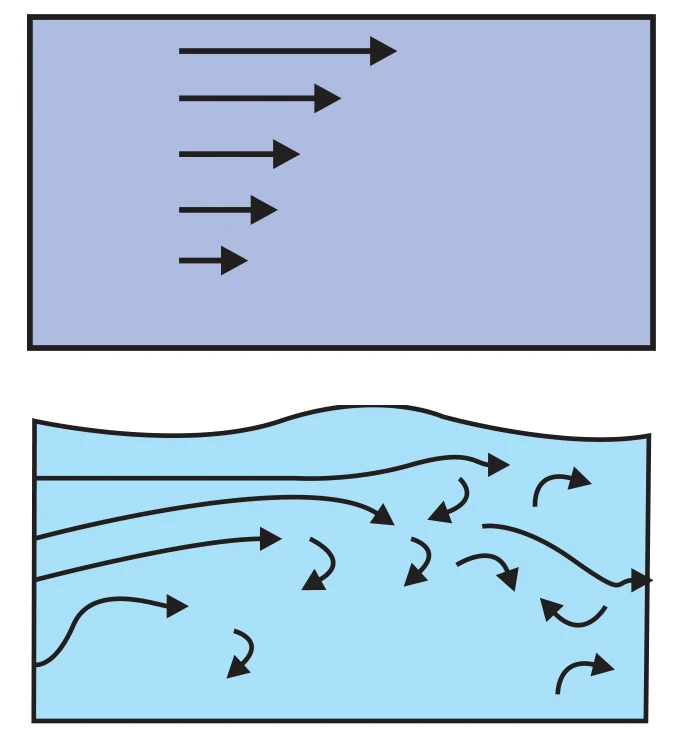
Fig. 2.27 · HSC Textbook · (a) Streamline flow (b) Turbulent flow
TOPIC 05

Concept in brief

  • Hydrodynamics studies fluids in motion. Streamline: a curve whose tangent at any point gives the direction of velocity there. Two streamlines never intersect.
  • Streamline (laminar) flow: smooth, steady flow below the critical velocity; velocity at a point stays constant.
  • Turbulent flow: irregular, unsteady flow beyond the critical velocity, with eddies (flooded river, fast tap).
  • Critical velocity vc = Rnηρd. Reynolds number Rn = vcρdη is a pure number.
  • Rn < 1000: streamline · 1000 to 2000: unsteady · Rn > 2000: turbulent.
  • Equation of continuity (incompressible, steady flow): A₁v₁ = A₂v₂, i.e. volume flux Av is constant. Narrow section ⇒ faster flow. It expresses conservation of mass.
FORMULAS

Formulas

Reynolds number

Rn = vρdη

Critical velocity

vc = Rnηρd

Continuity

A₁v₁ = A₂v₂

Pipe of diameter d

d₁²v₁ = d₂²v₂

KEY WORDS

Key words

WordMeaning
streamlinepath whose tangent gives the velocity
laminarin smooth parallel layers
turbulentirregular, with eddies
eddysmall whirling current
critical velocityspeed at which flow turns turbulent
Reynolds numberpure number deciding the type of flow
volume fluxvolume flowing per second
continuityAv is the same everywhere

Board questions

7 questions · HSC papers 2022–2026, SCERT Question Bank, HSC Textbook
Q11 mark · HSC Mar 2022
State the formula for critical velocity in terms of Reynold’s number for a flow of a fluid.
Solution
vc = Rn ηρd
→vc critical velocity, Rn Reynolds number, η coefficient of viscosity, ρ density, d diameter of the tube.
Q21 mark · Expected question · based on HSC Textbook 2.6
What is the nature of flow when Reynolds number is (i) less than 1000 (ii) greater than 2000?
Solution
→Rn < 1000: streamline · Rn > 2000: turbulent · between 1000 and 2000 the flow is unsteady (changes from streamline to turbulent).
Q32 marks · HSC Textbook Ex. 4
Why does velocity increase when water flowing in broader pipe enters a narrow pipe?
Solution
→Equation of continuity:
for an incompressible fluid in steady flow, Av = constant.
A₁v₁ = A₂v₂
⇒ v₂ = A₁A₂v₁
→A₂ < A₁
⇒ v₂ > v₁: the same volume per second must pass through the smaller area, so water moves faster.
Q42 marks · HSC Jul 2023 · SCERT Question Bank · SA-I 2
Distinguish between streamline flow and turbulent flow (any two points).
Solution
→Speed: streamline – velocity smaller than critical velocity; turbulent – velocity beyond critical velocity.
→Velocity at a point: streamline – always constant; turbulent – does not remain constant.
→Paths: streamline – streamlines never intersect, layers parallel; turbulent – eddies (rotational motion) form.
→Order: streamline – flow tube keeps its order; turbulent – particles move in random directions.
Q52 marks · HSC Textbook Example 2.10
A piston of cross sectional area 2 cm² pushes the liquid out of a tube whose area at the outlet is 40 mm². The piston is pushed at a rate of 2 cm/s. Determine the speed at which the fluid leaves the tube.
Solution
→Given: A₁ = 2 × 10⁻⁴ m²
v₁ = 2 × 10⁻² m/s
A₂ = 40 × 10⁻⁶ m²
A₁v₁ = A₂v₂
⇒ v₂ = A₁v₁A₂ = 2 × 10⁻⁴ × 2 × 10⁻²40 × 10⁻⁶
= 0.1 m/s
→Answer: 0.1 m/s
Q62 marks · HSC Textbook Ex. 15
The speed of water is 2 m/s through a pipe of internal diameter 10 cm. What should be the internal diameter of nozzle of the pipe if the speed of water at nozzle is 4 m/s?
Solution
A₁v₁ = A₂v₂
⇒ d₁²v₁ = d₂²v₂
d₂ = d₁v₁v₂ = 1024
= 7.07 cm
d₂ = 7.07 × 10⁻² m
→Answer: 7.07 × 10⁻² m
Q73 marks · HSC Textbook Ex. 7
Obtain an expression for conservation of mass starting from the equation of continuity.
Solution
→Set-up: steady flow of an incompressible fluid (density ρ) through a tube of flow; sections A₁ at A and A₂ at B, speeds v₁ and v₂.
→Fluid cannot leave or enter through the walls of the tube of flow; matter is neither created nor destroyed between the sections.
→Mass entering at A in time Δt: ρA₁v₁Δt · mass leaving at B: ρA₂v₂Δt
ρA₁v₁Δt = ρA₂v₂Δt
A₁v₁ = A₂v₂
⇒ Av = constant (equation of continuity)
→Av = dVdt is the volume flux and ρdVdt = dmdt is the mass flux: the mass flowing per second is the same at every section
⇒ mass is conserved.

MHT CET corner

4 MHT CET questions on the same formulas
C1MHT CET 2026
In case of a liquid, if Reynolds number Rn is 1450, then the flow of liquid will
(a) be streamline(b) be turbulent(c) change from streamline to turbulent flow(d) be sometimes turbulent and sometimes streamline
Solution
→Rn between 1000 and 2000
⇒ the flow is unsteady: it changes from streamline to turbulent
→Answer: (c) change from streamline to turbulent flow
C2MHT CET 2023
Select the WRONG statement. In a streamline flow
(a) velocity of a fluid at a given point is never constant(b) velocity is smaller than critical velocity(c) layers are always parallel(d) the particles do not move in random direction
Solution
→In streamline flow the velocity at a given point is always constant, so (a) is wrong;
→(b), (c), (d) are true
→Answer: (a) velocity of a fluid at a given point is never constant
C3MHT CET 2023
A fluid of density ρ and viscosity η is flowing through a pipe of diameter d with a velocity v. The Reynolds number is
(a) 2dρvη(b) dρvη(c) dρvη²(d) 2ηdvρ
Solution
→Rn = vρdη (from vc = Rnηρd)
→Answer: (b) dρvη
C4MHT CET 2025
An incompressible fluid flows steadily through a cylindrical pipe having radius R at point A and R/3 at point B further along the flow. If the velocity at point A is V, then that at point B is
(a) V9(b) V3(c) 3V(d) 9V
Solution
→Continuity: πR²V = π(R3)²vB
⇒ vB = 9V
→Answer: (d) 9V
Practise more MHT CET PYQsStreamline Flow and Continuity · topic-wise, with step-by-step solutions
06
TOPIC

Viscosity and Terminal Velocity

In this topic
  • Viscosity and velocity gradient
  • Newton’s law of viscosity, coefficient η
  • Stokes’ law
  • Terminal velocity of a falling sphere
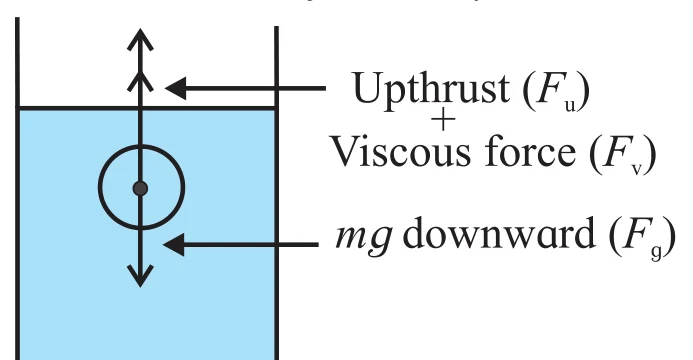
Fig. 2.32 · HSC Textbook · Forces acting on an object moving through a viscous medium
TOPIC 06

Concept in brief

  • Viscosity: the property of a fluid by which layers in relative motion feel a dragging force (viscous drag). Honey is more viscous than water.
  • Velocity gradient dvdx: rate of change of velocity with distance from a stationary layer (unit s⁻¹).
  • Newton’s law of viscosity: f = ηA dvdx. η is the coefficient of viscosity, unit N s/m² (CGS: poise, 1 N s/m² = 10 poise).
  • For most liquids η decreases with rise in temperature; for gases η increases.
  • Stokes’ law: viscous force on a small sphere moving through a fluid F = 6πηrv.
  • Terminal velocity: when weight = viscous force + buoyant force, the sphere falls with constant velocity v = 2r²(ρ − σ)g9η. v ∝ r²; if σ > ρ the body rises (air bubble).
FORMULAS

Formulas

Viscous force

f = ηA dvdx

Stokes’ law

F = 6πηrv

Terminal velocity

v = 2r²(ρ − σ)g9η

Coefficient

η = fA (dv/dx)

KEY WORDS

Key words

WordMeaning
viscosityinternal friction of a fluid
viscous dragforce opposing relative motion of layers
velocity gradientchange of velocity per unit distance
poiseCGS unit of viscosity
terminal velocityconstant velocity in a viscous fluid
buoyant forceupthrust of the fluid
stationary layerlayer at rest, e.g. at the wall
specific gravitydensity relative to water

Board questions

16 questions · HSC papers 2022–2026, SCERT Question Bank, HSC Textbook
Q11 mark · SCERT Question Bank · MCQ 4
Unit of coefficient of viscosity is _____.
(a) Ns/m(b) Ns²/m(c) Ns²/m²(d) Ns/m²
Solution
η = fA (dv/dx) → Nm² × s⁻¹ = Ns/m²
→Answer: (d) Ns/m²
Q21 mark · HSC Jun 2026
For a streamline flow, the relative velocity between the two liquid layers is 10 cm/s. The distance between them is 5 cm. The velocity gradient is _____.
(a) 3 s⁻¹(b) 5 s⁻¹(c) 4 s⁻¹(d) 2 s⁻¹
Solution
dvdx = 10 cm/s5 cm = 2 s⁻¹
→Answer: (d) 2 s⁻¹
Q31 mark · SCERT Question Bank · MCQ 7 · HSC Textbook Ex. 1(iv)
Two stones with radii 1 : 2 fall from a great height through atmosphere. Their terminal velocities are in the ratio _____.
(a) 2 : 1(b) 1 : 4(c) 4 : 1(d) 1 : 2
Solution
v = 2r²(ρ − σ)g9η
⇒ v ∝ r²
v₁v₂ = (12)² = 14
→Same rule (Ex. 1(iv)): hail stones with radii 1 : 4
⇒ terminal velocities 1 : 16.
→Answer: (b) 1 : 4
Q41 mark · SCERT Question Bank · VSA 4
What is the net weight of a body when it falls with terminal velocity through a viscous medium?
Solution
→Zero. At terminal velocity, weight = viscous force + buoyant force, so the net force (effective weight) is zero.
Q51 mark · SCERT Question Bank · VSA 5
A square metal plate of area 100 cm² moves parallel to another plate with a velocity of 10 cm/s, both plates immersed in water. If the viscous force is 200 dyne and viscosity of water is 0.01 poise, what is the distance between them?
Solution
f = ηAvx
⇒ x = ηAvf = 0.01 × 100 × 10200
= 0.05 cm
→Answer: 0.05 cm
Q61 mark · SCERT Question Bank · VSA 6
The relative velocity between two parallel layers of water is 8 cm/s and perpendicular distance between them is 0.1 cm. Calculate the velocity gradient.
Solution
dvdx = 80.1 = 80 s⁻¹
→Answer: 80 s⁻¹
Q72 marks · HSC Feb 2023
Define coefficient of viscosity. State its formula and SI unit.
Solution
→Definition: the coefficient of viscosity is the viscous force per unit area per unit velocity gradient.
η = fA (dv/dx)
→SI unit: N s/m² (CGS unit: poise; 1 N s/m² = 10 poise).
Q82 marks · HSC Feb 2025
Using Newton’s law of viscosity for streamline flow, derive an expression for coefficient of viscosity.
Solution
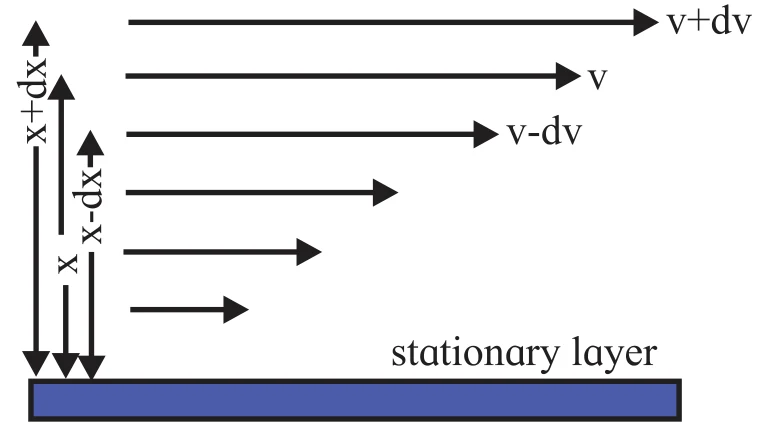
Fig. 2.30 · HSC Textbook · Velocity of layers above a stationary layer
→Newton’s law of viscosity: for streamline flow, viscous force f on a layer is directly proportional to the area A of the layer and the velocity gradient dvdx.
f ∝ A dvdx
⇒ f = ηA dvdx
η = fA (dv/dx)
→η is the coefficient of viscosity; A is the area of the layer parallel to the flow (not the cross section).
Q92 marks · HSC Feb 2024 · HSC Textbook Ex. 13
A horizontal force of 0.5 N is required to move a metal plate of area 10⁻² m² with a velocity of 3 × 10⁻² m/s, when it rests on a layer of glycerin 0.5 mm thick. Find the coefficient of viscosity of glycerin.
Solution
→Given: f = 0.5 N
A = 10⁻² m²
v = 3 × 10⁻² m/s
x = 0.5 × 10⁻³ m
η = fxAv = 0.5 × 0.5 × 10⁻³10⁻² × 3 × 10⁻²
= 0.833 N s/m²
→Same method (Ex. 13): f = 1 N
A = 10⁻² m²
v = 2 × 10⁻² m/s
x = 1.5 × 10⁻³ m
⇒ η = 7.5 N s/m².
→Answer: 0.833 N s/m²
Q102 marks · HSC Feb 2026 · HSC Textbook Example 2.8
A steel ball of radius 0.3 mm is falling with a velocity of 2 m/s through a tube filled with glycerine having coefficient of viscosity 0.833 N s/m². Determine the viscous force acting on the steel ball.
Solution
→Stokes’ law: F = 6πηrv
F = 6 × 3.142 × 0.833 × 0.3 × 10⁻³ × 2
F = 9.422 × 10⁻³ N
→Answer: 9.422 × 10⁻³ N
Q112 marks · SCERT Question Bank · SA-I 5
A rain drop of radius 0.3 mm falls through air with a terminal velocity of 1 m/s. The viscosity of air is 18 × 10⁻⁶ N s/m². Find the viscous force on the rain drop.
Solution
F = 6πηrv = 6 × 3.142 × 18 × 10⁻⁶ × 0.3 × 10⁻³ × 1
F = 1.018 × 10⁻⁷ N
→Answer: 1.018 × 10⁻⁷ N
Q122 marks · HSC Textbook Ex. 12
Calculate the viscous force acting on a rain drop of diameter 1 mm, falling with a uniform velocity 2 m/s through air. The coefficient of viscosity of air is 1.8 × 10⁻⁵ N s/m².
Solution
F = 6πηrv = 6 × 3.142 × 1.8 × 10⁻⁵ × 0.5 × 10⁻³ × 2
F = 3.393 × 10⁻⁷ N
→Answer: 3.393 × 10⁻⁷ N
Q132 marks · HSC Jul 2023 · HSC Textbook Ex. 14
With what terminal velocity will an air bubble 0.4 mm in diameter rise in a liquid of viscosity 0.1 N s/m² and specific gravity 0.9? Density of air is 1.29 kg/m³.
Solution
→Given: r = 0.2 × 10⁻³ m
ρ (air) = 1.29 kg/m³
σ (liquid) = 900 kg/m³
η = 0.1 N s/m²
v = 2r²(ρ − σ)g9η = 2 × (0.2 × 10⁻³)² × (1.29 − 900) × 9.89 × 0.1
v = −0.782 × 10⁻³ m/s
→The negative sign shows that the bubble rises up with speed 0.782 mm/s.
→Answer: 0.782 × 10⁻³ m/s (upwards)
Q143 marks · SCERT Question Bank · SA-II 3
State Stokes’ law and give two factors affecting angle of contact.
Solution
→Stokes’ law: the viscous force acting on a small sphere falling through a viscous medium is directly proportional to the radius r of the sphere, its velocity v and the coefficient of viscosity η of the fluid.
Fv = 6πηrv
→Factors affecting angle of contact:
→(i) the nature of the liquid and the solid in contact;
→(ii) impurities in the liquid; (iii) temperature: increase in temperature decreases the angle of contact.
Q153 marks · HSC Textbook Example 2.9
A spherical drop of oil falls at a constant speed of 4 cm/s in steady air. Calculate the radius of the drop. The density of the oil is 0.9 g/cm³, density of air is 0.0013 g/cm³ and the coefficient of viscosity of air is 1.8 × 10⁻⁴ poise. (g = 980 cm/s²)
Note: The HSC Textbook prints r = 1.356 × 10⁻³ cm; working it out with the given data gives 1.918 × 10⁻³ cm.
Solution
v = 2r²(ρ − σ)g9η
⇒ r² = 9ηv2(ρ − σ)g
r² = 9 × 1.8 × 10⁻⁴ × 42 × (0.9 − 0.0013) × 980 = 3.679 × 10⁻⁶ cm²
r = 1.918 × 10⁻³ cm
→Answer: r ≈ 1.92 × 10⁻³ cm
Note: The HSC Textbook prints r = 1.356 × 10⁻³ cm; working it out with the given data gives 1.918 × 10⁻³ cm.
Q163 marks · HSC Mar 2022 · SCERT Question Bank · LA 3
Derive an expression for terminal velocity of a spherical object falling under gravity through a viscous medium.
Solution
Fig. 2.32 · HSC Textbook · Forces on an object moving through a viscous medium
→Forces on the sphere (radius r, density ρ) in a fluid (density σ, viscosity η): weight mg down; viscous force Fv and buoyant force Fu up.
→Fv increases with speed; at the terminal velocity v the net force is zero:
mg = Fv + Fu
43πr³ρg = 6πηrv + 43πr³σg
6πηrv = 43πr³(ρ − σ)g
v = 2r²(ρ − σ)g9η
→Hence also η = 2r²(ρ − σ)g9v. (Valid for streamline flow only.)

MHT CET corner

4 MHT CET questions on the same formulas
C1MHT CET 2026
A spherical object is falling under gravity through a viscous fluid. The sphere attains the terminal velocity when
(a) viscous force is zero(b) buoyant force is equal to force due to gravity(c) viscous force plus force of gravity becomes equal to buoyant force(d) buoyant force plus viscous force becomes equal to force due to gravity
Solution
→Terminal velocity
⇒ net force zero: weight = buoyant force + viscous force
→Answer: (d) buoyant force plus viscous force becomes equal to force due to gravity
C2MHT CET 2024
A steel ball of radius 6 mm has a terminal speed of 12 cm/s in a viscous liquid. What will be the terminal speed of a steel ball of radius 3 mm in the same liquid?
(a) 12 cm/s(b) 9 cm/s(c) 6 cm/s(d) 3 cm/s
Solution
→v ∝ r²
⇒ v₂ = 12 × (36)² = 3 cm/s
→Answer: (d) 3 cm/s
C3MHT CET 2026
A tiny water droplet falls through air at a uniform terminal speed of 1 cm/s. If 27 such identical droplets coalesce to form a single larger drop, the new terminal velocity will be
(a) 3 cm/s(b) 27 cm/s(c) 81 cm/s(d) 9 cm/s
Solution
→Volume conserved
⇒ R = 271/3r = 3r. v ∝ r²
⇒ v′ = 9 × 1 = 9 cm/s
→Answer: (d) 9 cm/s
C4MHT CET 2023
A metal sphere of mass m and density σ₁ falls with terminal velocity through a liquid of density σ₂. The viscous force acting on the sphere is
(a) mg(1 + σ₂σ₁)(b) mg(1 − σ₁σ₂)(c) mg(1 − σ₂σ₁)(d) mg(1 + σ₁σ₂)
Solution
→Fv = mg − buoyant force = mg − mσ₁σ₂g
= mg(1 − σ₂σ₁)
→Answer: (c) mg(1 − σ₂σ₁)
Practise more MHT CET PYQsViscosity and Terminal Velocity · topic-wise, with step-by-step solutions
07
TOPIC

Bernoulli’s Equation

In this topic
  • Bernoulli’s principle and equation
  • Speed of efflux (Torricelli)
  • Venturi tube
  • Aeroplane lift, atomizer, roofs blown off
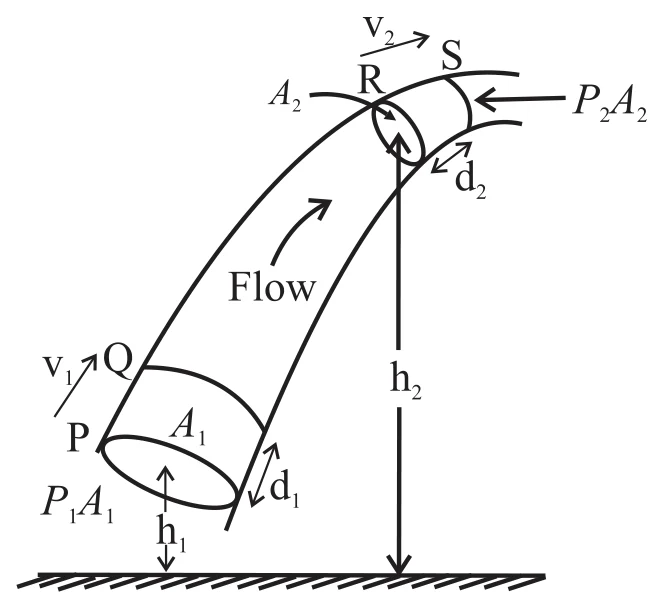
Fig. 2.34 · HSC Textbook · Flow of fluid through a tube of varying cross section and height
TOPIC 07

Concept in brief

  • Bernoulli’s principle: where the speed of a fluid increases (narrow region), its internal pressure decreases.
  • Bernoulli’s equation (ideal fluid, streamline flow): P + 12ρv² + ρgh = constant. It is the work–energy theorem for a fluid: energy is conserved.
  • P, 12ρv² and ρgh are pressure energy, kinetic energy and potential energy per unit volume (pressure head, velocity head, potential head).
  • Speed of efflux (Torricelli): liquid leaving an orifice at depth h moves with v = 2gh, like a freely falling body.
  • Venturi tube: at the constriction speed rises and pressure falls; the level difference h gives the rate of flow.
  • Applications: dynamic lift on aeroplane wings, atomizer / paint-gun / carburettor, roofs blown off by stormy wind.
FORMULAS

Formulas

Bernoulli

P + 12ρv² + ρgh = const

Efflux (Torricelli)

v = 2gh

Horizontal pipe

P₁ − P₂ = 12ρ(v₂² − v₁²)

Closed → open pipe

v = 2ΔPρ

KEY WORDS

Key words

WordMeaning
effluxoutflow of a fluid
orificesmall hole in a vessel
constrictionnarrow part of a pipe
venturimeterdevice that measures rate of flow
dynamic liftupward force on a wing
atomizerdevice that sprays fine droplets
pressure headpressure energy per unit volume
aerofoilshape of an aeroplane wing

Board questions

11 questions · HSC papers 2022–2026, SCERT Question Bank, HSC Textbook
Q11 mark · HSC Feb 2025 · HSC Textbook Ex. 1(v)
In Bernoulli’s theorem, which of the following is constant?
(a) Linear momentum(b) Angular momentum(c) Mass(d) Energy
Solution
→Bernoulli’s equation is the work–energy theorem for a flowing fluid: pressure energy + KE + PE per unit volume is constant.
→Answer: (d) Energy
Q21 mark · HSC Textbook Ex. 2(iii)
What is the basis of the Bernoulli’s principle?
Solution
→The principle of conservation of energy (work–energy theorem applied to an ideal fluid in streamline flow).
Q32 marks · HSC Textbook Ex. 5
Why does the speed of a liquid increase and its pressure decrease when a liquid passes through constriction in a horizontal pipe?
Solution
→Continuity: A₁v₁ = A₂v₂
⇒ smaller area at the constriction
⇒ greater speed.
→Bernoulli (horizontal pipe): P + 12ρv² = constant
⇒ larger v
⇒ smaller P.
Q42 marks · HSC Textbook Ex. 16
With what velocity does water flow out of an orifice in a tank with gauge pressure 4 × 10⁵ N/m² before the flow starts? Density of water = 1000 kg/m³.
Solution
→Bernoulli: gauge pressure is converted into kinetic energy per unit volume.
P − P₀ = 12ρv²
⇒ v = 2(P − P₀)ρ
v = 2 × 4 × 10⁵1000 = 800
= 28.28 m/s
→Answer: 28.28 m/s
Q52 marks · HSC Textbook Ex. 17
The pressure of water inside the closed pipe is 3 × 10⁵ N/m². This pressure reduces to 2 × 10⁵ N/m² on opening the valve of the pipe. Calculate the speed of water flowing through the pipe. (Density of water = 1000 kg/m³)
Solution
→Bernoulli (closed: v = 0): P₁ = P₂ + 12ρv²
v = 2(P₁ − P₂)ρ = 2 × 10⁵1000
= 200 = 14.14 m/s
→Answer: 14.14 m/s
Q62 marks · HSC Textbook Example 2.12
Doors of a dam are 20 m below the surface of water in the dam. If one door is opened, what will be the speed of the water that flows out of the door? (g = 9.8 m/s²)
Solution
→Torricelli’s law: v = 2gh
v = 2 × 9.8 × 20 = 392
= 19.79 m/s
→Answer: 19.79 m/s
Q72 marks · Expected question · based on HSC Textbook 2.9
Explain the lifting up of an aeroplane using Bernoulli’s principle.
Solution
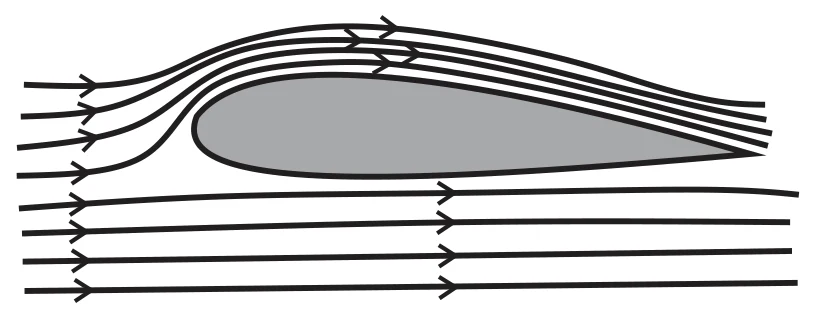
Fig. 2.37 · HSC Textbook · Airflow along an aerofoil
→Due to the aerodynamic shape of the wings, streamlines of air are crowded above the wings
⇒ air above moves faster than air below.
→By Bernoulli’s principle the pressure above the wings decreases while that below does not change.
→This pressure difference gives an upward dynamic lift; when it exceeds the weight, the aeroplane takes off.
Q83 marks · HSC Textbook Example 2.11
In a streamline flow of a non-viscous liquid of density 1000 kg/m³, the cross sectional area at point A is 2 cm² and at point B is 1 cm². The speed of liquid at point A is 5 cm/s. Both points A and B are at the same horizontal level. Calculate the difference in pressure at A and B.
Note: The HSC Textbook prints 37500 Pa = 3.75 × 10⁴ Pa (it keeps the speeds in cm/s); in SI units the difference is 3.75 Pa.
Solution
→Continuity:
v₂ = A₁A₂v₁ = 21 × 5
= 10 cm/s = 0.1 m/s
→Bernoulli (h₁ = h₂): P₁ − P₂ = 12ρ(v₂² − v₁²)
P₁ − P₂ = 12 × 1000 × (0.01 − 0.0025) = 3.75 Pa
→Answer: 3.75 Pa
Note: The HSC Textbook prints 37500 Pa = 3.75 × 10⁴ Pa (it keeps the speeds in cm/s); in SI units the difference is 3.75 Pa.
Q93 marks · HSC Textbook Example 2.13
Water flows through a horizontal tube (venturimeter). Find the difference in mercury level in the manometer if the speed of flow of water at point A is 2 m/s and at point B is 5 m/s. (g = 9.8 m/s², specific gravity of mercury = 13.6)
Solution
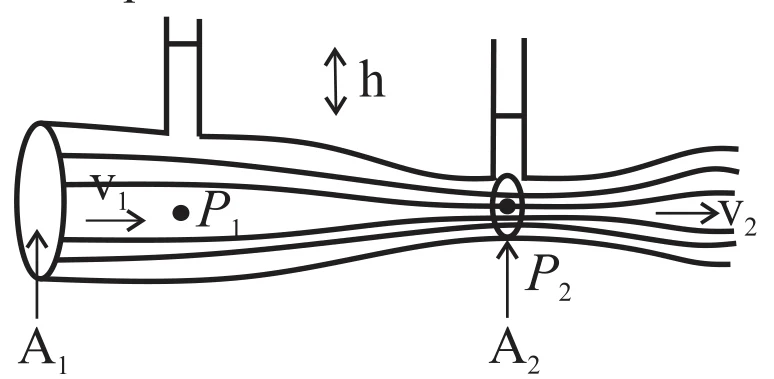
Fig. 2.36 · HSC Textbook · Venturi tube
→Bernoulli: ΔP = 12ρw(v₂² − v₁²)
and ΔP = hρHgg (textbook method)
h = v₂² − v₁²2g (ρHg/ρw) = 25 − 42 × 9.8 × 13.6
h = 0.07878 m = 7.878 cm
→Answer: 7.878 cm
Q103 marks · Expected question · based on HSC Textbook 2.9 (a)
Obtain the expression for the speed of efflux of a liquid from an orifice at depth h below the free surface (Torricelli’s law).
Solution
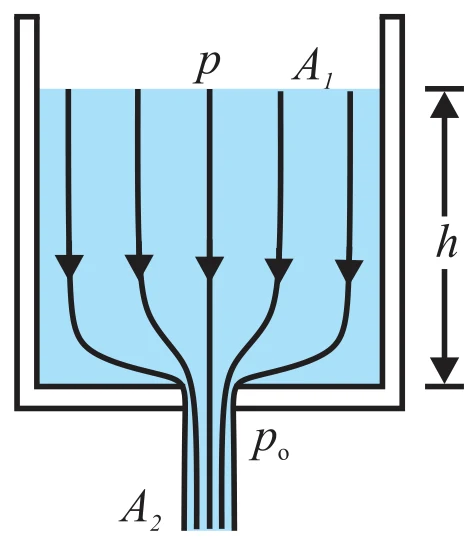
Fig. 2.35 · HSC Textbook · Efflux of fluid from an orifice
→Set-up: tank of large area A₁ with an orifice of area A₂ ≪ A₁ at depth h; both open to the atmosphere (pressure P₀).
→Bernoulli between the free surface and the orifice:
P₀ + 12ρv₁² + ρgh = P₀ + 12ρv₂²
→Continuity: v₁ = A₂A₁v₂
v₂² = 2gh1 − (A₂/A₁)²
→A₂ ≪ A₁
⇒ v₂ = 2gh, the same as the speed of a body falling freely through height h.
Q114 marks · Expected question · based on HSC Textbook 2.9
State Bernoulli’s principle and derive Bernoulli’s equation for the flow of an ideal fluid.
Solution
Fig. 2.34 · HSC Textbook · Flow through a tube of varying cross section and height
→Statement:
for streamline flow of an ideal fluid, the speed in a narrow region increases and the pressure there decreases; P + 12ρv² + ρgh = constant.
→Set-up: fluid element between P (area A₁, speed v₁, pressure P₁, height h₁) and R (A₂, v₂, P₂, h₂); in time dt it moves d₁ and d₂.
dV = A₁d₁ = A₂d₂
→Work by pressure:
W = P₁A₁d₁ − P₂A₂d₂ = (P₁ − P₂) dV
→Change in KE: ΔK = 12ρ dV (v₂² − v₁²)
→Change in PE: ΔU = ρ dV g(h₂ − h₁)
→Work–energy: W = ΔK + ΔU
P₁ − P₂ = 12ρ(v₂² − v₁²) + ρg(h₂ − h₁)
P₁ + 12ρv₁² + ρgh₁ = P₂ + 12ρv₂² + ρgh₂
P + 12ρv² + ρgh = constant

MHT CET corner

4 MHT CET questions on the same formulas
C1MHT CET 2023
Water is flowing through a horizontal pipe in streamline flow. At the narrowest part of the pipe
(a) velocity is maximum and pressure minimum(b) pressure is maximum and velocity minimum(c) both pressure and velocity are minimum(d) both pressure and velocity are maximum
Solution
→Continuity: smallest A
⇒ largest v
→Bernoulli (horizontal): P + 12ρv² = constant
⇒ largest v
⇒ smallest P
→Answer: (a) velocity is maximum and pressure minimum
C2MHT CET 2025
A horizontal pipeline carries water in streamline flow. At a point where the cross-sectional area is 10 cm², the velocity of water is 1 m/s and the pressure is 2000 Pa. The pressure at another point where the cross-sectional area is 5 cm² is (density of water = 1000 kg/m³)
(a) 1000 Pa(b) 750 Pa(c) 500 Pa(d) 250 Pa
Solution
→Continuity: v₂ = 105 × 1 = 2 m/s
→P₂ = P₁ − 12ρ(v₂² − v₁²) = 2000 − 12 × 1000 × 3
= 500 Pa
→Answer: (c) 500 Pa
C3MHT CET 2026
A closed pipe containing liquid showed a pressure P₁ by gauge. When the valve was opened, the pressure was reduced to P₂. The speed of water flowing out of the pipe is (ρ = density of water)
(a) [P₁ − P₂ρ]1/2(b) [2(P₁ − P₂)ρ]1/2(c) [P₂ − P₁ρ]1/2(d) [2(P₂ − P₁)ρ]1/2
Solution
→Closed: v = 0
→Bernoulli: P₁ = P₂ + 12ρv²
⇒ v = [2(P₁ − P₂)ρ]1/2
→Answer: (b) [2(P₁ − P₂)ρ]1/2
C4MHT CET 2025
A wind with speed 50 m/s blows parallel to the roof of a house. The area of the roof is 300 m². The pressure inside the house is atmospheric and the density of air is 1.2 kg/m³. The magnitude of the force exerted by the wind on the roof will be
(a) 1.5 × 10⁵ N(b) 3.0 × 10⁵ N(c) 4.5 × 10⁵ N(d) 9.0 × 10⁵ N
Solution
→Bernoulli: ΔP = 12ρv² = 12 × 1.2 × 2500
= 1500 Pa
→F = ΔP × A = 1500 × 300
= 4.5 × 10⁵ N
→Answer: (c) 4.5 × 10⁵ N
Practise more MHT CET PYQsBernoulli’s Equation · topic-wise, with step-by-step solutions