
Physics Circle home Student Login

Home›Study material›Formula Book›Surface Tension

Surface Tension Formula Book

42 formulas in 6 topics, in the same order as the PYQ topics.

Only formulas used in the solutions of 170 MHT CET PYQs (Level 1, 2, 3)
01

Molecular Theory & Factors

1 formulas · from 12 MHT CET PYQs

Practise these PYQs ›
02

Force due to Surface Tension

8 formulas · from 16 MHT CET PYQs

Practise these PYQs ›
  • Force on a straight wire / frame (film has two surfaces)F=2TLF = 2TL
  • Force on a frame lifted from a filmF=2T×perimeterF = 2T \times \text{perimeter}
  • Force on a ring (one contact circle)F=T×2πr=2πrTF = T \times 2\pi r = 2\pi rT
  • Force on a ring: inner and outer edgesF=T(2πR+2πr)=2πT(R+r)F = T(2\pi R + 2\pi r) = 2\pi T(R + r)
  • Vertical pull with contact angleF=2πrTcos⁡θF = 2\pi rT\cos\theta
  • Two plates with a thin liquid film between themF=2ATt,t=VAF = \dfrac{2AT}{t},\qquad t = \dfrac{V}{A}
  • Floating needle / cylinder held by surface tensionπr2Ldg=2TL  ⇒  r=2Tπdg\pi r^2 L d g = 2TL \;\Rightarrow\; r = \sqrt{\dfrac{2T}{\pi d g}}
  • Floating thin disc held by surface tensionπR2tρg=2πRT  ⇒  R=2Tρgt\pi R^2 t\rho g = 2\pi RT \;\Rightarrow\; R = \dfrac{2T}{\rho g t}

🔒 For Vajra 2.0 Pro studentsTopic 1 is free. Log in with your Vajra 2.0 Pro number to see every formula.

03

Surface Energy & Work Done

4 formulas · from 21 MHT CET PYQs

Practise these PYQs ›
  • Work to increase area of a film (two surfaces)W=2T ΔA,ΔA=l ΔxW = 2T\,\Delta A,\qquad \Delta A = l\,\Delta x
  • Work to blow a soap bubble of radius RW=T×2×4πR2=8πR2TW = T \times 2 \times 4\pi R^2 = 8\pi R^2 T
  • Work depends on radius and volumeW∝r2,r∝V1/3  ⇒  W∝V2/3W \propto r^2,\qquad r \propto V^{1/3} \;\Rightarrow\; W \propto V^{2/3}
  • Bubble enlarged from diameter d to DW=8πT D2−d24=2πT(D2−d2)W = 8\pi T\,\dfrac{D^2 - d^2}{4} = 2\pi T\left(D^2 - d^2\right)

🔒 For Vajra 2.0 Pro studentsTopic 1 is free. Log in with your Vajra 2.0 Pro number to see every formula.

04

Splitting & Merging of Drops

9 formulas · from 35 MHT CET PYQs

Practise these PYQs ›
  • Volume conservation: n small drops into one big dropnr3=R3  ⇒  R=n1/3rnr^3 = R^3 \;\Rightarrow\; R = n^{1/3}r
  • Surface energy of a dropE=4πr2TE = 4\pi r^2 T
  • Big drop split into n drops: total surface energyEf=n1/3EiE_f = n^{1/3}E_i
  • n drops merge into one: ratio of energiesEfEi=1n1/3\dfrac{E_f}{E_i} = \dfrac{1}{n^{1/3}}
  • Work done in splitting a dropW=T ΔA=4πT(nr2−R2)=4πR2T(n1/3−1)W = T\,\Delta A = 4\pi T\left(nr^2 - R^2\right) = 4\pi R^2T\left(n^{1/3} - 1\right)
  • Work in splitting, in terms of R and rW=4πTR2[Rr−1]W = 4\pi TR^2\left[\dfrac{R}{r} - 1\right]
  • Energy released when drops mergeΔE=3VT(1r−1R)\Delta E = 3VT\left(\dfrac{1}{r} - \dfrac{1}{R}\right)
  • Rise in temperature when drops mergeΔθ=3TJρs(1r−1R)\Delta\theta = \dfrac{3T}{J\rho s}\left(\dfrac{1}{r} - \dfrac{1}{R}\right)
  • Speed gained if released energy becomes KEv=6Tρ(1r−1R)v = \sqrt{\dfrac{6T}{\rho}\left(\dfrac{1}{r} - \dfrac{1}{R}\right)}

🔒 For Vajra 2.0 Pro studentsTopic 1 is free. Log in with your Vajra 2.0 Pro number to see every formula.

05

Excess Pressure: Drops & Bubbles

8 formulas · from 39 MHT CET PYQs

Practise these PYQs ›
  • Excess pressure inside a liquid dropΔP=2TR\Delta P = \dfrac{2T}{R}
  • Excess pressure inside a soap bubble (two surfaces)ΔP=4TR\Delta P = \dfrac{4T}{R}
  • Excess pressure is inversely proportional to radiusΔP∝1R  ⇒  ΔPAΔPB=RBRA\Delta P \propto \dfrac{1}{R} \;\Rightarrow\; \dfrac{\Delta P_A}{\Delta P_B} = \dfrac{R_B}{R_A}
  • Pressure inside a bubblePin=P0+4TrP_{in} = P_0 + \dfrac{4T}{r}
  • Radius from measured inside pressurer∝1P−P0,r1r2=P2−P0P1−P0r \propto \dfrac{1}{P - P_0},\qquad \dfrac{r_1}{r_2} = \dfrac{P_2 - P_0}{P_1 - P_0}
  • Excess pressure times volume of a bubbleΔP⋅V=4Tr⋅43πr3∝r2\Delta P \cdot V = \dfrac{4T}{r}\cdot\dfrac{4}{3}\pi r^3 \propto r^2
  • Two bubbles join (isothermal)(P+4TR)R3=(P+4Tr1)r13+(P+4Tr2)r23\left(P + \dfrac{4T}{R}\right)R^3 = \left(P + \dfrac{4T}{r_1}\right)r_1^3 + \left(P + \dfrac{4T}{r_2}\right)r_2^3
  • Two bubbles join in vacuumR2=a2+b2R^2 = a^2 + b^2

🔒 For Vajra 2.0 Pro studentsTopic 1 is free. Log in with your Vajra 2.0 Pro number to see every formula.

06

Angle of Contact & Capillarity

12 formulas · from 47 MHT CET PYQs

Practise these PYQs ›
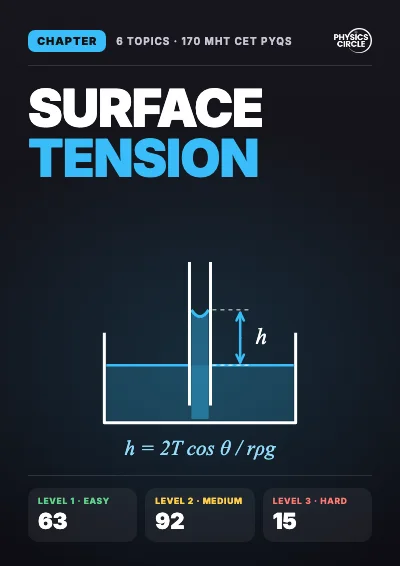
  • Capillary rise (Jurin's law)h=2Tcos⁡θrρgh = \dfrac{2T\cos\theta}{r\rho g}
  • Height and radius of the tubeh∝1r,hr=2Tcos⁡θρg=constanth \propto \dfrac{1}{r},\qquad hr = \dfrac{2T\cos\theta}{\rho g} = \text{constant}
  • Height and cross-section area of the tubeA=πr2  ⇒  h∝1AA = \pi r^2 \;\Rightarrow\; h \propto \dfrac{1}{\sqrt{A}}
  • Height for different liquidsh∝Tcos⁡θρh \propto \dfrac{T\cos\theta}{\rho}
  • Capillary rise and gravityh∝1g,gmoon=g6⇒hmoon=6hh \propto \dfrac{1}{g},\qquad g_{moon} = \dfrac{g}{6} \Rightarrow h_{moon} = 6h
  • Capillary in an accelerating lifth=2Tcos⁡θrρgeff,geff=g+a (up), g−a (down)h = \dfrac{2T\cos\theta}{r\rho g_{eff}},\quad g_{eff} = g + a\ (\text{up}),\ g - a\ (\text{down})
  • Capillary in a horizontally accelerating framegeff=g2+a2g_{eff} = \sqrt{g^2 + a^2}
  • Capillary inside a mine of depth dg′=g(1−dR)  ⇒  h2h1=RR−dg' = g\left(1 - \dfrac{d}{R}\right) \;\Rightarrow\; \dfrac{h_2}{h_1} = \dfrac{R}{R - d}
  • Pressure balance in a capillaryhρg=2Trh\rho g = \dfrac{2T}{r}
  • Tilted tube: length of liquid columnl=hcos⁡αl = \dfrac{h}{\cos\alpha}
  • Rise between two coaxial tubes2πT(r1+r2)=π(r22−r12)hρg  ⇒  h=2T(r2−r1)ρg2\pi T(r_1 + r_2) = \pi\left(r_2^2 - r_1^2\right)h\rho g \;\Rightarrow\; h = \dfrac{2T}{(r_2 - r_1)\rho g}
  • Drop falling from a tube: weight balances surface forcemg=2πrT  ⇒  m∝rmg = 2\pi rT \;\Rightarrow\; m \propto r

🔒 For Vajra 2.0 Pro studentsTopic 1 is free. Log in with your Vajra 2.0 Pro number to see every formula.