Under isothermal conditions, a single drop of radius R is formed from two mercury drops of radii R1 and R2. After combination, the relation between R,R1 and R2 is
The pressures inside two soap bubbles A and B are 1.02 atmosphere and 1.04 atmosphere respectively. The ratio of volume of bubble A to that of bubble B is (outside pressure =1 atmosphere)
The excess pressure inside the first soap bubble is three times that inside the second soap bubble. The ratio of the volume of the first soap bubble to the volume of the second soap bubble is
The excess pressure inside a spherical water drop A is four times that of another water drop B. Then, the ratio of the mass of water drop A to that of drop B is
The excess pressure inside the first soap bubble of radius R1 is three times that inside the second soap bubble of radius R2. The ratio of volumes of the first to second bubble is
The excess pressure inside the first soap bubble of radius R1 is three times that inside the second soap bubble of radius R2. The ratio of volumes of the first bubble to second bubble is
Due to surface tension, the excess pressure inside a smaller drop is 9 units. If 27 smaller drops combine then excess pressure inside the bigger drop is
Under isothermal condition, two soap bubbles of radii r1 and r2 combine to form a single soap bubble of radius R. The surface tension of the soap is (P = outside pressure)
Let R1,R2 and R3 be the radii of three mercury drops. A big mercury drop is formed from them under isothermal conditions. The radius of the resultant drop is
The excess pressure inside a soap bubble is 1.5 times the excess pressure inside a second soap bubble. The volume of the second bubble is ' x ' times the volume of the first bubble. The value of ' x ' is
An air bubble of radius 0.1 cm lies at a depth of 20 cm below the free surface of a liquid of density 1000 kg/m3. If the pressure inside the bubble is 2100 N/m2 greater than the atmospheric pressure, then the surface tension of the liquid in SI unit is (use g=10 m/s2)
An air bubble of radius 1.0 mm is observed at a depth 20 cm below the free surface of a liquid having surface tension 0.095 J/m2 and density 103 kg/m3. The difference between pressure inside the bubble and atmospheric pressure is __________ N/m2. (Take g=10 m/s2)
Numerical answer type. Work it out, then open the answer.
The excess pressure inside a soap bubble A in air is half the excess pressure inside another soap bubble B in air. If the volume of the bubble A is n times the volume of the bubble B, then, the value of n is__________.
Numerical answer type. Work it out, then open the answer.
Two soap bubbles of radius 2 cm and 4 cm, respectively, are in contact with each other. The radius of curvature of the common surface, in cm, is _________.
Numerical answer type. Work it out, then open the answer.
In air, a charged soap bubble of radius R breaks into 64 small soap bubbles of equal radius r. The ratio of mechanical force per unit area of big soap bubble to that of a small bubble is
The excess pressure inside a soap bubble is thrice the excess pressure inside a second soap bubble. The ratio between the volume of the first and the second bubble is:
Two soap bubbles having radii ' r1 ' and ' r2 ' has inside pressure ' P1 ' and ' P2 ' respectively. If P0 is external pressure then ratio of their volume is
The pressure inside a soap bubble A is 1.01 atmosphere and that in a soap bubble B is 1.02 atmosphere. The ratio of volume of bubble A to that of B is [Surrounding pressure =1 atmosphere]
The pressure inside two soap bubbles, (A) is 1.01 and that of (B) is 1.02 atmosphere respectively. The ratio of their respective radii (A to B) is (outside pressure =1 atm.)
A liquid column of height 0.04 cm balances excess pressure of a soap bubble of certain radius. If density of liquid is 8×10³ kg m−3 and surface tension of soap is 0.28 N m−1, then diameter of the soap bubble is __________ cm. (if g=10 m s−2)
Numerical answer type. Work it out, then open the answer.
The excess pressure inside a first spherical drop of water is three times that of second spherical drop of water. Then the ratio of mass of first spherical drop to that of second spherical drop is
There is an air bubble of radius 1.0 mm in a liquid of surface tension 0.075 N m−1 and density 1000 kg m−3 at a depth of 10 cm below the free surface. The amount by which the pressure inside the bubble is greater than the atmospheric pressure is _________ Pa(g=10 m s−2)
Numerical answer type. Work it out, then open the answer.
The radii of two soap bubbles are r1 and r2. In isothermal condition they combine with each other to form a single bubble. The radius of resultant bubble is
The excess pressure inside a liquid drop is 500 Nm−2. If the radius of the drop is 2 mm, the surface tension of liquid is x × 10−3 Nm−1. The value of x is _____________.
Numerical answer type. Work it out, then open the answer.
A spherical soap bubble of radius 3 cm is formed inside another spherical soap bubble of radius 6 cm. If the internal pressure of the smaller bubble of radius 3 cm in the above system is equal to the internal pressure of another single soap bubble of radius r cm. The value of r is ___________.
Numerical answer type. Work it out, then open the answer.
A big water drop is divided into 8 equal droplets. ΔPs and ΔPB be the excess pressure inside a smaller and bigger drop respectively. The relation between ΔPs and ΔPB is
Let 'R1' and 'R2' are radii of two mercury drops. A big mercury drop is formed from them under isothermal conditions. The radius of the resultant drop is
A soap bubble of radius 3 cm is formed inside the another soap bubble of radius 6 cm. The radius of an equivalent soap bubble which has the same excess pressure as inside the smaller bubble with respect to the atmospheric pressure is ................ cm.
Numerical answer type. Work it out, then open the answer.
Under isothermal conditions, two soap bubbles of radii 'r1' and 'r2 ' combine to form a single soap bubble of radius 'R'. The surface tension of soap is ( P= outside pressure)
A soap bubble, having radius of 1 mm, is blown from a detergent having a surface tension of 2.5 × 10⁻² N/m. The pressure inside the bubble equals the pressure at a point Z0 below the free surface of water in a container. Taking g = 10 m/s2, density of water = 103 kg/m3, the value of Z0 is:
In air, a charged soap bubble of radius ' R ' breaks into 27 small soap bubbles of equal radius ' r '. Then the ratio of mechanical force acting per unit area of big soap bubble to that of a small soap bubble is
A soap bubble, blown by a mechanical pump at the mouth of a tube, increases in volume, with time, at a constant rate. The graph that correctly depicts the time dependence of pressure inside the bubble is given by:
A small soap bubble of radius 4 cm is trapped inside another bubble of radius 6 cm without any contact. Let P2 be the pressure inside the inner bubble and P0, the pressure outside the outer bubble. Radius of another bubble with pressure difference P2 ______ P0 between its inside and outside would be:
An air bubble of radius 0.1 cm is in a liquid having surface tension 0.06 N/m and density 103 kg/m3. The pressure inside the bubble is 1100 Nm−2 greater than the atmospheric pressure. At what depth is the bubble below the surface of the liquid? (g = 9.8 ms−2)
Two soap bubbles coalesce to form a single bubble. If V is the subsequent change in volume of contained air and S the change in total surface area, T is the surface tension and P atmospheric pressure, which of the following relation is correct?
A bubble has surface tension S. The ideal gas inside the bubble has ratio of specific heats γ=35. The bubble is exposed to the atmosphere and it always retains its spherical shape. When the atmospheric pressure is Pa1, the radius of the bubble is found to be r1 and the temperature of the enclosed gas is T1. When the atmospheric pressure is Pa2, the radius of the bubble and the temperature of the enclosed gas are r2 and T2, respectively. Which of the following statement(s) is(are) correct?
More than one option can be correct. Tap every correct option, then tap Check.
Two soap bubbles A and B are kept in a closed chamber where the air is maintained at pressure 8N/m2. The radii of bubbles A and B are 2cm and 4cm, respectively. Surface tension of the soap-water used to make bubbles is 0.04N/m. Find the ratio nB/nA, where nA and nB are the number of moles of air in bubbles A and B, respectively. (Neglect the effect of gravity.)
Numerical answer type. Work it out, then open the answer.
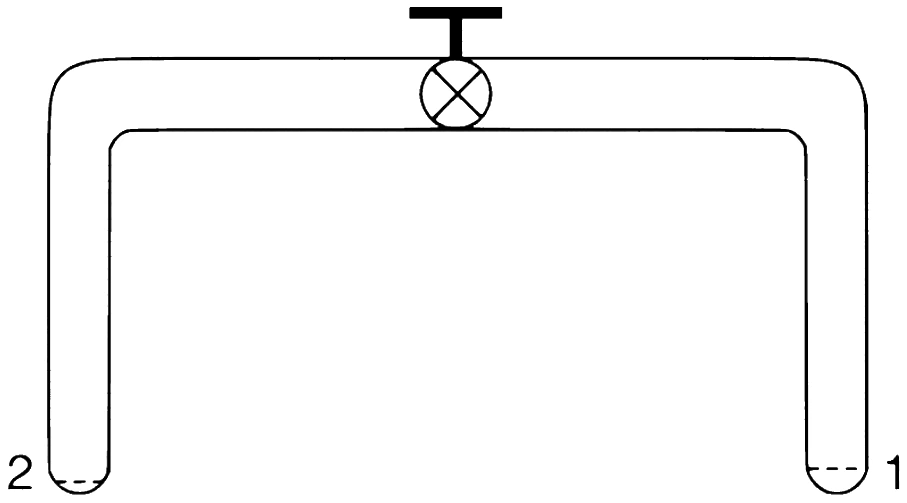
A glass tube of uniform internal radius (r) has a valve separating the two identical ends. Initially, the valve is in a tightly closed position. End 1 has a hemispherical soap bubble of radius r. End 2 has sub-hemispherical soap bubble as shown in figure. Just after opening the valve,
Assertion: Smaller drop of water resist deformation forces better than the larger drops. Reason: Excess pressure inside drop is inversely proportional to its radius.
Assertion: Smaller drops of liquid resist deforming forces better than the larger drops. Reason: Excess pressure inside a drop is directly proportional to its surface area.
Two soap bubbles coalesce. It is noticed that, whilst joined together, the radii of the two bubbles are a and b where a>b. Then the radius of curvature of interface between the two bubbles will be
Calculate the vapour pressure that can help the formation of a spherical droplet of water of radius 6.25×10⁻⁵m at 22∘C. Given: The surface tension of water at the given temperature is 7.28×10⁻²N m−1.
A small hollow vessel which has a small circular hole of radius r in its base, is immersed in a tank of oil of density ρ and surface tension T. The oil will penetrate into the vessel at a depth of
A long cylindrical vessel of glass having a hole of 0.5mm radius at its bottom is slowly lowered vertically into a deep water bath. If the surface tension of water is 7×10⁻²N m−1, then the maximum depth the vessel can be submerged without water entering through the hole is (Acceleration due to gravity =10m s−2)
If two soap bubbles A and B of radii r1 and r2 respectively are kept in vacuum at constant temperature, then the ratio of masses of air inside the bubbles A and B is
A liquid of density 800kg m−3 rises 4cm in a capillary tube of inner radius 0.2mm. The capillary tube is dipped vertically in the liquid and the angle of contact between the capillary tube and the liquid is 0∘. The excess pressure inside the spherical drop of diameter 2cm of the same liquid is (Acceleration due to gravity =10m s−2)
The excess pressure inside a soap bubble of radius 0.5cm is balanced by the pressure due to an oil column of height 4mm. If the density of the oil is 900kg m−3, then the surface tension of the soap solution is (Acceleration due to gravity =10m s−2)
A vessel having small hole in the bottom has to hold water without leakage, if water is poured into if upto a height of 7cm. Then the radius of the hole is (surface tension of water is 0.07N m−1, angle of contact is 0∘ and g=10m s−2)
An air bubble of radius 1mm is at a depth of 8cm below the free surface of a liquid column. If the surface tension and density of the liquid is 0.1N/m and 2000kg/m3, respectively, by what amount is the pressure inside the bubble greater than the atmospheric pressure? (take, g=10m/s2)
Under isothermal conditions, two soap bubbles of radii a and b coalesce to form a single bubble of radius c. If the external pressure is p, then surface tension of the bubbles is
A smaller soap bubble of radius r is inside a larger soap bubble of radius R. The smaller bubble bursts and the radius of the external bubble changes to Q. Assume the air inside the bubbles to be ideal gas and the process to be isothermal. If the external pressure is P, the surface tension of the soap solution is

 Mechanical Properties of Fluids · Lecture 5 · Excess Pressure & Soap Bubble1:02:21All 8 Surface Tension videos →