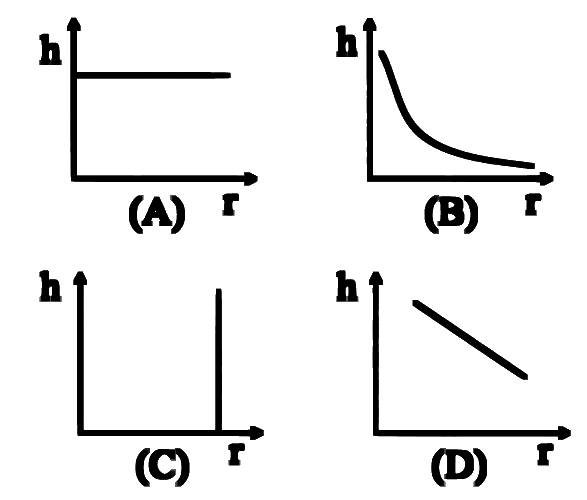
The height of the liquid column raised in a capillary tube of certain radius when dipped in liquid A vertically is 5 cm. If the same tube is dipped in similar way in another liquid B of surface tension and density double the values of liquid A, the height of liquid column raised in liquid B is (Assume that angle of contact for both the liquids is almost same)
Water rises to a height of 2.2 cm in glass capillary tube. The height to which water will rise in another capillary having one-fourth area of cross-section as that of the first is.
Water rises up to a height h in a capillary tube on the surface of the earth. The value of h will increase, if the experimental set up is kept in (g = acceleration due to gravity)
In a capillary tube of area of cross-section 'a' water rises to height 'h'. To what height will water rise in a capillary tube of area of cross-section 4a?
Water rises to a height 3 cm in a capillary tube. If cross-sectional area of capillary tube is reduced to 1/3rd of its initial area then water will rise to a height of
A capillary tube is taken from the earth to the surface of the moon. The rise of the liquid column on the moon (acceleration due to gravity on earth is 6 times that of the moon) is
Three liquids have same surface tension and densities ρ1,ρ2 and ρ3 (ρ1<ρ2<ρ3). In three identical capillaries rise of liquid is same. The corresponding angle of contact θ1,θ2 and θ3 are related as
Three liquids have same surface tension and have densities ρ1,ρ2 and ρ3(ρ1>ρ2>ρ3). In three identical capillaries rise of liquid is same. The corresponding angles of contact θ1,θ2 and θ3 are related as
When a part of a straight capillary tube is placed vertically in a liquid, the liquid raises upto certain height h. If the inner radius of the capillary tube, density of the liquid and surface tension of the liquid decrease by 1% each, then the height of the liquid in the tube will change by %.
When one end of a capillary tube is dipped in water, water rises to a height h. The upward force of 105 dyne due to surface tension is balanced by the force due to weight of water column. The inner circumference of the capillary is (surface tension of water = 7×10⁻² N/m)
When a capillary tube of radius 'r' is immersed in water, rise of water is upto height 'h'. The mass of water in capillary tube is 'm'. When another capillary tube of radius 'xr' is immersed in water, the mass of water that will rise in this tube is
Surface tension of two liquids (having same densities), T1 and T2, are measured using capillary rise method utilizing two tubes with inner radii of r1 and r2 where r1>r2. The measured liquid heights in these tubes are h1 and h2 respectively. [Ignore the weight of the liquid above the lowest point of miniscus]. The heights h1 and h2 and surface tensions T1 and T2 satisfy the relation:
A 20 cm long capillary is dipped vertically in water. Water rises to 8 cm. If the arrangement is put in a freely falling elevator, the length of water column in capillary tube will be
In a capillary tube of radius 'R', a straight thin metal wire of radius 'r' is inserted symmetrically and one end of the combination is dipped vertically in water such that lower end of the capillary and thin wire are at same level. If 'T' is the surface tension of water and 'ρ' is the density of water then the rise of water in the capillary is
Two capillary tubes of same diameter are kept vertically in two liquids whose densities are in the ratio 4:3. If their surface tensions are in the ratio 6:5, the ratio of heights (h2h1) of liquids in the two capillary tubes is (Their angle of contacts are same)
In a capillary tube of area of cross-section 'a' water rises to height ' h '. To what height will water rise in a capillary tube of area of cross-section 4a?
A liquid rises to a height of 2.4 cm in a glass capillary P. Another glass capillary Q having diameter 80% of capillary P is immersed in the same liquid. The rise of liquid in capillary Q is
A capillary tube is taken from earth's surface to moon's surface. The rise of liquid column on the moon's surface is (acceleration due to gravity on the earth's surface is six times that of moon's surface)
Pure water rises through a height h in a capillary tube of internal radius r. Surface tension of water is T. The pressure difference between the water level in the container and the lowest point of the concave meniscus is
A capillary tube of radius 0.1 mm is partly dipped in water (surface tension 70 dyn/cm and glass water contact angle ≈ 0°) with 30° inclined with the vertical. The length of water risen in the capillary is _______ cm. (Take g=9.8 m/s2)
When one end of the capillary is dipped in water, the height of water column is ' h '. The upward force of 108 dyne due to surface tension is balanced by the force due to the weight of water column. The inner circumference of the capillary is (surface tension of water =7.2×10⁻² N/m)
When one end of a capillary tube is dipped in water, the height of water column is ' h '. The upward force of 105 dyne due to surface tension is balanced by the force due to the weight of water column. The inner circumference of the capillary tube is
Water rises in a capillary tube of radius r up to height h. The mass of water in a capillary is m. The mass of water that will rise in capillary of radius 5r will be
One end of a capillary tube is dipped in water, the rise of water column is ' h '. The upward force of 98 dyne due to surface tension is balanced by the force due to the weight of the water column. The inner circumference of the capillary is ( surface tension of water =7×10⁻² N m−1)
A capillary tube when immersed vertically in water, the rise of water column is upto height h1 on earth's surface. When this arrangement is taken into a mine of depth 'd', below earth's surface, the height of the water column is h2. If R is the radius of the earth, the ratio h1h2 is
Two capillary tubes A and B of the same internal diameter are kept vertically in two different liquids whose densities are in the ratio 4:3. If the surface tensions of these two liquids are in the ratio 6:5, then the ratio of rise of liquid in capillary A to that in B is (assume their angles of contact are nearly equal)
Statement I: The contact angle between a solid and a liquid is a property of the material of the solid and liquid as well.
Statement II: The rise of a liquid in a capillary tube does not depend on the inner radius of the tube. In the light of the above statements, choose the correct answer from the options given below:
When capillary is dipped vertically in water, rise of water in capillary is ' h '. The angle of contact is zero. Now the tube is depressed so that its length above the water surface is 3h. The new apparent angle of contact is (cos0∘=1)
The angle of contact between glass and water is 0∘ and water rises in a glass capillary upto 6 cm (Surface tension of water is T). Another liquid of surface tension ' 2T ', angle of contact 60∘ and relative density 2 will rise in the same capillary up to (cos0∘=1,cos60∘=0.5)
A glass capillary of radius 0.35 mm is inclined at 60∘ with the vertical in water. The height of the water column in the capillary is (surface tension of water =7×10⁻² N/m, acceleration due to gravity, g=10 m/s2,cos0∘=1,cos60∘=0.5)
Three liquids of densities ρ1,ρ2 and ρ3 (with ρ1>ρ2>ρ3) having same value of surface tension T, rise to the same height in three identical capillaries. Angle of contact θ1,θ2 and θ3 respectively obey
Water rises in a capillary tube of radius ' r ' up to height ' h '. The mass of water in capillary is ' m '. The mass of water that will rise in capillary of radius r/3 will be
Water rises up to height ' X ' in a capillary tube immersed vertically in water. When the whole arrangement is taken to a depth ' d ' in a mine, the water level rises up to height ' Y '. If ' R ' is the radius of earth then the ratio XY is
The height of liquid column raised in a capillary tube of certain radius when dipped in liquid 'A' vertically is 5 cm. If the tube is dipped in a similar manner in another liquid 'B' of surface tension and density double the values of liquid 'A', the height of liquid column raised in liquid 'B' would be (Assume angle of contact same)
The height of liquid column raised in a capillary tube of certain radius when dipped in liquid A vertically is, 5 cm. If the tube is dipped in a similar manner in another liquid B of surface tension and density double the values of liquid A, the height of liquid column raised in liquid B would be __________ m.
Two capillary tubes of the same diameter are kept vertically in two different liquids whose densities are in the ratio 4:3. The rise of liquid in two capillaries is 'h1 ' and 'h2' respectively. If the surface tensions of liquids are in the ratio 6:5, the ratio of heights (h2h1) is
Three liquids have same surface tension and densities ρ1,ρ2, and ρ3(ρ1>ρ2>ρ3). In three identical capillaries rise of liquid is same. The corresponding angles of contact θ1,θ2 and θ3 are related as
Water rises in a capillary tube of radius 'r' upto a height 'h'. The mass of water in a capillary is 'm'. The mass of water that will rise in a capillary tube of radius 3r will be
Water rises to a height of 2 cm in a capillary tube. If cross-sectional area of the tube is reduced to 161th of initial area then water will rise to a height of
In a capillary tube having area of cross-section A, water rises to a height 'h'. If cross-sectional area is reduced to 9A, the rise of water in the capillary tube is
Two narrow bores of diameter 5.0 mm and 8.0 mm are joined together to form a U-shaped tube open at both ends. If this U-tube contains water, what is the difference in the level of two limbs of the tube. [Take surface tension of water T = 7.3 × 10⁻² Nm−1, angle of contact = 0, g = 10 ms2 and density of water = 1.0 × 10³ kg m−3]
Water rises upto a height 10 cm in a capillary tube. It will rise to a height which is much more than 10 cm in a very long capillary tube if the apparatus is kept.
Water rises in a capillary tube of radius 'r' up to a height 'h'. The mass of water in a capillary is 'm'. The mass of water that will rise in a capillary tube of radius 3r will be
A glass rod of radius 'r1 ' is inserted symmetrically into a vertical capillary tube of radius 'r2' (r1<r2) such that their lower ends are at same level. The arrangement is dipped in water. The height to which water will rise into the tube will be (ρ= density of water, T = surface tension in water, g = acceleration due to gravity)
Water rises upto a height of 4 cm in a capillary tube. The lower end of the capillary tube is at a depth of 8 cm below the water level. The mouth pressure required to blow an air bubble at the lower end of the capillary will be 'X' cm of water, where X is equal to
Water rises upto a height h in a capillary tube on the surface of the earth. The value of h will increase, if the experimental setup is kept in [ g= acceleration due to gravity]
A capillary tube made of glass of radius 0.15 mm is dipped vertically in a beaker filled with methylene iodide (surface tension = 0.05 Nm–1, density = 667 kg m–3) which rises to height h in the tube. It is observed that the two tangents drawn from liquid-glass interfaces (from opp. sides of the capillary) make an angle of 60° with one another. Then h is close to (g = 10 ms–2)
When a long glass capillary tube of radius 0.015 cm is dipped in a liquid, the liquid rises to a height of 15 cm within it. If the contact angle between the liquid and glass to close to 0°, the surface tension of the liquid, in milliNewton m–1, is [ρ(liquid) = 900 kgm–3, g = 10 ms–2]
(Give answer in closest integer) _____.
Numerical answer type. Work it out, then open the answer.
Water rises in a capillary tube of radius r upto a height h. The mass of water in a capillary is m. The mass of water that will rise in a capillary of radius 4r will be
A capillary tube of radius r is immersed in water and water rises in it to a height h. The mass of the water in the capillary is 5 g. Another capillary tube of radius 2r is immersed in water. The mass of water that will rise in this tube is:
The ratio of surface tensions of mercury and water is given to be 7.5 while the ratio of their densities is 13.6. Their contact angles, with glass, are close to 135° and 0°, respectively. It is observed that mercury gets depressed by an amount h in a capillary tube of radius r1, while water rises by the same amount h in a capillary tube of radius r2. The ratio, (r1/r2), is then close to:
Three liquids of densities ρ1, ρ2 and ρ3 (with ρ1 > ρ2 > ρ3), having the same value of surface tension T, rise to the same height in three identical capillaries. The angles of contact θ1, θ2 and θ3 obey
A capillary tube is immersed vertically in water and the height of the water column is x. When this arrangement is taken into a mine of depth d, the height of the water column is y. If R is the radius of earth, the ratio yx is:
Wax is coated on the inner wall of a capillary tube and the tube is then dipped in water. Then, compared to the unwaxed capillary, the angle of contact θ and the height h upto which water rises change. These changes are:
This question has Statement-1 and Statement-2. Of the four choices given after the Statements, choose the one that best describes the two Statements.
Statement-1: A capillary is dipped in a liquid and liquid rises to a height h in it. As the temperature of the liquid is raised, the height h increases (if the density of the liquid and the angle of contact remain the same).
Statement-2: Surface tension of a liquid decreases with the rise in its temperature.
A capillary tube (A) is dipped in water. Another identical tube (B) is dipped in a soap-water solution. Which of the following shows the relative nature of the liquid columns in the two tubes?
A 20 cm long capillary tube is dipped in water. The water rises up to 8 cm. If the entire arrangement is put in a freely falling elevator the length of water column in the capillary tube will be
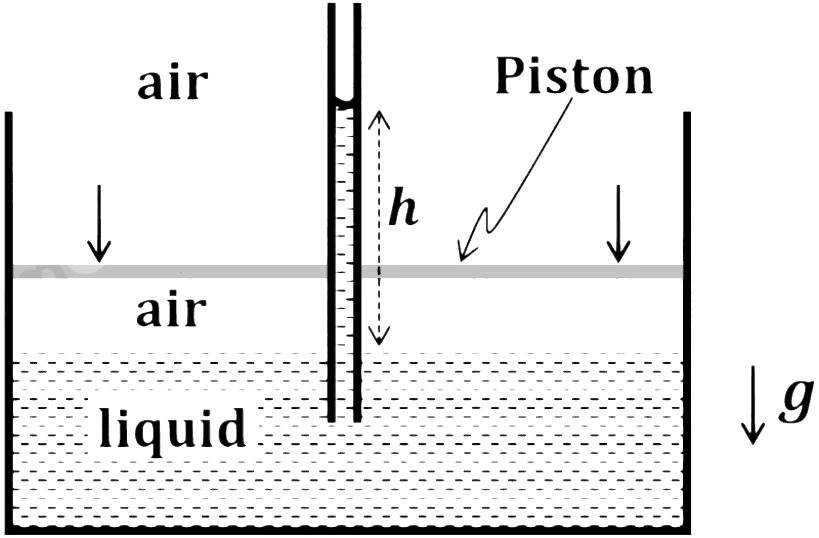
An incompressible liquid is kept in a container having a weightless piston with a hole. A capillary tube of inner radius 0.1mm is dipped vertically into the liquid through the airtight piston hole, as shown in the figure. The air in the container is isothermally compressed from its original volume V0 to 101100V0 with the movable piston. Considering air as an ideal gas, the height (h) of the liquid column in the capillary above the liquid level in cm is ______. [Given: Surface tension of the liquid is 0.075N m−1, atmospheric pressure is 105N m−2, acceleration due to gravity (g) is 10m s−2, density of the liquid is 103kg m−3 and contact angle of capillary surface with the liquid is zero]
Numerical answer type. Work it out, then open the answer.
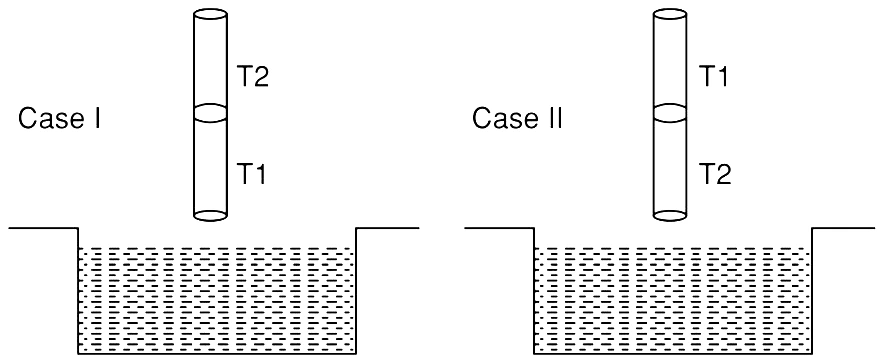
A cylindrical capillary tube of 0.2mm radius is made by joining two capillaries T1 and T2 of different materials having water contact angles of 0∘ and 60∘, respectively. The capillary tube is dipped vertically in water in two different configurations, case I and II as shown in figure. Which of the following option(s) is (are) correct? [Surface tension of water =0.075N m−1, density of water =1000kg m−3, take g=10m s−2]
More than one option can be correct. Tap every correct option, then tap Check.
A uniform capillary tube of inner radius r is dipped vertically into a beaker filled with water. The water rises to a height h in the capillary tube above the water surface in the beaker. The surface tension of water is σ. The angle of contact between water and the wall of the capillary tube is θ. Ignore the mass of water in the meniscus. Which of the following statements is (are) true?
More than one option can be correct. Tap every correct option, then tap Check.
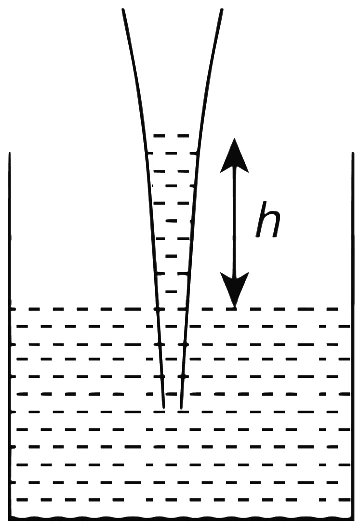
A glass capillary tube is of the shape of truncated cone with an apex angle α so that its two ends have cross sections of different radii. When dipped in water vertically, water rises in it to a height h, where the radius of its cross section is b. If the surface tension of water is S, its density is ρ, and its contact angle with glass is θ, the value of h will be (g is the acceleration due to gravity)
Assertion: When height of a tube is less than liquid rise in the capillary tube, the liquid does not overflow. Reason: Product of radius of meniscus and height of liquid in capillary tube always remains constant.
Assertion: The water rises higher in a capillary tube of small diameter than in the capillary tube of large diameter. Reason: Height through which liquid rise in capillary tube inversely proportional to the capillary tube.
The lower end of capillary tube is immersed in mercury. The level of mercury in the tube is found to be 2cm below the outer level. If the same tube is immersed in water, upto what height will the water rise in the capillary?
A long glass capillary tube is dipped in water. It is known that water wets glass. The water level rises by h in the tube. The tube is now pushed down so that only a length h/2 is outside the water surface. The angle of contact at the water surface at the upper end of the tube will be
Into a vessel containing pure water a clean glass tube of radius 3.6×10⁻⁴m is held vertically with 12cm of the tube above the water level. Now the capillary tube is moved down into the water so that only 2cm of its length is above the water surface. Angle of contact Θ at this position is (given surface tension of water =7.2×10⁻²N m−1 and g=10m s−2)
What is the relation obeyed by the angles of contact θ1, θ2 and θ3 of 3 liquids of different densities ρ1, ρ2 and ρ3 respectively (ρ1<ρ2<ρ3) when they rise to the same capillary height in 3 identical capillaries and having nearly same surface tension T?
A 30cm long capillary tube is dipped in water, water rises upto a height of 10cm due to capillarity. If this experiment is conducted in a freely falling water in an elevator, then the length of the water column becomes
Two capillary tubes P and Q are dipped vertically in water. The height of water level in capillary tube P is 32 of the height in capillary tube Q. The ratio of their diameter is
A capillary tube of inner radius 1.5mm is dipped vertically in water. If the surface tension of water is 7×10⁻²N m−1, then the volume of the water that rises in the capillary tube is (Acceleration due to gravity =10m s−2)
If S1, S2 and S3 are the tensions at liquid-air, solid-air and solid-liquid interfaces respectively and θ is the angle of contact at the solid-liquid interface, then
A capillary tube of radius 0.1mm is dipped in water. The water rises to a height of 2cm in the tube. If the surface tension of water is 0.072N m−1, the contact angle between water and wall of the tube is
Statement (A) When the temperature increases the viscosity of gases increases and the viscosity of liquids decreases. Statement (B) Water does not wet an oily glass because cohesive force of oil is less than that of water. Statement (C) A liquid will wet a surface of a solid, if the angle of contact is greater than 90∘.
In a U-shaped tube the radius of one limb is 2mm and that of other limb is 4mm. A liquid of surface tension 0.03N m−1, density 1500kg m−3 and angle of contact zero is taken in the tube. The difference in the heights of the levels of the liquid in the two limbs is (Acceleration due to gravity =10m s−2)
The lower end of a capillary tube is dipped into water and it is observed that the water in capillary tube rises by 7.5cm. Find the radius of the capillary tube used, if surface tension of water is 7.5×10⁻²N m−1. Angle of contact between water and glass is 0∘ and acceleration due to gravity is 10m s−2.
If a capillary tube of inner radius 0.5mm is immersed vertically in water, then the mass of the water risen in the capillary tube is (Surface tension of water =0.07N m−1 and acceleration due to gravity =10m s−2)
The maximum length of water column that can stay without falling in a vertically held capillary tube of diameter 1mm and open at both the ends is (Acceleration due to gravity =10m s−2 and surface tension of water =0.07N m−1)
The angle of contact is 120∘ when a cylindrical rod is vertically placed in a liquid. If the same rod is placed horizontally in the liquid, then the angle of contact is
A uniform capillary tube of length l and inner radius r with its upper end sealed is submerged vertically into water. The outside pressure is p0 and surface tension of water is γ. When a length x of the capillary is submerged into water, it is found that water levels inside and outside the capillary coincide. The value of x is