Q11 mark · SCERT Question Bank · MCQ 1
Insect moves over surface of water because of _____.
(a) Elasticity(b) Surface tension(c) Friction(d) Viscosity
Solution
→The surface film behaves like a stretched elastic membrane and supports the light insect.
→Answer: (b) Surface tension
Q21 mark · HSC Feb 2024
The dimensional formula of surface tension is _____.
(a) [L⁻¹M¹T⁻²](b) [L²M¹T⁻²](c) [L¹M¹T⁻¹](d) [L⁰M¹T⁻²]
Solution
T = FL = [L¹M¹T⁻²][L¹]
= [L⁰M¹T⁻²]
→Answer: (d) [L⁰M¹T⁻²]
Q31 mark · HSC Jul 2023
When soluble substance such as common salt (i.e. sodium chloride) is dissolved in water, surface tension of water _____.
(a) decreases(b) becomes zero(c) remains the same(d) increases
Solution
→A highly soluble substance (NaCl) dissolved in water increases its surface tension.
→Answer: (d) increases
Q41 mark · HSC Feb 2026
When a number of droplets coalesce to form a single drop, the total surface area of the drop _____.
(a) decreases(b) becomes zero(c) remains same(d) increases
Solution
→Volume is conserved: R³ = nr³
⇒ R = n1/3r.
→New area 4πR² = n2/3(4πr²) is less than the old area n(4πr²)
⇒ area decreases (energy is released).
→Answer: (a) decreases
Q51 mark · SCERT Question Bank · MCQ 6 · HSC Textbook Ex. 1(iii)
The energy stored in a soap bubble of diameter 6 cm and T = 0.04 N/m is nearly _____.
(a) 0.9 × 10⁻³ J(b) 0.4 × 10⁻³ J(c) 0.7 × 10⁻³ J(d) 0.5 × 10⁻³ J
Solution
→Soap bubble has two surfaces: A = 2 × 4πr²
r = 3 cm = 0.03 m.
E = T × 8πr² = 0.04 × 8 × 3.142 × (0.03)²
E = 9.05 × 10⁻⁴ J ≈ 0.9 × 10⁻³ J
→Answer: (a) 0.9 × 10⁻³ J
Q61 mark · HSC Feb 2025 · SCERT Question Bank · MCQ 3
At what temperature does the surface tension of a liquid become zero?
Solution
→Surface tension of a liquid becomes zero at its critical temperature.
Q71 mark · HSC Feb 2024
Why is detergent powder mixed with water to wash clothes?
Solution
→Detergent (sparingly soluble) decreases the surface tension of water, so water makes good contact with the fabric and removes tough stains.
Q81 mark · SCERT Question Bank · VSA 1
What is surface film?
Solution
→The surface layer of a liquid with thickness equal to the range of intermolecular force is called the surface film.
Q91 mark · SCERT Question Bank · VSA 2
What are cohesive forces?
Solution
→The force of attraction between the molecules of the same substance is called cohesive force (e.g. between two water molecules).
Q101 mark · HSC Textbook Ex. 2(i)
Why is the surface tension of paints and lubricating oils kept low?
Solution
→Low surface tension lets paints and lubricating oils spread easily and wet the surface completely (smaller angle of contact).
Q111 mark · HSC Textbook Ex. 2(ii)
How much amount of work is done in forming a soap bubble of radius r?
Solution
→A soap bubble has two surfaces
⇒ area = 2 × 4πr².
W = T × ΔA = 8πr²T
Q121 mark · Expected question · based on HSC Textbook 2.4.2
Prove that the equivalent SI unit of surface tension is J/m².
Solution
T = FL → Nm = N × mm × m
= Jm²
Q132 marks · HSC Textbook Ex. 3
Why do two or more mercury drops form a single drop when brought in contact with each other?
Solution
→Surface molecules have extra potential energy (surface energy = T × area).
→A system tries to attain minimum potential energy, so the liquid tries to reduce its surface area.
→For the same volume, one big drop has less area than many small drops
⇒ cohesive forces make the drops coalesce (energy is released).
Q142 marks · HSC Mar 2022
Eight droplets of water each of radius 0.2 mm coalesce into a single drop. Find the decrease in the surface area.
Solution
→Volume conserved: 43πR³ = 8 × 43πr³
⇒ R = 2r = 0.4 mm
Initial area = 8 × 4πr² = 32π(0.2)²
= 1.28π mm²
Final area = 4πR² = 4π(0.4)²
= 0.64π mm²
Decrease = 0.64π = 2.011 mm²
= 2.011 × 10⁻⁶ m²
→Answer: 2.011 × 10⁻⁶ m²
Q152 marks · HSC Textbook Example 2.4
A beaker of radius 10 cm is filled with water. Calculate the force of surface tension on any diametrical line on its surface. Surface tension of water is 0.075 N/m.
Solution
→Given: L = 2 × 10 = 20 cm
= 0.2 m
T = 0.075 N/m
F = TL = 0.075 × 0.2
= 1.5 × 10⁻² N
→Answer: 1.5 × 10⁻² N
Q162 marks · HSC Feb 2023 · HSC Textbook Example 2.5
Calculate the work done in blowing a soap bubble to a radius of 1 cm. The surface tension of soap solution is 2.5 × 10⁻² N/m.
Solution
→A soap bubble has two surfaces: initial area 0, final area 2 × 4πr² = 8πr², r = 0.01 m.
ΔA = 8 × 3.142 × (0.01)² = 2.514 × 10⁻³ m²
W = TΔA = 2.5 × 10⁻² × 2.514 × 10⁻³
= 6.284 × 10⁻⁵ J
→Answer: 6.284 × 10⁻⁵ J
Q172 marks · SCERT Question Bank · SA-I 6
Two soap bubbles have radius in the ratio 2 : 3. Compare the works done in blowing these bubbles.
Solution
W = 8πr²T
⇒ W ∝ r²
W₁W₂ = (23)² = 49
→Answer: W₁ : W₂ = 4 : 9
Q182 marks · HSC Textbook Ex. 22
How much work is required to form a bubble of 2 cm radius from the soap solution having surface tension 0.07 N/m?
Solution
W = T × 8πr² = 0.07 × 8 × 3.142 × (0.02)²
W = 7.038 × 10⁻⁴ J = 0.7038 × 10⁻³ J
→Answer: 0.7038 × 10⁻³ J
Q193 marks · SCERT Question Bank · SA-II 6 · HSC Textbook Ex. 23
A rectangular wire frame of size 2 cm × 2 cm is dipped in a soap solution and taken out. A soap film is formed. If the size of the film is changed to 3 cm × 3 cm, calculate the work done in the process. The surface tension of soap film is 3 × 10⁻² N/m.
Solution
→Film has two surfaces:
ΔA = 2 × (9 − 4) cm² = 10 cm²
= 10⁻³ m²
W = TΔA = 3 × 10⁻² × 10⁻³
= 3 × 10⁻⁵ J
→Answer: 3 × 10⁻⁵ J
Q203 marks · SCERT Question Bank · SA-II 4 · HSC Textbook Ex. 20
Twenty seven droplets of water, each of radius 0.1 mm coalesce into a single drop. Find the change in surface energy. Surface tension of water is 0.072 N/m.
Solution
→Volume conserved: R³ = 27r³
⇒ R = 3r = 0.3 mm
= 3 × 10⁻⁴ m
ΔA = 27 × 4πr² − 4πR² = 4π(27 × 10⁻⁸ − 9 × 10⁻⁸)
ΔA = 4π × 18 × 10⁻⁸ = 2.262 × 10⁻⁶ m²
ΔE = TΔA = 0.072 × 2.262 × 10⁻⁶
= 1.628 × 10⁻⁷ J
→The surface energy decreases (released) by 1.628 × 10⁻⁷ J = 1.628 erg.
→Answer: 1.628 × 10⁻⁷ J (decrease)
Q213 marks · HSC Textbook Ex. 21
A drop of mercury of radius 0.2 cm is broken into 8 identical droplets. Find the work done if the surface tension of mercury is 435.5 dyne/cm.
Solution
→Volume conserved: 8r³ = R³
⇒ r = R2 = 0.1 cm
ΔA = 8 × 4πr² − 4πR² = 4π(0.08 − 0.04)
= 0.5027 cm²
W = TΔA = 435.5 × 0.5027
= 218.9 erg
W = 2.189 × 10⁻⁵ J
→Answer: 2.189 × 10⁻⁵ J
Q223 marks · HSC Jun 2026 · SCERT Question Bank · SA-II 1
Explain surface tension on the basis of molecular theory.
Solution
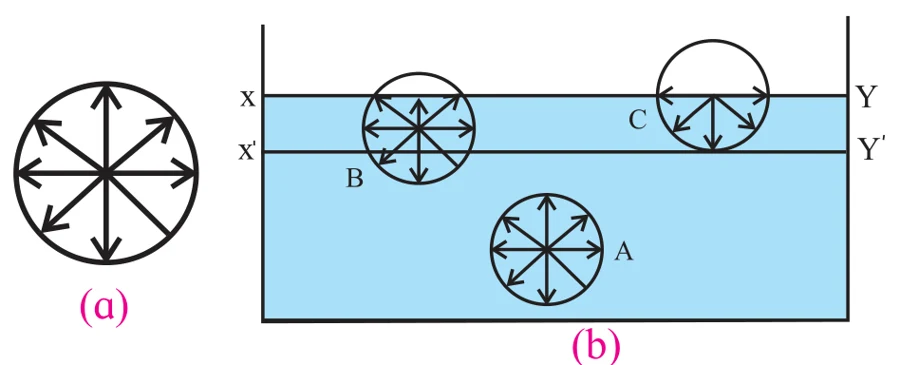
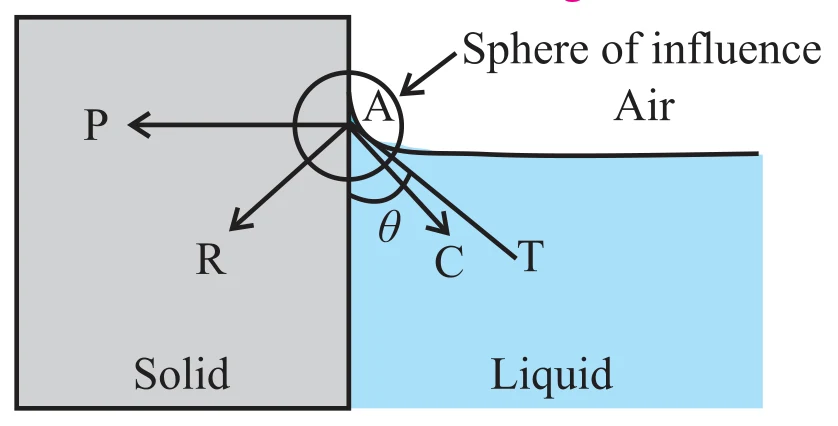
Fig. 2.15 · HSC Textbook · (a) Sphere of influence (b) Surface film
→Terms: range of molecular force (~10⁻⁹ m), sphere of influence, surface film (layer XY–X′Y′ of thickness = range).
→Molecule A deep inside: sphere of influence wholly in the liquid
⇒ equal cohesive forces in all directions
⇒ net force zero.
→Molecule B in the surface film: larger part of its sphere in the liquid
⇒ strong downward cohesive force, weak upward adhesive force of air
⇒ pulled inside.
→Molecule C on the free surface: half sphere in air (few air molecules)
⇒ net force into the liquid.
→All molecules of the surface film feel a net inward pull
⇒ the number of surface molecules is minimised.
→The surface film behaves like a stretched elastic membrane; this tension, acting tangential to the surface, is surface tension.
Q233 marks · HSC Feb 2024 · HSC Feb 2023 · SCERT Question Bank · LA 1
Define surface energy. Obtain the relation between surface energy and surface tension.
Solution
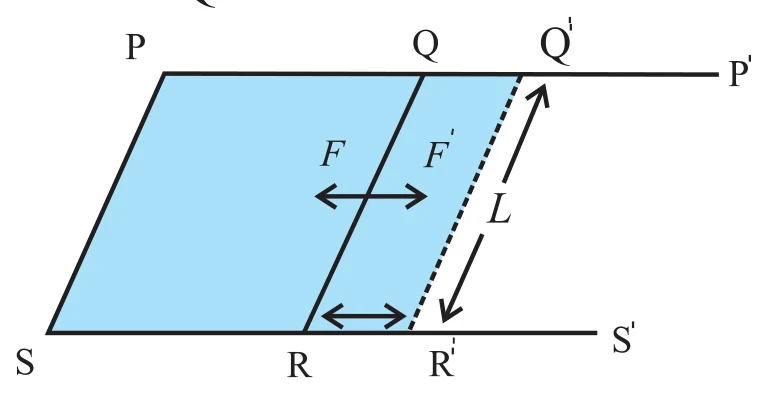
Fig. 2.17 · HSC Textbook · Surface energy of a liquid
→Surface energy: the extra potential energy of the molecules in the surface film (work done to increase the surface area isothermally is stored as surface energy).
→Set-up: C-shaped wire frame PQRS with a movable arm QR of length L, holding a soap film (two surfaces).
F = T × 2L (inward force on QR)
→Stretch: an equal force F′ moves QR isothermally to Q′R′ through dx.
dW = F dx = T(2L dx)
→Area:
2L dx = dA, the increase in area of the two surfaces.
dW = T dA
⇒ surface energy = T × dA
→Surface tension = surface energy per unit area: Surface energydA = T.
Q243 marks · Expected question · based on HSC Textbook 2.4.4
Explain the effect of impurity and temperature on surface tension of a liquid.
Solution
→Soluble impurity (common salt in water): surface tension increases.
→Sparingly soluble (phenol, detergent): surface tension decreases, so detergent water removes stains.
→Insoluble impurity (dust on mercury): surface tension decreases; dusty mercury does not form spherical droplets.
→Temperature: in most liquids surface tension decreases with rise in temperature (hot water removes stains).
→Exceptions: molten copper and cadmium (increases). Surface tension is zero at the critical temperature.
C1MHT CET 2023
The potential energy of a molecule on the surface of a liquid compared to the molecules inside the liquid is
(a) zero(b) less(c) same(d) large
Solution
→Work is done against the net inward cohesive force to bring a molecule to the surface; it is stored as extra potential energy (surface energy)
→Answer: (d) large
C2MHT CET 2026
A square frame of each side L is dipped in a soap solution and taken out. The force acting on the film formed is (T = surface tension of soap solution)
(a) 4TL(b) 8TL(c) 12TL(d) 16TL
Solution
→The film has two surfaces, so the length in contact = 2 × 4L = 8L
⇒ F = T × 8L = 8TL
→Answer: (b) 8TL
C3MHT CET 2023
Consider a soap film on a rectangular frame of wire of area 3 × 3 cm². If the area of the soap film is increased to 5 × 5 cm², the work done in the process will be (surface tension of soap is 2.5 × 10⁻² N/m)
(a) 9 × 10⁻⁶ J(b) 16 × 10⁻⁶ J(c) 40 × 10⁻⁶ J(d) 80 × 10⁻⁶ J
Solution
→Two surfaces: W = 2TΔA = 2 × 2.5 × 10⁻² × (25 − 9) × 10⁻⁴
= 80 × 10⁻⁶ J
→Answer: (d) 80 × 10⁻⁶ J
C4MHT CET 2023
1000 small water drops of equal size combine to form a big drop. The ratio of final surface energy to the total initial surface energy is
(a) 10 : 1(b) 1 : 10(c) 1000 : 1(d) 1 : 1000
Solution
→R = n1/3r = 10r
→Ef : Ei = 4πR² : n(4πr²) = 100 : 1000
= 1 : 10
→Answer: (b) 1 : 10