
Energy of the Electron & Energy Levels · Kinetic, potential & total energy
The kinetic energy of the electron in an orbit of radius in hydrogen atom is proportional to ( = electronic charge)
Show answer and solution
Answer: (c)
Loading the solution…
Home›Practice Hub›Chapters›Atomic Structure›Energy of the Electron & Energy Levels
Atomic Structure PYQs · MHT CET · JEE Main · NEET
Energy of the Electron & Energy Levels · Kinetic, potential & total energy
The kinetic energy of the electron in an orbit of radius in hydrogen atom is proportional to ( = electronic charge)
Answer: (c)
Energy of the Electron & Energy Levels · Kinetic, potential & total energy
An electron makes a transition from an excited state to the ground state of a hydrogen like atom. Out of the following statements which one is correct?
(A) K.E, P. E. and T.E. decreases
(B) K.E. increases but P. E. and T.E. decreases
(C) K.E. and T.E. decreases but P.E. increases
(D) K.E. decreases, P.E. increases but T.E. remains the same
Answer: (b)
Energy of the Electron & Energy Levels · Kinetic, potential & total energy
The kinetic energy of the electron in an orbit of radius in hydrogen atom is proportional to ( = electronic charge)
Answer: (c)
Energy of the Electron & Energy Levels · Ionisation & excitation energy
If the ionisation energy for the hydrogen atom is eV, then the energy required to excite it from the ground state to the next higher state is nearly
Answer: (c)
Energy of the Electron & Energy Levels · Kinetic, potential & total energy
If 'E' and 'L' denote the magnitude of total energy and angular momentum of revolving electron in Bohr orbit then
Answer: (c)
Energy of the Electron & Energy Levels · Energy levels of H & H-like ions
In Bohr's atomic model, the energy of the electron is 'E' in the second orbit of hydrogen atom. So the energy of the electron in the third orbit of helium atom will be
Answer: (b)
Energy of the Electron & Energy Levels · Energy levels of H & H-like ions
Angular momentum of an electron in a hydrogen atom is , then the energy of the electron is _____ eV.
Answer: (c)
Energy of the Electron & Energy Levels · Energy levels of H & H-like ions
In hydrogen atom, the energy of electron in first and third orbit is ' ' and' ' respectively. If then the value of will be
Answer: (a)
Energy of the Electron & Energy Levels · Energy levels of H & H-like ions
The ratio of the total energy of the nd orbit electron for the hydrogen atom ( ) to that of a helium ion () is:
Answer: (d)
Energy of the Electron & Energy Levels · Energy levels of H & H-like ions
In a hydrogen like ion, the energy difference between the nd excitation energy state and ground is 108.8 eV. The atomic number of the ion is:
Answer: (c)
Energy of the Electron & Energy Levels · Energy levels of H & H-like ions
Considering Bohr's atomic model for hydrogen atom:
(A) the energy of H atom in ground state is same as energy of ion in its first excited state. (B) the energy of H atom in ground state is same as that for ion in its second excited state. (C) the energy of H atom in its ground state is same as that of ion for its ground state. (D) the energy of ion in its first excited state is same as that for ion in its ground state. Choose the correct answer from the options given below:
Answer: (a)
Energy of the Electron & Energy Levels · Energy level diagrams
During the transition of electron from state A to state C of a Bohr atom, the wavelength of emitted radiation is and it becomes when the electron jumps from state B to state C. Then the wavelength of the radiation emitted during the transition of electrons from state A to state B is
Answer: (d)
Energy of the Electron & Energy Levels · Kinetic, potential & total energy
When a hydrogen atom is raised from the ground state to the excited state
Answer: (a)
Energy of the Electron & Energy Levels · Kinetic, potential & total energy
An electron rotates in a circle around a nucleus having positive charge . Correct relation between total energy (E) of electron to its potential energy (U) is:
Answer: (c)
Energy of the Electron & Energy Levels · Kinetic, potential & total energy
The ratio of the magnitude of the kinetic energy to the potential energy of an electron in the 5th excited state of a hydrogen atom is:
Answer: (c)
Energy of the Electron & Energy Levels · Ionisation & excitation energy
If the ionisation energy for the hydrogen atom is 13.6 eV, then the energy required to excite it from the ground state to the next higher state is nearly
Answer: (a)
Energy of the Electron & Energy Levels · Kinetic, potential & total energy
Which of the following statements about the Bohr model of the hydrogen atom is false?
Answer: (d)
Energy of the Electron & Energy Levels · Energy levels of H & H-like ions
In the second orbit of hydrogen atom, the energy of an electron is ' '. In the third orbit of helium atom, the energy of the electron will be (atomic number of helium )
Answer: (c)
Energy of the Electron & Energy Levels · Energy levels of H & H-like ions
In the third orbit of hydrogen atom the energy of an electron ' '. In the fifth orbit of helium the energy of an electron will be
Answer: (b)
Energy of the Electron & Energy Levels · Energy levels of H & H-like ions
Radius of a certain orbit of hydrogen atom is 8.48 . If energy of electron in this orbit is . then ________ (Given energy of electron in ground state).
Numerical answer type. Work it out, then open the answer.
Answer: 16
Energy of the Electron & Energy Levels · Energy level diagrams
Some energy levels of a molecule are shown in the figure with their wavelengths of transitions. Then:
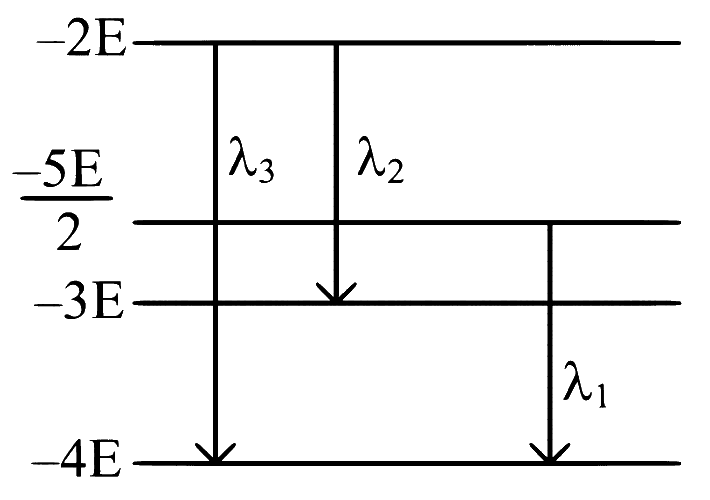
Answer: (d)
Energy of the Electron & Energy Levels · Kinetic, potential & total energy
According to Bohr's theory of hydrogen atom, the total energy of the electron in the th stationary orbit is
Answer: (d)
Energy of the Electron & Energy Levels · Energy levels of H & H-like ions
The energy of ion in its first excited state is, (The ground state energy for the Hydrogen atom is :
Answer: (a)
Energy of the Electron & Energy Levels · Ionisation & excitation energy
The ground state energy of hydrogen atom is . The energy needed to ionize hydrogen atom from its second excited state will be:
Answer: (c)
Energy of the Electron & Energy Levels · Energy level diagrams
The energy levels of an hydrogen atom are shown below. The transition corresponding to emission of shortest wavelength is:
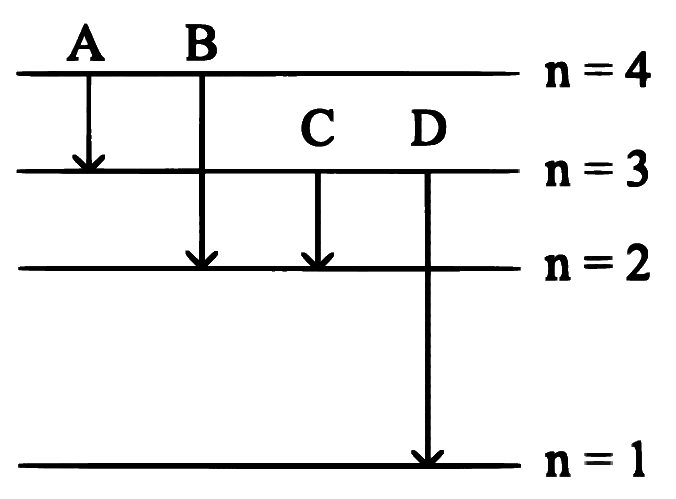
Answer: (d)
Energy of the Electron & Energy Levels · Energy levels of H & H-like ions
The angular momentum of an electron moving in an orbit of hydrogen atom is . The energy in the same orbit is nearly.
Answer: (a)
Energy of the Electron & Energy Levels · Ionisation & excitation energy
If the binding energy of ground state electron in a hydrogen atom is , then, the energy required to remove the electron from the second excited state of will be: . The value of is ________.
Numerical answer type. Work it out, then open the answer.
Answer: 136
Energy of the Electron & Energy Levels · Energy level diagrams
The energy levels of an atom is shown in figure.
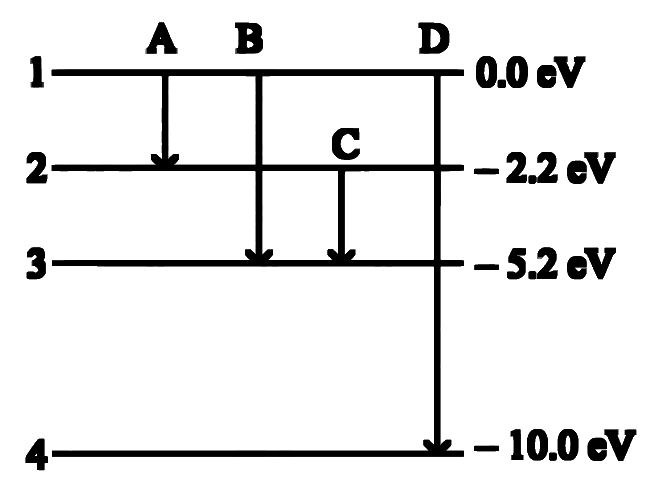
Which one of these transitions will result in the emission of a photon of wavelength 124.1 nm? Given (h = 6.62 10 Js)
Answer: (d)
Energy of the Electron & Energy Levels · Kinetic, potential & total energy
In Bohr's atomic model of hydrogen, let K, P and E are the kinetic energy, potential energy and total energy of the electron respectively. Choose the correct option when the electron undergoes transitions to a higher level:
Answer: (b)
Energy of the Electron & Energy Levels · Energy levels of H & H-like ions
Let T1 and T2 be the energy of an electron in the first and second excited states of hydrogen atoms, respectively. According to the Bohr's model of an atom, the ratio T1: T2 is
Answer: (d)
Energy of the Electron & Energy Levels · Kinetic, potential & total energy
An electron makes a transition from an excited state to the ground state of a hydrogen like atom. Out of the following statements which one is correct?
Answer: (c)
Energy of the Electron & Energy Levels · Kinetic, potential & total energy
In th Bohr orbit, the ratio of the kinetic energy of an electron to the total energy of it, is
Answer: (b)
Energy of the Electron & Energy Levels · Kinetic, potential & total energy
If the electron in a hydrogen atom moves from ground state orbit to 5th orbit, then the potential energy of the electron
Answer: (a)
Energy of the Electron & Energy Levels · Kinetic, potential & total energy
If '' and '' denote the magnitude of total energy and angular momentum of revolving electron in th Bohr orbit, then
Answer: (c)
Energy of the Electron & Energy Levels · Energy levels of H & H-like ions
Energy of electron in the second orbit of hydrogen atom is . The energy of electron '' in the third orbit of helium atom will be
Answer: (a)
Energy of the Electron & Energy Levels · Energy levels of H & H-like ions
Which level of the single ionized carbon has the same energy as the ground state energy of hydrogen atom?
Answer: (b)
Energy of the Electron & Energy Levels · Energy level diagrams
In the given figure, the energy levels of hydrogen atom have been shown along with some transitions marked A, B, C, D and E.
The transitions A, B and C respectively represent:
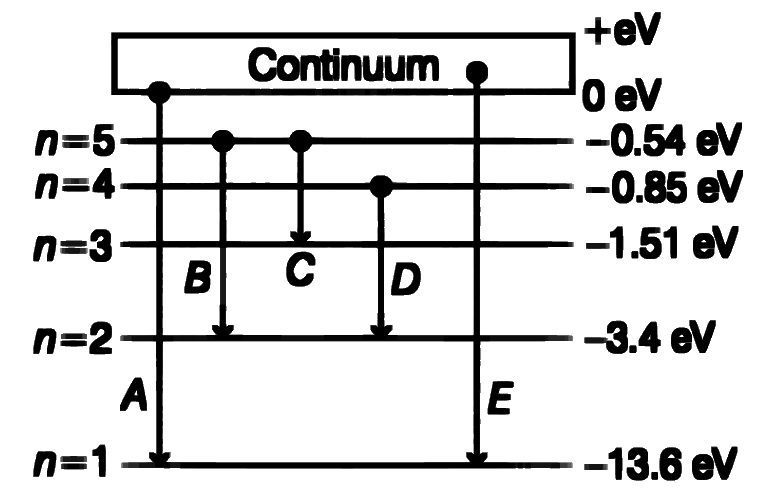
Answer: (c)
Energy of the Electron & Energy Levels · Kinetic, potential & total energy
The total energy of an electron in the th stationary orbit of the hydrogen atom can be obtained by
Answer: (c)
Energy of the Electron & Energy Levels · Energy level diagrams
The energy levels with transitions for the atom are shown. The transitions corresponding to emission of radiation of maximum and minimum wavelength are respectively
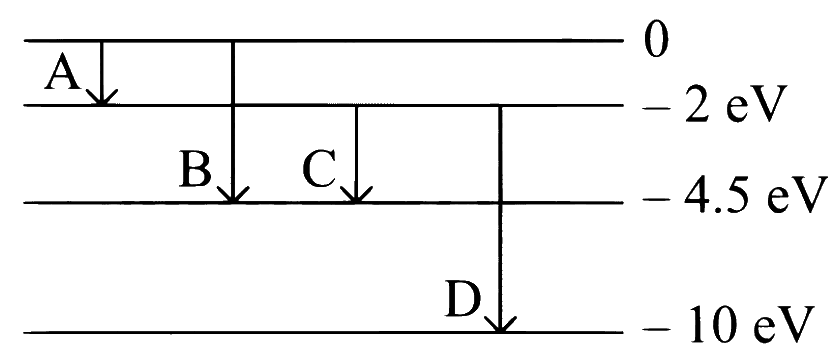
Answer: (d)
Energy of the Electron & Energy Levels · Kinetic, potential & total energy
The total energy of an electron in an atom in an orbit is –3.4 eV. Its kinetic and potential energies are, respectively.
Answer: (a)
Energy of the Electron & Energy Levels · Ionisation & excitation energy
A He+ ion is in its first excited state. Its ionization energy is :-
Answer: (a)
Energy of the Electron & Energy Levels · Kinetic, potential & total energy
The ratio of kinetic energy to the total energy of an electron in a Bohr orbit of the hydrogen atom, is
Answer: (b)
Energy of the Electron & Energy Levels · Ionisation & excitation energy
The energy required to remove the electron from a singly ionized Helium atom is times the energies required to remove an electron from Helium atom. The total energy required to ionize the Helium atom completely is:
Answer: (c)
Energy of the Electron & Energy Levels · Energy level diagrams
Some energy levels of a molecule are shown in the figure. The ratio of the wavelengths r = , is given by:
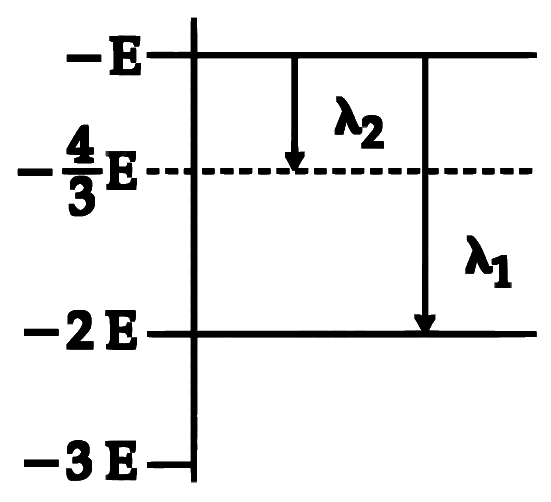
Answer: (a)
Energy of the Electron & Energy Levels · Kinetic, potential & total energy
As an electron makes a transition from an excited state to the ground state of a hydrogen - like atom/ion:
Answer: (c)
Energy of the Electron & Energy Levels · Ionisation & excitation energy
If the binding energy of the electron in a hydrogen atom is 13.6 eV, the energy required to remove the electron from the first excited state of Li++ is:
Answer: (b)
Energy of the Electron & Energy Levels · Ionisation & excitation energy
Energy required for the electron excitation in from the first to the third Bohr orbit is:
Answer: (b)
Energy of the Electron & Energy Levels · Energy levels of H & H-like ions
The energy of a hydrogen atom in the ground state is 13.6 eV. The energy of a He+ ion in the first excited state will be
Answer: (a)
Energy of the Electron & Energy Levels · Ionisation & excitation energy
The ground state energy of hydrogen atom is 13.6 eV. When its electron is in the first excited state, its excitation energy is
Answer: (a)
Energy of the Electron & Energy Levels · Kinetic, potential & total energy
The total energy of electron in the ground state of hydrogen atom is 13.6 eV. The kinetic energy of an electron in the first excited state is
Answer: (d)
Energy of the Electron & Energy Levels · Kinetic, potential & total energy
The total energy of an electron in the first excited state of hydrogen atom is about 3.4 eV. Its kinetic energy in this state is
Answer: (a)
Energy of the Electron & Energy Levels · Energy level diagrams
The diagram shows the energy levels for an electron in a certain atom. Which transition shown represents the emission of a photon with the most energy?
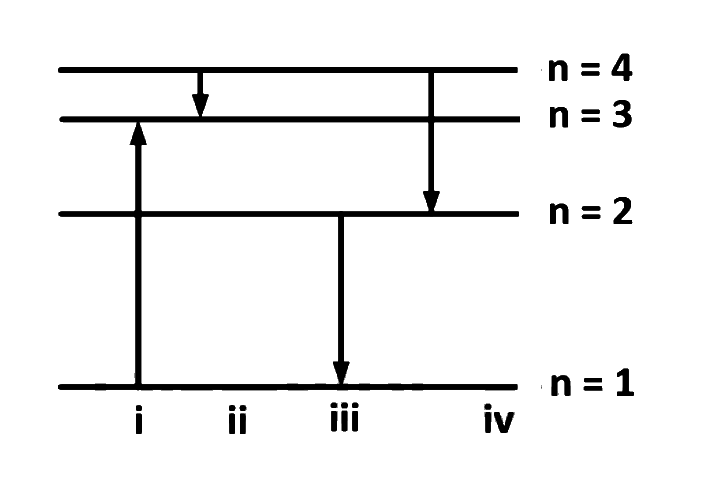
Answer: (b)
Energy of the Electron & Energy Levels · Energy level diagrams
Energy levels A, B and C of a certain atom corresponding to increasing values of energy i.e. EA < EB < EC. If 1, 2 and 3 are wavelengths of radioations corresponding to transitions C to B, B to A and C to A respectively, which of the following relations is correct?
Answer: (b)
Energy of the Electron & Energy Levels · Ionisation & excitation energy
Which of the following atoms has the lowest ionization potential?
Answer: (b)
Energy of the Electron & Energy Levels · Ionisation & excitation energy
If the binding energy of the electron in a hydrogen atom is the energy required to remove the electron from the first excited state of is
Answer: (a)
Energy of the Electron & Energy Levels · Ionisation & excitation energy
If energy is required to ionize the hydrogen atom, then the energy required to remove an electron from is
Answer: (c)
Energy of the Electron & Energy Levels · Energy levels of H & H-like ions
The energy of the ground electronic state of hydrogen atom is eV. The energy of the first excited state will be
Answer: (c)
Energy of the Electron & Energy Levels · Energy levels of H & H-like ions
The energy of a hydrogen atom in its ground state is eV. The energy of the level corresponding to the quantum number in the hydrogen atom is
Answer: (b)
Energy of the Electron & Energy Levels · Kinetic, potential & total energy
When a hydrogen atom is raised from the ground state to an excited state,
Answer: (d)
Energy of the Electron & Energy Levels · Energy level diagrams
The figure indicates the energy level diagram of an atom and the origin of six spectral lines in emission (e.g. line no. 5 arises from the transition from level to ). Which of the following spectral lines will occur in the absorption spectrum?
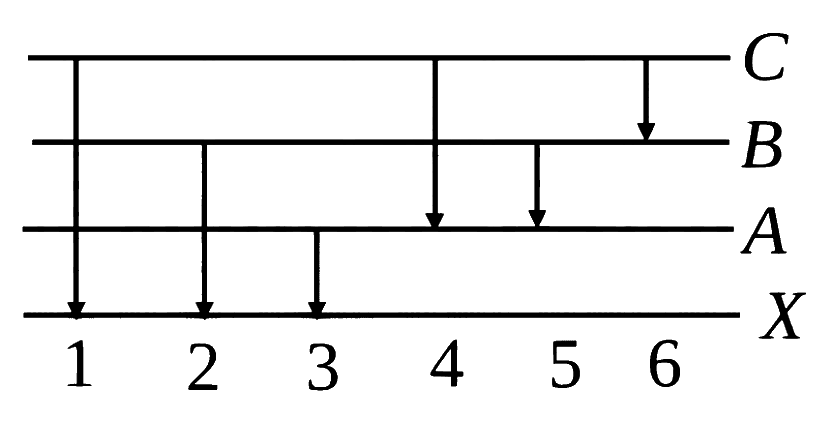
Answer: (c)
Energy of the Electron & Energy Levels · Ionisation & excitation energy
The ground state energy of H-atom is 13.6 eV. The energy needed to ionize H-atom from its second excited state
Answer: (a)
Energy of the Electron & Energy Levels · Energy level diagrams
Energy levels and of a certain atom corresponding to increasing values of energy i.e. . If and are wavelengths of radiations corresponding to transitions to to and to respectively, which of the following relations is correct?
Answer: (b)
Energy of the Electron & Energy Levels · Ionisation & excitation energy
The ionisation energy of hydrogen atom is 13.6 eV, the ionisation energy of a singly ionised helium atom would be
Answer: (d)
No questions match these filters.