
Transitions, Photon Emission & Excitation
Which of the following transition in hydrogen atom emits photon of highest frequency?
Show answer and solution
Answer: (a)
Loading the solution…
Home›Practice Hub›Chapters›Atomic Structure›Transitions, Photon Emission & Excitation
Atomic Structure PYQs · MHT CET · JEE Main · NEET
Transitions, Photon Emission & Excitation
Which of the following transition in hydrogen atom emits photon of highest frequency?
Answer: (a)
Transitions, Photon Emission & Excitation
The electron in hydrogen atom is initially in the second excited state. When it finally moves to ground state, the maximum number of spectral lines emitted are
Answer: (b)
Transitions, Photon Emission & Excitation
In hydrogen like spectrum if wavelength of transition from to orbit is then wavelength of transition from to orbit (Bohr's) is . If then value of is
Answer: (c)
Transitions, Photon Emission & Excitation
The wavelength of the radiation emitted is when an electron jumps from the second excited state to the first excited state of hydrogen atom. If the electron jumps from the third excited state to the second orbit of the hydrogen atom, the wavelength of the radiation emitted will be . The value of is
Answer: (c)
Transitions, Photon Emission & Excitation
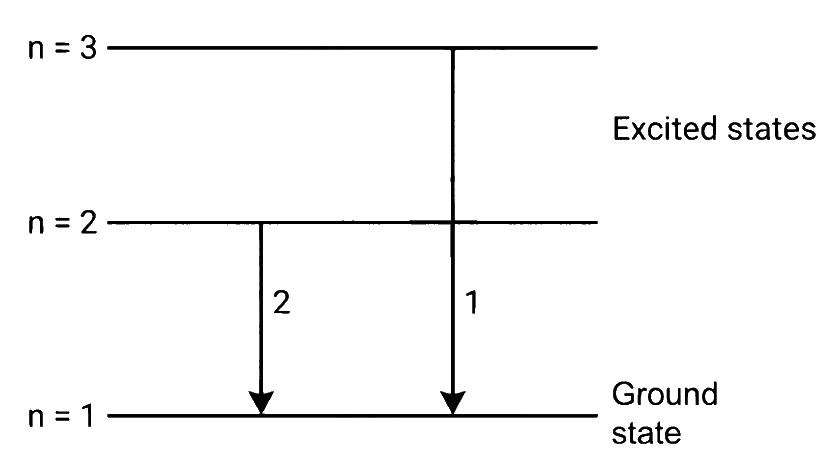
For hydrogen atom, and are the wavelengths corresponding to the transitions and respectively as shown in figure. The ratio of and is . The value of is
Answer: (b)
Transitions, Photon Emission & Excitation
The ratio of momentum of the photons of the st and nd line of Balmer series of Hydrogen atoms is . The possible values of and are:-
Answer: (d)
Transitions, Photon Emission & Excitation
In the hydrogen atom, the electron makes a transition from the higher orbit (i) to a lower orbit . The ratio of the radius of the orbits in given by . The wavelength of photon emitted due to this transition is ______ nm.
(Given Rydberg constant )
Answer: (c)
Transitions, Photon Emission & Excitation
An electron in the hydrogen atom jumps from energy state to the ground state. The wavelength so emitted illuminates a photosensitive material having work function eV. If the maximum kinetic energy of the emitted photoelectrons is eV, then the value of '' is
Answer: (c)
Transitions, Photon Emission & Excitation
An electron of stationary hydrogen atom jumps from 4th energy level to ground level. The recoil velocity of the atom as a result of electron transition will be
( = Planck's constant, = Rydberg's constant, mass of hydrogen atom)
Answer: (d)
Transitions, Photon Emission & Excitation
Out of the following transitions in hydrogen atom, identify the transition which emits photons of highest frequency.
Answer: (b)
Transitions, Photon Emission & Excitation
Which of the following transitions in hydrogen atom emit photons of highest frequency? ( principle quantum number)
Answer: (d)
Transitions, Photon Emission & Excitation
The number of spectral lines emitted by atomic hydrogen that is in the 4th energy level, is
Answer: (b)
Transitions, Photon Emission & Excitation
The ratio of energies of photons produced due to transition of electron of hydrogen atom from its (i) third to nd energy level and (ii) highest energy level to rd level is
Answer: (b)
Transitions, Photon Emission & Excitation
In hydrogen atom, transition from the state to results in ultraviolet radiation. Infrared radiation will be obtained in the transition
Answer: (d)
Transitions, Photon Emission & Excitation
In hydrogen atom spectrum, when an electron jumps from second excited state to the first excited state, the wavelength of radiation emitted is ' '. If the electron jumps from the third excited state to the second orbit, the wavelength of radiation emitted will be . The value of is
Answer: (b)
Transitions, Photon Emission & Excitation
An electron in the hydrogen atom initially in the fourth excited state makes a transition to th energy state by emitting a photon of energy 2.86 eV. The integer value of n will be__________.
Numerical answer type. Work it out, then open the answer.
Answer: 2
Transitions, Photon Emission & Excitation
The ratio of energies of photons produced due to transition of electron of hydrogen atom from its (a) second to first energy level and (b) highest energy level to second level is
Answer: (c)
Transitions, Photon Emission & Excitation
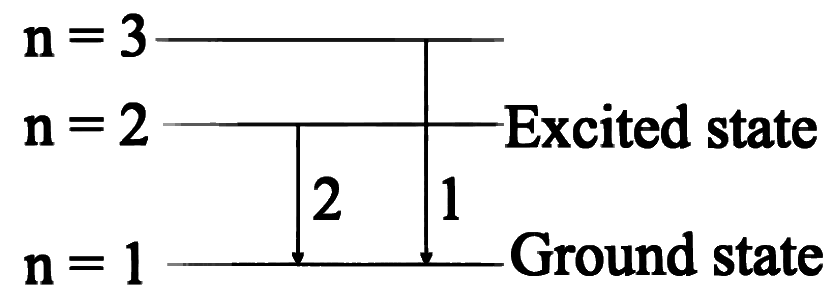
For hydrogen atom, ' ' and ' ' are the wavelengths corresponding to the transitions 1 and 2 respectively as shown in figure. The ratio of ' ' and ' ' is . The value of ' ' is
Answer: (c)
Transitions, Photon Emission & Excitation
A particular hydrogen-like ion emits the radiation of frequency when it makes transition from to . The frequency of radiation emitted in transition from to is , when ________.
Numerical answer type. Work it out, then open the answer.
Answer: 32
Transitions, Photon Emission & Excitation
A hydrogen atom in ground state is given an energy of . How many spectral lines will be emitted due to transition of electrons?
Answer: (d)
Transitions, Photon Emission & Excitation
An electron of hydrogen atom in an excited state is having energy . The maximum number of allowed transitions to lower energy level is _________.
Numerical answer type. Work it out, then open the answer.
Answer: 6
Transitions, Photon Emission & Excitation
The minimum energy required by a hydrogen atom in ground state to emit radiation in Balmer series is nearly:
Answer: (c)
Transitions, Photon Emission & Excitation
An electron of stationary Hydrogen atom passes from fifth energy level to ground level. The velocity that the atom acquired as a result of photo emission is
( mass of electron, Rydberg's constant)
( Planck's constant)
Answer: (a)
Transitions, Photon Emission & Excitation
Hydrogen atom is bombarded with electrons accelerated through a potential difference of , which causes excitation of hydrogen atoms. If the experiment is being performed at , the minimum potential difference needed to observe any Balmer series lines in the emission spectra will be , where __________.
Numerical answer type. Work it out, then open the answer.
Answer: 121
Transitions, Photon Emission & Excitation
A hydrogen atom changes its state from to . Due to recoil, the percentage change in the wavelength of emitted light is approximately . The value of is _______. [Given Rhc mass of the hydrogen atom ]
Numerical answer type. Work it out, then open the answer.
Answer: 7
Transitions, Photon Emission & Excitation
When a hydrogen atom going from to emits a photon, its recoil speed is . Where ________. (Use, mass of hydrogen atom )
Numerical answer type. Work it out, then open the answer.
Answer: 17
Transitions, Photon Emission & Excitation
The wavelength of light for the least energetic photons emitted in the Lyman series of the hydrogen spectrum is nearly [Take , change in energy of the levels ]
Answer: (b)
Transitions, Photon Emission & Excitation
If an electron in a hydrogen atom jumps from an orbit of level to orbit of level , then the emitted radiation frequency is (where R = Rydberg's constant, C = Velocity of light)
Answer: (d)
Transitions, Photon Emission & Excitation
A photon is emitted in transition from n = 4 to n = 1 level in hydrogen atom. The corresponding wavelength for this transition is (given, h = 4 10 eVs):
Answer: (b)
Transitions, Photon Emission & Excitation
An excited hydrogen atom emits a photon of wavelength in returning to ground state. The quantum number of the excited state is ( Rydberg's constant)
Answer: (b)
Transitions, Photon Emission & Excitation
The wavelength of radiation emitted is '' when an electron jumps from the second excited state to the first excited state of hydrogen atom. If the electron jumps from the third excited state to the second orbit of the hydrogen atom, the wavelength of the radiation emitted will be . The value of is
Answer: (d)
Transitions, Photon Emission & Excitation
The ratio of wavelengths for transition of electrons from nd orbit to st orbit of Helium and Lithium is (Atomic number of Helium , Atomic number of Lithium )
Answer: (a)
Transitions, Photon Emission & Excitation
An electron of a hydrogen like atom, having , jumps from th energy state to nd energy state. The energy released in this process, will be:
(Given Rch = )
Where R = Rydberg constant
c = Speed of light in vacuum
h = Planck's constant
Answer: (b)
Transitions, Photon Emission & Excitation
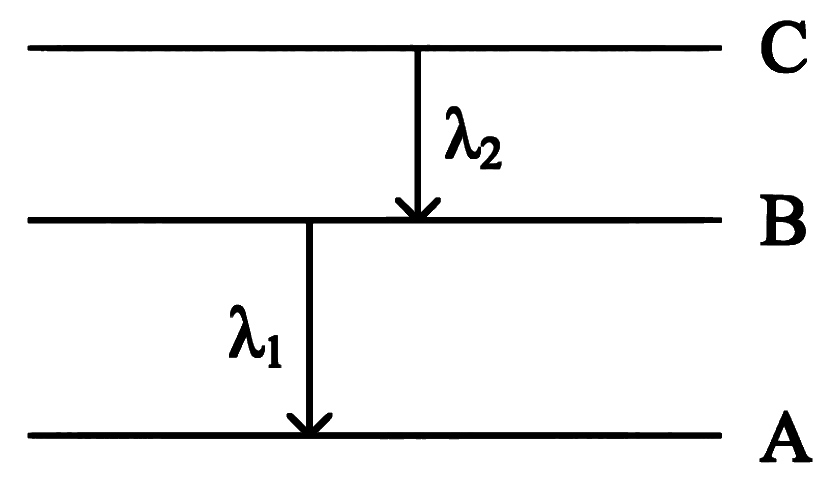
As per given figure and are the first, second and third excited energy levels of hydrogen atom respectively. If the ratio of the two wavelengths i.e. is , then the value of will be __________.
Numerical answer type. Work it out, then open the answer.
Answer: 5
Transitions, Photon Emission & Excitation
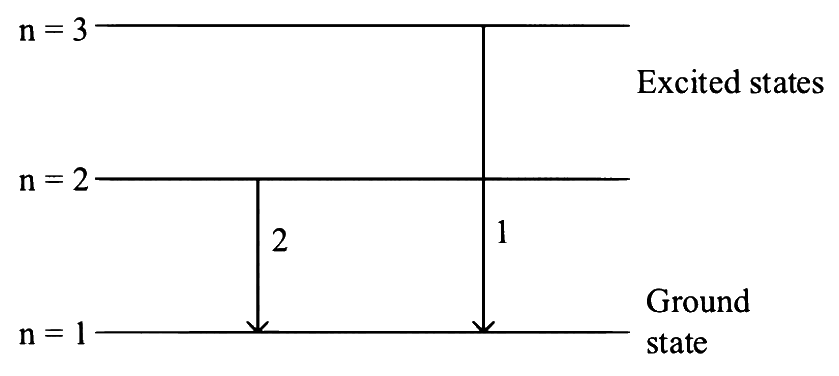
For hydrogen atom, and are the wavelengths corresponding to the transitions 1 and 2 respectively as shown in figure. The ratio of and is . The value of is __________.
Numerical answer type. Work it out, then open the answer.
Answer: 27
Transitions, Photon Emission & Excitation
The wavelength of the radiation emitted is when an electron jumps from the second excited state to the first excited state of hydrogen atom. If the electron jumps from the third excited state to the second orbit of the hydrogen atom, the wavelength of the radiation emitted will be . The value of is _____________.
Numerical answer type. Work it out, then open the answer.
Answer: 27
Transitions, Photon Emission & Excitation
A electron beam is used to bombard gaseous hydrogen at room temperature. The number of spectral lines emitted will be:
Answer: (c)
Transitions, Photon Emission & Excitation
A monochromatic light is incident on a hydrogen sample in ground state. Hydrogen atoms absorb a fraction of light and subsequently emit radiation of six different wavelengths. The frequency of incident light is . The value of is ____________.
(Given h )
Numerical answer type. Work it out, then open the answer.
Answer: 3
Transitions, Photon Emission & Excitation
Find the ratio of energies of photons produced due to transition of an electron of hydrogen atom from its (i) second permitted energy level to the first level, and (ii) the highest permitted energy level to the first permitted level.
Answer: (a)
Transitions, Photon Emission & Excitation
Hydrogen atom from excited state comes to the ground state by emitting a photon of wavelength . The value of principal quantum number '' of the excited state will be: ( Rydberg constant)
Answer: (b)
Transitions, Photon Emission & Excitation
is the ratio of energies of photons produced due to transition of an electron of hydrogen atom from its
(i) third permitted energy level to the second level and
(ii) the highest permitted energy level to the second permitted level.
The value of x will be ____________.
Numerical answer type. Work it out, then open the answer.
Answer: 5
Transitions, Photon Emission & Excitation
A hydrogen atom in its first excited state absorbs a photon of energy x 102 eV and excited to a higher energy state where the potential energy of electron is.08 eV. The value of x is ______________.
Numerical answer type. Work it out, then open the answer.
Answer: 286
Transitions, Photon Emission & Excitation
A beam of monochromatic light is used to excite the electron in Li++ from the first orbit to the third orbit. The wavelength of monochromatic light is found to be x 1010 m. The value of x is ___________.
[Given hc = 1242 eV nm]
Numerical answer type. Work it out, then open the answer.
Answer: 114
Transitions, Photon Emission & Excitation
The wavelength of the photon emitted by a hydrogen atom when an electron makes a transition from n = 2 to n = 1 state is:
Answer: (d)
Transitions, Photon Emission & Excitation
According to Bohr atomic model, in which of the following transitions will the frequency be maximum?
Answer: (a)
Transitions, Photon Emission & Excitation
The electron in hydrogen atom is initially in the third excited state. When it finally moves to ground state, the maximum number of spectral lines emitted are
Answer: (d)
Transitions, Photon Emission & Excitation
X different wavelengths may be observed in the spectrum from a hydrogen sample if the atoms are excited to states with principal quantum number n = 6? The value of X is ______________.
Numerical answer type. Work it out, then open the answer.
Answer: 15
Transitions, Photon Emission & Excitation
The ratio of energies of photons produced due to transition of electron of hydrogen atom from its (i) second to first energy level and (ii) highest energy level to second energy level is
Answer: (b)
Transitions, Photon Emission & Excitation
A particular hydrogen like ion emits radiation of frequency 2.92 1015 Hz when it makes transition from n = 3 to n = 1. The frequency in Hz of radiation emitted in transition from n = 2 to n = 1 will be:
Answer: (d)
Transitions, Photon Emission & Excitation
The ratio of energies of photons produced due to transition of electron of hydrogen atom from its (i) second to first energy level and (ii) highest energy level to second level is respectively
Answer: (b)
Transitions, Photon Emission & Excitation
The energy required to ionise a hydrogen like ion in its ground state is 9 Rydbergs. What is the wavelength of the radiation emitted when the electron in this ion jumps from the second excited state to the ground state?
Answer: (b)
Transitions, Photon Emission & Excitation
In a hydrogen atom the electron makes a transition from (n + 1)th level to the nth level. If n >> 1, the frequency of radiation emitted is proportional to:
Answer: (c)
Transitions, Photon Emission & Excitation
A particle of mass 200 MeV/c2 collides with a hydrogen atom at rest. Soon after the collision the particle comes to rest, and the atom recoils and goes to its first excited state. The initial kinetic energy of the particle (in eV) is
. The value of N is:
(Given the mass of the hydrogen atom to be 1 GeV/c2) ______.
Numerical answer type. Work it out, then open the answer.
Answer: 51
Transitions, Photon Emission & Excitation
The electron in a hydrogen atom first jumps from the third excited state to the second excited state and subsequently to the first excited state. The ratio of the respective wavelengths, , of the photons emitted in this process is:
Answer: (d)
Transitions, Photon Emission & Excitation
In a hydrogen like atom, when an electron jumps from the M-shell to the L-shell, the wavelength of emitted radiation is . If an electron jumps from N-shell to the L-shell, the wavelength of emitted radiation will be:
Answer: (d)
Transitions, Photon Emission & Excitation
A hydrogen atom, initially in the ground state is excited by absorbing a photon of wavelength 980. The radius of the atom in the excited state, in terms of Bohr radius a0 will be: (hc = 12500 eV)
Answer: (d)
Transitions, Photon Emission & Excitation
An excited He+ ion emits two photons in succession, with wavelengths 108.5 nm and 30.4 nm, in making a transition to ground state. The quantum number n, corresponding to its initial excited state is (for photon of wavelength , energy ):
Answer: (c)
Transitions, Photon Emission & Excitation
In Li+ +, electron in first Bohr orbit is excited to a level by a radiation of wavelength . When the ion gets deexcited to the ground state in all possible ways (including intermediate emissions), a total of six spectral lines are observed. What is the value of ?
(Given: H = 6.63 × 10⁻³⁴ Js; c = 3 × 10⁸ ms –1)
Answer: (a)
Transitions, Photon Emission & Excitation
Radiation coming from transitions n = 2 to n = 1 of hydrogen atoms fall on He+ ions in n = 1 and n = 2 states. The possible transition of helium ions as they absorb energy from the radiation is:
Answer: (c)
Transitions, Photon Emission & Excitation
If an electron in a hydrogen atom jumps from the 3rd orbit to the 2nd orbit, it emits a photon of wavelength . When it jumps from the 4th orbit to the 3rd orbit, the corresponding wavelength of the photon will be
Answer: (c)
Transitions, Photon Emission & Excitation
A hydrogen atom makes a transition from n = 2 to n = 1 and emits a photon. This photon strikes a doubly ionized lithium atom (z = 3) in excited state and completely removes the orbiting electron. The least quantum number for the excited state of the ion for the process is:
Answer: (c)
Transitions, Photon Emission & Excitation
Hydrogen , Deuterium , singly ionised Helium and doubly ionised lithium all have one electron around the nucleus. Consider an electron transition from to If the wavelengths of emitted radiation are and respectively then approximately which one of the following is correct?
Answer: (c)
Transitions, Photon Emission & Excitation
Hydrogen atom in ground state is excited by a monochromatic radiation of = 975 . Number of spectral lines in the resulting spectrum emitted will be
Answer: (c)
Transitions, Photon Emission & Excitation
The radiation corresponding to transition of hydrogen atom falls on a metal surface to produce photoelectrons. These electrons are made to enter a magnetic field If the radius of the larger circular path followed by these electrons is , the work function of the metal is close to:
Answer: (b)
Transitions, Photon Emission & Excitation
A 12.5 eV electron beam is used to bombard gaseous hydrogen at room temperature. It will emit:
Answer: (a)
Transitions, Photon Emission & Excitation
In a hydrogen like atom electron make transition from an energy level with quantum number to another with quantum number . If the frequency of radiation emitted is proportional to:
Answer: (d)
Transitions, Photon Emission & Excitation
Hydrogen atom is excited from ground state to another state with principal quantum number equal to Then the number of spectral lines in the emission spectra will be:
Answer: (d)
Transitions, Photon Emission & Excitation
The transition from the state n = 3 to n = 1 in a hydrogen like atom results in ultraviolet radiation. Infrared radiation will be obtained in the transition from
Answer: (d)
Transitions, Photon Emission & Excitation
Electron in hydrogen atom first jumps from third excited state to second excited state and then from second excited to the first excited state. The ratio of the wavelengths 1: 2 emitted in the two cases is
Answer: (d)
Transitions, Photon Emission & Excitation
An electron of a stationary hydrogen atom passes from the fifth energy level to the ground level. The velocity that the atom acquired as a result of photon emission will be
Answer: (a)
Transitions, Photon Emission & Excitation
Out of the following which one is not a possible energy for a photon to be emitted by hydrogen atom according to Bohr's atomic model?
Answer: (c)
Transitions, Photon Emission & Excitation
An electron in the hydrogen atom jumps from excited state n to the ground state. The wavelength so emitted illuminates a photosensitive material having work function 2.75 eV. If the stopping potential of the photoelectron is 10 V, then the value of n is
Answer: (c)
Transitions, Photon Emission & Excitation
The transition from the state to in a hydrogen like atom results in ultraviolet radiation. Infrared radiation will be obtained in the transition from:
Answer: (c)
Transitions, Photon Emission & Excitation
The ionization energy of the electron in the hydrogen atom in its ground state is 13.6 eV. The atoms are excited to higher energy levels to emit radiations of 6 wavelengths. Maximum wavelength of emitted radiation corresponds to the transition between
Answer: (c)
Transitions, Photon Emission & Excitation
Which of the following transitions in hydrogen atoms emit photons of highest frequency?
Answer: (d)
Transitions, Photon Emission & Excitation
Ionization potential of hydrogen atom is 13.6 eV. Hydrogen atoms in the ground state are excited by monochromatic radiation of photon energy 12.1 eV. According to Bohr's theory, the spectral lines emited by hydrogen will be
Answer: (c)
Transitions, Photon Emission & Excitation
Energy of a hydrogen atom with principal quantum number is given by . The energy of a photon ejected when the electron jumps from state to state of hydrogen, is approximately
Answer: (d)
Transitions, Photon Emission & Excitation
The wavelengths involved in the spectrum of deuterium are slightly different from that of hydrogen spectrum, because
Answer: (c)
Transitions, Photon Emission & Excitation
Maximum frequency of emission is obtained for the transition
Answer: (a)
Transitions, Photon Emission & Excitation
An electron makes a transition from orbit to the orbit of a hydrogen atom. What is the wavelength of the emitted radiations? ( = Rydberg's constant)
Answer: (d)
Transitions, Photon Emission & Excitation
Hydrogen atoms are excited from ground state of the principle quantum number 4. Then the number of spectral lines observed will be
Answer: (b)
Transitions, Photon Emission & Excitation
The ionization energy of hydrogen atom is 13.6 eV. Following Bohr's theory, the energy corresponding to a transition between rd and th orbit is
Answer: (d)
No questions match these filters.