0 of 52 attemptedPick an answer to see the solution
Q1MHT CET 2026 · 13 MAY · SHIFT 1Medium
Centripetal Acceleration & Force · Centripetal force & ratios
The real force F acting on particle of mass m performing circular motion acts along the radius of circle r and is directed forwards the centre of the circle. The magnitude of square root of such a force is (T = periodic time)
Centripetal Acceleration & Force · Centripetal force & ratios
Two stones of masses m and 3m are whirled in horizontal circles, the heavier one in a radius 3r and the lighter one in radius r. When both the stones experience same centripetal forces, the tangential speed of lighter stone is 'n' times that of the value of heavier stone. The value of 'n' is
Centripetal Acceleration & Force · Centripetal acceleration
Two bodies of mass 10 kg and 5 kg are moving in concentric circular orbits of radii ' R ' and ' r ' respectively such that their periods are same. The ratio between their centripetal acceleration is
Centripetal Acceleration & Force · Centripetal force & ratios
Two stones of masses m and 3 m are whirled in horizontal circles, the heavier one in a radius (3r) and lighter one in a radius r. The tangential speed of lighter stone is ' n ' times the value of heavier stone. When the magnitude of centripetal force becomes equal the value of n is
Centripetal Acceleration & Force · Spring or string provides the force
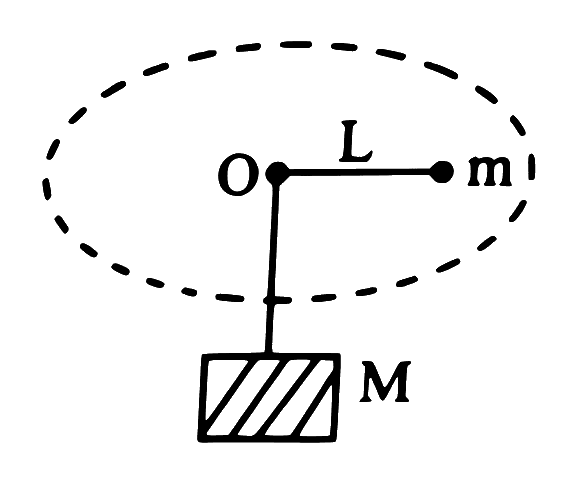
The figure shows two masses ' m ' and ' M ' connected by a light string that passes through a small hole ' O ' at the centre of the table. Mass ' m ' is moved round in a horizontal circle with ' O ' as the centre. The frequency with which ' m ' should be revolved so that ' M ' remains stationary is ( g= gravitational acceleration)
Centripetal Acceleration & Force · Spring or string provides the force
A body of mass 100 gram is tied to a spring of spring constant 8 N/m, while the other end of a spring is fixed. If the body moves in a circular path on smooth horizontal surface with constant angular speed 8 rad/s then the ratio of extension in the spring to its natured length will be
Centripetal Acceleration & Force · Spring or string provides the force
A tube of length 1 m is filled completely with an ideal liquid of mass 2 M, and closed at both ends. The tube is rotated uniformly in horizontal plane about one of its ends. If the force exerted by the liquid at the other end is F then angular velocity of the tube is αMF in SI unit. The value of α is _________.
Numerical answer type. Work it out, then open the answer.
Centripetal Acceleration & Force · Centripetal acceleration
A body performing uniform circular motion of radius ' R ' has frequency ' n '. Its centripetal acceleration per unit radius is proportional to (n)x. The value of x is
Centripetal Acceleration & Force · Centripetal acceleration
A particle is performing uniform circular motion along the circumference of the circle of diameter 1 m with frequency 4 Hz. The acceleration of the particle in m/s2 is
Centripetal Acceleration & Force · Centripetal acceleration
A man carrying a monkey on his shoulder does cycling smoothly on a circular track of radius 9 m and completes 120 revolutions in 3 minutes. The magnitude of centripetal acceleration of monkey is (in m/s2):
Centripetal Acceleration & Force · Centripetal force & ratios
If the radius of curvature of the path of two particles of same mass are in the ratio 3:4, then in order to have constant centripetal force, their velocities will be in the ratio of:
Centripetal Acceleration & Force · Centripetal force & ratios
A particle of mass ' m ' is performing uniform circular motion along a circular path of radius ' r '. Its angular momentum about the axis passing through the centre and perpendicular to the plane is ' L '. The kinetic energy of the particle is
Centripetal Acceleration & Force · Centripetal force & ratios
A particle of mass ' m ' performs uniform circular motion of radius ' r ' with linear speed ' v ' under the application of force ' F '. If ' m ', ' v ' and r ' are all increased by 20% the necessary change in force required to maintain the particle in uniform circular motion, is
Centripetal Acceleration & Force · Radius of curvature
A particle moving in a circle of radius R with uniform speed takes time T to complete one revolution.
If this particle is projected with the same speed at an angle θ to the horizontal, the maximum height attained by it is equal to 4R. The angle of projection θ is then given by:
Centripetal Acceleration & Force · Centripetal acceleration
A stone tied to 180 cm long string at its end is making 28 revolutions in horizontal circle in every minute. The magnitude of acceleration of stone is x1936 m s−2. The value of x ________. (Take π=722)
Numerical answer type. Work it out, then open the answer.
Centripetal Acceleration & Force · Centripetal force & ratios
A vehicle of mass 200 kg is moving along a levelled curved road of radius 70 m with angular velocity of 0.2 rad/s. The centripetal force acting on the vehicle is:
Centripetal Acceleration & Force · Centripetal force & ratios
A child of mass 5 kg is going round a merry-go-round that makes 1 rotation in 3.14 s. The radius of the merry-go-round is 2 m. The centrifugal force on the child will be
Centripetal Acceleration & Force · Centripetal acceleration
An object moves at a constant speed along a circular path in a horizontal plane with center at the origin. When the object is at x=+2 m, its velocity is −4j^ m/s. The object's velocity (v) and acceleration (a) at x=−2 m will be
Centripetal Acceleration & Force · Spring or string provides the force
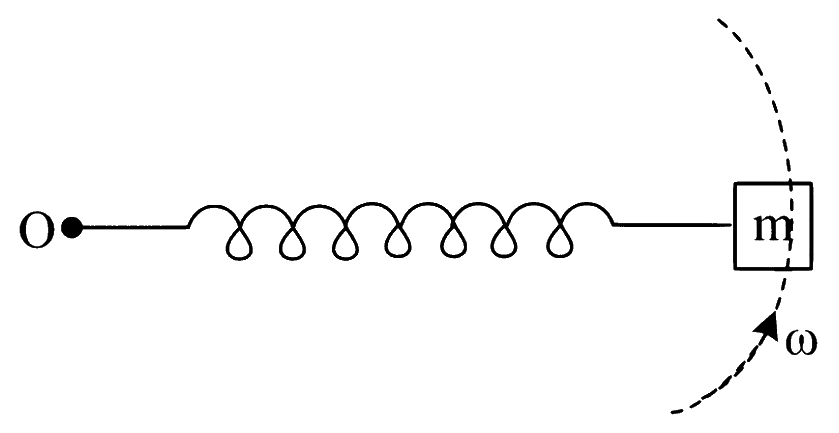
A body of mass 200 gram is tied to a spring of spring constant 12.5 N/m, while other end of spring is fixed at point 'O'. If the body moves about 'O' in a circular path on a smooth horizontal surface with constant angular speed 5 rad/s then the ratio of extension in the spring to its natural length will be
Centripetal Acceleration & Force · Spring or string provides the force
A small block of mass 100 g is tied to a spring of spring constant 7.5 N/m and length 20 cm. The other end of spring is fixed at a particular point A. If the block moves in a circular path on a smooth horizontal surface with constant angular velocity 5 rad/s about point A, then tension in the spring is -
Centripetal Acceleration & Force · Spring or string provides the force
A body of mass 200g is tied to a spring of spring constant 12.5 N/m, while the other end of spring is fixed at point O. If the body moves about O in a circular path on a smooth horizontal surface with constant angular speed 5 rad/s, then the ratio of extension in the spring to its natural length will be:
Centripetal Acceleration & Force · Radius of curvature
A stone is projected at angle θ with velocity u. If it executes nearly a circular motion at its maximum point for short time, then the radius of the circular path will be ( g= acceleration due to gravity)
Centripetal Acceleration & Force · Centripetal acceleration
For a particle in uniform circular motion, the accelerationaat any point P(R, θ) on the circular path of radius R is (when θ is measured from the positive x-axis and v is uniform speed):
Centripetal Acceleration & Force · Centripetal force & ratios
Two bodies of masses 'm' and '3m' are rotating in horizontal circles of radii 'r' and ' 3r' respectively. The tangential speed of the body of mass 'm' is n times that of the heavier body; while the centripetal force is same for both. The value of n is
Centripetal Acceleration & Force · Spring or string provides the force
A mass of 0.5 kg is attached to one end of a massless spring whose natural length is 1 m and spring constant is 800 N/m The other end of the spring is fixed while the mass moves in a circular path in a horizontal plane with an angular speed of 20 rad/s. The extension in the length of the spring will be:
Centripetal Acceleration & Force · Spring or string provides the force
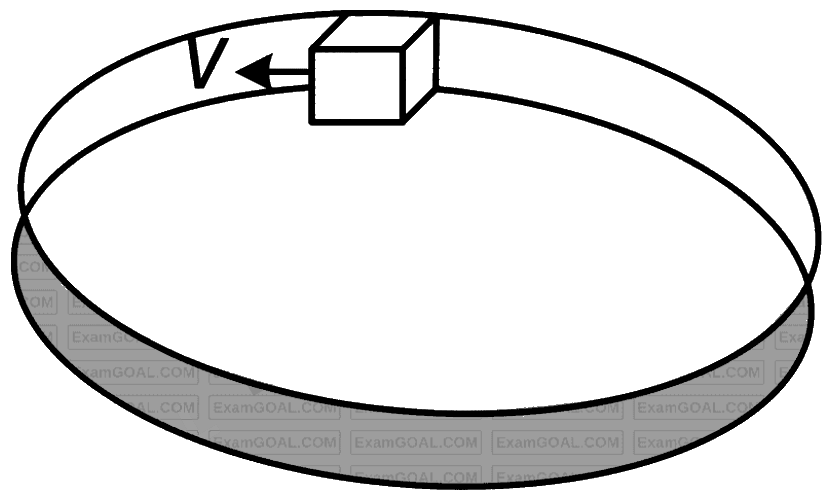
A smooth circular groove has a smooth vertical wall as shown in figure. A block of mass m moves against the wall with a speed v. Which of the following curve represents the correct relation between the normal reaction on the block by the wall (N) and speed of the block (v)?
Centripetal Acceleration & Force · Centripetal acceleration
A particle is moving along the circular path with constant speed and centripetal acceleration 'a'. If the speed is doubled, the ratio of its acceleration after and before the change is
Centripetal Acceleration & Force · Spring or string provides the force
A block of 200 g mass moves with a uniform speed in a horizontal circular groove, with vertical side walls of radius 20 cm. If the block takes 40 s to complete one round, the normal force by the side walls of the groove is:
Centripetal Acceleration & Force · Centripetal force & ratios
A body of mass 'm' is moving with speed 'V' along a circular path of radius 'r'. Now the speed is reduced to 2V and radius is increased to '3r'. For this change, initial centripetal force needs to be
Centripetal Acceleration & Force · Central force orbits
A particle moves in a circular orbit of radius 'r' under a central attractive force, F=−rk, where k is a constant. The periodic time of its motion is proportional to
Centripetal Acceleration & Force · Central force orbits
A particle is moving with uniform speed along the circumference of a circle of radius R under the action of a central fictitious force F which is inversely proportional to R3. Its time period of revolution will be given by:
Centripetal Acceleration & Force · Radius of curvature
A projectile is thrown with an initial velocity (ai^+bj^) m/s, where i^ and j^ are unit vectors along horizontal and vertical directions respectively. If the range of the projectile is twice the maximum height reached by it, then
Centripetal Acceleration & Force · Central force orbits
A particle of mass m moves in a circular orbit under the central potential field, U(r)=−rC, where C is a positive constant. The correct radius − velocity graph of the particle's motion is:
Centripetal Acceleration & Force · Centripetal acceleration
A clock has a continuously moving second's hand of 0.1 m length. The average acceleration of the tip of the hand (in units of ms–2) is of the order of:
Centripetal Acceleration & Force · Spring or string provides the force
A particle of mass m is fixed to one end of a light spring having force constant k and unstretched length ℓ. The other end is fixed. The system is given an angular speed ω about the fixed end of the spring such that it rotates in a circle in gravity free space. Then the stretch in the spring is:
Centripetal Acceleration & Force · What stays constant in UCM
A body of mass m is performing a UCM in a circle of radius r with speed v. The work done by the centripetal force in moving it through (32)rd of the circular path is
Centripetal Acceleration & Force · Centripetal force & ratios
A mass is whirled in a circular path with constant angular velocity and its linear velocity is v. If the string is now halved keeping the angular momentum same, the linear velocity is
Centripetal Acceleration & Force · Centripetal force & ratios
The real force ' F ' acting on a particle of mass m ' performing circular motion acts along the radius of circle ' r ' and is directed towards the centre of circle. The square root of magnitude of such force is ( T= periodic time)
Centripetal Acceleration & Force · Radius of curvature
A body is projected at t = 0 with a velocity 10 ms–1 at an angle of 60o with the horizontal. The radius of curvature of its trajectory at t = 1s is R. neglecting air resistance and taking acceleration due to gravity g = 10 ms–2, the value of R is:
Centripetal Acceleration & Force · Centripetal acceleration
If a body moving in a circular path maintains constant speed of 10ms−1, then which of the following correctly describes relation between acceleration and radius?
Centripetal Acceleration & Force · Spring or string provides the force
A body of mass 'm' is tied to one end of a spring and whirled round in a horizontal plane with a constant angular velocity. The elongation in the spring is 1 cm. If the angular velocity is doubled, the elongation in the spring is 5 cm. The original length of the spring is:
Centripetal Acceleration & Force · Centripetal acceleration
Two cars of masses m1 and m2 are moving in circles of radii r1 and r2, respectively. Their speeds are such that they make complete circles in the same time t. The ratio of their centripetal acceleration is