
Non-Uniform Circular Motion
A car is travelling at 40 m/s on a circular path of radius 40 m. It is increasing its speed at the rate of m/s. Its net acceleration is (in m/s) nearly
Show answer and solution
Answer: (d)
Loading the solution…
Home›Practice Hub›Chapters›Circular Motion›Non-Uniform Circular Motion
Circular Motion PYQs · MHT CET · JEE Main · NEET
Non-Uniform Circular Motion
A car is travelling at 40 m/s on a circular path of radius 40 m. It is increasing its speed at the rate of m/s. Its net acceleration is (in m/s) nearly
Answer: (d)
Non-Uniform Circular Motion
In non uniform circular motion, the ratio of radial acceleration to tangential acceleration is (V is the velocity, r is the radius and is the angular acceleration)
Answer: (b)
Non-Uniform Circular Motion
A particle is rotating in a circular path and at any instant its motion can be described as .
The angular acceleration of the particle after 10 seconds is _________ rad/s2.
Answer: (c)
Non-Uniform Circular Motion
A particle is moving with constant angular acceleration rad/s in circular path. At what time the magnitudes of its tangential acceleration and centripetal acceleration will be equal?
Answer: (c)
Non-Uniform Circular Motion
A particle at rest starts moving with constant angular acceleration '' in a circular path of radius 'r'. At certain instant, the magnitude of centripetal acceleration is the tangential acceleration. The relation between linear speed (V) and angular acceleration () is
Answer: (c)
Non-Uniform Circular Motion
A wheel initially at rest, begins to rotate about its axis with constant angular acceleration. If it rotates through an angle in first 2 s and a further angle in the next 2 s, the ratio is
Answer: (d)
Non-Uniform Circular Motion
When a ceiling fan is switched off, its angular velocity falls to rd while it makes 24 rotations. How many more rotations will it make before coming to rest?
Answer: (a)
Non-Uniform Circular Motion
A particle at rest starts moving with a constant angular acceleration of in a circular path. The time at which magnitudes of its centripetal acceleration and tangential acceleration will be equal, is (in second)
Answer: (c)
Non-Uniform Circular Motion
A disc at rest is subjected to a uniform angular acceleration about its axis. Let and be the angle made by the disc in nd and rd second of its motion. The ratio is
Answer: (d)
Non-Uniform Circular Motion
A particle starting from rest moves along the circumference of a circle of radius ' ' with angular acceleration ' '. The magnitude of the average velocity in time it completes the small angular displacement ' ' is
Answer: (d)
Non-Uniform Circular Motion
A particle is moving in a circle of radius in such a way that at any instant the normal and tangential components of it's acceleration are equal. If its speed at is , the time taken to complete the first revolution will be , where _________.
Numerical answer type. Work it out, then open the answer.
Answer: 8
Non-Uniform Circular Motion
A particle at rest starts moving with constant angular acceleration in circular path. At what time the magnitudes of its tangential acceleration and centrifugal acceleration will be equal?
Answer: (b)
Non-Uniform Circular Motion
A particle of mass '' moves along a circle of radius '' with constant tangential acceleration. If K.E. of the particle is '' by the end of third revolution after beginning of the motion, then magnitude of tangential acceleration is
Answer: (b)
Non-Uniform Circular Motion
A car is moving on a circular path of radius 600 m such that the magnitudes of the tangential acceleration and centripetal acceleration are equal. The time taken by the car to complete first quarter of revolution, if it is moving with an initial speed of 54 km/hr is . The value of t is ____________.
Numerical answer type. Work it out, then open the answer.
Answer: 40
Non-Uniform Circular Motion
A particle of mass m is moving in a circular path of constant radius r such that its centripetal acceleration (a) is varying with time t as a = k2rt2, where k is a constant. The power delivered to the particle by the force acting on it is given as
Answer: (c)
Non-Uniform Circular Motion
A particle at rest starts moving with a constant angular acceleration of in a circular path. At what time the magnitude of its centripetal acceleration and tangential acceleration will be equal?
Answer: (c)
Non-Uniform Circular Motion
A body is moving along a circular track of radius 100 m with velocity . Its tangential acceleration is , then its resultant acceleration will be
Answer: (a)
Non-Uniform Circular Motion
In non-uniform circular motion, the ratio of tangential to radial acceleration is ( radius, angular acceleration and linear velocity)
Answer: (d)
Non-Uniform Circular Motion
A particle starting from rest moves along the circumference of a circle of radius with angular acceleration . The magnitude of the average velocity, in the time it completes the small angular displacement is
Answer: (d)
Non-Uniform Circular Motion
A child starts running from rest along a circular track of radius with constant tangential acceleration a. After time he feels that slipping of shoes on the ground has started. The coefficient of friction between shoes and the ground is
[g = acceleration due to gravity]
Answer: (a)
Non-Uniform Circular Motion
A point moves in counter-clockwise direction on a circular path as shown in the figure. The movement of is such that it sweeps out a length where is in metres and is in seconds. The radius of the path is The acceleration of when is nearly.
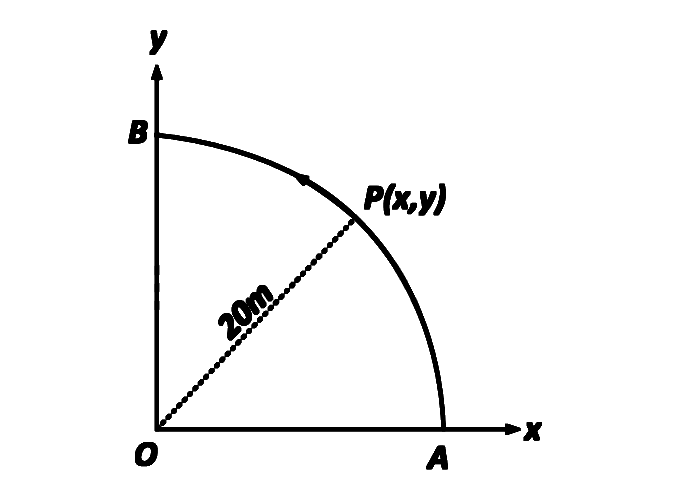
Answer: (d)
No questions match these filters.