
Matter Waves: de Broglie Wavelength · de Broglie wavelength, momentum & KE
Two particles A and B of masses and () have the same de-Broglie wavelength, then
Show answer and solution
Answer: (a)
Loading the solution…
Home›Practice Hub›Chapters›Dual Nature of Radiation and Matter›Matter Waves: de Broglie Wavelength
Dual Nature of Radiation and Matter PYQs · MHT CET · JEE Main · NEET
Matter Waves: de Broglie Wavelength · de Broglie wavelength, momentum & KE
Two particles A and B of masses and () have the same de-Broglie wavelength, then
Answer: (a)
Matter Waves: de Broglie Wavelength · de Broglie wavelength, momentum & KE
The de-Broglie wavelength of a particle
Answer: (c)
Matter Waves: de Broglie Wavelength · de Broglie wavelength, momentum & KE
The kinetic energy of a free electron increases to 3 times the previous K.E. The ratio of new de- Broglie wavelength to previous de-Broglie wavelength is
Answer: (a)
Matter Waves: de Broglie Wavelength · Comparing electron, proton & alpha
The ratio of de-Broglie wavelength of an -particle and proton accelerated from rest by the same potential is . The value of is
Answer: (b)
Matter Waves: de Broglie Wavelength · Comparing electron, proton & alpha
The proton and - particle are accelerated through same potential difference. Then the ratio of the de-Broglie wavelength of proton and - particle is (mass of -particle is times mass of proton, charge of -particle is times charge of proton)
Answer: (d)
Matter Waves: de Broglie Wavelength · de Broglie wavelength, momentum & KE
If the kinetic energy of a particle is increased to 16 times, the percentage change in the de Broglie wavelength of a particle is
Answer: (c)
Matter Waves: de Broglie Wavelength · de Broglie wavelength, momentum & KE
An electron is travelling with a velocity in free space and when it enters a medium, its velocity is reduced by . The de Broglie wavelength of electron in the medium is , where is its de Broglie wavelength in free space. The value of is ______.
Answer: (c)
Matter Waves: de Broglie Wavelength · Particle accelerated through a potential
An electron accelerated through a potential difference has a de-Broglie wavelength of . When the potential is changed to , its de-Broglie wavelength increases to . The value of is equal to
Answer: (d)
Matter Waves: de Broglie Wavelength · Particle accelerated through a potential
The de Broglie wavelength for an electron accelerated through the potential difference of volt is . When the potential difference is changed to volt, the associated de Broglie wavelength is increased by . If , then the value of is ______。
Numerical answer type. Work it out, then open the answer.
Answer: 4
Matter Waves: de Broglie Wavelength · Particle accelerated through a potential
A particle having electric charge and mass is accelerated by applying an electric potential of 1.21 V.
Wavelength of the matter wave associated with the particle is . The value of is ______. (Take Planck's constant )
Numerical answer type. Work it out, then open the answer.
Answer: 10
Matter Waves: de Broglie Wavelength · Comparing electron, proton & alpha
The ratio of the accelerating potentials required to accelerate (i) an -particle and (ii) a proton to have the same de Broglie wavelength associated with them is
(mass of - particle = kg, mass of proton = kg)
Answer: (a)
Matter Waves: de Broglie Wavelength · Comparing electron, proton & alpha
The de Broglie wavelength associated with an electron accelerated through a potential difference V is and the de Broglie wavelength associated with a proton accelerated through the same potential difference is . If their corresponding masses are and , respectively, then the ratio of their de Broglie wavelengths is ______.
Answer: (a)
Matter Waves: de Broglie Wavelength · Comparing electron, proton & alpha
The ratio of de Broglie wavelength of a deuteron with kinetic energy to that of an alpha particle with kinetic energy , is . The value of is ______.
(Assume mass of proton mass of neutron)
Numerical answer type. Work it out, then open the answer.
Answer: 2
Matter Waves: de Broglie Wavelength · Thermal neutrons & gas molecules
The ratio of de-Broglie wavelengths of molecules of hydrogen and helium which are at temperatures and respectively is ()
Answer: (b)
Matter Waves: de Broglie Wavelength · Thermal neutrons & gas molecules
The de Broglie wavelength of an oxygen molecule at is . The value of is (take Planck's constant , Boltzmann constant , mass of oxygen molecule )
Answer: (d)
Matter Waves: de Broglie Wavelength · Photon vs electron
The wavelength '' of photon and the de-Broglie wavelength of an electron have same value. The ratio of kinetic energy of electron to the energy of a photon is (m=mass of electron, h = Planck's constant, c = velocity of light)
Answer: (a)
Matter Waves: de Broglie Wavelength · Photon vs electron
The energy of a photon is equal to the kinetic energy of a proton. If is the de-Broglie wavelength of a proton, is the wavelength associated with the photon and if the energy of the photon is then is proportional to
Answer: (b)
Matter Waves: de Broglie Wavelength · Photon vs electron
An electromagnetic wave of wavelength is incident on a photosensitive surface of negligible work function. If the photoelectrons emitted from this surface have de-Broglie wavelength , then
Answer: (b)
Matter Waves: de Broglie Wavelength · Photon vs electron
According to de-Broglie hypothesis, the ratio of the wave-length of a photon and that of an electron having same energy 'E' is (m = mass of electron, c = velocity of light)
Answer: (c)
Matter Waves: de Broglie Wavelength · Photon vs electron
A photon and an electron have equal energy E. The ratio of (electron) to (photon) is proportional to
Answer: (b)
Matter Waves: de Broglie Wavelength · Photon vs electron
A photon and an electron, each of 20 eV energy, move in free space. The ratio of linear momentum of electron to that of photon is:
[Take speed of light , charge of electron and mass of electron ]
Answer: (d)
Matter Waves: de Broglie Wavelength · de Broglie wavelength in electric & magnetic fields
An electron is moving with initial velocity in a magnetic field . Its de-Broglie wavelength will
Answer: (d)
Matter Waves: de Broglie Wavelength · de Broglie wavelength in electric & magnetic fields
An electron is moving with initial velocity in a magnetic field . Its de-Broglie wavelength will
Answer: (c)
Matter Waves: de Broglie Wavelength · Photon vs electron
A photoemissive substance is illuminated with a radiation of wavelength so that it releases electrons with de-Broglie wavelength . The longest wavelength of radiation that can emit photoelectron is . Expression for de-Broglie wavelength is (m = mass of electron, h = Planck's constant, C = Speed of light)
Answer: (c)
Matter Waves: de Broglie Wavelength · Photon vs electron
Light of wavelength '' which is less than threshold wavelength is incident on a photosensitive material. If incident wavelength is decreased so that emitted photoelectrons are moving with some velocity then stopping potential
Answer: (b)
Matter Waves: de Broglie Wavelength · de Broglie wavelength in electric & magnetic fields
An electron of mass and charge initially at rest gets accelerated by a constant electric field . The rate of change of de-Broglie wavelength of the electron at time is
( = Planck's constant)
Answer: (a)
Matter Waves: de Broglie Wavelength · de Broglie wavelength in electric & magnetic fields
An electron of mass is moving in an electric field constant , with an initial velocity constant . If , its de Broglie wavelength at time is ______.
( charge of electron)
Answer: (c)
Matter Waves: de Broglie Wavelength · de Broglie wavelength, momentum & KE
The de-Broglie wavelength of a particle
Answer: (a)
Matter Waves: de Broglie Wavelength · de Broglie wavelength, momentum & KE
If and are de Broglie wavelength and kinetic energy, respectively, of a particle with constant mass. The correct graphical representation for the particle will be:
Answer: (d)
Matter Waves: de Broglie Wavelength · Particle accelerated through a potential
Electron beam when accelerated by a voltage of 10 kV, has a de-Broglie wavelength ' '. If the voltage is increased to 20 kV then the deBroglie wavelength associated with the electron beam would be
Answer: (d)
Matter Waves: de Broglie Wavelength · Particle accelerated through a potential
An electron accelerated by a potential difference ' ' has de-Broglie wavelength ' '. If the electron is accelerated by a potential difference ' 9 V ', its de-Broglie wavelength will be
Answer: (b)
Matter Waves: de Broglie Wavelength · de Broglie wavelength, momentum & KE
The energy that should be added to an electron to reduce its de-Broglie wavelength from to is times the initial energy. The value of ' ' is
Answer: (b)
Matter Waves: de Broglie Wavelength · de Broglie wavelength, momentum & KE
A sub-atomic particle of mass is moving with a velocity . Under the matter wave consideration, the particle will behave closely like
Answer: (a)
Matter Waves: de Broglie Wavelength · Thermal neutrons & gas molecules
The de-Broglie wavelength of a neutron at is ' '. What will be its wavelength at ?
Answer: (c)
Matter Waves: de Broglie Wavelength · Photon vs electron
The wavelength ' ' of a photon and the deBroglie wavelength of an electron have same value. The ratio of kinetic energy of the electron to the energy of a photon is
( mass of electron, velocity of light, Planck's constant)
Answer: (c)
Matter Waves: de Broglie Wavelength · Photon vs electron
A light of wavelength is incident on a photosensitive surface of negligible work function. The photoelectrons emitted from the surface have de-Broglie wavelength . Then ratio is ( Planck's constant, velocity of light, mass of electron)
Answer: (c)
Matter Waves: de Broglie Wavelength · Photon vs electron
A photon and an electron (mass ) have the same energy . The ratio ( photon electron) of their de Broglie wavelengths is: ( is the speed of light)
Answer: (a)
Matter Waves: de Broglie Wavelength · Photon vs electron
A proton of mass ' ' has same energy ' ' as that of a photon of wavelength ' '. If the proton is moving at non-relativistic speed, then ratio of its de Broglie wavelength to the wavelength of photon is.
Answer: (d)
Matter Waves: de Broglie Wavelength · de Broglie wavelength in electric & magnetic fields
An electron of mass ' m ' with an initial velocity enters an electric field . If the initial de Broglie wavelength is , the value after time t would be
Answer: (c)
Matter Waves: de Broglie Wavelength · de Broglie waves & Bohr orbits
When the electron orbiting in hydrogen atom goes from one orbit to another orbit (principal quantum number ), the de-Broglie wavelength ( ) associated with it is related to as
Answer: (d)
Matter Waves: de Broglie Wavelength · de Broglie waves & Bohr orbits
De-Broglie wavelength of an electron orbiting in the state of hydrogen atom is close to (Given Bohr radius )
Answer: (d)
Matter Waves: de Broglie Wavelength · de Broglie waves & Bohr orbits
An electron in the ground state of the hydrogen atom has the orbital radius of while that for the electron in third excited state is . The ratio of the de Broglie wavelengths of electron in the ground state to that in the excited state is
Answer: (a)
Matter Waves: de Broglie Wavelength · Photon vs electron
Let and represents kinetic energy of electron and photon respectively. If de-Broglie wavelength of a photon is twice the de-Broglie wavelength of an electron then is (speed of electron where C is the velocity of light)
Answer: (b)
Matter Waves: de Broglie Wavelength · Photon vs electron
A photoemissive substance is illuminated with a radiation of wavelength so that it releases electrons with de-Broglie wavelength . The longest wavelength of radiation that can emit photoelectron is . Expression for de-Broglie wavelength is given by:
(m: mass of the electron, h: Planck's constant and c: speed of light)
Answer: (c)
Matter Waves: de Broglie Wavelength · de Broglie wavelength in electric & magnetic fields
An electron of mass ' ' and charge ' ' initially at rest gets accelerated by a constant electric field ' E '. The rate of change of de-Broglie wavelength of the electron at time ' ' is
(Ignore relativistic effect)( Planck's constant)
Answer: (a)
Matter Waves: de Broglie Wavelength · de Broglie wavelength in electric & magnetic fields
An electron with mass ' m ' with an initial velocity enters a magnetic field . If the initial de-Broglie wavelength at is then its value after time ' t ' would be:
Answer: (b)
Matter Waves: de Broglie Wavelength · de Broglie wavelength in electric & magnetic fields
An electron is released from rest near an infinite non-conducting sheet of uniform charge density ''. The rate of change of de-Broglie wave length associated with the electron varies inversely as nth power of time. The numerical value of n is _____.
Numerical answer type. Work it out, then open the answer.
Answer: 2
Matter Waves: de Broglie Wavelength · de Broglie wavelength, momentum & KE
The kinetic energy of an electron is increased by 2 times, then the de-Broglie wavelength associated with it changes by a factor.
Answer: (b)
Matter Waves: de Broglie Wavelength · de Broglie wavelength, momentum & KE
The graph which shows the variation of and its kinetic energy, is (where is de Broglie wavelength of a free particle):
Answer: (d)
Matter Waves: de Broglie Wavelength · Particle accelerated through a potential
Electrons are accelerated through a potential difference of 16 kV. If the potential difference is increased to 64 kV, then de-Broglie wavelength associated with electron will
Answer: (b)
Matter Waves: de Broglie Wavelength · Particle accelerated through a potential
If the potential difference used to accelerate electrons is doubled. By what factor does the deBroglie wavelength associated with the electrons change?
Answer: (c)
Matter Waves: de Broglie Wavelength · Particle accelerated through a potential
If the potential difference used to accelerate electrons is increased four times, by what factor does the de-Broglie wavelength associated with the electrons change?
Answer: (b)
Matter Waves: de Broglie Wavelength · Comparing electron, proton & alpha
An electron and an alpha particle are accelerated by the same potential difference. Let and denote the de-Broglie wavelengths of the electron and the alpha particle, respectively, then:
Answer: (a)
Matter Waves: de Broglie Wavelength · Comparing electron, proton & alpha
A proton, an electron and an alpha particle have the same energies. Their de-Broglie wavelengths will be compared as:
Answer: (b)
Matter Waves: de Broglie Wavelength · Comparing electron, proton & alpha
A proton and an electron have the same de Broglie wavelength. If and be the kinetic energies of proton and electron respectively, then choose the correct relation:
Answer: (c)
Matter Waves: de Broglie Wavelength · Comparing electron, proton & alpha
The de Broglie wavelengths of a proton and an particle are and respectively. The ratio of the velocities of proton and particle will be:
Answer: (a)
Matter Waves: de Broglie Wavelength · Comparing electron, proton & alpha
A proton and an electron are associated with same de-Broglie wavelength. The ratio of their kinetic energies is:
(Assume h = 6.63 and times )
Answer: (c)
Matter Waves: de Broglie Wavelength · Photon vs electron
Kinetic energy of a proton is equal to energy of a photon. Let ' ' be the de-Broglie wavelength of proton and ' ' be the wavelength of photon. If then the value of ' ' is
Answer: (d)
Matter Waves: de Broglie Wavelength · Photon vs electron
The ratio of the wavelength of a photon of energy ' ' to that of the electron of same energy is ( mass of an electron, speed of light, Planck's constant)
Answer: (d)
Matter Waves: de Broglie Wavelength · Photon vs electron
The de-Broglie wavelength of an electron is the same as that of a photon. If velocity of electron is of the velocity of light, then the ratio of K.E. of electron and K.E. of photon will be:
Answer: (c)
Matter Waves: de Broglie Wavelength · de Broglie waves & Bohr orbits
When the electron orbiting in hydrogen atom in its ground state moves to the third excited state, the de-Broglie wavelength associated with it
Answer: (d)
Matter Waves: de Broglie Wavelength · de Broglie wavelength, momentum & KE
The de-Broglie wavelength of a particle is related to its kinetic energy (E) as
Answer: (d)
Matter Waves: de Broglie Wavelength · de Broglie wavelength, momentum & KE
The de Broglie wavelength of an electron having kinetic energy is . If the kinetic energy of electron becomes , then its de-Broglie wavelength will be:
Answer: (b)
Matter Waves: de Broglie Wavelength · Particle accelerated through a potential
When an electron is accelerated through a potential '', the de-Broglie wavelength associated with it is ''. When the accelerating potential is increased to , its wavelength will be
Answer: (d)
Matter Waves: de Broglie Wavelength · Particle accelerated through a potential
If the potential difference used to accelerate electrons is doubled, by what factor does the de- Broglie wavelength associated with electrons change?
Answer: (c)
Matter Waves: de Broglie Wavelength · Particle accelerated through a potential
The de Broglie wavelength associated with an electron, accelerated by a potential difference of 81 V is given by:
Answer: (d)
Matter Waves: de Broglie Wavelength · Particle accelerated through a potential
Electron beam used in an electron microscope, when accelerated by a voltage of 20 kV, has a de- Broglie wavelength of . IF the voltage is increased to 40 kV, then the de-Broglie wavelength associated with the electron beam would be:
Answer: (c)
Matter Waves: de Broglie Wavelength · Comparing electron, proton & alpha
Proton and electron (e) will have same de-Broglie wavelength when the ratio of their momentum is (assume, ):
Answer: (a)
Matter Waves: de Broglie Wavelength · Comparing electron, proton & alpha
The ratio of de-Broglie wavelength of an particle and a proton accelerated from rest by the same potential is , the value of m is -
Answer: (c)
Matter Waves: de Broglie Wavelength · Comparing electron, proton & alpha
An -particle, a proton and an electron have the same kinetic energy. Which one of the following is correct in case of their de-Broglie wavelength:
Answer: (d)
Matter Waves: de Broglie Wavelength · Thermal neutrons & gas molecules
The de Broglie wavelength of a molecule in a gas at room temperature (300 K) is . If the temperature of the gas is increased to 600 K, then the de Broglie wavelength of the same gas molecule becomes
Answer: (c)
Matter Waves: de Broglie Wavelength · Particle accelerated through a potential
Graph shows the variation of de-Broglie wavelength versus where '' is the accelerating potential for four particles A, B, C, D carrying same charge but of masses . Which on represents a particle of largest mass?
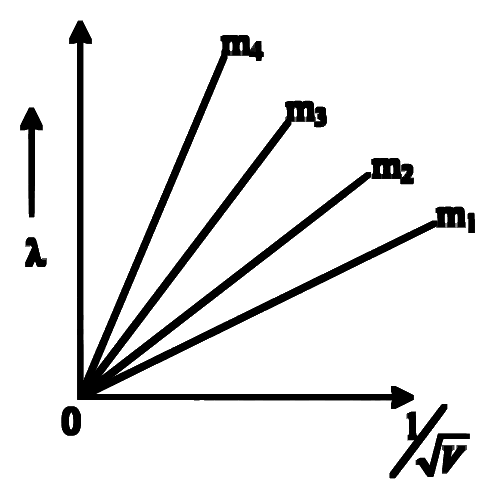
Answer: (a)
Matter Waves: de Broglie Wavelength · Particle accelerated through a potential
An electron accelerated through a potential difference ' ' has a de-Broglie wavelength ''. When the potential is changed to '' its de-Broglie wavelength increases by . The value of is
Answer: (b)
Matter Waves: de Broglie Wavelength · Particle accelerated through a potential
An electron accelerated through a potential difference has a de-Broglie wavelength of . When the potential is changed to , its de-Broglie wavelength increases by . The value of is equal to
Answer: (d)
Matter Waves: de Broglie Wavelength · Comparing electron, proton & alpha
A proton and an -particle are accelerated from rest by and potentials, respectively. The ratio of their de-Broglie wavelength is:
Answer: (a)
Matter Waves: de Broglie Wavelength · Comparing electron, proton & alpha
The ratio of the de-Broglie wavelengths of proton and electron having same Kinetic energy: (Assume )
Answer: (a)
Matter Waves: de Broglie Wavelength · Comparing electron, proton & alpha
The kinetic energy of an electron, -particle and a proton are given as and respectively. The de-Broglie wavelength associated with electron -particle and the proton are as follows:
Answer: (a)
Matter Waves: de Broglie Wavelength · Comparing electron, proton & alpha
A proton moving with one tenth of velocity of light has a certain de Broglie wavelength of . An alpha particle having certain kinetic energy has the same de-Broglie wavelength . The ratio of kinetic energy of proton and that of alpha particle is:
Answer: (c)
Matter Waves: de Broglie Wavelength · de Broglie wavelength, momentum & KE
If the kinetic energy of a free electron doubles, it's de Broglie wavelength () changes by a factor
Answer: (a)
Matter Waves: de Broglie Wavelength · de Broglie wavelength, momentum & KE
The equation can be used to find the de-Brogli wavelength of an electron. In this equation stands for:
Where
mass of electron
momentum of electron
Kinetic energy of electron
Accelerating potential in volts for electron
Answer: (d)
Matter Waves: de Broglie Wavelength · Particle accelerated through a potential
The de Broglie wavelength associated with an electron, accelerated through a potential difference of , is:
Answer: (a)
Matter Waves: de Broglie Wavelength · Comparing electron, proton & alpha
An particle and a proton are accelerated from rest through the same potential difference. The ratio of linear momenta acquired by above two particles will be:
Answer: (b)
Matter Waves: de Broglie Wavelength · Comparing electron, proton & alpha
An particle and a carbon 12 atom has same kinetic energy K. The ratio of their de-Broglie wavelengths is:
Answer: (b)
Matter Waves: de Broglie Wavelength · Comparing electron, proton & alpha
A proton, a neutron, an electron and an particle have same energy. If p, n, e and are the de Broglie's wavelengths of proton, neutron, electron and particle respectively, then choose the correct relation from the following:
Answer: (b)
Matter Waves: de Broglie Wavelength · Comparing electron, proton & alpha
The ratio of wavelengths of proton and deuteron accelerated by potential Vp and Vd is 1: . Then the ratio of Vp to Vd will be:
Answer: (d)
Matter Waves: de Broglie Wavelength · Photon vs electron
The de Broglie wavelengths for an electron and a photon are e and p respectively. For the same kinetic energy of electron and photon, which of the following presents the correct relation between the de Broglie wavelengths of two?
Answer: (a)
Matter Waves: de Broglie Wavelength · Photon vs electron
An electron with speed v and a photon with speed c have the same de-Broglie wavelength. If the kinetic energy and momentum of electron are Ee and pe and that of photon are Eph and pph respectively. Which of the following is correct?
Answer: (b)
Matter Waves: de Broglie Wavelength · de Broglie wavelength in electric & magnetic fields
An electron (mass ) with an initial velocity is moving in an electric field where is constant. If at de Broglie wavelength is , then its de Broglie wavelength after time t is given by
Answer: (d)
Matter Waves: de Broglie Wavelength · de Broglie wavelength, momentum & KE
The de-Broglie wavelength of a particle having kinetic energy E is . How much extra energy must be given to this particle so that the de-Broglie wavelength reduces to 75% of the initial value?
Answer: (b)
Matter Waves: de Broglie Wavelength · Particle accelerated through a potential
de-Broglie wavelength associated with an electron accelerated through a potential difference '' is ''. When the accelerating potential is increased to '', de-Broglie wavelength.
Answer: (a)
Matter Waves: de Broglie Wavelength · Comparing electron, proton & alpha
A proton and alpha particle are accelerated through the same potential difference. The ratio of the de-Broglie wavelength of proton to that of alpha particle will be (mass of alpha particle is four times mass of proton.)
Answer: (b)
Matter Waves: de Broglie Wavelength · Comparing electron, proton & alpha
A moving proton and electron have the same de-Broglie wavelength. If K and P denote the K.E. and momentum respectively. Then choose the correct option:
Answer: (a)
Matter Waves: de Broglie Wavelength · Comparing electron, proton & alpha
What should be the order of arrangement of de-Broglie wavelength of electron (e), an -particle (a) and proton (p) given that all have the same kinetic energy?
Answer: (c)
Matter Waves: de Broglie Wavelength · Comparing electron, proton & alpha
An electron of mass me and a proton of mass mp are accelerated through the same potential difference. The ratio of the de-Broglie wavelength associated with the electron to that with the proton is
Answer: (d)
Matter Waves: de Broglie Wavelength · Comparing electron, proton & alpha
The de-Broglie wavelength associated with an electron and a proton were calculated by accelerating them through same potential of 100 V. What should nearly be the ratio of their wavelengths? (mp = 1.00727u me = 0.00055u)
Answer: (d)
Matter Waves: de Broglie Wavelength · Comparing electron, proton & alpha
An electron of mass me and a proton of mass mp = 1836 me are moving with the same speed. The ratio of their de Broglie wavelength will be:
Answer: (b)
Matter Waves: de Broglie Wavelength · Comparing electron, proton & alpha
The de-Broglie wavelength of a proton and -particle are equal. The ratio of their velocities is:
Answer: (c)
Matter Waves: de Broglie Wavelength · de Broglie wavelength, momentum & KE
What is the additional energy that should be supplied to a moving electron to reduce its de Broglie wavelength from to ?
Answer: (d)
Matter Waves: de Broglie Wavelength · de Broglie wavelength, momentum & KE
A particle is travelling 4 time as fast as an electron. Assuming the ratio of de-Broglie wavelength of a particle to that of electron is 2: 1, the mass of the particle is:
Answer: (d)
Matter Waves: de Broglie Wavelength · Comparing electron, proton & alpha
According to de-Broglie hypothesis if an electron of mass '' is accelerated by potential difference '', the associated wavelength is ''. When a proton of mass '' is accelerated through potential difference , then the wavelength associated with it is
Answer: (a)
Matter Waves: de Broglie Wavelength · Comparing electron, proton & alpha
An particle and a proton are accelerated from rest by a potential difference of 200V. After this, their de Broglie wavelengths are and p respectively. The ratio is:
Answer: (b)
Matter Waves: de Broglie Wavelength · Thermal neutrons & gas molecules
The temperature of an ideal gas in 3-dimensions is 300 K. The corresponding de-Broglie wavelength of the electron approximately at 300 K, is:
[me = mass of electron = 9 1031 kg, h = Planck constant = 6.6 1034 Js, kB = Boltzmann constant = 1.38 1023 JK]
Answer: (a)
Matter Waves: de Broglie Wavelength · Photon vs electron
An electron of mass '' and a photon have same energy ''. The ratio of de-Broglie wavelength of electron to the wavelength of photon is velocity of light)
Answer: (c)
Matter Waves: de Broglie Wavelength · Photon vs electron
Kinetic energy of a proton is equal to energy '' of a photon. Let '' be the de-Broglie wavelength of proton and '' is the wavelength of photon. If , then the value of '' is
Answer: (a)
Matter Waves: de Broglie Wavelength · Photon vs electron
An electromagnetic wave of wavelength '' is incident on a photosensitive surface of negligible work function. If 'm' mass is of photoelectron emitted from the surface has de-Broglie wavelength d, then:
Answer: (d)
Matter Waves: de Broglie Wavelength · Photon vs electron
An electron moving with speed v and a photon moving with speed c, have same de-Broglie wavelength. The ratio of kinetic energy of electron to that of photon is:
Answer: (c)
Matter Waves: de Broglie Wavelength · Photon vs electron
An electron of mass m and a photon have same energy E. The ratio of wavelength of electron to that of photon is: (c being the velocity of light)
Answer: (b)
Matter Waves: de Broglie Wavelength · Photon vs electron
A particle of mass 9.1 1031 kg travels in a medium with a speed of 106 m/s and a photon of a radiation of linear momentum 1027 kg m/s travels in vacuum. The wavelength of photon is __________ times the wavelength of the particle.
Numerical answer type. Work it out, then open the answer.
Answer: 910
Matter Waves: de Broglie Wavelength · Collisions, decay & fission
A particle of mass 4M at rest disintegrates into two particles of mass M and 3M respectively having non zero velocities. The ratio of de-Broglie wavelength of particle of mass M to that of mass 3M will be:
Answer: (d)
Matter Waves: de Broglie Wavelength · de Broglie wavelength, momentum & KE
The de Broglie wavelength of an electron moving with kinetic energy of 144 eV is nearly
Answer: (b)
Matter Waves: de Broglie Wavelength · de Broglie wavelength, momentum & KE
A particle moving with kinetic energy E has de Broglie wavelength . If energy E is added to its energy, the wavelength become /2. Value of E, is:
Answer: (b)
Matter Waves: de Broglie Wavelength · Particle accelerated through a potential
An electron is accelerated from rest through a potential difference of V volt. If the de-Broglie wavelength of the electron is 1.227 10-2 nm, the potential difference is:
Answer: (c)
Matter Waves: de Broglie Wavelength · Comparing electron, proton & alpha
An electron, a doubly ionized helium ion (He++) and a proton are having the same kinetic energy. The relation between their respective de-Broglie wavelengths e, He++ and p is:
Answer: (c)
Matter Waves: de Broglie Wavelength · de Broglie wavelength, momentum & KE
A particle is moving 5 times as fast as an electron. The ratio of the de-Broglie wavelength of the particle to that of the electron is 1.878 10–4. The mass of the particle is close to
Answer: (d)
Matter Waves: de Broglie Wavelength · Thermal neutrons & gas molecules
Assuming the nitrogen molecule is moving with r.m.s. velocity at 400 K, the de-Broglie wavelength of nitrogen molecule is close to:
(Given: nitrogen molecule weight: 4.64 10–26 kg,
Boltzmann constant: 1.38 10–23 J/K,
Planck constant: 6.63 10–34 J.s)
Answer: (d)
Matter Waves: de Broglie Wavelength · Photon vs electron
An electron (of mass m) and a photon have the same energy E in the range of a few eV. The ratio of the de-Broglie wavelength associated with the electron and the wavelength of the photon is (c = speed of light in vaccuum)
Answer: (b)
Matter Waves: de Broglie Wavelength · de Broglie wavelength in electric & magnetic fields
An electron (mass m) with initial velocity is in an electric field . If is initial de-Broglie wavelength of electron, its de-Broglie wave length at time t is given by:
Answer: (c)
Matter Waves: de Broglie Wavelength · de Broglie wavelength in electric & magnetic fields
An electron of mass m and magnitude of charge |e| initially at rest gets accelerated by a constant electric field E. The rate of change of de-Broglie wavelength of this electron at time t ignoring relativistic effects is:
Answer: (c)
Matter Waves: de Broglie Wavelength · Collisions, decay & fission
Particle A of mass mA = moving along the x-axis with velocity v0 collides elastically with another particle B at rest having mass mB = . If both particles move along the x-axis after the collision, the change in de-Broglie wavlength of particle A, in terms of its de-Broglie wavelength (0) before collision is:
Answer: (d)
Matter Waves: de Broglie Wavelength · Particle accelerated through a potential
An electron is accelerated through a potential difference of 10,000 V. Its de Broglie wavelength is (nearly): (me = 9 10–31 kg)
Answer: (a)
Matter Waves: de Broglie Wavelength · Comparing electron, proton & alpha
A proton and an -particle are accelerated from rest to the same energy. The de Broglie wavelengths and are in the ratio,
Answer: (b)
Matter Waves: de Broglie Wavelength · Comparing electron, proton & alpha
A particle A of mass 'm' and charge 'q' is accelerated by a potential difference of 50 V. Another particle B of mass ' 4 m' and charge 'q' is accelerated by a potential difference of 2500 V. The ratio of de-Broglie wavelengths is close to:
Answer: (c)
Matter Waves: de Broglie Wavelength · Photon vs electron
If the de Broglie wavelength of an electron is equal to 10–3 times the wavelength of a photon of frequency 6 1014 Hz, then the speed of electron is equal to: (Speed of light = 3 108 m/s, Planck's constant = 6.63 10–34 J.s, Mass of electron = 9.1 10–31 kg)
Answer: (b)
Matter Waves: de Broglie Wavelength · Collisions, decay & fission
A particle 'P' is formed due to a completely inelastic collision of particles 'x' and 'y' having de-Broglie wavelengths 'x' and 'y' respectively. If x and y were moving in opposite directions, then the de- Broglie wavelength of 'P' is :-
Answer: (b)
Matter Waves: de Broglie Wavelength · Collisions, decay & fission
A nucleus A, with a finite de-broglie wavelength A, undergoes spontaneous fission into two nuclei B and C of equal mass. B flies in the same direction as that of A, while C flies in the opposite direction with a velocity equal to half of that of B. The de-Broglie wavelengths B and C of B and C are respectively:
Answer: (d)
Matter Waves: de Broglie Wavelength · Collisions, decay & fission
Two particles move at right angle to each other. Their de-Broglie wavelengths are and respectively. The particles suffer perfectly inelastic collision. The de-Broglie wavelength of the final particle, is given by:
Answer: (b)
Matter Waves: de Broglie Wavelength · Comparing electron, proton & alpha
If the de Broglie wavelengths associated with a proton and an -particle are equal, then the ratio of velocities of the proton and the -particle will be:
Answer: (a)
Matter Waves: de Broglie Wavelength · de Broglie wavelength in electric & magnetic fields
An electron of mass m with an initial velocity (v0 > 0) enters an electric field (E0 = constant > 0) at t = 0. If 0 is its de-Broglie wavelength initially, then its de- Broglie wavelength at time t is
Answer: (a)
Matter Waves: de Broglie Wavelength · de Broglie waves & Bohr orbits
The de-Broglie wavelength (B) associated with the electron orbiting in the second excited state of hydrogen atom is related to that in the ground state (G) by:
Answer: (b)
Matter Waves: de Broglie Wavelength · Collisions, decay & fission
Two electrons are moving with non-relativistic speed perpendicular to each other. If corresponding de Broglie wavelength are and their de Broglie wavelength in the frame of reference attached to their center of masses:
Answer: (b)
Matter Waves: de Broglie Wavelength · Thermal neutrons & gas molecules
The de-Broglie wavelength of a neutron in thermal equilibrium with heavy water at a temperature T (kelvin) and mass m, is
Answer: (a)
Matter Waves: de Broglie Wavelength · Collisions, decay & fission
A particle A of mass m and initial velocity v collides with a particle B of mass m/2 which is at rest. The collision is head on, and elastic. The ratio of the de-Broglie wavelengths to after the collision is:
Answer: (b)
Matter Waves: de Broglie Wavelength · Photon vs electron
An electron of mass m and a photon have same energy E. The ratio of de-Broglie wavelengths associated with them is
Answer: (c)
Matter Waves: de Broglie Wavelength · de Broglie wavelength, momentum & KE
Which of the following figures represent the variation of particle momentum and the associated de- Broglie wavelength?
Answer: (d)
Matter Waves: de Broglie Wavelength · Particle accelerated through a potential
de-Broglie wavelength of an electron accelerated by a voltage of 50 V is close to ( = 1.6 1019 C, me = 9.1 1031 kg, h = 6.6 1034 Js):
Answer: (c)
Matter Waves: de Broglie Wavelength · de Broglie wavelength, momentum & KE
For which of the following particles will it be most difficult to experimentally verify the de-Broglie relationship?
Answer: (d)
Matter Waves: de Broglie Wavelength · de Broglie wavelength, momentum & KE
If the kinetic energy of the particle is increased to 16 times its previous value, the percentage change in the de Broglie wavelength of the particle is
Answer: (b)
Matter Waves: de Broglie Wavelength · Comparing electron, proton & alpha
Electrons are accelerated through a potential difference V and protons are accelerated through a potential difference 4 V. The de-Broglie wavelengths are and for electrons and protons respectively. The ratio of is given by: (given is mass of electron and is mass of proton).
Answer: (d)
Matter Waves: de Broglie Wavelength · Thermal neutrons & gas molecules
The de-broglie wavelength of neutrons in thermal equilibrium at temperature T is
Answer: (d)
Matter Waves: de Broglie Wavelength · Photon vs electron
The wavelength e of an electron and p of a photon of same energy E are related by
Answer: (c)
Matter Waves: de Broglie Wavelength · de Broglie waves & Bohr orbits
Orbits of a particle moving in a circle are such that the perimeter of the orbit equals an integer number of de-Broglie wavelengths of the particle. For a charged particle moving in a plane perpendicular to a magnetic field, the radius of the orbital will therefore be proportional to:
Answer: (c)
Matter Waves: de Broglie Wavelength · de Broglie wavelength, momentum & KE
If the momentum of an electron is changed by P, then the de Broglie wavelength associated with changes by 0.5%. The initial momentum of electron will be
Answer: (a)
Matter Waves: de Broglie Wavelength · de Broglie wavelength in electric & magnetic fields
An -particle moves in a circular path of radius 0.83 cm in the presence of a magnetic field of 0.25 Wb/m2. The de Broglie wavelength associated with the particle will be
Answer: (d)
Matter Waves: de Broglie Wavelength · Particle accelerated through a potential
Electrons used in an electron microscope are accelerated by a voltage of 25 kV. If the voltage is increased to 100 kV then the de-Broglie wavelength associated with the electrons would
Answer: (b)
Matter Waves: de Broglie Wavelength · de Broglie wavelength, momentum & KE
A particle of mass 1 mg has the same wavelength as an electron moving with a velocity of 3 106 m s. The velocity of the particle is
Answer: (c)
Matter Waves: de Broglie Wavelength · de Broglie wavelength, momentum & KE
If the kinetic energy of a free electron doubles, it's deBroglie wavelength changes by the factor
Answer: (d)
Matter Waves: de Broglie Wavelength · Comparing electron, proton & alpha
If particles are moving with same velocity, then which has maximum de Broglie wavelength?
Answer: (d)
Matter Waves: de Broglie Wavelength · de Broglie wavelength, momentum & KE
An electron beam has a kinetic energy equal to 100 eV. Find its wavelength associated with a beam, if mass of electron = kg and 1 eV = J/eV.
(Planck's constant = Js)
Answer: (c)
Matter Waves: de Broglie Wavelength · Photon vs electron
If we consider electrons and photons of same wavelength, then they will have same
Answer: (a)
Matter Waves: de Broglie Wavelength · Comparing electron, proton & alpha
An electron of mass , when accelerated through a potential difference , has de Broglie wavelength . The de Broglie wavelength associated with a proton of mass accelerated through the same potential difference, will be
Answer: (d)
Matter Waves: de Broglie Wavelength · de Broglie wavelength, momentum & KE
The de Broglie wave corresponding to a particle of mass and velocity has a wavelength associated with it
Answer: (a)
No questions match these filters.