Q1 JEE Main 2026 · 2 APR · SHIFT 2 Easy ☆
Nature of EM Waves & Wave Equation · Field values: E0 = cB0
An electromagnetic wave travels in free space along the x-direction. At a particular point in space and time, B ⃗ = 2 × 1 0 − 7 j ^ \vec{B} = 2\times 10^{-7}\hat{j} B = 2 × 1 0 − 7 j ^ E ⃗ \vec{E} E
(a) 60 k ^ 60\,\hat{k} 60 k ^ (b) − 60 k ^ -60\,\hat{k} − 60 k ^ (c) 30 k ^ 30\,\hat{k} 30 k ^ (d) − 600 k ^ -600\,\hat{k} − 600 k ^ Show answer and solution
Answer: (b)
Loading the solution…
Report a mistake Q2 JEE Main 2026 · 6 APR · SHIFT 2 Medium ☆
Nature of EM Waves & Wave Equation · Direction of E, B and propagation
For an electromagnetic wave propagating through vacuum, k ⃗ , E ⃗ \vec{k}, \vec{E} k , E ω \omega ω
(a) E ⃗ × k ⃗ ω \frac{\vec{E}\times\vec{k}}{\omega} ω E × k (b) k ⃗ × E ⃗ ω \frac{\vec{k}\times\vec{E}}{\omega} ω k × E (c) ω ( E ⃗ × k ⃗ ) \omega(\vec{E}\times\vec{k}) ω ( E × k ) (d) ω ( k ⃗ × E ⃗ ) \omega(\vec{k}\times\vec{E}) ω ( k × E ) Show answer and solution
Answer: (b)
Loading the solution…
Report a mistake Q3 JEE Main 2026 · 4 APR · SHIFT 2 Medium ☆
Nature of EM Waves & Wave Equation · Writing B from E and E from B
A magnetic field vector in an electromagnetic wave is represented by B ⃗ = B 0 sin ( 2 π ν t − 2 π x λ ) j ^ \vec{B} = B_0\sin\left(2\pi\nu t - \frac{2\pi x}{\lambda}\right)\hat{j} B = B 0 sin ( 2 π ν t − λ 2 π x ) j ^ ______ .
(a) E ⃗ = − ν λ B 0 sin ( 2 π ν t − 2 π x λ ) k ^ \vec{E} = -\nu\lambda B_0\sin\left(2\pi\nu t - \frac{2\pi x}{\lambda}\right)\hat{k} E = − ν λ B 0 sin ( 2 π ν t − λ 2 π x ) k ^ (b) E ⃗ = − ν λ B 0 sin ( 2 π ν t − 2 π x λ ) i ^ \vec{E} = -\nu\lambda B_0\sin\left(2\pi\nu t - \frac{2\pi x}{\lambda}\right)\hat{i} E = − ν λ B 0 sin ( 2 π ν t − λ 2 π x ) i ^ (c) E ⃗ = ν λ B 0 sin ( 2 π ν t − 2 π x λ ) k ^ \vec{E} = \nu\lambda B_0\sin\left(2\pi\nu t - \frac{2\pi x}{\lambda}\right)\hat{k} E = ν λ B 0 sin ( 2 π ν t − λ 2 π x ) k ^ (d) E ⃗ = ν λ B 0 sin ( 2 π ν t − 2 π x λ ) i ^ \vec{E} = \nu\lambda B_0\sin\left(2\pi\nu t - \frac{2\pi x}{\lambda}\right)\hat{i} E = ν λ B 0 sin ( 2 π ν t − λ 2 π x ) i ^ Show answer and solution
Answer: (a)
Loading the solution…
Report a mistake Q4 JEE Main 2026 · 28 JAN · SHIFT 2 Medium ☆
Nature of EM Waves & Wave Equation · Writing B from E and E from B
A plane electromagnetic wave is moving in free space with velocity c = 3 × 1 0 8 c = 3\times 10^{8} c = 3 × 1 0 8 E ⃗ = 54 sin ( k z − ω t ) j ^ \vec{E} = 54\sin(kz - \omega t)\,\hat{j} E = 54 sin ( k z − ω t ) j ^ j ^ \hat{j} j ^ B ⃗ \vec{B} B
(a) − 1.8 × 1 0 − 7 sin ( k z − ω t ) i ^ -1.8\times 10^{-7}\sin(kz - \omega t)\,\hat{i} − 1.8 × 1 0 − 7 sin ( k z − ω t ) i ^ (b) + 1.8 × 1 0 − 7 sin ( k z − ω t ) i ^ +1.8\times 10^{-7}\sin(kz - \omega t)\,\hat{i} + 1.8 × 1 0 − 7 sin ( k z − ω t ) i ^ (c) 1.4 × 1 0 − 7 sin ( k z − ω t ) k ^ 1.4\times 10^{-7}\sin(kz - \omega t)\,\hat{k} 1.4 × 1 0 − 7 sin ( k z − ω t ) k ^ (d) 1.4 × 1 0 − 7 sin ( k z − ω t ) i ^ 1.4\times 10^{-7}\sin(kz - \omega t)\,\hat{i} 1.4 × 1 0 − 7 sin ( k z − ω t ) i ^ Show answer and solution
Answer: (a)
Loading the solution…
Report a mistake Q5 JEE Main 2026 · 21 JAN · SHIFT 1 Medium ☆
Nature of EM Waves & Wave Equation · Writing B from E and E from B
The electric field in a plane electromagnetic wave is given by:
E y = 69 sin [ 0.6 × 1 0 3 x − 1.8 × 1 0 11 t ] V/m. E_y = 69\sin\left[0.6\times 10^{3}x - 1.8\times 10^{11}t\right]\text{ V/m.} E y = 69 sin [ 0.6 × 1 0 3 x − 1.8 × 1 0 11 t ] V/m.
The expression for magnetic field associated with this electromagnetic wave is ______ T.
(a) B z = 2.3 × 1 0 − 7 sin [ 0.6 × 1 0 3 x − 1.8 × 1 0 11 t ] B_z = 2.3\times 10^{-7}\sin\left[0.6\times 10^{3}x - 1.8\times 10^{11}t\right] B z = 2.3 × 1 0 − 7 sin [ 0.6 × 1 0 3 x − 1.8 × 1 0 11 t ] (b) B z = 2.3 × 1 0 − 7 sin [ 0.6 × 1 0 3 x + 1.8 × 1 0 11 t ] B_z = 2.3\times 10^{-7}\sin\left[0.6\times 10^{3}x + 1.8\times 10^{11}t\right] B z = 2.3 × 1 0 − 7 sin [ 0.6 × 1 0 3 x + 1.8 × 1 0 11 t ] (c) B y = 2.3 × 1 0 − 7 sin [ 0.6 × 1 0 3 x − 1.8 × 1 0 11 t ] B_y = 2.3\times 10^{-7}\sin\left[0.6\times 10^{3}x - 1.8\times 10^{11}t\right] B y = 2.3 × 1 0 − 7 sin [ 0.6 × 1 0 3 x − 1.8 × 1 0 11 t ] (d) B y = 69 sin [ 0.6 × 1 0 3 x + 1.8 × 1 0 11 t ] B_y = 69\sin\left[0.6\times 10^{3}x + 1.8\times 10^{11}t\right] B y = 69 sin [ 0.6 × 1 0 3 x + 1.8 × 1 0 11 t ] Show answer and solution
Answer: (a)
Loading the solution…
Report a mistake Q6 JEE Main 2026 · 2 APR · SHIFT 1 Medium ☆
Nature of EM Waves & Wave Equation · Force on a charge
An electromagnetic wave travelling in x-direction is described by field equation
E y = 300 sin ω ( t − x c ) E_y = 300 \sin \omega \left(t - \frac{x}{c}\right) E y = 300 sin ω ( t − c x )
If the electron is restricted to move in y-direction only with speed of 1.5 × 1 0 6 1.5 \times 10^{6} 1.5 × 1 0 6
Show answer and solution
Answer: (a)
Loading the solution…
Report a mistake Q7 JEE Main 2025 · 29 JAN · SHIFT 2 Easy ☆
Nature of EM Waves & Wave Equation · Direction of E, B and propagation
A plane electromagnetic wave propagates along the + x direction in free space. The components of the electric field, E ⃗ \vec{E} E B ⃗ \vec{B} B
(a) E x , B y E_x, B_y E x , B y (b) E y , B x E_y, B_x E y , B x (c) E y , B z E_y, B_z E y , B z (d) E z , B y E_z, B_y E z , B y Show answer and solution
Answer: (c)
Loading the solution…
Report a mistake Q8 NEET 2025 Easy ☆
Nature of EM Waves & Wave Equation · Writing B from E and E from B
The electric field in a plane electromagnetic wave is given by E z = 60 cos ( 5 x + 1.5 × 1 0 9 t ) V/m E_z = 60\cos\left(5x + 1.5\times 10^{9}t\right)\text{ V/m} E z = 60 cos ( 5 x + 1.5 × 1 0 9 t ) V/m
(a) B z = 60 cos ( 5 x + 1.5 × 1 0 9 t ) T B_z = 60\cos\left(5x + 1.5\times 10^{9}t\right)\text{ T} B z = 60 cos ( 5 x + 1.5 × 1 0 9 t ) T (b) B y = 60 sin ( 5 x + 1.5 × 1 0 9 t ) T B_y = 60\sin\left(5x + 1.5\times 10^{9}t\right)\text{ T} B y = 60 sin ( 5 x + 1.5 × 1 0 9 t ) T (c) B y = 2 × 1 0 − 7 cos ( 5 x + 1.5 × 1 0 9 t ) T B_y = 2\times 10^{-7}\cos\left(5x + 1.5\times 10^{9}t\right)\text{ T} B y = 2 × 1 0 − 7 cos ( 5 x + 1.5 × 1 0 9 t ) T (d) B x = 2 × 1 0 − 7 cos ( 5 x + 1.5 × 1 0 9 t ) T B_x = 2\times 10^{-7}\cos\left(5x + 1.5\times 10^{9}t\right)\text{ T} B x = 2 × 1 0 − 7 cos ( 5 x + 1.5 × 1 0 9 t ) T Show answer and solution
Answer: (c)
Loading the solution…
Report a mistake Q9 JEE Main 2025 · 23 JAN · SHIFT 2 Medium ☆
Nature of EM Waves & Wave Equation · Field values: E0 = cB0
A plane electromagnetic wave of frequency 20 MHz travels in free space along the + x +x + x E y = 9.3 V m − 1 E_y = 9.3\text{ V m}^{-1} E y = 9.3 V m − 1
(a) B z = 1.55 × 1 0 − 8 T B_z = 1.55\times 10^{-8}\text{ T} B z = 1.55 × 1 0 − 8 T (b) B z = 6.2 × 1 0 − 8 T B_z = 6.2\times 10^{-8}\text{ T} B z = 6.2 × 1 0 − 8 T (c) B z = 3.1 × 1 0 − 8 T B_z = 3.1\times 10^{-8}\text{ T} B z = 3.1 × 1 0 − 8 T (d) B z = 9.3 × 1 0 − 8 T B_z = 9.3\times 10^{-8}\text{ T} B z = 9.3 × 1 0 − 8 T Show answer and solution
Answer: (c)
Loading the solution…
Report a mistake Q10 JEE Main 2025 · 28 JAN · SHIFT 2 Medium ☆
Nature of EM Waves & Wave Equation · Writing B from E and E from B
The magnetic field of an E.M. wave is given by B ⃗ = ( 3 2 i ^ + 1 2 j ^ ) 30 sin [ ω ( t − z c ) ] \vec{B} = \left(\frac{\sqrt{3}}{2}\hat{i} + \frac{1}{2}\hat{j}\right)30\sin\left[\omega\left(t - \frac{z}{c}\right)\right] B = ( 2 3 i ^ + 2 1 j ^ ) 30 sin [ ω ( t − c z ) ]
(a) E ⃗ = ( 1 2 i ^ + 3 2 j ^ ) 30 c sin [ ω ( t + z c ) ] \vec{E} = \left(\frac{1}{2}\hat{i} + \frac{\sqrt{3}}{2}\hat{j}\right)30c\sin\left[\omega\left(t + \frac{z}{c}\right)\right] E = ( 2 1 i ^ + 2 3 j ^ ) 30 c sin [ ω ( t + c z ) ] (b) E ⃗ = ( 1 2 i ^ − 3 2 j ^ ) 30 c sin [ ω ( t − z c ) ] \vec{E} = \left(\frac{1}{2}\hat{i} - \frac{\sqrt{3}}{2}\hat{j}\right)30c\sin\left[\omega\left(t - \frac{z}{c}\right)\right] E = ( 2 1 i ^ − 2 3 j ^ ) 30 c sin [ ω ( t − c z ) ] (c) E ⃗ = ( 3 2 i ^ − 1 2 j ^ ) 30 c sin [ ω ( t + z c ) ] \vec{E} = \left(\frac{\sqrt{3}}{2}\hat{i} - \frac{1}{2}\hat{j}\right)30c\sin\left[\omega\left(t + \frac{z}{c}\right)\right] E = ( 2 3 i ^ − 2 1 j ^ ) 30 c sin [ ω ( t + c z ) ] (d) E ⃗ = ( 3 4 i ^ + 1 4 j ^ ) 30 c cos [ ω ( t − z c ) ] \vec{E} = \left(\frac{3}{4}\hat{i} + \frac{1}{4}\hat{j}\right)30c\cos\left[\omega\left(t - \frac{z}{c}\right)\right] E = ( 4 3 i ^ + 4 1 j ^ ) 30 c cos [ ω ( t − c z ) ] Show answer and solution
Answer: (b)
Loading the solution…
Report a mistake Q11 JEE Main 2025 · 23 JAN · SHIFT 1 Medium ☆
Nature of EM Waves & Wave Equation · Writing B from E and E from B
The electric field of an electromagnetic wave in free space is
E ⃗ = 57 cos [ 7.5 × 1 0 6 t − 5 × 1 0 − 3 ( 3 x + 4 y ) ] ( 4 i ^ − 3 j ^ ) N/C \vec{E} = 57\cos\left[7.5\times 10^{6}t - 5\times 10^{-3}(3x + 4y)\right](4\hat{i} - 3\hat{j})\text{ N/C} E = 57 cos [ 7.5 × 1 0 6 t − 5 × 1 0 − 3 ( 3 x + 4 y ) ] ( 4 i ^ − 3 j ^ ) N/C
(a) B ⃗ = 57 3 × 1 0 8 cos [ 7.5 × 1 0 6 t − 5 × 1 0 − 3 ( 3 x + 4 y ) ] ( k ^ ) \vec{B} = \frac{57}{3\times 10^{8}}\cos\left[7.5\times 10^{6}t - 5\times 10^{-3}(3x + 4y)\right](\hat{k}) B = 3 × 1 0 8 57 cos [ 7.5 × 1 0 6 t − 5 × 1 0 − 3 ( 3 x + 4 y ) ] ( k ^ ) (b) B ⃗ = 57 3 × 1 0 8 cos [ 7.5 × 1 0 6 t − 5 × 1 0 − 3 ( 3 x + 4 y ) ] ( 5 k ^ ) \vec{B} = \frac{57}{3\times 10^{8}}\cos\left[7.5\times 10^{6}t - 5\times 10^{-3}(3x + 4y)\right](5\hat{k}) B = 3 × 1 0 8 57 cos [ 7.5 × 1 0 6 t − 5 × 1 0 − 3 ( 3 x + 4 y ) ] ( 5 k ^ ) (c) B ⃗ = − 57 3 × 1 0 8 cos [ 7.5 × 1 0 6 t − 5 × 1 0 − 3 ( 3 x + 4 y ) ] ( k ^ ) \vec{B} = -\frac{57}{3\times 10^{8}}\cos\left[7.5\times 10^{6}t - 5\times 10^{-3}(3x + 4y)\right](\hat{k}) B = − 3 × 1 0 8 57 cos [ 7.5 × 1 0 6 t − 5 × 1 0 − 3 ( 3 x + 4 y ) ] ( k ^ ) (d) B ⃗ = − 57 3 × 1 0 8 cos [ 7.5 × 1 0 6 t − 5 × 1 0 − 3 ( 3 x + 4 y ) ] ( 5 k ^ ) \vec{B} = -\frac{57}{3\times 10^{8}}\cos\left[7.5\times 10^{6}t - 5\times 10^{-3}(3x + 4y)\right](5\hat{k}) B = − 3 × 1 0 8 57 cos [ 7.5 × 1 0 6 t − 5 × 1 0 − 3 ( 3 x + 4 y ) ] ( 5 k ^ ) Show answer and solution
Answer: (d)
Loading the solution…
Report a mistake Q12 NEET 2024 Easy ☆
Nature of EM Waves & Wave Equation · Nature of EM waves
The property which is not of an electromagnetic wave travelling in free space is that:
(a) They are transverse in nature (b) The energy density in electric field is equal to energy density in magnetic field (c) They travel with a speed equal to 1 μ 0 ε 0 \frac{1}{\sqrt{\mu_0\varepsilon_0}} μ 0 ε 0 1 (d) They originate from charges moving with uniform speed Show answer and solution
Answer: (d)
Loading the solution…
Report a mistake Q13 JEE Main 2024 · 1 FEB · SHIFT 2 Easy ☆
Nature of EM Waves & Wave Equation · Reading the wave equation
If frequency of electromagnetic wave is 60 MHz 60\text{ MHz} 60 MHz z z z m \text{m} m
Show answer and solution
Answer: (b)
Loading the solution…
Report a mistake Q14 JEE Main 2024 · 29 JAN · SHIFT 2 Easy ☆
Nature of EM Waves & Wave Equation · Field values: E0 = cB0
A plane electromagnetic wave of frequency 35 MHz 35\text{ MHz} 35 MHz x x x E ⃗ = 9.6 j ^ V/m \vec{E} = 9.6\hat{j}\text{ V/m} E = 9.6 j ^ V/m
(a) 9.6 j ^ T 9.6\hat{j}\text{ T} 9.6 j ^ T (b) 3.2 × 1 0 − 8 i ^ T 3.2\times 10^{-8}\hat{i}\text{ T} 3.2 × 1 0 − 8 i ^ T (c) 9.6 × 1 0 − 8 k ^ T 9.6\times 10^{-8}\hat{k}\text{ T} 9.6 × 1 0 − 8 k ^ T (d) 3.2 × 1 0 − 8 k ^ T 3.2\times 10^{-8}\hat{k}\text{ T} 3.2 × 1 0 − 8 k ^ T Show answer and solution
Answer: (d)
Loading the solution…
Report a mistake Q15 JEE Main 2024 · 9 APR · SHIFT 2 Medium ☆
Nature of EM Waves & Wave Equation · Writing B from E and E from B
The magnetic field in a plane electromagnetic wave is
B y = ( 3.5 × 1 0 − 7 ) sin ( 1.5 × 1 0 3 x + 0.5 × 1 0 11 t ) T B_y = \left(3.5\times 10^{-7}\right)\sin\left(1.5\times 10^{3}x + 0.5\times 10^{11}t\right)\text{ T} B y = ( 3.5 × 1 0 − 7 ) sin ( 1.5 × 1 0 3 x + 0.5 × 1 0 11 t ) T
(a) E z = 105 sin ( 1.5 × 1 0 3 x + 0.5 × 1 0 11 t ) V m − 1 E_z = 105\sin\left(1.5\times 10^{3}x + 0.5\times 10^{11}t\right)\text{ V m}^{-1} E z = 105 sin ( 1.5 × 1 0 3 x + 0.5 × 1 0 11 t ) V m − 1 (b) E y = 10.5 sin ( 1.5 × 1 0 3 x + 0.5 × 1 0 11 t ) V m − 1 E_y = 10.5\sin\left(1.5\times 10^{3}x + 0.5\times 10^{11}t\right)\text{ V m}^{-1} E y = 10.5 sin ( 1.5 × 1 0 3 x + 0.5 × 1 0 11 t ) V m − 1 (c) E y = 1.17 sin ( 1.5 × 1 0 3 x + 0.5 × 1 0 11 t ) V m − 1 E_y = 1.17\sin\left(1.5\times 10^{3}x + 0.5\times 10^{11}t\right)\text{ V m}^{-1} E y = 1.17 sin ( 1.5 × 1 0 3 x + 0.5 × 1 0 11 t ) V m − 1 (d) E z = 1.17 sin ( 1.5 × 1 0 3 x + 0.5 × 1 0 11 t ) V m − 1 E_z = 1.17\sin\left(1.5\times 10^{3}x + 0.5\times 10^{11}t\right)\text{ V m}^{-1} E z = 1.17 sin ( 1.5 × 1 0 3 x + 0.5 × 1 0 11 t ) V m − 1 Show answer and solution
Answer: (a)
Loading the solution…
Report a mistake Q16 JEE Main 2024 · 9 APR · SHIFT 1 Medium ☆
Nature of EM Waves & Wave Equation · Writing B from E and E from B
A plane EM wave is propagating along x x x 4 mm 4\text{ mm} 4 mm y y y 60 V m − 1 60\text{ V m}^{-1} 60 V m − 1
(a) B z = 2 × 1 0 − 7 sin [ π 2 ( x − 3 × 1 0 8 t ) ] k ^ T B_z = 2\times 10^{-7}\sin\left[\frac{\pi}{2}\left(x - 3\times 10^{8}t\right)\right]\hat{k}\text{ T} B z = 2 × 1 0 − 7 sin [ 2 π ( x − 3 × 1 0 8 t ) ] k ^ T (b) B z = 2 × 1 0 − 7 sin [ π 2 × 1 0 3 ( x − 3 × 1 0 8 t ) ] k ^ T B_z = 2\times 10^{-7}\sin\left[\frac{\pi}{2}\times 10^{3}\left(x - 3\times 10^{8}t\right)\right]\hat{k}\text{ T} B z = 2 × 1 0 − 7 sin [ 2 π × 1 0 3 ( x − 3 × 1 0 8 t ) ] k ^ T (c) B z = 60 sin [ π 2 ( x − 3 × 1 0 8 t ) ] k ^ T B_z = 60\sin\left[\frac{\pi}{2}\left(x - 3\times 10^{8}t\right)\right]\hat{k}\text{ T} B z = 60 sin [ 2 π ( x − 3 × 1 0 8 t ) ] k ^ T (d) B x = 60 sin [ π 2 ( x − 3 × 1 0 8 t ) ] i ^ T B_x = 60\sin\left[\frac{\pi}{2}\left(x - 3\times 10^{8}t\right)\right]\hat{i}\text{ T} B x = 60 sin [ 2 π ( x − 3 × 1 0 8 t ) ] i ^ T Show answer and solution
Answer: (b)
Loading the solution…
Report a mistake Q17 JEE Main 2024 · 4 APR · SHIFT 1 Medium ☆
Nature of EM Waves & Wave Equation · Writing B from E and E from B
The electric field in an electromagnetic wave is given by E ⃗ = i ^ 40 cos ω ( t − z / c ) NC − 1 \vec{E} = \hat{i}\,40\cos\omega(t - z/c)\text{ NC}^{-1} E = i ^ 40 cos ω ( t − z / c ) NC − 1
(a) B ⃗ = j ^ 40 c cos ω ( t − z / c ) \vec{B} = \hat{j}\frac{40}{c}\cos\omega(t - z/c) B = j ^ c 40 cos ω ( t − z / c ) (b) B ⃗ = i ^ 40 c cos ω ( t − z / c ) \vec{B} = \hat{i}\frac{40}{c}\cos\omega(t - z/c) B = i ^ c 40 cos ω ( t − z / c ) (c) B ⃗ = j ^ 40 cos ω ( t − z / c ) \vec{B} = \hat{j}\,40\cos\omega(t - z/c) B = j ^ 40 cos ω ( t − z / c ) (d) B ⃗ = k ^ 40 c cos ω ( t − z / c ) \vec{B} = \hat{k}\frac{40}{c}\cos\omega(t - z/c) B = k ^ c 40 cos ω ( t − z / c ) Show answer and solution
Answer: (a)
Loading the solution…
Report a mistake Q18 JEE Main 2024 · 30 JAN · SHIFT 1 Medium ☆
Nature of EM Waves & Wave Equation · Writing B from E and E from B
The electric field of an electromagnetic wave in free space is represented as E ⃗ = E 0 cos ( ω t − k z ) i ^ \vec{E} = E_0\cos(\omega t - kz)\hat{i} E = E 0 cos ( ω t − k z ) i ^
(a) B ⃗ = E 0 C cos ( ω t + k z ) j ^ \vec{B} = E_0 C\cos(\omega t + kz)\hat{j} B = E 0 C cos ( ω t + k z ) j ^ (b) B ⃗ = E 0 C cos ( ω t − k z ) j ^ \vec{B} = \frac{E_0}{C}\cos(\omega t - kz)\hat{j} B = C E 0 cos ( ω t − k z ) j ^ (c) B ⃗ = E 0 C cos ( ω t − k z ) j ^ \vec{B} = E_0 C\cos(\omega t - kz)\hat{j} B = E 0 C cos ( ω t − k z ) j ^ (d) B ⃗ = E 0 C cos ( ω t + k z ) j ^ \vec{B} = \frac{E_0}{C}\cos(\omega t + kz)\hat{j} B = C E 0 cos ( ω t + k z ) j ^ Show answer and solution
Answer: (b)
Loading the solution…
Report a mistake Q19 MHT CET 2023 · 13 MAY · SHIFT 1 Easy ☆
Nature of EM Waves & Wave Equation · Nature of EM waves
Select the 'WRONG' statement out of the following.
(a) Electromagnetic waves do not require any medium for their propagation. (b) Electromagnetic waves can travel through vacuum with speed of light (c) Material medium is necessary for propagation of electromagnetic waves. (d) Electromagnetic waves are transverse in nature. Show answer and solution
Answer: (c)
Loading the solution…
Report a mistake Q20 JEE Main 2023 · 29 JAN · SHIFT 2 Easy ☆
Nature of EM Waves & Wave Equation · Nature of EM waves
Given below are two statements:
Statement I: Electromagnetic waves are not deflected by electric and magnetic field. Statement II: The amplitude of electric field and the magnetic field in electromagnetic waves are related to each other as E 0 = μ 0 ε 0 B 0 E_0 = \sqrt{\frac{\mu_0}{\varepsilon_0}}\,B_0 E 0 = ε 0 μ 0 B 0
In the light of the above statements, choose the correct answer from the options given below:
(a) Both Statement I and Statement II are true (b) Statement I is true and Statement II is false (c) Both Statement I and Statement II are false (d) Statement I is false but Statement II is true Show answer and solution
Answer: (b)
Loading the solution…
Report a mistake Q21 JEE Main 2023 · 13 APR · SHIFT 2 Easy ☆
Nature of EM Waves & Wave Equation · Direction of E, B and propagation
In an electromagnetic wave, at an instant and at particular position, the electric field is along the negative z z z x x x
(a) at 4 5 ∘ 45^\circ 4 5 ∘ (b) positive y y y (c) negative y y y (d) positive z-axis Show answer and solution
Answer: (c)
Loading the solution…
Report a mistake Q22 JEE Main 2023 · 25 JAN · SHIFT 1 Easy ☆
Nature of EM Waves & Wave Equation · Direction of E, B and propagation
An electromagnetic wave is transporting energy in the negative z z z y y y
(a) Negative direction of y y y (b) Positive direction of z z z (c) Positive direction of x x x (d) Negative direction x x x Show answer and solution
Answer: (c)
Loading the solution…
Report a mistake Q23 JEE Main 2023 · 24 JAN · SHIFT 1 Easy ☆
Nature of EM Waves & Wave Equation · Direction of E, B and propagation
If E ⃗ \vec{E} E K ⃗ \vec{K} K
(ω \omega ω
(a) 1 ω ( K ⃗ × E ⃗ ) \frac{1}{\omega}\left(\vec{K}\times\vec{E}\right) ω 1 ( K × E ) (b) K ⃗ × E ⃗ \vec{K}\times\vec{E} K × E (c) ω ( K ⃗ × E ⃗ ) \omega\left(\vec{K}\times\vec{E}\right) ω ( K × E ) (d) ω ( E ⃗ × K ⃗ ) \omega\left(\vec{E}\times\vec{K}\right) ω ( E × K ) Show answer and solution
Answer: (a)
Loading the solution…
Report a mistake Q24 NEET 2023 Easy ☆
Nature of EM Waves & Wave Equation · Field values: E0 = cB0
In a plane electromagnetic wave travelling in free space, the electric field component oscillates sinusoidally at a frequency of 2.0 × 1 0 10 Hz 2.0\times 10^{10}\text{ Hz} 2.0 × 1 0 10 Hz 48 V m − 1 48\text{ V m}^{-1} 48 V m − 1 = 3 × 1 0 8 m s − 1 = 3\times 10^{8}\text{ m s}^{-1} = 3 × 1 0 8 m s − 1
(a) 1.6 × 1 0 − 8 T 1.6\times 10^{-8}\text{ T} 1.6 × 1 0 − 8 T (b) 1.6 × 1 0 − 7 T 1.6\times 10^{-7}\text{ T} 1.6 × 1 0 − 7 T (c) 1.6 × 1 0 − 6 T 1.6\times 10^{-6}\text{ T} 1.6 × 1 0 − 6 T (d) 1.6 × 1 0 − 9 T 1.6\times 10^{-9}\text{ T} 1.6 × 1 0 − 9 T Show answer and solution
Answer: (b)
Loading the solution…
Report a mistake Q25 JEE Main 2023 · 11 APR · SHIFT 2 Easy ☆
Nature of EM Waves & Wave Equation · Field values: E0 = cB0
A plane electromagnetic wave of frequency 20 MHz 20\text{ MHz} 20 MHz x x x E ⃗ = 6.6 j ^ V/m \vec{E} = 6.6\hat{j}\text{ V/m} E = 6.6 j ^ V/m B ⃗ \vec{B} B
(a) − 2.2 × 1 0 − 8 i ^ T -2.2\times 10^{-8}\hat{i}\text{ T} − 2.2 × 1 0 − 8 i ^ T (b) 2.2 × 1 0 − 8 i ^ T 2.2\times 10^{-8}\hat{i}\text{ T} 2.2 × 1 0 − 8 i ^ T (c) 2.2 × 1 0 − 8 k ^ T 2.2\times 10^{-8}\hat{k}\text{ T} 2.2 × 1 0 − 8 k ^ T (d) − 2.2 × 1 0 − 8 k ^ T -2.2\times 10^{-8}\hat{k}\text{ T} − 2.2 × 1 0 − 8 k ^ T Show answer and solution
Answer: (c)
Loading the solution…
Report a mistake Q26 JEE Main 2023 · 10 APR · SHIFT 2 Easy ☆
Nature of EM Waves & Wave Equation · Field values: E0 = cB0
The amplitude of magnetic field in an electromagnetic wave propagating along y-axis is 6.0 × 1 0 − 7 T 6.0\times 10^{-7}\text{ T} 6.0 × 1 0 − 7 T
(a) 6.0 × 1 0 − 7 V m − 1 6.0\times 10^{-7}\text{ V m}^{-1} 6.0 × 1 0 − 7 V m − 1 (b) 5 × 1 0 14 V m − 1 5\times 10^{14}\text{ V m}^{-1} 5 × 1 0 14 V m − 1 (c) 180 V m − 1 180\text{ V m}^{-1} 180 V m − 1 (d) 2 × 1 0 15 V m − 1 2\times 10^{15}\text{ V m}^{-1} 2 × 1 0 15 V m − 1 Show answer and solution
Answer: (c)
Loading the solution…
Report a mistake Q27 JEE Main 2023 · 24 JAN · SHIFT 2 Easy ☆
Nature of EM Waves & Wave Equation · Field values: E0 = cB0
The electric field and magnetic field components of an electromagnetic wave going through vacuum is described by
E x = E 0 sin ( k z − ω t ) E_x = E_0\sin(kz - \omega t) E x = E 0 sin ( k z − ω t )
B y = B 0 sin ( k z − ω t ) B_y = B_0\sin(kz - \omega t) B y = B 0 sin ( k z − ω t )
Then the correct relation between E0 {}_0 0 0 {}_0 0
(a) E 0 B 0 = ω k E_0 B_0 = \omega k E 0 B 0 = ωk (b) E 0 = k B 0 E_0 = k B_0 E 0 = k B 0 (c) k E 0 = ω B 0 k E_0 = \omega B_0 k E 0 = ω B 0 (d) ω E 0 = k B 0 \omega E_0 = k B_0 ω E 0 = k B 0 Show answer and solution
Answer: (c)
Loading the solution…
Report a mistake Q28 MHT CET 2023 · 9 MAY · SHIFT 2 Easy ☆
Nature of EM Waves & Wave Equation · Force on a charge
A charge 'q q q v v v
(a) q ( v ⃗ × B ⃗ ) q(\vec{v}\times\vec{B}) q ( v × B ) (b) q ( B ⃗ × v ⃗ ) q(\vec{B}\times\vec{v}) q ( B × v ) (c) q ( E ⃗ × v ⃗ ) q(\vec{E}\times\vec{v}) q ( E × v ) (d) q E ⃗ + q ( v ⃗ × B ⃗ ) q\vec{E} + q(\vec{v}\times\vec{B}) q E + q ( v × B ) Show answer and solution
Answer: (d)
Loading the solution…
Report a mistake Q29 NEET 2022 · PHASE 2 Easy ☆
Nature of EM Waves & Wave Equation · Field values: E0 = cB0
The ratio of the magnitude of the magnetic field and electric field intensity of a plane electromagnetic wave in free space of permeability μ 0 \mu_0 μ 0 ε 0 \varepsilon_0 ε 0
(a) μ 0 ε 0 c \frac{\sqrt{\mu_0\varepsilon_0}}{c} c μ 0 ε 0 (b) c (c) 1 c \frac{1}{c} c 1 (d) c μ 0 ε 0 \frac{c}{\sqrt{\mu_0\varepsilon_0}} μ 0 ε 0 c Show answer and solution
Answer: (c)
Loading the solution…
Report a mistake Q30 JEE Main 2022 · 30 JUL · SHIFT 2 Easy ☆
Nature of EM Waves & Wave Equation · Field values: E0 = cB0
A plane electromagnetic wave propagating in free space has amplitude of electric field of 900 N C 900\ \frac{\text{N}}{\text{C}} 900 C N
(a) 9 μ T 9\ \mu\text{T} 9 μ T (b) 27 μ T 27\ \mu\text{T} 27 μ T (c) 3 μ T 3\ \mu\text{T} 3 μ T (d) 270 GT 270\text{ GT} 270 GT Show answer and solution
Answer: (c)
Loading the solution…
Report a mistake Q31 JEE Main 2022 · 26 JUL · SHIFT 2 Easy ☆
Nature of EM Waves & Wave Equation · Field values: E0 = cB0
The oscillating magnetic field in a plane electromagnetic wave is given by
B y = 5 × 1 0 − 6 sin 1000 π ( 5 x − 4 × 1 0 8 t ) T B_y = 5\times 10^{-6}\sin 1000\pi\left(5x - 4\times 10^{8}t\right)\text{ T} B y = 5 × 1 0 − 6 sin 1000 π ( 5 x − 4 × 1 0 8 t ) T
(a) 15 × 1 0 2 V m − 1 15\times 10^{2}\text{ V m}^{-1} 15 × 1 0 2 V m − 1 (b) 5 × 1 0 − 6 V m − 1 5\times 10^{-6}\text{ V m}^{-1} 5 × 1 0 − 6 V m − 1 (c) 16 × 1 0 12 V m − 1 16\times 10^{12}\text{ V m}^{-1} 16 × 1 0 12 V m − 1 (d) 4 × 1 0 2 V m − 1 4\times 10^{2}\text{ V m}^{-1} 4 × 1 0 2 V m − 1 Show answer and solution
Answer: (d)
Loading the solution…
Report a mistake Q32 JEE Main 2022 · 25 JUL · SHIFT 2 Easy ☆
Nature of EM Waves & Wave Equation · Field values: E0 = cB0
Light wave travelling in air along x-direction is given by E y = 540 sin π × 1 0 4 ( x − c t ) V m − 1 E_y = 540\sin\pi\times 10^{4}(x - ct)\text{ V m}^{-1} E y = 540 sin π × 1 0 4 ( x − c t ) V m − 1 × \times × − 1 {}^{-1} − 1
(a) 18 × \times × − - − (b) 54 × \times × − - − (c) 54 × \times × − - − (d) 18 × \times × − - − Show answer and solution
Answer: (a)
Loading the solution…
Report a mistake Q33 JEE Main 2022 · 30 JUN · SHIFT 1 Easy ☆
Nature of EM Waves & Wave Equation · Field values: E0 = cB0
An expression for oscillating electric field in a plane electromagnetic wave is given as Ez = 300 sin(5π × \pi\times π × − - − π × \pi\times π × − 1 {}^{-1} − 1
Then, the value of magnetic field amplitude will be:
(Given: speed of light in Vacuum c = 3 × \times × − 1 {}^{-1} − 1
(a) 1 × \times × − - − (b) 5 × \times × − - − (c) 18 × \times × (d) 21 × \times × Show answer and solution
Answer: (b)
Loading the solution…
Report a mistake Q34 JEE Main 2022 · 27 JUL · SHIFT 2 Medium ☆
Nature of EM Waves & Wave Equation · Nature of EM waves
Identify the correct statements from the following descriptions of various properties of electromagnetic waves.
(A) In a plane electromagnetic wave electric field and magnetic field must be perpendicular to each other and direction of propagation of wave should be along electric field or magnetic field. (B) The energy in electromagnetic wave is divided equally between electric and magnetic fields. (C) Both electric field and magnetic field are parallel to each other and perpendicular to the direction of propagation of wave.
(D) The electric field, magnetic field and direction of propagation of wave must be perpendicular to each other.
(E) The ratio of amplitude of magnetic field to the amplitude of electric field is equal to speed of light.
Choose the most appropriate answer from the options given below:
(a) (D) only (b) (B) and (D) only (c) (B), (C) and (E) only (d) (A), (B) and (E) only Show answer and solution
Answer: (b)
Loading the solution…
Report a mistake Q35 JEE Main 2022 · 26 JUL · SHIFT 1 Medium ☆
Nature of EM Waves & Wave Equation · Field values: E0 = cB0
The magnetic field of a plane electromagnetic wave is given by:
B ⃗ = 2 × 1 0 − 8 sin ( 0.5 × 1 0 3 x + 1.5 × 1 0 11 t ) j ^ T \vec{B} = 2\times 10^{-8}\sin\left(0.5\times 10^{3}x + 1.5\times 10^{11}t\right)\hat{j}\text{ T} B = 2 × 1 0 − 8 sin ( 0.5 × 1 0 3 x + 1.5 × 1 0 11 t ) j ^ T
The amplitude of the electric field would be:
(a) 6 V m − 1 6\text{ V m}^{-1} 6 V m − 1 x x x (b) 3 V m − 1 3\text{ V m}^{-1} 3 V m − 1 z z z (c) 6 V m − 1 6\text{ V m}^{-1} 6 V m − 1 z z z (d) 2 × 1 0 − 8 V m − 1 2\times 10^{-8}\text{ V m}^{-1} 2 × 1 0 − 8 V m − 1 z z z Show answer and solution
Answer: (c)
Loading the solution…
Report a mistake Q36 JEE Main 2022 · 26 JUN · SHIFT 1 Medium ☆
Nature of EM Waves & Wave Equation · Field values: E0 = cB0
If Electric field intensity of a uniform plane electromagnetic wave is given as
E = − 301.6 sin ( k z − ω t ) a ^ x + 452.4 sin ( k z − ω t ) a ^ y V m E = -301.6\sin(kz - \omega t)\hat{a}_x + 452.4\sin(kz - \omega t)\hat{a}_y\,\frac{\text{V}}{\text{m}} E = − 301.6 sin ( k z − ω t ) a ^ x + 452.4 sin ( k z − ω t ) a ^ y m V − 1 {}^{-1} − 1
[Given: Speed of light in vacuum c = 3 × 1 0 8 c = 3\times 10^{8} c = 3 × 1 0 8 − 1 {}^{-1} − 1 μ 0 = 4 π × 1 0 − 7 \mu_0 = 4\pi\times 10^{-7} μ 0 = 4 π × 1 0 − 7 − 2 {}^{-2} − 2
(a) + 0.8 sin ( k z − ω t ) a ^ y + 0.8 sin ( k z − ω t ) a ^ x +0.8\sin(kz - \omega t)\hat{a}_y + 0.8\sin(kz - \omega t)\hat{a}_x + 0.8 sin ( k z − ω t ) a ^ y + 0.8 sin ( k z − ω t ) a ^ x (b) + 1.0 × 1 0 − 6 sin ( k z − ω t ) a ^ y + 1.5 × 1 0 − 6 sin ( k z − ω t ) a ^ x +1.0\times 10^{-6}\sin(kz - \omega t)\hat{a}_y + 1.5\times 10^{-6}\sin(kz - \omega t)\hat{a}_x + 1.0 × 1 0 − 6 sin ( k z − ω t ) a ^ y + 1.5 × 1 0 − 6 sin ( k z − ω t ) a ^ x (c) − 0.8 sin ( k z − ω t ) a ^ y − 1.2 sin ( k z − ω t ) a ^ x -0.8\sin(kz - \omega t)\hat{a}_y - 1.2\sin(kz - \omega t)\hat{a}_x − 0.8 sin ( k z − ω t ) a ^ y − 1.2 sin ( k z − ω t ) a ^ x (d) − 1.0 × 1 0 − 6 sin ( k z − ω t ) a ^ y − 1.5 × 1 0 − 6 sin ( k z − ω t ) a ^ x -1.0\times 10^{-6}\sin(kz - \omega t)\hat{a}_y - 1.5\times 10^{-6}\sin(kz - \omega t)\hat{a}_x − 1.0 × 1 0 − 6 sin ( k z − ω t ) a ^ y − 1.5 × 1 0 − 6 sin ( k z − ω t ) a ^ x Show answer and solution
Answer: (c)
Loading the solution…
Report a mistake Q37 NEET 2022 · PHASE 2 Medium ☆
Nature of EM Waves & Wave Equation · Writing B from E and E from B
The magnetic field of a plane electromagnetic wave is given by
B ⃗ = 3 × 1 0 − 8 cos ( 1.6 × 1 0 3 x + 48 × 1 0 10 t ) j ^ \vec{B} = 3\times 10^{-8}\cos(1.6\times 10^{3}x + 48\times 10^{10}t)\hat{j} B = 3 × 1 0 − 8 cos ( 1.6 × 1 0 3 x + 48 × 1 0 10 t ) j ^
(a) 9 cos ( 1.6 × 1 0 3 x + 48 × 1 0 10 t ) k ^ 9\cos(1.6\times 10^{3}x + 48\times 10^{10}t)\hat{k} 9 cos ( 1.6 × 1 0 3 x + 48 × 1 0 10 t ) k ^ (b) 3 × 1 0 − 8 cos ( 1.6 × 1 0 3 x + 48 × 1 0 10 t ) i ^ 3\times 10^{-8}\cos(1.6\times 10^{3}x + 48\times 10^{10}t)\hat{i} 3 × 1 0 − 8 cos ( 1.6 × 1 0 3 x + 48 × 1 0 10 t ) i ^ (c) 3 × 1 0 − 8 sin ( 1.6 × 1 0 3 x + 48 × 1 0 10 t ) i ^ 3\times 10^{-8}\sin(1.6\times 10^{3}x + 48\times 10^{10}t)\hat{i} 3 × 1 0 − 8 sin ( 1.6 × 1 0 3 x + 48 × 1 0 10 t ) i ^ (d) 9 sin ( 1.6 × 1 0 3 x − 48 × 1 0 10 t ) k ^ 9\sin(1.6\times 10^{3}x - 48\times 10^{10}t)\hat{k} 9 sin ( 1.6 × 1 0 3 x − 48 × 1 0 10 t ) k ^ Show answer and solution
Answer: (a)
Loading the solution…
Report a mistake Q38 JEE Main 2022 · 28 JUN · SHIFT 2 Medium ☆
Nature of EM Waves & Wave Equation · Writing B from E and E from B
An EM wave propagating in x-direction has a wavelength of 8 mm. The electric field vibrating y- direction has maximum magnitude of 60 Vm− 1 {}^{-1} − 1
(a) E y = 60 sin [ π 4 × 1 0 3 ( x − 3 × 1 0 8 t ) ] j ^ V m − 1 B z = 2 sin [ π 4 × 1 0 3 ( x − 3 × 1 0 8 t ) ] k ^ T E_y = 60\sin\left[\frac{\pi}{4}\times 10^{3}(x - 3\times 10^{8}t)\right]\hat{j}\text{ V m}^{-1}\quad B_z = 2\sin\left[\frac{\pi}{4}\times 10^{3}(x - 3\times 10^{8}t)\right]\hat{k}\text{ T} E y = 60 sin [ 4 π × 1 0 3 ( x − 3 × 1 0 8 t ) ] j ^ V m − 1 B z = 2 sin [ 4 π × 1 0 3 ( x − 3 × 1 0 8 t ) ] k ^ T (b) E y = 60 sin [ π 4 × 1 0 3 ( x − 3 × 1 0 8 t ) ] j ^ V m − 1 B z = 2 × 1 0 − 7 sin [ π 4 × 1 0 3 ( x − 3 × 1 0 8 t ) ] k ^ T E_y = 60\sin\left[\frac{\pi}{4}\times 10^{3}(x - 3\times 10^{8}t)\right]\hat{j}\text{ V m}^{-1}\quad B_z = 2\times 10^{-7}\sin\left[\frac{\pi}{4}\times 10^{3}(x - 3\times 10^{8}t)\right]\hat{k}\text{ T} E y = 60 sin [ 4 π × 1 0 3 ( x − 3 × 1 0 8 t ) ] j ^ V m − 1 B z = 2 × 1 0 − 7 sin [ 4 π × 1 0 3 ( x − 3 × 1 0 8 t ) ] k ^ T (c) E y = 2 × 1 0 − 7 sin [ π 4 × 1 0 3 ( x − 3 × 1 0 8 t ) ] j ^ V m − 1 B z = 60 sin [ π 4 × 1 0 3 ( x − 3 × 1 0 8 t ) ] k ^ T E_y = 2\times 10^{-7}\sin\left[\frac{\pi}{4}\times 10^{3}(x - 3\times 10^{8}t)\right]\hat{j}\text{ V m}^{-1}\quad B_z = 60\sin\left[\frac{\pi}{4}\times 10^{3}(x - 3\times 10^{8}t)\right]\hat{k}\text{ T} E y = 2 × 1 0 − 7 sin [ 4 π × 1 0 3 ( x − 3 × 1 0 8 t ) ] j ^ V m − 1 B z = 60 sin [ 4 π × 1 0 3 ( x − 3 × 1 0 8 t ) ] k ^ T (d) E y = 2 × 1 0 − 7 sin [ π 4 × 1 0 4 ( x − 4 × 1 0 8 t ) ] j ^ V m − 1 B z = 60 sin [ π 4 × 1 0 4 ( x − 4 × 1 0 8 t ) ] k ^ T E_y = 2\times 10^{-7}\sin\left[\frac{\pi}{4}\times 10^{4}(x - 4\times 10^{8}t)\right]\hat{j}\text{ V m}^{-1}\quad B_z = 60\sin\left[\frac{\pi}{4}\times 10^{4}(x - 4\times 10^{8}t)\right]\hat{k}\text{ T} E y = 2 × 1 0 − 7 sin [ 4 π × 1 0 4 ( x − 4 × 1 0 8 t ) ] j ^ V m − 1 B z = 60 sin [ 4 π × 1 0 4 ( x − 4 × 1 0 8 t ) ] k ^ T Show answer and solution
Answer: (b)
Loading the solution…
Report a mistake Q39 JEE Main 2022 · 27 JUL · SHIFT 1 Medium ☆
Nature of EM Waves & Wave Equation · Force on a charge
A beam of light travelling along X X X E y = 900 sin ω ( t − x / c ) E_y = 900 \sin \omega (t - x/c) E y = 900 sin ω ( t − x / c ) q q q Y Y Y 3 × 1 0 7 ms − 1 3 \times 10^{7}\text{ ms}^{-1} 3 × 1 0 7 ms − 1
(Given speed of light = 3 × 1 0 8 ms − 1 = 3 \times 10^{8}\text{ ms}^{-1} = 3 × 1 0 8 ms − 1
(a) 1: 1 (b) 1: 10 (c) 10: 1 (d) 1: 2 Show answer and solution
Answer: (c)
Loading the solution…
Report a mistake Q40 NEET 2021 Easy ☆
Nature of EM Waves & Wave Equation · Direction of E, B and propagation
For a plane electromagnetic wave propagating in x-direction, which one of the following combination gives the correct possible directions for electric field (E) and magnetic field (B) respectively?
(a) − j ^ + k ^ , − j ^ + k ^ -\hat{j}+\hat{k},\ -\hat{j}+\hat{k} − j ^ + k ^ , − j ^ + k ^ (b) j ^ + k ^ , j ^ + k ^ \hat{j}+\hat{k},\ \hat{j}+\hat{k} j ^ + k ^ , j ^ + k ^ (c) − j ^ + k ^ , − j ^ − k ^ -\hat{j}+\hat{k},\ -\hat{j}-\hat{k} − j ^ + k ^ , − j ^ − k ^ (d) j ^ + k ^ , − j ^ − k ^ \hat{j}+\hat{k},\ -\hat{j}-\hat{k} j ^ + k ^ , − j ^ − k ^ Show answer and solution
Answer: (c)
Loading the solution…
Report a mistake Q41 JEE Main 2021 · 20 JUL · SHIFT 2 Easy ☆
Nature of EM Waves & Wave Equation · Direction of E, B and propagation
In an electromagnetic wave the electric field vector and magnetic field vector are given as E ⃗ = E 0 i ^ \vec{E} = E_0\hat{i} E = E 0 i ^ B ⃗ = B 0 k ^ \vec{B} = B_0\hat{k} B = B 0 k ^
(a) ( k ^ ) \left(\hat{k}\right) ( k ^ ) (b) j ^ \hat{j} j ^ (c) ( − k ^ ) \left(-\hat{k}\right) ( − k ^ ) (d) ( − j ^ ) \left(-\hat{j}\right) ( − j ^ ) Show answer and solution
Answer: (d)
Loading the solution…
Report a mistake Q42 JEE Main 2021 · 18 MAR · SHIFT 2 Easy ☆
Nature of EM Waves & Wave Equation · Direction of E, B and propagation
A plane electromagnetic wave propagating along y-direction can have the following pair of electric field ( E ⃗ ) \left(\vec{E}\right) ( E ) ( B ⃗ ) \left(\vec{B}\right) ( B )
(a) Ex, Bz or Ez, Bx (b) Ex, By or Ey, Bx (c) Ey, By or Ez, Bz (d) Ey, Bx or Ex, By Show answer and solution
Answer: (a)
Loading the solution…
Report a mistake Q43 JEE Main 2021 · 18 MAR · SHIFT 1 Easy ☆
Nature of EM Waves & Wave Equation · Field values: E0 = cB0
A plane electromagnetic wave of frequency 100 MHz is travelling in vacuum along the x-direction. At a particular point in space and time, B ⃗ = 2.0 × 1 0 − 8 k ^ T \vec{B} = 2.0\times 10^{-8}\hat{k}\text{ T} B = 2.0 × 1 0 − 8 k ^ T k ^ \hat{k} k ^ E ⃗ \vec{E} E
(a) 0.6 j ^ \hat{j} j ^ (b) 6.0 k ^ \hat{k} k ^ (c) 6.0 j ^ \hat{j} j ^ (d) 0.6 k ^ \hat{k} k ^ Show answer and solution
Answer: (c)
Loading the solution…
Report a mistake Q44 JEE Main 2021 · 16 MAR · SHIFT 1 Easy ☆
Nature of EM Waves & Wave Equation · Field values: E0 = cB0
A plane electromagnetic wave of frequency 500 MHz is travelling in vacuum along y-direction. At a particular point in space and time,
B ⃗ \vec{B} B × \times × − - − z ^ \hat{z} z ^
(speed of light = 3 × \times × − 1 {}^{-1} − 1
x ^ y ^ z ^ \hat{x}\ \hat{y}\ \hat{z} x ^ y ^ z ^
(a) 2.6 x ^ \hat{x} x ^ (b) − - − x ^ \hat{x} x ^ (c) 24 x ^ \hat{x} x ^ (d) − - − y ^ \hat{y} y ^ Show answer and solution
Answer: (b)
Loading the solution…
Report a mistake Q45 JEE Main 2021 · 27 AUG · SHIFT 2 Easy ☆
Nature of EM Waves & Wave Equation · Field values: E0 = cB0
A plane electromagnetic wave with frequency of 30 MHz travels in free space. At particular point in space and time, electric field is 6 V/m. The magnetic field at this point will be x × \times × − - −
Numerical answer type. Work it out, then open the answer.
Show answer and solution
Answer: 2
Loading the solution…
Report a mistake Q46 JEE Main 2021 · 26 AUG · SHIFT 2 Medium ☆
Nature of EM Waves & Wave Equation · Force on a charge
A light beam is described by E = 800 sin ω ( t − x c ) E = 800 \sin \omega \left(t - \frac{x}{c}\right) E = 800 sin ω ( t − c x ) × \times × − 1 {}^{-1} − 1
(a) 1.28 × \times × − - − (b) 1.28 × \times × − - − (c) 12.8 × \times × − - − (d) 12.8 × \times × − - − Show answer and solution
Answer: (d)
Loading the solution…
Report a mistake Q47 JEE Main 2021 · 25 JUL · SHIFT 1 Difficult ☆
Nature of EM Waves & Wave Equation · Writing B from E and E from B
A linearly polarized electromagnetic wave in vacuum
E = 3.1 cos [ ( 1.8 ) z − ( 5.4 × 1 0 6 ) t ] i ^ N/C E = 3.1 \cos\left[(1.8)z - (5.4 \times 10^{6})t\right] \hat{i}\text{ N/C} E = 3.1 cos [ ( 1.8 ) z − ( 5.4 × 1 0 6 ) t ] i ^ N/C
is incident normally on a perfectly reflecting wall at z = a. Choose the correct option
(a) The wavelength is 5.4 m (b) The frequency of electromagnetic wave is 54 × \times × (c) The transmitted wave will be 3.1 cos [ ( 1.8 ) z − ( 5.4 × 1 0 6 ) t ] i ^ N/C 3.1 \cos\left[(1.8)z - (5.4 \times 10^{6})t\right] \hat{i}\text{ N/C} 3.1 cos [ ( 1.8 ) z − ( 5.4 × 1 0 6 ) t ] i ^ N/C (d) The reflected wave will be 3.1 cos [ ( 1.8 ) z + ( 5.4 × 1 0 6 ) t ] i ^ N/C 3.1 \cos\left[(1.8)z + (5.4 \times 10^{6})t\right] \hat{i}\text{ N/C} 3.1 cos [ ( 1.8 ) z + ( 5.4 × 1 0 6 ) t ] i ^ N/C Show answer and solution
Answer: (d)
Loading the solution…
Report a mistake Q48 JEE Main 2021 · 31 AUG · SHIFT 2 Difficult ☆
Nature of EM Waves & Wave Equation · Force on a charge
The magnetic field vector of an electromagnetic wave is given by B = B 0 i ^ + j ^ 2 cos ( k z − ω t ) B = B_0 \frac{\hat{i} + \hat{j}}{\sqrt{2}} \cos(kz - \omega t) B = B 0 2 i ^ + j ^ cos ( k z − ω t ) i ^ , j ^ \hat{i}, \hat{j} i ^ , j ^ π \pi π π \pi π ( 0 , 0 , π k ) \left(0, 0, \frac{\pi}{k}\right) ( 0 , 0 , k π ) ( 0 , 0 , 3 π k ) \left(0, 0, \frac{3\pi}{k}\right) ( 0 , 0 , k 3 π ) i ^ \hat{i} i ^
(a) 2 2 : 1 2\sqrt{2} : 1 2 2 : 1 (b) 1 : 2 1 : \sqrt{2} 1 : 2 (c) 2: 1 (d) 2 : 1 \sqrt{2} : 1 2 : 1 Show answer and solution
Answer: (c)
Loading the solution…
Report a mistake Q49 JEE Main 2020 · 2 SEP · SHIFT 2 Easy ☆
Nature of EM Waves & Wave Equation · Direction of E, B and propagation
In a plane electromagnetic wave, the directions of electric field and magnetic field are represented by k ^ \hat{k} k ^ 2 i ^ − 2 j ^ 2\hat{i}-2\hat{j} 2 i ^ − 2 j ^
(a) 1 5 ( i ^ + 2 j ^ ) \frac{1}{\sqrt{5}}\left(\hat{i}+2\hat{j}\right) 5 1 ( i ^ + 2 j ^ ) (b) 1 5 ( 2 i ^ + j ^ ) \frac{1}{\sqrt{5}}\left(2\hat{i}+\hat{j}\right) 5 1 ( 2 i ^ + j ^ ) (c) 1 2 ( i ^ + j ^ ) \frac{1}{\sqrt{2}}\left(\hat{i}+\hat{j}\right) 2 1 ( i ^ + j ^ ) (d) 1 2 ( j ^ + k ^ ) \frac{1}{\sqrt{2}}\left(\hat{j}+\hat{k}\right) 2 1 ( j ^ + k ^ ) Show answer and solution
Answer: (c)
Loading the solution…
Report a mistake Q50 NEET 2020 · PHASE 2 Easy ☆
Nature of EM Waves & Wave Equation · Reading the wave equation
The magnetic field in a plane electromagnetic wave is given by,
B y = 2 × 1 0 − 7 sin ( π × 1 0 3 x + 3 π × 1 0 11 t ) T B_y = 2\times 10^{-7}\sin(\pi\times 10^{3}x + 3\pi\times 10^{11}t)\text{ T} B y = 2 × 1 0 − 7 sin ( π × 1 0 3 x + 3 π × 1 0 11 t ) T
Calculate the wavelength.
(a) π × 1 0 − 3 m \pi\times 10^{-3}\text{ m} π × 1 0 − 3 m (b) π × 1 0 3 m \pi\times 10^{3}\text{ m} π × 1 0 3 m (c) 2 × 1 0 − 3 m 2\times 10^{-3}\text{ m} 2 × 1 0 − 3 m (d) 2 × 1 0 3 m 2\times 10^{3}\text{ m} 2 × 1 0 3 m Show answer and solution
Answer: (c)
Loading the solution…
Report a mistake Q51 JEE Main 2020 · 6 SEP · SHIFT 2 Medium ☆
Nature of EM Waves & Wave Equation · Writing B from E and E from B
For a plane electromagnetic wave, the magnetic field at a point x and time t is
B ⃗ ( x , t ) = [ 1.2 × 1 0 − 7 sin ( 0.5 × 1 0 3 x + 1.5 × 1 0 11 t ) k ^ ] \vec{B}(x,t) = \left[1.2\times 10^{-7}\sin\left(0.5\times 10^{3}x + 1.5\times 10^{11}t\right)\hat{k}\right] B ( x , t ) = [ 1.2 × 1 0 − 7 sin ( 0.5 × 1 0 3 x + 1.5 × 1 0 11 t ) k ^ ]
The instantaneous electric field E ⃗ \vec{E} E B ⃗ \vec{B} B
(speed of light c = 3 × 10⁸ ms–1)
(a) E ⃗ ( x , t ) = [ 36 sin ( 1 × 1 0 3 x + 1.5 × 1 0 11 t ) i ^ ] V m \vec{E}(x,t) = \left[36\sin\left(1\times 10^{3}x + 1.5\times 10^{11}t\right)\hat{i}\right]\frac{\text{V}}{\text{m}} E ( x , t ) = [ 36 sin ( 1 × 1 0 3 x + 1.5 × 1 0 11 t ) i ^ ] m V (b) E ⃗ ( x , t ) = [ 36 sin ( 0.5 × 1 0 3 x + 1.5 × 1 0 11 t ) k ^ ] V m \vec{E}(x,t) = \left[36\sin\left(0.5\times 10^{3}x + 1.5\times 10^{11}t\right)\hat{k}\right]\frac{\text{V}}{\text{m}} E ( x , t ) = [ 36 sin ( 0.5 × 1 0 3 x + 1.5 × 1 0 11 t ) k ^ ] m V (c) E ⃗ ( x , t ) = [ 36 sin ( 1 × 1 0 3 x + 0.5 × 1 0 11 t ) j ^ ] V m \vec{E}(x,t) = \left[36\sin\left(1\times 10^{3}x + 0.5\times 10^{11}t\right)\hat{j}\right]\frac{\text{V}}{\text{m}} E ( x , t ) = [ 36 sin ( 1 × 1 0 3 x + 0.5 × 1 0 11 t ) j ^ ] m V (d) E ⃗ ( x , t ) = [ − 36 sin ( 0.5 × 1 0 3 x + 1.5 × 1 0 11 t ) j ^ ] V m \vec{E}(x,t) = \left[-36\sin\left(0.5\times 10^{3}x + 1.5\times 10^{11}t\right)\hat{j}\right]\frac{\text{V}}{\text{m}} E ( x , t ) = [ − 36 sin ( 0.5 × 1 0 3 x + 1.5 × 1 0 11 t ) j ^ ] m V Show answer and solution
Answer: (d)
Loading the solution…
Report a mistake Q52 JEE Main 2020 · 4 SEP · SHIFT 2 Medium ☆
Nature of EM Waves & Wave Equation · Writing B from E and E from B
The electric field of a plane electromagnetic wave is given by
E ⃗ = E 0 ( x ^ + y ^ ) sin ( k z − ω t ) \vec{E} = E_0\left(\hat{x} + \hat{y}\right)\sin(kz - \omega t) E = E 0 ( x ^ + y ^ ) sin ( k z − ω t )
Its magnetic field will be given by:
(a) E 0 c ( x ^ + y ^ ) sin ( k z − ω t ) \frac{E_0}{c}\left(\hat{x} + \hat{y}\right)\sin(kz - \omega t) c E 0 ( x ^ + y ^ ) sin ( k z − ω t ) (b) E 0 c ( x ^ − y ^ ) sin ( k z − ω t ) \frac{E_0}{c}\left(\hat{x} - \hat{y}\right)\sin(kz - \omega t) c E 0 ( x ^ − y ^ ) sin ( k z − ω t ) (c) E 0 c ( x ^ − y ^ ) cos ( k z − ω t ) \frac{E_0}{c}\left(\hat{x} - \hat{y}\right)\cos(kz - \omega t) c E 0 ( x ^ − y ^ ) cos ( k z − ω t ) (d) E 0 c ( − x ^ + y ^ ) sin ( k z − ω t ) \frac{E_0}{c}\left(-\hat{x} + \hat{y}\right)\sin(kz - \omega t) c E 0 ( − x ^ + y ^ ) sin ( k z − ω t ) Show answer and solution
Answer: (d)
Loading the solution…
Report a mistake Q53 JEE Main 2020 · 3 SEP · SHIFT 2 Medium ☆
Nature of EM Waves & Wave Equation · Writing B from E and E from B
The electric field of a plane electromagnetic wave propagating along the x direction in vacuum is E ⃗ = E 0 j ^ cos ( ω t − k x ) \vec{E} = E_0\hat{j}\cos(\omega t - kx) E = E 0 j ^ cos ( ω t − k x )
The magnetic field B ⃗ \vec{B} B
(a) B ⃗ = E 0 μ 0 ε 0 cos ( k x ) j ^ \vec{B} = \frac{E_0}{\sqrt{\mu_0\varepsilon_0}}\cos(kx)\hat{j} B = μ 0 ε 0 E 0 cos ( k x ) j ^ (b) B ⃗ = E 0 μ 0 ε 0 cos ( k x ) k ^ \vec{B} = \frac{E_0}{\sqrt{\mu_0\varepsilon_0}}\cos(kx)\hat{k} B = μ 0 ε 0 E 0 cos ( k x ) k ^ (c) B ⃗ = E 0 μ 0 ε 0 cos ( k x ) k ^ \vec{B} = E_0\sqrt{\mu_0\varepsilon_0}\cos(kx)\hat{k} B = E 0 μ 0 ε 0 cos ( k x ) k ^ (d) B ⃗ = E 0 μ 0 ε 0 cos ( k x ) j ^ \vec{B} = E_0\sqrt{\mu_0\varepsilon_0}\cos(kx)\hat{j} B = E 0 μ 0 ε 0 cos ( k x ) j ^ Show answer and solution
Answer: (c)
Loading the solution…
Report a mistake Q54 JEE Main 2020 · 3 SEP · SHIFT 1 Medium ☆
Nature of EM Waves & Wave Equation · Writing B from E and E from B
The magnetic field of a plane electromagnetic wave is
B ⃗ = 3 × 1 0 − 8 sin [ 200 π ( y + c t ) ] i ^ \vec{B} = 3\times 10^{-8}\sin\left[200\pi(y + ct)\right]\hat{i} B = 3 × 1 0 − 8 sin [ 200 π ( y + c t ) ] i ^
where c = 3 × \times ×
(a) E ⃗ = − 1 0 − 6 sin [ 200 π ( y + c t ) ] k ^ \vec{E} = -10^{-6}\sin\left[200\pi(y + ct)\right]\hat{k} E = − 1 0 − 6 sin [ 200 π ( y + c t ) ] k ^ (b) E ⃗ = − 9 sin [ 200 π ( y + c t ) ] k ^ \vec{E} = -9\sin\left[200\pi(y + ct)\right]\hat{k} E = − 9 sin [ 200 π ( y + c t ) ] k ^ (c) E ⃗ = 9 sin [ 200 π ( y + c t ) ] k ^ \vec{E} = 9\sin\left[200\pi(y + ct)\right]\hat{k} E = 9 sin [ 200 π ( y + c t ) ] k ^ (d) E ⃗ = 3 × 1 0 − 8 sin [ 200 π ( y + c t ) ] k ^ \vec{E} = 3\times 10^{-8}\sin\left[200\pi(y + ct)\right]\hat{k} E = 3 × 1 0 − 8 sin [ 200 π ( y + c t ) ] k ^ Show answer and solution
Answer: (b)
Loading the solution…
Report a mistake Q55 JEE Main 2020 · 8 JAN · SHIFT 2 Medium ☆
Nature of EM Waves & Wave Equation · Writing B from E and E from B
A plane electromagnetic wave of frequency 25 GHz is propagating in vacuum along the z-direction. At a particular point in space and time, the magnetic field is given by B ⃗ = 5 × 1 0 − 8 j ^ T \vec{B} = 5\times 10^{-8}\hat{j}\text{ T} B = 5 × 1 0 − 8 j ^ T E ⃗ \vec{E} E
(a) 15 i ^ \hat{i} i ^ (b) -15 i ^ \hat{i} i ^ (c) 1.66 × 10⁻¹⁶ i ^ \hat{i} i ^ (d) -1.66 × 10⁻¹⁶ i ^ \hat{i} i ^ Show answer and solution
Answer: (a)
Loading the solution…
Report a mistake Q56 JEE Main 2020 · 7 JAN · SHIFT 1 Medium ☆
Nature of EM Waves & Wave Equation · Writing B from E and E from B
If the magnetic field in a plane electromagnetic wave is given by
B ⃗ \vec{B} B × \times × × \times × × \times × j ^ \hat{j} j ^
(a) E ⃗ \vec{E} E × \times × × \times × k ^ \hat{k} k ^ (b) E ⃗ \vec{E} E × \times × × \times × k ^ \hat{k} k ^ (c) E ⃗ \vec{E} E × \times × × \times × × \times × i ^ \hat{i} i ^ (d) E ⃗ \vec{E} E × \times × × \times × × \times × j ^ \hat{j} j ^ Show answer and solution
Answer: (a)
Loading the solution…
Report a mistake Q57 JEE Main 2020 · 5 SEP · SHIFT 1 Medium ☆
Nature of EM Waves & Wave Equation · Force on a charge
An electron is constrained to move along the y-axis with a speed of 0.1 c (c is the speed of light) in the presence of electromagnetic wave, whose electric field is
E ⃗ = 30 j ^ sin ( 1.5 × 1 0 7 t − 5 × 1 0 − 2 x ) \vec{E} = 30\hat{j} \sin\left(1.5 \times 10^{7} t - 5 \times 10^{-2} x\right) E = 30 j ^ sin ( 1.5 × 1 0 7 t − 5 × 1 0 − 2 x )
The maximum magnetic force experienced by the electron will be:
(given c = 3 × \times × × \times ×
(a) 4.8 × \times × (b) 2.4 × \times × (c) 3.2 × \times × (d) 1.6 × \times × Show answer and solution
Answer: (a)
Loading the solution…
Report a mistake Q58 JEE Main 2020 · 9 JAN · SHIFT 2 Difficult ☆
Nature of EM Waves & Wave Equation · Direction of E, B and propagation
A plane electromagnetic wave is propagating along the direction i ^ + j ^ 2 \frac{\hat{i} + \hat{j}}{\sqrt{2}} 2 i ^ + j ^ k ^ \hat{k} k ^
(a) B 0 i ^ − j ^ 2 cos ( ω t − k i ^ + j ^ 2 ) B_0 \frac{\hat{i} - \hat{j}}{\sqrt{2}} \cos\left(\omega t - k\frac{\hat{i} + \hat{j}}{\sqrt{2}}\right) B 0 2 i ^ − j ^ cos ( ω t − k 2 i ^ + j ^ ) (b) B 0 i ^ + j ^ 2 cos ( ω t − k i ^ + j ^ 2 ) B_0 \frac{\hat{i} + \hat{j}}{\sqrt{2}} \cos\left(\omega t - k\frac{\hat{i} + \hat{j}}{\sqrt{2}}\right) B 0 2 i ^ + j ^ cos ( ω t − k 2 i ^ + j ^ ) (c) B 0 j ^ − i ^ 2 cos ( ω t + k i ^ + j ^ 2 ) B_0 \frac{\hat{j} - \hat{i}}{\sqrt{2}} \cos\left(\omega t + k\frac{\hat{i} + \hat{j}}{\sqrt{2}}\right) B 0 2 j ^ − i ^ cos ( ω t + k 2 i ^ + j ^ ) (d) B 0 k ^ cos ( ω t − k i ^ + j ^ 2 ) B_0 \hat{k} \cos\left(\omega t - k\frac{\hat{i} + \hat{j}}{\sqrt{2}}\right) B 0 k ^ cos ( ω t − k 2 i ^ + j ^ ) Show answer and solution
Answer: (a)
Loading the solution…
Report a mistake Q59 JEE Main 2020 · 9 JAN · SHIFT 1 Difficult ☆
Nature of EM Waves & Wave Equation · Force on a charge
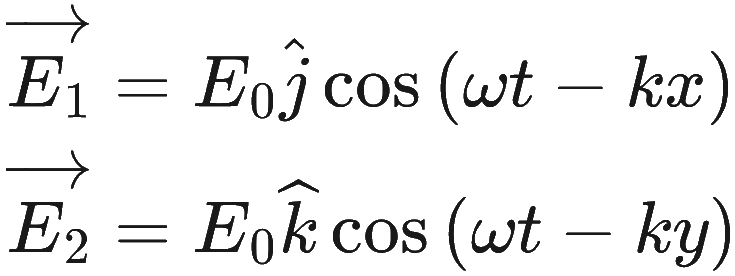
The electric fields of two plane electromagnetic plane waves in vacuum are given by
At t = 0, a particle of charge q is at origin with
a velocityv ⃗ = 0.8 c j ^ \vec{v} = 0.8c\hat{j} v = 0.8 c j ^
(a) E 0 q ( 0.8 i ^ − j ^ + 0.4 k ^ ) E_0 q \left(0.8\hat{i} - \hat{j} + 0.4\hat{k}\right) E 0 q ( 0.8 i ^ − j ^ + 0.4 k ^ ) (b) E 0 q ( − 0.8 i ^ + j ^ + k ^ ) E_0 q \left(-0.8\hat{i} + \hat{j} + \hat{k}\right) E 0 q ( − 0.8 i ^ + j ^ + k ^ ) (c) E 0 q ( 0.8 i ^ + j ^ + 0.2 k ^ ) E_0 q \left(0.8\hat{i} + \hat{j} + 0.2\hat{k}\right) E 0 q ( 0.8 i ^ + j ^ + 0.2 k ^ ) (d) E 0 q ( 0.4 i ^ − 3 j ^ + 0.8 k ^ ) E_0 q \left(0.4\hat{i} - 3\hat{j} + 0.8\hat{k}\right) E 0 q ( 0.4 i ^ − 3 j ^ + 0.8 k ^ ) Show answer and solution
Answer: (c)
Loading the solution…
Report a mistake Q60 JEE Main 2020 · 7 JAN · SHIFT 2 Difficult ☆
Nature of EM Waves & Wave Equation · Force on a charge
The electric field of a plane electromagnetic wave is given by
E ⃗ = E 0 i ^ + j ^ 2 cos ( k z + ω t ) \vec{E} = E_0 \frac{\hat{i} + \hat{j}}{\sqrt{2}} \cos(kz + \omega t) E = E 0 2 i ^ + j ^ cos ( k z + ω t )
At t = 0, a positively charged particle is at the point (x, y, z) = ( 0 , 0 , π k ) \left(0, 0, \frac{\pi}{k}\right) ( 0 , 0 , k π )
If its instantaneous velocity at (t = 0) is v 0 k ^ v_0 \hat{k} v 0 k ^
(a) parallel to k ^ \hat{k} k ^ (b) parallel to i ^ + j ^ 2 \frac{\hat{i} + \hat{j}}{\sqrt{2}} 2 i ^ + j ^ (c) antiparallel to i ^ + j ^ 2 \frac{\hat{i} + \hat{j}}{\sqrt{2}} 2 i ^ + j ^ (d) zero Show answer and solution
Answer: (c)
Loading the solution…
Report a mistake Q61 JEE Main 2019 · 12 APR · SHIFT 1 Easy ☆
Nature of EM Waves & Wave Equation · Direction of E, B and propagation
An electromagnetic wave is represented by the electric field E ⃗ = E 0 n ^ sin [ ω t + ( 6 y − 8 z ) ] \vec{E} = E_0\hat{n}\sin\left[\omega t + (6y - 8z)\right] E = E 0 n ^ sin [ ω t + ( 6 y − 8 z ) ] i ^ , j ^ , k ^ \hat{i}, \hat{j}, \hat{k} i ^ , j ^ , k ^ s ^ \hat{s} s ^
(a) s ^ = 3 i ^ − 4 j ^ 5 \hat{s} = \frac{3\hat{i}-4\hat{j}}{5} s ^ = 5 3 i ^ − 4 j ^ (b) s ^ = − 4 k ^ + 3 j ^ 5 \hat{s} = \frac{-4\hat{k}+3\hat{j}}{5} s ^ = 5 − 4 k ^ + 3 j ^ (c) s ^ = ( − 3 j ^ + 4 k ^ 5 ) \hat{s} = \left(\frac{-3\hat{j}+4\hat{k}}{5}\right) s ^ = ( 5 − 3 j ^ + 4 k ^ ) (d) s ^ = 4 j ^ − 3 k ^ 5 \hat{s} = \frac{4\hat{j}-3\hat{k}}{5} s ^ = 5 4 j ^ − 3 k ^ Show answer and solution
Answer: (c)
Loading the solution…
Report a mistake Q62 JEE Main 2019 · 8 APR · SHIFT 1 Easy ☆
Nature of EM Waves & Wave Equation · Field values: E0 = cB0
A plane electromagnetic wave travels in free space along the x-direction. The electric field component of the wave at a particular point of space and time is E = 6 V m–1 along y-direction. Its corresponding magnetic field component, B would be:
(a) 2 × 10⁻⁸ T along y-direction (b) 6 × 10⁻⁸ T along z-direction (c) 2 × 10⁻⁸ T along z-direction (d) 6 × 10⁻⁸ T along x-direction Show answer and solution
Answer: (c)
Loading the solution…
Report a mistake Q63 JEE Main 2019 · 10 JAN · SHIFT 1 Easy ☆
Nature of EM Waves & Wave Equation · Field values: E0 = cB0
If the magnetic field of a plane electromagnetic wave is given by (the speed of light = 3 × 10⁸ m/s) B = 100 × 10–6 sin [ 2 π × 2 × 1 0 15 ( t − x c ) ] \left[2\pi\times 2\times 10^{15}\left(t - \frac{x}{c}\right)\right] [ 2 π × 2 × 1 0 15 ( t − c x ) ]
(a) 4.5 × \times × (b) 4 × \times × (c) 6 × \times × (d) 3 × \times × Show answer and solution
Answer: (d)
Loading the solution…
Report a mistake Q64 JEE Main 2019 · 9 JAN · SHIFT 1 Easy ☆
Nature of EM Waves & Wave Equation · Field values: E0 = cB0
A plane electromagnetic wave of frequency 50 MHz travels in free space along the positive x- direction. At a particular point in space and time, E ⃗ = 6.3 j ^ V/m \vec{E} = 6.3\hat{j}\text{ V/m} E = 6.3 j ^ V/m B ⃗ \vec{B} B
(a) 18.9 × \times × − - − k ^ \hat{k} k ^ (b) 2.1 × \times × − - − k ^ \hat{k} k ^ (c) 6.3 × \times × − - − k ^ \hat{k} k ^ (d) 18.9 × \times × k ^ \hat{k} k ^ Show answer and solution
Answer: (b)
Loading the solution…
Report a mistake Q65 JEE Main 2019 · 12 APR · SHIFT 2 Medium ☆
Nature of EM Waves & Wave Equation · Writing B from E and E from B
A plane electromagnetic wave having a frequency v = 23.9 GHz propagates along the positive z- direction in free space. The peak value of the Electric Field is 60 V/m. Which among the following is the acceptable magnetic field component in the electromagnetic wave?
(a) B ⃗ \vec{B} B j ^ \hat{j} j ^ (b) B ⃗ \vec{B} B k ^ \hat{k} k ^ (c) B ⃗ \vec{B} B i ^ \hat{i} i ^ (d) B ⃗ \vec{B} B i ^ \hat{i} i ^ Show answer and solution
Answer: (d)
Loading the solution…
Report a mistake Q66 JEE Main 2019 · 10 APR · SHIFT 1 Medium ☆
Nature of EM Waves & Wave Equation · Writing B from E and E from B
The electric field of a plane electromagnetic wave is given by
E ⃗ = E 0 i ^ cos ( k z ) cos ( ω t ) \vec{E} = E_0 \hat{i} \cos(kz) \cos(\omega t) E = E 0 i ^ cos ( k z ) cos ( ω t )
The corresponding magnetic field B ⃗ \vec{B} B
(a) B ⃗ = E 0 C j ^ sin ( k z ) sin ( ω t ) \vec{B} = \frac{E_0}{C} \hat{j} \sin(kz) \sin(\omega t) B = C E 0 j ^ sin ( k z ) sin ( ω t ) (b) B ⃗ = E 0 C j ^ sin ( k z ) cos ( ω t ) \vec{B} = \frac{E_0}{C} \hat{j} \sin(kz) \cos(\omega t) B = C E 0 j ^ sin ( k z ) cos ( ω t ) (c) B ⃗ = E 0 C j ^ cos ( k z ) sin ( ω t ) \vec{B} = \frac{E_0}{C} \hat{j} \cos(kz) \sin(\omega t) B = C E 0 j ^ cos ( k z ) sin ( ω t ) (d) B ⃗ = E 0 C k ^ sin ( k z ) cos ( ω t ) \vec{B} = \frac{E_0}{C} \hat{k} \sin(kz) \cos(\omega t) B = C E 0 k ^ sin ( k z ) cos ( ω t ) Show answer and solution
Answer: (a)
Loading the solution…
Report a mistake Q67 JEE Main 2019 · 8 APR · SHIFT 2 Medium ☆
Nature of EM Waves & Wave Equation · Writing B from E and E from B
The magnetic field of an electromagnetic wave is given by :-
B ⃗ = 1.6 × 1 0 − 6 cos ( 2 × 1 0 7 z + 6 × 1 0 15 t ) ( 2 i ^ + j ^ ) Wb m 2 \vec{B} = 1.6 \times 10^{-6} \cos\left(2 \times 10^{7} z + 6 \times 10^{15} t\right) \left(2\hat{i} + \hat{j}\right) \frac{\text{Wb}}{\text{m}^2} B = 1.6 × 1 0 − 6 cos ( 2 × 1 0 7 z + 6 × 1 0 15 t ) ( 2 i ^ + j ^ ) m 2 Wb
The associated electric field will be :-
(a) E ⃗ = 4.8 × 1 0 2 cos ( 2 × 1 0 7 z − 6 × 1 0 15 t ) ( − 2 i ^ + j ^ ) V m \vec{E} = 4.8 \times 10^{2} \cos\left(2 \times 10^{7} z - 6 \times 10^{15} t\right) \left(-2\hat{i} + \hat{j}\right) \frac{\text{V}}{\text{m}} E = 4.8 × 1 0 2 cos ( 2 × 1 0 7 z − 6 × 1 0 15 t ) ( − 2 i ^ + j ^ ) m V (b) E ⃗ = 4.8 × 1 0 2 cos ( 2 × 1 0 7 z − 6 × 1 0 15 t ) ( 2 i ^ + j ^ ) V m \vec{E} = 4.8 \times 10^{2} \cos\left(2 \times 10^{7} z - 6 \times 10^{15} t\right) \left(2\hat{i} + \hat{j}\right) \frac{\text{V}}{\text{m}} E = 4.8 × 1 0 2 cos ( 2 × 1 0 7 z − 6 × 1 0 15 t ) ( 2 i ^ + j ^ ) m V (c) E ⃗ = 4.8 × 1 0 2 cos ( 2 × 1 0 7 z + 6 × 1 0 15 t ) ( i ^ − 2 j ^ ) V m \vec{E} = 4.8 \times 10^{2} \cos\left(2 \times 10^{7} z + 6 \times 10^{15} t\right) \left(\hat{i} - 2\hat{j}\right) \frac{\text{V}}{\text{m}} E = 4.8 × 1 0 2 cos ( 2 × 1 0 7 z + 6 × 1 0 15 t ) ( i ^ − 2 j ^ ) m V (d) E ⃗ = 4.8 × 1 0 2 cos ( 2 × 1 0 7 z + 6 × 1 0 15 t ) ( − i ^ + 2 j ^ ) V m \vec{E} = 4.8 \times 10^{2} \cos\left(2 \times 10^{7} z + 6 \times 10^{15} t\right) \left(-\hat{i} + 2\hat{j}\right) \frac{\text{V}}{\text{m}} E = 4.8 × 1 0 2 cos ( 2 × 1 0 7 z + 6 × 1 0 15 t ) ( − i ^ + 2 j ^ ) m V Show answer and solution
Answer: (c)
Loading the solution…
Report a mistake Q68 JEE Main 2019 · 10 JAN · SHIFT 2 Difficult ☆
Nature of EM Waves & Wave Equation · Writing B from E and E from B
The electric field of a plane polarized electromagnetic wave in free space at time t = 0 is given by an expression E ⃗ ( x , y ) = 10 j ^ cos [ ( 6 x + 8 z ) ] . \vec{E}(x, y) = 10\hat{j} \cos[(6x + 8z)]. E ( x , y ) = 10 j ^ cos [( 6 x + 8 z )] . B ⃗ \vec{B} B − - −
(a) 1 c ( 6 k ^ + 8 i ^ ) cos [ ( 6 x + 8 z − 10 c t ) ] \frac{1}{c}\left(6\hat{k} + 8\hat{i}\right) \cos[(6x + 8z - 10ct)] c 1 ( 6 k ^ + 8 i ^ ) cos [( 6 x + 8 z − 10 c t )] (b) 1 c ( 6 k ^ − 8 i ^ ) cos [ ( 6 x + 8 z − 10 c t ) ] \frac{1}{c}\left(6\hat{k} - 8\hat{i}\right) \cos[(6x + 8z - 10ct)] c 1 ( 6 k ^ − 8 i ^ ) cos [( 6 x + 8 z − 10 c t )] (c) 1 c ( 6 k ^ + 8 i ^ ) cos [ ( 6 x − 8 z + 10 c t ) ] \frac{1}{c}\left(6\hat{k} + 8\hat{i}\right) \cos[(6x - 8z + 10ct)] c 1 ( 6 k ^ + 8 i ^ ) cos [( 6 x − 8 z + 10 c t )] (d) 1 c ( 6 k ^ − 8 i ^ ) cos [ ( 6 x − 8 z + 10 c t ) ] \frac{1}{c}\left(6\hat{k} - 8\hat{i}\right) \cos[(6x - 8z + 10ct)] c 1 ( 6 k ^ − 8 i ^ ) cos [( 6 x − 8 z + 10 c t )] Show answer and solution
Answer: (b)
Loading the solution…
Report a mistake Q69 JEE Main 2019 · 9 APR · SHIFT 1 Difficult ☆
Nature of EM Waves & Wave Equation · Force on a charge
The magnetic field of a plane electromagnetic wave is given by:
B ⃗ = B 0 i ^ [ cos ( k z − ω t ) ] + B 0 j ^ cos ( k z + ω t ) \vec{B} = B_0 \hat{i} [\cos(kz - \omega t)] + B_0 \hat{j} \cos(kz + \omega t) B = B 0 i ^ [ cos ( k z − ω t )] + B 0 j ^ cos ( k z + ω t )
B0 = 3 × 10⁻⁵ T and B1 = 2 × 10⁻⁶ T.
The rms value of the force experienced by a stationary charge Q = 10–4 C at z = 0 is closest to:
(a) 0.6 N (b) 0.9 N (c) 3 × 10⁻² N (d) 0.1 N Show answer and solution
Answer: (a)
Loading the solution…
Report a mistake Q70 NEET 2018 Easy ☆
Nature of EM Waves & Wave Equation · Direction of E, B and propagation
An EM wave is propagating in a medium with a velocityv ⃗ = v i ^ \vec{v} = v\hat{i} v = v i ^
(a) –z direction (b) +z direction (c) –y direction (d) –x direction Show answer and solution
Answer: (b)
Loading the solution…
Report a mistake Q71 JEE Main 2018 · 16 APR · SHIFT 1 Difficult ☆
Nature of EM Waves & Wave Equation · Direction of E, B and propagation
A plane electromagnetic wave of wavelength λ \lambda λ
Show answer and solution
Answer: (a)
Loading the solution…
Report a mistake Q72 JEE Main 2018 · 15 APR · SHIFT 1 Difficult ☆
Nature of EM Waves & Wave Equation · Direction of E, B and propagation
A monochromatic beam of light has a frequency ν = 3 2 π × 1 0 12 Hz \nu = \frac{3}{2\pi} \times 10^{12}\text{ Hz} ν = 2 π 3 × 1 0 12 Hz i ^ + j ^ 2 . \frac{\hat{i} + \hat{j}}{\sqrt{2}}. 2 i ^ + j ^ .
It is polarized along the k ^ \hat{k} k ^
Show answer and solution
Answer: (a)
Loading the solution…
Report a mistake Q73 JEE Main 2018 · 15 APR · SHIFT 2 Difficult ☆
Nature of EM Waves & Wave Equation · Reading the wave equation
A plane polarized monochromatic EM wave is traveling in vacuum along z direction such that at t = t1 it is found that the electric field is zero at a spatial point z1. The next zero that occurs in its neighbourhood is at z2. The frequency of the electromagnetic wave is:
(a) 3 × 1 0 8 ∣ z 2 − z 1 ∣ \frac{3 \times 10^{8}}{|z_2 - z_1|} ∣ z 2 − z 1 ∣ 3 × 1 0 8 (b) 1.5 × 1 0 8 ∣ z 2 − z 1 ∣ \frac{1.5 \times 10^{8}}{|z_2 - z_1|} ∣ z 2 − z 1 ∣ 1.5 × 1 0 8 (c) 6 × 1 0 8 ∣ z 2 − z 1 ∣ \frac{6 \times 10^{8}}{|z_2 - z_1|} ∣ z 2 − z 1 ∣ 6 × 1 0 8 (d) 1 t 1 + ∣ z 2 − z 1 ∣ 3 × 1 0 8 \frac{1}{t_1 + \frac{|z_2 - z_1|}{3 \times 10^{8}}} t 1 + 3 × 1 0 8 ∣ z 2 − z 1 ∣ 1 Show answer and solution
Answer: (b)
Loading the solution…
Report a mistake Q74 NEET 2017 Medium ☆
Nature of EM Waves & Wave Equation · Field values: E0 = cB0
In an electromagnetic wave in free space that root mean square value of the electric field is Erms = 6 V m− 1 {}^{-1} − 1
(a) 2.83 × \times × − - − (b) 0.70 × \times × − - − (c) 4.23 × \times × − - − (d) 1.41 × \times × − - − Show answer and solution
Answer: (a)
Loading the solution…
Report a mistake Q75 JEE Main 2017 · 8 APR · SHIFT 1 Medium ☆
Nature of EM Waves & Wave Equation · Writing B from E and E from B
Magnetic field in a plane electromagnetic wave is given by
B ⃗ \vec{B} B ω \omega ω j ^ T \hat{j}\,\text{T} j ^ T
Expression for corresponding electric field will be:
Where c is speed of light.
(a) E ⃗ \vec{E} E ω \omega ω k ^ \hat{k} k ^ (b) E ⃗ = B 0 c \vec{E} = \frac{B_0}{c} E = c B 0 ω \omega ω k ^ \hat{k} k ^ (c) E ⃗ = − \vec{E} = - E = − ω \omega ω k ^ \hat{k} k ^ (d) E ⃗ \vec{E} E − ω -\omega − ω k ^ \hat{k} k ^ Show answer and solution
Answer: (a)
Loading the solution…
Report a mistake Q76 JEE Main 2017 · 9 APR · SHIFT 1 Difficult ☆
Nature of EM Waves & Wave Equation · Writing B from E and E from B
The electric field component of a monochromatic radiation is given by
E ⃗ \vec{E} E i ^ \hat{i} i ^ ω \omega ω
Its magnetic field B ⃗ \vec{B} B
(a) 2 E 0 c j ^ \frac{2E_0}{c} \hat{j} c 2 E 0 j ^ ω \omega ω (b) − 2 E 0 c j ^ -\frac{2E_0}{c} \hat{j} − c 2 E 0 j ^ ω \omega ω (c) 2 E 0 c j ^ \frac{2E_0}{c} \hat{j} c 2 E 0 j ^ ω \omega ω (d) 2 E 0 c j ^ \frac{2E_0}{c} \hat{j} c 2 E 0 j ^ ω \omega ω Show answer and solution
Answer: (c)
Loading the solution…
Report a mistake Q77 JEE Main 2016 · 10 APR · SHIFT 1 Medium ☆
Nature of EM Waves & Wave Equation · Direction of E, B and propagation
Consider an electromagnetic wave propagating in vacuum. Choose the correct statement:
(a) For an electromagnetic wave propagating in +x direction the electric field is E ⃗ = 1 2 E y z ( x , t ) ( y ^ − z ^ ) \vec{E} = \frac{1}{\sqrt{2}}E_{yz}(x,t)\left(\hat{y} - \hat{z}\right) E = 2 1 E yz ( x , t ) ( y ^ − z ^ ) B ⃗ = 1 2 B y z ( x , t ) ( y ^ + z ^ ) \vec{B} = \frac{1}{\sqrt{2}}B_{yz}(x,t)\left(\hat{y} + \hat{z}\right) B = 2 1 B yz ( x , t ) ( y ^ + z ^ ) (b) For an electromagnetic wave propagating in +x direction the electric field is E ⃗ = 1 2 E y z ( y , z , t ) ( y ^ + z ^ ) \vec{E} = \frac{1}{\sqrt{2}}E_{yz}(y,z,t)\left(\hat{y} + \hat{z}\right) E = 2 1 E yz ( y , z , t ) ( y ^ + z ^ ) B ⃗ = 1 2 B y z ( y , z , t ) ( y ^ + z ^ ) \vec{B} = \frac{1}{\sqrt{2}}B_{yz}(y,z,t)\left(\hat{y} + \hat{z}\right) B = 2 1 B yz ( y , z , t ) ( y ^ + z ^ ) (c) For an electromagnetic wave propagating in + y direction the electric field is E ⃗ = 1 2 E y z ( x , t ) y ^ \vec{E} = \frac{1}{\sqrt{2}}E_{yz}(x,t)\hat{y} E = 2 1 E yz ( x , t ) y ^ B ⃗ = 1 2 B y z ( x , t ) z ^ \vec{B} = \frac{1}{\sqrt{2}}B_{yz}(x,t)\hat{z} B = 2 1 B yz ( x , t ) z ^ (d) For an electromagnetic wave propagating in + y direction the electric field is E ⃗ = 1 2 E y z ( x , t ) z ^ \vec{E} = \frac{1}{\sqrt{2}}E_{yz}(x,t)\hat{z} E = 2 1 E yz ( x , t ) z ^ B ⃗ = 1 2 B z ( x , t ) y ^ \vec{B} = \frac{1}{\sqrt{2}}B_{z}(x,t)\hat{y} B = 2 1 B z ( x , t ) y ^ Show answer and solution
Answer: (a)
Loading the solution…
Report a mistake Q78 JEE Main 2015 · 11 APR · SHIFT 1 Easy ☆
Nature of EM Waves & Wave Equation · Direction of E, B and propagation
For plane electromagnetic waves propagating in the z direction, which one of the following combination gives the correct possible direction for E ⃗ \vec{E} E B ⃗ \vec{B} B
(a) ( i ^ + 2 j ^ ) \left(\hat{i}+2\hat{j}\right) ( i ^ + 2 j ^ ) ( 2 i ^ − j ^ ) \left(2\hat{i}-\hat{j}\right) ( 2 i ^ − j ^ ) (b) ( − 2 i ^ − 3 j ^ ) \left(-2\hat{i}-3\hat{j}\right) ( − 2 i ^ − 3 j ^ ) ( 3 i ^ − 2 j ^ ) \left(3\hat{i}-2\hat{j}\right) ( 3 i ^ − 2 j ^ ) (c) ( 2 i ^ + 3 j ^ ) \left(2\hat{i}+3\hat{j}\right) ( 2 i ^ + 3 j ^ ) ( i ^ + 2 j ^ ) \left(\hat{i}+2\hat{j}\right) ( i ^ + 2 j ^ ) (d) ( 3 i ^ + 4 j ^ ) \left(3\hat{i}+4\hat{j}\right) ( 3 i ^ + 4 j ^ ) ( 4 i ^ − 3 j ^ ) \left(4\hat{i}-3\hat{j}\right) ( 4 i ^ − 3 j ^ ) Show answer and solution
Answer: (b)
Loading the solution…
Report a mistake Q79 JEE Main 2015 · 10 APR · SHIFT 1 Medium ☆
Nature of EM Waves & Wave Equation · Writing B from E and E from B
An electromagnetic wave travelling in the x-direction has frequency of 2 × \times × − 1 {}^{-1} − 1
(a) B ⃗ \vec{B} B × \times × − - − j ^ \hat{j} j ^ π \pi π × \times × − - − − - − × \times × (b) B ⃗ \vec{B} B × \times × − - − k ^ \hat{k} k ^ π \pi π × \times × − - − − - − × \times × (c) B ⃗ \vec{B} B × \times × − - − i ^ \hat{i} i ^ π \pi π × \times × − - − − - − × \times × (d) B ⃗ \vec{B} B × \times × − - − j ^ \hat{j} j ^ × \times × − - − − - − × \times × Show answer and solution
Answer: (b)
Loading the solution…
Report a mistake Q80 JEE Main 2013 · 23 APR · SHIFT 1 Easy ☆
Nature of EM Waves & Wave Equation · Nature of EM waves
Select the correct statement from the following:
(a) Electromagnetic waves cannot travel in vacuum. (b) Electromagnetic waves are longitudinal waves. (c) Electromagnetic waves are produced by charges moving with uniform velocity. (d) Electromagnetic waves carry both energy and momentum as they propagate through space. Show answer and solution
Answer: (d)
Loading the solution…
Report a mistake Q81 JEE Main 2013 Easy ☆
Nature of EM Waves & Wave Equation · Field values: E0 = cB0
The magnetic field in a travelling electromagnetic wave has a peak value of 20 nT 20\text{ nT} 20 nT
(a) 3 V/m 3\text{ V/m} 3 V/m (b) 6 V/m 6\text{ V/m} 6 V/m (c) 9 V/m 9\text{ V/m} 9 V/m (d) 12 V/m 12\text{ V/m} 12 V/m Show answer and solution
Answer: (b)
Loading the solution…
Report a mistake Q82 JEE Main 2012 · AIEEE Easy ☆
Nature of EM Waves & Wave Equation · Direction of E, B and propagation
An electromagnetic wave in vacuum has the electric and magnetic field E ⃗ \vec{E} E B ⃗ \vec{B} B X ⃗ \vec{X} X k ⃗ \vec{k} k
(a) X ⃗ ∥ B ⃗ \vec{X}\parallel\vec{B} X ∥ B X ⃗ ∥ B ⃗ × E ⃗ \vec{X}\parallel\vec{B}\times\vec{E} X ∥ B × E (b) X ⃗ ∥ E ⃗ \vec{X}\parallel\vec{E} X ∥ E k ⃗ ∥ E ⃗ × B ⃗ \vec{k}\parallel\vec{E}\times\vec{B} k ∥ E × B (c) X ⃗ ∥ B ⃗ \vec{X}\parallel\vec{B} X ∥ B k ⃗ ∥ E ⃗ × B ⃗ \vec{k}\parallel\vec{E}\times\vec{B} k ∥ E × B (d) X ⃗ ∥ E ⃗ \vec{X}\parallel\vec{E} X ∥ E k ⃗ ∥ B ⃗ × E ⃗ \vec{k}\parallel\vec{B}\times\vec{E} k ∥ B × E Show answer and solution
Answer: (b)
Loading the solution…
Report a mistake Q83 NEET 2012 · AIPMT · PRELIMS Easy ☆
Nature of EM Waves & Wave Equation · Reading the wave equation
The electric field associated with an em wave in vacuum is given by
E = i ^ \hat{i} i ^ − - − × \times ×
(a) 2 m− 1 {}^{-1} − 1 (b) 0.5 m− 1 {}^{-1} − 1 (c) 6 m− 1 {}^{-1} − 1 (d) 3 m− 1 {}^{-1} − 1 Show answer and solution
Answer: (a)
Loading the solution…
Report a mistake Q84 NEET 2012 · AIPMT · MAINS Easy ☆
Nature of EM Waves & Wave Equation · Field values: E0 = cB0
The ratio of amplitude of magnetic field to the amplitude of electric field for an electromagnetic wave propagatting in vacuum is equal to
(a) the speed of light in vacuum (b) reciprocal of speed of light in vacuum (c) the ratio of magnetic permeability to the electric susceptibility of vacuum (d) unity Show answer and solution
Answer: (b)
Loading the solution…
Report a mistake Q85 NEET 2011 · AIPMT · PRELIMS Easy ☆
Nature of EM Waves & Wave Equation · Direction of E, B and propagation
The electric and the magnetic field, associated with an e.m. wave, propagating along the +z-axis, can be represented by
(a) [ E ⃗ = E 0 i ^ , B ⃗ = B 0 j ^ ] \left[\vec{E} = E_0\hat{i},\ \vec{B} = B_0\hat{j}\right] [ E = E 0 i ^ , B = B 0 j ^ ] (b) [ E ⃗ = E 0 k ^ , B ⃗ = B 0 i ^ ] \left[\vec{E} = E_0\hat{k},\ \vec{B} = B_0\hat{i}\right] [ E = E 0 k ^ , B = B 0 i ^ ] (c) [ E ⃗ = E 0 j ^ , B ⃗ = B 0 i ^ ] \left[\vec{E} = E_0\hat{j},\ \vec{B} = B_0\hat{i}\right] [ E = E 0 j ^ , B = B 0 i ^ ] (d) [ E ⃗ = E 0 j ^ , B ⃗ = B 0 k ^ ] \left[\vec{E} = E_0\hat{j},\ \vec{B} = B_0\hat{k}\right] [ E = E 0 j ^ , B = B 0 k ^ ] Show answer and solution
Answer: (a)
Loading the solution…
Report a mistake Q86 NEET 2010 · AIPMT · PRELIMS Easy ☆
Nature of EM Waves & Wave Equation · Nature of EM waves
Which of the following statements is false for the properties of electromagnetic waves?
(a) Both electric and magnetic field vectors attain the maxima and minima at the same place and same time. (b) The energy in electromagnetic wave is divided equally between electric and magnetic vectors. (c) Both electric and magnetic field vectors are parallel to each other and perpendicular to the direction of propagation of wave. (d) These waves do not require any material medium for propagation. Show answer and solution
Answer: (c)
Loading the solution…
Report a mistake Q87 NEET 2010 · AIPMT · MAINS Medium ☆
Nature of EM Waves & Wave Equation · Reading the wave equation
The electric field of an electromagnetic wave in free space is given by E ⃗ = 10 cos ( 1 0 7 t + k x ) j ^ V/m , \vec{E} = 10\cos(10^{7}t + kx)\hat{j}\text{ V/m}, E = 10 cos ( 1 0 7 t + k x ) j ^ V/m ,
(1) the wavelength λ \lambda λ
(2) the wave number k is 0.33 rad/m.
(3) the wave amplitude is 10 V/m.
(4) the wave is propagating along +x direction.
Which one of the following pairs of statements is correct?
(a) (3) and (4) (b) (1) and (2) (c) (2) and (3) (d) (1) and (3) Show answer and solution
Answer: (d)
Loading the solution…
Report a mistake Q88 NEET 2009 · AIPMT Medium ☆
Nature of EM Waves & Wave Equation · Reading the wave equation
The electric field part of an electromagnetic wave in a medium is represented by Ex = 0; E y = 2.5 N C cos [ ( 2 π × 1 0 6 rad s ) t − ( π × 1 0 − 2 rad m ) x ] ; E_y = 2.5\frac{\text{N}}{\text{C}}\cos\left[\left(2\pi\times 10^{6}\frac{\text{rad}}{\text{s}}\right)t - \left(\pi\times 10^{-2}\frac{\text{rad}}{\text{m}}\right)x\right]; E y = 2.5 C N cos [ ( 2 π × 1 0 6 s rad ) t − ( π × 1 0 − 2 m rad ) x ] ;
Ez = 0. The wave is
(a) moving along x direction with frequency 106 Hz and wavelength 100 m. (b) moving along x direction with frequency 106 Hz and wavelength 200 m. (c) moving along − - − (d) moving along y direction with frequency 2 π × 1 0 6 Hz 2\pi\times 10^{6}\text{ Hz} 2 π × 1 0 6 Hz Show answer and solution
Answer: (b)
Loading the solution…
Report a mistake Q89 NEET 2007 · AIPMT Easy ☆
Nature of EM Waves & Wave Equation · Nature of EM waves
The electric and magnetic field of an electromagnetic wave are
(a) in opposite phase and perpendicular to each other (b) in opposite phase and parallel to each other (c) in phase and perpendicular to each other (d) in phase and parallel to each other. Show answer and solution
Answer: (c)
Loading the solution…
Report a mistake Q90 JEE Main 2002 · AIEEE Easy ☆
Nature of EM Waves & Wave Equation · Nature of EM waves
Electromagnetic waves are transverse in nature is evident by
(a) polarization (b) interference (c) reflection (d) diffraction Show answer and solution
Answer: (a)
Loading the solution…
Report a mistake Q91 NEET 2002 · AIPMT Easy ☆
Nature of EM Waves & Wave Equation · Direction of E, B and propagation
The velocity of electromagnetic wave is parallel to
(a) B ⃗ × E ⃗ \vec{B}\times\vec{E} B × E (b) E ⃗ × B ⃗ \vec{E}\times\vec{B} E × B (c) E ⃗ \vec{E} E (d) B ⃗ \vec{B} B Show answer and solution
Answer: (b)
Loading the solution…
Report a mistake Q92 NEET 1999 · AIPMT Easy ☆
Nature of EM Waves & Wave Equation · Reading the wave equation
The wavelength of light of frequency 100 Hz 100\text{ Hz} 100 Hz
(a) 2 × 1 0 6 m 2\times 10^{6}\text{ m} 2 × 1 0 6 m (b) 3 × 1 0 6 m 3\times 10^{6}\text{ m} 3 × 1 0 6 m (c) 4 × 1 0 6 m 4\times 10^{6}\text{ m} 4 × 1 0 6 m (d) 5 × 1 0 6 m 5\times 10^{6}\text{ m} 5 × 1 0 6 m Show answer and solution
Answer: (b)
Loading the solution…
Report a mistake Q93 NEET 1994 · AIPMT Easy ☆
Nature of EM Waves & Wave Equation · Nature of EM waves
The electric and magnetic field of an electromagnetic wave are
(a) in opposite phase and perpendicular to each other (b) in opposite phase and parallel to each other (c) in phase and perpendicular to each other (d) in phase and parallel to each other Show answer and solution
Answer: (c)
Loading the solution…
Report a mistake
No questions match these filters.

 and