0 of 83 attemptedPick an answer to see the solution
Q1MHT CET 2026 · 16 APR · SHIFT 2Easy
Electric Charge & Coulomb's Law · Properties of charge & charging
Two spherical hollow spheres of radii 'R1' and 'R2' are charged with same charge. Let 'σ1' and 'σ2 ' are their respective charge densities, then the ratio σ1 to σ2 is
Electric Charge & Coulomb's Law · Coulomb's law & medium
Two point charges placed at a certain distance r in air exert force F on each other. Then the distance r1 at which these charges will exert the same force in a medium of dielectric constant K is
Electric Charge & Coulomb's Law · Coulomb's law & medium
Two point charges q1 and q2 are 'l' distance apart. If one of the charges is doubled and the distance between them is halved. The magnitude of the force becomes 'n' times, where 'n' is
Electric Charge & Coulomb's Law · Coulomb's law & medium
Two equal point charges exert a force F on each other when they are placed distance 'd' apart in air. When they are placed distance 'D' apart in a medium of dielectric constant K, they exert the same force. The distance D is equal to
Electric Charge & Coulomb's Law · Coulomb's law & medium
If two charges q1 and q2 are separated with distance 'd' and placed in a medium of dielectric constant K. What will be the equivalent distance between charges in air for the same electrostatic force?
Electric Charge & Coulomb's Law · Coulomb's law & medium
Two point charges q1=3μC and q2=−4μC are placed at points (2i^+3j^+3k^) and (i^+j^+k^) respectively. Force on charge q2 is ______ N. (Take 4πϵ01=9×10⁹ SI Units)
Electric Charge & Coulomb's Law · Equilibrium of charges
Two point charges +e and +4e are kept at a distance 'd' units apart. Third point charge +q is placed between the two charges at a distance 'x' units from charge +e so as to be in equilibrium. The value of 'x' is
Electric Charge & Coulomb's Law · Coulomb's law & medium
Two charged identical metal spheres A and B repel each other with a force 3×10⁻⁵ N. Another identical uncharged sphere C is touched with A and then placed at the mid-point between A and B. Net force on C is x×10−5 N. The value of x is
Electric Charge & Coulomb's Law · Coulomb's law & medium
Charge q2 of mass 'm' revolves around a stationary charge q1 in a circular orbit of radius 'r'. The orbital periodic time of q2 would be (k=4πϵ01)
Electric Charge & Coulomb's Law · Coulomb's law & medium
Two point charges placed in air separated by distance R exert a force F on each other. Now the space between those charges is filled with dielectric constant K. At distance R1 between the charges, the same force is exerted as F. Then
Electric Charge & Coulomb's Law · Superposition of forces
Three charges q,Q and +4q are placed in a straight line of length d at points at distance 0,3d,32d respectively. In order to make the net force on q be zero, the value of Q should be
Electric Charge & Coulomb's Law · Equilibrium of charges
Two charged particles each having a charge '+q' and mass 'm' are kept at a distance 'd'. If they are in equilibrium under the gravitational force and the electric force between them, then the ratio mq (specific charge) of each particle is (G- Universal gravitation constant, ε0 = permittivity of free space)
Electric Charge & Coulomb's Law · Equilibrium of charges
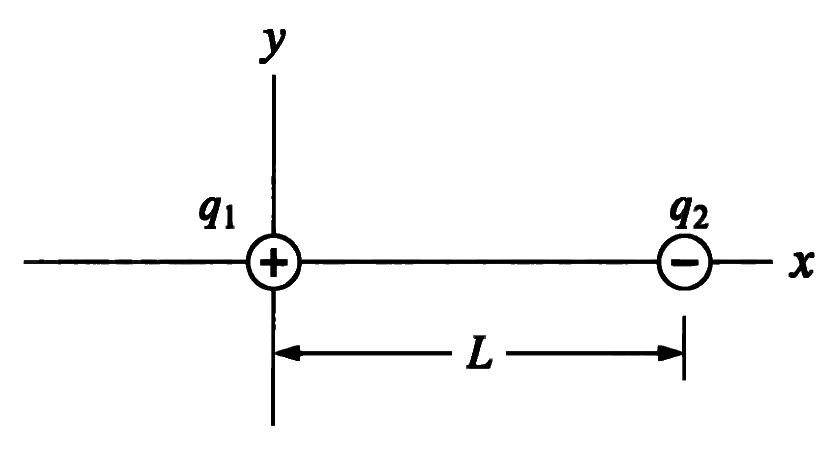
Two particles of charges q1=8q and q2=−2q are placed as shown in figure. At what point away from q2 on x-axis can a proton be placed placed so that it is in equilibrium?
Electric Charge & Coulomb's Law · Coulomb's law & medium
Two point charges q1 and q2 are ' l ' distance apart. If one of the charges is doubled and distance between them is halved. The magnitude of force becomes n times, where n is
Electric Charge & Coulomb's Law · Coulomb's law & medium
A positive ion A and a negative ion B has charges 6.67×10⁻¹⁹ C and 9.6×10⁻¹⁰ C, and masses 19.2×10⁻²⁷ kg and 9×10⁻²⁷ kg respectively. At an instant, the ions are separated by a certain distance r. At that instant the ratio of the magnitudes of electrostatic force to gravitational force is P×10−13, where the value of P is _________.
(Take 4πε01=9×10⁹ N m2 C−2 and universal gravitational constant as 6.67×10⁻¹¹ N m2 kg−2)
Numerical answer type. Work it out, then open the answer.
Electric Charge & Coulomb's Law · Superposition of forces
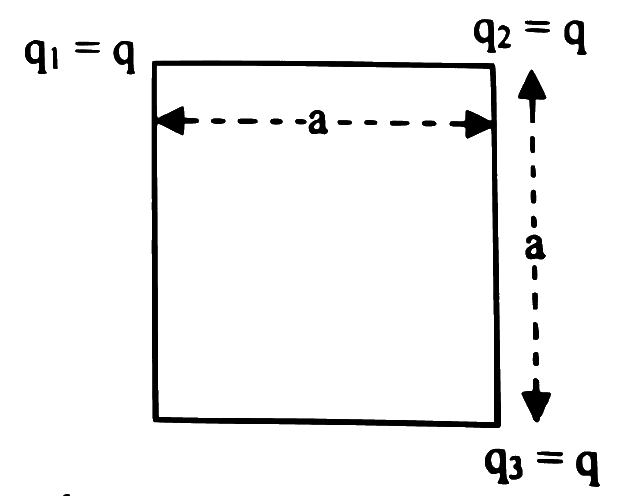
Three equal charges are placed on the three corners of a square as shown below. If the magnitude of force between ' q1 ' and ' q2 ' is ' F12 ' and that between ' q1 ' and ' q3 ' is F13, then the ratio of F13 to F12 is
Electric Charge & Coulomb's Law · Coulomb's law & medium
Two equally charged small balls placed at a fixed distance experience a force ' F '. A similar uncharged ball after touching one of them is placed at the middle point between the two balls. the force experienced by this ball is
Electric Charge & Coulomb's Law · Coulomb's law & medium
Two identical charged conducting spheres A and B have their centres separated by a certain distance. Charge on each sphere is q and the force of repulsion between them is F. A third identical uncharged conducting sphere is brought in contact with sphere A first and then with B and finally removed from both. New force of repulsion between spheres A and B (Radii of A and B are negligible compared to the distance of separation so that for calculating force between them they can be considered as point charges) is best given as:
Electric Charge & Coulomb's Law · Coulomb's law & medium
A small uncharged conducting sphere is placed in contact with an identical sphere but having 4×10⁻⁸ C charge and then removed to a distance such that the force of repulsion between them is 9×10⁻³ N. The distance between them is (Take 4πϵ01 as 9×10⁹ in SI units)
Electric Charge & Coulomb's Law · Superposition of forces
Three charges ' +3q ', ' Q ' and ' +q ' are placed in a straight line of length ' l ' at points at distances 0,2l and l respectively. The value of Q in order to have the net force on +q to be zero, Q=xq. The value of x is
Electric Charge & Coulomb's Law · Equilibrium of charges
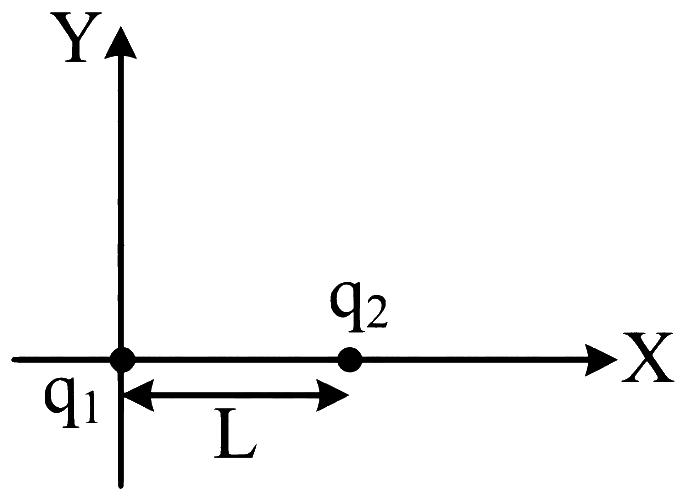
Two charges q1=+6q and q2=−3q placed as shown in figure. A proton is placed on x -axis away from q2. To remain proton in equilibrium, the distance between q1 and proton is
Electric Charge & Coulomb's Law · Coulomb's law & medium
Two equal point charges ' q ' each exert a force ' F ' on each other, when they are placed distance ' x ' apart in air. When the same charges are placed distance ' y ' apart in a medium of dielectric constant ' k ', they exert the same force. The ratio of distance ' y ' to ' x ' is equal to
Electric Charge & Coulomb's Law · Coulomb's law & medium
Force between two point charges q1 and q2 placed in vacuum at 'r' cm apart is F. Force between them when placed in a medium having dielectric constant K=5 at 'r/5' cm apart will be:
Electric Charge & Coulomb's Law · Coulomb's law & medium
Two point charges +q1 and q2 repel each other with a force of 100 N.q1 is increased by 10% and q2 is decreased by 10%. If they are kept at their original positions the change in the force of repulsion between them is
Electric Charge & Coulomb's Law · Coulomb's law & medium
Two point charges (A and B)+4q and −4q are placed along a line separated by a distance I '. Force acting between them is F. If 25% of charge from point A is transferred to that at point B, the force between the charges now becomes
Electric Charge & Coulomb's Law · Coulomb's law & medium
Two identical conducting spheres P and S with charge Q on each, repel each other with a force 16 N. A third identical uncharged conducting sphere R is successively brought in contact with the two spheres. The new force of repulsion between P and S is:
Electric Charge & Coulomb's Law · Superposition of forces
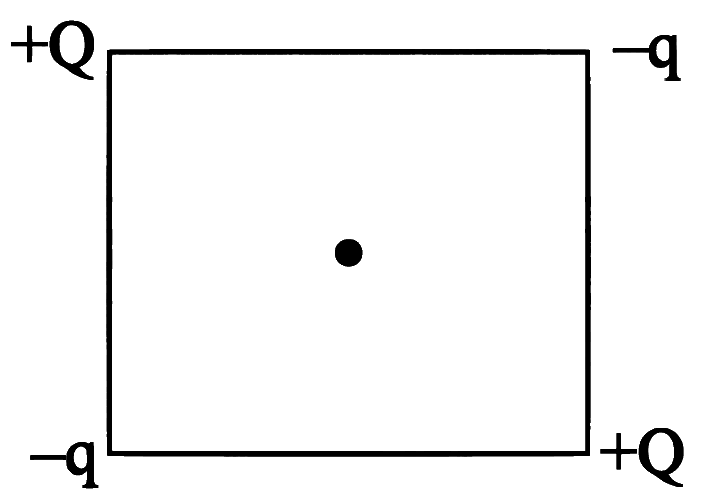
A charge +Q is placed at each of the diagonally opposite corners of a square. A charge -q is placed at each of the other diagonally opposite corners as shown. If the net electrical force on +Q is zero, then −q+Q is equal to
Electric Charge & Coulomb's Law · Equilibrium of charges
Two identical charged spheres are suspended by strings of equal lengths. The strings make an angle θ with each other. When suspended in water the angle remains the same. If density of the material of the sphere is 1.5 g/cc, the dielectric constant of water will be __________. (Take density of water =1 g/cc)
Numerical answer type. Work it out, then open the answer.
Electric Charge & Coulomb's Law · Equilibrium of charges
Two identical charged spheres are suspended by strings of equal lengths. The strings make an angle of 37∘ with each other. When suspended in a liquid of density 0.7 g/cm3, the angle remains same. If density of material of the sphere is 1.4 g/cm3, the dielectric constant of the liquid is _______ (tan37∘=43)
Numerical answer type. Work it out, then open the answer.
Electric Charge & Coulomb's Law · Superposition of forces
A thin metallic wire having cross sectional area of 10−4 m2 is used to make a ring of radius 30 cm. A positive charge of 2π C is uniformly distributed over the ring, while another positive charge of 30 pC is kept at the centre of the ring. The tension in the ring is ______ N; provided that the ring does not get deformed (neglect the influence of gravity). (given, 4πϵ01=9×10⁹ SI units)
Numerical answer type. Work it out, then open the answer.
Electric Charge & Coulomb's Law · Coulomb's law & medium
Two positively charged identical spheres separated by a distance 'd' exert some force (F) on each other when they are kept in air. If both the spheres are immersed in a liquid of dielectric constant 5, the force experienced by each is (All other parameters are unchanged.)
Electric Charge & Coulomb's Law · Coulomb's law & medium
A 10μC charge is divided into two parts and placed at 1 cm distance so that the repulsive force between them is maximum. The charges of the two parts are:
Electric Charge & Coulomb's Law · Coulomb's law & medium
If two charges q1 and q2 are separated with distance 'd' and placed in a medium of dielectric constant K. What will be the equivalent distance between charges in air for the same electrostatic force?
Electric Charge & Coulomb's Law · Superposition of forces
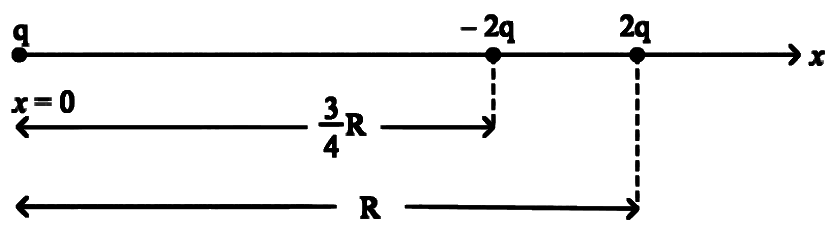
Three point charges q,−2q and 2q are placed on x-axis at a distance x=0,x=43R and x=R respectively from origin as shown. If q=2×10⁻⁶ C and R=2 cm, the magnitude of net force experienced by the charge −2q is ___________ N.
Numerical answer type. Work it out, then open the answer.
Electric Charge & Coulomb's Law · Equilibrium of charges
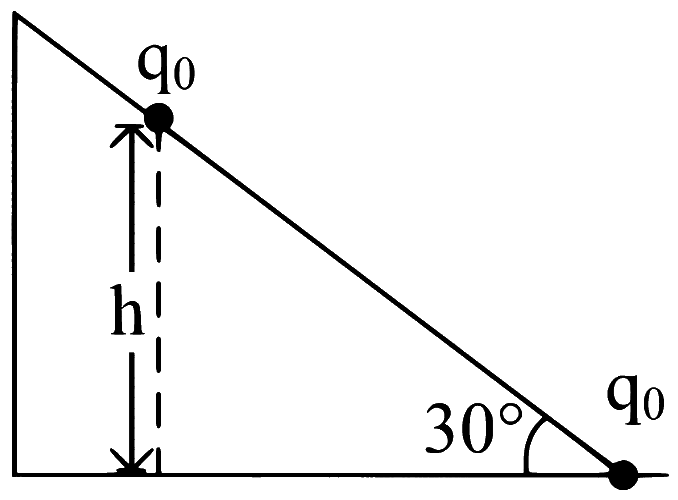
As shown in the figure, a configuration of two equal point charges (q0=+2μC) is placed on an inclined plane. Mass of each point charge is 20 g. Assume that there is no friction between charge and plane. For the system of two point charges to be in equilibrium (at rest) the height h=x×10−3 m.
The value of x is ____________.
(Take 4πε01=9×10⁹ N m2C−2,g=10 m s−2)
Numerical answer type. Work it out, then open the answer.
Electric Charge & Coulomb's Law · Equilibrium of charges
A point charge q1=4q0 is placed at origin. Another point charge q2=−q0 is placed at x=12 cm. Charge of proton is q0. The proton is placed on x axis so that the electrostatic force on the proton is zero. In this situation, the position of the proton from the origin is ___________ cm.
Numerical answer type. Work it out, then open the answer.
Electric Charge & Coulomb's Law · Coulomb's law & medium
A charge of 4μC is to be divided into two. The distance between the two divided charges is constant. The magnitude of the divided charges so that the force between them is maximum, will be:
Electric Charge & Coulomb's Law · Superposition of forces
Three equal charges 'q1', 'q2 ' and 'q3' are placed on the three corners of a square of side 'a'. If the force between q1 and q2 is 'F12' and that between q1 and q3 is 'F13', then the ratio of magnitudes (F13F12) is
Electric Charge & Coulomb's Law · Coulomb's law & medium
Two identical metallic spheres A and B when placed at certain distance in air repel each other with a force of F. Another identical uncharged sphere C is first placed in contact with A and then in contact with B and finally placed at midpoint between spheres A and B. The force experienced by sphere C will be:
Electric Charge & Coulomb's Law · Superposition of forces
Three point charges of magnitude 5μC,0.16μC and 0.3μC are located at the vertices A,B,C of a right angled triangle whose sides are AB=3 cm,BC=32 cm and CA=3 cm and point A is the right angle corner. Charge at point A experiences ____________ N of electrostatic force due to the other two charges.
Numerical answer type. Work it out, then open the answer.
Electric Charge & Coulomb's Law · Equilibrium of charges
Two identical charged particles each having a mass 10 g and charge 2.0 × 10⁻⁷C are placed on a horizontal table with a separation of L between them such that they stay in limiting equilibrium. If the coefficient of friction between each particle and the table is 0.25, find the value of L. [Use g = 10 ms−2]
Electric Charge & Coulomb's Law · Equilibrium of charges
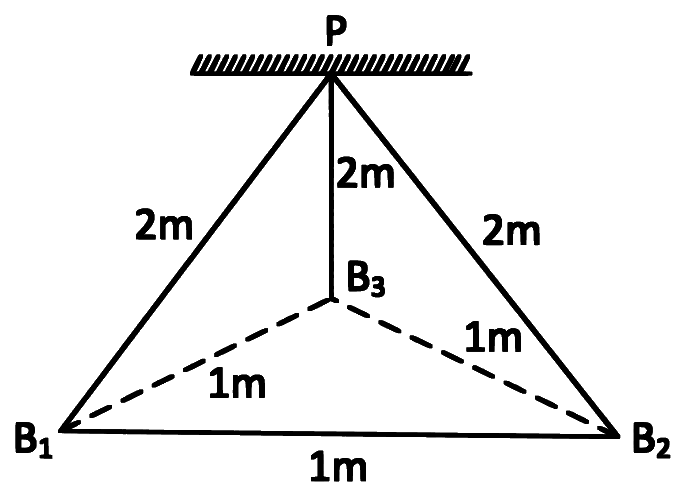
Three identical charged balls each of charge 2 C are suspended from a common point P by silk threads of 2 m each (as shown in figure). They form an equilateral triangle of side 1m. The ratio of net force on a charged ball to the force between any two charged balls will be:
Electric Charge & Coulomb's Law · Properties of charge & charging
Two positive ions, each carrying a charge 'q' are separated by a distance 'd'. If 'F' is the force of repulsion between the ions, the number of electrons from each ion will be (e = charge on electron,ε0 = permittivity of free space)
Electric Charge & Coulomb's Law · Properties of charge & charging
When a piece of polythene is rubbed with wool, a negative charge of 4×10⁻⁷ C is developed on the polythene. The number of electrons transferred from wool to polythene is [e=1.6×10⁻¹⁹ C]
Electric Charge & Coulomb's Law · Coulomb's law & medium
'F' is the force between the two identical charged particles placed at a distance 'Y' from each other. If the distance between the charges is reduced to half the previous distance then force between them becomes
Electric Charge & Coulomb's Law · Coulomb's law & medium
A certain charge Q is divided into two parts q and (Q − q). How should the charges Q and q be divided so that q and (Q − q) placed at a certain distance apart experience maximum electrostatic repulsion?
Electric Charge & Coulomb's Law · Superposition of forces
Three charges each of +1μC are placed at the corners of an equilateral triangle. If the repulsive force between any two charges is F, then the net force on either charge will be [cos60∘=0.5]
Electric Charge & Coulomb's Law · Equilibrium of charges
A point charge Q is placed at the centre of the line joining two equal point charges +q and +q. The value of Q if the system of the charges is in equilibrium, is
Electric Charge & Coulomb's Law · Equilibrium of charges
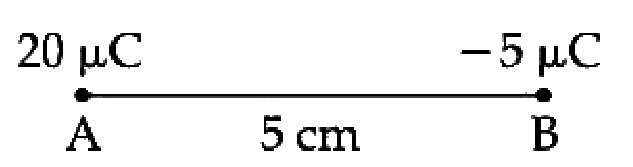
Two particles A and B having charges 20μC and −5μC respectively are held fixed with a separation of 5 cm. At what position a third charged particle should be placed so that it does not experience a net electric force?
Electric Charge & Coulomb's Law · Coulomb's law & medium
Two point charges +3μC and +8μC repel each other with a force of 40 N. If a charge of −5μC is added to each of them, then force between them will become
Electric Charge & Coulomb's Law · Coulomb's law & medium
Two identical conducting spheres with negligible volume have 2.1 nC and −0.1 nC charges, respectively. They are brought into contact and then separated by a distance of 0.5 m. The electrostatic force acting between the spheres is __________ × 10−9 N.
[Given: 4πε0=9×1091 SI unit]
Numerical answer type. Work it out, then open the answer.
Electric Charge & Coulomb's Law · Equilibrium of charges
Two identical tennis balls each having mass 'm' and charge 'q' are suspended from a fixed point by threads of length 'l'. What is the equilibrium separation when each thread makes a small angle 'θ' with the vertical?
Electric Charge & Coulomb's Law · Equilibrium of charges
Two small spheres each of mass 10 mg are suspended from a point by threads 0.5 m long. They are equally charged and repel each other to a distance of 0.20 m. The charge on each of the sphere is 21a×10−8 C. The value of 'a' will be ___________. [Given g = 10 ms−2]
Numerical answer type. Work it out, then open the answer.
Electric Charge & Coulomb's Law · Superposition of forces
Three charges + Q, q, + Q are placed respectively, at distance, 0, d/2 and d from the origin, on the x- axis. If the net force experienced by + Q, placed at x = 0, is zero, then value of q is:
Electric Charge & Coulomb's Law · Coulomb's law & medium
Two point charges A and B, having charges +Q and – Q respectively, are placed at certain distance apart and force acting between them is F. If 25% charge of A is transferred to B, then force between the charges becomes:
Electric Charge & Coulomb's Law · Coulomb's law & medium
Two identical conducting spheres A and B, carry equal charge. They are separated by a distance much larger than their diameters, and the force between them is F. A third identical conducting sphere, C, is uncharged. Sphere C is first touched to A, then to B, and then removed. As a result, the force between A and B would be equal to:
Electric Charge & Coulomb's Law · Coulomb's law & medium
Suppose the charge of a proton and an electron differ slightly. One of them is −e, the other is (e + Δe). If the net of electrostatic force and gravitational force between two hydrogen atoms placed at a distance d (musch greater than atomic size) apart is zero, then Δe is of the order of [Given: mass of hydrogen mh = 1.67 × 10⁻²⁷ kg]
Electric Charge & Coulomb's Law · Equilibrium of charges
Two identical charged spheres suspended from a common point by two massless strings of lengths l, are initially at a distance d(d < < l) apart because of their mutual repulsion. The charges begin to leak from both the spheres at a constant rate. As a result, the spheres approach each other with a velocity v. Then v varies as a function of the distance x between the spheres, as
Electric Charge & Coulomb's Law · Equilibrium of charges
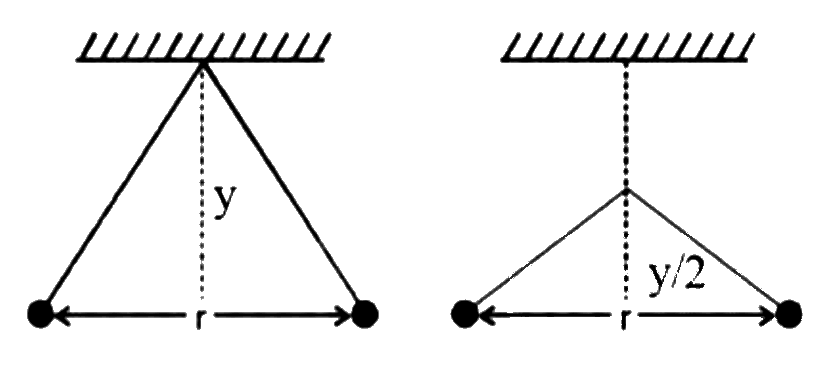
Two pith balls carrying equal charges are suspended from a common point by strings of equal length, the equilibrium separation between them is r. Now the strings are rigidly clamped at half the height. The equilibrium separation between the balls now becomes
Electric Charge & Coulomb's Law · Equilibrium of charges
Two small equal point charges of magnitude q are suspended from a common point on the ceiling by insulating mass less strings of equal lengths. They come to equilibrium with each string making angle θ from the vertical. If the mass of each charge is m, then the electrostatic potential at the centre of line joining them will be (4πϵ01=k).
Electric Charge & Coulomb's Law · Equilibrium of charges
Two balls of same mass and carrying equal charge are hung from a fixed support by threads of length l. At electrostatic equilibrium, assuming that angles made by each thread is small, the separation, x between the balls is proportional to:
Electric Charge & Coulomb's Law · Equilibrium of charges
Two identical charged spheres suspended from a common point by two massless strings of length l are initially a distance d(d<<l) apart because of their mutual repulsion. The charge begins to leak from both the spheres at a constant rate. As a result charges approach each other with a velocity v. Then as a function of distance x between them,
Electric Charge & Coulomb's Law · Properties of charge & charging
Two positive ions, each carrying a charge q, are separated by a distance d. If F is the force of repulsion between the ions, the number of electrons missing from each ion will be (e being the charge on an electron)
Electric Charge & Coulomb's Law · Equilibrium of charges
Two identical charged spheres are suspended by strings of equal lengths. The strings make an angle of 30∘ with each other. When suspended in a liquid of density 0.8 g cm−3, the angle remains the same. If density of the material of the sphere is 1.6 g cm−3, the dielectric constant of the liquid is
Electric Charge & Coulomb's Law · Superposition of forces
A charge Q is placed at each of the opposite corners of a square. A charge q is placed at each of the other two corners. If the net electrical force on Q is zero, then Q/q equals:
Electric Charge & Coulomb's Law · Coulomb's law & medium
Two spherical conductors B and C having equal radii and carrying equal charges on them repel each other with a force F when kept apart at some distance. A third spherical conductor having same radius as that of B but uncharged is brought in contact with B, then brought in contact with C and finally removed away from both. The new force of repulsion between B and C is
Electric Charge & Coulomb's Law · Equilibrium of charges
A charge q is placed at the centre of the line joining two exactly equal positive charges Q. The system of three charges will be in equilibrium, if q is equal to