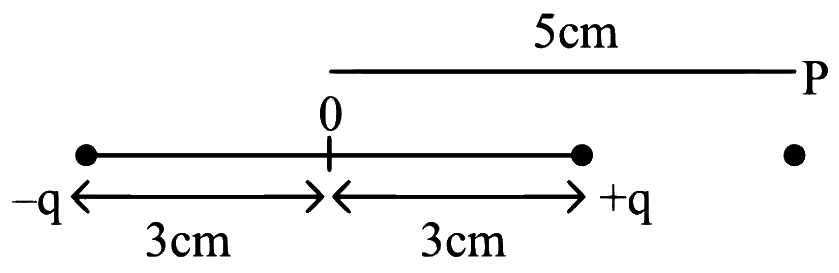
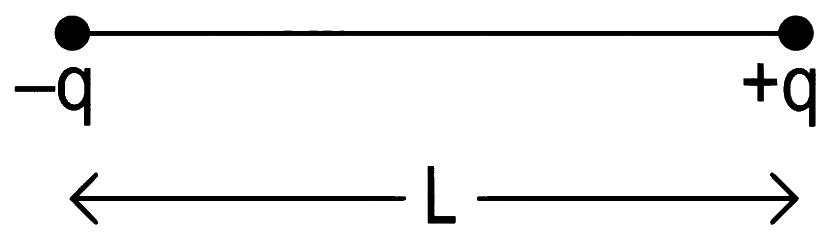
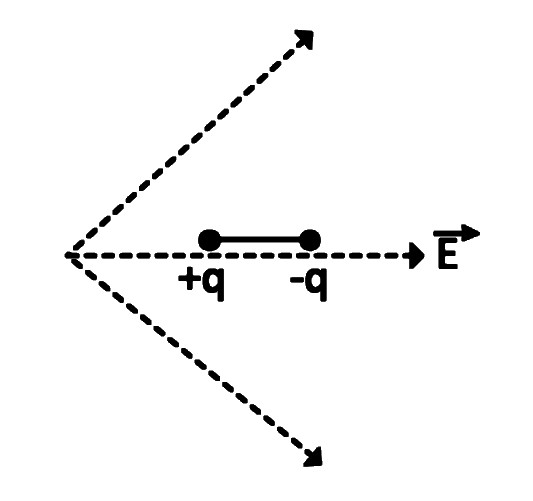
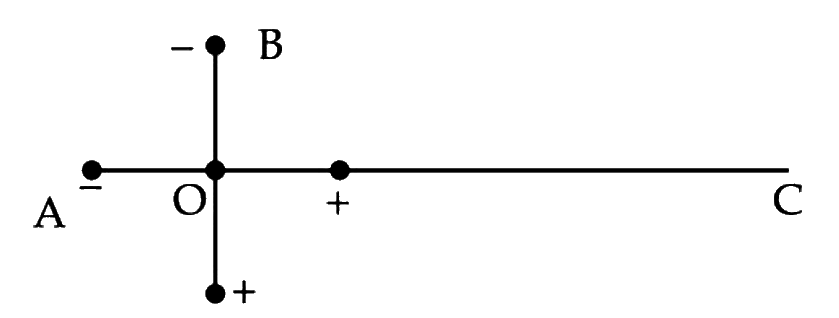
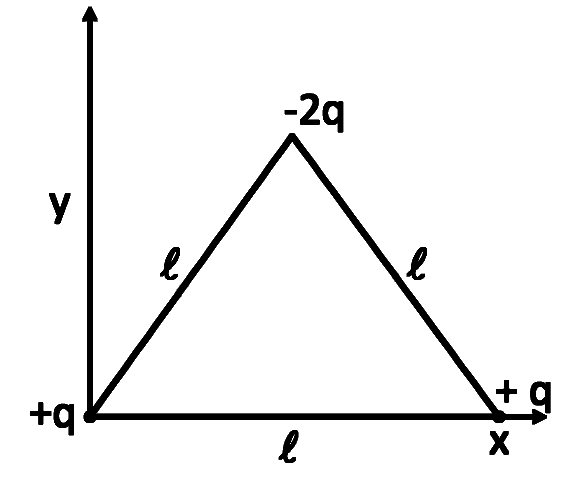
Three charges +2q,+3q and −4q are situated at (0,−3a),(2a,0) and (−2a,0) respectively in the xy plane. The resultant dipole moment about origin is ______.
A dipole of electric dipole moment P is placed in an electric field of strength E. The angle between P and E for which the potential energy of the electric dipole is maximum, is
An electric dipole of length 3cm is placed with its axis making an angle of 60∘ with a uniform electric field of 5×10⁴N/C. It experiences a torque of 93 Nm. The magnitude of charge on the dipole is (sin60∘=23)
An electric dipole of length 0.5μm is placed with its axis making an angle of 30∘ with uniform electric field 104 V/m. If it experiences a torque of 5×10⁻⁹ Nm, the magnitude of the charge on the dipole is (sin30∘=0.5)
A rigid dipole undergoes a simple harmonic motion about its centre in the presence of an electric field E1=E0x^. If another electric field E2=2E0(y^+z^) is introduced to the system, what will be the percentage change in the frequency of the oscillation (approximate)?
Two electric dipoles of moment P and 8P are placed in opposite directions on a line at a distance of 24 cm. The electric field will be zero at the point between the dipoles whose distance from the dipole of moment P will be x1. When 8P is replaced by 27P keeping all other quantities the same, the distance x1 now becomes x2. The difference ∣x2−x1∣ is ( All the distances are measured from the centers of the dipole.)
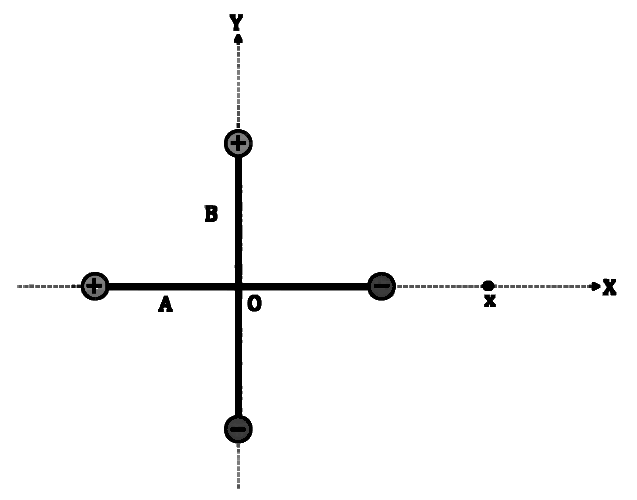
Two short electric dipoles A and B having dipole moment p1 and p2 respectively are placed with their axes mutually perpendicular as shown in the figure. The resultant electric field at a point x is making an angle of 60∘ with the line joining points O and x. The ratio of the dipole moments p2/p1 is _________.
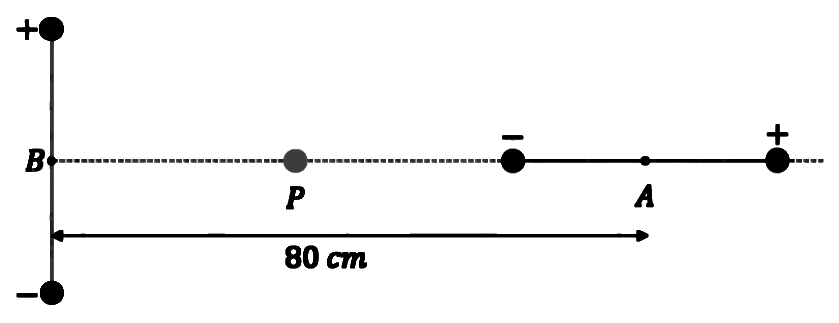
Two short dipoles (A,B),A having charges ±2μC and length 1 cm and B having charges ±4μC and length 1 cm are placed with their centres 80 cm apart as shown in the figure. The electric field at a point P, equi-distant from the centres of both dipoles is ______ N/C.
An electric dipole of length 2 cm is placed with its axis making an angle of 60∘ to a uniform electric field of 10+5 N/C. If it experiences a torque of 93 Nm, the magnitude of the charge on the dipole is (sin60∘=23)
An electric dipole having each charge of magnitude 2μC is placed in an electric field of intensity 8×10+4 N/C. If the maximum torque acting on the dipole is 4×10⁻³ N-m, the length of the dipole is
An electric dipole of dipole moment ' p ' is aligned parallel to a uniform electric field ' E '. The energy required to rotate the dipole by 90∘ is [sin0∘=0,cos0∘=1,sin90∘=1cos90∘=0]
An electric dipole with dipole moment 5×10⁻⁶ Cm is aligned with the direction of a uniform electric field of magnitude 4×10⁵ N/C. The dipole is then rotated through an angle of 60∘ with respect to the electric field. The change in the potential energy of the dipole is:
A dipole with two electric charges of 2 µC magnitude each, with separation distance 0.5 µm, is placed between the plates of a capacitor such that its axis is parallel to an electric field established between the plates when a potential difference of 5 V is applied. Separation between the plates is 0.5 mm. If the dipole is rotated by 30° from the axis, it tends to realign in the direction due to a torque. The value of torque is:
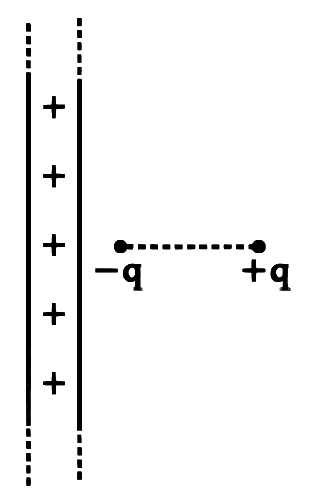
An electric dipole is placed at a distance of 2 cm from an infinite plane sheet having positive charge density σ0. Choose the correct option from the following.
Two point charges −4μC and 4μC, constituting an electric dipole, are placed at (−9,0,0) cm and (9,0,0) cm in a uniform electric field of strength 104 NC−1. The work done on the dipole in rotating it from the equilibrium through 180∘ is:
An electric dipole of dipole moment 6×10⁻⁶ Cm is placed in uniform electric field of magnitude 106 V/m. Initially, the dipole moment is parallel to electric field. The work that needs to be done on the dipole to make its dipole moment opposite to the field, will be _______ J.
Numerical answer type. Work it out, then open the answer.
Given below are two statements: one is labelled as Assertion (A) and the other is labelled as Reason (R).
Assertion (A): Net dipole moment of a polar linear isotropic dielectric substance is not zero even in the absence of an external electric field.
Reason (R): In absence of an external electric field, the different permanent dipoles of a polar dielectric substance are oriented in random directions.
In the light of the above statements, choose the most appropriate answer from the options given below:
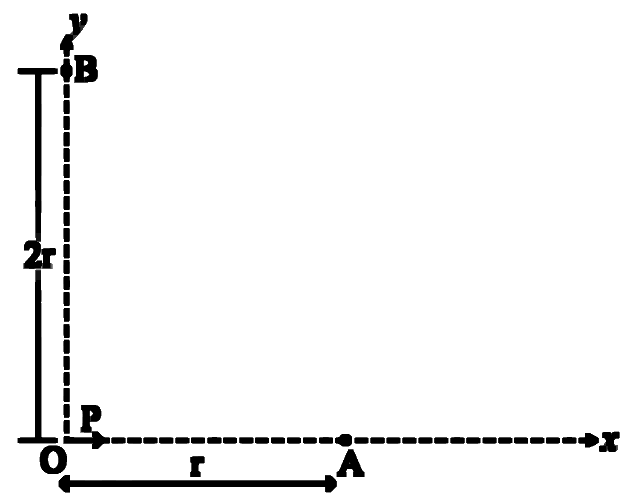
For a short dipole placed at origin O, the dipole moment P is along x-axis, as shown in the figure. If the electric potential and electric field at A are V0 and E0, respectively, then the correct combination of the electric potential and electric field, respectively, at point B on the y-axis is given by
Two small spherical balls of mass 10 g each with charges −2μC and 2μC, are attached to two ends of very light rigid rod of length 20 cm. The arrangement is now placed near an infinite nonconducting charge sheet with uniform charge density of 100μC/m2 such that length of rod makes an angle of 30∘ with electric field generated by charge sheet. Net torque acting on the rod is: (Take ε0:8.85×10⁻¹² C2/Nm2)
An electric dipole of mass m, charge q, and length l is placed in a uniform electric field E=E0i^. When the dipole is rotated slightly from its equilibrium position and released, the time period of its oscillations will be:
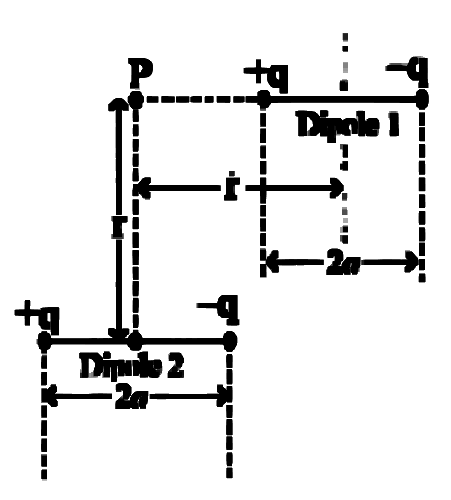
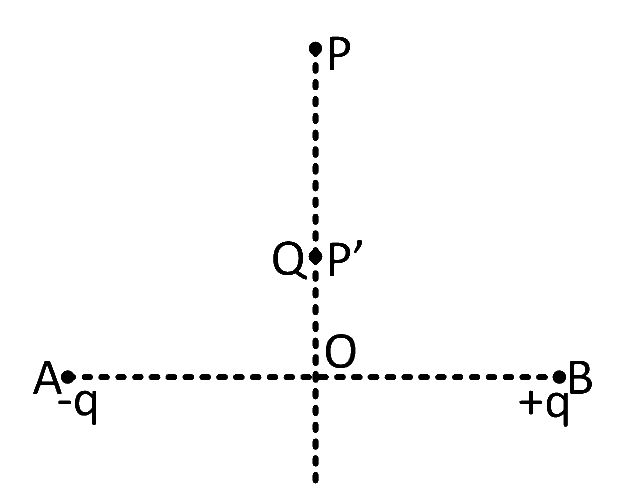
A point particle of charge Q is located at P along the axis of an electric dipole 1 at a distance r as shown in the figure. The point P is also on the equatorial plane of a second electric dipole 2 at a distance r. The dipoles are made of opposite charge q separated by a distance 2a. For the charge particle at P not to experience any net force, which of the following correctly describes the situation?
The electric potential at a point on the axis of an electric dipole is proportional to [r = distance between centre of the electric dipole and the point]
Given below are two statements: one is labelled as Assertion A and the other is labelled as Reason R.
Assertion A: The potential (V) at any axial point, at 2 m distance (r) from the centre of the dipole of dipole moment vector P of magnitude, 4×10⁻⁶ Cm, is ±9×10³ V.
(Take 4πϵ01=9×10⁹ SI units)
Reason R: V=±4πϵ0r22P, where r is the distance of any axial point, situated at 2 m from the centre of the dipole.
In the light of the above statements, choose the correct answer from the options given below:
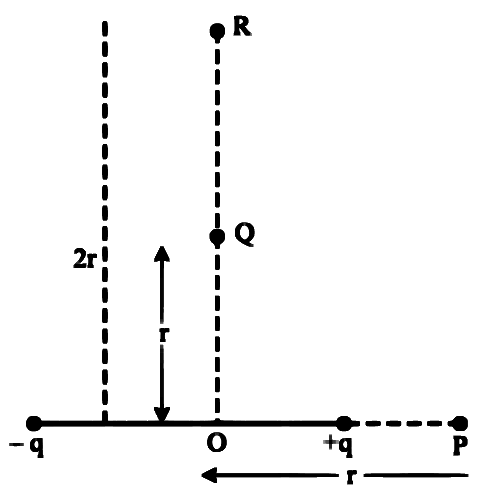
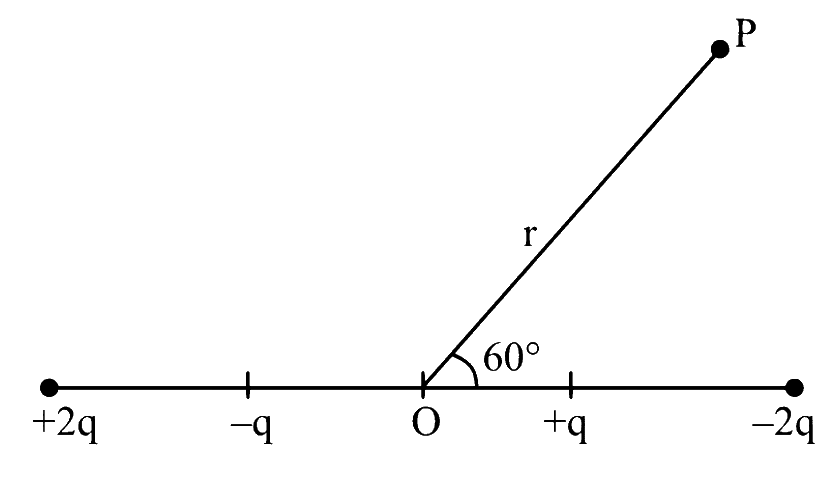
The distance between charges +q and −q is 2l and between +2q and −2q is 4l. The electrostatic potential at point P at a distance r from center O is −α[r2ql]×109 V, where the value of α is __________. (Use 4πε01=9×10⁹ Nm2C−2)
Numerical answer type. Work it out, then open the answer.
An electric dipole of momentpis lying along a uniform electric field E. The work done in rotating the dipole through 3πc is [sin30∘=cos60∘=0.5,cos30∘=sin60∘=3/2]
Two charges of −4μC and +4μC are placed at the points A(1,0,4) m and B(2,−1,5) m located in an electric field E=0.20i^ V/cm. The magnitude of the torque acting on the dipole is 8α×10−5 Nm, where α= _________.
Numerical answer type. Work it out, then open the answer.
If Ea and Eq represent the electric field intensity due to a short dipole at a point on its axial line and on the equatorial line at the same distance 'r' from the centre of the dipole, then
An electric dipole consisting of two opposite charges of 2×10⁻⁶ C separated by a distance of 3 cm placed in an electric field of 2×10⁵ N/C then the maximum torque acting on dipole is
An electric dipole is placed at an angle of 30∘ with an electric field of intensity 2×10⁵ NC−1. It experiences a torque equal to 4 N m. Calculate the magnitude of charge on the dipole, if the dipole length is 2 cm.
Two charges each of magnitude 0.01 C and separated by a distance of 0.4 mm constitute an electric dipole. If the dipole is placed in an uniform electric field 'E' of 10 dyne/C making 30∘ angle with E, the magnitude of torque acting on dipole is:
An electric dipole of dipole moment 6.0×10⁻⁶ Cm is placed in a uniform electric field of 1.5×10³ NC−1 in such a way that dipole moment is along electric field. The work done in rotating dipole by 180∘ in this field will be ___________ mJ.
Numerical answer type. Work it out, then open the answer.
If the magnitude of intensity of electric field at a distance 'r1 ' on an axial line and at a distance 'r2 ' on an equatorial line due to a given short dipole are equal, then r1:r2, is
The work done in rotating a dipole placed parallel to the electric field through 180∘ is W. So, the work done in rotating it through 60∘ is (cos0∘=1,cos60∘=21,cos180∘=−1)
Two electric dipoles of moment P and 27P are placed on a line with their centres 24 cm apart. Their dipole moments are in opposite direction. At which point the electric field will be zero between the dipoles from the centre of dipole of moment P?
A dipole comprises of two charged particles of identical magnitude q and opposite in nature. The mass 'm' of the positive charged particle is half of the mass of the negative charged particle. The two charges are separated by a distance 'l'. If the dipole is placed in a uniform electric field 'E'; in such a way that dipole axis makes a very small angle with the electric field, 'E'. The angular frequency of the oscillations of the dipole when released is given by:
Two electric dipoles of dipole moments 1.2×10⁻³⁰ Cm and 2.4×10⁻³⁰ Cm are placed in two different uniform electric fields of strengths 5×10⁴ NC−1 and 15×104 NC−1 respectively. The ratio of maximum torque experienced by the electric dipoles will be x1. The value of x is __________.
Numerical answer type. Work it out, then open the answer.
Given below two statements: One is labelled as Assertion (A) and other is labelled as Reason (R). Assertion (A): Non-polar materials do not have any permanent dipole moment. Reason (R): When a non-polar material is placed in an electric field, the centre of the positive charge distribution of it's individual atom or molecule coincides with the centre of the negative charge distribution.
In the light of above statements, choose the most appropriate answer from the options given below.
An electric dipole having dipole moment P=q×2ℓ is placed in a uniform electric field 'E'. The dipole moment is along the direction of the field. The force acting on it and its potential energy are respectively
Two ideal electric dipoles A and B, having their dipole moment p1 and p2 respectively are placed on a plane with their centres at O as shown in the figure. At point C on the axis of dipole A, the resultant electric field is making an angle of 37∘ with the axis. The ratio of the dipole moment of A and B, p2p1 is: (take sin37∘=53)
An electric dipole is placed on x-axis in proximity to a line charge of linear charge density 3.0 × 10 −6 C/m. Line charge is placed on z-axis and positive and negative charge of dipole is at a distance of 10 mm and 12 mm from the origin respectively. If total force of 4N is exerted on the dipole, find out the amount of positive or negative charge of the dipole.
A short electric dipole has a dipole moment of 16 × 10-9 Cm. The electric potential due to the dipole at a point at a distance of 0.6 m from the centre of the dipole, situated on a line making an angle of 60∘ with the dipole axis is:
Two identical electric point dipoles have dipole moments p1=pi^ and p2=−pi^ and are held on the x axis at distance 'a' from each other. When released, they move along the x-axis with the direction of their dipole moments remaining unchanged. If the mass of each dipole is 'm', their speed when they are infinitely far apart is:
A point dipole p=−p0x^ is kept at the origin. The potential and electric field due to this dipole on the y-axis at a distance d are, respectively: (Take V= 0 at infinity)
An electric field of 1000 V/m is applied to an electric dipole at angle of 45o. The value of electric dipole moment is 10–29 C.m. What is the potential energy of the electric dipole?
Charges –q and +q located at A and B, respectively, constitude an electric dipole. Distance AB = 2a, O is the mid point of the dipole and OP is perpendicular to AB. A charge Q is placed at P where OP = y and y >> 2a. The charge Q experiences an electrostatic force F. If Q is now moved along the equatorial line to P' such that OP' = (3y), the force on Q will be close to - (3y≫2a)
An electric dipole is formed by two equal and opposite charges q with separation d. The charges have same mass m. It is kept in a uniform electric field E. If it is slightly rotated from its equilibrium orientation, then its angular frequency ω is :-
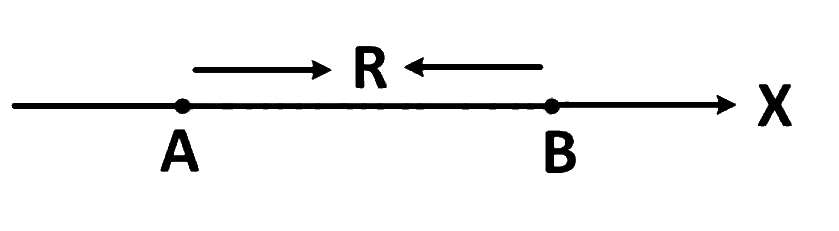
Two electric dipoles, A, B with respective dipole moments dA=−4qai^ and dB=−2qai^ are placed on the x-axis with a separation R, as shown in the figure. The distance from A at which both of them produce the same potential is -
An electric dipole has a fixed dipole moment p, which makes angle θ with respect to x-axis. When subjected to an electric field E1=Ei^, it experiences a torque T1=τk^. When subjected to another electric field E2=3E1j^ it experiences a torque T2=−T1. The angle θ is:
An electric dipole is placed at an angle of 30o with an electric field intensity 2 × 10⁵ N C−1. It experiences a torque equal to 4 N m. The charge on the dipole, if the dipole length is 2 cm, is
An electric dipole of moment p is placed in an electric field of intensity E. The dipole acquires a position such that the axis of the dipole makes an angle θ with the direction of the field. Assuming that the potential energy of the dipole to be zero when θ = 90o, the torque and the potential energy of the dipole will respectively be
An electric dipole has the magnitude of its charge as q and its dipole moment is p. It is placed in a uniform electric field E. If its dipole moment is along the direction of the field, the force on it and its potential energy are respectively
A point Q lies on the perpendicular bisector of an electrical dipole of dipole moment p. If the distance of Q from the dipole is r (much larger than the size of the dipole) then electric field at Q is proportional to
An electric dipole of moment p is placed in the position of stable equilibrium in uniform electric field of intensity E. This is rotated through an angle θ from the initial position. The potential energy of the electric dipole in the final position is