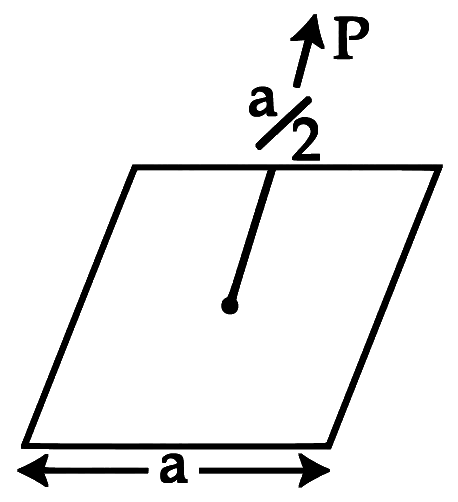
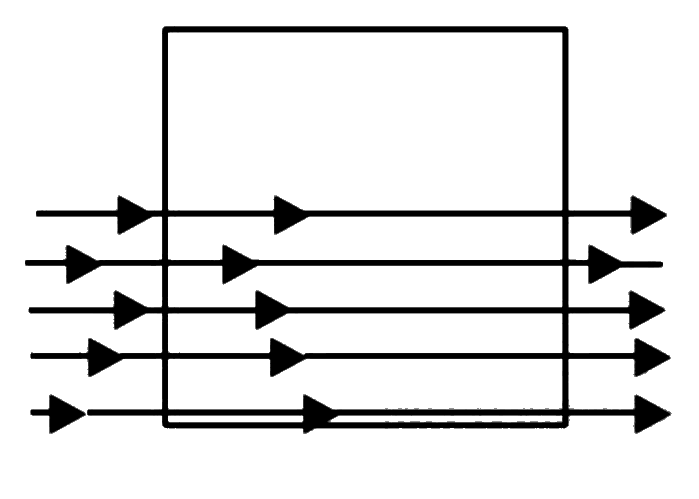
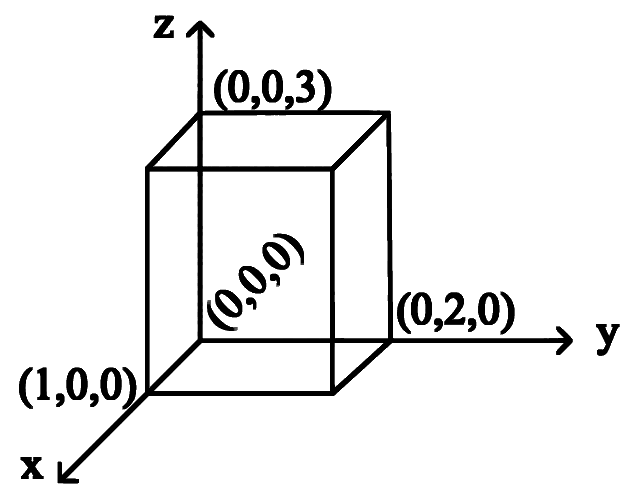
The electric field in the region is E=ai^+bj^ where 'a' and 'b' are constants. The net electric flux passing through a square area of side 'l' parallel to Y-Z plane is
The electric flux entering and leaving an enclosed surface are Φ1 and Φ2 respectively. The electric charge inside the surface will be (ε0 = permittivity of vacuum)
Two point charges 8μC and −2μC are located at x=2 cm and x=4 cm, respectively on the x-axis. The ratio of electric flux due to these charges through two spheres of radii 3 cm and 5 cm with their centers at the origin is ________.
The electric field intensity at a point near and outside the surface of a charged conductor of any shape is E1. The electric field intensity due to a uniformly charged infinite thin plane sheet having the same surface charge density is E2. The relation between E1 and E2 is
A. Inside a conductor, the electrostatic field is zero.
B. Electric field at the surface of a charged conductor does not depend on its surface charge density.
C. The interior of a charged conductor can have no excess charge in the static situation. D. At the surface of a charged conductor, the electrostatic field must be normal to the surface at every point.
E. The electrostatic potential is zero everywhere inside a charged conductor.
Choose the correct answer from the options given below:
Given below are two statements: one is labelled as Assertion A and the other is labelled as Reason R
Assertion A: In electrostatics, a conductor does not store any net charge inside. Reason R: Inside the capacitor (with no dielectric medium), the free charge carriers, if placed between the plates of capacitor, experience force and drift.
Choose the correct answer from the options given below
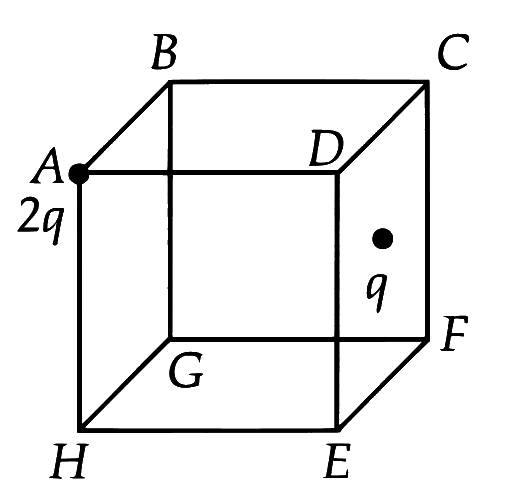
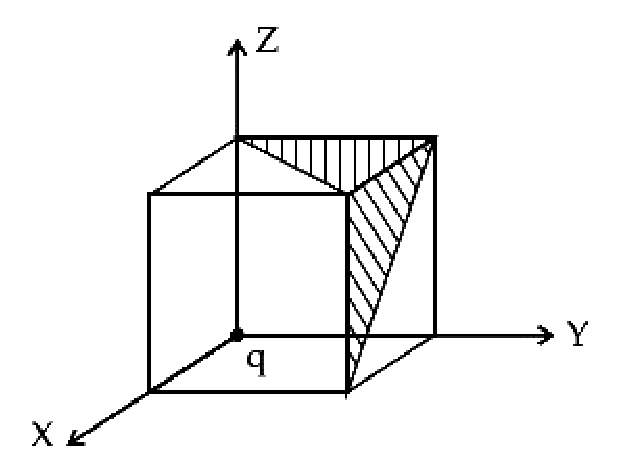
Two point charges 2q and q are placed at vertex A and centre of face CDEF of the cube as shown in figure. The electric flux passing through the cube is:
A spherical conductor of diameter 3 mm is kept in a uniform electric field of intensity 4×10⁷ N/C. The maximum charge on the conductor is (4πϵ01=9×10⁹ SI units)
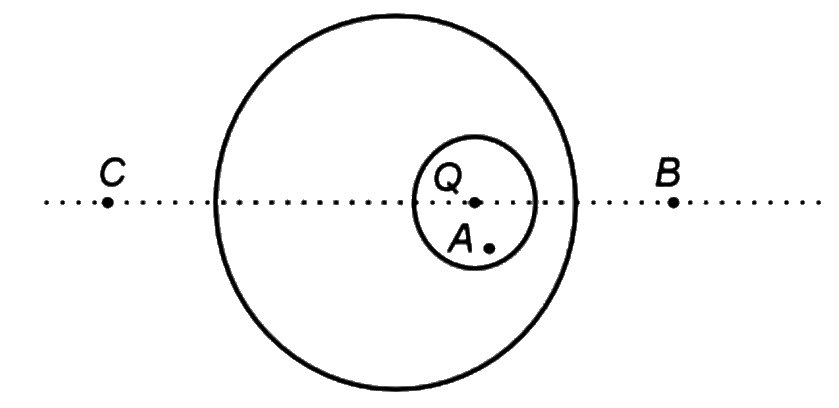
A point charge Q is placed inside a cavity within a solid isolated conducting sphere. Consider points A,B and C as shown in the figure, where the magnitudes of the electric fields are EA,EB,EC, respectively. The points B and C are at the same distance from the center of the solid sphere. The correct option is:
The electric field in a region is given by E=(2i^+4j^+6k^)×103 N/C. The flux of the field through a rectangular surface parallel to x−z plane is 6.0 N m2C−1. The area of the surface is _____________ cm2.
Numerical answer type. Work it out, then open the answer.
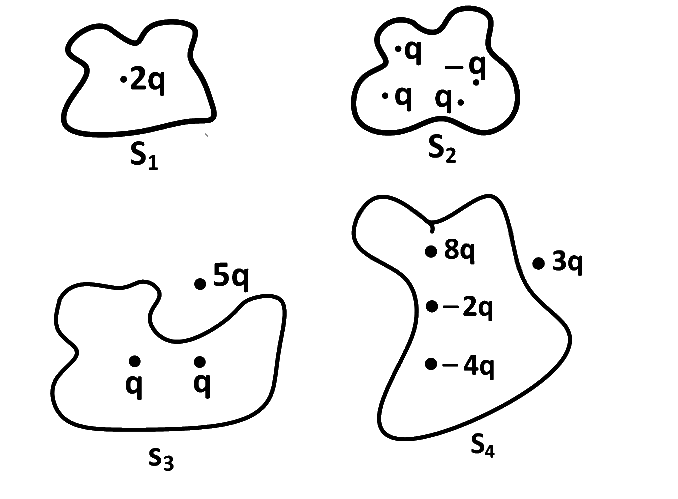
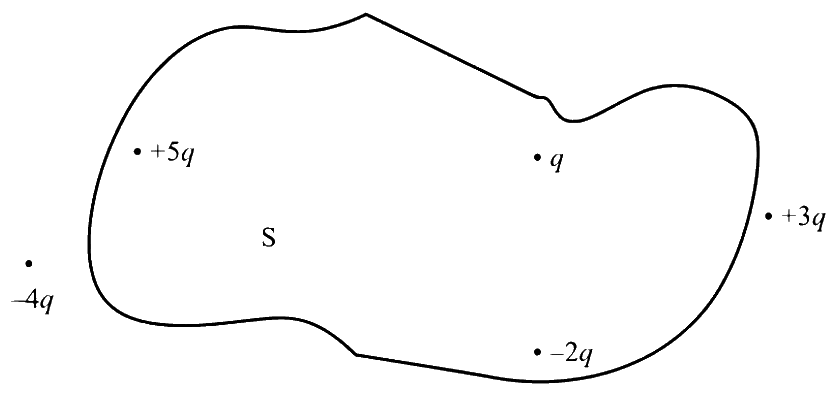
Four charges 2μC,−3μC,4μC,−4μC and −1μC are enclosed by the Gaussian surface of radius 2 m. Net outward flux through the Gaussian surface is (in μV-m) [ ε0= permittivity of free space]
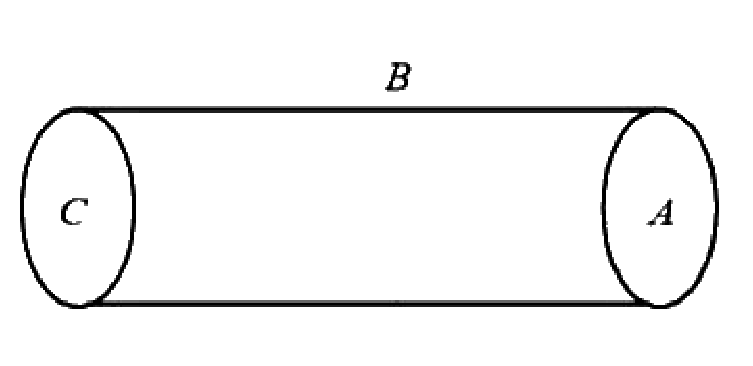
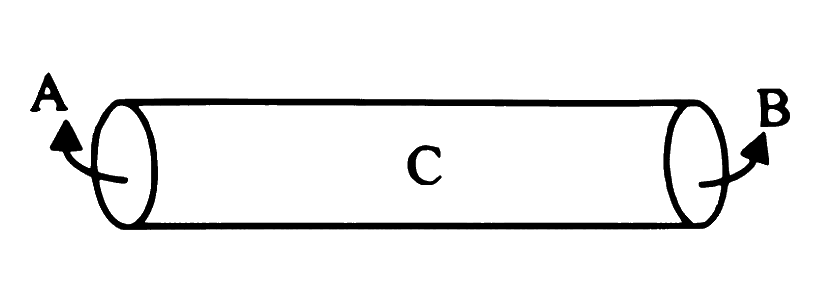
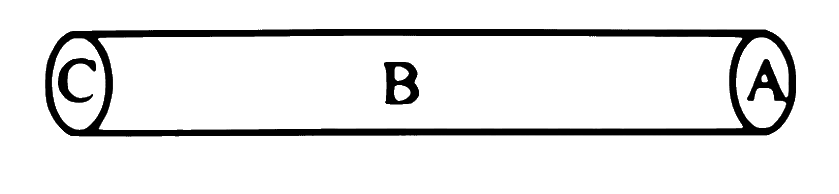
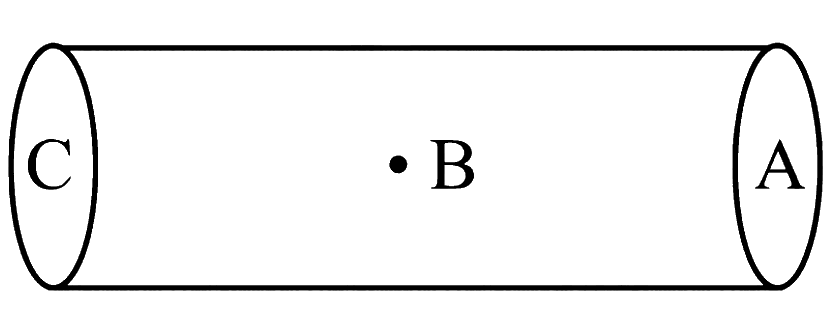
A hollow cylinder has a charge ' q ' coulomb within it. If ' ϕ ' is the electric flux in unit of V-m associated with the curved surface C, the flux linked with the plane surface ' A ' in unit of V-m will be [ ε0= permittivity of free space]0
A hollow cylinder has a charge of ' q ' C within it. If ϕ is the electric flux associated with the curved surface B, the flux linked with the plane surface A will be
A point charge causes an electric flux of −2×10⁴ N m2C−1 to pass through a spherical Gaussian surface of 8.0 cm radius, centred on the charge. The value of the point charge is: (Given ϵ0=8.85×10⁻¹² C2N−1m−2)
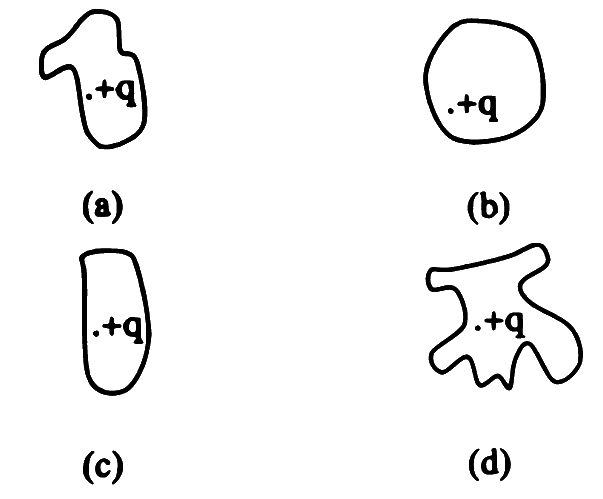
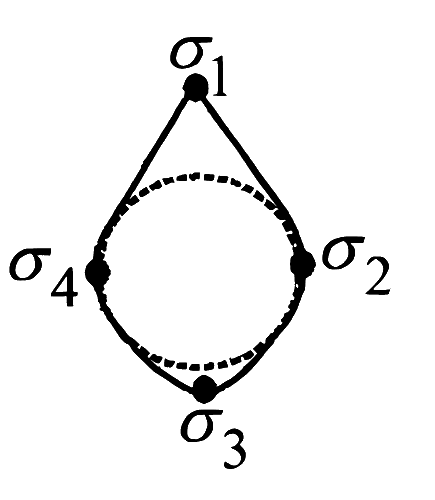
Electric charge is transferred to an irregular metallic disk as shown in the figure. If σ1,σ2,σ3 and σ4 are charge densities at given points then, choose the correct answer from the options given below:
Given below are two statements: one is labelled as Assertion (A) and the other is labelled as Reason (R).
Assertion (A): The outer body of an aircraft is made of metal which protects persons sitting inside from lightning strikes.
Reason (R): The electric field inside the cavity enclosed by a conductor is zero. In the light of the above statements, choose the most−appropriate answer from the options given below:
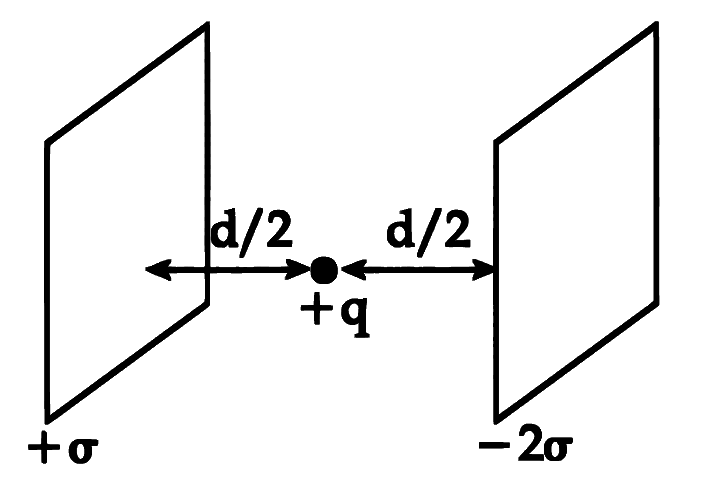
Consider two infinitely large plane parallel conducting plates as shown below. The plates are uniformly charged with a surface charge density +σ and −2σ. The force experienced by a point charge +q placed at the mid point between two plates will be:
A uniformly charged conducting sphere of diameter 3.5 cm has a surface charge density of 20μC m−2. The total electric flux leaving the surface of the sphere is nearly [permittivity of free space, ε0=8.85×10⁻¹² SI unit]
An infinitely long wire has uniform linear charge density λ=2 nC/m. The net flux through a Gaussian cube of side length 3 cm, if the wire passes through any two corners of the cube, that are maximally displaced from each other, would be x Nm2C−1, where x is:
[Neglect any edge effects and use 4πϵ01=9×10⁹ SI units]
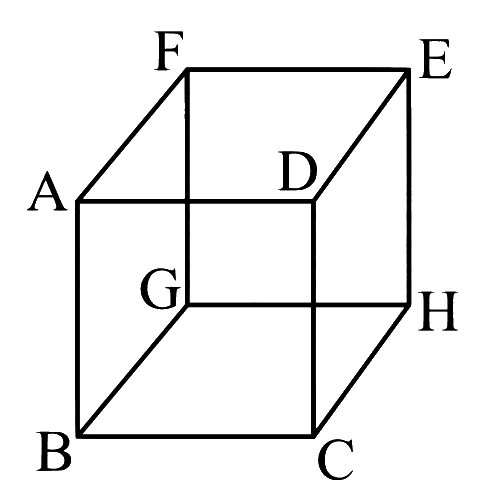
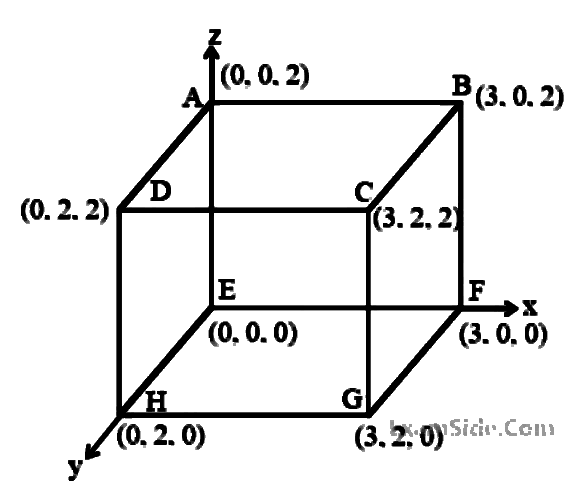
A line charge of length 2a is kept at the center of an edge BC of a cube ABCDEFGH having edge length ' a ' as shown in the figure. If the density of line charge is λ C per unit length, then the total electric flux through all the faces of the cube will be ___________. (Take, ϵ0 as the free space permittivity)
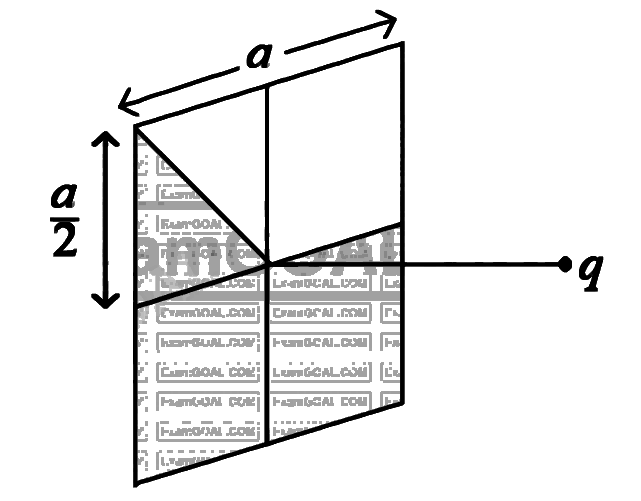
A square loop of sides a=1 m is held normally in front of a point charge q=1 C at a distance 2a. The flux of the electric field through the shaded region is p5×ε01CNm2, where the value of p is ________.
Numerical answer type. Work it out, then open the answer.
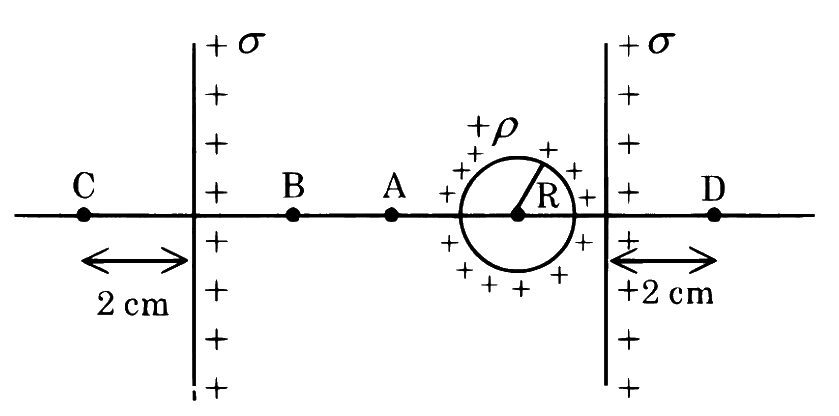
Two infinite identical charged sheets and a charged spherical body of charge density ' ρ ' are arranged as shown in figure. Then the correct relation between the electrical fields at A,B,C and D points is:
An electric field, E=62i^+6j^+8k^ passes through the surface of 4 m2 area having unit vector n^=(62i^+j^+k^). The electric flux for that surface is _________ V m.
Numerical answer type. Work it out, then open the answer.
A hollow cylinder has charge ' q ' C within it. If ' ϕ ' is the electric flux associated with the curved surface B, the flux linked with the plane surface A will be:
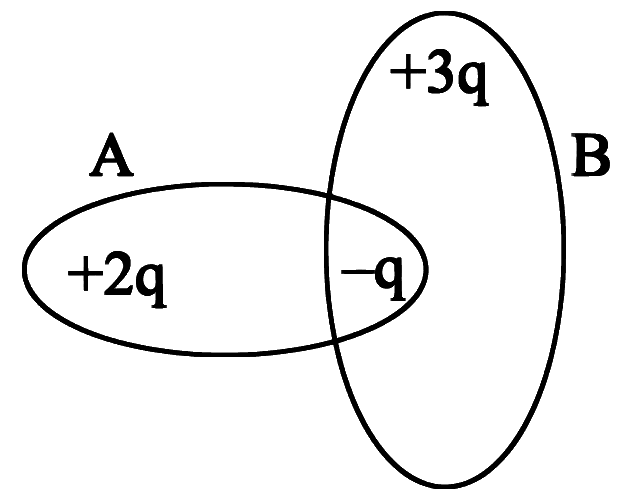
Two surfaces A and B are enclosing the charges as shown below. The total normal electric induction (T.N.E.I) through the surfaces A and B are respectively.
A spherical rubber balloon carries a charge, uniformly distributed over the surface. As the balloon is blown up and increases in size, the total electric flux coming out of the surface
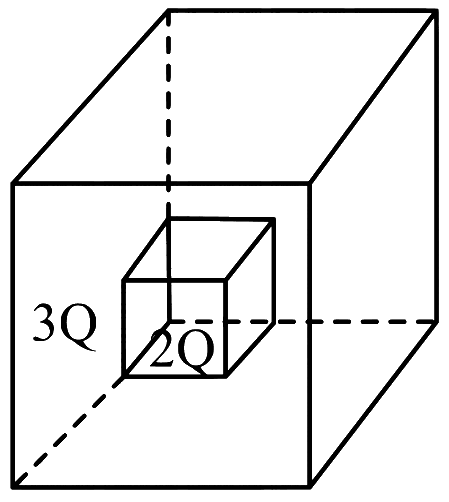
C1 and C2 are two hollow concentric cubes enclosing charges 2Q and 3Q respectively as shown in figure. The ratio of electric flux passing through C1 and C2 is:
Two charges of 5Q and −2Q are situated at the points (3a,0) and (−5a,0) respectively. The electric flux through a sphere of radius '4a' having center at origin is:
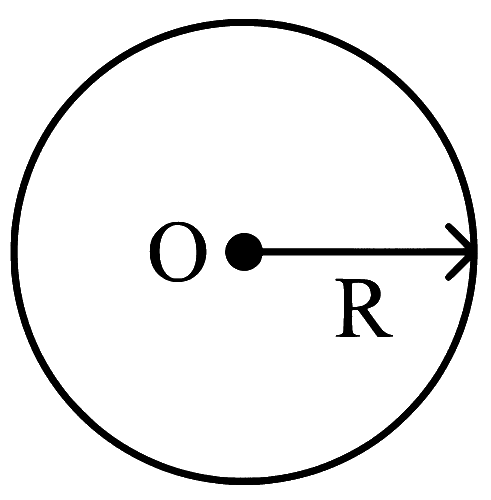
σ is the uniform surface charge density of a thin spherical shell of radius R. The electric field at any point on the surface of the spherical shell is:
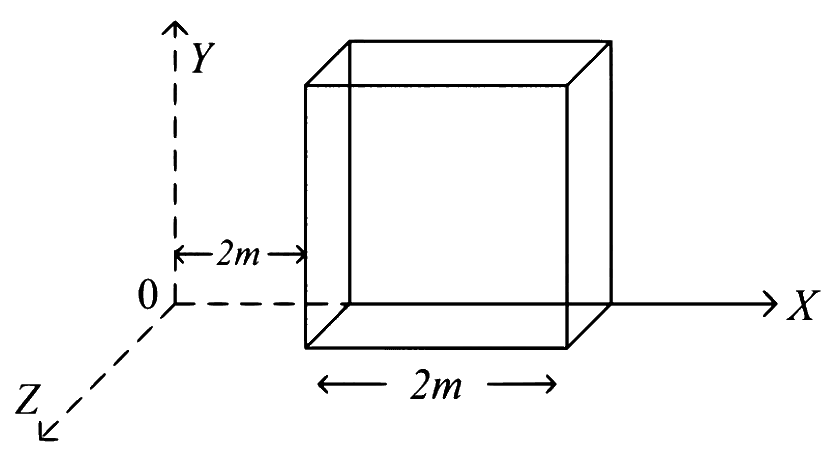
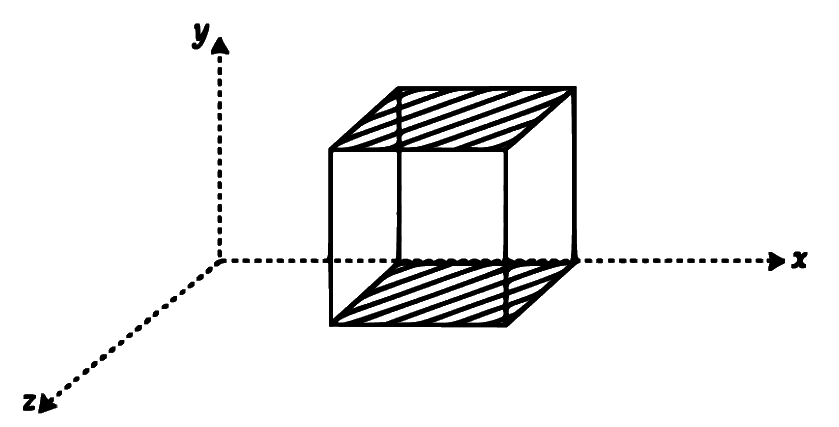
An electric field E=(2xi^) NC−1 exists in space. A cube of side 2 m is placed in the space as per figure given below. The electric flux through the cube is ______ Nm2/C.
Numerical answer type. Work it out, then open the answer.
A uniformly charged conducting sphere of diameter 14 cm has surface charge density of 40μC m−2. The total electric flux leaving the surface of the sphere is nearly (Permittivity of free space =8.85×10⁻¹² SI unit)
Consider a long uniformly charged cylinder having constant volume charge density ' λ ' and radius ' R '. A Gaussian surface is in the form of a cylinder of radius ' r ' such that vertical axis of both the cylinders coincide. For a point inside the cylinder (r<R), electric field is directly proportional to
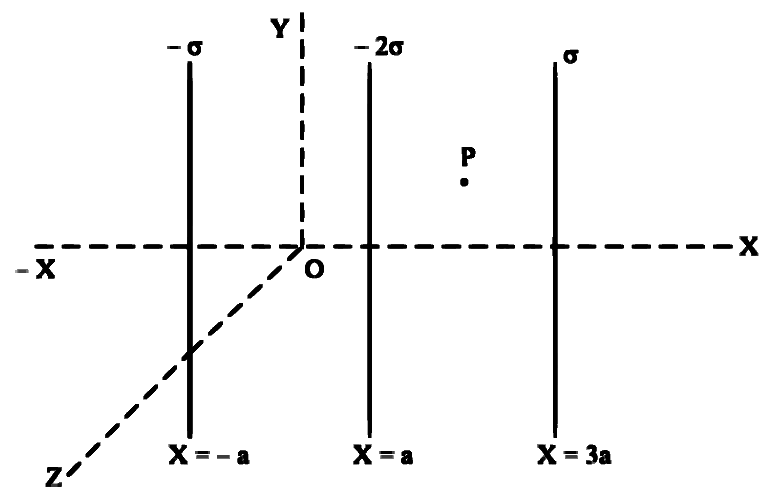
Three infinitely long charged thin sheets are placed as shown in figure. The magnitude of electric field at the point P is ϵ0xσ. The value of x is _________ (all quantities are measured in SI units).
Numerical answer type. Work it out, then open the answer.
An infinite plane sheet of charge having uniform surface charge density +σs C/m2 is placed on x-y plane. Another infinitely long line charge having uniform linear charge density +λe C/m is placed at z=4 m plane and parallel to y-axis. If the magnitude values ∣σs∣=2∣λe∣ then at point (0,0,2), the ratio of magnitudes of electric field values due to sheet charge to that of line charge is πn:1. The value of n is _________.
Numerical answer type. Work it out, then open the answer.
A charge 17.7×10⁻⁴ C is distributed uniformly over a large sheet of area 200 m2. The electric field intensity at a distance 20 cm from it in air will be [ε0=8.85×10⁻¹² C2/N m2]
Graphical variation of electric field due to a uniformly charged insulating solid sphere of radius R, with distance r from the centre O is represented by:
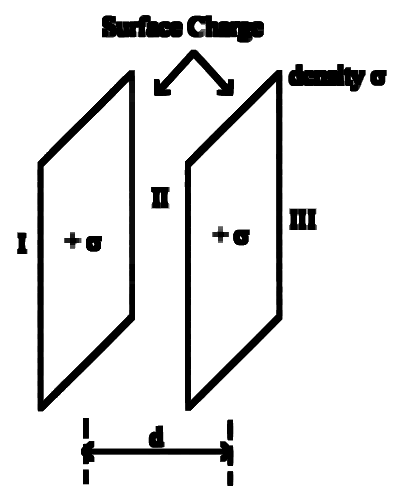
Let σ be the uniform surface charge density of two infinite thin plane sheets shown in figure. Then the electric fields in three different regions EI,EII and EIII are:
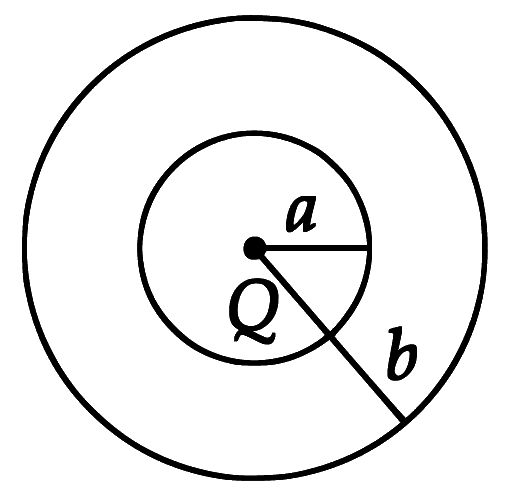
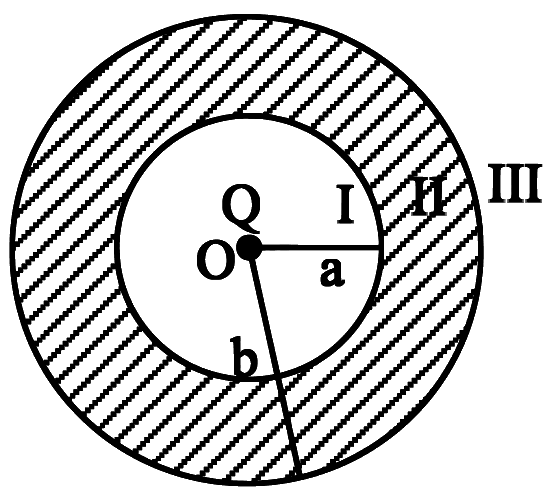
As shown in the figure, a point charge Q is placed at the centre of conducting spherical shell of inner radius a and outer radius b. The electric field due to charge Q in three different regions I, II and III is given by:
A cubical volume is bounded by the surfaces x=0,x=a,y=0,y=a,z=0,z=a. The electric field in the region is given by E=E0xi^. Where E0=4×10⁴ NC−1 m−1. If a=2 cm, the charge contained in the cubical volume is Q×10−14 C. The value of Q is ________________. (Take ϵ0=9×10⁻¹² C2/Nm2)
Numerical answer type. Work it out, then open the answer.
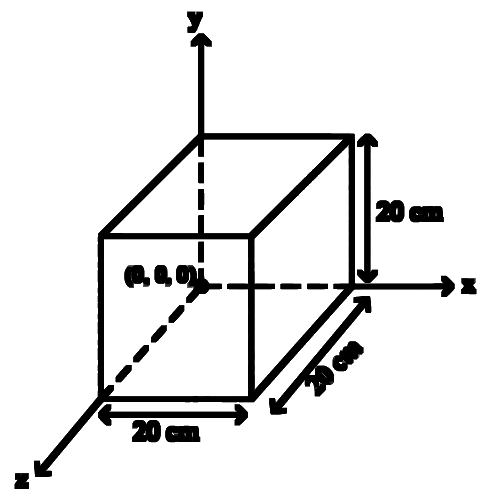
Expression for an electric field is given by E=4000x2i^mV. The electric flux through the cube of side 20 cm when placed in electric field (as shown in the figure) is __________ V cm.
Numerical answer type. Work it out, then open the answer.
In a cuboid of dimension 2L×2L×L, a charge q is placed at the center of the surface 'S' having area of 4L2. The flux through the opposite surface to 'S' is given by
A thin infinite sheet charge and an infinite line charge of respective charge densities +σ and +λ are placed parallel at 5 m distance from each other. Points 'P' and 'Q' are at π3 m and π4 m perpendicular distances from line charge towards sheet charge, respectively. 'EP ' and 'EQ' are the magnitudes of resultant electric field intensities at point 'P' and 'Q', respectively. If EQEP=a4 for 2∣σ∣=∣λ∣, then the value of a is ___________.
Numerical answer type. Work it out, then open the answer.
A conducting sphere of radius 0.1 m has uniform charge density 1.8μC/m2 on its surface. The electric field in free space at radial distance 0.2 m from a point on the surface is ( ε0= permittivity of free space)
A solid metallic sphere has a charge +3Q. Concentric with this sphere is a conducting spherical shell having charge −Q. The radius of the sphere is 'A' and that of the spherical shell is 'B'. (B>A). The electric field at a distance 'R' (A<R<B) from the centre is ( ε0= permittivity of vacuum)
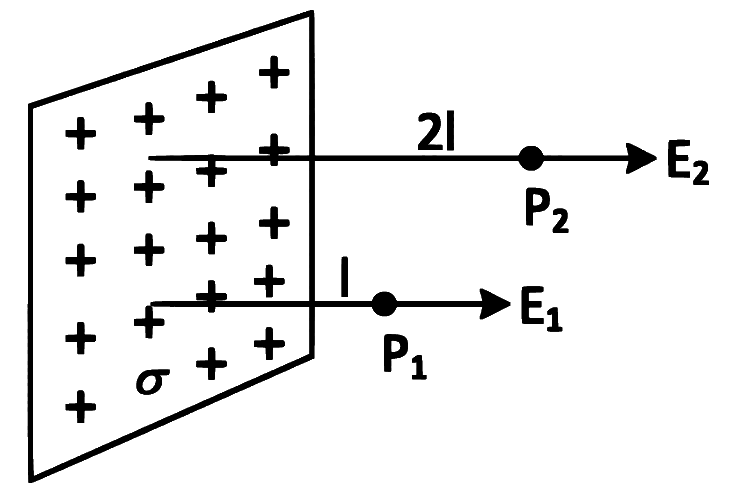
In the figure, a very large plane sheet of positive charge is shown. P1 and P2 are two points at distance l and 2l from the charge distribution. If σ is the surface charge density, then the magnitude of electric fields E1 and E2 at P1 and P2 respectively are:
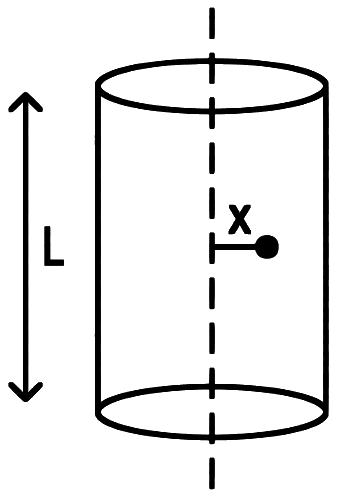
A long cylindrical volume contains a uniformly distributed charge of density ρ C m−3. The electric field inside the cylindrical volume at a distance x=ρ2ε0 m from its axis is ________ V m−1.
Numerical answer type. Work it out, then open the answer.
Statement I: Electric potential is constant within and at the surface of each conductor. Statement II: Electric field just outside a charged conductor is perpendicular to the surface of the conductor at every point.
In the light of the above statements, choose the most appropriate answer from the options given below.
The volume charge density of a sphere of radius 6 m is 2μC cm−3. The number of lines of force per unit surface area coming out from the surface of the sphere is _______________ ×1010 NC−1. [Given: Permittivity of vacuum ϵ0=8.85×10⁻¹² C2 N−1-m−2 ]
Numerical answer type. Work it out, then open the answer.
The electric field in a region is given by E=52E0i^+53E0j^ with E0=4.0×10³CN. The flux of this field through a rectangular surface area 0.4 m2 parallel to the Y-Z plane is __________ Nm2C−1.
Numerical answer type. Work it out, then open the answer.
The electric field in a region is given by E=(53E0i^+54E0j^)CN. The ratio of flux of reported field through the rectangular surface of area 0.2 m2 (parallel to y − z plane) to that of the surface of area 0.3 m2 (parallel to x − z plane) is a: b, where a = __________ [Here i^j^ and k^ are unit vectors along x, y and z-axes respectively.]
Numerical answer type. Work it out, then open the answer.
Statement I: An electric dipole is placed at the center of a hollow sphere. The flux of the electric field through the sphere is zero but the electric field is not zero anywhere in the sphere. Statement II: If R is the radius of a solid metallic sphere and Q be the total charge on it. The electric field at any point on the spherical surface of radius r (< R) is zero but the electric flux passing through this closed spherical surface of radius r is not zero.
In the light of the above statements, choose the correct answer from the options given below:
The electric field intensity on the surface of a charged solid sphere of radius 'r' and volume charge density 'ρ' is given by (ϵ0= permittivity of free space)
A cube is placed inside an electric field, E=150y2j^. The side of the cube is 0.5 m and is placed in the field as shown in the given figure. The charge inside the cube is:
(1) The electric lines of force entering into a Gaussian surface provide negative flux. (2) A charge 'q' is placed at the centre of a cube. The flux through all the faces will be the same. (3) In a uniform electric field net flux through a closed Gaussian surface containing no net charge, is zero.
(4) When electric field is parallel to a Gaussian surface, it provides a finite non-zero flux. Choose the most appropriate answer from the options given below
The total charge enclosed in an incremental volume of 2 × 10⁻⁹ m3 located at the origin is ___________ nC, if electric flux density of its field is found as
D = e−x sin y i^− e−x cos y j^ + 2z k^ C/m2
Numerical answer type. Work it out, then open the answer.
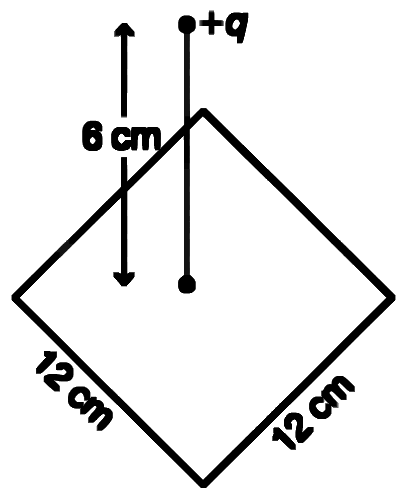
A point charge of +12μC is at a distance 6 cm vertically above the centre of a square of side 12 cm as shown in figure. The magnitude of the electric flux through the square will be __________ × 103 Nm2/C.
Numerical answer type. Work it out, then open the answer.
Find out the surface charge density at the intersection of point x = 3 m plane and x-axis, in the region of uniform line charge of 8 nC/m lying along the z-axis in free space.
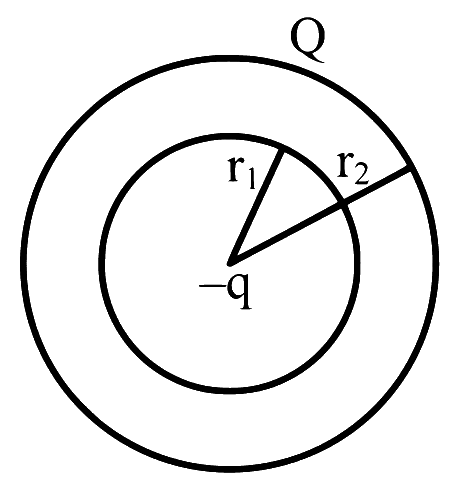
A spherical conducting shell of inner radius 'r 1' and outer radius 'r2 ' has a charge 'Q'. A charge −q is placed at the centre of the shell. The surface charge density on the inner and outer surface of the shell will be
A spherical rubber balloon carries a charge, uniformly distributed over the surface. As the balloon is blown up and increases in size, the total electric flux coming out of the surface
In finding the electric field using Gauss Law the formula E=ε0∣A∣qenc is applicable. In the formula ε0 is permittivity of free space, A is the area of Gaussian surface and qenc is charge enclosed by the Gaussian surface. The equation can be used in which of the following situation?
Consider the force F on a charge 'q' due to a uniformly charged spherical shell of radius R carrying charge Q distributed uniformly over it. Which one of the following statements is true for F, if 'q' is placed at distance r from the centre of the shell?
A spherical conductor of radius 10 cm has a charge of 3.2 × 10⁻⁷ C distributed uniformly. What is the magnitude of electric field at a point 15 cm from the centre of the sphere?
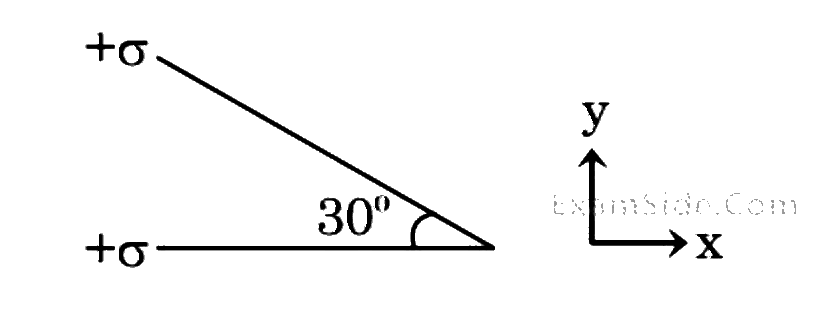
Two infinite planes each with uniform surface charge density σ are kept in such a way that the angle between them is 30o. The electric field in the region shown between them is given by:
Surface density of charge on a charged conducting sphere of radius R in terms of electric field intensity E at a distance r in free space is (r>R,ε0= permittivity of free space)
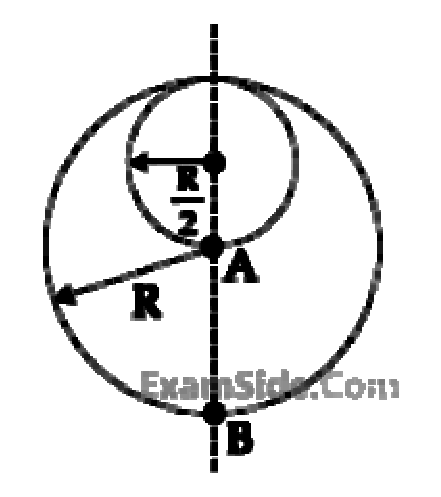
Consider a sphere of radius R which carries a uniform charge density ρ. If a sphere of radius 2R is carved out of it, as shown, the ratio of magnitude of electric field EA and EB, respectively, at points A and B due to the remaining portion is:
Two parallel infinite line charges with linear charge densities +λ C/m and -λ C/m are placed at a distance of 2R in free space. What is the electric field mid-way between the two line charges?
A charged conductor produces an electric field of intensity 103 V/m just outside its surface in vacuum. Then, it produces the electric field of intensity E just outside its surface, when it is placed in a medium of dielectric constant 4. The value of E will be
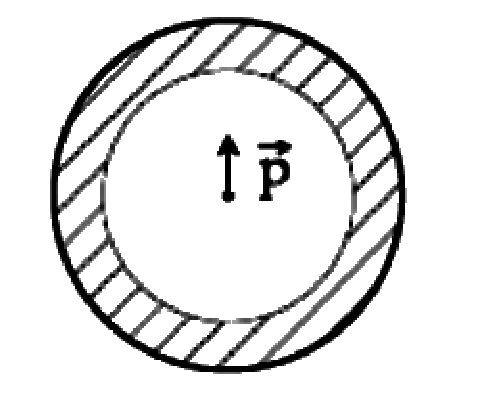
Shown in the figure is a shell made of a conductor. It has inner radius a and outer radius b, and carries charge Q. At its centre is a dipole Pas shown. In this case:
Let a total charge 2Q be distributed in a sphere of radius R, with the charge density given by ρ(r) = kr, where r is the distance from the centre. Two charges A and B, of –Q each, are placed on diametrically opposite points, at equal distance, a from the centre. If A and B do not experience any force, then:
Charge is distributed within a sphere of radius R with a volume charge density ρ(r)=r2Ae−a2r, where A and a are constants. If Q is the total charge of this charge distribution, the radius R is:
The region between two concentric spheres of radii a and b, respectively (see figure), has volume charge density ρ=rA, where A is a constant and r is the distance from the center. At the center of the spheres is a point charge Q. The value of A such that the electric field in the region between the spheres will be constant, is:
The electric field in a certain region is acting radially outward and is given by E = Ar. A charge contained in a sphere of radius 'a' centred at the origin of the field, will be given by
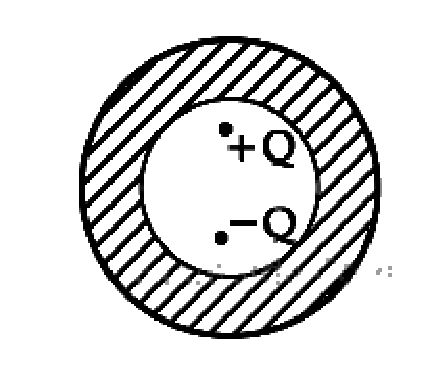
Shown in the figure are two point charges + Q and − Q inside the cavity of a spherical shell. The charges are kept near the surface of the cavity on opposite sides of the centre of the shell. If σ1 is the surface charge on the inner surface and Q1 net charge on it and σ2 the surface charge on the outer surface and Q2 net charge on it then:
The electric field in a region of space is given by, E=E0i^ + 2E0j^ where E0 = 100 N/C. The flux of this field through a circular surface of a radius 0.02 m parallel to the Y-Z plane is nearly:
The magnitude of the average electric field normally present in the atmosphere just above the surface of the Earth is about 150 N/C, directed inward towards the center of the Earth. This gives the total net surface charge carried by the Earth to be:
In a uniformly charged sphere of total charge Q and radius R, the electric field E is plotted as a function of distance from the center. The graph which would correspond to the above will be:
This question has statement- 1 and statement- 2. Of the four choices given after the statements, choose the one that best describes the two statements.
An insulating solid sphere of radius R has a uniformly positive charge density ρ. As a result of this uniform charge distribution there is a finite value of electric potential at the center of the sphere, at the surface of the sphere and also at a point outside the sphere. The electric potential at infinity is zero.
Statement- 1: When a charge q is taken from the centre to the surface of the sphere its potential energy changes by 3ε0qρ
Statement- 2: The electric field at a distance r(r<R) from the center of the sphere is 3ε0ρr
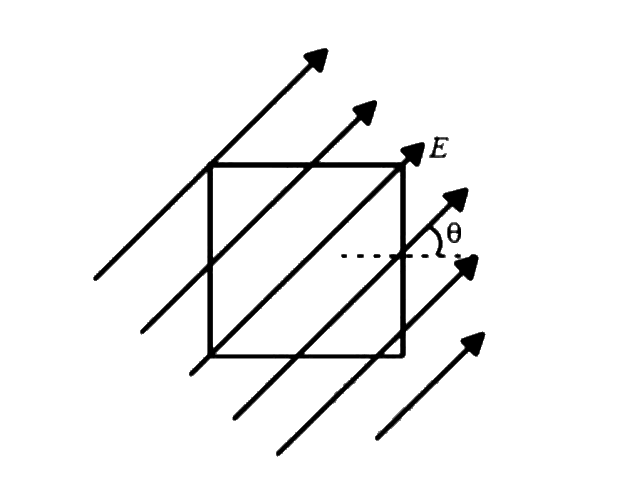
A square surface of side L meter in the plane of the paper is placed in a uniform electric field E(volt/m) acting along the same plane at an angle θ with the horizontal side of the square as shown in figurre.
The electric flux linked to the surface, in units of volt m is
The electric field at a distance 23R from the centre of a charged conducting spherical shell of radius R is E. The electric field at a distance 2R from the centre of the sphere is
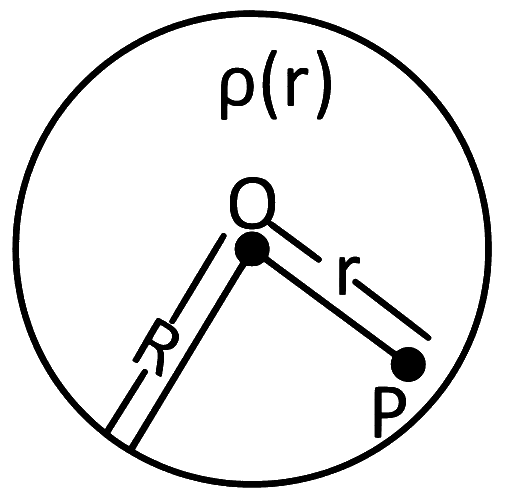
Let there be a spherically symmetric charge distribution with charge density varying as ρ(r)=ρ0(45−Rr) upto r=R, and ρ(r)=0 for r>R, where r is the distance from the origin. The electric field at a distance r(r<R) from the origin is given by
Let ρ(r)=πR4Qr be the charge density distribution for a solid sphere of radius R and total charge Q. For a point p inside the sphere at distance r1 from the center of the sphere, the magnitude of electric field is:
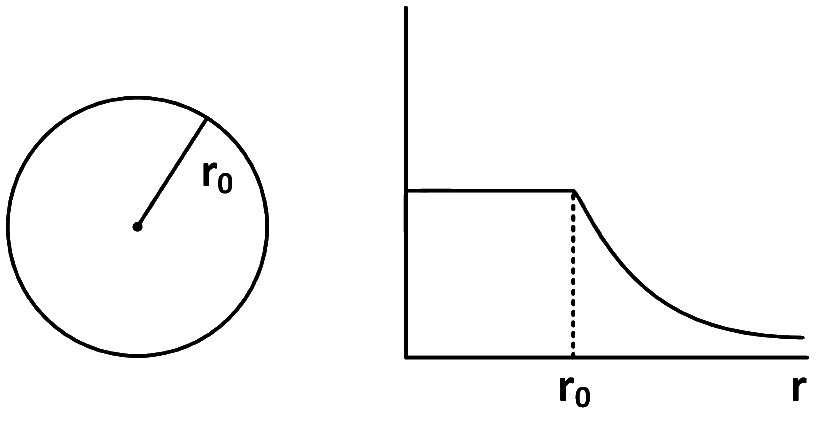
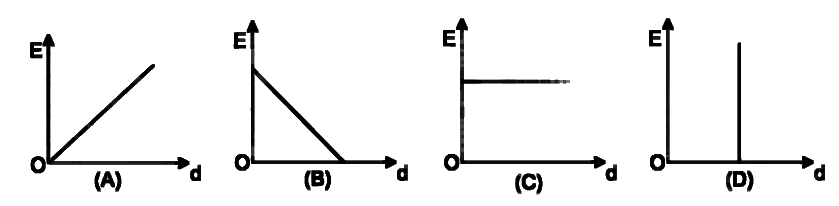
A thin spherical shell of radius R has charge Q spread uniformly over its surface. Which of the following graphs most closely represents the electric field E(r) produced by the shell in the range 0≤r<∞, where r is the distance from the center of the shell?
A hollow cylinder has a charge q coulomb within it. If ϕ is the electric flux in units of volt-metre associated with the curved surface B, the flux linked with the plane surface A in units of V-m will be
A square surface of side L metres is in the plane of the paper. A uniform electric field E(volt/m), also in the plane of the paper is limited only to the lower half of the square surface (see figure). The electric flux in SI inits associated with the surface is
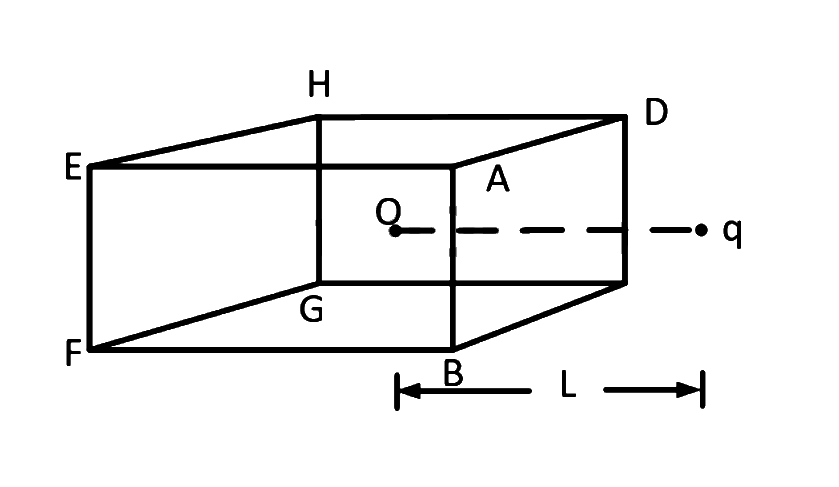
A charged particle q is placed at the centre O of cube of length L(ABCDEFGH). Another same charge q is placed at a distance L from O. Then the electric flux through ABCD is
A hollow insulated conducting sphere is given a positive charge of 10μC. What will be the electric field at the centre of the sphere if its radius is 2 m?

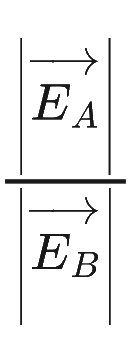 of magnitude of electric field and , respectively, at points A and B due to the remaining portion is: