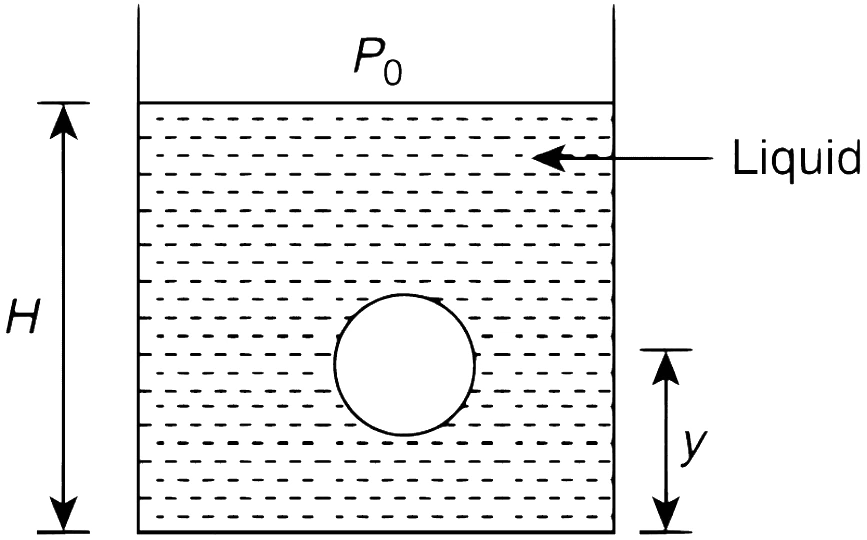
The pressure at half the depth of a lake is equal to two-third pressure at the bottom of the lake. So the depth 'h' of the lake is (ρ = density of water in the lake, g = acceleration due to gravity, P0 = atmospheric pressure).
When a large bubble rises from bottom of a water lake to its surface, then its radius doubles. If the atmospheric pressure is equal to the pressure of height H of a certain water column then the depth of lake will be
Two cylindrical vessels of equal cross sectional area of 2 m2 contain water upto heights 10 m and 6 m, respectively. If the vessels are connected at their bottom then the work done by the force of gravity is (Density of water is 103 kg/m3 and g=10 m/s2)
A vessel with square cross-section and height of 6 m is vertically partitioned. A small window of 100 cm2 with hinged door is fitted at a depth of 3 m in the partition wall. One part of the vessel is filled completely with water and the other side is filled with the liquid having density 1.5×10³ kg/m3. What force one needs to apply on the hinged door so that it does not get opened? (Acceleration due to gravity =10 m/s2)
Numerical answer type. Work it out, then open the answer.
The temperature of an air bubble while rising from bottom to surface of a lake remains constant but diameter is doubled. If pressure on the surface is h meter of mercury column and relative density of mercury is ' ρ ' then the depth of the lake is
When an air bubble rises from the bottom of lake to the surface, its radius is doubled. The atmospheric pressure is equal to that of a column of water of height ' H '. The depth of the lake is
A drum of radius ' R ' full of liquid of density ' d ' is rotated at angular velocity ' ω ' rad/s. The increase in pressure at the centre of the drum will be
Statement I: Pressure in a reservoir of water is same at all points at the same level of water. Statement II: The pressure applied to enclosed water is transmitted in all directions equally. In the light of the above statements, choose the correct answer from the options given below:
An air bubble of volume 1 cm3 rises from the bottom of a lake 40 m deep to the surface at a temperature of 12∘C. The atmospheric pressure is 1×10⁵ Pa the density of water is 1000 kg/m3 and g=10 m/s2. There is no difference of the temperature of water at the depth of 40 m and on the surface. The volume of air bubble when it reaches the surface will be:
Two copper vessels A and B have the same base area but of different shapes. A takes twice the volume of water as that B requires to fill upto a particular common height. Then the correct statement among the following is:
Two cylindrical vessels of equal cross-sectional area 16 cm2 contain water upto heights 100 cm and 150 cm respectively. The vessels are interconnected so that the water levels in them become equal. The work done by the force of gravity during the process, is [Take, density of water =103 kg/m3 and g=10 m s−2 ]:
The pressure acting on a submarine is 3 × 10⁵ Pa at a certain depth. If the depth is doubled, the percentage increase in the pressure acting on the submarine would be:
(Assume that atmospheric pressure is 1 × 10⁵ Pa and density of water is 103 kg m−3, g = 10 ms−2)
Two identical cylindrical vessels are kept on the ground and each contain the same liquid of density d. The area of the base of both vessels is S but the height of liquid in one vessel is x1 and in the other, x2. When both cylinders are connected through a pipe of negligible volume very close to the bottom, the liquid flows from one vessel to the other until it comes to equilibrium at a new height. The change in energy of the system in the process is:
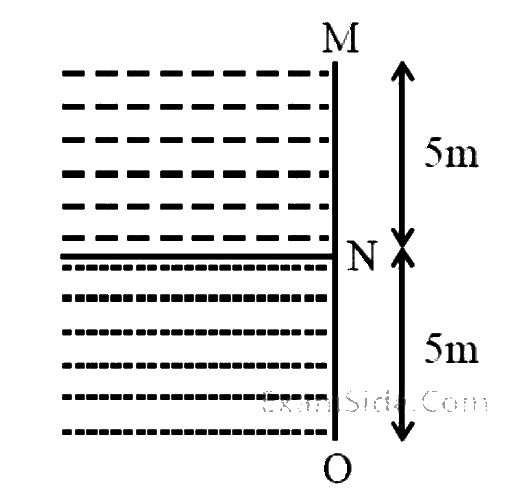
Two liquids of densities ρ1 and ρ2 (ρ2 = 2ρ1) are filled up behind a square wall of side 10 m as shown in figure. Each liquid has a height of 5 m. The ratio of the forces due to these liquids exerted on upper part MN to that at the lower part NO is (Assume that the liquids are not mixing)
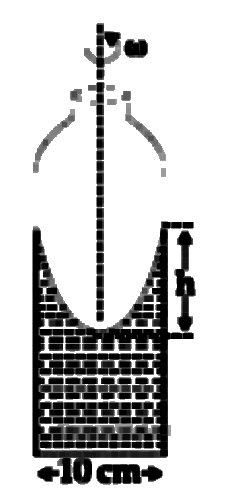
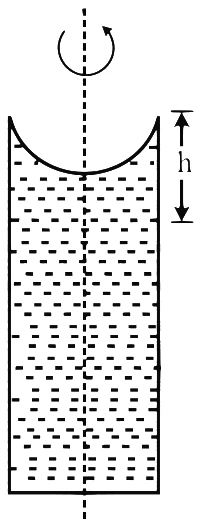
A cylindrical vessel containing a liquid is rotated about its axis so that the liquid rises at its sides as shown in the figure. The radius of vessel is 5 cm and the angular speed of rotation is ω rad s–1. The difference in the height, h (in cm) of liquid at the centre of vessel and at the side will be:
A submarine experiences a pressure of 5.05 × 10⁶ Pa at a depth of d1 in a sea. When it goes further to a depth of d2, it experiences a pressure of 8.08 × 10⁶ Pa. Then d2 –d1 is approximately (density of water = 103 kg/m3 and acceleration due to gravity = 10 ms–2):
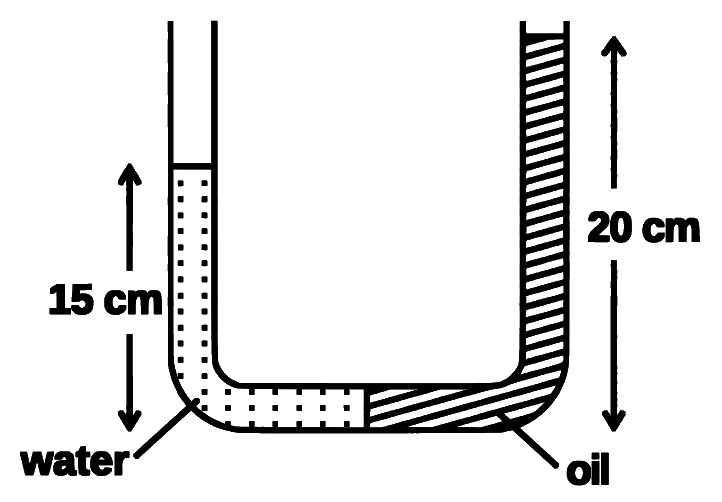
In a u-tube as shown in the fig. water and oil are in the left side and right side of the tube respectively. The heights from the bottom for water and oil columns are 15 cm and 20 cm respectively. The density of the oil is
When a large bubble rises from bottom of a water lake to its surface, then its radius doubles. If the atmospheric pressure is equal to the pressure of height H of a certain water column, then the depth of lake will be
A long cylindrical vessel is half filled with a liquid. When the vessel is rotated about its own vertical axis, the liquid rises up near the wall. If the radius of vessel is 5 cm and its rotational speed is 2 rotations per second, then the difference in the heights between the centre and the sides, in cm, will be:
When an air bubble of radius r rises from the bottom to the surface of a lake its radius becomes 45r Taking the atmospheric pressure to be equal to 10 m height of water column, the depth of the lake would approximately be (ignore the surface tension and the effect of temperature):
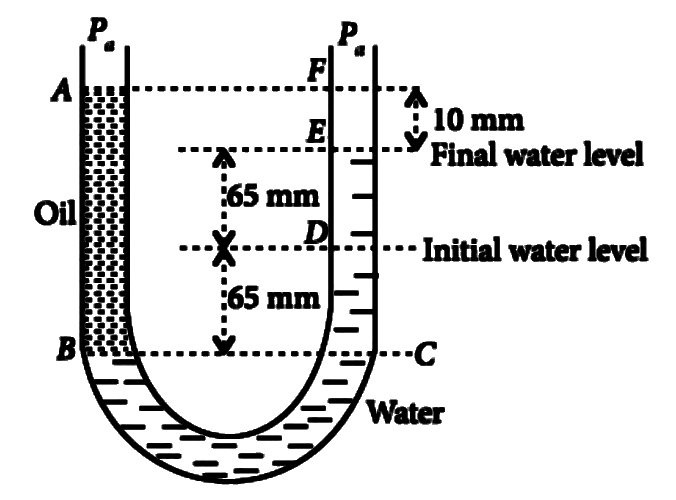
A U tube with both ends open to the atmosphere, is partially filled with water. Oil, which is immiscible with water, is poured into one side until it stands at a distance of 10 mm above the water level on the other side. Meanwhile the water rises by 65 mm from its original level (see diagram). The density of the oil is
A block of wood (40cm×20cm×10cm) is kept on a tabletop in three different positions: (a) with its side of dimensions 20cm×10cm; (b) with its side of dimensions 10cm×40cm; and (c) with its side of dimensions 40cm×20cm. The pressure exerted by the wooden block on the tabletop in these positions is represented by PA, PB and PC, respectively. The pressure follows the trend
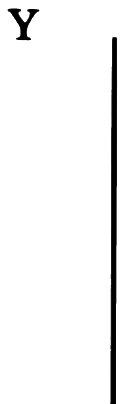
Two identical containers X and Y are connected at the bottom by a thin tube of negligible volume. The tube has a valve in it, as shown in the figure. Initially container X has a liquid filled up to height h in it and container Y is empty. When the valve is opened, both containers have equal amount of liquid in equilibrium. If the initial (before the valve is opened) potential energy of the liquid is P1 and the final potential energy is P2 then:
A wooden box of mass 2kg and dimensions (30cm×15cm×10cm) is placed on a table with sides 30cm and 10cm touching the tabletop. Which one of the following is the approximate pressure exerted on the table?
A liquid is kept in a glass beaker. Which one of the following statements is correct regarding the pressure exerted by the liquid column at the base of the beaker?
Which of the following statements about a fluid at rest in a cup is/are correct? 1. Pressure is same at all the points in the fluid. 2. Pressure is exerted on the walls. 3. Pressure exists everywhere in the fluid. Select the correct answer using the code given below:
A person stands on his two feet over a surface and experiences a pressure P. Now the person stands on only one foot. He would experience a pressure of magnitude
A piece of paper and a coin both having the same mass are dropped from the 10th floor of a building. The piece of paper would take more time to reach the ground because
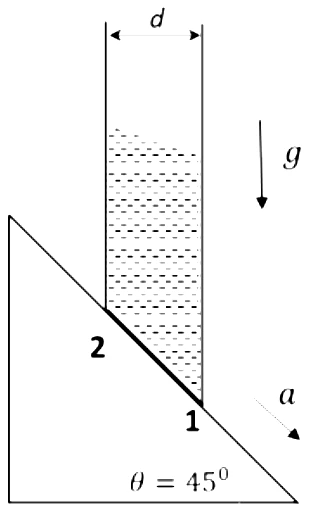
A cylindrical tube, with its base as shown in the figure, is filled with water. It is moving down with a constant acceleration a along a fixed inclined plane with angle θ=45∘. P1 and P2 are pressures at points 1 and 2, respectively, located at the base of the tube. Let β=(P1−P2)/(ρgd), where ρ is density of water, d is the inner diameter of the tube and g is the acceleration due to gravity. Which of the following statement(s) is(are) correct?
More than one option can be correct. Tap every correct option, then tap Check.
A liquid at 30∘C is poured very slowly into a Calorimeter that is at temperature of 110∘C. The boiling temperature of the liquid is 80∘C. It is found that the first 5gm of the liquid completely evaporates. After pouring another 80gm of the liquid the equilibrium temperature is found to be 50∘C. The ratio of the latent heat of the liquid to its specific heat will be ............ ∘C. [Neglect the heat exchange with surrounding]
Numerical answer type. Work it out, then open the answer.
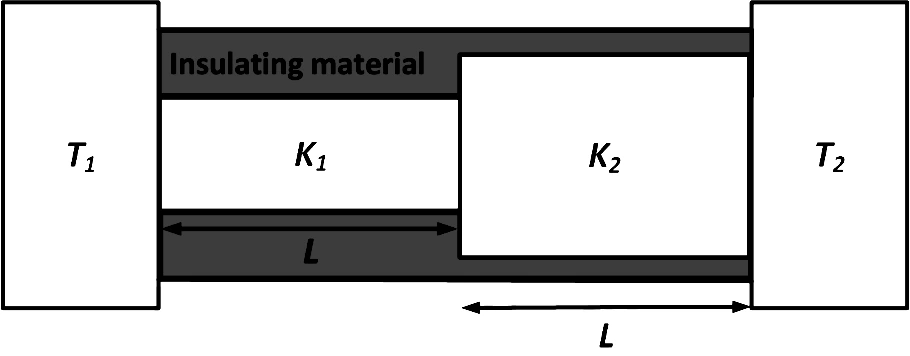
Two conducting cylinders of equal length but different radii are connected in series between two heat baths kept at temperatures T1=300K and T2=100K, as shown in the figure. The radius of the bigger cylinder is twice that of the smaller one and the thermal conductivities of the materials of the smaller and the larger cylinders are K1 and K2 respectively. If the temperature at the junction of the two cylinders in the steady state is 200K, then K1/K2= ______.
Numerical answer type. Work it out, then open the answer.
A spherical body of radius R consists of a fluid of constant density and is in equilibrium under its own gravity. If P(r) is the pressure at r (r<R), then the correct option(s) is(are)
More than one option can be correct. Tap every correct option, then tap Check.
A cylindrical vessel of height 500mm has an orifice (small hole) at its bottom. The orifice is initially closed and water is filled in it up to height H. Now the top is completely sealed with a cap and the orifice at the bottom is opened. Some water comes out from the orifice and the water level in the vessel becomes steady with height of water column being 200mm. Find the fall in height (in mm) of water level due to opening of the orifice. (Take atmospheric pressure =1.0×10⁵N/m2, density of water =1000kg/m3 and g=10m/s2. Neglect any effect of surface tension.)
Numerical answer type. Work it out, then open the answer.
A small spherical monoatomic ideal gas bubble (γ=35) is trapped inside a liquid of density ρl (see figure). Assume that the bubble does not exchange any heat with the liquid. The bubble contains n moles of gas. The temperature of the gas when the bubble is at the bottom is T0, the height of the liquid is H and the atmospheric pressure is P0 (Neglect surface tension) When the gas bubble is at a height y from the bottom, its temperature is:
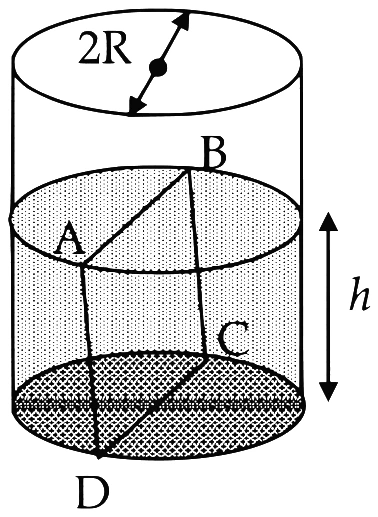
Water is filled up to a height h in a beaker of radius R as shown in the figure. The density of water is ρ, the surface tension of water is T and the atmospheric pressure is P0. Consider a vertical section ABCD of the water column through a diameter of the beaker. The force on water on one side of this section by water on the other side of this section has magnitude
Assertion: Railway tracks are laid on small sized wooden sleepers. Reason: Small sized wooden sleepers are used so that rails exert more pressure on the railway track. Due to which rail does not leave the track.
In each of the following questions a statement of Assertion is given followed by a corresponding statement of Reason just below it. Of the statements mark the correct answer is Assertion: A bubble comes from the bottom of a lake to the top. Reason: Its radius increases.
By sucking through a straw, a student can reduce the pressure in his lungs to 750mm of Hg (density =13.6g/cm3). Using the straw, he can drink water from a glass upto a maximum depth of :
A given shaped glass tube having uniform cross-section is filled with water and is mounted on a rotatable shaft as shown in figure. If the tube is rotated with a constant angular velocity ω then :
In a water tank, an air bubble rises from the bottom to the top surface of the water. If the depth of the water in the tank is 7.28m and atmospheric pressure is 10m of water, then the ratio of the radii of the bubble at the bottom of the tank and at the top surface of the water is
(Temperature of the water in the tank is constant)
Two cylindrical vessels A and B of different areas of cross-section kept on same horizontal plane are filled with water to the same height. If the volume of water in vessel A is 3 times the volume of water in vessel B, then the ratio of the pressures at the bottom of the vessels A and B is
A tank of oil has height of 4m and density of 850kg m−3. The gauge pressure at the bottom of the tank is (1atm=105Pa, acceleration due to gravity =10m s−2)
A person of height 1.65m is standing upright. The additional external force required by blood vessel of length 1cm, diameter 1mm at feet to balance the pressure compared to similar blood vessel in head is (Density of blood =1.1×10³kg m−3, g=10m s−2)
A uniform cylindrical vessel is filled with two immiscible liquids A and B of densities 750kg m−3 and 1000kg m−3 respectively. The thickness of the liquid layer A is 10m and the thickness of the liquid layer B which lies at the bottom is 15m. If the atmospheric pressure is 105N m−2, then the ratio of the absolute pressures at the bottom of the vessel and at the interface of the two liquids is (Acceleration due to gravity =10m s−2)
In a uniform U-tube containing water, if a liquid of density 800kg m−3 is poured into one of its limbs to a height of 25cm column of liquid, then the rise in water level in the other limb of the tube is
An air bubble rises from the bottom to the top of a water tank in which the temperature of the water is uniform. The surface area of the bubble at the top of the tank is 125% more than its surface area at the bottom of the tank. If the atmospheric pressure is equal to the pressure of 10m water column, then the depth of water in the tank is
Three identical vessels are filled up to the same height with three different liquids A, B and C of densities ρA, ρB and ρC, respectively. If ρA>ρB>ρC, then the pressure at the bottom of the vessels is
A liquid is taken in a long vertical cylindrical vessel and the cylinder is rotated about its vertical axis as shown in figure. During rotation, the liquid rises along its sides. If the radius of vessel is 0.05m and speed of rotation is 10rad s−1, then the height difference between the liquid at the centre of the vessel and its sides is (g=10m s−2)
Three identical vessels are filled with three liquids A, B and C with equal masses but having densities ρA, ρB and ρC respectively. If ρA>ρB>ρC then the pressure at the bottom of the vessels will be
When a large bubble rises from the bottom of a lake to the surface, the volume of the bubble becomes 5 times its volume at the bottom of the lake. If H is the atmospheric pressure expressed in terms of water column height, then the depth of the lake is (The temperature of the water in the lake is same at all points)
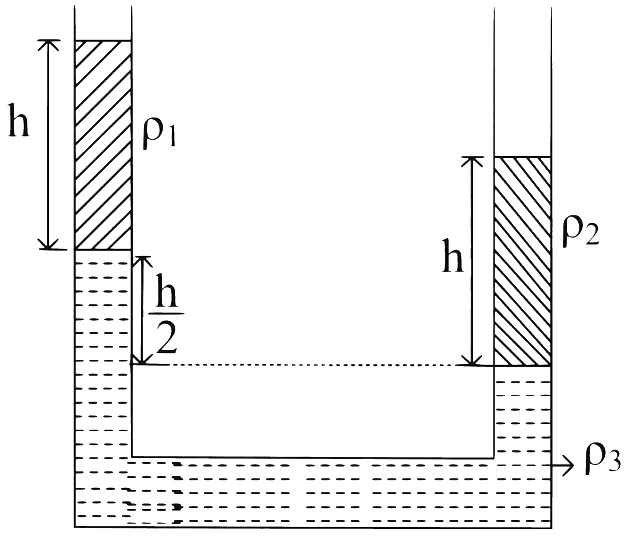
Three different liquids are filled in a U-tube as shown in figure. Their densities are ρ1, ρ2 and ρ3 respectively. From the figure we may conclude that
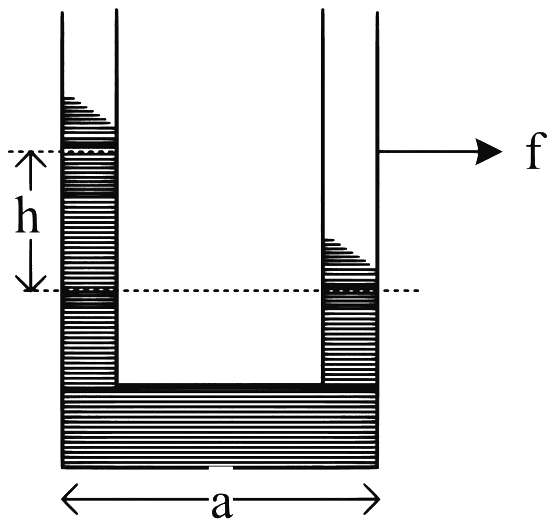
As shown in the figure, a liquid is at same levels in two arms of a U-tube of uniform cross-section when at rest. If the U-tube moves with an acceleration f towards right, the difference between liquid heights between two arms of the U-tube will be, (acceleration due to gravity =g)
A planet of mass M and radius R is surrounded by a thin layer of atmosphere of height H and of constant density ρ, having pressure P and temperature T. The atmosphere consists of ideal gas molecules of only one type, each of mass m with root-mean-square speed vrms. Taking acceleration due to gravity to be constant within the atmosphere, at height h<H from the surface
More than one option can be correct. Tap every correct option, then tap Check.
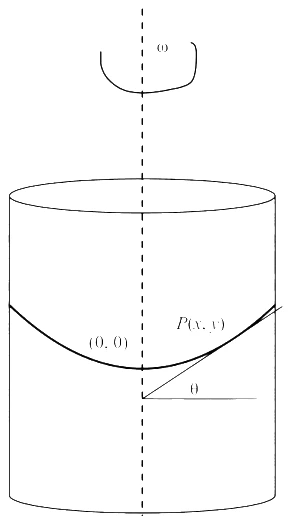
A beaker containing a liquid with a reflecting surface is placed on a turntable and set to rotate about its axis as shown in the figure. The angle θ made by the reflecting surface with the horizontal is given by tanθ=gω2x. The radius of curvature of the surface R≫x. Then
More than one option can be correct. Tap every correct option, then tap Check.
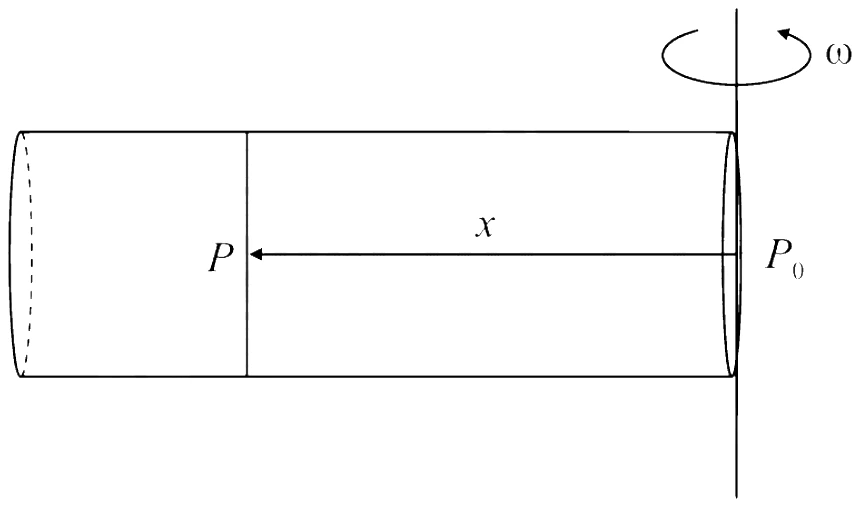
A horizontal cylinder, closed at one end, is rotated with a constant angular velocity ω about a vertical axis passing through the open end of the cylinder as shown in the figure. The outside air pressure is P0, temperature is T and the molar mass of the air is μ. Assume air to be an ideal gas and the temperature T remaining constant everywhere. The air pressure inside the cylinder is best described by
The variation in the atmospheric pressure with height can be estimated by balancing force due to gradient in pressure with the gravity. Assume ideal gas behaviour, isothermal conditions with temperature T=290K, and constant composition of air throughout the atmosphere. The approximate percentage reduction in oxygen at a height of 1km above sea level is (note: take the mean molecular mass of air at the sea level as 29gm mol−1)
A long container has a square base of side L. The height to which water should be filled so that the force on one of its side surface is the same as that at its bottom is (ignore atmospheric pressure)
The wall of a dam is straight with height H and length L. It holds a lake of water on one side of height h (h<H) and base dimension L×L. Let the density of water be ρw. Ignore atmospheric pressure. Then due to the water
More than one option can be correct. Tap every correct option, then tap Check.
Acceleration due to gravity on Earth g=10.0m s−2 Atmospheric pressure 1atmos=105Pa
A 3.0m long metal pipe, closed at the top end, is held vertically above a large water tank. It is then very slowly pushed vertically down into the water and held there such that the top end of the pipe is at level with the water surface. Take the density of water to be 1000kg m−3. Then
More than one option can be correct. Tap every correct option, then tap Check.
Water in a dam is 15m deep. A horizontal pipe of 4cm diameter passes through the wall of the dam 6m below the surface of the water. A plug secures the pipe opening. The frictional force between the plug and the pipe wall is about (Take density of water to be 103kg m−3 and g is 10m s−2.)
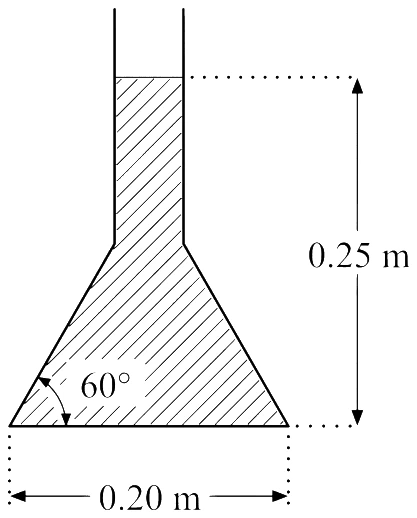
The figure shows the cross-section of a conical flask having a circular base of diameter 0.20m. The slanted surface of the cone makes an angle of 60∘ with the base. When 2.0 litres (1litre=10−3m3) of water is poured in the flask, the level of water is 0.25m above the base.
What is the magnitude of the total vertical force exerted by the water on the slanted surface of the flask? (Take acceleration due to gravity g=10m s−2 and ignore atmospheric pressure.)
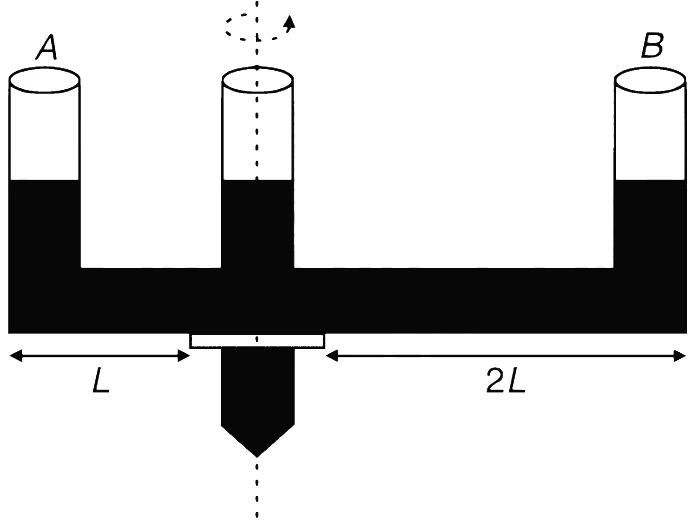
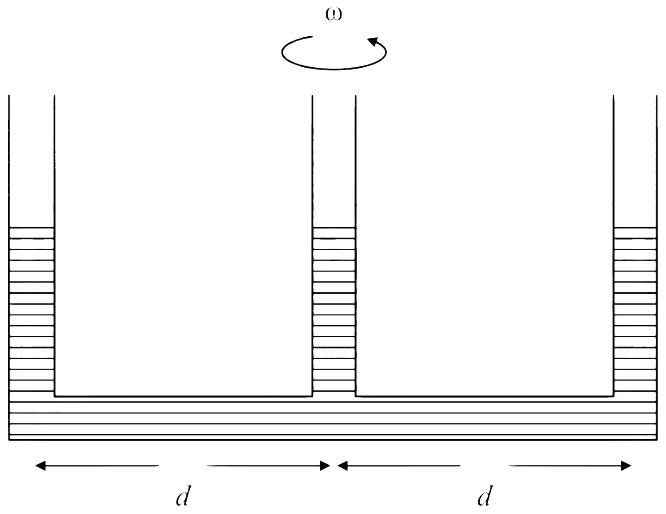
A thin uniform tube in the shape of "W" containing a liquid is rotated about the central vertical column with constant angular speed ω. If the separation between two adjacent columns is d, then
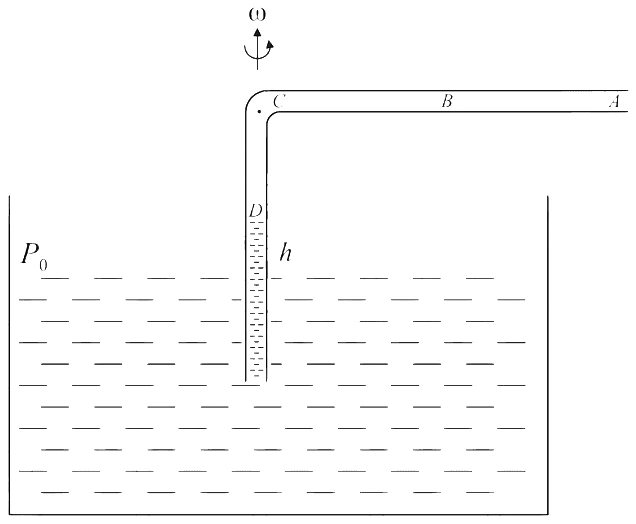
Figure shows an open L-shaped glass tube of uniform cross section. One arm is immersed in a tub of water and the other (horizontal) arm remains in air. When the tube is rotated about the vertical arm with a constant angular velocity ω, water rises in the vertical arm up a height h. P0 is the atmosphere pressure.
B is the mid-point of the arm AC of length L. ρw is density of water and g is acceleration due to gravity. Assuming air to be an ideal gas, pressures at the points A, B, C and D in the rotating tube satisfy the relations:
More than one option can be correct. Tap every correct option, then tap Check.