The mean free path of molecules in an ideal gas A is half that of another ideal gas B. The diameter of the spherical molecules of gas A is twice the diameter of the molecules of B. If number densities of the gases A and B are nA and nB, respectively, the correct option is:
The mean free path of a molecule of diameter 5×10⁻¹⁰ m at the temperature 41∘ C and pressure 1.38×10⁵ Pa, is given as ________ m. (Given kB=1.38×10⁻²³ J/K).
Consider two boxes containing ideal gases A and B such that their temperatures, pressures and number densities are same. The molecular size of A is half of that of B and mass of molecule A is four times that of B. If the collision frequency in gas B is 32×1018/s then collision frequency in gas A is ______ /s.
The mean free path and the average speed of oxygen molecules at 300 K and 1 atm are 3×10⁻⁷ m and 600 m/s, respectively. Find the frequency of its collisions.
If n is the number density and d is the diameter of the molecule, then the average distance covered by a molecule between two successive collisions (i.e. mean free path) is represented by:
At S.T.P., the mean free path of gas molecule is 1500 d, where ' d ' is diameter of molecule. What will be the mean free path at 373 K at constant volume?
The mean free path of molecules of a certain gas at STP is 1500 d, where d is the diameter of the gas molecules. While maintaining the standard pressure, the mean free path of the molecules at 373 K is approximately:
The number of air molecules per cm3 increased from 3×10¹⁹ to 12×1019. The ratio of collision frequency of air molecules before and after the increase in number respectively is:
A. The motion of the gas molecules freezes at 0∘C.
B. The mean free path of gas molecules decreases if the density of molecules is increased. C. The mean free path of gas molecules increases if temperature is increased keeping pressure constant.
D. Average kinetic energy per molecule per degree of freedom is 23kBT (for monoatomic gases). Choose the most appropriate answer from the options given below:
Calculate the value of mean free path (λ) for oxygen molecules at temperature 27∘ C and pressure 1.01 × 10⁵ Pa. Assume the molecular diameter 0.3 nm and the gas is ideal. (k = 1.38 × 10⁻²³ JK−1)
A system consists of two types of gas molecules A and B having same number density 2 × 1025/m3. The diameter of A and B are 10 A˚ and 5 A˚ respectively. They suffer collision at room temperature. The ratio of average distance covered by the molecule A to that of B between two successive collision is ____________ × 10−2
Numerical answer type. Work it out, then open the answer.
The plot that depicts the behavior of the mean free time t (time between two successive collisions) for the molecules of an ideal gas, as a function of temperature (T), qualitatively, is: (Graphs are schematic and not drawn to scale)
Two gases-argon (atomic radius 0.07 nm, atomic weight 40) and xenon (atomic radius 0.1 nm, atomic weight 140) have the same number density and are at the same temperature. The ratio of their respective mean free times is closest to:
A 25 × 10–3 m3 volume cylinder is filled with 1 mol of O2 gas at room temperature (300K). The molecular diameter of O2, and its root mean square speed, are found to be 0.3 nm, and 200 m/s, respectively. What is the average collision rate (per second) for an O2 molecule?
An ideal gas is enclosed in a cylinder at pressure of 2 atm and temperature 300 K. The mean time between two successive collisions is 6 × 10⁻⁸ s. If the pressure is doubled and temperature is increased to 500 K, the mean time between two successive collisions will be close to
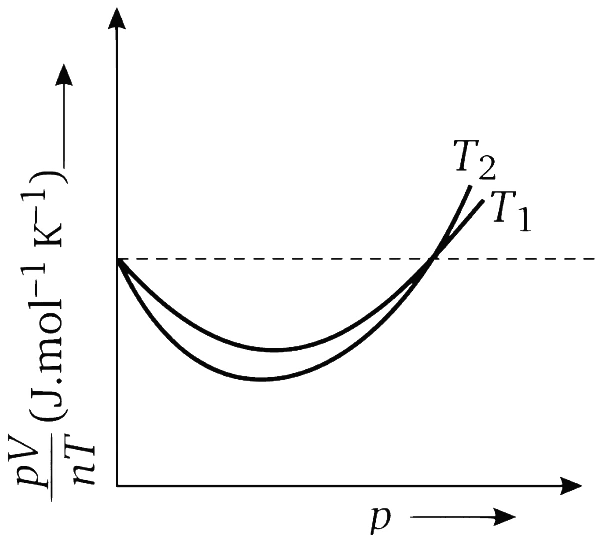
The figure below shows the plot of nTpV versus p for oxygen gas at two different temperatures. Read the following statements concerning the above curves (i) The dotted line corresponds to the 'ideal' gas behaviour (ii) T1>T2 (iii) The value of nTpV at the point where the curves meet on the y-axis is the same for all gases. Which of the above statements is true?
The mean free path of a gas molecule whose diameter is 2×10⁻¹⁰m is 1.6×10⁻⁷m. Calculate the mean free path of another gas molecule whose diameter is 4×10⁻¹⁰m (under the same conditions).
Two identical boxes contain the same ideal gas. Let (n1,λ1,T1) and (n2,λ2,T2) be the number density, mean free path and temperature of the gas in the first and the second box, respectively. One of the boxes is emptied into the other one. What will be the mean free path λ and temperature T of the gas now?
Two identical containers kept at the same temperature carry the same gas with different molecular mean free paths l1 and l2. The gas from the first container is completely transferred into the second at the same temperature. What is the molecular mean free path of the resultant mixture in the second container?
An incandescent lamp of wattage W is filled with argon gas and has a tungsten filament. The collision frequency of evaporated tungsten atoms with the argon atoms is found to be proportional to Wα. The most reasonable value of α is