Q1 MHT CET 2026 · 19 APR · SHIFT 1 Easy ☆
Magnetic Materials & Curie Law
A diamagnetic liquid is filled in a U-tube. One arm of a U-tube is placed in an external magnetic field with the meniscus in line with the field. The level of the liquid in that arm will
(a) rise. (b) fall. (c) oscillate slowly. (d) remains as it is. Show answer and solution
Answer: (b)
Loading the solution…
Report a mistake Open question page Q2 MHT CET 2026 · 15 APR · SHIFT 1 Easy ☆
Magnetic Materials & Curie Law
The product of magnetic susceptibility (χ \chi χ
(a) diamagnetic substance. (b) paramagnetic substance. (c) ferromagnetic substance. (d) paramagnetic as well as ferromagnetic substance. Show answer and solution
Answer: (b)
Loading the solution…
Report a mistake Open question page Q3 MHT CET 2026 · 11 APR · SHIFT 1 Easy ☆
Magnetic Materials & Curie Law
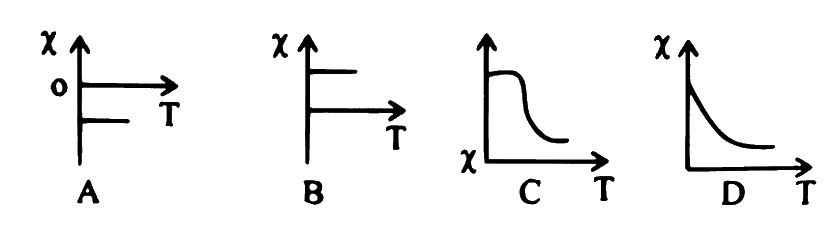
Which of the following figure best represents the variation of magnetic susceptibility (χ \chi χ
Show answer and solution
Answer: (c)
Loading the solution…
Report a mistake Open question page Q4 JEE Main 2026 · 23 JAN · SHIFT 1 Medium ☆
Magnetic Materials & Curie Law
Given below are two statements: one is labelled as Assertion (A) and the other is labelled as Reason (R).
Consider a ferromagnetic material:
Assertion (A): The individual atoms in a ferromagnetic material possess a magnetic dipole moment and interact with one another in such a way that they spontaneously align themselves forming domains.
Reason (R): At high enough temperature, the domain structure of ferromagnetic material disintegrates. Thus, magnetization will disappear at high enough temperature known as Curie temperature.
In the light of the above statements, choose the correct answer from the options given below:
(a) (A) is true but (R) is false (b) Both (A) and (R) are true and (R) is the correct explanation of (A) (c) (A) is false but (R) is true (d) Both (A) and (R) are true but (R) is not the correct explanation of (A) Show answer and solution
Answer: (d)
Loading the solution…
Report a mistake Open question page Q5 MHT CET 2025 · 22 APR · SHIFT 1 Easy ☆
Magnetic Materials & Curie Law
Susceptibility of a paramagnetic substance is
(a) negative and large. (b) negative and small. (c) positive and large. (d) positive and small. Show answer and solution
Answer: (d)
Loading the solution…
Report a mistake Open question page Q6 MHT CET 2025 · 21 APR · SHIFT 1 Easy ☆
Magnetic Materials & Curie Law
The variation of magnetic susceptibility ( χ ) (\chi) ( χ )
Show answer and solution
Answer: (c)
Loading the solution…
Report a mistake Open question page Q7 MHT CET 2024 · 16 MAY · SHIFT 1 Easy ☆
Magnetic Materials & Curie Law
The materials having negative magnetic susceptibility are
(a) both paramagnetic and ferromagnetic. (b) paramagnetic. (c) diamagnetic. (d) ferromagnetic. Show answer and solution
Answer: (c)
Loading the solution…
Report a mistake Open question page Q8 NEET 2024 Easy ☆
Magnetic Materials & Curie Law
The incorrect relation for a diamagnetic material (all the symbols carry their usual meaning and ε \varepsilon ε
(a) μ < μ 0 \mu < \mu_0 μ < μ 0 (b) 0 ≤ μ r < 1 0 \le \mu_r < 1 0 ≤ μ r < 1 (c) − 1 ≤ χ < 0 -1 \le \chi < 0 − 1 ≤ χ < 0 (d) 1 < μ r < 1 + ε 1 < \mu_r < 1 + \varepsilon 1 < μ r < 1 + ε Show answer and solution
Answer: (d)
Loading the solution…
Report a mistake Open question page Q9 NEET 2024 Easy ☆
Magnetic Materials & Curie Law
Match List I with List II
Choose the correct answer from the options given below.
List I (Material) List II (Susceptibility ($$\chi)) A. Diamagnetic I. χ = 0 \chi = 0 χ = 0 B. Ferromagnetic II. 0 > χ ≥ − 1 0 > \chi \geq -1 0 > χ ≥ − 1 C. Paramagnetic III. χ ≫ 1 \chi \gg 1 χ ≫ 1 D. Non-magnetic IV. 0 < χ < ε 0 < \chi < \varepsilon 0 < χ < ε
(a) A-II, B-III, C-IV, D-I (b) A-II, B-I, C-III, D-IV (c) A-III, B-II, C-I, D-IV (d) A-IV, B-III, C-II, D-I Show answer and solution
Answer: (a)
Loading the solution…
Report a mistake Open question page Q10 JEE Main 2024 · 8 APR · SHIFT 1 Easy ☆
Magnetic Materials & Curie Law
Paramagnetic substances:
A. align themselves along the directions of external magnetic field.
B. attract strongly towards external magnetic field.
C. has susceptibility little more than zero.
D. move from a region of strong magnetic field to weak magnetic field.
Choose the most appropriate answer from the options given below:
(a) A, B, C Only (b) A, C Only (c) A, B, C, D (d) B, D Only Show answer and solution
Answer: (b)
Loading the solution…
Report a mistake Open question page Q11 MHT CET 2024 · 2 MAY · SHIFT 2 Easy ☆
Magnetic Materials & Curie Law
A ferromagnetic material is heated above its curie temperature. The correct statement from the following is that
(a) ferromagnetic domains are perfectly arranged. (b) ferromagnetic domains become random. (c) ferromagnetic domains are not influenced. (d) ferromagnetic material changes itself into diamagnetic material. Show answer and solution
Answer: (b)
Loading the solution…
Report a mistake Open question page Q12 JEE Main 2023 · 12 APR · SHIFT 1 Easy ☆
Magnetic Materials & Curie Law
Given below are two statements:
Statement I: The diamagnetic property depends on temperature.
Statement II: The induced magnetic dipole moment in a diamagnetic sample is always opposite to the magnetizing field.
In the light of given statements, choose the correct answer from the options given below.
(a) Statement I is incorrect but Statement II is true. (b) Statement I is correct but Statement II is false. (c) Both Statement I and Statement II are False. (d) Both Statement I and Statement II are true. Show answer and solution
Answer: (a)
Loading the solution…
Report a mistake Open question page Q13 JEE Main 2023 · 10 APR · SHIFT 2 Easy ☆
Magnetic Materials & Curie Law
Given below are two statements:
Statement I: For diamagnetic substance, − 1 ≤ χ < 0 -1 \le \chi < 0 − 1 ≤ χ < 0 χ \chi χ
In the light of the above statements, choose the correct answer from the options given below
(a) Both Statement I and Statement II are true (b) Statement I is correct but Statement II is false (c) Both Statement I and Statement II are False (d) Statement I is incorrect but Statement II is true. Show answer and solution
Answer: (a)
Loading the solution…
Report a mistake Open question page Q14 MHT CET 2023 · 13 MAY · SHIFT 1 Easy ☆
Magnetic Materials & Curie Law
For which of the following substances, the magnetic susceptibility is independent of temperature?
(a) Diamagnetic only. (b) Paramagnetic only. (c) Ferromagnetic only. (d) Diamagnetic and paramagnetic both. Show answer and solution
Answer: (a)
Loading the solution…
Report a mistake Open question page Q15 MHT CET 2023 · 10 MAY · SHIFT 1 Easy ☆
Magnetic Materials & Curie Law
According to Curie's law in magnetism, the correct relation is ( M = \mathrm{M} = M = B = \mathrm{B} = B = T = \mathrm{T} = T = C = \mathrm{C} = C =
(a) M = T C B \mathrm{M} = \frac{\mathrm{T}}{\mathrm{CB}} M = CB T (b) M = C B T \mathrm{M} = \frac{\mathrm{CB}}{\mathrm{T}} M = T CB (c) C = M B T \mathrm{C} = \frac{\mathrm{MB}}{\mathrm{T}} C = T MB (d) C = T 2 M B \mathrm{C} = \frac{\mathrm{T}^{2}}{\mathrm{MB}} C = MB T 2 Show answer and solution
Answer: (b)
Loading the solution…
Report a mistake Open question page Q16 NEET 2023 Easy ☆
Magnetic Materials & Curie Law
The variation of susceptibility ( χ ) (\chi) ( χ ) T \mathrm{T} T
Show answer and solution
Answer: (a)
Loading the solution…
Report a mistake Open question page Q17 JEE Main 2022 · 25 JUN · SHIFT 2 Medium ☆
Magnetic Materials & Curie Law
Given below are two statements:
Statement I: Susceptibilities of paramagnetic and ferromagnetic substances increase with decrease in temperature.
Statement II: Diamagnetism is a result of orbital motions of electrons developing magnetic moments opposite to the applied magnetic field.
Choose the correct answer from the options given below:
(a) Both Statement I and Statement II are true. (b) Both Statement I and Statement II are false. (c) Statement I is true but Statement II is false. (d) Statement I is false but Statement II is true. Show answer and solution
Answer: (a)
Loading the solution…
Report a mistake Open question page Q18 JEE Main 2021 · 25 FEB · SHIFT 2 Easy ☆
Magnetic Materials & Curie Law
In a ferromagnetic material, below the curie temperature, a domain is defined as:
(a) a macroscopic region with zero magnetization. (b) a macroscopic region with saturation magnetization. (c) a macroscopic region with randomly oriented magnetic dipoles. (d) a macroscopic region with consecutive magnetic dipoles oriented in opposite direction. Show answer and solution
Answer: (b)
Loading the solution…
Report a mistake Open question page Q19 JEE Main 2021 · 24 FEB · SHIFT 2 Easy ☆
Magnetic Materials & Curie Law
A soft ferromagnetic material is placed in an external magnetic field. The magnetic domains:
(a) may increase or decrease in size and change its orientation. (b) increase in size but no change in orientation. (c) decrease in size and changes orientation. (d) have no relation with external magnetic field. Show answer and solution
Answer: (a)
Loading the solution…
Report a mistake Open question page Q20 JEE Main 2021 · 1 SEP · SHIFT 2 Medium ☆
Magnetic Materials & Curie Law
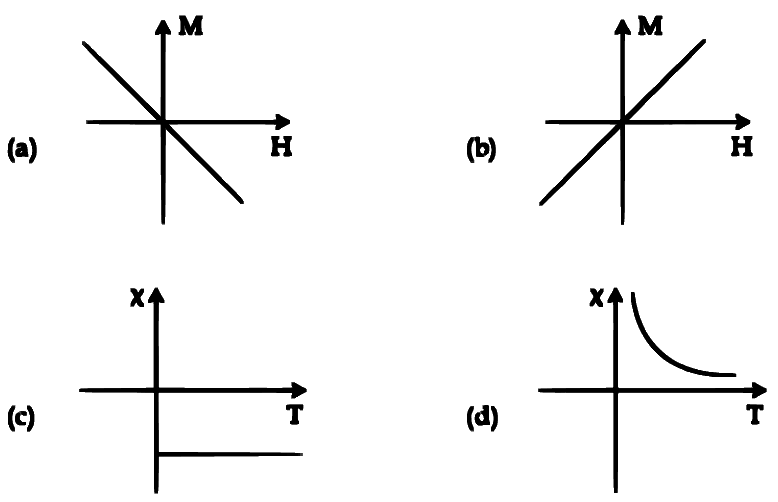
Following plots show magnetization (M) vs magnetizing field (H) and magnetic susceptibility (χ \chi χ
Which of the following combination will be represented by a diamagnetic material?
(a) (a), (c) (b) (a), (d) (c) (b), (d) (d) (b), (c) Show answer and solution
Answer: (a)
Loading the solution…
Report a mistake Open question page Q21 JEE Main 2021 · 22 JUL · SHIFT 2 Medium ☆
Magnetic Materials & Curie Law
Statement I: The ferromagnetic property depends on temperature. At high temperature, ferromagnet becomes paramagnet.
Statement II: At high temperature, the domain wall area of a ferromagnetic substance increases. In the light of the above statements, choose the most appropriate answer from the options given below:
(a) Statement I is false but Statement II is true (b) Statement I is true but Statement II is false (c) Both Statement I and Statement II are false (d) Both Statement I and Statement II are true Show answer and solution
Answer: (b)
Loading the solution…
Report a mistake Open question page Q22 MHT CET 2020 · 19 OCT · SHIFT 2 Easy ☆
Magnetic Materials & Curie Law
For a paramagnetic substance, the magnetic susceptibility is
(a) large and negative (b) small and positive (c) large and positive (d) small and negative Show answer and solution
Answer: (b)
Loading the solution…
Report a mistake Open question page Q23 MHT CET 2020 · 16 OCT · SHIFT 2 Easy ☆
Magnetic Materials & Curie Law
A thin light weight rod of diamagnetic substance such as silver is suspended in uniform external magnetic field. It will align itself with its length
(a) parallel to magnetic field (b) perpendicular to magnetic field (c) inclined at an angle 4 5 ∘ 45^\circ 4 5 ∘ (d) inclined at an angle 12 0 ∘ 120^\circ 12 0 ∘ Show answer and solution
Answer: (b)
Loading the solution…
Report a mistake Open question page Q24 JEE Main 2020 · 3 SEP · SHIFT 2 Medium ☆
Magnetic Materials & Curie Law
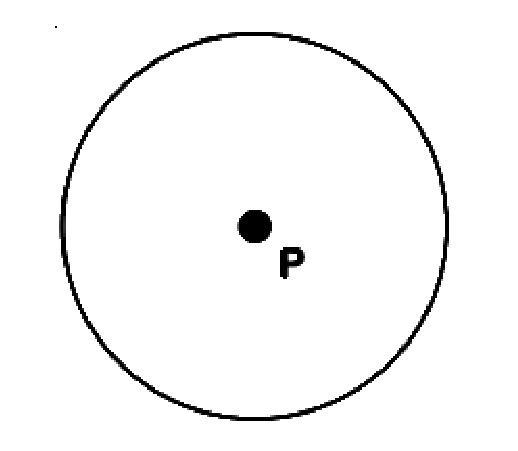
A perfectly diamagnetic sphere has a small spherical cavity at its centre, which is filled with a paramagnetic substance. The whole system is placed in a uniform magnetic field B ⃗ \vec{B} B
(a) B ⃗ \vec{B} B (b) zero (c) much large than ∣ B ⃗ ∣ \left|\vec{B}\right| B B ⃗ \vec{B} B (d) much large than ∣ B ⃗ ∣ \left|\vec{B}\right| B B ⃗ \vec{B} B Show answer and solution
Answer: (b)
Loading the solution…
Report a mistake Open question page Q25 MHT CET 2020 · 16 OCT · SHIFT 2 Medium ☆
Magnetic Materials & Curie Law
The magnetic susceptibility of a paramagnetic material at − 7 3 ∘ C -73^\circ\text{C} − 7 3 ∘ C − 17 3 ∘ C -173^\circ\text{C} − 17 3 ∘ C
(a) 0.0150 (b) 0.0075 (c) 0.0030 (d) 0.0045 Show answer and solution
Answer: (a)
Loading the solution…
Report a mistake Open question page Q26 JEE Main 2020 · 4 SEP · SHIFT 2 Medium ☆
Magnetic Materials & Curie Law
A paramagnetic sample shows a net magnetisation of 6 A/m when it is placed in an external magnetic field of 0.4 T at a temperature of 4 K. When the sample is placed in an external magnetic field of 0.3 T at a temperature of 24 K, then the magnetisation will be:
(a) 4 A/m (b) 1 A/m (c) 0.75 A/m (d) 2.25 A/m Show answer and solution
Answer: (c)
Loading the solution…
Report a mistake Open question page Q27 MHT CET 2019 · 2 MAY · SHIFT 2 Easy ☆
Magnetic Materials & Curie Law
Magnetic susceptibility of a paramagnetic substance is
(a) large and positive (b) small and positive (c) small and negative (d) large and negative Show answer and solution
Answer: (b)
Loading the solution…
Report a mistake Open question page Q28 JEE Main 2019 · 12 JAN · SHIFT 2 Medium ☆
Magnetic Materials & Curie Law
A paramagnetic material has 1028 atoms/m3. Its magnetic susceptibility at temperature 350 K is 2.8 × \times ×
(a) 3.726 × \times × (b) 2.672 × \times × (c) 3.672 × \times × (d) 3.267 × \times × − - − Show answer and solution
Answer: (d)
Loading the solution…
Report a mistake Open question page Q29 NEET 2018 Medium ☆
Magnetic Materials & Curie Law
A thin diamagnetic rod is placed vertically between the poles of an electromagnet. When the current in the electromagnet is switched on, then the diamagnetic rod is pushed up, out of the horizontal magnetic field. Hence the rod gains gravitational potential energy. The work required to do this comes from
(a) The current source (b) The magnetic field (c) The lattice structure of the material of the rod (d) The induced electric field due to the changing magnetic field Show answer and solution
Answer: (a)
Loading the solution…
Report a mistake Open question page Q30 NEET 2016 · PHASE 1 Easy ☆
Magnetic Materials & Curie Law
The magnetic susceptibility is negative for
(a) ferromagnetic material only (b) paramagnetic and ferromagnetic materials (c) diamagnetic material only (d) paramagnetic material only Show answer and solution
Answer: (c)
Loading the solution…
Report a mistake Open question page Q31 JEE Main 2014 · 19 APR · SHIFT 1 Easy ☆
Magnetic Materials & Curie Law
An example of a perfect diamagnet is a superconductor. This implies that when a superconductor is put in a magnetic field of intensity B, the magnetic field Bs inside the superconductor will be such that:
(a) Bs = − - − (b) Bs = 0 (c) Bs = B (d) Bs < B but Bs ≠ \neq = Show answer and solution
Answer: (b)
Loading the solution…
Report a mistake Open question page Q32 JEE Main 2014 · 11 APR · SHIFT 1 Easy ☆
Magnetic Materials & Curie Law
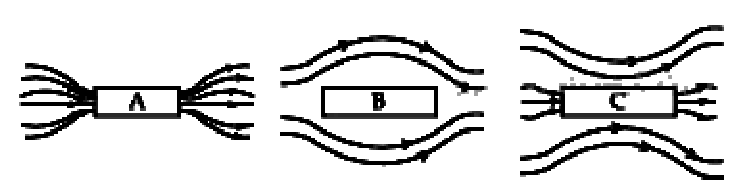
Three identical bars A, B and C are made of different magnetic materials. When kept in a uniform magnetic field, the field lines around them look as follows:
Make the correspondence of these bars with their material being diamagnetic (D), ferromagnetic (F) and paramagnetic (P):
(a) A ↔ \leftrightarrow ↔ ↔ \leftrightarrow ↔ ↔ \leftrightarrow ↔ (b) A ↔ \leftrightarrow ↔ ↔ \leftrightarrow ↔ ↔ \leftrightarrow ↔ (c) A ↔ \leftrightarrow ↔ ↔ \leftrightarrow ↔ ↔ \leftrightarrow ↔ (d) A ↔ \leftrightarrow ↔ ↔ \leftrightarrow ↔ ↔ \leftrightarrow ↔ Show answer and solution
Answer: (b)
Loading the solution…
Report a mistake Open question page Q33 NEET 2011 · AIPMT · PRELIMS Easy ☆
Magnetic Materials & Curie Law
There are four light-weight-rod samples A, B, C, D separately suspended by threads. A bar magnet is slowly brought near each sample and the following observations are noted
(i) A is feebly repelled
(ii) B is feebly attracted
(iii) C is strongly attracted
(iv) D remains unaffected
Which one of the following is true?
(a) B is of a paramagnetic material (b) C is of a diamagnetic material (c) D is of a ferromagnetic material (d) A is of a non-magnetic material Show answer and solution
Answer: (a)
Loading the solution…
Report a mistake Open question page Q34 NEET 2010 · AIPMT · MAINS Easy ☆
Magnetic Materials & Curie Law
The magnetic moment of a diamagnetic atom is
(a) much greater than one (b) 1 (c) between zero and one (d) equal to zero Show answer and solution
Answer: (d)
Loading the solution…
Report a mistake Open question page Q35 NEET 2009 · AIPMT Easy ☆
Magnetic Materials & Curie Law
If a diamagnetic substance is brought near the north or the south pole of a bar magnet, it is
(a) repelled by the north pole and attracted by the south pole (b) attracted by the north pole and repelled by the south pole (c) attracted by both the poles (d) repelled by both the poles Show answer and solution
Answer: (d)
Loading the solution…
Report a mistake Open question page Q36 JEE Main 2008 · AIEEE Easy ☆
Magnetic Materials & Curie Law
Relative permittivity and permeability of a material ε r \varepsilon_r ε r μ r , \mu_r, μ r ,
(a) ε r = 0.5 , μ r = 1.5 \varepsilon_r = 0.5,\ \mu_r = 1.5 ε r = 0.5 , μ r = 1.5 (b) ε r = 1.5 , μ r = 0.5 \varepsilon_r = 1.5,\ \mu_r = 0.5 ε r = 1.5 , μ r = 0.5 (c) ε r = 0.5 , μ r = 0.5 \varepsilon_r = 0.5,\ \mu_r = 0.5 ε r = 0.5 , μ r = 0.5 (d) ε r = 1.5 , μ r = 1.5 \varepsilon_r = 1.5,\ \mu_r = 1.5 ε r = 1.5 , μ r = 1.5 Show answer and solution
Answer: (b)
Loading the solution…
Report a mistake Open question page Q37 NEET 2008 · AIPMT Easy ☆
Magnetic Materials & Curie Law
Curie temperature above which
(a) paramagnetic material becomes ferromagnetic material (b) ferromagnetic material becomes diamagnetic material (c) ferromagnetic material becomes paramagnetic material (d) paramagnetic material becomes diamagnetic material Show answer and solution
Answer: (c)
Loading the solution…
Report a mistake Open question page Q38 NEET 2007 · AIPMT Easy ☆
Magnetic Materials & Curie Law
Nickel shows ferromagnetic property at room temperature. If the temperature is increased beyond Curie temperature, then it will show
(a) anti ferromagnetism (b) no magnetic property (c) diamagnetism (d) paramagnetism. Show answer and solution
Answer: (d)
Loading the solution…
Report a mistake Open question page Q39 JEE Main 2006 · AIEEE Easy ☆
Magnetic Materials & Curie Law
Needles N 1 , N 2 N_1, N_2 N 1 , N 2 N 3 N_3 N 3
(a) attract N 1 N_1 N 1 N 2 N_2 N 2 N 3 N_3 N 3 (b) attract N 1 N_1 N 1 N 2 N_2 N 2 N 3 N_3 N 3 (c) attract N 1 N_1 N 1 N 2 N_2 N 2 N 3 N_3 N 3 (d) attract all three of them Show answer and solution
Answer: (b)
Loading the solution…
Report a mistake Open question page Q40 NEET 2006 · AIPMT Easy ☆
Magnetic Materials & Curie Law
Curie temperature above which
(a) paramagnetic material becomes ferromagnetic material (b) ferromagnetic material becomes diamagnetic material (c) ferromagnetic material becomes paramagnetic material (d) paramagnetic material becomes diamagnetic material Show answer and solution
Answer: (c)
Loading the solution…
Report a mistake Open question page Q41 NEET 2005 · AIPMT Easy ☆
Magnetic Materials & Curie Law
If the magnetic dipole moment of an atom of diamagnetic material, paramagnetic material and ferromagnetic material are denoted by μ \mu μ μ \mu μ μ \mu μ
(a) μ d = 0 \mu_d = 0 μ d = 0 μ \mu μ ≠ \neq = (b) μ \mu μ ≠ \neq = μ \mu μ (c) μ \mu μ μ \mu μ ≠ \neq = (d) μ \mu μ ≠ \neq = μ \mu μ ≠ \neq = Show answer and solution
Answer: (a)
Loading the solution…
Report a mistake Open question page Q42 JEE Main 2004 · AIEEE Easy ☆
Magnetic Materials & Curie Law
Curie temperature is the temperature above which
(a) a ferromagnetic material becomes paramagnetic (b) a paramagnetic material becomes diamagnetic (c) a ferromagnetic material becomes diamagnetic (d) a paramagnetic material becomes ferromagnetic Show answer and solution
Answer: (a)
Loading the solution…
Report a mistake Open question page Q43 NEET 2003 · AIPMT Easy ☆
Magnetic Materials & Curie Law
A diamagnetic material in a magnetic field moves
(a) from stronger to the weaker parts of the field (b) from weaker to the stronger parts of the field (c) perpendicular to the field (d) in none of the above directions Show answer and solution
Answer: (a)
Loading the solution…
Report a mistake Open question page Q44 NEET 2003 · AIPMT Easy ☆
Magnetic Materials & Curie Law
According to Curie's law, the magnetic susceptibility of a substance at an absolute temperature T T T
(a) 1 / T 1/T 1/ T (b) T T T (c) 1 / T 1/T 1/ T (d) T T T Show answer and solution
Answer: (a)
Loading the solution…
Report a mistake Open question page Q45 NEET 2001 · AIPMT Easy ☆
Magnetic Materials & Curie Law
Among which the magnetic susceptibility does not depend on the temperature?
(a) diamagnetism (b) paramagnetism (c) ferromagnetism (d) ferrite. Show answer and solution
Answer: (a)
Loading the solution…
Report a mistake Open question page Q46 NEET 1999 · AIPMT Easy ☆
Magnetic Materials & Curie Law
A diamagnetic substance is brought near a strong magnet, then it is
(a) attracted by a magnet (b) repelled by a magnet (c) repelled by north pole and attracted by south pole (d) attracted by north pole and repelled by south pole Show answer and solution
Answer: (b)
Loading the solution…
Report a mistake Open question page Q47 NDA 2011 Easy ☆
Magnetic Materials & Curie Law
Magnets attract magnetic substances such as iron, nickel, cobalt etc. They can also repel :
(a) paramagnetic substances. (b) ferromagnetic substances. (c) diamagnetic substances. (d) non-magnetic substances. Show answer
Answer: (c)
Step-by-step solution coming soon.
Report a mistake Q48 NDA 2010 Easy ☆
Magnetic Materials & Curie Law
Magnetism of a bar magnet can be destroyed if it is:
(a) 1 and 3 only (b) 2 only (c) 2 and 3 only (d) 1, 2 and 3 Show answer
Answer: (c)
Step-by-step solution coming soon.
Report a mistake Q49 JEE Advanced 2010 Medium ☆
Magnetic Materials & Curie Law
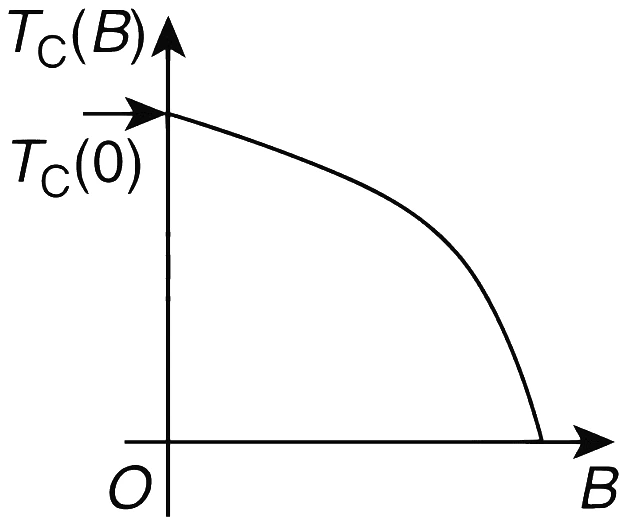
Electrical resistance of certain materials, known as superconductors, changes abruptly from a non-zero value to zero as their temperature is lowered below a critical temperature T c ( 0 ) T_c(0) T c ( 0 ) T c ( 0 ) T_c(0) T c ( 0 ) T c ( B ) T_c(B) T c ( B ) B B B T c ( B ) T_c(B) T c ( B ) B B B
In the graph below, the resistance R R R T T T B 1 B_1 B 1 B 2 B_2 B 2 B 2 B_2 B 2 B 1 B_1 B 1 R R R T T T
(a) Graph (A) (b) Graph (B) (c) Graph (C) (d) Graph (D) Show answer
Answer: (a)
Step-by-step solution coming soon.
Report a mistake Q50 JEE Advanced 2010 Medium ☆
Magnetic Materials & Curie Law
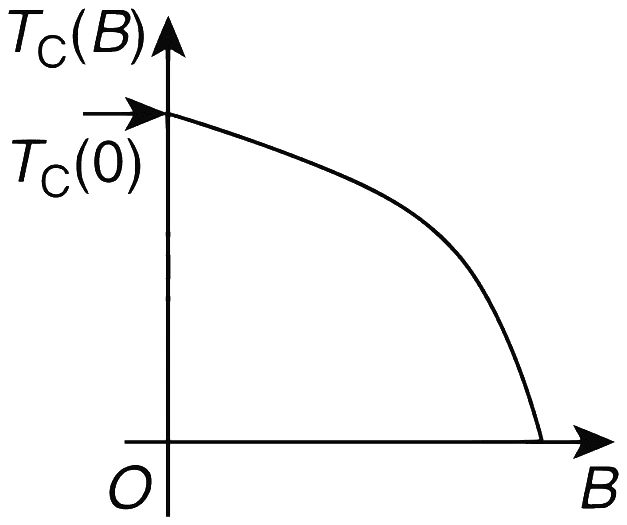
Electrical resistance of certain materials, known as superconductors, changes abruptly from a non-zero value to zero as their temperature is lowered below a critical temperature T c ( 0 ) T_c(0) T c ( 0 ) T c ( 0 ) T_c(0) T c ( 0 ) T c ( B ) T_c(B) T c ( B ) B B B T c ( B ) T_c(B) T c ( B ) B B B
A superconductor has T c ( 0 ) = 100 K T_c(0) = 100\,\text{K} T c ( 0 ) = 100 K 7.5 T 7.5\,\text{T} 7.5 T T c T_c T c 75 K 75\,\text{K} 75 K
(a) B = 5 T B = 5\,\text{T} B = 5 T T c ( B ) = 80 K T_c(B) = 80\,\text{K} T c ( B ) = 80 K (b) B = 5 T B = 5\,\text{T} B = 5 T 75 K < T c ( B ) < 100 K 75\,\text{K} < T_c(B) < 100\,\text{K} 75 K < T c ( B ) < 100 K (c) B = 10 T B = 10\,\text{T} B = 10 T 75 K < T c < 100 K 75\,\text{K} < T_c < 100\,\text{K} 75 K < T c < 100 K (d) B = 10 T B = 10\,\text{T} B = 10 T T c = 70 K T_c = 70\,\text{K} T c = 70 K Show answer
Answer: (b)
Step-by-step solution coming soon.
Report a mistake Q51 AIIMS 2019 Easy ☆
Magnetic Materials & Curie Law
Assertion: Paramagnetic substances get poorly attracted in magnetic field.
(a) Both Assertion and Reason are true and Reason is the correct explanation of Assertion. (b) Both Assertion and Reason are true but Reason is not the correct explanation of Assertion. (c) Assertion is true but Reason is false. (d) Both Assertion and Reason are false. Show answer
Answer: (a)
Step-by-step solution coming soon.
Report a mistake Q52 AIIMS 2017 Easy ☆
Magnetic Materials & Curie Law
Assertion: The magnetism of magnet is due to the spin motion of electrons.
(a) Both assertion and reason are true and reason is the correct explanation of assertion (b) Both assertion and reason are true but reason is not the correct explanation of assertion (c) Assertion is true but reason is false (d) Both assertion and reason are false. Show answer
Answer: (c)
Step-by-step solution coming soon.
Report a mistake Q53 AIIMS 2015 Easy ☆
Magnetic Materials & Curie Law
If the magnetizing field on a ferromagnetic material is increased, its permeability
(a) decreased (b) increased (c) is unaffected (d) may be increased or decreased Show answer
Answer: (d)
Step-by-step solution coming soon.
Report a mistake Q54 AIIMS 2015 Easy ☆
Magnetic Materials & Curie Law
The variation of magnetic susceptibility with the temperature of a ferromagnetic material can be plotted as
(a) Graph (A) (b) Graph (B) (c) Graph (C) (d) Graph (D) Show answer
Answer: (b)
Step-by-step solution coming soon.
Report a mistake Q55 AIIMS 2015 Easy ☆
Magnetic Materials & Curie Law
Assertion: Above Curie temperature, a ferromagnetic material becomes paramagnetic.
(a) Both Assertion and Reason are true and Reason is the correct explanation of Assertion. (b) Both Assertion and Reason are true but Reason is not the correct explanation of Assertion. (c) Assertion is true but Reason is false. (d) Both Assertion and Reason are false. Show answer
Answer: (a)
Step-by-step solution coming soon.
Report a mistake Q56 AIIMS 2013 Easy ☆
Magnetic Materials & Curie Law
A uniform magnetic field parallel to the plane of paper, existed in space initially directed from left to right. When a bar of soft iron is placed in the field parallel to it, the lines of force passing through it will be represented by figure.
(a) Figure (A) (b) Figure (B) (c) Figure (C) (d) Figure (D) Show answer
Answer: (b)
Step-by-step solution coming soon.
Report a mistake Q57 AIIMS 2010 Easy ☆
Magnetic Materials & Curie Law
Assertion: A paramagnetic sample displays greater magnetisation (for the same magnetising field) when cooled.
(a) Both Assertion and Reason are true and Reason is the correct explanation of Assertion. (b) Both Assertion and Reason are true but Reason is not the correct explanation of Assertion. (c) Assertion is true but Reason is false. (d) Both Assertion and Reason are false. Show answer
Answer: (c)
Step-by-step solution coming soon.
Report a mistake Q58 AIIMS 2006 Easy ☆
Magnetic Materials & Curie Law
Assertion: Magnetic resonance imaging (MRI) is a useful diagnostic tool for producing images of various parts of human body.
(a) Both Assertion and Reason are true and the Reason is the correct explanation of the Assertion (b) Both Assertion and Reason are true but the Reason is not the correct explanation of the Assertion (c) Assertion is true but Reason is false (d) Both Assertion and Reason are false Show answer
Answer: (b)
Step-by-step solution coming soon.
Report a mistake Q59 AIIMS 2006 Easy ☆
Magnetic Materials & Curie Law
Assertion: Diamagnetic materials can exhibit magnetism.
(a) Both Assertion and Reason are true and the Reason is the correct explanation of the Assertion (b) Both Assertion and Reason are true but the Reason is not the correct explanation of the Assertion (c) Assertion is true but Reason is false (d) Both Assertion and Reason are false Show answer
Answer: (c)
Step-by-step solution coming soon.
Report a mistake Q60 AIIMS 2004 Easy ☆
Magnetic Materials & Curie Law
Liquid oxygen remains suspended between two pole faces of a magnet because it is :
(a) diamagnetic (b) paramagnetic (c) ferromagnetic (d) antiferromagnetic Show answer
Answer: (b)
Step-by-step solution coming soon.
Report a mistake Q61 AIIMS 2004 Easy ☆
Magnetic Materials & Curie Law
The Magnetic Resonance Imaging (MRI) is based on the phenomenon of :
(a) nuclear magnetic resonance (b) electron spin resonance (c) electron paramagnetic resonance (d) diamagnetism of human tissues Show answer
Answer: (a)
Step-by-step solution coming soon.
Report a mistake Q62 AIIMS 2004 Easy ☆
Magnetic Materials & Curie Law
Assertion: A disc-shaped magnet is levitated above a superconducting material that has been cooled by liquid nitrogen.
(a) Both Assertion and Reason are true and the Reason is the correct explanation of the Assertion (b) Both Assertion and Reason are true but the Reason is not the correct explanation of the Assertion (c) Assertion is true but Reason is false (d) Both Assertion and Reason are false Show answer
Answer: (a)
Step-by-step solution coming soon.
Report a mistake Q63 JIPMER 2010 Easy ☆
Magnetic Materials & Curie Law
A frog can be levitated in magnetic field produced by a current in a vertical solenoid placed below the frog. This is possible because the body of the frog behaves as
(a) paramagnetic (b) diamagnetic (c) ferromagnetic (d) anti-ferromagnetic Show answer
Answer: (b)
Step-by-step solution coming soon.
Report a mistake Q64 JIPMER 2007 Easy ☆
Magnetic Materials & Curie Law
If the magnetic dipole moment of an atom of diamagnetic material, paramagnetic material and ferromagnetic material are denoted by μ d \mu_d μ d μ p \mu_p μ p μ f \mu_f μ f
(a) μ d ≠ 0 \mu_d \neq 0 μ d = 0 μ f ≠ 0 \mu_f \neq 0 μ f = 0 (b) μ p = 0 \mu_p = 0 μ p = 0 μ f ≠ 0 \mu_f \neq 0 μ f = 0 (c) μ d = 0 \mu_d = 0 μ d = 0 μ p ≠ 0 \mu_p \neq 0 μ p = 0 (d) μ d ≠ 0 \mu_d \neq 0 μ d = 0 μ p = 0 \mu_p = 0 μ p = 0 Show answer
Answer: (c)
Step-by-step solution coming soon.
Report a mistake Q65 BITSAT 2026 Easy ☆
Magnetic Materials & Curie Law
The magnetic susceptibility of a diamagnetic substance is
(a) small and positive (b) small and negative (c) large and positive (d) large and negative Show answer
Answer: (b)
Step-by-step solution coming soon.
Report a mistake Q66 VITEEE 2023 Easy ☆
Magnetic Materials & Curie Law
Susceptibility of ferromagnetic substance is
(a) > 1 > 1 > 1 (b) < 1 < 1 < 1 (c) 0 0 0 (d) 1 1 1 Show answer
Answer: (a)
Step-by-step solution coming soon.
Report a mistake Q67 VITEEE 2023 Easy ☆
Magnetic Materials & Curie Law
The susceptibility of a magnetism at 300 K 300\,\text{K} 300 K 1.5 × 1 0 − 5 1.5 \times 10^{-5} 1.5 × 1 0 − 5 4.5 × 1 0 − 5 4.5 \times 10^{-5} 4.5 × 1 0 − 5
(a) 150 K 150\,\text{K} 150 K (b) 100 K 100\,\text{K} 100 K (c) 50 K 50\,\text{K} 50 K (d) 20 K 20\,\text{K} 20 K Show answer
Answer: (b)
Step-by-step solution coming soon.
Report a mistake Q68 VITEEE 2008 Easy ☆
Magnetic Materials & Curie Law
Identify the INCORRECT statement regarding a superconducting wire
(a) transport current flows through its surface (b) transport current flows through the entire area of cross-section of the wire (c) it exhibits zero electrical resistivity and expels applied magnetic field (d) it is used to produce large magnetic field Show answer
Answer: (b)
Step-by-step solution coming soon.
Report a mistake Q69 VITEEE 2007 Easy ☆
Magnetic Materials & Curie Law
The magnetic moment of the ground state of an atom whose open sub shell is half filled with five electrons is
(a) 35 μ B \sqrt{35}\sqrt{\mu_B} 35 μ B (b) 35 μ B 35\mu_B 35 μ B (c) 35 μ B 35\sqrt{\mu_B} 35 μ B (d) μ B 35 \mu_B\sqrt{35} μ B 35 Show answer
Answer: (d)
Step-by-step solution coming soon.
Report a mistake Q70 COMEDK 2026 Easy ☆
Magnetic Materials & Curie Law
Paramagnetic substances
Show answer
Answer: (b)
Step-by-step solution coming soon.
Report a mistake Q71 COMEDK 2025 Easy ☆
Magnetic Materials & Curie Law
Which of the following is not a characteristic of diamagnetism?
(a) The material moves from a region of strong magnetic field to weak magnetic field. (b) The origin of diamagnetism is the spin of electrons. (c) Their magnetic susceptibility is small and negative. (d) Diamagnetic materials are repelled by bar magnets. Show answer
Answer: (b)
Step-by-step solution coming soon.
Report a mistake Q72 COMEDK 2024 Easy ☆
Magnetic Materials & Curie Law
For a paramagnetic material, the dependence of the magnetic susceptibility χ \chi χ
(a) Independent of T T T (b) χ ∝ 1 T 2 \chi \propto \dfrac{1}{T^2} χ ∝ T 2 1 (c) χ ∝ T \chi \propto T χ ∝ T (d) χ ∝ 1 T \chi \propto \dfrac{1}{T} χ ∝ T 1 Show answer
Answer: (d)
Step-by-step solution coming soon.
Report a mistake Q73 COMEDK 2024 Easy ☆
Magnetic Materials & Curie Law
The magnetic susceptibility of an ideal diamagnetic substance is
(a) − 1 -1 − 1 (b) ∞ \infty ∞ (c) 0 0 0 (d) 1 1 1 Show answer
Answer: (a)
Step-by-step solution coming soon.
Report a mistake Q74 COMEDK 2023 Easy ☆
Magnetic Materials & Curie Law
The magnetic permeability μ \mu μ
(a) μ > 1 \mu > 1 μ > 1 (b) μ = 1 \mu = 1 μ = 1 (c) μ = 0 \mu = 0 μ = 0 (d) μ \mu μ Show answer
Answer: (a)
Step-by-step solution coming soon.
Report a mistake Q75 KCET 2026 Easy ☆
Magnetic Materials & Curie Law
Pick out the WRONG statements about magnetic substances. (χ \chi χ μ r \mu_r μ r − 1 ≤ χ < 0 -1 \leq \chi < 0 − 1 ≤ χ < 0 χ ≫ 1 \chi \gg 1 χ ≫ 1 χ ≪ 1 \chi \ll 1 χ ≪ 1 μ r ≫ 1 \mu_r \gg 1 μ r ≫ 1
(a) I and II (b) III and IV (c) II and III (d) II and IV Show answer
Answer: (c)
Step-by-step solution coming soon.
Report a mistake Q76 KCET 2026 Easy ☆
Magnetic Materials & Curie Law
If a paramagnetic bar is brought near a bar magnet, then it is
(a) Attracted by both the poles of the bar magnet (b) Repelled by both the poles of the bar magnet (c) Attracted by the South-pole and repelled by the North-pole of the bar magnet (d) Attracted by the North-pole and repelled by the South-pole of the bar magnet Show answer
Answer: (a)
Step-by-step solution coming soon.
Report a mistake Q77 KCET 2025 Easy ☆
Magnetic Materials & Curie Law
Which of the following statements is true in respect of diamagnetic substances?
(a) They are feebly attracted by magnets (b) Permeability is greater than 1000 1000 1000 (c) Susceptibility decreases with temperature. (d) Susceptibility is small and negative Show answer
Answer: (d)
Step-by-step solution coming soon.
Report a mistake Q78 KCET 2024 Easy ☆
Magnetic Materials & Curie Law
Magnetic susceptibility of Mg at 300 K 300\,\text{K} 300 K 1.2 × 1 0 − 5 1.2 \times 10^{-5} 1.2 × 1 0 − 5 200 K 200\,\text{K} 200 K
(a) 18 × 1 0 − 5 18 \times 10^{-5} 18 × 1 0 − 5 (b) 180 × 1 0 − 5 180 \times 10^{-5} 180 × 1 0 − 5 (c) 1.8 × 1 0 − 5 1.8 \times 10^{-5} 1.8 × 1 0 − 5 (d) 0.18 × 1 0 − 5 0.18 \times 10^{-5} 0.18 × 1 0 − 5 Show answer
Answer: (c)
Step-by-step solution coming soon.
Report a mistake Q79 KCET 2023 Medium ☆
Magnetic Materials & Curie Law
The Curie temperature of cobalt and iron are 1400 K 1400\,\text{K} 1400 K 1000 K 1000\,\text{K} 1000 K T = 1600 K T = 1600\,\text{K} T = 1600 K
(a) 1 / 3 1/3 1/3 (b) 3 3 3 (c) 7 / 5 7/5 7/5 (d) 5 / 7 5/7 5/7 Show answer
Answer: (b)
Step-by-step solution coming soon.
Report a mistake Q80 KCET 2020 Easy ☆
Magnetic Materials & Curie Law
In a permanent magnet at room temperature
(a) magnetic moment of each molecule is zero (b) the individual molecules have non-zero magnetic moment which are all perfectly aligned (c) domains are partially aligned (d) domains are all perfectly aligned Show answer
Answer: (d)
Step-by-step solution coming soon.
Report a mistake Q81 KCET 2020 Medium ☆
Magnetic Materials & Curie Law
A paramagnetic sample shows a net magnetisation of 8 A m − 1 8\,\text{A m}^{-1} 8 A m − 1 0.6 T 0.6\,\text{T} 0.6 T 4 K 4\,\text{K} 4 K 0.2 T 0.2\,\text{T} 0.2 T 16 K 16\,\text{K} 16 K
(a) 32 3 A m − 1 \dfrac{32}{3}\,\text{A m}^{-1} 3 32 A m − 1 (b) 2 3 A m − 1 \dfrac{2}{3}\,\text{A m}^{-1} 3 2 A m − 1 (c) 6 A m − 1 6\,\text{A m}^{-1} 6 A m − 1 (d) 2.4 A m − 1 2.4\,\text{A m}^{-1} 2.4 A m − 1 Show answer
Answer: (b)
Step-by-step solution coming soon.
Report a mistake Q82 KCET 2019 Easy ☆
Magnetic Materials & Curie Law
In a permanent magnet at room temperature
(a) magnetic moment of each molecule is zero (b) the individual molecules have non zero magnetic moment which are all perfectly aligned. (c) domains are partially aligned (d) domains are all perfectly aligned Show answer
Answer: (d)
Step-by-step solution coming soon.
Report a mistake Q83 KCET 2018 Easy ☆
Magnetic Materials & Curie Law
Needles N 1 N_1 N 1 N 2 N_2 N 2 N 3 N_3 N 3
(a) attract all three of them (b) attract N 1 N_1 N 1 N 2 N_2 N 2 N 3 N_3 N 3 (c) attract N 1 N_1 N 1 N 2 N_2 N 2 N 3 N_3 N 3 (d) attract N 1 N_1 N 1 N 2 N_2 N 2 N 3 N_3 N 3 Show answer
Answer: (b)
Step-by-step solution coming soon.
Report a mistake Q84 KCET 2017 Easy ☆
Magnetic Materials & Curie Law
The susceptibility of a ferromagnetic substance is
(a) Zero (b) > 1 > 1 > 1 (c) < 1 < 1 < 1 (d) ≫ 1 \gg 1 ≫ 1 Show answer
Answer: (d)
Step-by-step solution coming soon.
Report a mistake Q85 AP EAPCET 2026 Medium ☆
Magnetic Materials & Curie Law
The temperature at which the susceptibility of nickel becomes 0.5 0.5 0.5 46 0 ∘ C 460^\circ\text{C} 46 0 ∘ C 36 0 ∘ C 360^\circ\text{C} 36 0 ∘ C
(a) 560 K 560\,\text{K} 560 K (b) 833 K 833\,\text{K} 833 K (c) 733 K 733\,\text{K} 733 K (d) 760 K 760\,\text{K} 760 K Show answer
Answer: (b)
Step-by-step solution coming soon.
Report a mistake Q86 AP EAPCET 2024 Easy ☆
Magnetic Materials & Curie Law
Any magnetic material loses its magnetic property when it is
(a) dipped in water (b) dipped in sand (c) attached to an iron piece (d) heated to high temperature Show answer
Answer: (d)
Step-by-step solution coming soon.
Report a mistake Q87 AP EAPCET 2023 Easy ☆
Magnetic Materials & Curie Law
One of the following substances having the tendency to move from stronger region to the weaker region of the magnetic field is
(a) paramagnetic (b) ferromagnetic (c) diamagnetic (d) ferrimagnetic Show answer
Answer: (c)
Step-by-step solution coming soon.
Report a mistake Q88 AP EAPCET 2021 Easy ☆
Magnetic Materials & Curie Law
A paramagnetic sample showing a net magnetisation of 0.8 A m − 1 0.8\,\text{A m}^{-1} 0.8 A m − 1 0.8 T 0.8\,\text{T} 0.8 T 5 K 5\,\text{K} 5 K 20 K 20\,\text{K} 20 K
(a) 0.8 A m − 1 0.8\,\text{A m}^{-1} 0.8 A m − 1 (b) 0.2 A m − 1 0.2\,\text{A m}^{-1} 0.2 A m − 1 (c) 0.1 A m − 1 0.1\,\text{A m}^{-1} 0.1 A m − 1 (d) 0.4 A m − 1 0.4\,\text{A m}^{-1} 0.4 A m − 1 Show answer
Answer: (b)
Step-by-step solution coming soon.
Report a mistake Q89 TS EAMCET 2026 Easy ☆
Magnetic Materials & Curie Law
If the susceptibility of a paramagnetic substance at a temperature of 23 ∘ C 23\,{}^\circ\text{C} 23 ∘ C 2.3 × 1 0 − 5 2.3 \times 10^{-5} 2.3 × 1 0 − 5 467 ∘ C 467\,{}^\circ\text{C} 467 ∘ C
(a) 2.3 × 1 0 − 6 2.3 \times 10^{-6} 2.3 × 1 0 − 6 (b) 6.9 × 1 0 − 6 6.9 \times 10^{-6} 6.9 × 1 0 − 6 (c) 9.2 × 1 0 − 6 9.2 \times 10^{-6} 9.2 × 1 0 − 6 (d) 4.6 × 1 0 − 6 4.6 \times 10^{-6} 4.6 × 1 0 − 6 Show answer
Answer: (c)
Step-by-step solution coming soon.
Report a mistake Q90 TS EAMCET 2024 Easy ☆
Magnetic Materials & Curie Law
The most exotic diamagnetic materials are
(a) superconductors (b) semiconductors (c) conductors (d) resistors Show answer
Answer: (a)
Step-by-step solution coming soon.
Report a mistake Q91 TS EAMCET 2023 Easy ☆
Magnetic Materials & Curie Law
If χ \chi χ μ r \mu_r μ r
(a) χ ≪ 1 \chi \ll 1 χ ≪ 1 (b) μ r ≪ 1 \mu_r \ll 1 μ r ≪ 1 (c) μ r = 0 \mu_r = 0 μ r = 0 (d) χ ≫ 1 \chi \gg 1 χ ≫ 1 Show answer
Answer: (d)
Step-by-step solution coming soon.
Report a mistake Q92 TS EAMCET 2023 Easy ☆
Magnetic Materials & Curie Law
The magnetic susceptibility of ferromagnetic materials is
(a) < 0 < 0 < 0 (b) > 1 > 1 > 1 (c) 1 1 1 (d) 0 0 0 Show answer
Answer: (b)
Step-by-step solution coming soon.
Report a mistake Q93 WB JEE 2021 Easy ☆
Magnetic Materials & Curie Law
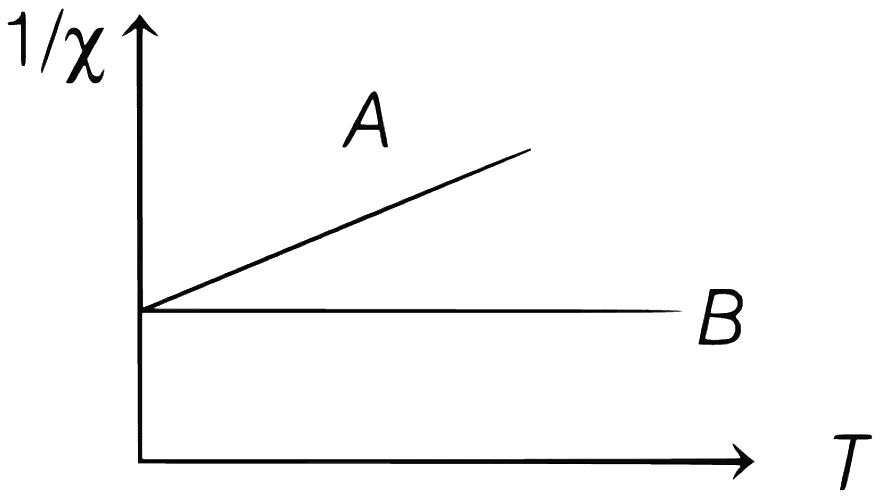
For two types of magnetic materials A A A B B B 1 χ \dfrac{1}{\chi} χ 1 χ \chi χ T T T
(a) A A A B B B (b) A A A B B B (c) A A A B B B (d) A A A B B B Show answer
Answer: (d)
Step-by-step solution coming soon.
Report a mistake Q94 WB JEE 2017 Easy ☆
Magnetic Materials & Curie Law
If χ \chi χ μ \mu μ μ 0 \mu_0 μ 0
More than one option can be correct. Tap every correct option, then tap Check.
(a) for a paramagnetic substance: χ < 0 , μ > 0 \chi < 0, \mu > 0 χ < 0 , μ > 0 (b) for a paramagnetic substance: χ > 0 , μ > μ 0 \chi > 0, \mu > \mu_0 χ > 0 , μ > μ 0 (c) for a diamagnetic substance: χ > 0 , μ < 0 \chi > 0, \mu < 0 χ > 0 , μ < 0 (d) for a ferromagnetic substance: χ > 1 , μ > μ 0 \chi > 1, \mu > \mu_0 χ > 1 , μ > μ 0 Show answer
Answer: (b), (d)
Step-by-step solution coming soon.
Report a mistake Q95 CBSE Class 12 2024 Easy ☆
Magnetic Materials & Curie Law
Which of the following pairs is that of paramagnetic materials?
(a) Copper and Aluminium (b) Sodium and Calcium (c) Lead and Iron (d) Nickel and Cobalt Show answer
Answer: (b)
Step-by-step solution coming soon.
Report a mistake Q96 CBSE Class 12 2023 Easy ☆
Magnetic Materials & Curie Law
Assertion (A): Diamagnetic substances exhibit magnetism.
(a) Both Assertion (A) and Reason (R) are true and Reason (R) is the correct explanation of the Assertion (A). (b) Both Assertion (A) and Reason (R) are true, but Reason (R) is NOT the correct explanation of the Assertion (A). (c) Assertion (A) is true, but Reason (R) is false. (d) Assertion (A) is false, but Reason (R) is true. Show answer
Answer: (a)
Step-by-step solution coming soon.
Report a mistake Q97 CBSE Class 12 2023 Easy ☆
Magnetic Materials & Curie Law
Which of the following has its permeability less than that of free space?
(a) Copper (b) Aluminium (c) Copper chloride (d) Nickel Show answer
Answer: (a)
Step-by-step solution coming soon.
Report a mistake
No questions match these filters.