A copper wire of length 3 m is stretched by 3 mm by applying an external force. The volume of the wire is 600×10−6 m3. The elastic potential energy stored in the wire in stretched condition would be ______ J.
(Given Young modulus of copper =1.1×10¹¹ N/m2)
Numerical answer type. Work it out, then open the answer.
A steel wire of length 2 m and Young's modulus 2.0×10¹¹ N m−2 is stretched by a force. If Poisson ratio and transverse strain for the wire are 0.2 and 10−3 respectively, then the elastic potential energy density of the wire is __________ ×105 (in SI units).
Numerical answer type. Work it out, then open the answer.
The amount of elastic potential energy per unit volume (in SI unit) of a steel wire of length 100 cm to stretch it by 1 mm is (if Young's modulus of the wire =2.0×10¹¹ Nm−2):
The elastic potential energy stored in a steel wire of length 20 m stretched through 2 cm is 80 J. The cross sectional area of the wire is __________ mm2.
( Given, Y=2.0×10¹¹ Nm−2)
Numerical answer type. Work it out, then open the answer.
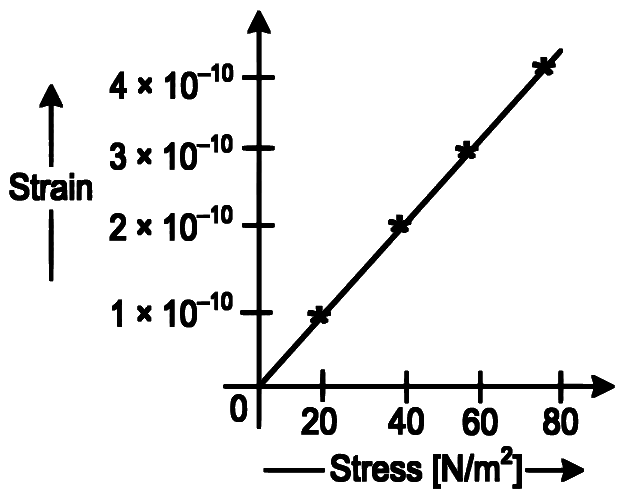
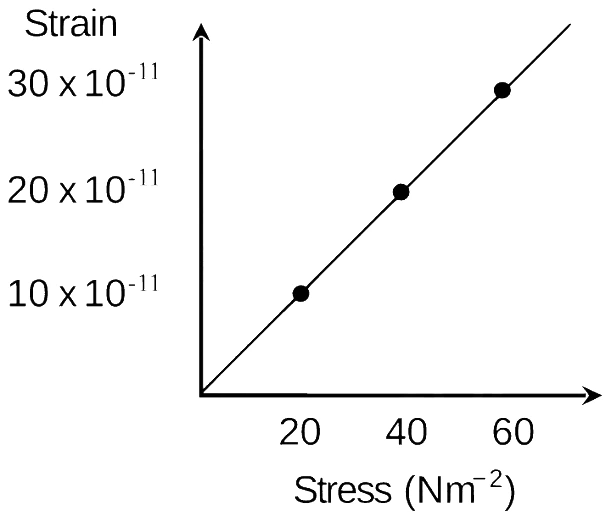
The elastic behaviour of material for linear stress and linear strain, is shown in the figure. The energy density for a linear strain of 5 × 10⁻⁴ is __________ kJ/m3. Assume that material is elastic upto the linear strain of 5 × 10⁻⁴.
Numerical answer type. Work it out, then open the answer.
A stone of mass 20 g is projected from a rubber catapult of length 0.1 m and area of cross section 10−6 m2 stretched by an amount 0.04 m. The velocity of the projected stone is ______________ m/s. (Young's modulus of rubber = 0.5 × 10⁹ N/m2)
Numerical answer type. Work it out, then open the answer.
A metal rod has length, cross-sectional area and Young's modulus as L,A and Y, respectively. If the elongation in the rod produced is ℓ, then work done is proportional to
Two steel wires having same length are suspended from a ceiling under the same load. If the ratio of their energy stored per unit volume is 1: 4, the ratio of their diameters is:
A wire of length ' L ' and area of cross section ' A ' is made of material of Young's modulus ' Y. It is stretched by an amount ' x '. The work done in stretching the wire is
When a block of mass M is suspended by a long wire of length L, the length of the wire becomes (L + l). The elastic potential energy stored in the extended wire is:
Work done in stretching a wire through 1 mm is 2 J. What amount of work will be done for elongating another wire of same material, with half the length and double the radius of cross section, by 1 mm?
A boy's catapult is made of rubber cord which is 42 cm long, with 6 mm diameter of cross-section and of negligible mass. The boy keeps a stone weighing 0.02kg on it and stretches the cord by 20 cm by applying a constant force. When released, the stone flies off with a velocity of 20 ms–1. Neglect the change in the area of cross-section of the cord while stretched. The Young's modulus of rubber is closest to:
A wire suspended vertically from one of its ends is stretched by attaching a weight of 200 N to the lower end. The weight stretches the wire by 1 mm. Then the elastic energy stored in the wire is
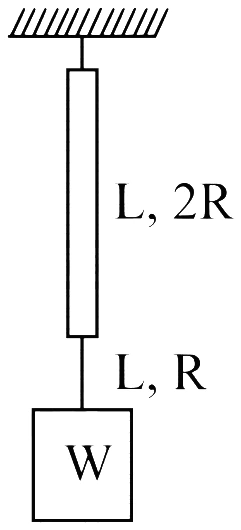
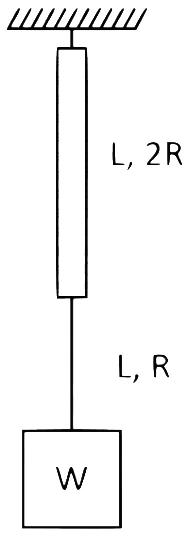
Two wires of the same material (Young's modulus =Y) and the same length L but radii R and 2R respectively are joined end to end and a weight w is suspended from the combination as shown in the figure. The elastic potential energy in the system is
Two wires of the same material (Young's modulus =Y) and the same length L but radii R and 2R respectively are joined end to end and a weight w is suspended from the combination as shown in the figure. The elastic potential energy in the system is
If the work done in stretching a wire by 1mm is 2J, the work necessary for stretching another wire of same material but with double radius of cross-section and half the length by 1mm is
The work done on a wire of volume of 2cm3 is 16×102J. If the Young's modulus of the material of the wire is 4×10¹²N m−2. Then the strain produced in the wire is
When the load applied to a wire is increased from 5kg wt to 8kg wt. The elongation of the wire increases from 1mm to 1.8mm. The work done during the elongation of the wire is (acceleration due to gravity =10m s−2)
Two copper wires A and B of lengths in the ratio 1:2 and diameters in the ratio 3:2 are stretched by forces in the ratio 3:1. The ratio of the elastic potential energies stored per unit volume in the wires A and B is.
A wire of length 100cm is made of a material of Young's modulus 1.6×10¹¹N m−2. If the work done in stretching this wire by 0.1cm is 2J, then the area of cross-section of the wire (in 10−5m2) is
A metal rod of area of cross-section 3cm2 is stretched along its length by applying a force of 9×10⁴N. If the Young's modulus of the material of the rod is 2×10¹¹N m−2, the energy stored per unit volume in the stretched rod is
What is the work done in stretching a uniform metal wire of length from 2m to 2.004m with an area of cross-section 10−6m2? [Young's modulus of the wire =2×10¹¹N/m2]