A batsman hits a ball with a velocity 'v', making an angle of 60∘ with the vertical. After some time direction of velocity is making an angle of 60∘ with the horizontal. The speed of the ball at this instant is
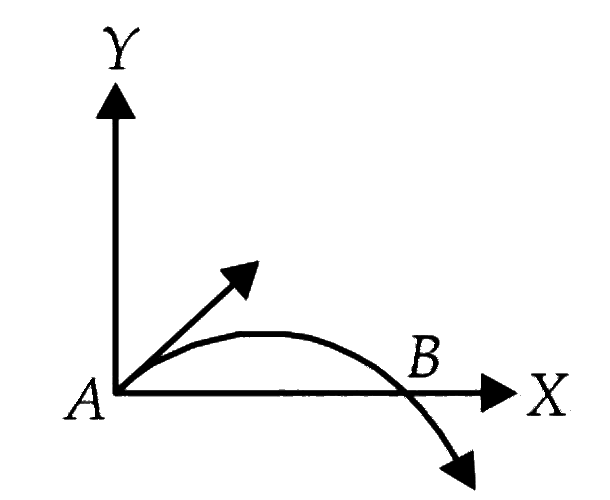
If x and y coordinates of a projectile as a function of time (t) are given as 24t and 43.6t−4.9t2, respectively, then the angle (in degrees) made by the projectile with horizontal when t=2 s is ______.
A projectile is thrown upward at an angle 60∘ with the horizontal. The speed of the projectile is 20 m/s when its direction of motion is 45∘ with the horizontal. The initial speed of the projectile is m/s.
A particle is projected from ground with speed u and at an angle θ with horizontal. If at maximum height from ground, the speed of a particle is half times its initial velocity of projection then its maximum height attained is (cos60∘=0.5,sin60∘=3/2) (g = acceleration due to gravity)
A ball P is projected at an angle of 60∘ with the vertical with certain initial speed. Another ball Q of the same mass as that of ball P is projected vertically upwards with the same initial speed as that of P. At the highest point, the ratio of potential energy of ball P to that of ball Q is
A ball of mass 100 g is projected with velocity 20 m/s at 60∘ with horizontal. The decrease in kinetic energy of the ball during the motion from point of projection to highest point is
An object of mass ' m ' is projected from origin in a vertical xy plane at an angle 45∘ with the x- axis with an initial velocity v0. The magnitude and direction of the angular momentum of the object with respect to origin, when it reaches at the maximum height, will be [ g is acceleration due to gravity]
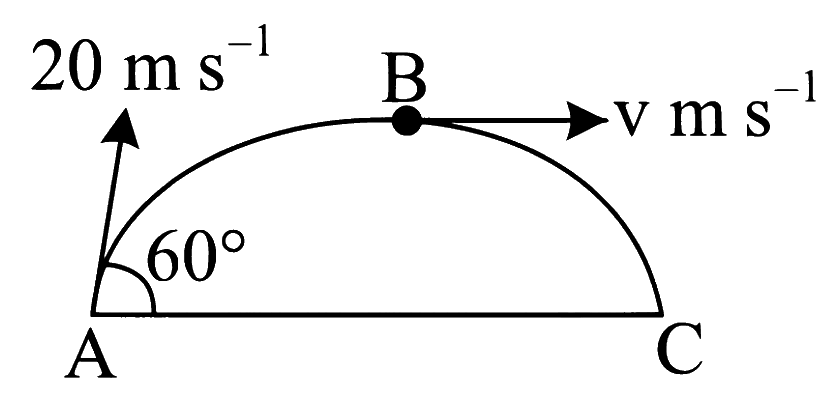
A ball is projected from point A with velocity 20 m s−1 at an angle 60∘ to the horizontal direction. At the highest point B of the path (as shown in figure), the velocity v ms−1 of the ball will be:
A projectile is projected at 30∘ from horizontal with initial velocity 40 ms−1. The velocity of the projectile at t=2 s from the start will be: (Given g=10 m/s2)
A projectile is launched at an angle 'α' with the horizontal with a velocity 20 ms−1. After 10 s, its inclination with horizontal is 'β'. The value of tanβ will be: (g = 10 ms−2).
A body is projected from the ground at an angle of 45 ∘ with the horizontal. Its velocity after 2s is 20 ms−1. The maximum height reached by the body during its motion is __________ m. (use g = 10 ms−2)
Numerical answer type. Work it out, then open the answer.
A body of mass 10 kg is projected at an angle of 45∘ with the horizontal. The trajectory of the body is observed to pass through a point (20,10). If T is the time of flight, then its momentum vector, at time t=2T, is _____________.
Two balls are thrown horizontally from the top of a tower with velocities v1 and v2 in opposite directions at the same time. After how much time, the angle between velocities of balls becomes 90∘ ?
A projectile is fired with a velocity u at angle θ with the ground surface. During the motion at any time it is making an angle α with the ground surface. The speed of particle at this time will be
What is the radius of curvature of the parabola traced out by a projectile thrown with speed v at an angle θ with the horizontal at a point where the particle velocity makes an angle 2θ with the horizontal?
A projectile is thrown in the upward direction making an angle of 60∘ with the horizontal direction with a velocity of 147m s−1. Then the time after which its inclination with the horizontal is 45∘, is
A particle having a mass 0.5kg is projected under gravity with a speed of 98m s−1 at an angle of 60∘. The magnitude of the change in momentum (in N s) of the particle after 10 seconds is [g=9.8m s−2]
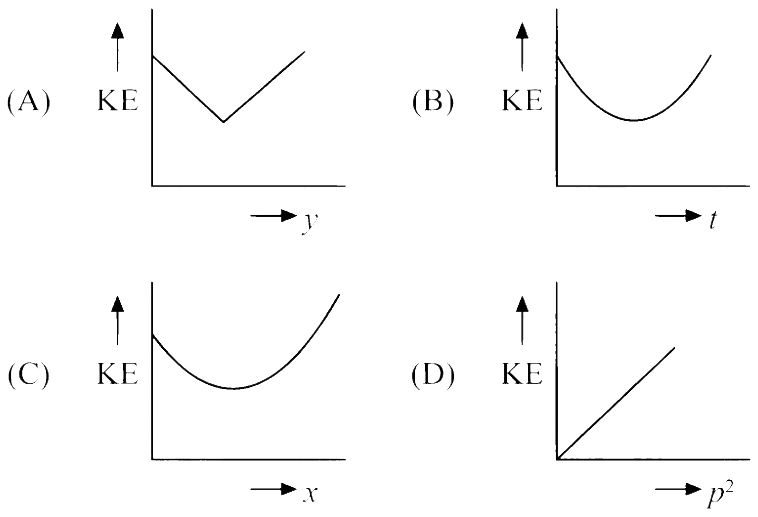
A particle is projected up from a point at an angle θ with the horizontal direction. At any time t, if p is the linear momentum, y is the vertical displacement, x is horizontal displacement, the graph among the following which does not represent the variation of kinetic energy KE of the particle is
An object is projected with an angle of 60∘ with horizontal with a velocity V. During the path, when it makes 30∘ with horizontal, its velocity becomes 10m s−1, then V is
A body is projected with a velocity of 153m s−1 at an angle of 60∘ with the horizontal and another body is projected simultaneously from the same point in the same vertical plane with a velocity of 40m s−1 at an angle of 30∘ with the horizontal. The time at which the velocity vector of the two bodies will be in the same direction is (Acceleration due to gravity =10m s−2)
A projectile is thrown into space so that it attains a maximum possible range of 200m. Taking the point of projection as origin, the coordinates of the point where the velocity of projectile is minimum is
A bowling machine placed at a height h above the earth surface releases different balls with different angles but with same velocity 103m s−1. All these balls' landing velocities make angles 30∘ or more with horizontal. Then the height h (in metre) (acceleration due to gravity =10m s−2) is
An object of mass m is projected with an initial velocity u with angle of θ with the horizontal. The average power delivered by gravity in reaching the highest point is
One second after projection, a projectile is travelling in a direction inclined at 45∘ to horizontal. After two more seconds, it is travelling horizontally. Then, the magnitude of velocity of the projectile is (g=10m s−2)
A particle of mass m is projected with a velocity u making an angle θ with the horizontal. The magnitude of angular momentum of the projectile about the point of projection when the particle is at its maximum height is
If a body is projected from the ground at an angle of 45∘ with the horizontal, then the ratio of the velocities of the body at maximum height and at half of the maximum height is
If the minimum velocity of a projectile is 15m s−1 and the maximum height reached by it is 20m, then the velocity of projection of the projectile is (acceleration due to gravity =10m s−2)
From a height of h above the ground, a ball is projected up at an angle 30∘ with the horizontal. If the ball strikes the ground with a speed of 1.25 times its initial speed of 40m s−1, the value of h is (acceleration due to gravity =10m s−2)
A body is projected from the ground at an angle of tan−1(7) with the horizontal. At half of the maximum height, the speed of the body is n times the speed of projection. The value of n is
In case of projectile motion, which one of the following figures represents the variation of the horizontal component of velocity (ux) with time t? (Assume that air resistance is negligible)