0 of 82 attemptedPick an answer to see the solution
Q1JEE Main 2026 · 5 APR · SHIFT 2Easy
Combination of Lenses · Lenses in contact
A thin convex lens and a thin concave lens are kept in contact and are co-axial. Which of the following statements is correct for this combination of two lenses?
The combined focal length is F when a convex lens of focal length F1 and concave lens of focal length F2 is combined. The combination of these lenses will behave like a concave lens, if
A thin convex lens of focal length 5 cm and a thin concave lens of focal length 4 cm are combined together (without any gap) and this combination has magnification m1 when an object is placed 10 cm before the convex lens. Keeping the positions of convex lens and object undisturbed a gap of 1 cm is introduced between the lenses by moving the concave lens away, which lead to a change in magnification of total lens system to m2. The value of m2m1 is ______.
Combination of Lenses · Separated lenses & systems
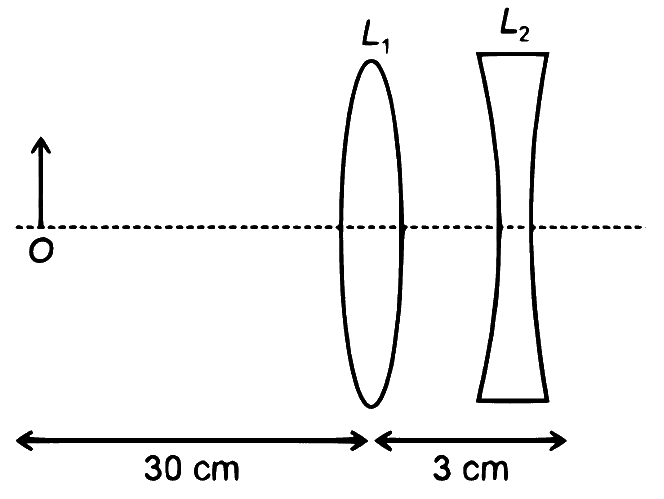
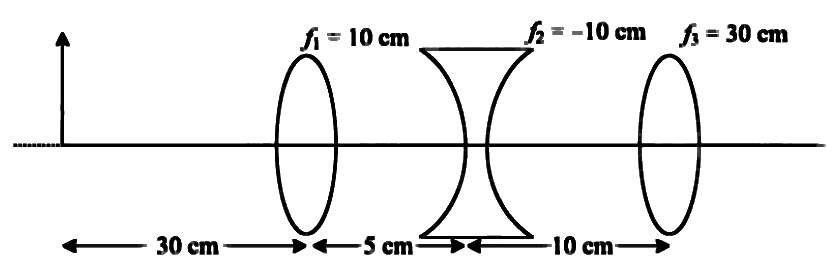
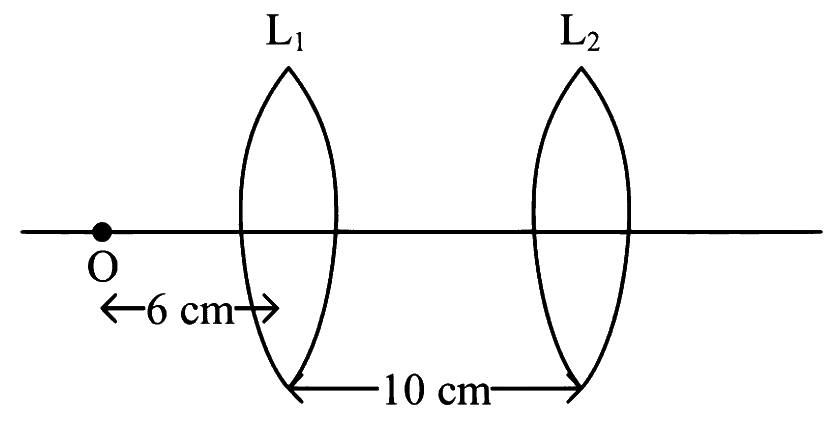
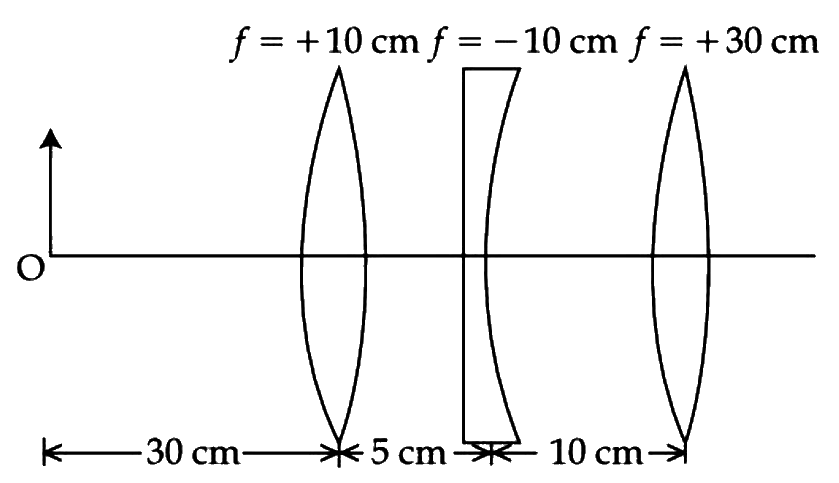
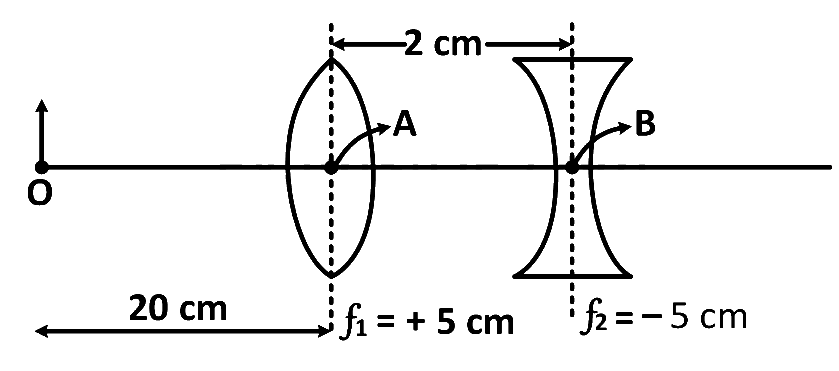
The lens combination as shown in the figure, consists of two lenses, L1 and L2, of the focal lengths +10 cm and -10 cm, respectively. The position of the image formed is:
Combination of Lenses · Separated lenses & systems
An object AB is placed 15 cm on the left of a convex lens P of focal length 10 cm. Another convex lens Q is now placed 15 cm right of lens P. If the focal length of lens Q is 15 cm, the final image is ______.
Combination of Lenses · Separated lenses & systems
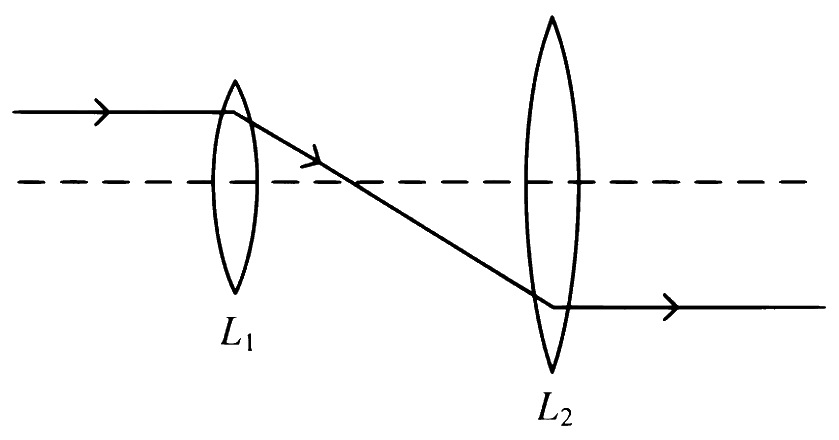
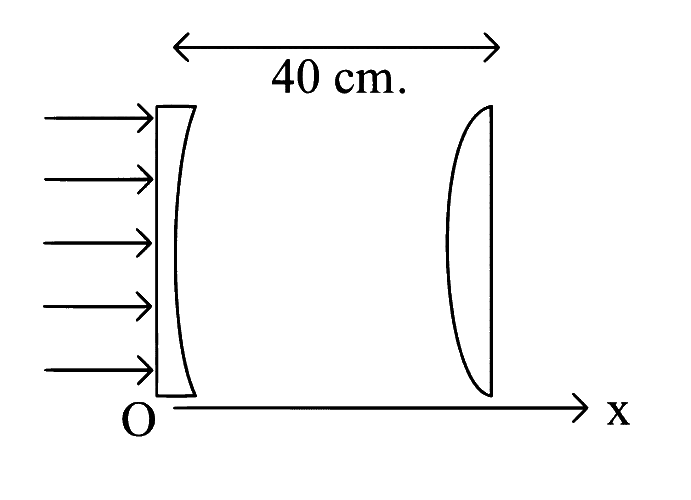
A collimated beam of light of diameter 2 mm is propagating along x-axis. The beam is required to be expanded in a collimated beam of diameter 14 mm using a system of two convex lenses. If first lens has focal length 40 mm, then the focal length of second lens is ______ mm.
Numerical answer type. Work it out, then open the answer.
Combination of Lenses · Silvered lenses & lens–mirror systems
A thin biconvex lens is prepared from the glass (μ=1.5) both curved surfaces of which have equal radii of 20 cm each. Left side surface of the lens is silvered from outside to make it reflecting. To have the position of image and object at the same place, the object should be placed, from the lens at a distance of ______ cm.
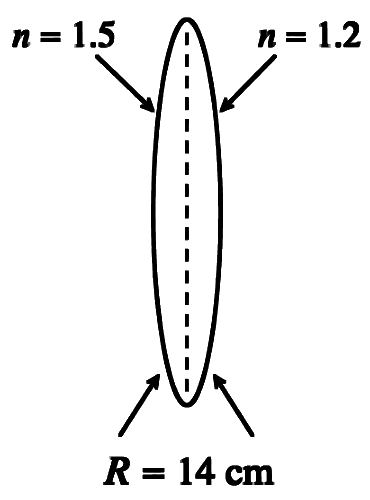
A bi-convex lens is formed with two thin plano-convex lenses as shown in the figure. Refractive index of the first lens is 1.5 and that of second is 1.2. Both the curved surfaces are of the same radius of curvature R=14 cm. For an object distance of 40 cm, the image distance will be
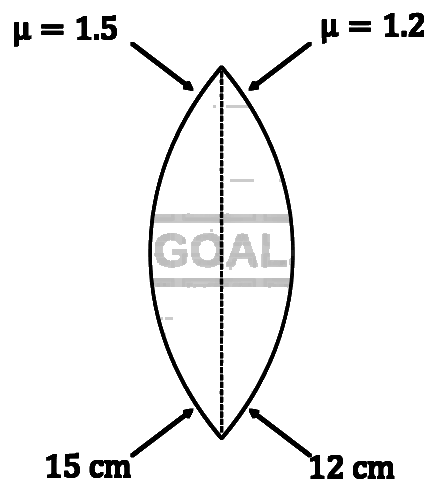
A biconvex lens is formed by using two thin planoconvex lenses, as shown in the figure. The refractive index and radius of curved surfaces are also mentioned in figure. When an object is placed on the left side of lens at a distance of 30 cm from the biconvex lens, the magnification of the image will be:
In a certain camera, a combination of four similar thin convex lenses are arranged axially in contact. Then the power of the combination and the total magnification in comparison to the power ( p) and magnification ( m) for each lens will be, respectively
A convex lens of focal length 30 cm is placed in contact with a concave lens of focal length 20 cm. An object is placed at 20 cm to the left of this lens system. The distance of the image from the lens in cm is ________.
Combination of Lenses · Silvered lenses & lens–mirror systems
A thin plano convex lens made of glass of refractive index 1.5 is immersed in a liquid of refractive index 1.2. When the plane side of the lens is silver coated for complete reflection, the lens immersed in the liquid behaves like a concave mirror of focal length 0.2 m. The radius of curvature of the curved surface of the lens is
Combination of Lenses · Silvered lenses & lens–mirror systems
Given is a thin convex lens of glass (refractive index μ) and each side having radius of curvature R. One side is polished for complete reflection. At what distance from the lens, an object be placed on the optic axis so that the image gets formed on the object itself?
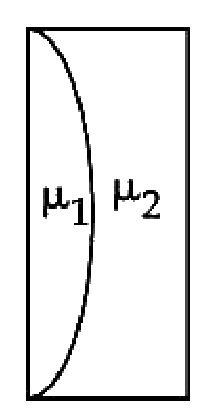
A plano convex lens fits exactly in to a plano concave lens. Their plane surfaces are parallel to each other. Lenses are made up of different materials of refractive indices ' n1 ' ' n2 ' and ' R ' is the radius of curvature of the curved surface of lenses. Focal length of the combination is
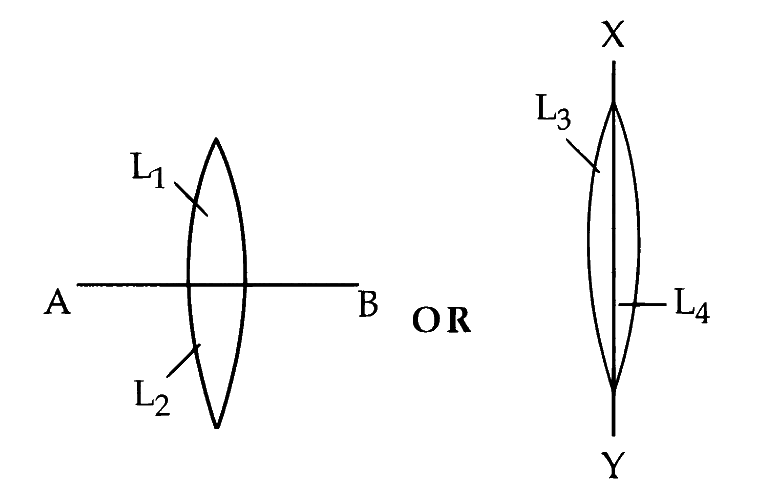
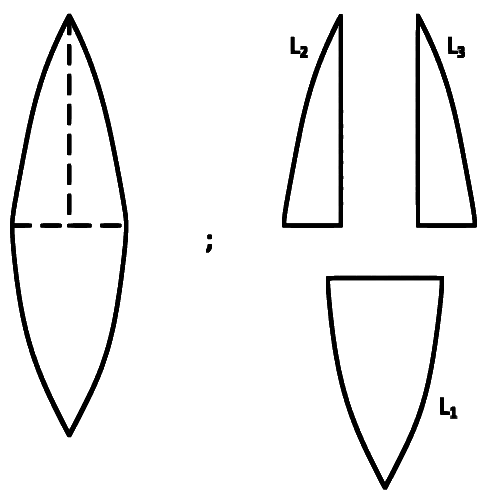
Two identical symmetric double convex lenses of focal length f are cut into two equal parts L1, L2 by AB plane and L3, L4 by XY plane as shown in figure respectively. The ratio of focal lengths of lenses L1 and L3 is
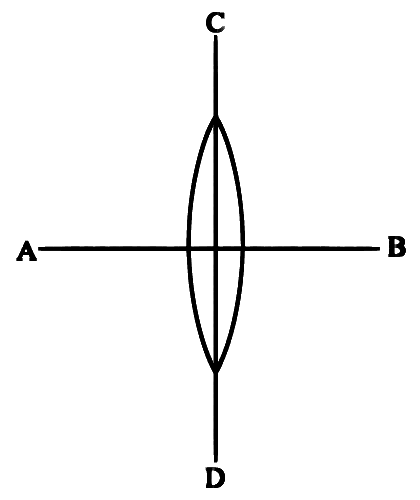
A symmetric thin biconvex lens is cut into four equal parts by two planes AB and CD as shown in figure. If the power of original lens is 4D then the power of a part of the divided lens is
In the diagram given below, there are three lenses formed. Considering negligible thickness of each of them as compared to ∣R1∣ and ∣R2∣, i.e., the radii of curvature for upper and lower surfaces of the glass lens, the power of the combination is
A concave-convex lens of refractive index 1.5 and the radii of curvature of its surfaces are 30 cm and 20 cm, respectively. The concave surface is upwards and is filled with a liquid of refractive index 1.3. The focal length of the liquid-glass combination will be
Combination of Lenses · Silvered lenses & lens–mirror systems
Given a thin convex lens (refractive index μ2 ), kept in a liquid (refractive index μ1,μ1<μ2) having radii of curvatures ∣R1∣ and ∣R2∣. Its second surface is silver polished. Where should an object be placed on the optic axis so that a real and inverted image is formed at the same place?
An optician makes spectacles having a combination of a convex lens of focal length 40 cm in contact with a concave lens of focal length 25 cm. The power of this combination of lenses in dioptre is
An effective power of a combination of 5 identical convex lenses which are kept in contact along the principal axis is 25 D. Focal length of each of the convex lens is:
Concave and convex lenses are placed touching each other. The ratio of magnitudes of their power is 2:3. The focal length of the system is 30 cm. The focal lengths of individual lens are
Combination of Lenses · Separated lenses & systems
Two thin lenses have a combined power of +9D. When they are separated by a distance of 20 cm, their equivalent power becomes +527 D. The power of both the lenses in dioptre are respectively
Two thin lenses are of same focal lengths (f), but one is convex and the other one is concave. When they are placed in contact with each other, the equivalent focal length of the combination will be:
A bi convex lens of focal length 10 cm is cut in two identical parts along a plane perpendicular to the principal axis. The power of each lens after cut is ____________ D.
Numerical answer type. Work it out, then open the answer.
Combination of Lenses · Separated lenses & systems
A combination of two thin lenses in contact have power +10 D. The power reduces to +6 D when the lenses are 0.25 m apart. The power of individual lens is
Combination of Lenses · Separated lenses & systems
Two convex lenses of focal length 20 cm each are placed coaxially with a separation of 60 cm between them. The image of the distant object formed by the combination is at _____________ cm from the first lens.
Numerical answer type. Work it out, then open the answer.
Combination of Lenses · Separated lenses & systems
A point object, 'O' is placed in front of two thin symmetrical coaxial convex lenses L1 and L2 with focal length 24 cm and 9 cm respectively. The distance between two lenses is 10 cm and the object is placed 6 cm away from lens L1 as shown in the figure. The distance between the object and the image formed by the system of two lenses is __________ cm.
Numerical answer type. Work it out, then open the answer.
Combination of Lenses · Separated lenses & systems
As shown in the figure, a combination of a thin plano concave lens and a thin plano convex lens is used to image an object placed at infinity. The radius of curvature of both the lenses is 30 cm and refraction index of the material for both the lenses is 1.75. Both the lenses are placed at distance of 40 cm from each other. Due to the combination, the image of the object is formed at distance x= _________ cm, from concave lens.
Numerical answer type. Work it out, then open the answer.
Combination of Lenses · Silvered lenses & lens–mirror systems
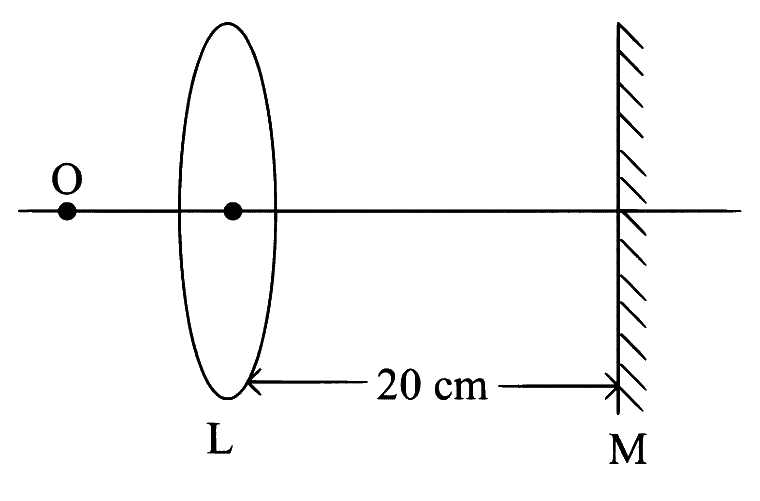
An object is placed on the principal axis of convex lens of focal length 10cm as shown. A plane mirror is placed on the other side of lens at a distance of 20 cm. The image produced by the plane mirror is 5cm inside the mirror. The distance of the object from the lens is ___________ cm.
Numerical answer type. Work it out, then open the answer.
Combination of Lenses · Silvered lenses & lens–mirror systems
A convex lens of focal length 20 cm is placed in front of a convex mirror with principal axis coinciding each other. The distance between the lens and mirror is 10 cm. A point object is placed on principal axis at a distance of 60 cm from the convex lens. The image formed by combination coincides the object itself. The focal length of the convex mirror is ____________ cm.
Numerical answer type. Work it out, then open the answer.
A convex lens has power P. It is cut into two halves along its principal axis. Further one piece (out of the two halves) is cut into two halves perpendicular to the principal axis (as shown in figures). Choose the incorrect option for the reported pieces.
Two identical thin biconvex lens of focal length 15 cm and refractive index 1.5 are in contact with each other. The space between the lenses is filled with a liquid of refractive index 1.25. The focal length of the combination is __________ cm.
Numerical answer type. Work it out, then open the answer.
Combination of Lenses · Separated lenses & systems
A convex lens 'A' of focal length 20 cm and a concave lens 'B' of focal length 5 cm are kept along the same axis with a distance 'd' between them. If a parallel beam of light falling on 'A' leaves 'B' as a parallel beam, then the distance 'd' in cm will be:
Combination of Lenses · Silvered lenses & lens–mirror systems
A point object is placed at a distance of 60 cm from a convex lens of focal length 30 cm. If a plane mirror were put perpendicular to the principal axis of the lens and at a distance of 40 cm from it, the final image would be formed at a distance of -
A plano-convex lens of refractive index (μ1 fits exactly into a plano-concave lens of refractive index μ2. Their plane surface are parallel to each other. 'R' is the radius of curvature of the curved surface of the lenses. The focal length of the combination is
Curved surfaces of a plano-convex lens of refractive index μ1 and a plano-concave lens of refractive index μ2 have equal radius of curvature as shown in figure. Find the ratio of radius of curvature to the focal length of the combined lenses.
Combination of Lenses · Silvered lenses & lens–mirror systems
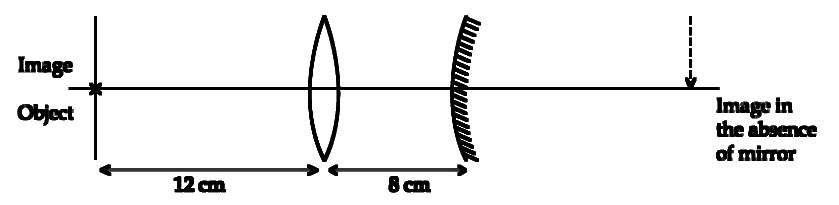
An object is placed at a distance of 12 cm from a convex lens. A convex mirror of focal length 15 cm is placed on other side of lens at 8 cm as shown in the figure. Image of object coincides with the object.
When the convex mirror is removed, a real and inverted image is formed at a position. The distance of the image from the object will be .............. (cm)
Numerical answer type. Work it out, then open the answer.
Combination of Lenses · Silvered lenses & lens–mirror systems
A point like object is placed at a distance of 1 m in front of a convex lens of focal length 0.5 m. A plane mirror is placed at a distance of 2 m behind the lens. The position and nature of the final image formed by the system is:
A convex lens of focal length ' f ' is placed in contact with a concave lens of the same focal length. The equivalent focal length of the combination is
The equi-convex lens has a focal length ' f '. If the lens is cut along the line perpendicular to the principal axis and passing through the pole, what will be the focal length of any half part?
A plano convex lens of refractive index μ1 and focal length ƒ1 is kept in contact with another plano concave lens of refractive index μ2 and focal length ƒ2. If the radius of curvature of their spherical faces is R each and ƒ1 = 2ƒ2, then μ1 and μ2 are related as -
Combination of Lenses · Silvered lenses & lens–mirror systems
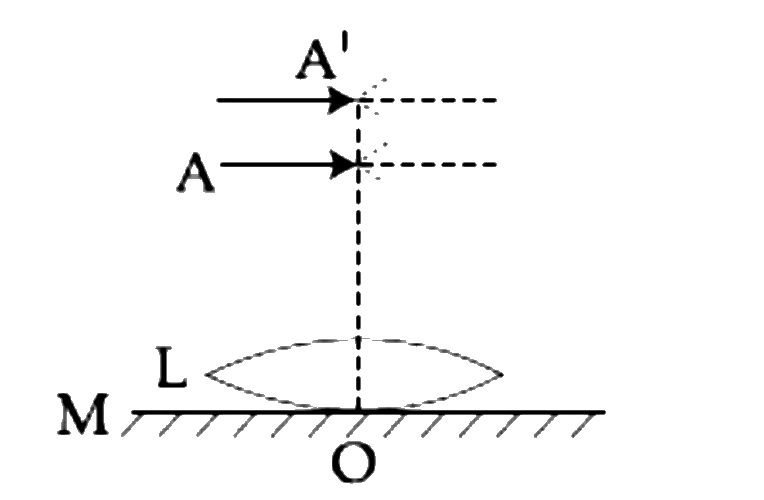
A thin convex lens L (refractive index = 1.5) is placed on a plane mirror M. When a pin is placed at A, such that OA = 18 cm, its real inverted image is formed at A itself, as shown in figure. When a liquid of refractive index μ1 is put between the lens and the mirror, The pin has to be moved to A', such that OA' = 27 cm, to get its inverted real image at A' itself. The value of μ1 will be :-
Two similar thin equi-convex lenses, of focal length f each, are kept coaxially in contact with each other such that the focal length of the combination is F1. When the space between the two lenses is filled with glycerin (which has the same refractive index (μ = 1.5) as that of glass) then the equivalent focal length is F2. The ratio F1: F2 will be:
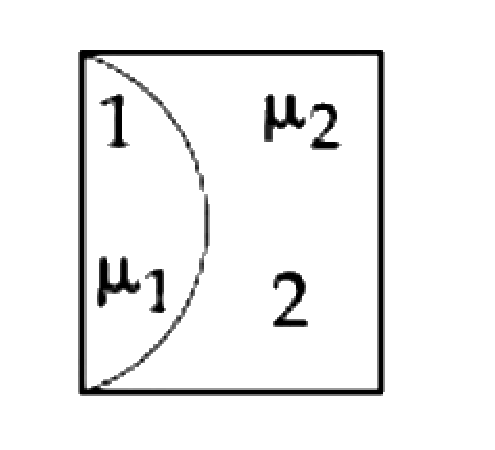
One plano-convex and one plano-concave lens of same radius of curvature 'R' but of different materials are joined side by side as shown in the figure. If the refractive index of the material of 1 is μ1 and that of 2 is μ2, then the focal length of the combination is:
A plano-convex lens (focal length f2, refractive index μ2, radius of curvature R) fits exactly into a plano-concave lens (focal length f1, refractive index μ1, radius of curvature R). Their plane surfaces are parallel to each other. Then, the focal length of the combination will be:
Combination of Lenses · Silvered lenses & lens–mirror systems
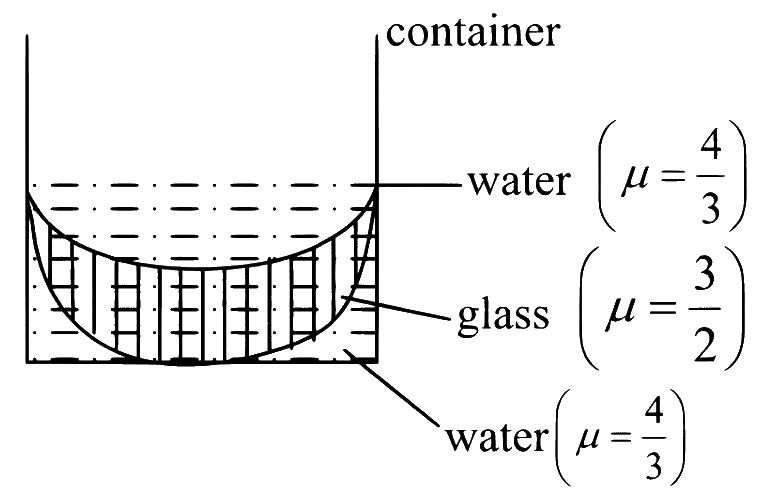
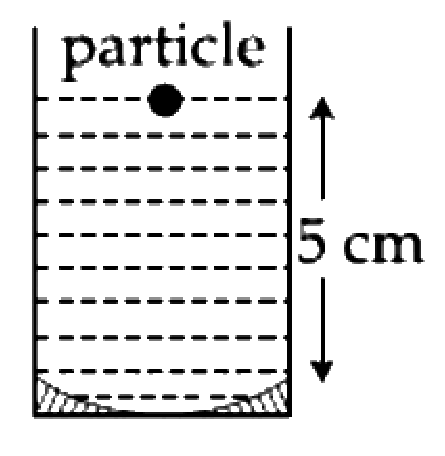
A concave mirror has radius of curvature of 40 cm. It is at the bottom of a glass that has water filled up to 5 cm (see figure). If a small particle is floating on the surface of water, its image as seen, from directly above the glass, is at a distance d from the surface of water. The value of d is close to: (Refractive index of water = 1.33)
Combination of Lenses · Silvered lenses & lens–mirror systems
A convex lens (of focal length 20 cm) and a concave mirror, having their principal axes along the same lines, are kept 80 cm apart from each other. The concave mirror is to the right of the convex lens. When an object is kept at a distance of 30 cm to the left of the convex lens, its image remains at the same position even if the concave mirror is removed. The maximum distance of the object for which this concave mirror, by itself would produce a virtual image would be :-
Combination of Lenses · Silvered lenses & lens–mirror systems
An upright object is placed at a distance of 40 cm in front of a convergent lens of focal length 20 cm. A convergent mirror of focal length 10 cm is placed at a distance of 60 cm on the other side of the lens. The position and size of the final image will be:
Combination of Lenses · Separated lenses & systems
A convergent doublet of separated lenses, corrected for spherical aberration, has resultant focal length of 10 cm. The separation between the two lenses is 2 cm. The focal lengths of the component lenses are:
Combination of Lenses · Silvered lenses & lens–mirror systems
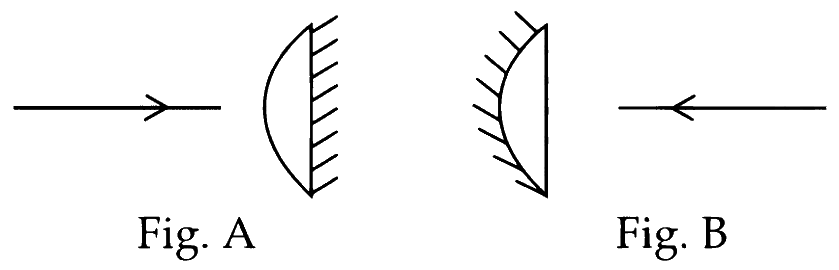
A planoconvex lens becomes an optical system of 28 cm focal length when its plane surface is silvered and illuminated from left to right as shown in Fig-A.
If the same lens is instead silvered on the curved surface and illuminated from other side as in Fig- B, it acts like an optical system of focal length 10 cm. The refractive index of the material of lens is:
Combination of Lenses · Separated lenses & systems
A diverging lens with magnitude of focal length 25 cm is placed at a distance of 15cm from a converging lens of magnitude of focal length 20cm. A beam of parallel light falls on the diverging lens. The final image formed is:
Combination of Lenses · Silvered lenses & lens–mirror systems
In an experiment a convex lens of focal length 15 cm is placed coaxially on an optical bench in front of a convex mirror at a distance of 5 cm from it. It is found that an object and its image coincide, if the object is placed at a distance of 20 cm from the lens. The focal length of the convex mirror is:
Two identical glass (μg = 3/2) equiconvex lenses of focal length f each are kept in contact. The space between the two lenses is filled with water (μw=4/3). The focal length of the combination is
Combination of Lenses · Silvered lenses & lens–mirror systems
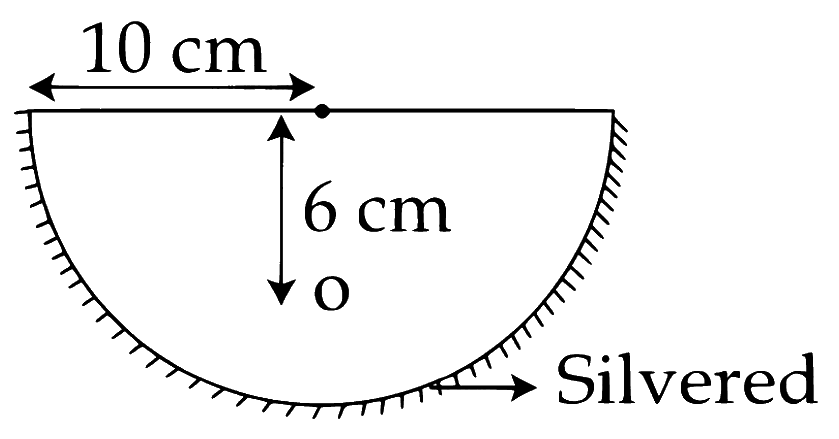
A hemispherical glass body of radius 10 cm and refractive index 1.5 is silvered on its curved surface. A small air bubble is 6 cm below the flat surface inside it along the axis. The position of the image of the air bubble made by the mirror is seen:
Combination of Lenses · Silvered lenses & lens–mirror systems
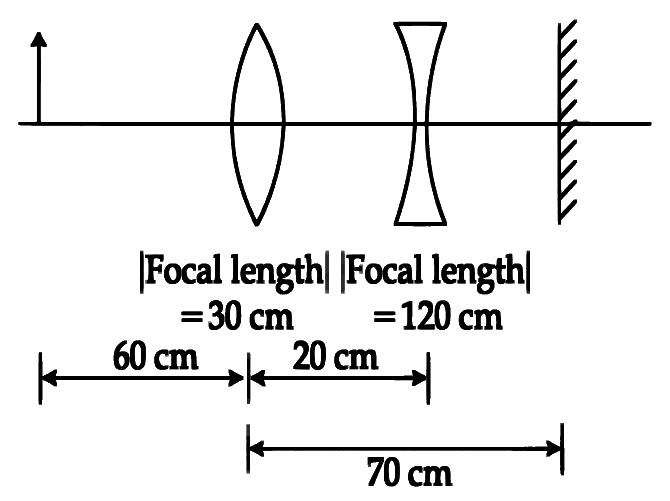
A convex lens, of focal length 30 cm, a concave lens of focal length 120 cm, and aplane mirror are arranged as shown. For an object kept at a distance of 60 cm from the convex lens, the final image, formed by the combination, is a real image, at a distance of:
Two identical thin plano-convex glass lenses (refractive index 1.5) each having radius of curvature of 20 cm are placed with their convex surfaces in contact at the centre. The intervening space is filled with oil of refractive index 1.7. The focal length of the combination is
Combination of Lenses · Silvered lenses & lens–mirror systems
A thin convex lens of focal length 'f' is put on a plane mirror as shown in the figure. When an object is kept at a distance 'a' from the lens − mirror combination, its image is formed at a distance 3a in front of the combination. The value of 'a' is:
A plano convex lens fits exactly into a plano concave lens. Their plane surfaces are parallel to each other. If lenses are made of different materials of refractive indices μ1 and μ2 and R is the radius of curvature of the curved surface of the lenses, then the focal length of the combination is
Combination of Lenses · Silvered lenses & lens–mirror systems
A concave mirror of focal length f1 is placed at a distance of d from a convex lens of focal length f 2. A beam of light coming from infinity and falling on this convex lens − concave mirror combination returns to infinity. The distance d must equal
A convex lens and a concave lens, each having same focal length of 25 cm, are put in contact to form a combination of lenses. The power in diopters of the combination is
Combination of Lenses · Silvered lenses & lens–mirror systems
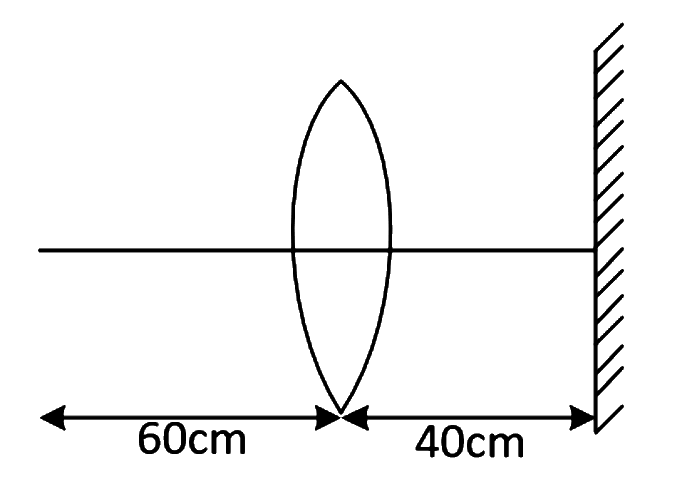
A plano convex lens of refractive index 1.5 and radius of curvature 30 cm is silvered at the curved surface. Now this lens has been used to form the image of an object. At what distance from this lens an object be placed in order to have a real image of size of the object
An equiconvex lens is cut into two halves along (i) XOX' and (ii) YOY' as shown in the figure. Let f,f′,f′′ be the focal lengths of the complete lens, of each half in case (i), and of each half in case (ii), respectively.
Combination of Lenses · Silvered lenses & lens–mirror systems
A luminous object is placed at a distance of 30 cm from the convex lens of focal length 20 cm. On the other side of the lens, at what distance from the lens, a convex mirror of radius of curvature 10 cm, be placed in order to have an upright image of the object coincident with it?