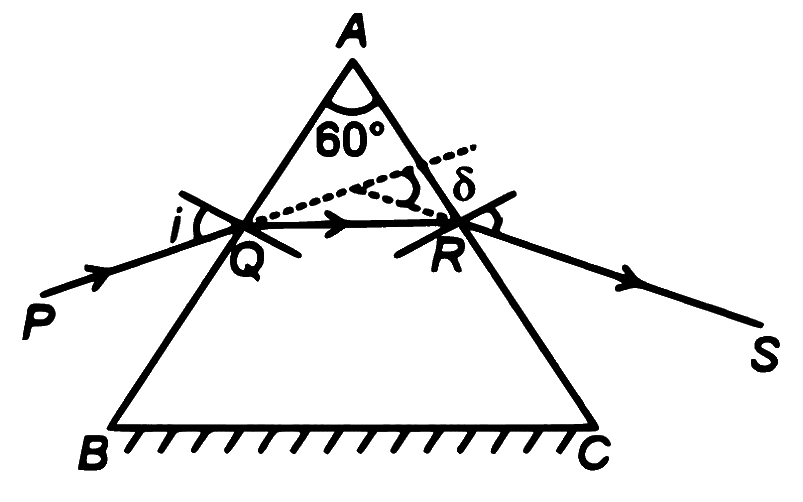
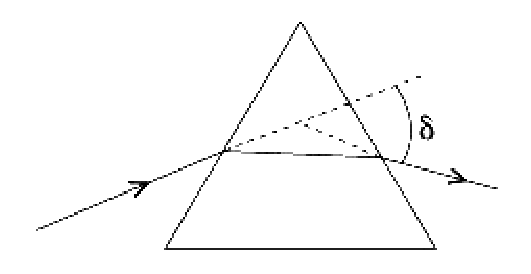
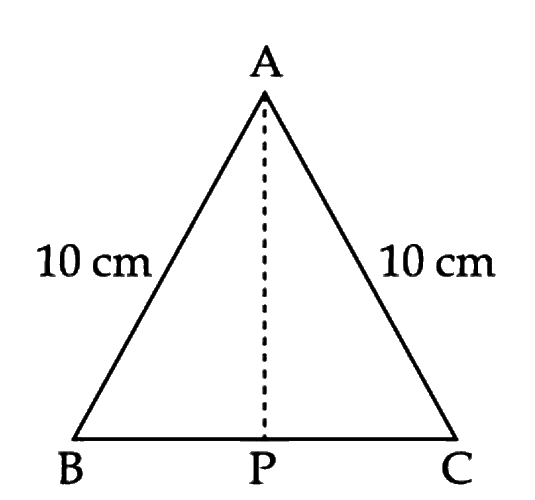
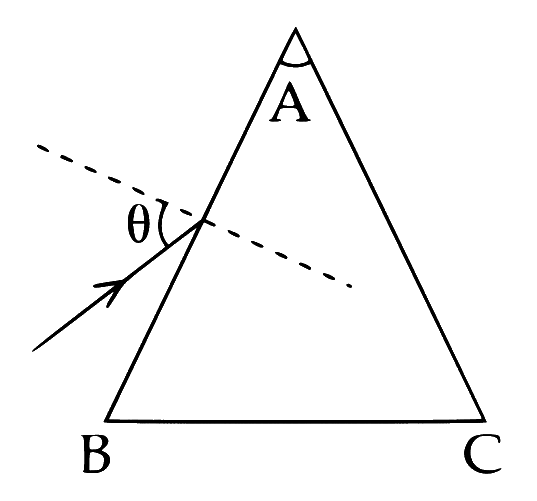
A ray of monochromatic light is passing through an equilateral prism (ABC) as shown in the figure. The refracted ray (QR) is parallel to its base (BC) and the angle of incidence (i) is 50∘. Then the angle of deviation (δ) is:
When a beam of white light is allowed to pass through convex lens parallel to principle axis, the different colors of light converge at different point on the principle axis after refraction. This is called
A thin prism in air produces the angle of minimum deviation δ. If the prism is immersed in water, the angle of minimum deviation for the same ray is (refractive index of water is 4/3 and that of glass prism is 3/2)
A ray of light incident on one face of an equilateral glass prism having refractive index 2, produces the emergent ray which just grazes along the adjacent face. The value of angle of incidence is (sin90∘=1)(sin30∘=21)(sin45∘=21)
Consider an equilateral prism (refractive index 2 ). A ray of light is incident on its one surface at a certain angle i. If the emergent ray is found to graze along the other surface then the angle of refraction at the incident surface is close to ______
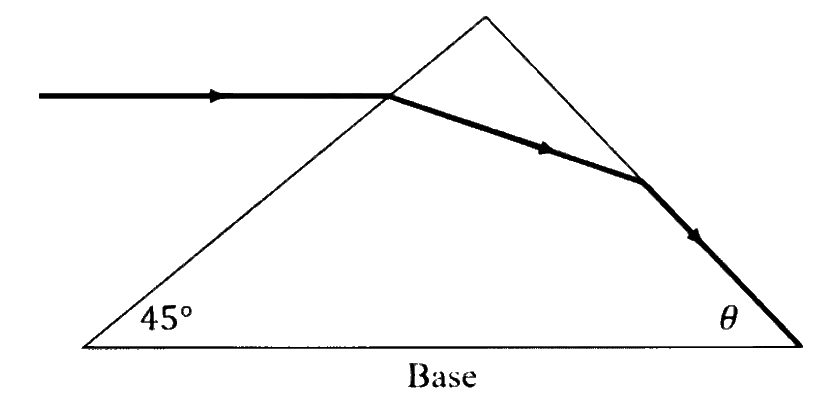
The prism has refracting angle A. The second refracting surface of the prism is silvered. Light ray falling on first refracting surface with angle of incidence 2A, reaches the second surface and returns back through same path due to reflection at the silvered surface. The refractive index of the material of prism is
An achromatic convergent doublet of two lenses in contact has a power of +2D. The convex lens has power +5D. What is the ratio of the dispersive powers of the convergent and divergent lenses?
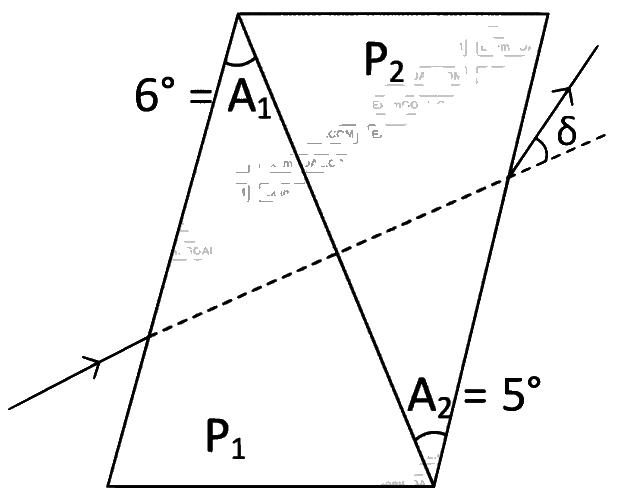
A thin prism with angle 5∘ of refractive index 1.72 is combined with another prism of refractive index 1.9 to produce dispersion without deviation. The angle of second prism is ______.
The exit surface of a prism with refractive index n is coated with a material having refractive index 2n. When this prism is set for minimum angle of deviation, it exactly meets the condition of critical angle. The prism angle is ______.
The refractive index of the material of a glass prism is 3. The angle of minimum deviation is equal to the angle of the prism. What is the angle of the prism?
A ray of light suffers minimum deviation when incident on a prism having angle of the prism equal to 60∘. The refractive index of the prism material is 2. The angle of incidence (in degrees) is__________
Numerical answer type. Work it out, then open the answer.
A monochromatic ray of light is incident normally on a thin prism of refracting angle A. The ray is deviated through an angle (1.15)∘ in passing through the prism. The ray reflected internally from the second face emerges from the first face making an angle of (6.3)∘ with the incident ray. The refractive index of the prism is
For a thin prism, δ1 is the angle of deviation produced, when prism is placed in air. When the prism is immersed in water, the angle of deviation produced is δ2. Given aμg=23 and aμw=34. The ratio δ2:δ1 is
A ray of light is incident on first face of an equilateral glass prism at an angle of incidence ' I '. The emergent ray just grazes along the adjacent face. The refractive index of the the prism is 2. The value of angle of incidence at first face is (sin45∘=21,sin90∘=1)
An achromatic convergent doublet of two lenses in contact has a power +2 D. The convex lens has power +5 D. The ratio of the dispersive powers of the convergent and divergent lenses is (in magnitude)
A thin prism P1 with angle 4∘ made of glass having refractive index 1.54, is combined with another thin prism P2 made of glass having refractive index 1.72 to get dispersion without deviation. The angle of the prism P2 in degrees is
Statement I: When the white light passed through a prism, the red light bends lesser than yellow and violet.
Statement II: The refractive indices are different for different wavelengths in dispersive medium. In the light of the above statements, choose the correct answer from the options given below:
A ray of light is incident at 60∘ on one face of a prism of angle 30∘ and the emergent ray makes 30∘ with the incident ray. The refractive index of the prism is (sin30∘=0.5,sin60∘=3/2)
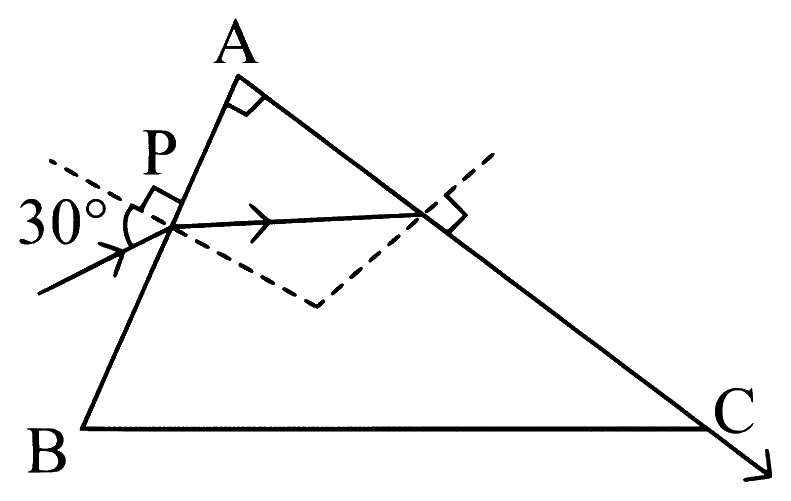
A light ray enters through a right angled prism at point P with the angle of incidence 30∘ as shown in figure. It travels through the prism parallel to its base BC and emerges along the face AC. The refractive index of the prism is:
The refractive index of prism is μ=3 and the ratio of the angle of minimum deviation to the angle of prism is one. The value of angle of prism is _________∘.
Numerical answer type. Work it out, then open the answer.
A glass prism ' A ' deviates the red and blue rays through 10∘ and 12∘ respectively. A second prism ' B ' deviates them through 8∘ and 10∘ respectively. The ratio of their dispersive powers is (A to B)
When a monochromatic ray of light is passed through an equilateral glass prism, it is found that the refracted ray in glass is parallel to the base of the prism. If 'i' and 'e' denote the angles of incidence and emergence respectively, then
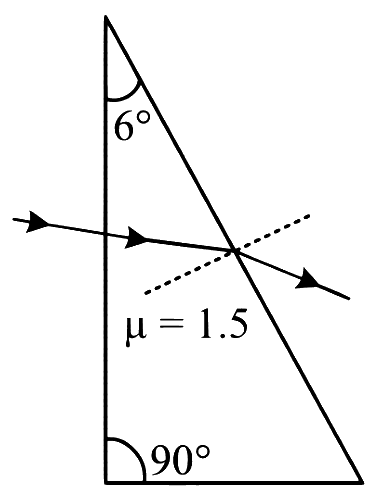
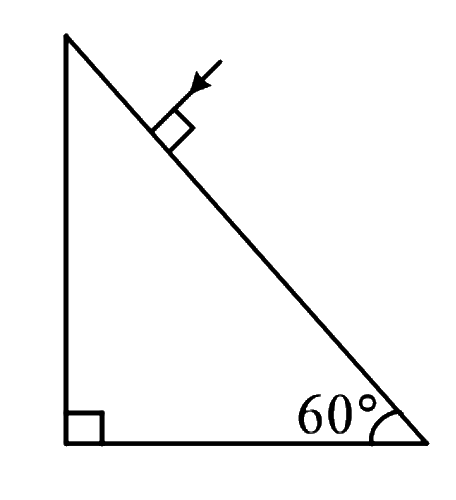
A horizontal ray of light is incident on the right angled prism with prism angle 6∘. If the refractive index of the material of the prism is 1.5, then the angle of emergence will be:
When a beam of white light is allowed to pass through convex lens parallel to principal axis, the different colours of light converge at different points on the principal axis after refraction. This is called:
A ray of light passes through an equilateral prism such that the angle of incidence (i) is equal to angle of emergence (e). The angle of emergence is equal to (43) th the angle of prism. The angle of deviation is
The angle of deviation produced by a thin prism when placed in air is 'δ1' and that when immersed in water is 'δ2 '. The refractive index of glass and water are 23 and 34 respectively. The ratio δ1:δ2 is
A ray of light is incident at an angle of incidence 'i' on one surface of a prism of small angle A and emerges normally from the other surface. If the refractive index of the material of the prism is 'μ', then the angle of incidence is equal to
The refractive index of a transparent liquid filled in an equilateral hollow prism is 2. The angle of minimum deviation for the liquid will be ___________ ∘.
Numerical answer type. Work it out, then open the answer.
The prism has refracting angle 'A'. The second refracting surface of the prism is silvered. Light ray falling on first refracting surface with angle of incidence '2A', reaches the second surface and returns back through the same path due to reflection at the silvered surface. The refractive index of the material of the prism is
The angle of prism is A and one of its refracting surface is silvered. Light rays falling at an angle of incidence '2A' on the first surface return back through the same path after suffering reflection at the silvered surface. The refractive index of the material of the prism is
A glass prism deviates the red and violet rays through 9∘ and 11∘ respectively. A second prism of equal angle deviates them through 11∘ and 13∘ respectively. The ratio of dispersive power of second prism to first prism is
A thin prism P1 with an angle 6∘ and made of glass of refractive index 1.54 is combined with another prism P2 made from glass of refractive index 1.72 to produce dispersion without average deviation. The angle of prism P2 is
A thin prism of angle 6∘ and refractive index for yellow light (nY)1.5 is combined with another prism of angle 5∘ and nY=1.55. The combination produces no dispersion. The net average deviation (δ) produced by the combination is (x1)∘. The value of x is ____________.
Numerical answer type. Work it out, then open the answer.
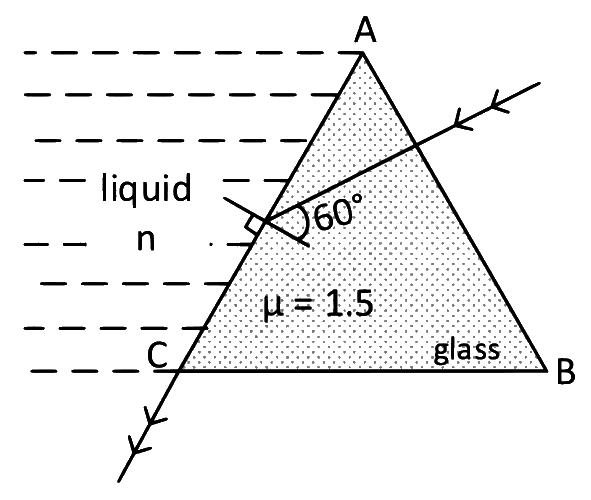
In the given figure, the face AC of the equilateral prism is immersed in a liquid of refractive index 'n'. For incident angle 60∘ at the side AC, the refracted light beam just grazes along face AC. The refractive index of the liquid n=4x. The value of x is ____________.
(Given refractive index of glass =1.5)
Numerical answer type. Work it out, then open the answer.
A prism of refractive index μ and angle of prism A is placed in the position of minimum angle of deviation. If minimum angle of deviation is also A, then the value of A in terms of refractive index is
Cross-section view of a prism is the equilateral triangle ABC in the figure. The minimum deviation is observed using this prism when the angle of incidence is equal to the prism angle. The time taken by light to travel from P (midpoint of BC) to A is ______________ × 10−10 s. (Given, speed of light in vacuum = 3 × 10⁸ m/s and cos30∘=23)
Numerical answer type. Work it out, then open the answer.
A ray of light is incident at an angle 'I' on one face of thin prism. The ray emerges normally from the other face. Refractive index of the glass prism is 'n' and angle of prism is 'A'. The value of 'I' is
A ray of light passing through a prism (μ=3) suffers minimum deviation. It is found that the angle of incidence is double the angle of refraction within the prism. Then, the angle of prism is _____________ (in degrees).
Numerical answer type. Work it out, then open the answer.
A ray of light is incident on one face of an equilateral glass prism having refractive index 2. It produces the emergent ray which just. grazes along the adjacent face. The value of angle of incidence is (sin45∘=cos45∘=21)
A deviation of 2∘ is produced in the yellow ray when prism of crown and flint glass are achromatically combined. Taking dispersive powers of crown and flint glass as 0.02 and 0.03 respectively and refractive index for yellow light for these glasses are 1.5 and 1.6 respectively. The refracting angles for crown glass prism will be ____________∘ (in degree). (Round off to the Nearest Integer)
Numerical answer type. Work it out, then open the answer.
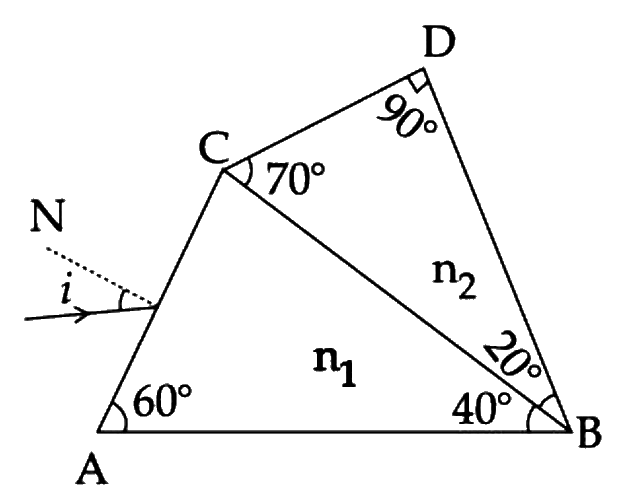
A prism of refractive index n1 and another prism of refractive index n2 are stuck together (as shown in the figure). n1 and n2 depend on λ, the wavelength of light, according to the relation n1=1.2+λ210.8×10⁻¹⁴ and n2=1.45+λ21.8×10⁻¹⁴
The wavelength for which rays incident at any angle on the interface BC pass through without bending at that interface will be _____________ nm.
Numerical answer type. Work it out, then open the answer.
A ray is incident at an angle of incidence i on one surface of a small angle prism (with angle of prism A) and emerges normally from the opposite surface. If the refractive index of the material of the prism is μ, then the angle of incidence is nearly equal to:
A ray of light is incident at an angle i on one face of a thin angled prism. The ray emerges normally from the other face. Refractive index of the glass prism is n and angle of prism is A. The value of i is
A ray of light is incident at an angle i on one face of prism of small angle A and emerges normally from the other surface. μ is the refractive index of the material of the prism. The angle of incidence is
A monochromatic light is incident at a certain angle on an equilateral triangular prism and suffers minimum deviation. If the refractive index of the material of the prism is 3, then the angle of incidence is:
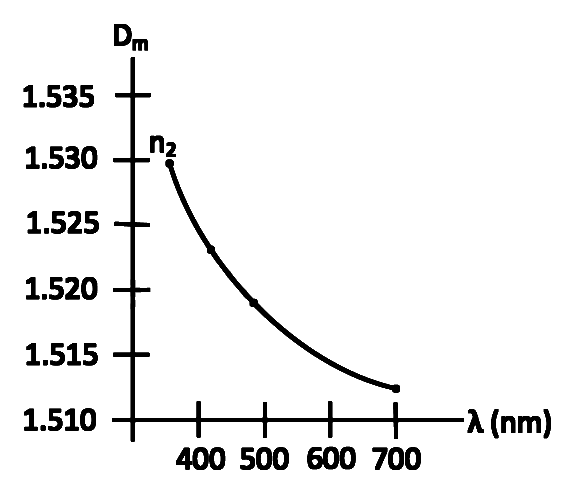
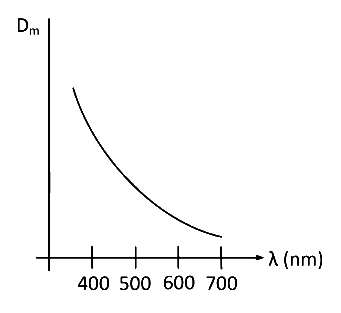
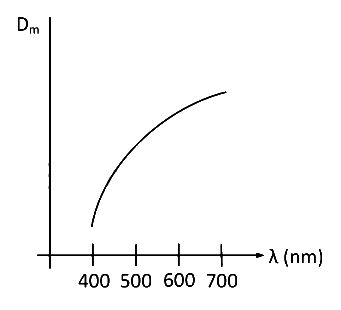
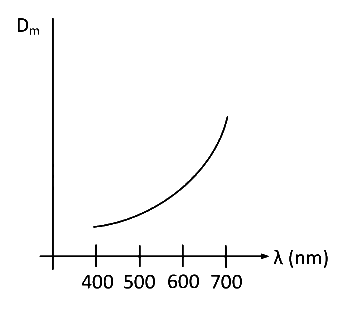
The variation of refractive index of a crown glass thin prism with wavelength of the incident light is shown. Which of the following graphs is the correct one, if Dm is the angle of minimum deviation?
(A)
(B)
(C)
Numerical answer type. Work it out, then open the answer.
A ray of light is incident at an angle of 60° on one face of a prism of angle 30°. The emergent ray of light makes an angle of 30° with incident ray. The angle made by the emergent ray with second face of prism will be:
The refractive index of the material of a prism is 2 and the angle of the prism is 30°. One of the two refracting surfaces of the prism is made a mirror inwards, by silver coating. A beam of monochromatic light entering the prism from the other face will retrace its path (after reflection from the silvered surface) if its angle of incidence on the prism is
A thin prism having refracting angle 10° is made of glass of refractive infex 1.42. This prism is combined with another thin prism of glass of refractive index 1.7. This combination producess dispersion without deviation. The refracting angle of second prism should be
The angle of incidence for a ray of light at a refracting surface of a prism is 45°. The angle of prism is 60°. If the ray suffers minimum deviation through the prism, the angle of minimum deviation and refractive index of the material of the prism respectively, are
In an experiment for determination of refractive index of glass of a prism by i−δ plot, it was found that a ray incident at angle 35∘, suffers a deviation of 40∘ and that it emerges at angle 79∘ In that case which of the following is closest to the maximum possible value of the refractive index?
Monochromatic light is incident on a glass prism of angle A. If the refractive index of the material of the prism is μ, a ray, incident at an angle θ. on the face AB would get transmitted through the face AC of the prism provided:
The angle of a prism is A. One of its refracting surfaces is silvered. Light rays falling at an angle of incidence 2 A on the first surface returns back through the same path after suffering reflection at the silvered surface.
A ray of light is incident at an angle of incidence i, on one face of a prism of angle A (assumed to be small) and emerges normally from the opposite face. If the refractive index of the prism is μ. the angle of incidence i, is nearly equal to
A thin prism of angle 15° made of glass of refractive index μ1 = 1.5 is combined with another prism of glass of refractive index μ2 = 1.75. The combination of the prisms produces dispersion without deviation. The angle of the second prism should be
A ray of light is incident on a 60° prism at the minimum deviation position. The angle of refraction at the first face (i.e., incident face) of the prism is
The refractive index of a glass is 1.520 for red light and 1.525 for blue light. Let D1 and D2 be angles of minimum deviation for red and blue light respectively in a prism of this glass. Then,
The refractive index of the material of a prism is 2 and its refracting angle is 30°. One of the refracting surfaces of the prism is made a mirror inwards. A beam of monochromatic light entering the prism from the other face with retrace its path after reflection from the mirrored surface if its angle of incidence on the prism is
If fV and fR are the focal lengths of a convex lens for violet and red light respectively and FV and FR are the focal lengths of a concave lens for violet and red light respectively, then we must have
There is a prism with refractive index equal to 2 and the refractive angle equal to 30∘. One of the refractive surface of the prism is polished. A beam of monochromatic light will retrace its path if its angle of incidence over the refracting surface of the prism is
A ray of light is incident at an angle of incidence i, on one face of a prism of angle A (assumed to be small) and emerges normally from the opposite face. If the refractive index of the prism is μ, the angle of incidence i, is nearly equal to