0 of 54 attemptedPick an answer to see the solution
Q1MHT CET 2026 · 13 APR · SHIFT 1Easy
Reflection & Mirrors · Laws of reflection & deviation
If a parallel beam of light is incident on spherical mirrors then after reflection they pass through focal point. If F is the focal length and R is the radius of curvature of mirror then
Reflection & Mirrors · Laws of reflection & deviation
A concave mirror of focal length 10 cm forms an image which is double the size of object when the object is placed at two different positions. The distance between the two positions of the object is ______ cm.
Numerical answer type. Work it out, then open the answer.
Reflection & Mirrors · Laws of reflection & deviation
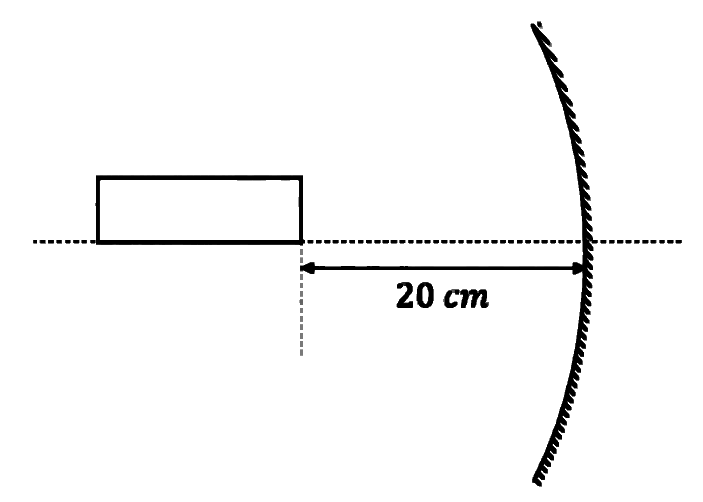
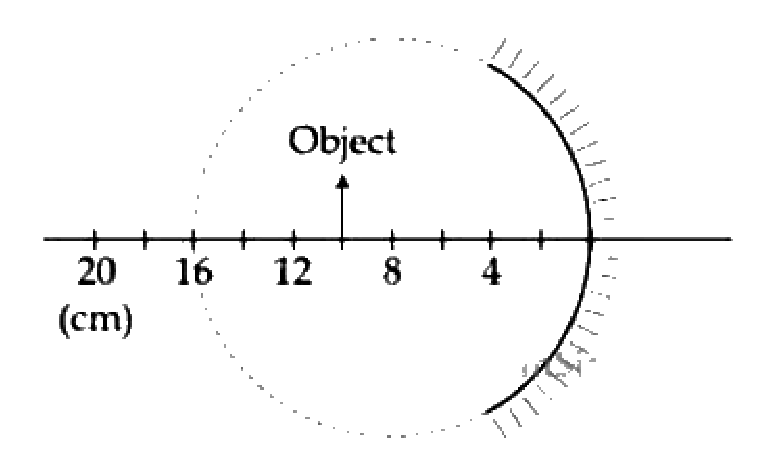
A rod of length 10 cm lies along the principle axis of a concave mirror of focal length 10 cm as shown in figure. The length of the image is ______ cm.
Reflection & Mirrors · Inclined mirrors & number of images
Two identical objects are placed in front of convex mirror and concave mirror having same radii of curvature of 12 cm, at same distance of 18 cm from the respective mirrors. The ratio of sizes of the images formed by convex mirror and by concave mirror is:
Distance between object and its image (magnified by −31) is 30 cm. The focal length of the mirror used is (4x)cm, where magnitude of value of x is _________.
Numerical answer type. Work it out, then open the answer.
The driver sitting inside a parked car is watching vehicles approaching from behind with the help of his side view mirror, which is a convex mirror with radius of curvature R=2 m. Another car approaches him from behind with a uniform speed of 90 km/hr. When the car is at a distance of 24 m from him, the magnitude of the acceleration of the image of the car in the side view mirror is ' a '. The value of 100a is __________ m/s2.
Numerical answer type. Work it out, then open the answer.
Reflection & Mirrors · Magnification & nature of image
A mirror is used to produce an image with magnification of 41. If the distance between object and its image is 40 cm, then the focal length of the mirror is ________.
Reflection & Mirrors · Magnification & nature of image
When an object is placed 40 cm away from a spherical mirror an image of magnification 21 is produced. To obtain an image with magnification of 31, the object is to be moved:
Reflection & Mirrors · Magnification & nature of image
A concave mirror produces an image of an object such that the distance between the object and image is 20 cm. If the magnification of the image is –3, then the magnitude of the radius of curvature of the mirror is:
The image of an object approaching a convex mirror of radius of curvature 20 m along its optical axis is observed to move from 325 m to 750 m in 30 second. The speed of the object in km/hr is
Reflection & Mirrors · Mirror formula & sign convention
A finite size object is placed normal to the principal axis at a distance of 30 cm from a convex mirror of focal length 30 cm. A plane mirror is now placed in such a way that the image produced by both the mirrors coincide with each other. The distance between the two mirrors is:
Reflection & Mirrors · Magnification & nature of image
A concave mirror of focal length ' f ' produces an image ' n ' time the size of the object. If the image is real, then the distance of the object from the mirror is
An object is placed at a distance of 12 cm in front of a plane mirror. The virtual and erect image is formed by the mirror. Now the mirror is moved by 4 cm towards the stationary object. The distance by which the position of image would be shifted, will be
Reflection & Mirrors · Inclined mirrors & number of images
Two objects A and B are placed at 15 cm and 25 cm from the pole in front of a concave mirror having radius of curvature 40 cm. The distance between images formed by the mirror is _______________.
Reflection & Mirrors · Inclined mirrors & number of images
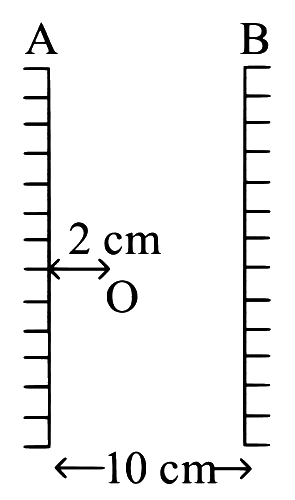
Two vertical parallel mirrors A and B are separated by 10 cm. A point object O is placed at a distance of 2 cm from mirror A. The distance of the second nearest image behind mirror A from the mirror A is _________ cm.
Numerical answer type. Work it out, then open the answer.
A thin cylindrical rod of length 10 cm is placed horizontally on the principal axis of a concave mirror of focal length 20 cm. The rod is placed in such a way that mid point of the rod is at 40 cm from the pole of mirror. The length of the image formed by the mirror will be 3x cm. The value of x is _____________.
Numerical answer type. Work it out, then open the answer.
In an experiment for estimating the value of focal length of converging mirror, image of an object placed at 40 cm from the pole of the mirror is formed at distance 120 cm from the pole of the mirror. These distances are measured with a modified scale in which there are 20 small divisions in 1 cm. The value of error in measurement of focal length of the mirror is K1 cm. The value of K is __________.
Numerical answer type. Work it out, then open the answer.
Reflection & Mirrors · Inclined mirrors & number of images
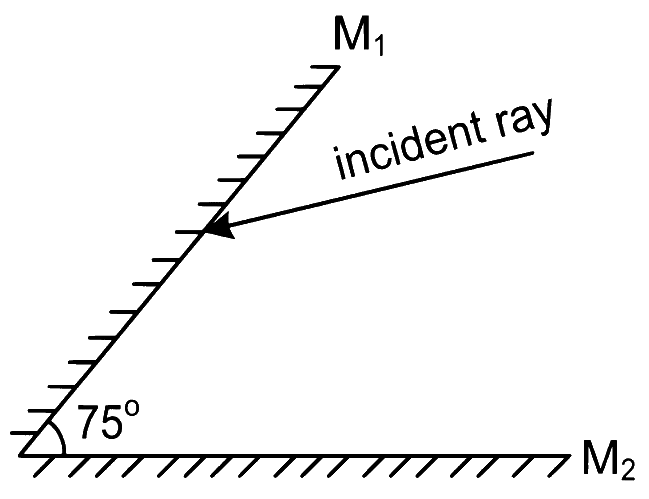
A light ray is incident, at an incident angle θ1, on the system of two plane mirrors M1 and M2 having an inclination angle 75∘ between them (as shown in figure). After reflecting from mirror M1 it gets reflected back by the mirror M2 with an angle of reflection 30∘. The total deviation of the ray will be _____________ degree.
Numerical answer type. Work it out, then open the answer.
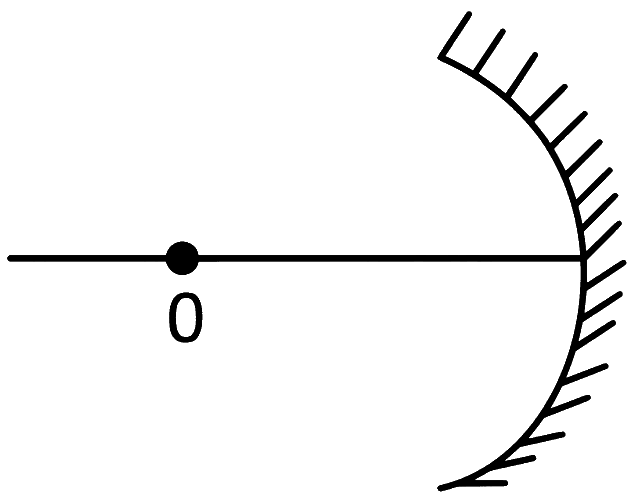
An object 'O' is placed at a distance of 100 cm in front of a concave mirror of radius of curvature 200 cm as shown in the figure. The object starts moving towards the mirror at a speed 2 cm/s. The position of the image from the mirror after 10 s will be at _________ cm.
Numerical answer type. Work it out, then open the answer.
Reflection & Mirrors · Laws of reflection & deviation
An object is placed beyond the centre of curvature C of the given concave mirror. If the distance of the object is d1 from C and the distance of the image formed is d2 from C, the radius of curvature of this mirror is:
Reflection & Mirrors · Laws of reflection & deviation
The incident ray, reflected ray and the outward drawn normal are denoted by the unit vectorsa,b, and crespectively. Then choose the correct relation for these vectors.
Reflection & Mirrors · Inclined mirrors & number of images
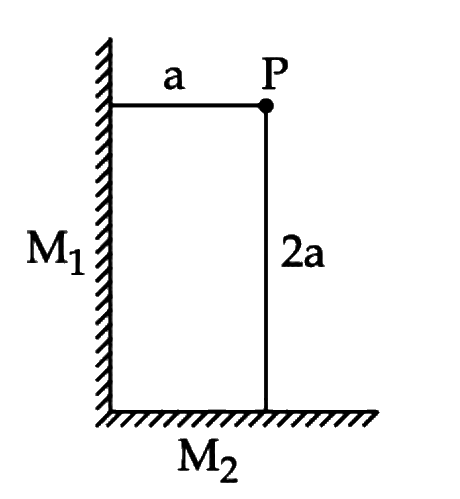
Two plane mirrors M1 and M2 are at right angle to each other shown. A point source 'P' is placed at 'a' and '2a' meter away from M1 and M2 respectively. The shortest distance between the images thus formed is: (Take 5 = 2.3)
Car B overtakes another car A at a relative speed of 40 ms−1. How fast will the image of car B appear to move in the mirror of focal length 10 cm fitted in car A, when the car B is 1.9 m away from the car A?
A short straight object of height 100 cm lies before the central axis of a spherical mirror whose focal length has absolute value | f | = 40 cm. The image of object produced by the mirror is of height 25 cm and has the same orientation of the object. One may conclude from the information:
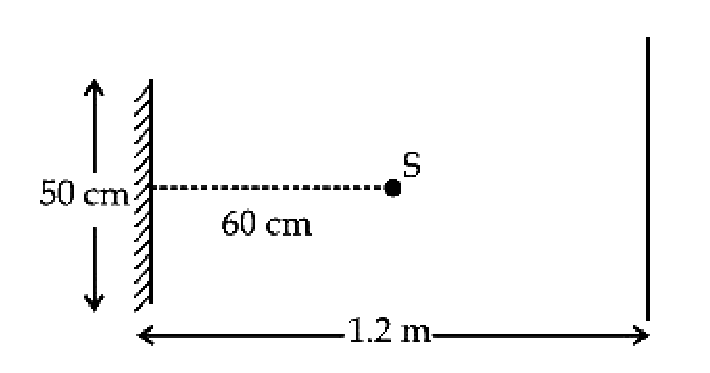
A point source of light S, placed at a distance 60cm in front of the centre of a plane mirror of width 50 cm, hangs vertically on a wall. A man walks in front of the mirror along a line parallel to the mirror at a distance 1.2 m from it (see in the figure). The distance between the extreme points where he can see the image of the light source in the mirror is __________ cm.
Numerical answer type. Work it out, then open the answer.
Reflection & Mirrors · Laws of reflection & deviation
A spherical mirror is obtained as shown in the figure from a hollow glass sphere. If an object is positioned in front of the mirror, what will be the nature and magnification of the image of the object?
Reflection & Mirrors · Laws of reflection & deviation
An object is gradually moving away from the focal point of a concave mirror along the axis of the mirror. The graphical representation of the magnitude of linear magnification (m) versus distance of the object from the mirror (x) is correctly given by:
(Graphs are drawn schematically and are not to scale)
When an object is kept at a distance of 30 cm from a concave mirror, the image is formed at a distance of 10 cm from the mirror. If the object is moved with a speed of 9 cms–1, the speed (in cms–1) with which image moves at that instant is ____.
Numerical answer type. Work it out, then open the answer.
Reflection & Mirrors · Laws of reflection & deviation
A concave mirror for face viewing has focal length of 0.4 m. The distance at which you hold the mirror from your face in order to see your image upright with a magnification of 5 is:
Reflection & Mirrors · Inclined mirrors & number of images
Two plane mirrors are inclined to each other such that a ray of light incident on the first mirror (M1) and parallel to the second mirror (M2) is finally reflected from the second mirror (M2) parallel to the first mirror (M1). The angle between the two mirrors will be:
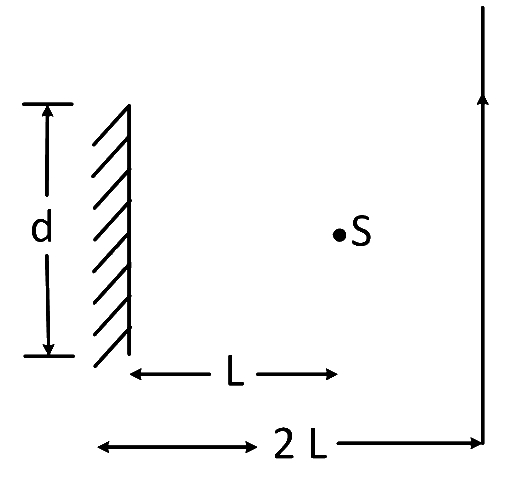
A point source of light, S is placed at distance L in front of the centre of plane mirror of width d which is hanging vertically on a wall. A man walks in front of the mirror along a line parallel to the mirror, at a distance 2L as shown below. The distance over which the man can see the image of the light source in the mirror is
Reflection & Mirrors · Laws of reflection & deviation
An object is placed at a distance of 40 cm from a concave mirror of focal length 15 cm. If the object is displaced through a distance of 20 cm towards the mirror, the displacement of the image will be
Reflection & Mirrors · Laws of reflection & deviation
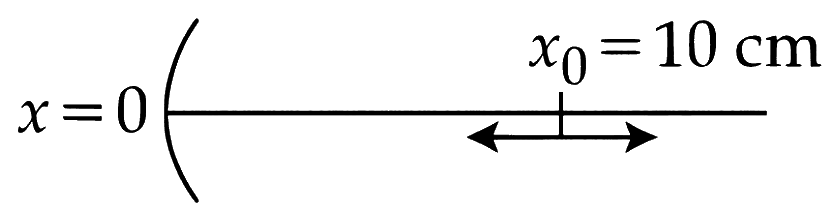
A particle is oscillating on the X-axis with an amplitude 2 cm about the point x0=10 cm, with a frequency ω. A concave mirror of focal length 5 cm is placed at the origin (see figure).
Identify the correct statements.
(A) The image executes periodic motion.
(B) The image executes non-periodic motion.
(C) The turning points of the image are asymmetric w.r.t. the image of the point at x=10 cm. (D) The distance between the turning points of the oscillation of the image is 21100 cm.
Reflection & Mirrors · Laws of reflection & deviation
A beam of light from a source L is incident normally on a plane mirror fixed at a certain distance x from the source. The beam is reflected back as a spot on a scale placed just above the source L. When the mirror is rotated through a small angle θ, the spot of the light is found to move through a distance y on the scale. The angle θ is given by
Reflection & Mirrors · Laws of reflection & deviation
You are asked to design a shaving mirror assuming that a person keeps it 10 cm from his face and views the magnified image of the face at the closest comfortable distance of 25 cm. The radius of curvature of the mirror would then be:
Reflection & Mirrors · Inclined mirrors & number of images
Two plane mirrors are inclined at 70°. A ray incident on one mirror at angle, θ after reflection falls on second mirror and is reflected from there parallel to first mirror. The value of θ is
Reflection & Mirrors · Laws of reflection & deviation
A rod of length 10 cm lies along the principal axis of a concave mirror of focal length 10 cm in such a way that its end closer to the pole is 20 cm away from the mirror. The length of the image is
A car is fitted with a convex side-view mirror of focal length 20 cm. A second car 2.8 m behind the first car is overtaking the first car at a relative speed of 15 m/s. The speed of the image of the second car as seen in the mirror of the first one is: