0 of 33 attemptedPick an answer to see the solution
Q1MHT CET 2026 · 15 MAY · SHIFT 2Medium
Viscosity & Stokes' Law · Viscous force on a moving sphere
The velocity of a small ball of mass M and density d when dropped in a container filled with glycerine becomes constant after some time. If density of glycerine is 2d then the viscous force acting on the ball will be (g=acceleration due to gravity)
Viscosity & Stokes' Law · Viscous force on a moving sphere
A spherical ball of radius 1 mm and density 10.5 g/cc is dropped in glycerine of coefficient of viscosity 9.8 poise and density 1.5 g/cc. Viscous force on the ball when it attains constant velocity is 3696×10−x N. The value of is
Viscosity & Stokes' Law · Newton's law & coefficient of viscosity
Given below are two statements:
Statement I: The hot water flows faster than cold water
Statement II: Soap water has higher surface tension as compared to fresh water. In the light above statements, choose the correct answer from the options given below
Viscosity & Stokes' Law · Viscous force on a moving sphere
A small rigid spherical ball of mass M is dropped in a long vertical tube containing glycerine. The velocity of the ball becomes constant after some time. If the density of glycerine is half of the density of the ball, then the viscous force acting on the ball will be (consider g as acceleration due to gravity)
Viscosity & Stokes' Law · Newton's law & coefficient of viscosity
Water is flowing steadily in a river. A and B are the two layers of water at heights 40 cm and 90 cm from the bottom. The velocity of the layer A is 12 cm/s. The velocity of the layer B is
Viscosity & Stokes' Law · Viscous force on a moving sphere
The velocity of small spherical ball of mass ' m ' and density ' d1 ', when dropped in a container filled with glycerine becomes constant after some time. The viscous force acting on the ball if density of glycerine is ' d2 ' is
Viscosity & Stokes' Law · Newton's law & coefficient of viscosity
Given below are two statements:
Statement (I) :Viscosity of gases is greater than that of liquids.
Statement (II): Surface tension of a liquid decreases due to the presence of insoluble impurities. In the light of the above statements, choose the most appropriate answer from the options given below:
Viscosity & Stokes' Law · Viscous force on a moving sphere
A ball rises to surface at a constant velocity in liquid whose density is 3 times greater than that of the material of the ball. The ratio of force of friction acting on the rising ball to its weight is
Viscosity & Stokes' Law · Viscous force on a moving sphere
A ball rises to surface at a constant velocity in liquid whose density is 4 times greater than that of the material of the ball. The ratio of the force of friction acting on the rising ball and its weight is
Viscosity & Stokes' Law · Viscous force on a moving sphere
A small ball of mass m and density ρ is dropped in a viscous liquid of density ρ0. After sometime, the ball falls with constant velocity. The viscous force on the ball is:
Viscosity & Stokes' Law · Viscous force on a moving sphere
A metal sphere of mass 'm' and density 'σ1' falls with terminal velocity through a container containing liquid. The density of liquid is 'σ2 '. The viscous force acting on the sphere is
Viscosity & Stokes' Law · Viscous force on a moving sphere
A small ball of mass M and density ρ is dropped in a viscous liquid of density ρ0. After some time, the ball falls with a constant velocity. What is the viscous force on the ball?
Viscosity & Stokes' Law · Viscous force on a moving sphere
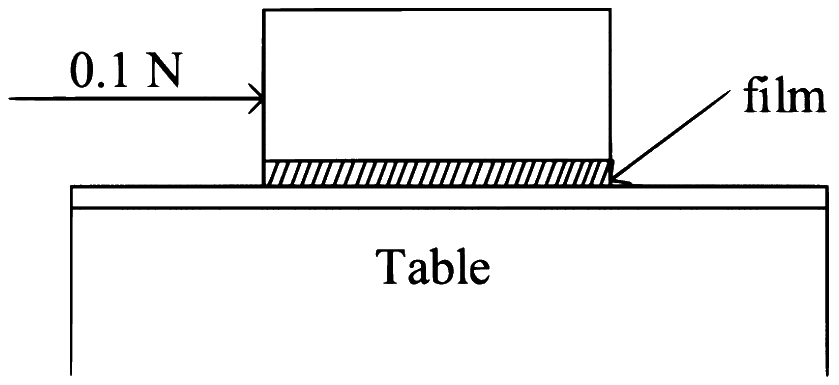
A metal block of base area 0.20 m2 is placed on a table, as shown in figure. A liquid film of thickness 0.25 mm is inserted between the block and the table. The block is pushed by a horizontal force of 0.1 N and moves with a constant speed. If the viscosity of the liquid is 5.0×10⁻³ Pl, the speed of block is ____________ ×10−3 m/s.
Numerical answer type. Work it out, then open the answer.
Viscosity & Stokes' Law · Viscous force on a moving sphere
A Spherical ball of radius 1mm and density 10.5 g/cc is dropped in glycerine of coefficient of viscosity 9.8 poise and density 1.5 g/cc. Viscous force on the ball when it attains constant velocity is 3696×10−x N. The value of x is ________.
(Given, g = 9.8 m/s2 and π=722)
Numerical answer type. Work it out, then open the answer.
Viscosity & Stokes' Law · Newton's law & coefficient of viscosity
The velocity of upper layer of water in a river is 36 kmh−1. Shearing stress between horizontal layers of water is 10−3 Nm−2. Depth of the river is __________ m. (Co-efficient of viscosity of water is 10−2 Pa.s)
Numerical answer type. Work it out, then open the answer.
Viscosity & Stokes' Law · Viscous force on a moving sphere
The terminal velocity of a copper ball of radius 5 mm falling through a tank of oil at room temperature is 10 cm s−1. If the viscosity of oil at room temperature is 0.9 kg m−1 s−1, the viscous drag force is:
Viscosity & Stokes' Law · Viscous force on a moving sphere
The velocity of a small ball of mass 'm' and density d1, when dropped in a container filled with glycerin, becomes constant after some time. If the density of glycerin is d2, then the viscous force acting on the ball, will be:
Viscosity & Stokes' Law · Viscous force on a moving sphere
The velocity of a small ball of mass 0.3 g and density 8 g/cc when dropped in a container filled with glycerine becomes constant after some time. If the density of glycerine is 1.3 g/cc, then the value of viscous force acting on the ball will be x×10−4 N. The value of x is _________. [use g=10 m/s2]
Numerical answer type. Work it out, then open the answer.
Viscosity & Stokes' Law · Viscous force on a moving sphere
A ball rises to the surface of a liquid with constant velocity. The density of the liquid is four times the density of the material of the ball. The viscous force of the liquid on the rising ball is greater than the weight of the ball by a factor of
Viscosity & Stokes' Law · Viscous force on a moving sphere
The velocity of a small ball of mass 'M' and density 'd1' when dropped in a container filled with glycerine becomes constant after some time. If the density of glycerine is 'd2', the viscous force acting on the ball is ( g= acceleration due to gravity)
Viscosity & Stokes' Law · Viscous force on a moving sphere
The velocity of a small ball of mass M and density d, when dropped in a container filled with glycerin becomes constant after some time. If the density of glycerin is 2d, then the viscous force acting on the ball will be:
Viscosity & Stokes' Law · Viscous force on a moving sphere
In Millikan's oil drop experiment, what is viscous force acting on an uncharged drop of radius 2.0 × 10⁻⁵ m and density 1.2 × 10³ kgm− 3? Take viscosity of liquid = 1.8 × 10⁻⁵ Nsm−2. (Neglect buoyancy due to air).
Viscosity & Stokes' Law · Viscous force on a moving sphere
A raindrop with radius R = 0.2 mm falls from a cloud at a height h = 2000 m above the ground. Assume that the drop is spherical throughout its fall and the force of buoyance may be neglected, then the terminal speed attained by the raindrop is:
[Density of water fw = 1000 kg m−3 and Density of air fa = 1.2 kg m−3, g = 10 m/s2, Coefficient of viscosity of air = 1.8 × 10⁻⁵ Nsm−2]
Viscosity & Stokes' Law · Viscous force on a moving sphere
A small metal sphere of mass M and density d1 when dropped in a jar filled with liquid moves with terminal velocity after sometime. The viscous force acting on the sphere is (d2= density of liquid and g= gravitational acceleration)
Viscosity & Stokes' Law · Viscous force on a moving sphere
A small sphere of radius ‘r’ falls from rest in a viscous liquid. As a result, heat is produced due to viscous force. The rate of production of heat when the sphere attains its terminal velocity, is proportional to
Two tubes of radii r1 and r2, and lengths l1 and l2, respectively, are connected in series and a liquid flows through each of them in stream line conditions. P1 and P2 are pressure differences across the two tubes.
If P2 is 4P1 and l2 is 4l1, then the radius r2 will be equal to:
Viscosity & Stokes' Law · Newton's law & coefficient of viscosity
The velocity of water in a river is 18 km/hr near the surface. If the river is 5 m deep, find the shearing stress between the horizontal layers of water. The co-efficient of viscosity of water = 10−2 poise.
Viscosity & Stokes' Law · Viscous force on a moving sphere
A spherical solid ball of volume V is made of a material of density ρ1. It is falling through a liquid of density ρ2(ρ2<ρ1). Assume that the liquid applies a viscous force on the ball that is proportional to the square of its speed v, i.e., Fviscous=−kv2(k>0). The terminal speed of the ball is
Viscosity & Stokes' Law · Viscous force on a moving sphere
Spherical balls of radius R are falling in a viscous fluid of viscosity η with a velocity v. The retarding viscous force acting on the spherical ball is