
Physics Circle home Student Login

Home›Study material›Formula Book›Dual Nature of Radiation and Matter

Dual Nature of Radiation and Matter Formula Book

36 formulas in 5 topics, in the same order as the PYQ topics.

Only formulas used in the solutions of 169 MHT CET PYQs (Level 1, 2, 3)
01

Photons: Energy, Momentum & Radiation Pressure

3 formulas · from 7 MHT CET PYQs

Practise these PYQs ›
02

Photoelectric Effect: Einstein's Equation

12 formulas · from 76 MHT CET PYQs

Practise these PYQs ›
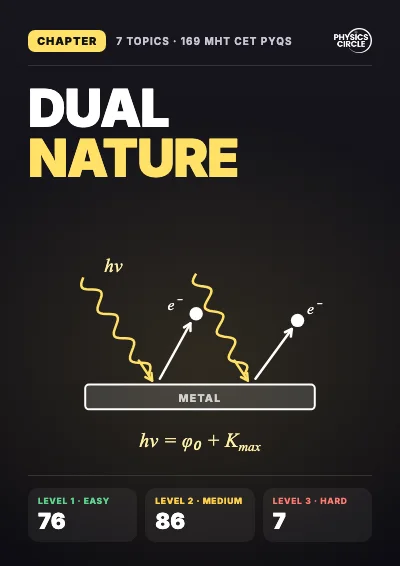
  • Einstein's photoelectric equationhν=ϕ+Kmaxh\nu = \phi + K_{max}
  • Maximum kinetic energyKmax=hν−ϕ=h(ν−ν0)K_{max} = h\nu - \phi = h(\nu - \nu_0)
  • In terms of wavelength12mvmax2=hcλ−ϕ\tfrac{1}{2}mv_{max}^2 = \dfrac{hc}{\lambda} - \phi
  • Stopping potentialeVs=hcλ−ϕ  ⇒  hcλ=ϕ+eVseV_s = \dfrac{hc}{\lambda} - \phi \;\Rightarrow\; \dfrac{hc}{\lambda} = \phi + eV_s
  • Stopping potential and speedeV0=12mvmax2  ⇒  V0=vmax22(e/m)eV_0 = \tfrac{1}{2}mv_{max}^2 \;\Rightarrow\; V_0 = \dfrac{v_{max}^2}{2(e/m)}
  • Work function and threshold wavelengthϕ=hν0=hcλ0\phi = h\nu_0 = \dfrac{hc}{\lambda_0}
  • Wavelength for a given stopping potentialλ=hcW0+eV\lambda = \dfrac{hc}{W_0 + eV}
  • Maximum speed of photoelectronsvmax=2(hν−ϕ)m  ⇒  v∝E−ϕv_{max} = \sqrt{\dfrac{2(h\nu - \phi)}{m}} \;\Rightarrow\; v \propto \sqrt{E - \phi}
  • Photon energy n times the work functionE=nW  ⇒  Kmax=(n−1)WE = nW \;\Rightarrow\; K_{max} = (n - 1)W
  • Frequency doubledK′=2hν−ϕ=K+hνK' = 2h\nu - \phi = K + h\nu
  • Two frequencies, speeds v1 and v2v12−v22=2hm(ν1−ν2)v_1^2 - v_2^2 = \dfrac{2h}{m}(\nu_1 - \nu_2)
  • Photoelectron in a magnetic fieldp=2mKmax,R=peBp = \sqrt{2mK_{max}},\qquad R = \dfrac{p}{eB}

🔒 For Vajra 2.0 Pro studentsTopic 1 is free. Log in with your Vajra 2.0 Pro number to see every formula.

03

Photoelectric Experiment: Intensity, Stopping Potential & Graphs

7 formulas · from 36 MHT CET PYQs

Practise these PYQs ›
  • Einstein's equation (stopping potential)eV0=hν−ϕeV_0 = h\nu - \phi
  • Stopping potential vs frequency (straight line)V0=heν−ϕe=he(ν−ν0)V_0 = \dfrac{h}{e}\nu - \dfrac{\phi}{e} = \dfrac{h}{e}(\nu - \nu_0)
  • Slope of V0 vs nu graphslope=he  ⇒  h=e(V2−V1)ν2−ν1\text{slope} = \dfrac{h}{e} \;\Rightarrow\; h = \dfrac{e(V_2 - V_1)}{\nu_2 - \nu_1}
  • Intercepts of V0 vs nu graphν-intercept=ν0=ϕh,V-intercept=−ϕe\nu\text{-intercept} = \nu_0 = \dfrac{\phi}{h},\qquad V\text{-intercept} = -\dfrac{\phi}{e}
  • At threshold frequencyKEmax=hν0−ϕ=0KE_{max} = h\nu_0 - \phi = 0
  • Intensity from a point sourceI∝1r2I \propto \dfrac{1}{r^2}
  • Frequency doubledeV0′=2hν−ϕ=2eV0+ϕeV_0' = 2h\nu - \phi = 2eV_0 + \phi

🔒 For Vajra 2.0 Pro studentsTopic 1 is free. Log in with your Vajra 2.0 Pro number to see every formula.

04

Matter Waves: de Broglie Wavelength

12 formulas · from 48 MHT CET PYQs

Practise these PYQs ›
  • de Broglie wavelengthλ=hp=hmv\lambda = \dfrac{h}{p} = \dfrac{h}{mv}
  • In terms of kinetic energyλ=h2mK  ⇒  λ∝1K\lambda = \dfrac{h}{\sqrt{2mK}} \;\Rightarrow\; \lambda \propto \dfrac{1}{\sqrt{K}}
  • Charge accelerated through Vλ=h2mqV  ⇒  λ∝1mqV\lambda = \dfrac{h}{\sqrt{2mqV}} \;\Rightarrow\; \lambda \propto \dfrac{1}{\sqrt{mqV}}
  • Electron accelerated through Vλ=h2meV  ⇒  λ∝1V\lambda = \dfrac{h}{\sqrt{2meV}} \;\Rightarrow\; \lambda \propto \dfrac{1}{\sqrt{V}}
  • Kinetic energy and momentumK=p22m=h22mλ2K = \dfrac{p^2}{2m} = \dfrac{h^2}{2m\lambda^2}
  • Thermal de Broglie wavelengthλ=h3mkT  ⇒  λ∝1mT\lambda = \dfrac{h}{\sqrt{3mkT}} \;\Rightarrow\; \lambda \propto \dfrac{1}{\sqrt{mT}}
  • Wavelength of a photonλph=hcE\lambda_{ph} = \dfrac{hc}{E}
  • Photon and electron of the same energy Eλphλe=c2mE\dfrac{\lambda_{ph}}{\lambda_e} = c\sqrt{\dfrac{2m}{E}}
  • Electron and photon of the same wavelengthKE=h2λmc\dfrac{K}{E} = \dfrac{h}{2\lambda mc}
  • Charge in an electric field for time tp=eEt  ⇒  λ=heEtp = eEt \;\Rightarrow\; \lambda = \dfrac{h}{eEt}
  • de Broglie wave in a Bohr orbit2πrn=nλ  ⇒  λ∝n2\pi r_n = n\lambda \;\Rightarrow\; \lambda \propto n
  • Electron from photoemissionK=hc(1λi−1λ0),λe=h2mKK = hc\left(\dfrac{1}{\lambda_i} - \dfrac{1}{\lambda_0}\right),\qquad \lambda_e = \dfrac{h}{\sqrt{2mK}}

🔒 For Vajra 2.0 Pro studentsTopic 1 is free. Log in with your Vajra 2.0 Pro number to see every formula.

05

Other / Mixed: Atoms & Bohr Links

2 formulas · from 2 MHT CET PYQs

Practise these PYQs ›
  • Gyromagnetic ratio of the orbiting electronμL=evr/2mvr=e2m\dfrac{\mu}{L} = \dfrac{evr/2}{mvr} = \dfrac{e}{2m}
  • Bohr magnetonμB=e2m⋅h2π=eh4πm\mu_B = \dfrac{e}{2m}\cdot\dfrac{h}{2\pi} = \dfrac{eh}{4\pi m}

🔒 For Vajra 2.0 Pro studentsTopic 1 is free. Log in with your Vajra 2.0 Pro number to see every formula.