Physics Circle home Student Login

Home›Practice Hub›Chapters›Dual Nature of Radiation and Matter›Matter Waves: de Broglie Wavelength

Dual Nature of Radiation and Matter PYQs · MHT CET · JEE Main · NEET

Matter Waves: de Broglie Wavelength

Read the theory for this topic →

Questions
233
MHT CET
48
JEE Main
76
NEET
27
Other exams
82
0 of 233 attempted

Q1MHT CET 2026 · 14 MAY · SHIFT 1Easy

Matter Waves: de Broglie Wavelength

Two particles A and B of masses m1m_1 and m2m_2 (m1>m2m_1 > m_2) have the same de-Broglie wavelength, then

Show answer and solution

Answer: (a)

Loading the solution…
Report a mistakeOpen question page
Q2MHT CET 2026 · 14 MAY · SHIFT 1Easy

Matter Waves: de Broglie Wavelength

The de-Broglie wavelength λ\lambda of a particle

Show answer and solution

Answer: (c)

Loading the solution…
Report a mistakeOpen question page
Q3MHT CET 2026 · 17 APR · SHIFT 1Easy

Matter Waves: de Broglie Wavelength

The kinetic energy of a free electron increases to 3 times the previous K.E. The ratio of new de- Broglie wavelength to previous de-Broglie wavelength is

Show answer and solution

Answer: (a)

Loading the solution…
Report a mistakeOpen question page
Q4MHT CET 2026 · 20 APR · SHIFT 2Easy

Matter Waves: de Broglie Wavelength

The ratio of de-Broglie wavelength of an α\alpha-particle and proton accelerated from rest by the same potential is 1m\frac{1}{\sqrt{m}}. The value of mm is

Show answer and solution

Answer: (b)

Loading the solution…
Report a mistakeOpen question page
Q5MHT CET 2026 · 20 APR · SHIFT 1Easy

Matter Waves: de Broglie Wavelength

The proton and α\alpha - particle are accelerated through same potential difference. Then the ratio of the de-Broglie wavelength of proton and α\alpha - particle is (mass of α\alpha-particle is 44 times mass of proton, charge of α\alpha-particle is 22 times charge of proton)

Show answer and solution

Answer: (d)

Loading the solution…
Report a mistakeOpen question page
Q6MHT CET 2026 · 18 APR · SHIFT 1Medium

Matter Waves: de Broglie Wavelength

If the kinetic energy of a particle is increased to 16 times, the percentage change in the de Broglie wavelength of a particle is

Show answer and solution

Answer: (c)

Loading the solution…
Report a mistakeOpen question page
Q7JEE Main 2026 · 5 APR · SHIFT 2Medium

Matter Waves: de Broglie Wavelength

An electron is travelling with a velocity vv in free space and when it enters a medium, its velocity is reduced by 20%20\%. The de Broglie wavelength of electron in the medium is αλ0\alpha\lambda_0, where λ0\lambda_0 is its de Broglie wavelength in free space. The value of α\alpha is ______.

Show answer and solution

Answer: (c)

Loading the solution…
Report a mistakeOpen question page
Q8MHT CET 2026 · 13 APR · SHIFT 2Medium

Matter Waves: de Broglie Wavelength

An electron accelerated through a potential difference V1V_1 has a de-Broglie wavelength of λ\lambda. When the potential is changed to V2V_2, its de-Broglie wavelength increases to 2λ2\lambda. The value of (V1/V2)(V_1/V_2) is equal to

Show answer and solution

Answer: (d)

Loading the solution…
Report a mistakeOpen question page
Q9JEE Main 2026 · 6 APR · SHIFT 2Medium

Matter Waves: de Broglie Wavelength

The de Broglie wavelength for an electron accelerated through the potential difference of V1V_1 volt is λ1\lambda_1. When the potential difference is changed to V2V_2 volt, the associated de Broglie wavelength is increased by 50%50\%. If (V1/V2)=(9/α)(V_1/V_2) = (9/\alpha), then the value of α\alpha is ______。

Numerical answer type. Work it out, then open the answer.

Show answer and solution

Answer: 4

Loading the solution…
Report a mistakeOpen question page
Q10JEE Main 2026 · 21 JAN · SHIFT 2Medium

Matter Waves: de Broglie Wavelength

A particle having electric charge 3×10⁻¹⁹ C3 \times 10^{-19}\text{ C} and mass 6×10⁻²⁷ kg6 \times 10^{-27}\text{ kg} is accelerated by applying an electric potential of 1.21 V.

Wavelength of the matter wave associated with the particle is α×10−12 m\alpha \times 10^{-12}\text{ m}. The value of α\alpha is ______. (Take Planck's constant =6.6×10⁻³⁴ J s= 6.6 \times 10^{-34}\text{ J s})

Numerical answer type. Work it out, then open the answer.

Show answer and solution

Answer: 10

Loading the solution…
Report a mistakeOpen question page
Q11MHT CET 2026 · 17 APR · SHIFT 2Medium

Matter Waves: de Broglie Wavelength

The ratio of the accelerating potentials required to accelerate (i) an α\alpha-particle and (ii) a proton to have the same de Broglie wavelength associated with them is

(mass of α\alpha - particle = 6.4×10−276.4 \times 10^{-27} kg, mass of proton = 1.6×10−271.6 \times 10^{-27} kg)

Show answer and solution

Answer: (a)

Loading the solution…
Report a mistakeOpen question page
Q12JEE Main 2026 · 4 APR · SHIFT 2Medium

Matter Waves: de Broglie Wavelength

The de Broglie wavelength associated with an electron accelerated through a potential difference V is λe\lambda_\mathrm{e} and the de Broglie wavelength associated with a proton accelerated through the same potential difference is λp\lambda_\mathrm{p}. If their corresponding masses are mem_\mathrm{e} and mpm_\mathrm{p}, respectively, then the ratio of their de Broglie wavelengths (λeλp)\left(\frac{\lambda_e}{\lambda_p}\right) is ______.

Show answer and solution

Answer: (a)

Loading the solution…
Report a mistakeOpen question page
Q13JEE Main 2026 · 28 JAN · SHIFT 1Medium

Matter Waves: de Broglie Wavelength

The ratio of de Broglie wavelength of a deuteron with kinetic energy EE to that of an alpha particle with kinetic energy 2E2E, is n:1n : 1. The value of nn is ______.

(Assume mass of proton == mass of neutron)

Numerical answer type. Work it out, then open the answer.

Show answer and solution

Answer: 2

Loading the solution…
Report a mistakeOpen question page
Q14MHT CET 2026 · 12 MAY · SHIFT 2Medium

Matter Waves: de Broglie Wavelength

The ratio of de-Broglie wavelengths of molecules of hydrogen and helium which are at temperatures 27∘C27^\circ C and 127∘C127^\circ C respectively is (mHe=2mH2m_{He} = 2m_{H_2})

Show answer and solution

Answer: (b)

Loading the solution…
Report a mistakeOpen question page
Q15JEE Main 2026 · 23 JAN · SHIFT 1Medium

Matter Waves: de Broglie Wavelength

The de Broglie wavelength of an oxygen molecule at 27∘C27^\circ\text{C} is x×10−12 mx \times 10^{-12}\text{ m}. The value of xx is (take Planck's constant =6.63×10⁻³⁴ J s= 6.63 \times 10^{-34}\text{ J s}, Boltzmann constant =1.38×10⁻²³ J/K= 1.38 \times 10^{-23}\text{ J/K}, mass of oxygen molecule =5.31×10⁻²⁶ kg= 5.31 \times 10^{-26}\text{ kg})

Show answer and solution

Answer: (d)

Loading the solution…
Report a mistakeOpen question page
Q16MHT CET 2026 · 20 MAY · SHIFT 1Medium

Matter Waves: de Broglie Wavelength

The wavelength 'λ\lambda' of photon and the de-Broglie wavelength of an electron have same value. The ratio of kinetic energy of electron to the energy of a photon is (m=mass of electron, h = Planck's constant, c = velocity of light)

Show answer and solution

Answer: (a)

Loading the solution…
Report a mistakeOpen question page
Q17MHT CET 2026 · 13 MAY · SHIFT 2Medium

Matter Waves: de Broglie Wavelength

The energy of a photon is equal to the kinetic energy of a proton. If λ1\lambda_1 is the de-Broglie wavelength of a proton, λ2\lambda_2 is the wavelength associated with the photon and if the energy of the photon is EE then (λ1/λ2)(\lambda_1/\lambda_2) is proportional to

Show answer and solution

Answer: (b)

Loading the solution…
Report a mistakeOpen question page
Q18MHT CET 2026 · 12 MAY · SHIFT 2Medium

Matter Waves: de Broglie Wavelength

An electromagnetic wave of wavelength λ\lambda is incident on a photosensitive surface of negligible work function. If the photoelectrons emitted from this surface have de-Broglie wavelength λ1\lambda_1, then

Show answer and solution

Answer: (b)

Loading the solution…
Report a mistakeOpen question page
Q19MHT CET 2026 · 11 APR · SHIFT 2Medium

Matter Waves: de Broglie Wavelength

According to de-Broglie hypothesis, the ratio of the wave-length of a photon and that of an electron having same energy 'E' is (m = mass of electron, c = velocity of light)

Show answer and solution

Answer: (c)

Loading the solution…
Report a mistakeOpen question page
Q20MHT CET 2026 · 11 APR · SHIFT 1Medium

Matter Waves: de Broglie Wavelength

A photon and an electron have equal energy E. The ratio of λ\lambda(electron) to λ\lambda(photon) is proportional to

Show answer and solution

Answer: (b)

Loading the solution…
Report a mistakeOpen question page
Q21NEET 2026 · RE-NEETMedium

Matter Waves: de Broglie Wavelength

A photon and an electron, each of 20 eV energy, move in free space. The ratio of linear momentum of electron pep_e to that of photon pPh,pepPhp_{Ph}, \frac{p_e}{p_{Ph}} is:

[Take speed of light =3×10⁸ ms−1= 3 \times 10^{8}\text{ ms}^{-1}, charge of electron =−1.6×10⁻¹⁹ C= -1.6 \times 10^{-19}\text{ C} and mass of electron =9×10⁻³¹ kg= 9 \times 10^{-31}\text{ kg} ]

Show answer and solution

Answer: (d)

Loading the solution…
Report a mistakeOpen question page
Q22MHT CET 2026 · 12 MAY · SHIFT 1Medium

Matter Waves: de Broglie Wavelength

An electron is moving with initial velocity v⃗=ak^\vec{v} = a\hat{k} in a magnetic field B⃗=bj^\vec{B} = b\hat{j}. Its de-Broglie wavelength will

Show answer and solution

Answer: (d)

Loading the solution…
Report a mistakeOpen question page
Q23MHT CET 2026 · 20 APR · SHIFT 2Medium

Matter Waves: de Broglie Wavelength

An electron is moving with initial velocity v⃗=V0j^\vec{v} = V_0\hat{j} in a magnetic field B⃗=B0i^\vec{B} = B_0\hat{i}. Its de-Broglie wavelength will

Show answer and solution

Answer: (c)

Loading the solution…
Report a mistakeOpen question page
Q24MHT CET 2026 · 16 APR · SHIFT 2Difficult

Matter Waves: de Broglie Wavelength

A photoemissive substance is illuminated with a radiation of wavelength λi\lambda_i so that it releases electrons with de-Broglie wavelength λe\lambda_e. The longest wavelength of radiation that can emit photoelectron is λ0\lambda_0. Expression for de-Broglie wavelength is (m = mass of electron, h = Planck's constant, C = Speed of light)

Show answer and solution

Answer: (c)

Loading the solution…
Report a mistakeOpen question page
Q25MHT CET 2026 · 15 APR · SHIFT 1Difficult

Matter Waves: de Broglie Wavelength

Light of wavelength 'λ\lambda' which is less than threshold wavelength is incident on a photosensitive material. If incident wavelength is decreased so that emitted photoelectrons are moving with some velocity then stopping potential

Show answer and solution

Answer: (b)

Loading the solution…
Report a mistakeOpen question page
Q26MHT CET 2026 · 15 MAY · SHIFT 1Difficult

Matter Waves: de Broglie Wavelength

An electron of mass mm and charge ee initially at rest gets accelerated by a constant electric field EE. The rate of change of de-Broglie wavelength of the electron at time tt is

(hh = Planck's constant)

Show answer and solution

Answer: (a)

Loading the solution…
Report a mistakeOpen question page
Q27JEE Main 2026 · 5 APR · SHIFT 1Difficult

Matter Waves: de Broglie Wavelength

An electron of mass mm is moving in an electric field E⃗=−2Eoi^ (Eo=\vec{E} = -2E_o\hat{i}\ (E_o = constant >0)> 0), with an initial velocity V⃗=voi^ (vo=\vec{V} = v_o\hat{i}\ (v_o = constant >0)> 0). If λo=h4mvo\lambda_o = \frac{h}{4mv_o}, its de Broglie wavelength at time tt is ______.

( e=e = charge of electron)

Show answer and solution

Answer: (c)

Loading the solution…
Report a mistakeOpen question page
Q28MHT CET 2025 · 21 APR · SHIFT 1Easy

Matter Waves: de Broglie Wavelength

The de-Broglie wavelength (λ)(\lambda) of a particle

Show answer and solution

Answer: (a)

Loading the solution…
Report a mistakeOpen question page
Q29JEE Main 2025 · 29 JAN · SHIFT 1Easy

Matter Waves: de Broglie Wavelength

If λ\lambda and KK are de Broglie wavelength and kinetic energy, respectively, of a particle with constant mass. The correct graphical representation for the particle will be:

Show answer and solution

Answer: (d)

Loading the solution…
Report a mistakeOpen question page
Q30MHT CET 2025 · 23 APR · SHIFT 2Easy

Matter Waves: de Broglie Wavelength

Electron beam when accelerated by a voltage of 10 kV, has a de-Broglie wavelength ' λ\lambda '. If the voltage is increased to 20 kV then the deBroglie wavelength associated with the electron beam would be

Show answer and solution

Answer: (d)

Loading the solution…
Report a mistakeOpen question page
Q31MHT CET 2025 · 19 APR · SHIFT 2Easy

Matter Waves: de Broglie Wavelength

An electron accelerated by a potential difference ' VV ' has de-Broglie wavelength ' λ\lambda '. If the electron is accelerated by a potential difference ' 9 V ', its de-Broglie wavelength will be

Show answer and solution

Answer: (b)

Loading the solution…
Report a mistakeOpen question page
Q32MHT CET 2025 · 23 APR · SHIFT 1Medium

Matter Waves: de Broglie Wavelength

The energy that should be added to an electron to reduce its de-Broglie wavelength from λ\lambda to λ2\frac{\lambda}{2} is nn times the initial energy. The value of ' nn ' is

Show answer and solution

Answer: (b)

Loading the solution…
Report a mistakeOpen question page
Q33JEE Main 2025 · 23 JAN · SHIFT 1Medium

Matter Waves: de Broglie Wavelength

A sub-atomic particle of mass 10−30 kg10^{-30}\text{ kg} is moving with a velocity 2.21×10⁶ m/s2.21 \times 10^{6}\text{ m/s}. Under the matter wave consideration, the particle will behave closely like (h=6.63×10⁻³⁴ J s)(\mathrm{h} = 6.63 \times 10^{-34}\text{ J s})

Show answer and solution

Answer: (a)

Loading the solution…
Report a mistakeOpen question page
Q34MHT CET 2025 · 22 APR · SHIFT 2Medium

Matter Waves: de Broglie Wavelength

The de-Broglie wavelength of a neutron at 27∘C27^\circ\text{C} is ' λ0\lambda_0 '. What will be its wavelength at 927∘C927^\circ\text{C}?

Show answer and solution

Answer: (c)

Loading the solution…
Report a mistakeOpen question page
Q35MHT CET 2025 · 26 APR · SHIFT 1Medium

Matter Waves: de Broglie Wavelength

The wavelength ' λ\lambda ' of a photon and the deBroglie wavelength of an electron have same value. The ratio of kinetic energy of the electron to the energy of a photon is

( m=\mathrm{m} = mass of electron, c=\mathrm{c} = velocity of light, h=\mathrm{h} = Planck's constant)

Show answer and solution

Answer: (c)

Loading the solution…
Report a mistakeOpen question page
Q36MHT CET 2025 · 20 APR · SHIFT 2Medium

Matter Waves: de Broglie Wavelength

A light of wavelength λ\lambda is incident on a photosensitive surface of negligible work function. The photoelectrons emitted from the surface have de-Broglie wavelength λ1\lambda_1. Then ratio λ:λ1 2\lambda : \lambda_1^{\,2} is ( h=\mathrm{h} = Planck's constant, c=\mathrm{c} = velocity of light, m=\mathrm{m} = mass of electron)

Show answer and solution

Answer: (c)

Loading the solution…
Report a mistakeOpen question page
Q37NEET 2025Medium

Matter Waves: de Broglie Wavelength

A photon and an electron (mass mm) have the same energy EE. The ratio ( λ\lambdaphoton /λ/\lambdaelectron) of their de Broglie wavelengths is: ( cc is the speed of light)

Show answer and solution

Answer: (a)

Loading the solution…
Report a mistakeOpen question page
Q38JEE Main 2025 · 28 JAN · SHIFT 1Medium

Matter Waves: de Broglie Wavelength

A proton of mass ' mPm_P ' has same energy ' EE ' as that of a photon of wavelength ' λ\lambda '. If the proton is moving at non-relativistic speed, then ratio of its de Broglie wavelength to the wavelength of photon is.

Show answer and solution

Answer: (d)

Loading the solution…
Report a mistakeOpen question page
Q39JEE Main 2025 · 24 JAN · SHIFT 1Medium

Matter Waves: de Broglie Wavelength

An electron of mass ' m ' with an initial velocityv⃗=v0i^ (v0>0)\vec{v} = v_0\hat{i}\ (v_0 > 0) enters an electric field E⃗=−Eok^\vec{E} = -E_o\hat{k}. If the initial de Broglie wavelength is λ0\lambda_0, the value after time t would be

Show answer and solution

Answer: (c)

Loading the solution…
Report a mistakeOpen question page
Q40MHT CET 2025 · 22 APR · SHIFT 2Medium

Matter Waves: de Broglie Wavelength

When the electron orbiting in hydrogen atom goes from one orbit to another orbit (principal quantum number =n= n ), the de-Broglie wavelength ( λ\lambda) associated with it is related to nn as

Show answer and solution

Answer: (d)

Loading the solution…
Report a mistakeOpen question page
Q41NEET 2025Medium

Matter Waves: de Broglie Wavelength

De-Broglie wavelength of an electron orbiting in the n=2n = 2 state of hydrogen atom is close to (Given Bohr radius =0.052 nm= 0.052\text{ nm})

Show answer and solution

Answer: (d)

Loading the solution…
Report a mistakeOpen question page
Q42JEE Main 2025 · 22 JAN · SHIFT 1Medium

Matter Waves: de Broglie Wavelength

An electron in the ground state of the hydrogen atom has the orbital radius of 5.3×10⁻¹¹ m5.3 \times 10^{-11}\text{ m} while that for the electron in third excited state is 8.48×10⁻¹⁰ m8.48 \times 10^{-10}\text{ m}. The ratio of the de Broglie wavelengths of electron in the ground state to that in the excited state is

Show answer and solution

Answer: (a)

Loading the solution…
Report a mistakeOpen question page
Q43MHT CET 2025 · 26 APR · SHIFT 2Difficult

Matter Waves: de Broglie Wavelength

Let EcE_c and EpE_p represents kinetic energy of electron and photon respectively. If de-Broglie wavelength of a photon is twice the de-Broglie wavelength of an electron then Ep/EcE_p/E_c is (speed of electron =C/100= C/100 where C is the velocity of light)

Show answer and solution

Answer: (b)

Loading the solution…
Report a mistakeOpen question page
Q44JEE Main 2025 · 7 APR · SHIFT 2Difficult

Matter Waves: de Broglie Wavelength

A photoemissive substance is illuminated with a radiation of wavelength λi\lambda_i so that it releases electrons with de-Broglie wavelength λe\lambda_e. The longest wavelength of radiation that can emit photoelectron is λo\lambda_o. Expression for de-Broglie wavelength is given by:

(m: mass of the electron, h: Planck's constant and c: speed of light)

Show answer and solution

Answer: (c)

Loading the solution…
Report a mistakeOpen question page
Q45MHT CET 2025 · 25 APR · SHIFT 2Difficult

Matter Waves: de Broglie Wavelength

An electron of mass ' mm ' and charge ' ee ' initially at rest gets accelerated by a constant electric field ' E '. The rate of change of de-Broglie wavelength of the electron at time ' tt ' is

(Ignore relativistic effect)( h=h = Planck's constant)

Show answer and solution

Answer: (a)

Loading the solution…
Report a mistakeOpen question page
Q46JEE Main 2025 · 2 APR · SHIFT 2Difficult

Matter Waves: de Broglie Wavelength

An electron with mass ' m ' with an initial velocity (t=0) v⃗=v0i^ (v0>0)(t = 0)\ \vec{v} = v_0\hat{i}\ (v_0 > 0) enters a magnetic field B⃗=B0j^\vec{B} = B_0\hat{j}. If the initial de-Broglie wavelength at t=0t = 0 is λ0\lambda_0 then its value after time ' t ' would be:

Show answer and solution

Answer: (b)

Loading the solution…
Report a mistakeOpen question page
Q47JEE Main 2025 · 8 APR · SHIFT 2Difficult

Matter Waves: de Broglie Wavelength

An electron is released from rest near an infinite non-conducting sheet of uniform charge density '−σ-\sigma'. The rate of change of de-Broglie wave length associated with the electron varies inversely as nth power of time. The numerical value of n is _____.

Numerical answer type. Work it out, then open the answer.

Show answer and solution

Answer: 2

Loading the solution…
Report a mistakeOpen question page
Q48MHT CET 2024 · 4 MAY · SHIFT 2Easy

Matter Waves: de Broglie Wavelength

The kinetic energy of an electron is increased by 2 times, then the de-Broglie wavelength associated with it changes by a factor.

Show answer and solution

Answer: (b)

Loading the solution…
Report a mistakeOpen question page
Q49NEET 2024Easy

Matter Waves: de Broglie Wavelength

The graph which shows the variation of (1λ2)\left(\frac{1}{\lambda^2}\right) and its kinetic energy, EE is (where λ\lambda is de Broglie wavelength of a free particle):

Show answer and solution

Answer: (d)

Loading the solution…
Report a mistakeOpen question page
Q50MHT CET 2024 · 15 MAY · SHIFT 1Easy

Matter Waves: de Broglie Wavelength

Electrons are accelerated through a potential difference of 16 kV. If the potential difference is increased to 64 kV, then de-Broglie wavelength associated with electron will

Show answer and solution

Answer: (b)

Loading the solution…
Report a mistakeOpen question page
Q51MHT CET 2024 · 11 MAY · SHIFT 1Easy

Matter Waves: de Broglie Wavelength

If the potential difference used to accelerate electrons is doubled. By what factor does the deBroglie wavelength (λ)(\lambda) associated with the electrons change?

Show answer and solution

Answer: (c)

Loading the solution…
Report a mistakeOpen question page
Q52MHT CET 2024 · 10 MAY · SHIFT 1Easy

Matter Waves: de Broglie Wavelength

If the potential difference used to accelerate electrons is increased four times, by what factor does the de-Broglie wavelength associated with the electrons change?

Show answer and solution

Answer: (b)

Loading the solution…
Report a mistakeOpen question page
Q53NEET 2024Easy

Matter Waves: de Broglie Wavelength

An electron and an alpha particle are accelerated by the same potential difference. Let λe\lambda_e and λα\lambda_\alpha denote the de-Broglie wavelengths of the electron and the alpha particle, respectively, then:

Show answer and solution

Answer: (a)

Loading the solution…
Report a mistakeOpen question page
Q54JEE Main 2024 · 9 APR · SHIFT 1Easy

Matter Waves: de Broglie Wavelength

A proton, an electron and an alpha particle have the same energies. Their de-Broglie wavelengths will be compared as:

Show answer and solution

Answer: (b)

Loading the solution…
Report a mistakeOpen question page
Q55JEE Main 2024 · 8 APR · SHIFT 2Easy

Matter Waves: de Broglie Wavelength

A proton and an electron have the same de Broglie wavelength. If Kp\mathrm{K_p} and Ke\mathrm{K_e} be the kinetic energies of proton and electron respectively, then choose the correct relation:

Show answer and solution

Answer: (c)

Loading the solution…
Report a mistakeOpen question page
Q56JEE Main 2024 · 1 FEB · SHIFT 1Easy

Matter Waves: de Broglie Wavelength

The de Broglie wavelengths of a proton and an α\alpha particle are λ\lambda and 2λ2\lambda respectively. The ratio of the velocities of proton and α\alpha particle will be:

Show answer and solution

Answer: (a)

Loading the solution…
Report a mistakeOpen question page
Q57JEE Main 2024 · 8 APR · SHIFT 1Medium

Matter Waves: de Broglie Wavelength

A proton and an electron are associated with same de-Broglie wavelength. The ratio of their kinetic energies is:

(Assume h = 6.63 ×10⁻³⁴ J s, me=9.0×10⁻³¹ kg\times 10^{-34}\text{ J s},\ \mathrm{m_e} = 9.0 \times 10^{-31}\text{ kg} and mp=1836\mathrm{m_p} = 1836 times me\mathrm{m_e})

Show answer and solution

Answer: (c)

Loading the solution…
Report a mistakeOpen question page
Q58MHT CET 2024 · 16 MAY · SHIFT 2Medium

Matter Waves: de Broglie Wavelength

Kinetic energy of a proton is equal to energy EE of a photon. Let ' λ1\lambda_1 ' be the de-Broglie wavelength of proton and ' λ2\lambda_2 ' be the wavelength of photon. If (λ1λ2)∝En\left(\frac{\lambda_1}{\lambda_2}\right) \propto E^n then the value of ' nn ' is

Show answer and solution

Answer: (d)

Loading the solution…
Report a mistakeOpen question page
Q59MHT CET 2024 · 3 MAY · SHIFT 1Medium

Matter Waves: de Broglie Wavelength

The ratio of the wavelength of a photon of energy ' EE ' to that of the electron of same energy is ( m=m = mass of an electron, c=c = speed of light, h=h = Planck's constant)

Show answer and solution

Answer: (d)

Loading the solution…
Report a mistakeOpen question page
Q60JEE Main 2024 · 29 JAN · SHIFT 1Medium

Matter Waves: de Broglie Wavelength

The de-Broglie wavelength of an electron is the same as that of a photon. If velocity of electron is 25%25\% of the velocity of light, then the ratio of K.E. of electron and K.E. of photon will be:

Show answer and solution

Answer: (c)

Loading the solution…
Report a mistakeOpen question page
Q61MHT CET 2024 · 3 MAY · SHIFT 2Medium

Matter Waves: de Broglie Wavelength

When the electron orbiting in hydrogen atom in its ground state moves to the third excited state, the de-Broglie wavelength associated with it

Show answer and solution

Answer: (d)

Loading the solution…
Report a mistakeOpen question page
Q62MHT CET 2023 · 14 MAY · SHIFT 1Easy

Matter Waves: de Broglie Wavelength

The de-Broglie wavelength (λ)(\lambda) of a particle is related to its kinetic energy (E) as

Show answer and solution

Answer: (d)

Loading the solution…
Report a mistakeOpen question page
Q63JEE Main 2023 · 15 APR · SHIFT 1Easy

Matter Waves: de Broglie Wavelength

The de Broglie wavelength of an electron having kinetic energy E\mathrm{E} is λ\lambda. If the kinetic energy of electron becomes E4\frac{E}{4}, then its de-Broglie wavelength will be:

Show answer and solution

Answer: (b)

Loading the solution…
Report a mistakeOpen question page
Q64MHT CET 2023 · 12 MAY · SHIFT 2Easy

Matter Waves: de Broglie Wavelength

When an electron is accelerated through a potential 'VV', the de-Broglie wavelength associated with it is '4λ4\lambda'. When the accelerating potential is increased to 4 V4\ \mathrm{V}, its wavelength will be

Show answer and solution

Answer: (d)

Loading the solution…
Report a mistakeOpen question page
Q65MHT CET 2023 · 10 MAY · SHIFT 2Easy

Matter Waves: de Broglie Wavelength

If the potential difference used to accelerate electrons is doubled, by what factor does the de- Broglie wavelength associated with electrons change?

Show answer and solution

Answer: (c)

Loading the solution…
Report a mistakeOpen question page
Q66NEET 2023Easy

Matter Waves: de Broglie Wavelength

The de Broglie wavelength associated with an electron, accelerated by a potential difference of 81 V is given by:

Show answer and solution

Answer: (d)

Loading the solution…
Report a mistakeOpen question page
Q67JEE Main 2023 · 25 JAN · SHIFT 1Easy

Matter Waves: de Broglie Wavelength

Electron beam used in an electron microscope, when accelerated by a voltage of 20 kV, has a de- Broglie wavelength of λ0\lambda_0. IF the voltage is increased to 40 kV, then the de-Broglie wavelength associated with the electron beam would be:

Show answer and solution

Answer: (c)

Loading the solution…
Report a mistakeOpen question page
Q68JEE Main 2023 · 8 APR · SHIFT 1Easy

Matter Waves: de Broglie Wavelength

Proton (P)(\mathrm{P}) and electron (e) will have same de-Broglie wavelength when the ratio of their momentum is (assume, mp=1849 me\mathrm{m_p} = 1849\, \mathrm{m_e} ):

Show answer and solution

Answer: (a)

Loading the solution…
Report a mistakeOpen question page
Q69JEE Main 2023 · 29 JAN · SHIFT 2Easy

Matter Waves: de Broglie Wavelength

The ratio of de-Broglie wavelength of an α\alpha particle and a proton accelerated from rest by the same potential is 1m\frac{1}{\sqrt{m}}, the value of m is -

Show answer and solution

Answer: (c)

Loading the solution…
Report a mistakeOpen question page
Q70JEE Main 2023 · 24 JAN · SHIFT 2Easy

Matter Waves: de Broglie Wavelength

An α\alpha-particle, a proton and an electron have the same kinetic energy. Which one of the following is correct in case of their de-Broglie wavelength:

Show answer and solution

Answer: (d)

Loading the solution…
Report a mistakeOpen question page
Q71JEE Main 2023 · 10 APR · SHIFT 1Easy

Matter Waves: de Broglie Wavelength

The de Broglie wavelength of a molecule in a gas at room temperature (300 K) is λ1\lambda_1. If the temperature of the gas is increased to 600 K, then the de Broglie wavelength of the same gas molecule becomes

Show answer and solution

Answer: (c)

Loading the solution…
Report a mistakeOpen question page
Q72MHT CET 2023 · 12 MAY · SHIFT 2Medium

Matter Waves: de Broglie Wavelength

Graph shows the variation of de-Broglie wavelength (λ)(\lambda) versus 1V\frac{1}{\sqrt{V}} where 'VV' is the accelerating potential for four particles A, B, C, D carrying same charge but of masses m1,m2,m3,m4\mathrm{m_1, m_2, m_3, m_4}. Which on represents a particle of largest mass?

Figure

Show answer and solution

Answer: (a)

Loading the solution…
Report a mistakeOpen question page
Q73MHT CET 2023 · 10 MAY · SHIFT 1Medium

Matter Waves: de Broglie Wavelength

An electron accelerated through a potential difference 'V1V_1 ' has a de-Broglie wavelength 'λ\lambda'. When the potential is changed to 'V2V_2' its de-Broglie wavelength increases by 50%50\%. The value of (V1V2)\left(\frac{V_1}{V_2}\right) is

Show answer and solution

Answer: (b)

Loading the solution…
Report a mistakeOpen question page
Q74JEE Main 2023 · 30 JAN · SHIFT 2Medium

Matter Waves: de Broglie Wavelength

An electron accelerated through a potential difference V1V_1 has a de-Broglie wavelength of λ\lambda. When the potential is changed to V2V_2, its de-Broglie wavelength increases by 50%50\%. The value of (V1V2)\left(\frac{V_1}{V_2}\right) is equal to

Show answer and solution

Answer: (d)

Loading the solution…
Report a mistakeOpen question page
Q75JEE Main 2023 · 12 APR · SHIFT 1Medium

Matter Waves: de Broglie Wavelength

A proton and an α\alpha-particle are accelerated from rest by 2 V2\text{ V} and 4 V4\text{ V} potentials, respectively. The ratio of their de-Broglie wavelength is:

Show answer and solution

Answer: (a)

Loading the solution…
Report a mistakeOpen question page
Q76JEE Main 2023 · 11 APR · SHIFT 2Medium

Matter Waves: de Broglie Wavelength

The ratio of the de-Broglie wavelengths of proton and electron having same Kinetic energy: (Assume mp=me×1849m_p = m_e \times 1849)

Show answer and solution

Answer: (a)

Loading the solution…
Report a mistakeOpen question page
Q77JEE Main 2023 · 6 APR · SHIFT 1Medium

Matter Waves: de Broglie Wavelength

The kinetic energy of an electron, α\alpha-particle and a proton are given as 4 K,2 K4\text{ K}, 2\text{ K} and K\text{K} respectively. The de-Broglie wavelength associated with electron (λe),α(\lambda \mathrm{e}), \alpha-particle (λα)(\lambda\alpha) and the proton (λp)(\lambda p) are as follows:

Show answer and solution

Answer: (a)

Loading the solution…
Report a mistakeOpen question page
Q78JEE Main 2023 · 1 FEB · SHIFT 1Medium

Matter Waves: de Broglie Wavelength

A proton moving with one tenth of velocity of light has a certain de Broglie wavelength of λ\lambda. An alpha particle having certain kinetic energy has the same de-Broglie wavelength λ\lambda. The ratio of kinetic energy of proton and that of alpha particle is:

Show answer and solution

Answer: (c)

Loading the solution…
Report a mistakeOpen question page
Q79MHT CET 2022 · 11 AUG · SHIFT 2Easy

Matter Waves: de Broglie Wavelength

If the kinetic energy of a free electron doubles, it's de Broglie wavelength (λ\lambda) changes by a factor

Show answer and solution

Answer: (a)

Loading the solution…
Report a mistakeOpen question page
Q80JEE Main 2022 · 28 JUL · SHIFT 1Easy

Matter Waves: de Broglie Wavelength

The equation λ=1.227x nm\lambda = \frac{1.227}{x}\text{ nm} can be used to find the de-Brogli wavelength of an electron. In this equation xx stands for:

Where

m=\mathrm{m} = mass of electron

P=\mathrm{P} = momentum of electron

K=\mathrm{K} = Kinetic energy of electron

V=\mathrm{V} = Accelerating potential in volts for electron

Show answer and solution

Answer: (d)

Loading the solution…
Report a mistakeOpen question page
Q81JEE Main 2022 · 30 JUL · SHIFT 2Easy

Matter Waves: de Broglie Wavelength

The de Broglie wavelength associated with an electron, accelerated through a potential difference of 15056 V15056\text{ V}, is:

Show answer and solution

Answer: (a)

Loading the solution…
Report a mistakeOpen question page
Q82JEE Main 2022 · 29 JUL · SHIFT 2Easy

Matter Waves: de Broglie Wavelength

An α\alpha particle and a proton are accelerated from rest through the same potential difference. The ratio of linear momenta acquired by above two particles will be:

Show answer and solution

Answer: (b)

Loading the solution…
Report a mistakeOpen question page
Q83JEE Main 2022 · 27 JUN · SHIFT 1Easy

Matter Waves: de Broglie Wavelength

An α\alpha particle and a carbon 12 atom has same kinetic energy K. The ratio of their de-Broglie wavelengths (λα:λC12)(\lambda_\alpha : \lambda_{C12}) is:

Show answer and solution

Answer: (b)

Loading the solution…
Report a mistakeOpen question page
Q84JEE Main 2022 · 25 JUN · SHIFT 2Easy

Matter Waves: de Broglie Wavelength

A proton, a neutron, an electron and an α\alpha particle have same energy. If λ\lambdap, λ\lambdan, λ\lambdae and λα\lambda_\alpha are the de Broglie's wavelengths of proton, neutron, electron and α\alpha particle respectively, then choose the correct relation from the following:

Show answer and solution

Answer: (b)

Loading the solution…
Report a mistakeOpen question page
Q85JEE Main 2022 · 25 JUL · SHIFT 2Medium

Matter Waves: de Broglie Wavelength

The ratio of wavelengths of proton and deuteron accelerated by potential Vp and Vd is 1: 2\sqrt{2}. Then the ratio of Vp to Vd will be:

Show answer and solution

Answer: (d)

Loading the solution…
Report a mistakeOpen question page
Q86JEE Main 2022 · 28 JUN · SHIFT 1Medium

Matter Waves: de Broglie Wavelength

The de Broglie wavelengths for an electron and a photon are λ\lambdae and λ\lambdap respectively. For the same kinetic energy of electron and photon, which of the following presents the correct relation between the de Broglie wavelengths of two?

Show answer and solution

Answer: (a)

Loading the solution…
Report a mistakeOpen question page
Q87JEE Main 2022 · 26 JUN · SHIFT 1Medium

Matter Waves: de Broglie Wavelength

An electron with speed v and a photon with speed c have the same de-Broglie wavelength. If the kinetic energy and momentum of electron are Ee and pe and that of photon are Eph and pph respectively. Which of the following is correct?

Show answer and solution

Answer: (b)

Loading the solution…
Report a mistakeOpen question page
Q88JEE Main 2022 · 27 JUL · SHIFT 1Medium

Matter Waves: de Broglie Wavelength

An electron (mass mm) with an initial velocity v⃗=v0i^ (v0>0)\vec{v} = v_0\hat{i}\ (v_0 > 0) is moving in an electric field E⃗=−E0i^ (E0>0)\vec{E} = -E_0\hat{i}\ (E_0 > 0) where E0E_0 is constant. If at t=0t = 0 de Broglie wavelength is λ0=hmv0\lambda_0 = \frac{h}{mv_0}, then its de Broglie wavelength after time t is given by

Show answer and solution

Answer: (d)

Loading the solution…
Report a mistakeOpen question page
Q89JEE Main 2021 · 26 AUG · SHIFT 2Easy

Matter Waves: de Broglie Wavelength

The de-Broglie wavelength of a particle having kinetic energy E is λ\lambda. How much extra energy must be given to this particle so that the de-Broglie wavelength reduces to 75% of the initial value?

Show answer and solution

Answer: (b)

Loading the solution…
Report a mistakeOpen question page
Q90MHT CET 2021 · 23 SEP · SHIFT 2Easy

Matter Waves: de Broglie Wavelength

de-Broglie wavelength associated with an electron accelerated through a potential difference 'V\mathrm{V}' is 'λ\lambda'. When the accelerating potential is increased to '4 V4\ \mathrm{V}', de-Broglie wavelength.

Show answer and solution

Answer: (a)

Loading the solution…
Report a mistakeOpen question page
Q91MHT CET 2021 · 21 SEP · SHIFT 2Easy

Matter Waves: de Broglie Wavelength

A proton and alpha particle are accelerated through the same potential difference. The ratio of the de-Broglie wavelength of proton to that of alpha particle will be (mass of alpha particle is four times mass of proton.)

Show answer and solution

Answer: (b)

Loading the solution…
Report a mistakeOpen question page
Q92JEE Main 2021 · 31 AUG · SHIFT 1Easy

Matter Waves: de Broglie Wavelength

A moving proton and electron have the same de-Broglie wavelength. If K and P denote the K.E. and momentum respectively. Then choose the correct option:

Show answer and solution

Answer: (a)

Loading the solution…
Report a mistakeOpen question page
Q93JEE Main 2021 · 25 JUL · SHIFT 1Easy

Matter Waves: de Broglie Wavelength

What should be the order of arrangement of de-Broglie wavelength of electron (λ\lambdae), an α\alpha-particle (λ\lambdaa) and proton (λ\lambdap) given that all have the same kinetic energy?

Show answer and solution

Answer: (c)

Loading the solution…
Report a mistakeOpen question page
Q94JEE Main 2021 · 22 JUL · SHIFT 2Easy

Matter Waves: de Broglie Wavelength

An electron of mass me and a proton of mass mp are accelerated through the same potential difference. The ratio of the de-Broglie wavelength associated with the electron to that with the proton is

Show answer and solution

Answer: (d)

Loading the solution…
Report a mistakeOpen question page
Q95JEE Main 2021 · 16 MAR · SHIFT 2Easy

Matter Waves: de Broglie Wavelength

The de-Broglie wavelength associated with an electron and a proton were calculated by accelerating them through same potential of 100 V. What should nearly be the ratio of their wavelengths? (mp = 1.00727u me = 0.00055u)

Show answer and solution

Answer: (d)

Loading the solution…
Report a mistakeOpen question page
Q96JEE Main 2021 · 25 FEB · SHIFT 2Easy

Matter Waves: de Broglie Wavelength

An electron of mass me and a proton of mass mp = 1836 me are moving with the same speed. The ratio of their de Broglie wavelength λelectronλproton\frac{\lambda_{electron}}{\lambda_{proton}} will be:

Show answer and solution

Answer: (b)

Loading the solution…
Report a mistakeOpen question page
Q97JEE Main 2021 · 24 FEB · SHIFT 2Easy

Matter Waves: de Broglie Wavelength

The de-Broglie wavelength of a proton and α\alpha-particle are equal. The ratio of their velocities is:

Show answer and solution

Answer: (c)

Loading the solution…
Report a mistakeOpen question page
Q98MHT CET 2021 · 20 SEP · SHIFT 2Medium

Matter Waves: de Broglie Wavelength

What is the additional energy that should be supplied to a moving electron to reduce its de Broglie wavelength from 1 nm1\text{ nm} to 0.5 nm0.5\text{ nm}?

Show answer and solution

Answer: (d)

Loading the solution…
Report a mistakeOpen question page
Q99JEE Main 2021 · 18 MAR · SHIFT 1Medium

Matter Waves: de Broglie Wavelength

A particle is travelling 4 time as fast as an electron. Assuming the ratio of de-Broglie wavelength of a particle to that of electron is 2: 1, the mass of the particle is:

Show answer and solution

Answer: (d)

Loading the solution…
Report a mistakeOpen question page
Q100MHT CET 2021 · 23 SEP · SHIFT 2Medium

Matter Waves: de Broglie Wavelength

According to de-Broglie hypothesis if an electron of mass 'mm' is accelerated by potential difference 'VV', the associated wavelength is 'λ\lambda'. When a proton of mass 'MM' is accelerated through potential difference 9 V9\text{ V}, then the wavelength associated with it is

Show answer and solution

Answer: (a)

Loading the solution…
Report a mistakeOpen question page
Q101JEE Main 2021 · 25 FEB · SHIFT 1Medium

Matter Waves: de Broglie Wavelength

An α\alpha particle and a proton are accelerated from rest by a potential difference of 200V. After this, their de Broglie wavelengths are λα\lambda_\alpha and λ\lambdap respectively. The ratio λpλα\frac{\lambda_p}{\lambda_\alpha} is:

Show answer and solution

Answer: (b)

Loading the solution…
Report a mistakeOpen question page
Q102JEE Main 2021 · 1 SEP · SHIFT 2Medium

Matter Waves: de Broglie Wavelength

The temperature of an ideal gas in 3-dimensions is 300 K. The corresponding de-Broglie wavelength of the electron approximately at 300 K, is:

[me = mass of electron = 9 ×\times 10−-31 kg, h = Planck constant = 6.6 ×\times 10−-34 Js, kB = Boltzmann constant = 1.38 ×\times 10−-23 JK−1{}^{-1}]

Show answer and solution

Answer: (a)

Loading the solution…
Report a mistakeOpen question page
Q103MHT CET 2021 · 23 SEP · SHIFT 1Medium

Matter Waves: de Broglie Wavelength

An electron of mass 'mm' and a photon have same energy 'EE'. The ratio of de-Broglie wavelength of electron to the wavelength of photon is (c=(c = velocity of light)

Show answer and solution

Answer: (c)

Loading the solution…
Report a mistakeOpen question page
Q104MHT CET 2021 · 22 SEP · SHIFT 1Medium

Matter Waves: de Broglie Wavelength

Kinetic energy of a proton is equal to energy 'EE' of a photon. Let 'λ1\lambda_1' be the de-Broglie wavelength of proton and 'λ2\lambda_2' is the wavelength of photon. If λ1λ2∝En\frac{\lambda_1}{\lambda_2} \propto E^{n}, then the value of 'nn' is

Show answer and solution

Answer: (a)

Loading the solution…
Report a mistakeOpen question page
Q105NEET 2021Medium

Matter Waves: de Broglie Wavelength

An electromagnetic wave of wavelength 'λ\lambda' is incident on a photosensitive surface of negligible work function. If 'm' mass is of photoelectron emitted from the surface has de-Broglie wavelength λ\lambdad, then:

Show answer and solution

Answer: (d)

Loading the solution…
Report a mistakeOpen question page
Q106JEE Main 2021 · 25 JUL · SHIFT 2Medium

Matter Waves: de Broglie Wavelength

An electron moving with speed v and a photon moving with speed c, have same de-Broglie wavelength. The ratio of kinetic energy of electron to that of photon is:

Show answer and solution

Answer: (c)

Loading the solution…
Report a mistakeOpen question page
Q107JEE Main 2021 · 17 MAR · SHIFT 1Medium

Matter Waves: de Broglie Wavelength

An electron of mass m and a photon have same energy E. The ratio of wavelength of electron to that of photon is: (c being the velocity of light)

Show answer and solution

Answer: (b)

Loading the solution…
Report a mistakeOpen question page
Q108JEE Main 2021 · 27 JUL · SHIFT 1Medium

Matter Waves: de Broglie Wavelength

A particle of mass 9.1 ×\times 10−-31 kg travels in a medium with a speed of 106 m/s and a photon of a radiation of linear momentum 10−-27 kg m/s travels in vacuum. The wavelength of photon is __________ times the wavelength of the particle.

Numerical answer type. Work it out, then open the answer.

Show answer and solution

Answer: 910

Loading the solution…
Report a mistakeOpen question page
Q109JEE Main 2021 · 25 JUL · SHIFT 1Medium

Matter Waves: de Broglie Wavelength

A particle of mass 4M at rest disintegrates into two particles of mass M and 3M respectively having non zero velocities. The ratio of de-Broglie wavelength of particle of mass M to that of mass 3M will be:

Show answer and solution

Answer: (d)

Loading the solution…
Report a mistakeOpen question page
Q110NEET 2020 · PHASE 2Easy

Matter Waves: de Broglie Wavelength

The de Broglie wavelength of an electron moving with kinetic energy of 144 eV is nearly

Show answer and solution

Answer: (b)

Loading the solution…
Report a mistakeOpen question page
Q111JEE Main 2020 · 9 JAN · SHIFT 1Easy

Matter Waves: de Broglie Wavelength

A particle moving with kinetic energy E has de Broglie wavelength λ\lambda. If energy Δ\DeltaE is added to its energy, the wavelength become λ\lambda/2. Value of Δ\DeltaE, is:

Show answer and solution

Answer: (b)

Loading the solution…
Report a mistakeOpen question page
Q112NEET 2020 · PHASE 1Easy

Matter Waves: de Broglie Wavelength

An electron is accelerated from rest through a potential difference of V volt. If the de-Broglie wavelength of the electron is 1.227 ×\times 10-2 nm, the potential difference is:

Show answer and solution

Answer: (c)

Loading the solution…
Report a mistakeOpen question page
Q113JEE Main 2020 · 6 SEP · SHIFT 1Easy

Matter Waves: de Broglie Wavelength

An electron, a doubly ionized helium ion (He++) and a proton are having the same kinetic energy. The relation between their respective de-Broglie wavelengths λ\lambdae, λ\lambdaHe++ and λ\lambdap is:

Show answer and solution

Answer: (c)

Loading the solution…
Report a mistakeOpen question page
Q114JEE Main 2020 · 2 SEP · SHIFT 2Medium

Matter Waves: de Broglie Wavelength

A particle is moving 5 times as fast as an electron. The ratio of the de-Broglie wavelength of the particle to that of the electron is 1.878 ×\times 10–4. The mass of the particle is close to

Show answer and solution

Answer: (d)

Loading the solution…
Report a mistakeOpen question page
Q115JEE Main 2020 · 6 SEP · SHIFT 2Medium

Matter Waves: de Broglie Wavelength

Assuming the nitrogen molecule is moving with r.m.s. velocity at 400 K, the de-Broglie wavelength of nitrogen molecule is close to:

(Given: nitrogen molecule weight: 4.64 ×\times 10–26 kg,

Boltzmann constant: 1.38 ×\times 10–23 J/K,

Planck constant: 6.63 ×\times 10–34 J.s)

Show answer and solution

Answer: (d)

Loading the solution…
Report a mistakeOpen question page
Q116JEE Main 2020 · 7 JAN · SHIFT 2Medium

Matter Waves: de Broglie Wavelength

An electron (of mass m) and a photon have the same energy E in the range of a few eV. The ratio of the de-Broglie wavelength associated with the electron and the wavelength of the photon is (c = speed of light in vaccuum)

Show answer and solution

Answer: (b)

Loading the solution…
Report a mistakeOpen question page
Q117JEE Main 2020 · 8 JAN · SHIFT 2Medium

Matter Waves: de Broglie Wavelength

An electron (mass m) with initial velocity v⃗=v0i^+v0j^\vec{v} = v_0\hat{i} + v_0\hat{j} is in an electric field E⃗=−E0k^\vec{E} = -E_0\hat{k}. If λ0\lambda_0 is initial de-Broglie wavelength of electron, its de-Broglie wave length at time t is given by:

Show answer and solution

Answer: (c)

Loading the solution…
Report a mistakeOpen question page
Q118JEE Main 2020 · 9 JAN · SHIFT 2Difficult

Matter Waves: de Broglie Wavelength

An electron of mass m and magnitude of charge |e| initially at rest gets accelerated by a constant electric field E. The rate of change of de-Broglie wavelength of this electron at time t ignoring relativistic effects is:

Show answer and solution

Answer: (c)

Loading the solution…
Report a mistakeOpen question page
Q119JEE Main 2020 · 4 SEP · SHIFT 1Difficult

Matter Waves: de Broglie Wavelength

Particle A of mass mA = m2\frac{m}{2} moving along the x-axis with velocity v0 collides elastically with another particle B at rest having mass mB = m3\frac{m}{3}. If both particles move along the x-axis after the collision, the change Δλ\Delta\lambda in de-Broglie wavlength of particle A, in terms of its de-Broglie wavelength (λ\lambda0) before collision is:

Show answer and solution

Answer: (d)

Loading the solution…
Report a mistakeOpen question page
Q120NEET 2019Easy

Matter Waves: de Broglie Wavelength

An electron is accelerated through a potential difference of 10,000 V. Its de Broglie wavelength is (nearly): (me = 9 ×\times 10–31 kg)

Show answer and solution

Answer: (a)

Loading the solution…
Report a mistakeOpen question page
Q121NEET 2019Easy

Matter Waves: de Broglie Wavelength

A proton and an α\alpha-particle are accelerated from rest to the same energy. The de Broglie wavelengths λp\lambda_p and λα\lambda_\alpha are in the ratio,

Show answer and solution

Answer: (b)

Loading the solution…
Report a mistakeOpen question page
Q122JEE Main 2019 · 12 JAN · SHIFT 1Medium

Matter Waves: de Broglie Wavelength

A particle A of mass 'm' and charge 'q' is accelerated by a potential difference of 50 V. Another particle B of mass ' 4 m' and charge 'q' is accelerated by a potential difference of 2500 V. The ratio of de-Broglie wavelengths λAλB\frac{\lambda_A}{\lambda_B} is close to:

Show answer and solution

Answer: (c)

Loading the solution…
Report a mistakeOpen question page
Q123JEE Main 2019 · 11 JAN · SHIFT 1Medium

Matter Waves: de Broglie Wavelength

If the de Broglie wavelength of an electron is equal to 10–3 times the wavelength of a photon of frequency 6 ×\times 1014 Hz, then the speed of electron is equal to: (Speed of light = 3 ×\times 108 m/s, Planck's constant = 6.63 ×\times 10–34 J.s, Mass of electron = 9.1 ×\times 10–31 kg)

Show answer and solution

Answer: (b)

Loading the solution…
Report a mistakeOpen question page
Q124JEE Main 2019 · 9 APR · SHIFT 2Difficult

Matter Waves: de Broglie Wavelength

A particle 'P' is formed due to a completely inelastic collision of particles 'x' and 'y' having de-Broglie wavelengths 'λ\lambdax' and 'λ\lambday' respectively. If x and y were moving in opposite directions, then the de- Broglie wavelength of 'P' is :-

Show answer and solution

Answer: (b)

Loading the solution…
Report a mistakeOpen question page
Q125JEE Main 2019 · 8 APR · SHIFT 2Difficult

Matter Waves: de Broglie Wavelength

A nucleus A, with a finite de-broglie wavelength λ\lambdaA, undergoes spontaneous fission into two nuclei B and C of equal mass. B flies in the same direction as that of A, while C flies in the opposite direction with a velocity equal to half of that of B. The de-Broglie wavelengths λ\lambdaB and λ\lambdaC of B and C are respectively:

Show answer and solution

Answer: (d)

Loading the solution…
Report a mistakeOpen question page
Q126JEE Main 2019 · 8 APR · SHIFT 1Difficult

Matter Waves: de Broglie Wavelength

Two particles move at right angle to each other. Their de-Broglie wavelengths are λ1\lambda_1 and λ2\lambda_2 respectively. The particles suffer perfectly inelastic collision. The de-Broglie wavelength λ\lambda of the final particle, is given by:

Show answer and solution

Answer: (b)

Loading the solution…
Report a mistakeOpen question page
Q127JEE Main 2018 · 15 APR · SHIFT 2Easy

Matter Waves: de Broglie Wavelength

If the de Broglie wavelengths associated with a proton and an α\alpha-particle are equal, then the ratio of velocities of the proton and the α\alpha-particle will be:

Show answer and solution

Answer: (a)

Loading the solution…
Report a mistakeOpen question page
Q128NEET 2018Medium

Matter Waves: de Broglie Wavelength

An electron of mass m with an initial velocityv⃗=v0i^\vec{v} = v_0\hat{i} (v0 > 0) enters an electric field E⃗=−E⃗0i^\vec{E} = -\vec{E}_0\hat{i} (E0 = constant > 0) at t = 0. If λ\lambda0 is its de-Broglie wavelength initially, then its de- Broglie wavelength at time t is

Show answer and solution

Answer: (a)

Loading the solution…
Report a mistakeOpen question page
Q129JEE Main 2018 · 16 APR · SHIFT 1Medium

Matter Waves: de Broglie Wavelength

The de-Broglie wavelength (λ\lambdaB) associated with the electron orbiting in the second excited state of hydrogen atom is related to that in the ground state (λ\lambdaG) by:

Show answer and solution

Answer: (b)

Loading the solution…
Report a mistakeOpen question page
Q130JEE Main 2018 · 15 APR · SHIFT 1Difficult

Matter Waves: de Broglie Wavelength

Two electrons are moving with non-relativistic speed perpendicular to each other. If corresponding de Broglie wavelength are λ1\lambda_1 and λ2,\lambda_2, their de Broglie wavelength in the frame of reference attached to their center of masses:

Show answer and solution

Answer: (b)

Loading the solution…
Report a mistakeOpen question page
Q131NEET 2017Medium

Matter Waves: de Broglie Wavelength

The de-Broglie wavelength of a neutron in thermal equilibrium with heavy water at a temperature T (kelvin) and mass m, is

Show answer and solution

Answer: (a)

Loading the solution…
Report a mistakeOpen question page
Q132JEE Main 2017Medium

Matter Waves: de Broglie Wavelength

A particle A of mass m and initial velocity v collides with a particle B of mass m/2 which is at rest. The collision is head on, and elastic. The ratio of the de-Broglie wavelengths λA\lambda_A to λB\lambda_B after the collision is:

Show answer and solution

Answer: (b)

Loading the solution…
Report a mistakeOpen question page
Q133NEET 2016 · PHASE 1Medium

Matter Waves: de Broglie Wavelength

An electron of mass m and a photon have same energy E. The ratio of de-Broglie wavelengths associated with them is

Show answer and solution

Answer: (c)

Loading the solution…
Report a mistakeOpen question page
Q134NEET 2015 · AIPMT · CANCELLED PAPEREasy

Matter Waves: de Broglie Wavelength

Which of the following figures represent the variation of particle momentum and the associated de- Broglie wavelength?

Show answer and solution

Answer: (d)

Loading the solution…
Report a mistakeOpen question page
Q135JEE Main 2015 · 10 APR · SHIFT 1Easy

Matter Waves: de Broglie Wavelength

de-Broglie wavelength of an electron accelerated by a voltage of 50 V is close to (∣e∣|e| = 1.6 ×\times 10−-19 C, me = 9.1 ×\times 10−-31 kg, h = 6.6 ×\times 10−-34 Js):

Show answer and solution

Answer: (c)

Loading the solution…
Report a mistakeOpen question page
Q136JEE Main 2014 · 9 APR · SHIFT 1Easy

Matter Waves: de Broglie Wavelength

For which of the following particles will it be most difficult to experimentally verify the de-Broglie relationship?

Show answer and solution

Answer: (d)

Loading the solution…
Report a mistakeOpen question page
Q137NEET 2014 · AIPMTMedium

Matter Waves: de Broglie Wavelength

If the kinetic energy of the particle is increased to 16 times its previous value, the percentage change in the de Broglie wavelength of the particle is

Show answer and solution

Answer: (b)

Loading the solution…
Report a mistakeOpen question page
Q138JEE Main 2013 · 23 APR · SHIFT 1Medium

Matter Waves: de Broglie Wavelength

Electrons are accelerated through a potential difference V and protons are accelerated through a potential difference 4 V. The de-Broglie wavelengths are λe\lambda_e and λp\lambda_p for electrons and protons respectively. The ratio of λeλp\frac{\lambda_e}{\lambda_p} is given by: (given mem_e is mass of electron and mpm_p is mass of proton).

Show answer and solution

Answer: (d)

Loading the solution…
Report a mistakeOpen question page
Q139NEET 2013Medium

Matter Waves: de Broglie Wavelength

The de-broglie wavelength of neutrons in thermal equilibrium at temperature T is

Show answer and solution

Answer: (d)

Loading the solution…
Report a mistakeOpen question page
Q140NEET 2013Medium

Matter Waves: de Broglie Wavelength

The wavelength λ\lambdae of an electron and λ\lambdap of a photon of same energy E are related by

Show answer and solution

Answer: (c)

Loading the solution…
Report a mistakeOpen question page
Q141JEE Main 2013 · 22 APR · SHIFT 1Difficult

Matter Waves: de Broglie Wavelength

Orbits of a particle moving in a circle are such that the perimeter of the orbit equals an integer number of de-Broglie wavelengths of the particle. For a charged particle moving in a plane perpendicular to a magnetic field, the radius of the nthn^{th} orbital will therefore be proportional to:

Show answer and solution

Answer: (c)

Loading the solution…
Report a mistakeOpen question page
Q142NEET 2012 · AIPMT · MAINSMedium

Matter Waves: de Broglie Wavelength

If the momentum of an electron is changed by P, then the de Broglie wavelength associated with changes by 0.5%. The initial momentum of electron will be

Show answer and solution

Answer: (a)

Loading the solution…
Report a mistakeOpen question page
Q143NEET 2012 · AIPMT · PRELIMSMedium

Matter Waves: de Broglie Wavelength

An α\alpha-particle moves in a circular path of radius 0.83 cm in the presence of a magnetic field of 0.25 Wb/m2. The de Broglie wavelength associated with the particle will be

Show answer and solution

Answer: (d)

Loading the solution…
Report a mistakeOpen question page
Q144NEET 2011 · AIPMT · PRELIMSEasy

Matter Waves: de Broglie Wavelength

Electrons used in an electron microscope are accelerated by a voltage of 25 kV. If the voltage is increased to 100 kV then the de-Broglie wavelength associated with the electrons would

Show answer and solution

Answer: (b)

Loading the solution…
Report a mistakeOpen question page
Q145NEET 2008 · AIPMTMedium

Matter Waves: de Broglie Wavelength

A particle of mass 1 mg has the same wavelength as an electron moving with a velocity of 3 ×\times 106 m s−1{}^{-1}. The velocity of the particle is

Show answer and solution

Answer: (c)

Loading the solution…
Report a mistakeOpen question page
Q146JEE Main 2005 · AIEEEEasy

Matter Waves: de Broglie Wavelength

If the kinetic energy of a free electron doubles, it's deBroglie wavelength changes by the factor

Show answer and solution

Answer: (d)

Loading the solution…
Report a mistakeOpen question page
Q147NEET 2002 · AIPMTEasy

Matter Waves: de Broglie Wavelength

If particles are moving with same velocity, then which has maximum de Broglie wavelength?

Show answer and solution

Answer: (d)

Loading the solution…
Report a mistakeOpen question page
Q148NEET 1996 · AIPMTEasy

Matter Waves: de Broglie Wavelength

An electron beam has a kinetic energy equal to 100 eV. Find its wavelength associated with a beam, if mass of electron = 9.1×10−319.1 \times 10^{-31} kg and 1 eV = 1.6×10−191.6 \times 10^{-19} J/eV.

(Planck's constant = 6.6×10−346.6 \times 10^{-34} Js)

Show answer and solution

Answer: (c)

Loading the solution…
Report a mistakeOpen question page
Q149NEET 1995 · AIPMTEasy

Matter Waves: de Broglie Wavelength

If we consider electrons and photons of same wavelength, then they will have same

Show answer and solution

Answer: (a)

Loading the solution…
Report a mistakeOpen question page
Q150NEET 1995 · AIPMTMedium

Matter Waves: de Broglie Wavelength

An electron of mass mm, when accelerated through a potential difference VV, has de Broglie wavelength λ\lambda. The de Broglie wavelength associated with a proton of mass MM accelerated through the same potential difference, will be

Show answer and solution

Answer: (d)

Loading the solution…
Report a mistakeOpen question page
Q151NEET 1989 · AIPMTEasy

Matter Waves: de Broglie Wavelength

The de Broglie wave corresponding to a particle of mass mm and velocity vv has a wavelength associated with it

Show answer and solution

Answer: (a)

Loading the solution…
Report a mistakeOpen question page
Q152JEE Advanced 2025Difficult

Matter Waves: de Broglie Wavelength

Consider an electron in the n=3n=3 orbit of a hydrogen-like atom with atomic number ZZ. At absolute temperature TT, a neutron having thermal energy kBTk_BT has the same de Broglie wavelength as that of this electron. If this temperature is given by T=Z2h2απ2a02mNkBT=\dfrac{Z^2h^2}{\alpha\pi^2a_0^2m_Nk_B}, (where hh is the Planck's constant, kBk_B is the Boltzmann constant, mNm_N is the mass of the neutron and a0a_0 is the first Bohr radius of hydrogen atom) then the value of α\alpha is ______.

Numerical answer type. Work it out, then open the answer.

Show answer

Answer: 72

Step-by-step solution coming soon.

Report a mistake
Q153JEE Advanced 2016Difficult

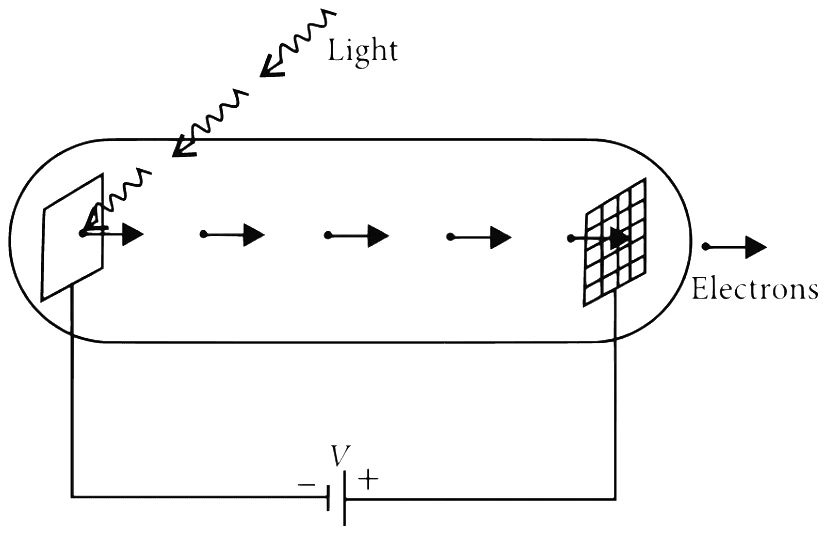
Matter Waves: de Broglie Wavelength

Light of wavelength λph\lambda_{ph} falls on a cathode plate inside a vacuum tube as shown in the figure. The work function of the cathode surface is ϕ\phi and the anode is a wire mesh of conducting material kept at a distance dd from the cathode. A potential difference VV is maintained between the electrodes. If the minimum de Broglie wavelength of the electrons passing through the anode is λe\lambda_e, which of the following statement(s) is (are) true?

Evacuated tube with cathode plate on the left lit by light, wire-mesh anode on the right, battery V between them, electrons emerging to the right

More than one option can be correct. Tap every correct option, then tap Check.

Show answer

Answer: (d)

Step-by-step solution coming soon.

Report a mistake
Q154JEE Advanced 2015Medium

Matter Waves: de Broglie Wavelength

An electron in an excited state of Li2+\text{Li}^{2+} ion has angular momentum 3h2π\dfrac{3h}{2\pi}. The de Broglie wavelength of the electron in this state is pπa0p\pi a_0 (where a0a_0 is the Bohr radius). The value of pp is ______.

Numerical answer type. Work it out, then open the answer.

Show answer

Answer: 2

Step-by-step solution coming soon.

Report a mistake
Q155JEE Advanced 2012Medium

Matter Waves: de Broglie Wavelength

A proton is fired from very far away towards a nucleus with charge Q=120eQ=120e, where ee is the electronic charge. It makes a closest approach of 10 fm10\,\text{fm} to the nucleus. The de Broglie wavelength (in units of fm) of the proton at its start is ______. (Take the proton mass, mp=(5/3)×10−27 kgm_p=(5/3)\times10^{-27}\,\text{kg}; h/e=4.2×10−15 J s C−1h/e=4.2\times10^{-15}\,\text{J s C}^{-1}; 14πε0=9×10⁹ m F−1\dfrac{1}{4\pi\varepsilon_0}=9\times10^{9}\,\text{m F}^{-1}; 1 fm=10−15 m1\,\text{fm}=10^{-15}\,\text{m}.)

Numerical answer type. Work it out, then open the answer.

Show answer

Answer: 7

Step-by-step solution coming soon.

Report a mistake
Q156JEE Advanced 2010Easy

Matter Waves: de Broglie Wavelength

An α\alpha-particle and a proton are accelerated from the rest by a potential difference of 100 V100\,\text{V}. After this, their de Broglie wavelengths are λα\lambda_\alpha and λp\lambda_p, respectively. The ratio λpλα\dfrac{\lambda_p}{\lambda_\alpha}, to the nearest integer, is ______.

Numerical answer type. Work it out, then open the answer.

Show answer

Answer: 3

Step-by-step solution coming soon.

Report a mistake
Q157JEE Advanced 2009Easy

Matter Waves: de Broglie Wavelength

When a particle is restricted to move along x-axis between x=0x=0 and x=ax=a, where aa is of nanometer dimension, its energy can take only certain specific values. The allowed energies of the particle moving in such a restricted region, correspond to the formation of standing waves with nodes at its ends x=0x=0 and x=ax=a. The wavelength of this standing wave is related to the linear momentum pp of the particle according to the de Broglie relation. The energy of the particle of mass mm is related to its linear momentum as E=p22mE=\dfrac{p^2}{2m}. Thus, the energy of the particle can be denoted by a quantum number 'nn' taking values 1,2,3,…1, 2, 3, \dots (n=1n=1, called the ground state) corresponding to the number of loops in the standing wave.

Use the model described above to answer the following three questions for a particle moving in the line x=0x=0 to x=ax=a. Take h=6.6×10⁻³⁴ J sh=6.6\times10^{-34}\,\text{J s} and e=1.6×10⁻¹⁹ Ce=1.6\times10^{-19}\,\text{C}.

The allowed energy for the particle for a particular value of nn is proportional to

Show answer

Answer: (a)

Step-by-step solution coming soon.

Report a mistake
Q158JEE Advanced 2009Medium

Matter Waves: de Broglie Wavelength

Refer to the passage above.

If the mass of the particle is m=1.0×10⁻³⁰ kgm=1.0\times10^{-30}\,\text{kg} and a=6.6 nma=6.6\,\text{nm}, the energy of the particle in its ground state is closest to

Show answer

Answer: (b)

Step-by-step solution coming soon.

Report a mistake
Q159JEE Advanced 2005Medium

Matter Waves: de Broglie Wavelength

The potential energy of a particle of mass mm is given by U(x)={E00≤x≤10x>1U(x) = \begin{cases} E_0 & 0 \le x \le 1 \\ 0 & x > 1 \end{cases}. λ1\lambda_1 and λ2\lambda_2 are the de Broglie wavelengths of the particle when 0≤x≤10 \le x \le 1 and x>1x > 1 respectively. If the total energy of the particle is 2E02E_0, find λ1λ2\dfrac{\lambda_1}{\lambda_2}.

Show answer

Answer: (b)

Step-by-step solution coming soon.

Report a mistake
Q160AIIMS 2018Medium

Matter Waves: de Broglie Wavelength

The graph between the energy log⁡E\log E of an electron and its de Broglie wavelength log⁡λ\log\lambda will be

Show answer

Answer: (c)

Step-by-step solution coming soon.

Report a mistake
Q161AIIMS 2015Medium

Matter Waves: de Broglie Wavelength

Assertion: A particle of mass MM at rest decay into two particles of masses m1m_1 and m2m_2, having non-zero velocities will have ratio of de Broglie wavelengths unity.
Reason: Here we cannot apply conservation of linear momentum.

Show answer

Answer: (c)

Step-by-step solution coming soon.

Report a mistake
Q162AIIMS 2013Easy

Matter Waves: de Broglie Wavelength

Assertion: The de Broglie wavelength equation has significance for any microscopic and submicroscopic particles.
Reason: de Broglie wavelength is inversely proportional to the mass of the object if its velocity is constant.

Show answer

Answer: (a)

Step-by-step solution coming soon.

Report a mistake
Q163AIIMS 2012Medium

Matter Waves: de Broglie Wavelength

Photon and electron are given same energy (10−20 J10^{-20}\,\text{J}). Wavelength associated with photon and electron are λp\lambda_p and λe\lambda_e, the correct statement will be

Show answer

Answer: (a)

Step-by-step solution coming soon.

Report a mistake
Q164AIIMS 2006Easy

Matter Waves: de Broglie Wavelength

If alpha, beta and gamma rays carry same momentum, which has the longest wavelength?

Show answer

Answer: (d)

Step-by-step solution coming soon.

Report a mistake
Q165AIIMS 2004Easy

Matter Waves: de Broglie Wavelength

We wish to see inside an atom. Assuming the atom to have a diameter of 100 pm100\,\text{pm}, this means that one must be able to resolve a width of say 10 pm10\,\text{pm}. If an electron microscope is used, the minimum electron energy required is about

Show answer

Answer: (b)

Step-by-step solution coming soon.

Report a mistake
Q166JIPMER 2017Medium

Matter Waves: de Broglie Wavelength

The wavelength λ\lambda of a photon and the de-Broglie wavelength of an electron have the same value. Find the ratio of energy of photon to the kinetic energy of electron in terms of mass mm, speed of light cc and Planck constant hh.

Show answer

Answer: (d)

Step-by-step solution coming soon.

Report a mistake
Q167JIPMER 2014Easy

Matter Waves: de Broglie Wavelength

Relation between wavelength of photon and electron of same energy is

Show answer

Answer: (a)

Step-by-step solution coming soon.

Report a mistake
Q168JIPMER 2008Easy

Matter Waves: de Broglie Wavelength

If alpha, beta and gamma rays carry same momentum, which has the longest wavelength?

Show answer

Answer: (d)

Step-by-step solution coming soon.

Report a mistake
Q169JIPMER 2004Easy

Matter Waves: de Broglie Wavelength

The kinetic energy of an electron is 5 eV5\,\text{eV}. Calculate the de-Broglie wavelength associated with it (h=6.6×10⁻³⁴ J sh=6.6\times10^{-34}\,\text{J s}, me=9.1×10⁻³¹ kgm_e=9.1\times10^{-31}\,\text{kg})

Show answer

Answer: (a)

Step-by-step solution coming soon.

Report a mistake
Q170BITSAT 2023Easy

Matter Waves: de Broglie Wavelength

In an electron gun the potential difference between the filament and plate is 4000 V4000\,\text{V}. What will be the velocity of electron emitting from the gun?

Show answer

Answer: (d)

Step-by-step solution coming soon.

Report a mistake
Q171BITSAT 2023Medium

Matter Waves: de Broglie Wavelength

An electron of mass mm and charge ee initially at rest gets accelerated by a constant field 2E2E. The rate of change of de-Broglie wavelength of this electron at time tt ignoring relativistic effects is

Show answer

Answer: (a)

Step-by-step solution coming soon.

Report a mistake
Q172BITSAT 2021Medium

Matter Waves: de Broglie Wavelength

A proton has kinetic energy E=100 eVE = 100\,\text{eV} which is equal to that of a photon. The wavelength of photon is λ2\lambda_2 and that of proton is λ1\lambda_1. The ratio λ2λ1\dfrac{\lambda_2}{\lambda_1} is proportional to

Show answer

Answer: (d)

Step-by-step solution coming soon.

Report a mistake
Q173VITEEE 2023Medium

Matter Waves: de Broglie Wavelength

The de-Broglie wavelength of a proton (m=1.67×10⁻²⁷ kgm = 1.67 \times 10^{-27}\,\text{kg}) accelerated through a potential difference of 2 kV2\,\text{kV} is

Show answer

Answer: (b)

Step-by-step solution coming soon.

Report a mistake
Q174VITEEE 2019Easy

Matter Waves: de Broglie Wavelength

If the kinetic energy of a free electron doubles, its de-Broglie wavelength changes by the factor

Show answer

Answer: (d)

Step-by-step solution coming soon.

Report a mistake
Q175VITEEE 2017Easy

Matter Waves: de Broglie Wavelength

If the kinetic energy of a moving particle is EE, then the de-Broglie wavelength is

Show answer

Answer: (c)

Step-by-step solution coming soon.

Report a mistake
Q176VITEEE 2017Medium

Matter Waves: de Broglie Wavelength

Light of wavelength 500 nm500\,\text{nm} is incident on a metal with work function 2.28 eV2.28\,\text{eV}. The de Broglie wavelength of the emitted electron is:

Show answer

Answer: (b)

Step-by-step solution coming soon.

Report a mistake
Q177VITEEE 2016Easy

Matter Waves: de Broglie Wavelength

In photoelectric effect, initially when energy of electrons emitted is E0E_0, de-Broglie wavelength associated with them is λ0\lambda_0. Now, energy is doubled then associated de-Broglie wavelength λ′\lambda' is

Show answer

Answer: (a)

Step-by-step solution coming soon.

Report a mistake
Q178VITEEE 2012Easy

Matter Waves: de Broglie Wavelength

The kinetic energy of an electron get tripled then the de-Broglie wavelength associated with it changes by a factor

Show answer

Answer: (c)

Step-by-step solution coming soon.

Report a mistake
Q179VITEEE 2011Easy

Matter Waves: de Broglie Wavelength

An electron accelerated under a potential difference VV volt has a certain wavelength λ\lambda. Mass of proton is some 20002000 times of the mass of the electron. If the proton has to have the same wavelength λ\lambda, then it will have to be accelerated under a potential difference of

Show answer

Answer: (c)

Step-by-step solution coming soon.

Report a mistake
Q180VITEEE 2011Medium

Matter Waves: de Broglie Wavelength

The ratio of momentum of an electron and α\alpha-particle which are accelerated from rest by a potential difference of 100 V100\,\text{V} is

Show answer

Answer: (d)

Step-by-step solution coming soon.

Report a mistake
Q181VITEEE 2006Easy

Matter Waves: de Broglie Wavelength

The de Broglie wavelength associated with a steel ball of mass 1000 gm1000\,\text{gm} moving at a speed of 1 m s−11\,\text{m s}^{-1} is [h=6.626×10⁻³⁴ J s][h=6.626\times10^{-34}\,\text{J s}]

Show answer

Answer: (c)

Step-by-step solution coming soon.

Report a mistake
Q182COMEDK 2026Easy

Matter Waves: de Broglie Wavelength

What is the ratio of de Broglie wavelength of an electron to that of proton if the velocity of proton is 16\dfrac{1}{6} the velocity of electron?

Show answer

Answer: (b)

Step-by-step solution coming soon.

Report a mistake
Q183COMEDK 2025Easy

Matter Waves: de Broglie Wavelength

The de Broglie wavelength associated with an electron accelerated through a potential difference ′V′'V' is λ\lambda. If the accelerating potential is halved, what will be the new wavelength associated with the charged particle?

Show answer

Answer: (d)

Step-by-step solution coming soon.

Report a mistake
Q184COMEDK 2025Easy

Matter Waves: de Broglie Wavelength

A particle of mass MM at rest decays into masses m1m_1 and m2m_2 with non-zero velocities. The ratio of de Broglie wavelengths λ1\lambda_1 and λ2\lambda_2 of the particles is

Show answer

Answer: (d)

Step-by-step solution coming soon.

Report a mistake
Q185COMEDK 2024Easy

Matter Waves: de Broglie Wavelength

A particle of mass 2 mg2\,\text{mg} has the same wavelength as a neutron moving with a velocity of 3×10⁵ m s−13 \times 10^{5}\,\text{m s}^{-1}. The velocity of the particle is (mass of neutron is 1.67×10⁻²⁷ kg1.67 \times 10^{-27}\,\text{kg})

Show answer

Answer: (a)

Step-by-step solution coming soon.

Report a mistake
Q186COMEDK 2024Medium

Matter Waves: de Broglie Wavelength

The mass of a particle A is double that of the particle B and the kinetic energy of B is 18\dfrac{1}{8}th that of A then the ratio of the de-Broglie wavelength of A to that of B is:

Show answer

Answer: (c)

Step-by-step solution coming soon.

Report a mistake
Q187COMEDK 2023Easy

Matter Waves: de Broglie Wavelength

A particle at rest decays into two particles of mass m1m_1 and m2m_2 and move with velocities v1v_1 and v2v_2. The ratio of their de Broglie wavelength λ1λ2\dfrac{\lambda_1}{\lambda_2} is:

Show answer

Answer: (b)

Step-by-step solution coming soon.

Report a mistake
Q188COMEDK 2020Easy

Matter Waves: de Broglie Wavelength

A proton accelerated through a potential VV has de-Broglie wavelength λ\lambda. Then, the de-Broglie wavelength of an α\alpha-particle, when accelerated through the same potential VV is

Show answer

Answer: (c)

Step-by-step solution coming soon.

Report a mistake
Q189KCET 2025Easy

Matter Waves: de Broglie Wavelength

If we consider an electron and a photon of the same de-Broglie wavelength, then they will have the same

Show answer

Answer: (d)

Step-by-step solution coming soon.

Report a mistake
Q190KCET 2022Easy

Matter Waves: de Broglie Wavelength

The de-Broglie wavelength of a particle of kinetic energy KK is λ\lambda. The wavelength of the particle, if its kinetic energy is K4\dfrac{K}{4}, is

Show answer

Answer: (a)

Step-by-step solution coming soon.

Report a mistake
Q191KCET 2020Easy

Matter Waves: de Broglie Wavelength

A hot filament liberates an electron with zero initial velocity. The anode potential is 1200 V1200\,\text{V}. The speed of the electron when it strikes the anode is

Show answer

Answer: (c)

Step-by-step solution coming soon.

Report a mistake
Q192KCET 2020Easy

Matter Waves: de Broglie Wavelength

The de-Broglie wavelength associated with the electron of a hydrogen atom in its ground state is

Show answer

Answer: (b)

Step-by-step solution coming soon.

Report a mistake
Q193KCET 2019Easy

Matter Waves: de Broglie Wavelength

An electron is moving with an initial velocity v⃗=v0i^\vec{v} = v_0\hat{i} and is in a uniform magnetic field B⃗=B0j^\vec{B} = B_0\hat{j}. Then its de-Broglie wavelength

Show answer

Answer: (a)

Step-by-step solution coming soon.

Report a mistake
Q194KCET 2018Easy

Matter Waves: de Broglie Wavelength

A proton and an α\alpha-particle are accelerated through the same potential difference VV. The ratio of their de-Broglie wavelengths is

Show answer

Answer: (b)

Step-by-step solution coming soon.

Report a mistake
Q195KCET 2017Medium

Matter Waves: de Broglie Wavelength

A particle is dropped from a height HH. The de-Broglie wavelength of the particle depends on height as

Show answer

Answer: (a)

Step-by-step solution coming soon.

Report a mistake
Q196AP EAPCET 2026Easy

Matter Waves: de Broglie Wavelength

If the potential difference used to accelerate electrons at rest is increased from 150 V150\,\text{V} to 600 V600\,\text{V}, then the percentage decrease in the de-Broglie wavelength associated with the electron is

Show answer

Answer: (c)

Step-by-step solution coming soon.

Report a mistake
Q197AP EAPCET 2026Easy

Matter Waves: de Broglie Wavelength

When two electrons A and B are accelerated through potential differences VAV_A and VBV_B respectively, their de Broglie wavelengths are in the ratio of 2:32:3, then the ratio of potential differences VAVB\dfrac{V_A}{V_B} is

Show answer

Answer: (d)

Step-by-step solution coming soon.

Report a mistake
Q198AP EAPCET 2026Easy

Matter Waves: de Broglie Wavelength

A proton and an α\alpha-particle are accelerated through the same potential difference. The ratio of their de Broglie wavelengths will be

Show answer

Answer: (d)

Step-by-step solution coming soon.

Report a mistake
Q199AP EAPCET 2025Easy

Matter Waves: de Broglie Wavelength

The de-Broglie wavelength associated with an electron accelerated through a potential difference of 2003 V\dfrac{200}{3}\,\text{V} is nearly

Show answer

Answer: (d)

Step-by-step solution coming soon.

Report a mistake
Q200AP EAPCET 2025Easy

Matter Waves: de Broglie Wavelength

The ratio of de-Broglie wavelengths associated with thermal neutrons at temperatures 127∘C127^\circ\text{C} and 352∘C352^\circ\text{C} is

Show answer

Answer: (d)

Step-by-step solution coming soon.

Report a mistake
Q201AP EAPCET 2025Easy

Matter Waves: de Broglie Wavelength

If the de-Broglie wavelength of an electron is 2 nm2\,\text{nm}, then its kinetic energy is nearly (Planck's constant =6.6×10⁻³⁴ J s=6.6\times10^{-34}\,\text{J s} and mass of electron =9×10⁻³¹ kg=9\times10^{-31}\,\text{kg})

Show answer

Answer: (c)

Step-by-step solution coming soon.

Report a mistake
Q202AP EAPCET 2025Easy

Matter Waves: de Broglie Wavelength

If a proton and an alpha particle are accelerated through the same potential difference, then the ratio of their de-Broglie wavelengths is

Show answer

Answer: (c)

Step-by-step solution coming soon.

Report a mistake
Q203AP EAPCET 2025Medium

Matter Waves: de Broglie Wavelength

If the linear momentum of a proton is changed by p0p_0 then the de-Broglie wavelength associated with the proton changes by 0.25%0.25\%. Then the initial linear momentum of the proton is

Show answer

Answer: (c)

Step-by-step solution coming soon.

Report a mistake
Q204AP EAPCET 2024Medium

Matter Waves: de Broglie Wavelength

If the kinetic energy of a particle in motion is decreased by 36%36\%, the increase in de-Broglie wavelength of the particle is

Show answer

Answer: (b)

Step-by-step solution coming soon.

Report a mistake
Q205AP EAPCET 2024Medium

Matter Waves: de Broglie Wavelength

An electron of mass mm with initial velocity v⃗=v0i^ (v0>0)\vec{v}=v_0\hat{i}\ (v_0>0) enters in an electric field E⃗=−E0i^ (E0\vec{E}=-E_0\hat{i}\ (E_0 is constant >0)>0) at t=0t=0. If λ\lambda is its de-Broglie wavelength initially, then the de-Broglie wavelength after time tt is

Show answer

Answer: (a)

Step-by-step solution coming soon.

Report a mistake
Q206AP EAPCET 2023Easy

Matter Waves: de Broglie Wavelength

The velocity of a particle AA is 33 times the velocity of proton. If the ratio of the de-Broglie wavelengths of the particle AA and the proton is 3:23:2, the mass of the particle AA is (mp=m_p= mass of proton)

Show answer

Answer: (a)

Step-by-step solution coming soon.

Report a mistake
Q207AP EAPCET 2021Easy

Matter Waves: de Broglie Wavelength

The de-Broglie wavelength associated with a proton under the influence of an electric potential of 100 V100\,\text{V} is

Show answer

Answer: (b)

Step-by-step solution coming soon.

Report a mistake
Q208TS EAMCET 2026Medium

Matter Waves: de Broglie Wavelength

If an electron initially at rest is subjected to a uniform electric field of 4125 N C−14125\,\text{N C}^{-1}, then the de Broglie wavelength associated with the electron at time t=2×10⁻⁹ st=2\times10^{-9}\,\text{s} is (Planck's constant =6.6×10⁻³⁴ J s=6.6\times10^{-34}\,\text{J s})

Show answer

Answer: (d)

Step-by-step solution coming soon.

Report a mistake
Q209TS EAMCET 2025Medium

Matter Waves: de Broglie Wavelength

The work done to accelerate an electron from rest so that it can have a de-Broglie wavelength of 6600 A˚6600\,\mathring{\text{A}} is nearly
(Planck's constant =6.6×10⁻³⁴ J s= 6.6\times10^{-34}\,\text{J s} and mass of electron =9×10⁻³¹ kg= 9\times10^{-31}\,\text{kg})

Show answer

Answer: (c)

Step-by-step solution coming soon.

Report a mistake
Q210TS EAMCET 2025Medium

Matter Waves: de Broglie Wavelength

Photons of energy 4.5 eV4.5\,\text{eV} are incident on a photosensitive material of work function 3 eV3\,\text{eV}. The de-Broglie wavelength associated with the photoelectrons emitted with maximum kinetic energy is nearly

Show answer

Answer: (a)

Step-by-step solution coming soon.

Report a mistake
Q211TS EAMCET 2024Medium

Matter Waves: de Broglie Wavelength

The de-Broglie wavelength of a proton is twice the de-Broglie wavelength of an alpha particle. The ratio of the kinetic energies of the proton and the alpha particle is

Show answer

Answer: (a)

Step-by-step solution coming soon.

Report a mistake
Q212TS EAMCET 2024Medium

Matter Waves: de Broglie Wavelength

If the de-Broglie wavelength of a neutron at a temperature of 77∘C77^\circ\text{C} is λ\lambda, then the de-Broglie wavelength of the neutron at a temperature of 1127∘C1127^\circ\text{C} is

Show answer

Answer: (a)

Step-by-step solution coming soon.

Report a mistake
Q213TS EAMCET 2023Easy

Matter Waves: de Broglie Wavelength

The de-Broglie wavelength of an electron accelerated between two plates having a potential difference of 900 V900\,\text{V} is nearly

Show answer

Answer: (d)

Step-by-step solution coming soon.

Report a mistake
Q214TS EAMCET 2023Medium

Matter Waves: de Broglie Wavelength

The de-Broglie wavelength of a particle moving with a speed of 0.8c0.8c is equal to the wavelength of a photon. If cc is speed of the photon in vacuum, the ratio of the energy of the photon and the kinetic energy of the particle is

Show answer

Answer: (b)

Step-by-step solution coming soon.

Report a mistake
Q215TS EAMCET 2023Medium

Matter Waves: de Broglie Wavelength

The additional energy that should be given to an electron to reduce its de-Broglie wavelength from 1 nm1\,\text{nm} to 0.5 nm0.5\,\text{nm} is

Show answer

Answer: (b)

Step-by-step solution coming soon.

Report a mistake
Q216TS EAMCET 2022Easy

Matter Waves: de Broglie Wavelength

Which of the following has the largest de-Broglie wavelength?

Show answer

Answer: (d)

Step-by-step solution coming soon.

Report a mistake
Q217TS EAMCET 2022Easy

Matter Waves: de Broglie Wavelength

The de-Broglie wavelength of an electron with kinetic energy of 320 eV320\,\text{eV} is (take, h=6.0×10⁻³⁴h = 6.0\times10^{-34} SI unit, mass of electron =me=9.0×10⁻³¹ kg= m_e = 9.0\times10^{-31}\,\text{kg}, charge of an electron =1.6×10⁻¹⁹ C= 1.6\times10^{-19}\,\text{C})

Show answer

Answer: (c)

Step-by-step solution coming soon.

Report a mistake
Q218TS EAMCET 2022Easy

Matter Waves: de Broglie Wavelength

The de-Broglie wavelength associated with an electron, accelerated through a potential difference of 121 V121\,\text{V} is about
(take, Planck's constant =h=6.6×10⁻³⁴ J s= h = 6.6\times10^{-34}\,\text{J s}, mass of electron =9×10⁻³¹ kg= 9\times10^{-31}\,\text{kg})

Show answer

Answer: (b)

Step-by-step solution coming soon.

Report a mistake
Q219WB JEE 2025Medium

Matter Waves: de Broglie Wavelength

The de Broglie wavelength of a moving bus with speed vv is λ\lambda. Some passengers left the bus at a stoppage. Now when the bus moves with twice of its initial speed, its kinetic energy is found to be twice of its initial value. What is the de Broglie wavelength of the bus now?

Show answer

Answer: (a)

Step-by-step solution coming soon.

Report a mistake
Q220WB JEE 2016Easy

Matter Waves: de Broglie Wavelength

The potential difference VV required for accelerating an electron to have the de Broglie wavelength of 1 A˚1\,\text{\AA} is

Show answer

Answer: (c)

Step-by-step solution coming soon.

Report a mistake
Q221IAT 2026Difficult

Matter Waves: de Broglie Wavelength

An experimental study of the photoelectric effect involves a metal of work function ϕ0\phi_0. What is the smallest wavelength of the incident photon to photoemit an electron of mass mm which has the same de Broglie wavelength as that of the incident photon? [Given hh is the Planck's constant, cc is the speed of light, and ϕ0≪mc2\phi_0 \ll mc^2]

Show answer

Answer: (b)

Step-by-step solution coming soon.

Report a mistake
Q222IAT 2025Medium

Matter Waves: de Broglie Wavelength

A particle of mass mm and charge qq is accelerated through a distance d1d_1 by an electric field E⃗\vec{E}. Another particle of mass MM and charge qq is accelerated by the same electric field through a distance d2d_2. Both the particles emerge with the same de Broglie wavelength λB\lambda_B. What is the ratio of the distances d2/d1d_2/d_1 ?

Show answer

Answer: (a)

Step-by-step solution coming soon.

Report a mistake
Q223IAT 2019Easy

Matter Waves: de Broglie Wavelength

Neutral gas molecules, each of mass mm, are at a temperature TT in a container at zero gravity. How does the average de Broglie wavelength λ\lambda of a molecule depend on TT ?

Show answer

Answer: (c)

Step-by-step solution coming soon.

Report a mistake
Q224NEST 2024Difficult

Matter Waves: de Broglie Wavelength

Consider a monoatomic ideal gas with number of atoms per unit volume, nn, at absolute temperature TT. The mass of each atom is mm. In describing the physics of the system, the wave nature of atoms can be ignored if

Show answer

Answer: (c)

Step-by-step solution coming soon.

Report a mistake
Q225NEST 2023Medium

Matter Waves: de Broglie Wavelength

A proton accelerated from rest by a potential difference of VV volts has a de Broglie wavelength of 0.20 A˚0.20\,\text{Å} (1.0 A˚=10−10 m1.0\,\text{Å}=10^{-10}\,\text{m}). A fully ionized Helium atom is similarly accelerated by a potential difference of 2V2V volts. Its de Broglie wavelength (A˚\text{Å}) is closest to

Show answer

Answer: (a)

Step-by-step solution coming soon.

Report a mistake
Q226NEST 2021Difficult

Matter Waves: de Broglie Wavelength

An electron beam of energy 150 eV150\,\text{eV} is incident normally on a Young's double slit setup. The distance between the slits is 0.1 mm0.1\,\text{mm} and the distance between the slits and the screen is 1 m1\,\text{m}. Neglect gravity and electron-electron interactions. Select the correct statement(s).

More than one option can be correct. Tap every correct option, then tap Check.

Show answer

Answer: (b), (d)

Step-by-step solution coming soon.

Report a mistake
Q227NEST 2020Medium

Matter Waves: de Broglie Wavelength

A free particle with initial kinetic energy EE and de Broglie wavelength λ\lambda enters a region in which it has potential energy −V-V. The new de Broglie wavelength of the particle is

Show answer

Answer: (a)

Step-by-step solution coming soon.

Report a mistake
Q228NEST 2015Medium

Matter Waves: de Broglie Wavelength

Planck constant h=6.63×10⁻³⁴ J sh=6.63\times10^{-34}\,\text{J s}
Mass of the electron me=9.11×10⁻³¹ kgm_e=9.11\times10^{-31}\,\text{kg}

In a Young double slit experiment, the distance between the slits is 50 μm50\,\mu\text{m} and the distance of the screen from the slits is 5 cm5\,\text{cm}. An infrared monochromatic light is used to produce an interference pattern with fringe width 1 mm1\,\text{mm}. If the light source is replaced by an electron source to produce the same fringe width then the speed of the electrons is approximately

Show answer

Answer: (b)

Step-by-step solution coming soon.

Report a mistake
Q229NEST 2014Medium

Matter Waves: de Broglie Wavelength

A free particle with initial kinetic energy 9 eV9\,\text{eV} and de Broglie wavelength 1 nm1\,\text{nm} enters a region of constant potential energy V0V_0 such that the new de Broglie wavelength is now 1.5 nm1.5\,\text{nm}. Then V0V_0 is

Show answer

Answer: (a)

Step-by-step solution coming soon.

Report a mistake
Q230NEST 2013Easy

Matter Waves: de Broglie Wavelength

The mean momentum pp of a particle has uncertainty Δp\Delta p. Taking Planck's constant to be hh, the uncertainty in the de Broglie wavelength of the particle is

Show answer

Answer: (d)

Step-by-step solution coming soon.

Report a mistake
Q231NEST 2008Medium

Matter Waves: de Broglie Wavelength

A free particle with initial kinetic energy EE and de Broglie wavelength λ\lambda enters a region in which it has potential energy VV. The particle's new de Broglie wavelength is

Show answer

Answer: (d)

Step-by-step solution coming soon.

Report a mistake
Q232CBSE Class 12 2025Easy

Matter Waves: de Broglie Wavelength

Let λe\lambda_e, λp\lambda_p and λd\lambda_d be the wavelengths associated with an electron, a proton and a deuteron, all moving with the same speed. Then the correct relation between them is

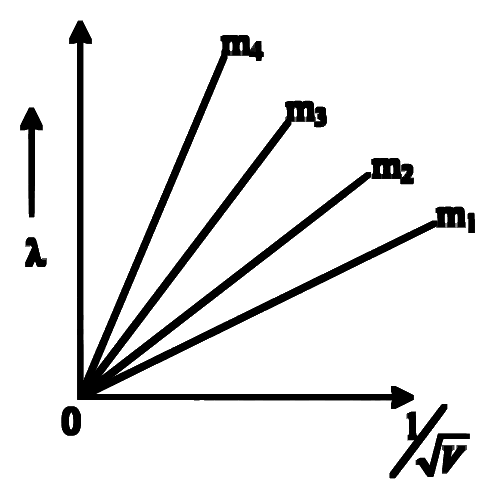
Show answer

Answer: (b)

Step-by-step solution coming soon.

Report a mistake
Q233CBSE Class 12 2023Easy

Matter Waves: de Broglie Wavelength

Which of the following graphs correctly represents the variation of a particle momentum with its associated de-Broglie wavelength?

Show answer

Answer: (d)

Step-by-step solution coming soon.

Report a mistake