
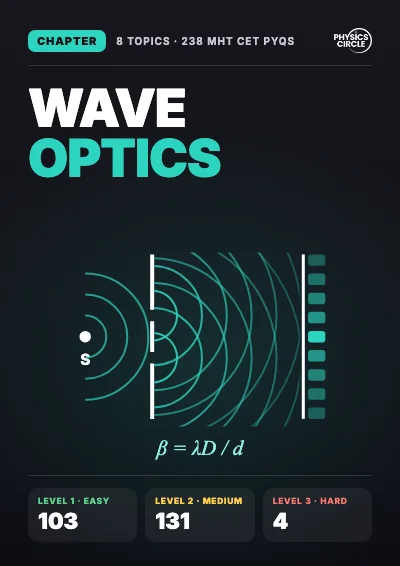
Wave Optics Formula Book
45 formulas in 8 topics, in the same order as the PYQ topics.
Only formulas used in the solutions of 238 MHT CET PYQs (Level 1, 2, 3)Wave Theory, Wavefronts & Doppler Effect
4 formulas · from 11 MHT CET PYQs
- Huygens' construction: reflection
- Refractive index from speeds
- Doppler effect for light
- Photon energy and momentum
Superposition, Coherence & Intensity
9 formulas · from 52 MHT CET PYQs
- Resultant intensity of two coherent waves
- Maximum and minimum intensity
- Sum and difference of I max and I min
- Ratio in terms of amplitudes
- Amplitude ratio from intensity ratio
- Equal intensities I0
- Intensity for equal sources at phase phi
- Path difference to phase difference
- Resultant amplitude of two equal waves
🔒 For Vajra 2.0 Pro studentsTopic 1 is free. Log in with your Vajra 2.0 Pro number to see every formula.
YDSE: Fringe Width & Fringe Positions
6 formulas · from 36 MHT CET PYQs
- Fringe width
- Position of n-th bright fringe
- Position of n-th dark fringe
- Fringe width depends on lambda, D and d
- Change in fringe width when screen moves
- Angular fringe width (slope of beta vs D)
🔒 For Vajra 2.0 Pro studentsTopic 1 is free. Log in with your Vajra 2.0 Pro number to see every formula.
YDSE: Film, Medium & Two Wavelengths
9 formulas · from 34 MHT CET PYQs
- Fringe width in a medium
- Extra path due to a thin film
- Fringe shift due to a thin film
- Film shifts the pattern by n fringes
- Phase difference from optical path
- Path difference at a point in front of one slit
- Dark fringe in front of one slit
- Two wavelengths: n-th fringes separation
- Two wavelengths: bright of one on dark of other
🔒 For Vajra 2.0 Pro studentsTopic 1 is free. Log in with your Vajra 2.0 Pro number to see every formula.
Biprism, Thin Films & Other Devices
5 formulas · from 23 MHT CET PYQs
- Fringe width (biprism and other devices)
- Fringe width for new lambda and D
- Same lambda and d: beta in proportion to D
- Distance between n-th and m-th bright fringes
- Path difference at a point in front of one slit
🔒 For Vajra 2.0 Pro studentsTopic 1 is free. Log in with your Vajra 2.0 Pro number to see every formula.
Diffraction at a Single Slit
7 formulas · from 51 MHT CET PYQs
- Single slit: minima
- Single slit: secondary maxima
- Width of central maximum
- Angular width of central maximum
- Central max width equal to slit width
- Shift of a fringe when lambda changes
- Intensity of central maximum
🔒 For Vajra 2.0 Pro studentsTopic 1 is free. Log in with your Vajra 2.0 Pro number to see every formula.
Resolving Power
1 formulas · from 10 MHT CET PYQs
- Separation of images in the focal plane
🔒 For Vajra 2.0 Pro studentsTopic 1 is free. Log in with your Vajra 2.0 Pro number to see every formula.
Polarisation
4 formulas · from 21 MHT CET PYQs
- Brewster's law
- Brewster angle and wavelengths / speeds
- Unpolarised light through a polaroid
- n polaroids, each at 45 degrees to the previous
🔒 For Vajra 2.0 Pro studentsTopic 1 is free. Log in with your Vajra 2.0 Pro number to see every formula.