In a biprism experiment, using a light of wavelength 4800 Å, a steady interference pattern was obtained on a screen 1 m away from the source. Now the source is replaced by another of wavelength 6400 Å and the screen is moved away from it by 20 cm. The fringewidth will
The distance of a point on the screen from two slits in biprism experiment is 1.8×10⁻⁵ m and 1.23×10⁻⁵ m. If wavelength of light used is 6000 Å the fringe number formed at that point is
In a biprism experiment, the distance between 4th and 13th bright band on the same side is 'y' when light of wavelength 6000 Å is used. For a light of wavelength 'λ' the distance between 6th and 16th bright band on the same side is again 'y'. The value of 'λ' in Å units is
In a biprism experiment, a steady interference pattern is observed on the screen kept at a distance of 100 cm using a light of wavelength 5000 Å. Without changing the distance between the virtual images of the slit, the source of light is replaced by a source of wavelength 6400 Å. Now, to reduce the fringe width by 20% of its initial value, the screen should be moved
In biprism experiment, the maximum intensity is I0. If the path difference between the two interfering waves is 3λ, then intensity at the point on the screen is
In a biprism experiment, fifth dark fringe is obtained at a point. A thin transparent film of refractive index 'μ' is placed in one of the interfering paths. Now 7th bright fringe is obtained at the same point. If 'λ' is the wavelength of light used, the thickness of film is equal to
In biprism experiment, the 4th dark band is formed opposite to one of the slits. The wavelength of light used is (D=distance between source and screen, d= the distance between the slits)
A parallel beam of light of intensity I0 is incident on a glass plate, 25% of light is reflected by upper surface (I1) and 50% of light is reflected from lower surface (I2). The ratio I2 to I1 is
In a biprism experiment a steady interference pattern is observed on the screen using a light of wavelength 5000A˚. Without disturbing the set up of the experiment, the source of light is replaced by a source of wavelength 6400A˚.
A transparent film of refractive index, 2.0 is coated on a glass slab of refractive index, 1.45. What is the minimum thickness of transparent film to be coated for the maximum transmission of Green light of wavelength 550 nm. [Assume that the light is incident nearly perpendicular to the glass surface.]
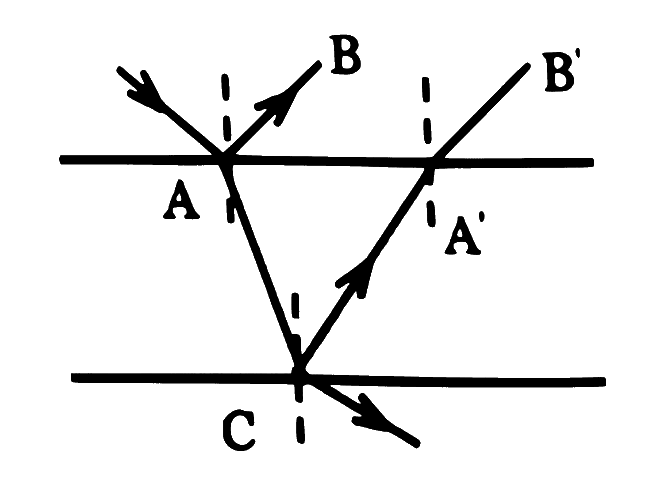
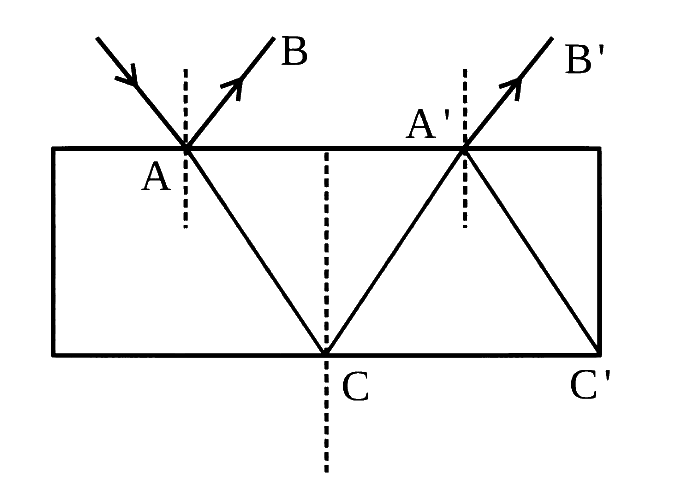
A ray of light of intensity ' I ' is incident on a parallel glass slab at a point ' A ' as shown in figure. It undergoes partial reflection and refraction. At each reflection 25% of incident energy is reflected. The rays AB and A′B′ undergo interference. The ratio IminImaxmaxmin is
A thin transparent film with refractive index 1.4, is held on circular ring of radius 1.8 cm. The fluid in the film evaporates such that transmission through the film at wavelength 560 nm goes to a minimum every 12 seconds. Assuming that the film is flat on its two sides, the rate of evaporation is ____________ π×10−13 m3/s.
Numerical answer type. Work it out, then open the answer.
In biprism experiment, the fringe width is 0.6 mm. The distance between 6th dark fringe and 8th bright fringe on the same side of central bright fringe is
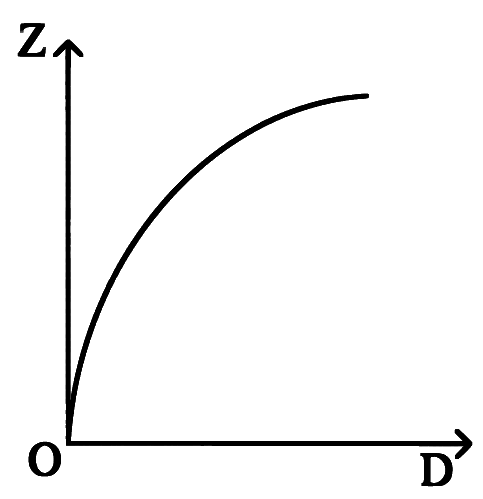
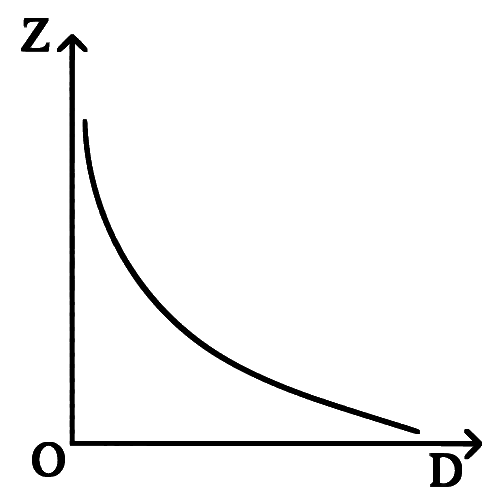
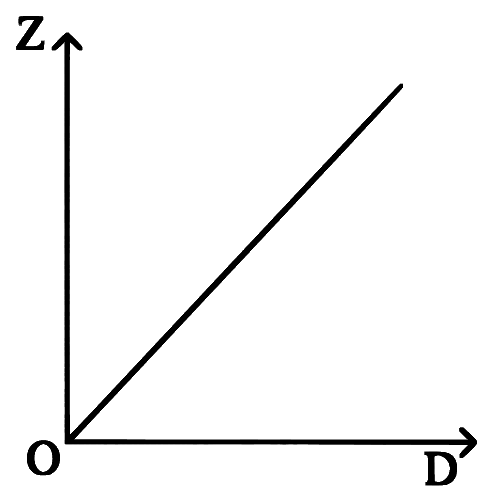
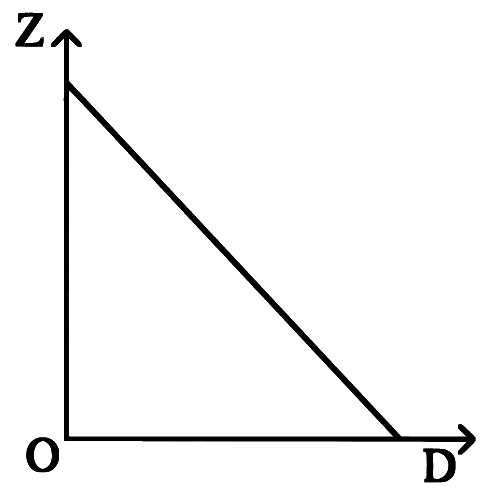
In a biprism experiment, monochromatic light of wavelength ' λ ' is used. The distance between the two coherent sources ' d ' is kept constant. If the distance between slit and eyepiece ' D ' is varied as D1,D2,D3,D4 and corresponding measured fringe widths are W1,W2,W3,W4 then
A parallel beam of light of intensity I0 is incident on a glass plate, 25% of light is reflected by upper surface and 50% of light is reflected from lower surface. The ratio of maximum to minimum intensity in interference region of reflected rays is
In a biprism experiment, monochromatic light of wavelength 'λ' is used. The distance between two coherent sources 'd' is kept constant. If the distance between slit and eyepiece 'D' is varied as D1,D2,D3&D4 and corresponding measured fringe widths are Z1,Z2,Z3 and Z4 then
In two separate setups for Biprism experiment using same wavelength, fringes of equal width are obtained. If ratio of slit separation is 2:3 then the ratio of the distance between the slit and screen in the two setups is
In the interference experiment using a biprism, the distance of the slits from the screen is increased by 25% and the separation between the slits is halved. If 'W' represents the original fringewidth, the new fringewidth is
In biprism experiment, 21 fringes are observed in a given region using light of wavelength 4800 A˚. If light of wavelength 5600 A˚ is used, the number of fringes in the same region will be
In biprism experiment, 6th bright band with wavelength 'λ1' coincides with 7th dark band with wavelength 'λ2' then the ratio λ1:λ2 is (other setting remains the same)
In biprims experiment, the 4th dark band is formed opposite to one of the slits. The wavelength of light used is (d= distance between the slits, D= distance between scource and the screen)
In biprism experiment, the distance between source and eyepiece is 1.2 m, the distance between two virtual sources is 0.84 mm. Then the wavelength of light used if eyepiece is to be moved transversely through a distance of 2.799 cm to shift 30 fringes is
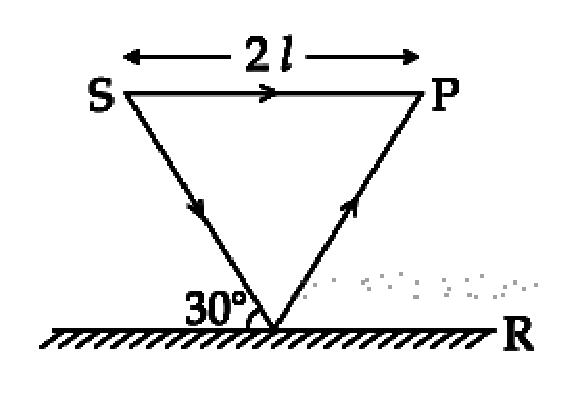
Interference pattern is observed at 'P' due to superimposition of two rays coming out from a source 'S' as shown in the figure. The value of ′l′ for which maxima is obtained at 'P' is: (R is perfect reflecting surface):
A ray of light of intensity I is incident on a parallel glass slab at point A as shown in the diagram. It undergoes partial reflection and refraction. At each reflection, 25% of incident energy is reflected. The rays AB and A'B' undergo interference. The ratio of Imax and Imin is:
This question has a paragraph followed by two statements, Statement −1 and Statement −2. Of the given four alternatives after the statements, choose the one that describes the statements. A thin air film is formed by putting the convex surface of a plane-convex lens over a plane glass plane. With monochromatic light, this film gives an interference pattern due to light, reflected from the top (convex) surface and the bottom (glass plate) surface of the film.
Statement - 1: When light reflects from the air-glass plate interface, the reflected wave suffers a phase change of π.
Statement - 2: The center of the interference pattern is dark.
In a Fresnel biprism experiment, the two positions of lens give separation between the slits as 16 cm and 9 cm respectively. What is the actual distance of separation?
Assertion: The thick film shows no interference pattern. Take thickness of the order of few cms. Reason: For interference pattern to observe, path difference between two waves is of the order of few wavelengths.
Assertion: At first glance, the top surface of the Morpho butterfly's wing appears a beautiful blue-green. If the wind moves the colour changes. Reason: Different pigments in the wing reflect light at different angles.
If prism angle α=1∘, μ=1.54, distance between screen and prism D=0.7m, distance between prism and source a=0.3m, λ=180πnm, then in a Fresnel biprism find the value of β (fringe width).
A thin film of soap solution (n=1.4) lies on the top of a glass plate (n=1.5). When visible light is incident almost normal to the plate, two adjacent reflection maxima are observed at two wavelengths 420 and 630nm. The minimum thickness of the soap solution is
In an experiment on Newton's rings, the diameter of the 20th dark ring was found to be 5.82mm and that of the 10th ring 3.36mm. If the radius of the plano-convex lens is 1m, the wavelength of light used is
Light of wavelength 6000A˚ is incident on a thin glass plate of refractive index 1.5 such that the angle of refraction into the plate is 60∘. Calculate the smallest thickness of the plate which will make dark fringe by reflected beam interference.
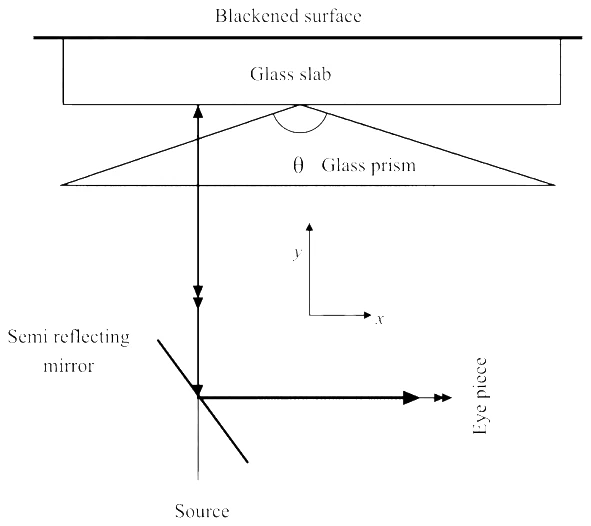
Consider the experimental set-up shown in the figure to observe the interference pattern. Note that the prism angle θ is close to π. The correct option(s) regarding this experiment is (are)
More than one option can be correct. Tap every correct option, then tap Check.
White light with uniform intensity across the visible wavelength range of 400nm to 800nm is incident almost perpendicularly from above onto a horizontal liquid film of refractive index 1.25 and of thickness 300nm. The medium on both sides of the film is air. The wavelength of light reflected by the film which appears brightest to an observer seeing it from the top is close to
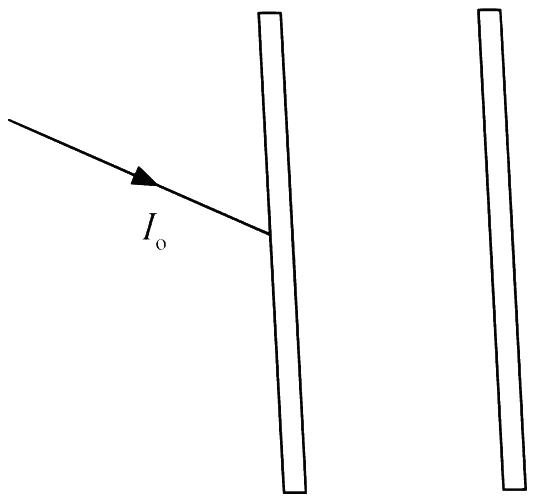
Two identical thin glass plates are placed close and parallel to each other as shown in the figure. A narrow monochromatic beam of light of intensity Io is incident on the first plate. Each plate reflects 50% of the light and transmits the remaining. Let Imin and Imax denote the minimum and maximum intensities in the interference pattern formed by the beam after one reflection from the front surface of each plate. Choose the correct statement(s)
More than one option can be correct. Tap every correct option, then tap Check.