0 of 103 attemptedPick an answer to see the solution
Q1MHT CET 2026 · 17 APR · SHIFT 2Easy
Superposition, Coherence & Intensity · Conditions for interference & coherence
For obtaining maximum contrast between the bright and dark fringes in an interference pattern, the intensities of the two light coherent sources should be
Superposition, Coherence & Intensity · Conditions for interference & coherence
In interference and diffraction, the light energy is redistributed. If it reduces in one region, producing a dark fringe, it increases in another region, producing a bright fringe.
A. As there is no gain or loss of energy, these phenomena are consistent with the principle of conservation of energy.
B. Diffraction and interference are characteristics exhibited only by light waves. Choose the correct answer from the options given below:
Superposition, Coherence & Intensity · Imax/Imin ratio & slit widths
In Young's experiment, the intensity ratio of the maxima and minima in an interference pattern produced by two coherent sources is 36:1. The ratio of the amplitudes of the two individual sources will be
Superposition, Coherence & Intensity · Imax/Imin ratio & slit widths
The interference pattern is obtained with two coherent light sources of intensity (I1 and I2) ratio 'β'. In the interference pattern, the ratio (Imax−IminImax+Imin) will be (β=I1I2)
Superposition, Coherence & Intensity · Intensity at a point
At two points P and Q on the screen in Young's double slit experiment, waves from slits S1 and S2 have a path difference of zero and 4λ respectively. The ratio of intensities at P and Q will be (cos0∘=1,cos45∘=21)
Superposition, Coherence & Intensity · Intensity at a point
Interference fringes are produced on a screen by using two light sources of intensities I and 9I. The phase difference between the beams is 2π, at point P and π at point Q on the screen. The difference between the resultant intensities at points P and Q is (cos2π=0,cosπ=−1)
Superposition, Coherence & Intensity · Intensity at a point
The ratio of intensity at the centre of a bright fringe to the intensity at a point distant (41)th of the distance between two successive bright fringes will be (cos0∘=1,cos90∘=0)
Superposition, Coherence & Intensity · Intensity at a point
The wavelength of light used in Young's double slit experiment, is λ. The intensity at a point on the screen is I, where the path difference is 6λ. If I0 is the maximum intensity then the ratio I to I0 is (cos30∘=23)
Superposition, Coherence & Intensity · Intensity at a point
In Young's double slit experiment, the wavelength of light used is λ. The intensity on the screen at a point for path difference 'λ' is 'X'. The intensity at the point for path difference (6λ) is (cos180∘=−1,cos30∘=23)
Superposition, Coherence & Intensity · Intensity at a point
In Young's double slit experiment, width of the second slit is double the width of first slit, consequently the amplitude of the light from two slits. 'Im' is the maximum intensity. The resultant intensity 'I' when they interfere with the phase difference of ϕ is given by
Superposition, Coherence & Intensity · Intensity at a point
The ratio of intensities at two points on the screen in Young's double slit experiment when waves from the two slits have a path difference of zero and λ/4 is (λ is the wavelength of light used) (cos0∘=1,cosπ/2=0)
Superposition, Coherence & Intensity · Intensity at a point
In a Young's double slit experiment, the intensities at two points, for the path difference 4λ and 3λ (λ being the wavelength of light used) are I1 and I2 respectively. If I0 denotes the intensity produced by each one of the individual slits, then I0I1+I2=
Superposition, Coherence & Intensity · Intensity at a point
In Young's double slit experiment, using monochromatic light of wavelength λ, the intensity of light at a point on the screen where the path difference is λ, is K units. The intensity of light at a point where the path difference is 3λ will be
Superposition, Coherence & Intensity · Intensity at a point
In interference experiment the path difference between two interfering waves at a point A on the screen is λ/3, where λ is the wavelength of these waves, and at another point B the path difference is λ/6. The ratio of intensities at points A and B is ______.
Superposition, Coherence & Intensity · Intensity at a point
In the Young's double slit experiment the intensity produced by each one of the individual slits is Io. The distance between two slits is 2 mm. The distance of screen from slits is 10 m. The wavelength of light is 6000A˚. The intensity of light on the screen in front of one of the slits is ______
Superposition, Coherence & Intensity · Intensity at a point
In a Young's double slit experiment, the intensity at some point on the screen is found to be 43 times of the maximum of the interference pattern. The path difference between the interfering waves at this point is xλ where λ is wavelength of the incident light. The value of x is _______.
Numerical answer type. Work it out, then open the answer.
Superposition, Coherence & Intensity · Intensity at a point
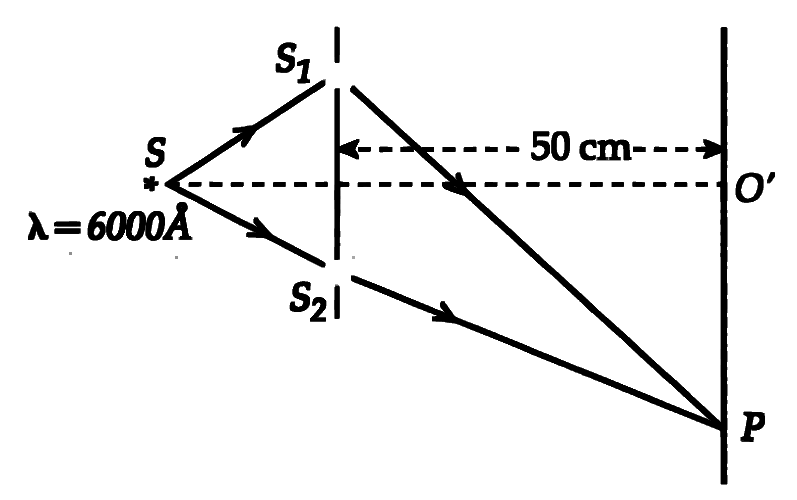
In a Young double slit experiment, the wavelength of incident light is 6000A˚, the separation between slits S1 and S2 is 5 cm and the distance between slits plane and screen is 50 cm, as shown in the figure below. If the resultant intensity at P is equal to the intensity due to individual slits, the path difference between interfering waves is ______ Å.
Superposition, Coherence & Intensity · Imax/Imin ratio & slit widths
Two monochromatic light beams have intensities in the ratio 1:9. An interference pattern is obtained by these beams. The ratio of the intensities of maximum to minimum is
Superposition, Coherence & Intensity · Imax/Imin ratio & slit widths
Two coherent monochromatic light beams of intensities 4I and 9I are superimposed. The difference between the maximum and minimum intensities in the resulting interference pattern is xI. The value of x is___________.
Numerical answer type. Work it out, then open the answer.
Superposition, Coherence & Intensity · Imax/Imin ratio & slit widths
The two coherent sources produce interference with intensity ratio ' b '. In the interference pattern, the ratio Imax−IminImax+Iminmaxmaxminmin will be
Superposition, Coherence & Intensity · Imax/Imin ratio & slit widths
In Young's double slit interference experiment, using two coherent sources of different amplitudes, the intensity ratio between bright to dark fringes is 5:1. The value of the ratio of resultant amplitudes of bright fringe to dark fringe is
Superposition, Coherence & Intensity · Imax/Imin ratio & slit widths
Width of one of the two slits in a Young's double slit interference experiment is half of the other slit. The ratio of the maximum to the minimum intensity in the interference pattern is:
Superposition, Coherence & Intensity · Imax/Imin ratio & slit widths
The width of one of the two slits in Young's double slit experiment is d while that of the other slit is xd. If the ratio of the maximum to the minimum intensity in the interference pattern on the screen is 9:4 then what is the value of x? (Assume that the field strength varies according to the slit width.)
Superposition, Coherence & Intensity · Intensity at a point
In Young's double slit experiment, the intensity on screen at a point, where path difference is 4λ is 4K. The intensity at a point when path difference is ' λ ' will be [cos2π=0,cos2π=1]
Superposition, Coherence & Intensity · Intensity at a point
In Young's double slit experiment, at two points P and Q on screen, waves from slits S1 and S2 have a path difference of 0 and 4λ respectively. The ratio of intensities at point P to that at Q will be (cos0∘=1,cos45∘=21)
Superposition, Coherence & Intensity · Intensity at a point
In Young's double slit experiment, the intensity of light at a point on the screen where the path difference is λ is ' I '. The intensity at a point where the path difference is λ/6 is [cos6π=23][λ= wavelength of light ][cosπ=−1]
Superposition, Coherence & Intensity · Intensity at a point
In Young's double slit experiment, the light of wavelength ' λ ' is used. The intensity at a point on the screen is ' I ' where the path difference is 4λ. If ' I0 ' denotes the maximum intensity then the ratio of ' I0 ' to ' I ' is (cos45∘=1/2)
Superposition, Coherence & Intensity · Intensity at a point
Interference fringes are produced on the screen by using two light sources of intensities I and 9I. The phase difference between the beams is π/2 at point P and π at point Q on the screen. The difference between the resultant intensities at points P and Q is (cos90∘=0,cosπ=−1)
Superposition, Coherence & Intensity · Intensity at a point
In Young's double slit experiment, the intensity on screen at a point where path difference is 4λ is 2K. The intensity at a point when path difference is ' λ ' will be
Two sound waves each of wavelength ' λ ' and having the same amplitude ' A ' from two source ' S1 ' and ' S2 ' interfere at a point P. If the path difference, S2P−S1P=λ/3 then the amplitude of resultant wave at point ' P ' will be [cos(120∘)=−0.5]
Superposition, Coherence & Intensity · Imax/Imin ratio & slit widths
The width of one of the two slits in a Young's double slit experiment is 4 times that of the other slit. The ratio of the maximum to the minimum intensity in the interference pattern is:
Superposition, Coherence & Intensity · Imax/Imin ratio & slit widths
Two coherent monochromatic light beams of intensities I and 4I are superimposed. The difference between maximum and minimum possible intensities in the resulting beam is xI. The value of x is __________.
Numerical answer type. Work it out, then open the answer.
Superposition, Coherence & Intensity · Intensity at a point
Two identical light waves having phase difference ϕ propagate in same direction. When they superpose, the intensity of resultant wave is proportional to
Superposition, Coherence & Intensity · Imax/Imin ratio & slit widths
The intensity ratio of the maxima and minima in an interference pattern produced by two coherent sources of light is 9:1. The intensities of the light sources used are in the ratio
Superposition, Coherence & Intensity · Imax/Imin ratio & slit widths
The intensity of light coming from one of the slits in Young's double slit experiment is double the intensity from the other slit. The ratio of the maximum intensity to the minimum intensity in the interference fringe pattern observed is
Superposition, Coherence & Intensity · Intensity at a point
In Young's double slit experiment, the intensity of light at a point on the screen where the path difference is λ is x units, λ being the wavelength of light used. The intensity at a point where the path difference is 4λ will be (cos2π=1,cos2π=0)
Superposition, Coherence & Intensity · Intensity at a point
In Young's double slit experiment, 'I' is the minimum intensity and ' I1 ' is the intensity at a point where the path difference is 4λ where ' λ ' is the wavelength of light used. The ratio I1I is (Intensities of the two interfering waves are same) (cos0∘=1,cos90∘=0)
Superposition, Coherence & Intensity · Intensity at a point
In the Young's double slit experiment, the intensity at a point on the screen, where the path difference is λ(λ= wavelength ) is β. The intensity at a point where the path difference is λ/3, will be cos3π=1/2]
Superposition, Coherence & Intensity · Intensity at a point
In Young's double slit experiment using monochromatic light of wavelength ' λ ', the maximum intensity of light at a point on the screen is ' K ' units. The intensity of light at a point where the path difference is 6λ is (cos60∘=sin30∘=0.5,sin60∘=cos30∘=3/2)
Superposition, Coherence & Intensity · Intensity at a point
In Young's double slit experiment using monochromatic light of wavelength ' λ ', the intensity of light at a point on the screen where path difference ' λ ' is K units. The intensity of light at a point where the path difference is 6λ is [cos6π=sin3π=23]
Superposition, Coherence & Intensity · Intensity at a point
In Young's double slit experiment, light from two identical sources are superimposing on a screen. The path difference between the two lights reaching at a point on the screen is 7λ/4. The ratio of intensity of fringe at this point with respect to the maximum intensity of the fringe is:
Superposition, Coherence & Intensity · Intensity at a point
Two waves of intensity ratio 1:9 cross each other at a point. The resultant intensities at that point, when (a) Waves are incoherent is I1 (b) Waves are coherent is I2 and differ in phase by 60∘. If I2I1=x10 then x= _________.
Numerical answer type. Work it out, then open the answer.
Superposition, Coherence & Intensity · Intensity at a point
In a Young's double slit experiment, the intensity at a point is (41)th of the maximum intensity, the minimum distance of the point from the central maximum is _________ μm. (Given: λ=600 nm,d=1.0 mm,D=1.0 m)
Numerical answer type. Work it out, then open the answer.
Superposition, Coherence & Intensity · Intensity at a point
In Young's double slit experiment, monochromatic light of wavelength 5000 Å is used. The slits are 1.0 mm apart and screen is placed at 1.0 m away from slits. The distance from the centre of the screen where intensity becomes half of the maximum intensity for the first time is _________ ×10−6 m.
Numerical answer type. Work it out, then open the answer.
Superposition, Coherence & Intensity · Imax/Imin ratio & slit widths
In a Young's double slits experiment, the ratio of amplitude of light coming from slits is 2:1. The ratio of the maximum to minimum intensity in the interference pattern is:
Superposition, Coherence & Intensity · Imax/Imin ratio & slit widths
Of the two slits producing interference in Young's experiment, one is covered with glass so that light intensity passing is reduced to 50%. Which of the following is correct?
Superposition, Coherence & Intensity · Intensity at a point
A and B are two interfering sources where A is ahead in phase by 54∘ relative to B. The observation is taken from point P such that PB − PA = 2.5 λ. Then the phase difference between the waves from A and B reaching point P is (in rad)
Superposition, Coherence & Intensity · Intensity at a point
The ratio of intensities of two points on a screen in Young's double slit experiment when waves from the two slits have a path difference of 4λ and 6λ is
Superposition, Coherence & Intensity · Intensity at a point
In Young's double slit experiment the intensities at two points, for the path difference 4λ and 3λ (λ= wavelength of light used) are I1 and I2 respectively. If I0 denotes the intensity produced by each one of the individual slits then I0I1+I2 is equal to (cos60∘=0.5,cos45∘=21)
Superposition, Coherence & Intensity · Intensity at a point
Light waves from two coherent sources arrive at two points on a screen with path difference of zero and 2λ. The ratio of intensities at the points is (cos0∘=1,cosπ=−1)
Superposition, Coherence & Intensity · Intensity at a point
In Young's double slit experiment, the wavelength of light used is 'λ'. The intensity at a point is 'I' where path difference is (4λ). If I0 denotes the maximum intensity, then the ratio (I0I) is (sin4π=cos4π=21)
Superposition, Coherence & Intensity · Intensity at a point
The ratio of intensities at two points P and Q on the screen in a Young's double slit experiment where phase difference between two waves of same amplitude are π/3 and π/2, respectively are
Superposition, Coherence & Intensity · Intensity at a point
In a Young's double slit experiment, the intensities at two points, for the path differences 4λ and 3λ ( λ being the wavelength of light used) are I1 and I2 respectively. If I0 denotes the intensity produced by each one of the individual slits, then I0I1+I2= __________.
Numerical answer type. Work it out, then open the answer.
Superposition, Coherence & Intensity · Imax/Imin ratio & slit widths
Two coherent sources of light interfere. The intensity ratio of two sources is 1:4. For this interference pattern if the value of Imax−IminImax+Imin is equal to β+32α+1, then βα will be:
Superposition, Coherence & Intensity · Imax/Imin ratio & slit widths
Find the ratio of maximum intensity to the minimum intensity in the interference pattern if the widths of the two slits in Young's experiment are in the ratio of 9: 16. (Assuming intensity of light is directly proportional to the width of slits)
Superposition, Coherence & Intensity · Imax/Imin ratio & slit widths
The interference pattern is obtained with two coherent light sources of intensity ratio 4: 1. And the ratio Imax−IminImax+Imin is x5. Then, the value of x will be equal to:
Superposition, Coherence & Intensity · Intensity at a point
The two light beams having intensities I and 9I interfere to produce a fringe pattern on a screen. The phase difference between the beams is π/2 at point P and π at point Q. Then the difference between the resultant intensities at P and Q will be:
Superposition, Coherence & Intensity · Intensity at a point
Two light beams of intensities 4I and 9I interfere on a screen. The phase difference between these beams on the screen at point A is zero and at point B is π. The difference of resultant intensities, at the point A and B, will be _________ I.
Numerical answer type. Work it out, then open the answer.
Superposition, Coherence & Intensity · Intensity at a point
Two beams of light having intensities I and 4I interfere to produce a fringe pattern on a screen. The phase difference between the two beams are π/2 and π/3 at points A and B respectively. The difference between the resultant intensities at the two points is xI. The value of x will be ________.
Numerical answer type. Work it out, then open the answer.
Superposition, Coherence & Intensity · Imax/Imin ratio & slit widths
Two monochromatic beams of intensities I and 4 I respectively are superposed to form a steady interference pattern. The maximum and minimum intensities in the pattern are
Superposition, Coherence & Intensity · Imax/Imin ratio & slit widths
The light waves from two coherent sources have same intensity I1 = I2 = I0. In interference pattern the intensity of light at minima is zero. What will be the intensity of light at maxima?
Superposition, Coherence & Intensity · Imax/Imin ratio & slit widths
In a Young's double slit experiment, the width of the one of the slit is three times the other slit. The amplitude of the light coming from a slit is proportional to the slit-width. Find the ratio of the maximum to the minimum intensity in the interference pattern.
Superposition, Coherence & Intensity · Imax/Imin ratio & slit widths
The width of one of the two slits in a Young's double slit experiment is three times the other slit. If the amplitude of the light coming from a slit is proportional to the slit-width, the ratio of minimum to maximum intensity in the interference pattern is x: 4 where x is ____________.
Numerical answer type. Work it out, then open the answer.
Superposition, Coherence & Intensity · Intensity at a point
Two beams of light having intensities I and 4I interfere to produce a fringe pattern on a screen. The phase difference between the beams is π/2 at point A and π at point B. Then the difference between the resultant intensities at A and B is
Superposition, Coherence & Intensity · Intensity at a point
In Young's double slit experiment, the intensity at a point where path difference is 6λ (λ being the wavelength of light used) is 'I'. If 'I0' denotes the maximum intensity, then I0I is equal to (cos0∘=1,cos60∘=21)
Superposition, Coherence & Intensity · Intensity at a point
In Young's double slit experiment using monochromatic light of wavelength 'λ', the maximum intensity of light at a point on the screen is K units. The intensity of light at point where the path difference is 3λ is
Superposition, Coherence & Intensity · Intensity at a point
In Young's double slit experiment, the intensity at a point where the path difference is 4λ [ λ is wavelength of light used] is 'I'. If 'I0' is the maximum intensity then I0I is equal to [cos4π=sin4π=21]
Superposition, Coherence & Intensity · Conditions for interference & coherence
Two coherent sources of light interfere and produce fringe pattern on a screen. For central maximum, the phase difference between the two waves will be,
Superposition, Coherence & Intensity · Intensity at a point
In a double slit experiment, at a certain point on the screen the path difference between the two interfering waves is 81th of a wavelength. The ratio of the intensity of light at that point to that at the centre of a bright fringe is:
Superposition, Coherence & Intensity · Intensity at a point
A Young's double-slit experiment is performed using monochromatic light of wavelength λ. The intensity of light at a point on the screen, where the path difference is λ, is K units. The intensity of light at a point where the path difference is 6λ is given by 12nK, where n is an integer. The value of n is __________.
Numerical answer type. Work it out, then open the answer.
Superposition, Coherence & Intensity · Intensity at a point
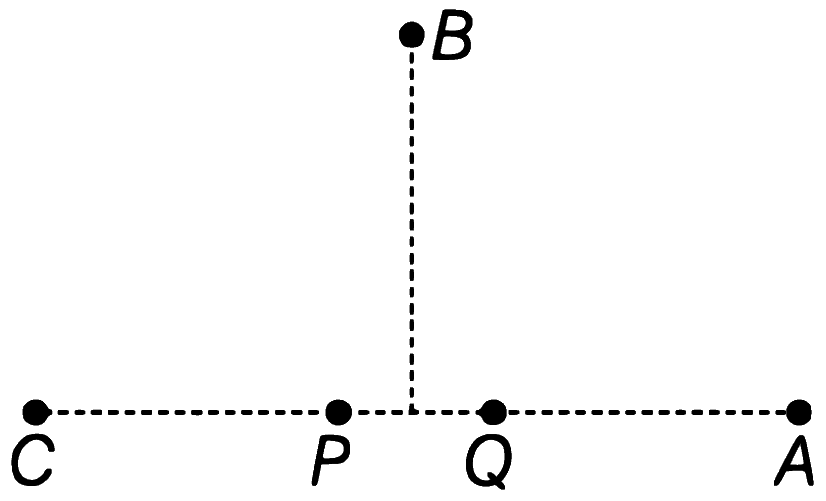
In the figure below, P and Q are two equally intense coherent sources emitting radiation of wavelength 20 m. The separation between P and Q is 5 m and the phase of P is ahead of that of Q by 90°. A, B and C are three distinct points of observation, each equidistant from the midpoint of PQ. The intensities of radiation at A, B, C will be in the ratio:
Superposition, Coherence & Intensity · Imax/Imin ratio & slit widths
In an interference experiment the ratio of amplitudes of coherent waves is a2a1=31. The ratio of maximum and minimum intensities of fringes will be:
Superposition, Coherence & Intensity · Imax/Imin ratio & slit widths
In a Young's double slit experiment, the ratio of the slit's width is 4: 1. The ratio of the intensity of maxima to minima, close to the central fringe on the screen, will be:
Superposition, Coherence & Intensity · Imax/Imin ratio & slit widths
Two coherent sources produce waves of different intensities which interfere. After interference, the ratio of the maximum intensity to the minimum intensity is 16. The intensity of the waves are in the ratio:
Superposition, Coherence & Intensity · Intensity at a point
In a Young's double slit experiment, the path difference, at a certain point on the screen, between two interfering waves is 81 th of wavelength. The ratio of the intensity at this point to that at the centre of a bright fringe is close to:
Superposition, Coherence & Intensity · Imax/Imin ratio & slit widths
The interference pattern is obtained with two coherent light sources of intensity ratio n. In the interference pattern, the ratio Imax+IminImax−Imin will be
Superposition, Coherence & Intensity · Imax/Imin ratio & slit widths
Two slits in Young's experiment have widths in the ratio 1: 25. The ratio of intensity at the maxima and minima in the interference pattern, IminImax is
Superposition, Coherence & Intensity · Intensity at a point
In a Young's double slit experiment with light of wavelength λ the separation of slits is d and distance of screen is D such that D > > d > > λ. If the Fringe width is β, the distance from point of maximum intensity to the point where intensity falls to half of maximum intensity on either side is:
Superposition, Coherence & Intensity · Imax/Imin ratio & slit widths
Two monochromatic light beams of intensity 16 and 9 units are interfering. The ratio of intensities of bright and dark parts of the resultant pattern is:
Superposition, Coherence & Intensity · Intensity at a point
In the Young's double slit experiment, the intensity of light at a point on the screen where the path difference λ is K, (λ being the wavelength of light used). The intensity at a point where the path difference is λ/4 will be
Superposition, Coherence & Intensity · Imax/Imin ratio & slit widths
n identical waves each of intensity I0 interfere with each other. The ratio of maximum intensities if the interference is (i) coherent and (ii) incoherent is:
Superposition, Coherence & Intensity · Imax/Imin ratio & slit widths
In Young's double slit experiment, one of the slit is wider than other, so that amplitude of the light from one slit is double of that from other slit. If Im be the maximum intensity, the resultant intensity I when they interfere at phase difference ϕ is given by:
Superposition, Coherence & Intensity · Intensity at a point
In a Young's double slit experiment the intensity at a point where the path difference is 6λ ( λ being the wavelength of light used) is I. If I0 denotes the maximum intensity, I0I is equal to