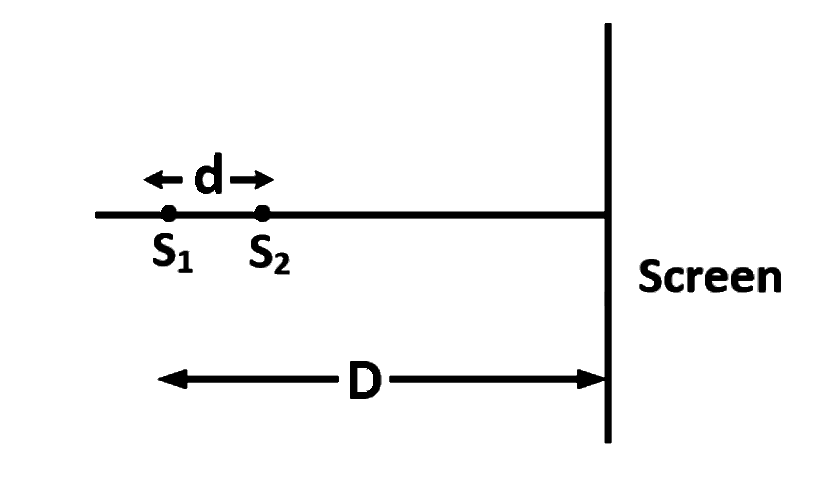
In two separate Young's double-slit experimental set-ups and two monochromatic light sources of different wavelengths are used to get fringes of equal width. The ratios of the slits separations and that of the wavelengths of light used are 2:1 and 1:2 respectively. The corresponding ratio of the distances between the slits and the respective screens ( D1/D2) is ______。
Numerical answer type. Work it out, then open the answer.
In Young's double slit experiment, the separation between the slits is decreased to (31)th of its original distance and the distance between the slits and the screen is doubled. The fringe width
In Young's double slit experiment, the fringe width is 2.4 mm with light of wavelength 9000 A.U. If the light of wavelength 5400 A.U. is used, with no other change in the experimental set up. The change in fringe width is
If fringe width is 0.4 mm, the distance between fifth bright and third dark band on the same side in interference pattern of Young's double slit experiment is (in mm)
In Young's double slit experiment, the fringe width is 0.4 mm. What is the distance between 4th dark band and 6th bright band on the same side of the interference pattern?
Two coherent sources P and Q produce interference at a point A on the screen where there is a dark band which is formed between 4th bright band and 5th bright band. Wavelength of light used is 6000 Å. The path difference between PA and QA is x×10−4 cm. The value of x is
In a certain region of the screen, number of fringes formed is observed to be 8 in Young's double slit experiment when light of wavelength 6600 Å is used. If the light of wavelength 4400 Å is used, the number of fringes observed in the same region of the screen will be
Statement I: In a Young's double slit experiment, the angular separation of fringes will increase as the screen is moved away from the plane of the slits
Statement II: In a Young's double slit experiment, the angular separation of fringes will increase when monochromatic source is replaced by another monochromatic source of higher wavelength In the light of the above statements, choose the correct answer from the options given below:
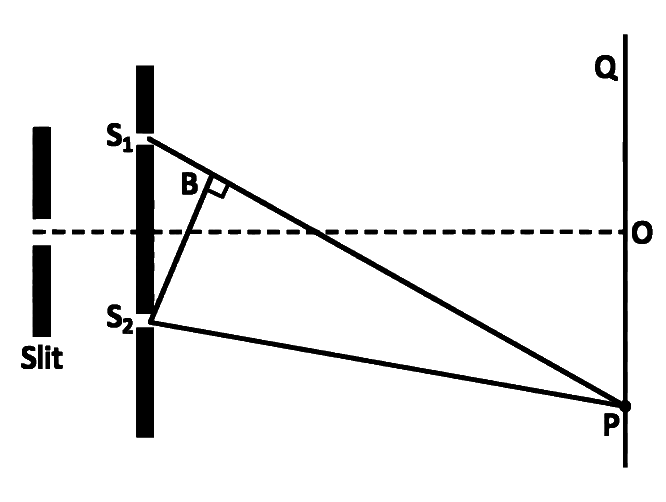
In Young's double slit experiment, following figure shows that Q is the position of second bright fringe on the right side of point O.P is the eleventh bright fringe on the other side measured from point Q. If the wavelength of light used is 6000 Å, then what will be the value of S1B?
In double slit experiment, the angular width of the fringes is 0.20∘ for sodium light (λ=5890 \AA). To increase the angular width of the fringes by 10%, the necessary change in wavelength is
In Young's double slit experiment the wavelength of light used is 6000A˚, the screen is 40 cm from the slits and the fringe width is 0.012 cm, the distance between two slits is
In a Young's double slit experiment, the slits are separated by 0.2 mm. If the slits separation is increased to 0.4 mm, the percentage change of the fringe width is:
In Young's double slit experiment, when light of wavelength 600 nm is used, 18 fringes are observed on the screen. If the wavelength of light is changed to 400 nm, the number of fringes observed on the screen is
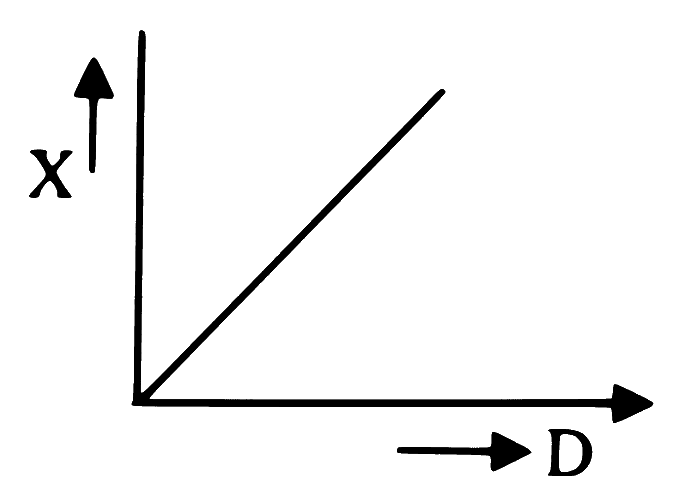
Graph shows the variation of fringe width ( X) versus distance of the screen from the plane of the slits (D) in Young's double slit experiment. (keeping other parameters same, d= distance between the slits). The wavelength of light used can be calculated as
In Young's double slit experiment with monochromatic light of wavelength 600 nm, the distance between the slits is 10−3 m. For changing the fringe width by 3×10⁻⁵ m
a. the screen is moved away from the slit by 5 cm.
b. the screen is moved 5 cm towards the slits.
c. the screen is moved 3 cm towards the slits.
d. the screen is moved away from the slits by 3 cm.
In a Young's double slit experiment wavelength of light used is 6000A˚. The first order maxima and tenth order maxima fall at 14.50 mm and 16.75 mm from the particular reference point in the interference pattern respectively. If the wavelength is changed to 5500A˚ then the position of zero order and tenth order maxima are respectively
A double slit interference experiment performed with a light of wavelength 600 nm forms an interference fringe pattern on a screen with 10 th bright fringe having its centre at a distance of 10 mm from the central maximum. Distance of the centre of the same 10 th bright fringe from the central maximum when the source of light is replaced by another source of wavelength 660 nm would be ________ mm.
Numerical answer type. Work it out, then open the answer.
Two slits in Young's double slit experiment are 1.5 mm apart and the screen is placed at a distance of 1 m from the slits. If the wavelength of light used is 600×10−9 m then the fringe separation is
In young's double slit experiment, the nth maximum of wavelength λ1 is at a distance of y1 from the central maximum. When the wavelength of the source is changed to λ2,(3n)th maximum is at a distance of y2 from its central maximum. The ratio y2y1 is
In Young's double slit experiment, carried out with light of wavelength 5000A˚, the distance between the slits is 0.3 mm and the screen is at 200 cm from the slits. The central maximum is at x=0 cm. The value of x for third maxima is __________ mm.
Numerical answer type. Work it out, then open the answer.
In Young's double slit experiment, the slits are separated by 0.6 mm and screen is placed at a distance of 1.2 m from slit. It is observed that the tenth bright fringe is at a distance of 8.85 mm from the third dark fringe on the same side. The wavelength of light used is
The fringe width in an interference pattern is ' X '. The distance between the sixth dark fringe from one side of central bright band to the fourth bright fringe on other side is
In Young's double slit experiment, green light is incident on two slits. The interference pattern is observed on a screen. Which one of the following changes would cause the observed fringes to be more closely spaced?
In Young's double slit experiment the separation between the slits is doubled without changing other setting of the experiment to obtain same fringe width, the distance 'D' of the screen from slit should be made
The width of fringe is 2 mm on the screen in a double slits experiment for the light of wavelength of 400 nm. The width of the fringe for the light of wavelength 600 nm will be:
In Young's double slit experiment, 8th maximum with wavelength 'λ1' is at a distance 'd1 ' from the central maximum and 6th maximum with wavelength 'λ2' is at a distance 'd2'. Then d1d2 is
In Young's double slit experiment, the fifth maximum with wavelength 'λ1 ' is at a distance 'y1' and the same maximum with wavelength 'λ2' is at a distance 'y2 ' measured from the central bright band. Then y2y1 is equal to [D and d are constant]
In Young's double slit experiment, the fringe width is 2 mm. The separation between the 13th bright fringe and the 4th dark fringe from the centre of the screen on same side will be
In Young's double slits experiment, the position of 5th bright fringe from the central maximum is 5 cm. The distance between slits and screen is 1 m and wavelength of used monochromatic light is 600 nm. The separation between the slits is:
The path difference between two identical light waves at a point Q on the screen is 3μm. If wavelength of the waves is 5000A˚, then at point Q there is
For Young's double slit experiment, two statements are given below:
Statement I: If screen is moved away from the plane of slits, angular separation of the fringes remains constant.
Statement II: If the monochromatic source is replaced by another monochromatic source of larger wavelength, the angular separation of fringes decreases.
In the light of the above statements, choose the correct answer from the options given below:
Two sources of light 0.6 mm apart and screen is placed at a distance of 1.2 m from them. A light of wavelength 6000A˚ used. Then the phase difference between the two light waves interfering on the screen at a point at a distance 3 mm from central bright band is
Using Young's double slit experiment, a monochromatic light of wavelength 5000 A˚ produces fringes of fringe width 0.5 mm. If another monochromatic light of wavelength 6000 A˚ is used and the separation between the slits is doubled, then the new fringe width will be:
In a Young's double slit experiment, a laser light of 560 nm produces an interference pattern with consecutive bright fringes' separation of 7.2 mm. Now another light is used to produce an interference pattern with consecutive bright fringes' separation of 8.1 mm. The wavelength of second light is __________ nm.
Numerical answer type. Work it out, then open the answer.
In a Young's double slit experiment, a student observes 8 fringes in a certain segment of screen when a monochromatic light of 600 nm wavelength is used. If the wavelength of light is changed to 400 nm, then the number of fringes he would observe in the same region of the screen is
In a double slit experiment with monochromatic light, fringes are obtained on a screen placed at some distance from the plane of slits. If the screen is moved by 5 × 10⁻² m towards the slits, the change in fringe width is 3 × 10⁻³ cm. If the distance between the slits is 1 mm, then the wavelength of the light will be ____________ nm.
Numerical answer type. Work it out, then open the answer.
In a Young's double slit experiment two slits are separated by 2 mm and the screen is placed one meter away. When a light of wavelength 500 nm is used, the fringe separation will be:
A fringe width of 6 mm was produced for two slits separated by 1 mm apart. The screen is placed 10 m away. The wavelength of light used is 'x' nm. The value of 'x' to the nearest integer is ____________.
Numerical answer type. Work it out, then open the answer.
In Young's double slit experiment, the 10th maximum of wavelength 'λ1' is at a distance of 'Y1 ' from the central maximum. When the wavelength of the source is changed to 'λ2 ', 5th maximum is at a distance 'Y2 ' from the central maximum. The ratio Y2Y1 is
In Young's double slit experiment, the 'nth' maximum of wavelength 'λ1 ' is at a distance 'y1' from the central maximum. When the wavelength of the source is changed to 'λ2', (2n)th maximum is at a distance of 'y2' from its central maximum. The ratio y2y1 is
In Young's double slit arrangement, slits are separated by a gap of 0.5 mm, and the screen is placed at a distance of 0.5 m from them. The distance between the first and the third bright fringe formed when the slits are illuminated by a monochromatic light of 5890 A˚ is :-
Two coherent sources 'P' and 'Q' produce interference at point 'A' on the screen, where there is a dark band which is formed between 4th and 5th bright band. Wavelength of light used is 6000 A˚. The path difference PA and QA is
In Young's experiment, fringes are obtained on a screen placed at a distance 75 cm from the slits. When the separation between two narrow slits is doubled, then the fringe width is decreased. In order to obtain the initial fringe width, the screen should be moved through.
In the Young's double slit experiment, the distance between the slits varies in time as d(t) = d0 + a0 sinωt; where d0, ω and a0 are constants. The difference between the largest fringe width and the smallest fringe width obtained over time is given as:
In a Young's double slit experiment, the slits are separated by 0.3 mm and the screen is 1.5 m away from the plane of slits. Distance between fourth bright fringes on both sides of central bright is 2.4 cm. The frequency of light used is ______________ × 1014 Hz.
Numerical answer type. Work it out, then open the answer.
White light is passed through a double slit and interference is observed on a screen 1.5 m away. The separation between the slits is 0.3 mm. The first violet and red fringes are formed 2.0 mm and 3.5 mm away from the central white fringes. the difference in wavelengths of red and violet light is ................ nm.
Numerical answer type. Work it out, then open the answer.
In Young's double slit experiment green light is incident on the two slits. The interference pattern is observed on a screen. Which one of the following changes would cause the observed fringes to be more closely spaced?
In Young's double slit experiment, if the separation between coherent sources is halved and the distance of the screen from the coherent sources is doubled, then the fringe width becomes:
In a Young’s double slit experiment, 16 fringes are observed in a certain segment of the screen when light of a wavelength 700 nm is used. If the wavelength of light is changed to 400 nm, the number of fringes observed in the same segment of the screen would be
In a Young's double slit experiment 15 fringes are observed on a small portion of the screen when light of wavelength 500 nm is used. Ten fringes are observed on the same section of the screen when another light source of wavelength λ is used. Then the value of λ is (in nm) __________.
Numerical answer type. Work it out, then open the answer.
In a Young’s double slit experiment, light of 500 nm is used to produce an interference pattern. When the distance between the slits is 0.05 mm, the angular width (in degree) of the fringes formed on the distance screen is close to
Interference fringes are observed on a screen by illuminating two thin slits 1 mm apart with a light source (λ = 632.8 nm). The distance between the screen and the slits is 100 cm. If a bright fringe is observed on a screen at a distance of 1.27 mm from the central bright fringe, then the path difference between the waves, which are reaching this point from the slits is close is
In a Young's double slit experiment, the separation between the slits is 0.15 mm. in the experiment, a source of light of wavelengh 589 nm is used and the interference pattern is observed on a screen kept 1.5 m away. The separation between the successive bright fringes on the screen is:
In a Young's double slit experiment, if there is no initial phase difference between the light from the two slits, a point on the screen corresponding to the fifth minimum has path difference
In a Young’s double slit experiment with slit separation 0.1 mm, one observes a bright fringe at angle 401 by using light of wavelength λ1. When the light of wavelength λ2 is used a bright fringe is seen at the same angle in the same set up. Given that λ1 and λ2 are in visible range (380 nm to 740 nm), their values are -
In Young’s double slit experiment the separation d between the slits is 2 mm, the wavelength λ of the light used is 5896 A˚ and distance D between the screen and slits is 100 cm. It is found that the angular width of the fringes is 0.20°. To increase the fringe angular width to 0.21° (with same λ and D) the separation between the slits needs to be changed to
In Young’s double slit experiment, the distance between slits and the screen is 1.0 m and monochromatic light of 600 nm is being used. A person standing near the slits is looking at the fringe pattern. When the separation between the slits is varied, the interference pattern disappears for a particular distance d0 between the slits. If the angular resolution of the eye is (601)∘, the value of d0 is close to:
In Young's double slit experiment the distance between the slits and the screen is doubled. The separation between the slits is reduced to half. As a result the fringe width
This question has Statement-1 and Statement-2. Of the four choices given after the Statements, choose the one that best describes the two Statements.
Statement-1: In Young's double slit experiment, the number of fringes observed in the field of view is small with longer wavelength of light and is large with shorter wavelength of light. Statement-2: In the double slit experiment the fringe width depends directly on the wavelength of light.
In Young's double slit experiment carried out with light of wavelength (λ)=5000 Å, the distance between the slits is 0.2 mm and the screen is at 200 cm from the slits. The central maximum is at x=0. The third maximum (taking the central maximum as zeroth maximum) will be at x equal to
In Young's experiment, two coherent sources are placed 0.90 mm apart and fringe are observed one metre away. If it produces second dark fringe at a distance of 1 mm from central fringe, the wavelength of monochromatic light used would be
The Young's double slit experiment is performed with blue and with green light of wavelengths 4360 Å and 5460 Å respectively. If x is the distance of 4th maxima from the central one, then