Q11 mark · HSC Mar 2022 · HSC Feb 2023
The first law of thermodynamics is concerned with the conservation of
(a) momentum(b) energy(c) temperature(d) mass
Solution
→ΔU = Q − W: heat given = increase in internal energy + work done. It is the law of conservation of energy.
→Answer: (b) energy
Q21 mark · HSC Textbook Ex. 1(i) · SCERT Question Bank · MCQ 5
A gas in a closed container is heated with 10 J of energy, causing the lid of the container to rise 2 m with 3 N of force. What is the total change in the internal energy of the system?
(a) 10 J(b) 4 J(c) −10 J(d) −4 J
Solution
→Q = +10 J (heat given)
W = F × d = 3 × 2
= 6 J (work done by the gas)
ΔU = Q − W = 10 − 6
= 4 J
→Answer: (b) 4 J
Q31 mark · HSC Textbook Ex. 1(ii)
Which of the following is an example of the first law of thermodynamics?
(a) The specific heat of an object explains how easily it changes temperatures.(b) While melting, an ice cube remains at the same temperature.(c) When a refrigerator is unplugged, everything inside of it returns to room temperature after some time.(d) After falling down the hill, a ball’s kinetic energy plus heat energy equals the initial potential energy.
Solution
→The first law is conservation of energy: the loss of potential energy appears as kinetic energy + heat.
→Answer: (d) KE + heat = initial PE
Q41 mark · SCERT Question Bank · VSA 9
What is the internal energy of the system, when the amount of heat Q is added to the system and the system does not do any work during the process?
Solution
→W = 0
so from ΔU = Q − W:
ΔU = Q
→The internal energy increases by Q.
Q51 mark · SCERT Question Bank · VSA 10
When does a system lose energy to its surrounding and its internal energy decreases?
Solution
→When the system does work to increase its volume and no heat is added to it: ΔU = −W, so U decreases.
Q61 mark · SCERT Question Bank · VSA 11
State first law of thermodynamics.
Solution
→The change in internal energy of a system is equal to the heat supplied to the system minus the work done by the system:
ΔU = Q − W
Q71 mark · SCERT Question Bank · VSA 12
A system releases 100 kJ of heat while 80 kJ of work is done on the system. Calculate the change in internal energy.
Note: SCERT key prints 20 kJ; the minus sign shows a decrease of 20 kJ.
Solution
→Heat released: Q = −100 kJ
→Work done on the system: W = −80 kJ
ΔU = Q − W = −100 − (−80)
= −20 kJ
→The internal energy decreases by 20 kJ.
→Answer: ΔU = −20 kJ
Note: SCERT key prints 20 kJ; the minus sign shows a decrease of 20 kJ.
Q82 marks · HSC Jul 2022 · HSC Feb 2023 · HSC Textbook Example 4.4
104 kJ of work is done on certain volume of a gas. If the gas releases 125 kJ of heat, calculate the change in internal energy of the gas.
Note: HSC Textbook prints 21 kJ (the size of the change). The Feb 2023 paper prints “104 J”; with 104 J, ΔU = −125 + 0.104 = −124.9 kJ.
Solution
→Work done on the gas: W = −104 kJ
→Heat released by the gas: Q = −125 kJ
ΔU = Q − W
ΔU = −125 − (−104) = −21 kJ
→The internal energy of the gas decreases by 21 kJ.
→Answer: ΔU = −21 kJ (decrease of 21 kJ)
Note: HSC Textbook prints 21 kJ (the size of the change). The Feb 2023 paper prints “104 J”; with 104 J, ΔU = −125 + 0.104 = −124.9 kJ.
Q92 marks · HSC Textbook Ex. 5
A system releases 130 kJ of heat while 109 kJ of work is done on the system. Calculate the change in internal energy.
Note: HSC Textbook answer prints ΔU = 21 kJ; the minus sign shows a decrease.
Solution
→Heat released: Q = −130 kJ
→Work done on the system: W = −109 kJ
ΔU = Q − W = −130 − (−109)
= −21 kJ
→The internal energy decreases by 21 kJ.
→Answer: ΔU = −21 kJ
Note: HSC Textbook answer prints ΔU = 21 kJ; the minus sign shows a decrease.
Q102 marks · HSC Textbook Ex. 4
A gas contained in a cylinder fitted with a frictionless piston expands against a constant external pressure of 1 atm from a volume of 5 litres to a volume of 10 litres. In doing so it absorbs 400 J of thermal energy from its surroundings. Determine the change in internal energy of system.
Solution
→Given: p = 1.013 × 10⁵ Pa
ΔV = 10 − 5 = 5 L
= 5 × 10⁻³ m³
Q = +400 J
W = pΔV = 1.013 × 10⁵ × 5 × 10⁻³
= 506.5 J
ΔU = Q − W = 400 − 506.5
= −106.5 J
→Answer: ΔU = −106.5 J
Q112 marks · HSC Textbook Example 4.2
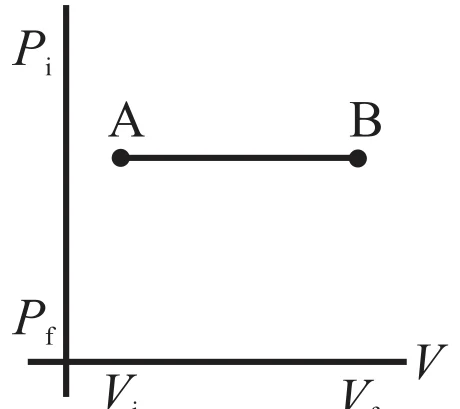
A gas enclosed in a cylinder is expanded to double its initial volume at a constant pressure of one atmosphere. How much work is done in this process? (Initial volume = 0.5 m³)
Note: HSC Textbook prints 5.05 × 10⁵ J; 1.01 × 10⁵ × 0.5 = 5.05 × 10⁴ J.
Solution
→Given: p = 1.01 × 10⁵ Pa
Vi = 0.5 m³
Vf = 1.0 m³
W = p(Vf − Vi) = 1.01 × 10⁵ × 0.5
W = 5.05 × 10⁴ J
→W is positive, so the work is done by the gas (it expands).
→Answer: 5.05 × 10⁴ J, done by the gas
Note: HSC Textbook prints 5.05 × 10⁵ J; 1.01 × 10⁵ × 0.5 = 5.05 × 10⁴ J.
Q122 marks · Expected question · based on HSC Textbook 4.5
State the sign conventions for heat Q and work W used in the first law of thermodynamics.
Solution
→Q is positive when heat is given to the system and negative when heat is released by the system.
→W is positive when work is done by the system (expansion) and negative when work is done on the system (compression).
→With these signs, ΔU = Q − W; ΔU can be positive, negative or zero.
Q132 marks · HSC Textbook Ex. 3(i)
A mixture of hydrogen and oxygen is enclosed in a rigid insulating cylinder. It is ignited by a spark. The temperature and the pressure both increase considerably. Assume that the energy supplied by the spark is negligible, what conclusions may be drawn by application of the first law of thermodynamics?
Solution
→Insulating walls
⇒ Q = 0; rigid cylinder
⇒ ΔV = 0
⇒ W = 0
ΔU = Q − W = 0
→The internal energy of the system does not change; the chemical energy released in the reaction is converted into thermal energy, so T and p rise.
Q142 marks · HSC Textbook Ex. 3(ii)
A resistor held in running water carries electric current. Treat the resistor as the system. (a) Does heat flow into the resistor? (b) Is there a flow of heat into the water? (c) Is any work done? (d) Assuming the state of resistance to remain unchanged, apply the first law of thermodynamics to this process.
Solution
→(a) No. The resistor is hotter than the water, so heat does not flow into it.
→(b) Yes. Heat flows from the resistor into the water (Q < 0 for the resistor).
→(c) Yes. Electrical work is done on the resistor by the source (W < 0).
→(d) State unchanged
⇒ ΔU = 0
⇒ Q = W: the electrical work done on the resistor is given out as heat to the water.
Q152 marks · HSC Textbook Ex. 3(iii)
A mixture of fuel and oxygen is burned in a constant-volume chamber surrounded by a water bath. It was noticed that the temperature of water is increased during the process. Treating the mixture of fuel and oxygen as the system, (a) Has heat been transferred? (b) Has work been done? (c) What is the sign of ΔU?
Solution
→(a) Yes. Heat is transferred from the system to the water (Q < 0).
→(b) No. The volume is constant, so W = 0.
→(c) ΔU = Q − W = Q, which is negative. So ΔU is negative.
Q163 marks · HSC Textbook Example 4.3
1.0 kg of liquid water is boiled at 100 °C and all of it is converted to steam at atmospheric pressure (1.01 × 10⁵ Pa). The volume changes from 1.0 × 10⁻³ m³ to 1.671 m³. L = 2256 kJ/kg. Calculate (a) the energy transferred to the system, (b) the work done by the system, (c) the change in the internal energy of the system.
Solution
→(a) Q = mL = 1.0 × 2256
= 2256 kJ
→(b) W = pΔV
W = 1.01 × 10⁵ × (1.671 − 0.001) = 1.69 × 10⁵ J
= 169 kJ
→(c) ΔU = Q − W = 2256 − 169
= 2087 kJ
→ΔU is positive: the energy separates the water molecules.
→Answer: 2256 kJ, 169 kJ, 2087 kJ
Q173 marks · SCERT Question Bank · SA-II 7
One gram of water (1 cm³) becomes 1671 cm³ of steam at a pressure of 1 atm. The latent heat of vaporization at this pressure is 2256 J/g. Calculate the external work and the increase in internal energy.
Solution
→Given: p = 1.013 × 10⁵ Pa
ΔV = 1671 − 1 = 1670 cm³
= 1.670 × 10⁻³ m³
Q = mL = 1 × 2256
= 2256 J
W = pΔV = 1.013 × 10⁵ × 1.670 × 10⁻³ ≈ 169 J
ΔU = Q − W = 2256 − 169
= 2087 J
→Answer: W = 169 J, ΔU = 2087 J
Q183 marks · Expected question · based on HSC Textbook 4.5
Obtain an expression for the work done by a gas when its volume changes.
Solution
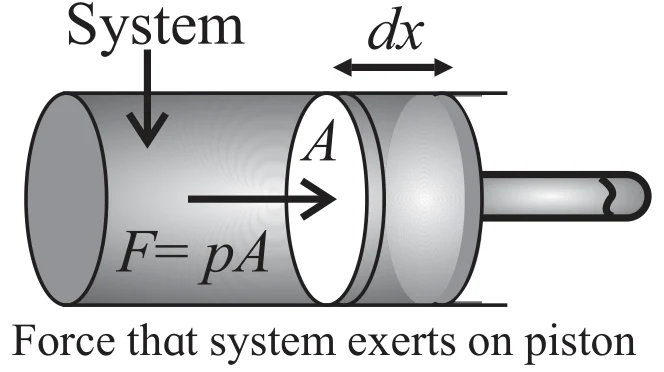
Fig. 4.7 · HSC Textbook · A system enclosed in a cylinder
→Gas in a cylinder with a movable piston of area A; pressure of the gas = p.
→Force exerted by the gas on the piston:
F = pA
→When the piston moves out by a small distance dx, the work done by the gas:
dW = F dx = pA dx
= p dV
→For a change of volume from Vi to Vf:
W = ∫ p dV (from Vi to Vf)
→At constant pressure: W = p(Vf − Vi).
Q194 marks · SCERT Question Bank · LA 1
State first law of thermodynamics and derive the relation between the change in internal energy (ΔU), work done (W) and heat (Q).
Solution
Fig. 4.7 · HSC Textbook · A system enclosed in a cylinder
→First law: the change in internal energy of a system equals the heat supplied to it minus the work done by it.
→Heat only (piston fixed, W = 0): the internal energy increases by the heat added
⇒ ΔU = Q.
→Work only (no heat, gas expands): the system loses energy
⇒ ΔU = −W.
→When heat Q is added and the system also does work W, both changes add up:
ΔU = Q − W
⇒ Q = ΔU + W
→Heat given to a system = increase in its internal energy + work done by it. This is the law of conservation of energy for systems that exchange energy.
C1MHT CET 2026
We consider a thermodynamic system. If ΔU is the increase in internal energy and W is the work done by the system, which one of the following statements is true?
(a) ΔU = −W in an adiabatic process(b) ΔU = W in an isothermal process(c) ΔU = −W in an isothermal process(d) ΔU = W in an adiabatic process
Solution
→ΔU = Q − W
→Adiabatic
⇒ Q = 0
⇒ ΔU = −W
→(Isothermal ⇒ ΔU = 0.)
→Answer: (a) ΔU = −W in an adiabatic process
C2MHT CET 2026
One gram of a liquid is converted to vapour at 3 × 10⁵ Pa pressure. If 10% of the heat supplied is used for increasing the volume by 1600 cm³ during this phase change, then the increase in internal energy in the process will be
(a) 4.32 × 10⁸ J(b) 4800 J(c) 4320 J(d) 4.32 × 10⁵ J
Solution
→W = pΔV = 3 × 10⁵ × 1600 × 10⁻⁶
= 480 J
→W = 0.1 Q
⇒ Q = 4800 J. ΔU = Q − W
= 4800 − 480 = 4320 J
→Answer: (c) 4320 J
C3MHT CET 2023
A gas is compressed at a constant pressure of 50 N/m² from a volume of 10 m³ to a volume of 4 m³. Energy of 100 J is then added to the gas by heating. Its internal energy is
(a) increased by 400 J(b) increased by 200 J(c) increased by 100 J(d) decreased by 200 J
Solution
→W = pΔV = 50 × (4 − 10)
= −300 J (done on the gas). ΔU = Q − W
= 100 − (−300) = 400 J, an increase
→Answer: (a) increased by 400 J
C4MHT CET 2024
If heat energy ΔQ is supplied to an ideal diatomic gas, the increase in internal energy is ΔU and the amount of work done by the gas is ΔW. The ratio ΔW : ΔU : ΔQ is
(a) 2 : 3 : 5(b) 2 : 5 : 7(c) 7 : 5 : 9(d) 1 : 2 : 5
Solution
→The ratio is asked for heating at constant pressure. ΔQ = nCPΔT = 72nRΔT
ΔU = 52nRΔT
ΔW = nRΔT. ΔW : ΔU : ΔQ = 1 : 52 : 72
= 2 : 5 : 7
→Answer: (b) 2 : 5 : 7