Physics Circle home Home Practice Hub Register / Login

Home›Practice Hub›Chapters›Thermodynamics›Heat, Work & First Law of Thermodynamics

Thermodynamics PYQs · MHT CET · JEE Main · NEET

Heat, Work & First Law of Thermodynamics

Questions
24
MHT CET
4
JEE Main
13
NEET
7
Years
1988–2026
0 of 24 attemptedPick an answer to see the solution

Q1NEET 2026Easy

Heat, Work & First Law of Thermodynamics

An electric heater supplies heat to a system at a rate of 100 W. If the system performs work at a rate of 75 J/s75\text{ J/s}, then the rate at which internal energy increases will be:

Show answer and solution

Answer: (d)

Loading the solution…
Report a mistake
Q2JEE Main 2026 · 5 APR · SHIFT 1Easy

Heat, Work & First Law of Thermodynamics

Given below are two statements: one is labelled as Assertion A and the other is labelled as Reason R\mathbf{R}

Statement I: Change in internal energy of a system containing nn mole of ideal gas can be written as ΔU=nCv(Tf−Ti)=nRγ−1(Tf−Ti)\Delta U = nC_v\left(T_f - T_i\right) = \frac{nR}{\gamma-1}\left(T_f - T_i\right), where γ=CpCv,Ti=\gamma = \frac{C_p}{C_v}, T_i = initial temperature, Tf=T_f = final temperature. Statement II: Relation between degree of freedom ff and γ (=Cp/Cv)\gamma\,(= C_p/C_v) is (γ=1+2f)\left(\gamma = 1 + \frac{2}{f}\right) Choose the correct answer from the options given below

Show answer and solution

Answer: (b)

Loading the solution…
Report a mistake
Q3MHT CET 2026 · 20 MAY · SHIFT 1Medium

Heat, Work & First Law of Thermodynamics

An ideal gas having pressure P, volume V and temperature T undergoes a thermodynamic process in which dW=0dW = 0 and dQ<0dQ < 0. Then, for the gas

Show answer and solution

Answer: (d)

Loading the solution…
Report a mistake
Q4MHT CET 2026 · 19 APR · SHIFT 2Medium

Heat, Work & First Law of Thermodynamics

An ideal gas having pressure P, volume V and temperature T undergoes a thermodynamic process in which dW=0dW = 0 and dQ<0dQ < 0. Then, for the gas

Show answer and solution

Answer: (c)

Loading the solution…
Report a mistake
Q5MHT CET 2026 · 16 APR · SHIFT 2Medium

Heat, Work & First Law of Thermodynamics

One gram of a liquid is converted to vapour at 3×1053 \times 10^{5} Pa pressure. If 10% of the heat supplied is used for increasing the volume by 16001600 cm33 during this phase change, then the increase in internal energy in the process will be

Show answer and solution

Answer: (c)

Loading the solution…
Report a mistake
Q6JEE Main 2025 · 22 JAN · SHIFT 2Easy

Heat, Work & First Law of Thermodynamics

Given are statements for certain thermodynamic variables,

(A) Internal energy, volume (V)(V) and mass (M)(M) are extensive variables.

(B) Pressure (P), temperature ( T) and density ( ρ\rho) are intensive variables.

(C) Volume (V), temperature (T) and density ( ρ\rho) are intensive variables.

(D) Mass (M), temperature (T) and internal energy are extensive variables.

Choose the correct answer from the options given below:

Show answer and solution

Answer: (b)

Loading the solution…
Report a mistake
Q7JEE Main 2025 · 3 APR · SHIFT 1Medium

Heat, Work & First Law of Thermodynamics

During the melting of a slab of ice at 273 K at atmospheric pressure:

Show answer and solution

Answer: (c)

Loading the solution…
Report a mistake
Q8MHT CET 2024 · 16 MAY · SHIFT 1Medium

Heat, Work & First Law of Thermodynamics

If heat energy ΔQ\Delta Q is supplied to an ideal diatomic gas, the increase in internal energy is ΔU\Delta U and the amount of work done by the gas is ΔW\Delta W. The ratio ΔW:ΔU:ΔQ\Delta W : \Delta U : \Delta Q is

Show answer and solution

Answer: (b)

Loading the solution…
Report a mistake
Q9JEE Main 2023 · 6 APR · SHIFT 1Easy

Heat, Work & First Law of Thermodynamics

A source supplies heat to a system at the rate of 1000 W1000\text{ W}. If the system performs work at a rate of 200 W200\text{ W}. The rate at which internal energy of the system increases is

Show answer and solution

Answer: (d)

Loading the solution…
Report a mistake
Q10JEE Main 2023 · 29 JAN · SHIFT 1Easy

Heat, Work & First Law of Thermodynamics

Given below are two statements: One is labelled as Assertion A and the other is labelled as Reason R.

Assertion A: If dQdQ and dWdW represent the heat supplied to the system and the work done on the system respectively. Then according to the first law of thermodynamics dQ=dU−dWdQ = dU - dW. Reason R: First law of thermodynamics is based on law of conservation of energy. In the light of the above statements, choose the correct answer from the options given below:

Show answer and solution

Answer: (b)

Loading the solution…
Report a mistake
Q11JEE Main 2023 · 11 APR · SHIFT 1Medium

Heat, Work & First Law of Thermodynamics

1 kg1\text{ kg} of water at 100∘C100^\circ\text{C} is converted into steam at 100∘C100^\circ\text{C} by boiling at atmospheric pressure. The volume of water changes from 1.00×10⁻³ m31.00 \times 10^{-3}\text{ m}^{3} as a liquid to 1.671 m31.671\text{ m}^{3} as steam. The change in internal energy of the system during the process will be

(Given latent heat of vaporisation =2257 kJ/kg= 2257\text{ kJ/kg}, Atmospheric pressure = 1×10⁵ Pa)1 \times 10^{5}\text{ Pa})

Show answer and solution

Answer: (a)

Loading the solution…
Report a mistake
Q12JEE Main 2023 · 8 APR · SHIFT 1Medium

Heat, Work & First Law of Thermodynamics

Given below are two statements:

Statement I: If heat is added to a system, its temperature must increase.

Statement II: If positive work is done by a system in a thermodynamic process, its volume must increase.

In the light of the above statements, choose the correct answer from the options given below

Show answer and solution

Answer: (b)

Loading the solution…
Report a mistake
Q13JEE Main 2023 · 24 JAN · SHIFT 1Medium

Heat, Work & First Law of Thermodynamics

1 g of a liquid is converted to vapour at 3 ×\times 1055 Pa pressure. If 10% of the heat supplied is used for increasing the volume by 1600 cm33 during this phase change, then the increase in internal energy in the process will be:

Show answer and solution

Answer: (b)

Loading the solution…
Report a mistake
Q14JEE Main 2021 · 26 AUG · SHIFT 1Medium

Heat, Work & First Law of Thermodynamics

An electric appliance supplies 6000 J/min heat to the system. If the system delivers a power of 90W. How long it would take to increase the internal energy by 2.5 ×\times 103 J?

Show answer and solution

Answer: (a)

Loading the solution…
Report a mistake
Q15JEE Main 2021 · 17 MAR · SHIFT 2Medium

Heat, Work & First Law of Thermodynamics

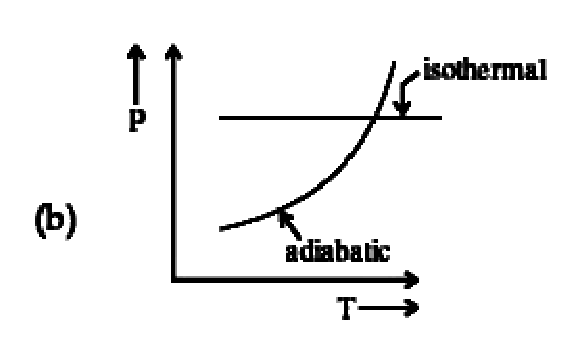
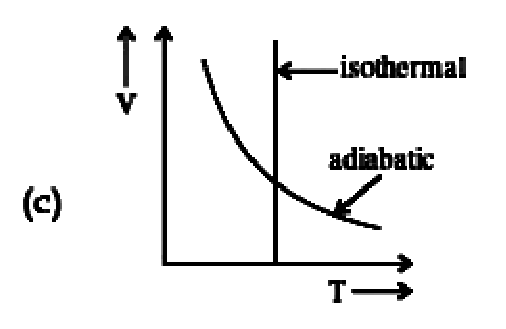
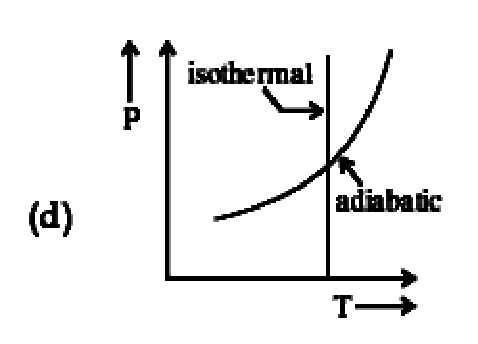
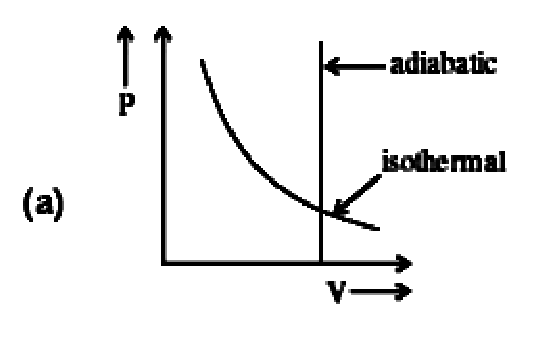
Which one is the correct option for the two different thermodynamic processes?

Figure

Figure

Figure

Figure

Show answer and solution

Answer: (b)

Loading the solution…
Report a mistake
Q16JEE Main 2021 · 1 SEP · SHIFT 2Medium

Heat, Work & First Law of Thermodynamics

The temperature of 3.00 mol of an ideal diatomic gas is increased by 40.0∘^\circC without changing the pressure of the gas. The molecules in the gas rotate but do not oscillate. If the ratio of change in internal energy of the gas to the amount of workdone by the gas is x10\frac{x}{10}. Then the value of x (round off to the nearest integer) is ___________. (Given R = 8.31 J mol−1{}^{-1} K−1{}^{-1})

Numerical answer type. Work it out, then open the answer.

Show answer and solution

Answer: 25

Loading the solution…
Report a mistake
Q17NEET 2019Medium

Heat, Work & First Law of Thermodynamics

1 g of water, of volume 1 cm31\text{ cm}^{3} at 100∘C100^\circ\text{C}, is converted into steam at same temperature under normal atmospheric pressure (≃1×10⁵ Pa\simeq 1 \times 10^{5}\text{ Pa}). The volume of steam formed equals 1671 cm31671\text{ cm}^{3}. If the specific latent heat of vaporisation of water is 2256 J/g2256\text{ J/g}, the change in internal energy is,

Show answer and solution

Answer: (c)

Loading the solution…
Report a mistake
Q18JEE Main 2019 · 12 JAN · SHIFT 2Difficult

Heat, Work & First Law of Thermodynamics

A vertical closed cylinder is separated into two parts by a frictionless piston of mass m and of negligible thickness. The piston is free to move along the length of the cylinder. The length of the cylinder above the piston is ℓ\ell1, and that below the piston is ℓ\ell2, such that ℓ\ell1 > ℓ\ell2. Each part of the cylinder contains n moles of an ideal gas at equal temperature T. If the piston is stationary, its mass, m, will be given by:

(R is universal gas constant and g is the acceleration due to gravity)

Show answer and solution

Answer: (a)

Loading the solution…
Report a mistake
Q19NEET 2018Medium

Heat, Work & First Law of Thermodynamics

A sample of 0.1 g of water at 100°C and normal pressure (1.013 × 10⁵ N m–2) requires 54 cal of heat energy to convert to steam at 100°C. If the volume of the steam produced is 167.1 cc, the change in internal energy of the sample, is

Show answer and solution

Answer: (b)

Loading the solution…
Report a mistake
Q20NEET 2009 · AIPMTEasy

Heat, Work & First Law of Thermodynamics

The internal energy change in a system that has absorbed 2 kcal of heat and done 500 J of work is

Show answer and solution

Answer: (c)

Loading the solution…
Report a mistake
Q21JEE Main 2003 · AIEEEEasy

Heat, Work & First Law of Thermodynamics

Which of the following parameters does not characterize the thermodynamic state of mattter?

Show answer and solution

Answer: (c)

Loading the solution…
Report a mistake
Q22NEET 1993 · AIPMTEasy

Heat, Work & First Law of Thermodynamics

Which of the following is not thermodynamical function?

Show answer and solution

Answer: (b)

Loading the solution…
Report a mistake
Q23NEET 1993 · AIPMTEasy

Heat, Work & First Law of Thermodynamics

110 joule of heat is added to a gaseous system whose internal energy is 40 J, then the amount of external work done is

Show answer and solution

Answer: (b)

Loading the solution…
Report a mistake
Q24NEET 1988 · AIPMTEasy

Heat, Work & First Law of Thermodynamics

First law of thermodynamics is consequence of conservation of

Show answer and solution

Answer: (b)

Loading the solution…
Report a mistake