0 of 255 attemptedPick an answer to see the solution
Q1MHT CET 2026 · 15 MAY · SHIFT 1Easy
Thermodynamic Processes · Types of processes: identify & compare
We consider a thermodynamic system. If ΔU is the increase in internal energy and W is the work done by the system, which one of the following statement is true?
When the temperature of 4 moles of a gas was increased from 70∘C to 90∘C, at constant volume, the change in internal energy was 60 J. The total heat capacity of the gas at constant volume is
In an adiabatic expansion, the temperature of one mole of an ideal monatomic gas ( γ=5/3) decreases from 60 K to 50 K. The work done by the gas in the process is:
(Take the universal gas constant as R=8.3 J mol−1 K−1)
Thermodynamic Processes · Types of processes: identify & compare
A vessel contains 0.15 m3 of a gas at pressure 8 bar and temperature 140 °C with cp=3R and cv=2R. It is expanded adiabatically till pressure falls to 1 bar. The work done during this process is _________ kJ. (R is gas constant)
Numerical answer type. Work it out, then open the answer.
Heat is supplied to a rigid diatomic gas at constant pressure. The ratio of ΔQ:ΔU:ΔW is {ΔQ= heat supplied,ΔU= change in internal energy ,ΔW= work done during expansion}
Two moles of a rigid diatomic gas does a work 4Q when the amount of heat supplied is Q. In this process the total heat capacity of the gas is (R = gas constant)
Heat required to raise the temperature of 2 mol of an ideal gas at constant pressure from 25∘C to 35∘ C is 310 J. The amount of heat required to raise the temperature of the gas through the same range at constant volume is
Six moles of oxygen gas is heated from 20∘C to 35∘C at constant volume. If specific heat capacity at constant pressure is 8 cal mol−1k −1 and gas constant is 2 cal mol−1k −1. The change in internal energy of the gas is
The r.m.s. speed of hydrogen at S.T.P. is 'u' m/s. If the gas is heated at constant pressure till its volume becomes three times, the final temperature of the gas and the r.m.s. speed are respectively
Two cylinders A and B fitted with pistons contain equal amount of an ideal diatomic gas at 303 K. The piston of cylinder A is free to move and that of cylinder B is held fixed. The same amount of heat is given to the gas in each cylinder. If the rise in temperature of the gas in cylinder B is 63 K then the rise in temperature of the gas in A is
The heat energy that must be supplied to 14 g of nitrogen at room temperature to raise its temperature by 48∘C at constant pressure is (R = gas constant, Molecular weight of nitrogen (N2) = 28)
The change in internal energy of the mass of gas, when the volume changes from V to 2V at constant pressure P is (γ is the ratio of specific heat at constant pressure to that of volume) (γ=CvCp)
If ΔQ is the amount of heat supplied to 'n' moles of a rigid diatomic gas at constant pressure, ΔU is the change in internal energy and ΔW is the work done then ΔW:ΔU:ΔQ is
5 moles of unknown gas is heated at constant volume from 10°C to 20°C. The molar specific heat of this gas at constant pressure cp=8 cal/mol.°C and R=8.36 J/mol.°C. The change in the internal energy of the gas is __________ calorie.
Numerical answer type. Work it out, then open the answer.
10 mole of oxygen is heated at constant volume from 30∘C to 40∘C. The change in the internal energy of the gas is ______ cal. (The molecular specific heat of oxygen at constant pressure, CP=7 cal/mol.∘C and R=2 cal./mol.∘C.)
Numerical answer type. Work it out, then open the answer.
Two identical containers A and B with friction-less pistons contain the same ideal gas at the same temperature and the same volume, V. The mass of gas in A is mA and that in B is mB. The gas in each cylinder is now allowed to expand isothermally to the same final volume 2V. The changes in pressure in A and B are found to be Δp and 3Δp respectively. Then
A rigid diatomic gas (γ=57) is compressed adiabatically to volume (32Vi), where Vi is the initial volume. The initial temperature of the gas is 'Ti ' K and the final temperature is 'xTi ' K. The value of x is
A gas at normal temperature is suddenly compressed to one-fourth of its original volume. If γ=1.5, then the increase in the temperature of the gas in Kelvin is (γ is the ratio of specific heats)
A monoatomic gas is stored in a thermally insulated container and the gas is suddenly compressed to (81)th of its initial volume. The ratio of final pressure to initial pressure is
Initial pressure and volume of a monoatomic ideal gas are P and V. The change in internal energy of this gas in adiabatic expansion to volume Vfinal =27V is ______ J.
The volume of an ideal gas increases 8 times and temperature becomes (1/4)th of initial temperature during a reversible change. If there is no exchange of heat in this process (ΔQ=0) then identify the gas from the following options (Assuming the gases given in the options are ideal gases):
An ideal gas having pressure P, volume V and temperature T is expanded isothermally, to a volume 3V and final pressure PI. The same gas is expanded adiabatically to a volume 3V, the final pressure being PA. The ratio PIPA is (CVCP=γ)
An ideal gas with pressure P, volume V and temperature T is expanded isothermally to volume 2V and a final pressure Pi. The same gas is expanded adiabatically to a volume 2V then the final pressure is Pa. In terms of γ, the ratio of the two specific heats for the gas, the ratio Pi/Pa is
Two samples A and B of gas initially at the same pressure and temperature. They are compressed from volume V to 2V (A isothermally and B adiabatically). The relation between pressure of the gas A (PA) and pressure of gas B (PB) is
One mole of an ideal diatomic gas expands from volume V to 2V isothermally at a temperature 27∘C and does W joule of work. If the gas undergoes same magnitude of expansion adiabatically from 27∘C doing the same amount of work W, then its final temperature will be (close to) ∘C.(loge2=0.693)
Thermodynamic Processes · Polytropic & other processes
An ideal rigid diatomic gas (γ=57) undergoes an adiabatic change. If the relation between temperature and volume is TVx= constant then the value of x is
Thermodynamic Processes · Polytropic & other processes
One mole of diatomic gas having rotational modes only is kept in a cylinder with a piston system. The cross-section area of the cylinder is 4 cm2. The gas is heated slowly to raise the temperature by 1.2∘C during which the piston moves by 25 mm. The amount of heat supplied to the gas is ______ J. (Atmospheric pressure =100 kPa,R=8.3 J/mol.K) (Neglect mass of the piston)
Thermodynamic Processes · Polytropic & other processes
The internal energy of a monoatomic gas is 3nRT. One mole of helium is kept in a cylinder having internal cross section area of 17 cm2 and fitted with a light movable frictionless piston. The gas is heated slowly by suppling 126 J heat. If the temperature rises by 4∘C, then the piston will move ______ cm.
A monoatomic ideal gas, initially at temperature T1 is enclosed in a cylinder fitted with a frictionless piston. The gas is allowed to expand adiabatically to a temperature T2 by releasing the piston suddenly. If L1 and L2 be the lengths of the gas column before and after expansion respectively, then T2T1 is
A cylinder with adiabatic walls is closed at both ends and is divided into two compartments by a frictionless adiabatic piston. Ideal gas is filled in both (left and right) the compartments at same P,V,T. Heating is started from left side until pressure changes to 27P/8. If initial volume of each compartment was 9 litres then the final volume in right-hand side compartment is ______ litres. (for this ideal gas CP/CV=1.5)
A monoatomic gas at pressure P having volume V expands isothermally to a volume 3V and then adiabatically to a volume 81 V. The final pressure of the gas is (γ=5/3).
Thermodynamic Processes · Polytropic & other processes
An ideal gas undergoes a process maintaining relation between pressure (P) and volume(V) as
P=P0(1+(VV0)2)−1, where P0 and V0 are constants. If two samples A and B (two moles each) with initial volumes V0 and 3V0 respectively undergo above mentioned process and attain same pressure, then the difference at the temperatures of these samples, TB−TA is ______. ( R= gas constant)
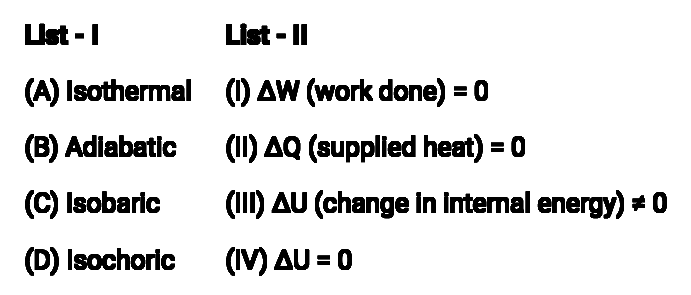
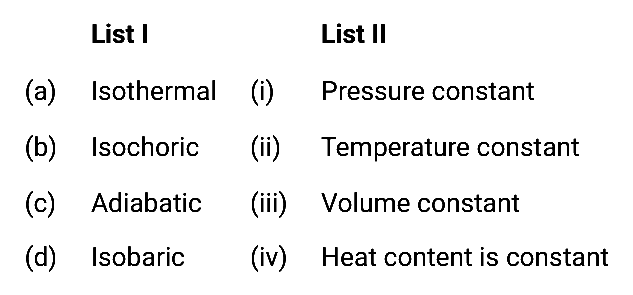
Thermodynamic Processes · Types of processes: identify & compare
During thermodynamic process, the increase in internal energy of a system is equal to the work done on the system. Which process does the system undergo?
Thermodynamic Processes · Types of processes: identify & compare
An ideal gas exists in a state with pressure P0, volume V0. It is isothermally expanded to 4 times of its initial volume (V0), then isobarically compressed to its original volume. Finally the system is heated isochorically to bring it to its initial state. The amount of heat exchanged in this process is
Thermodynamic Processes · Types of processes: identify & compare
Given below are two statements. One is labelled as Assertion (A) and the other is labelled as Reason (R).
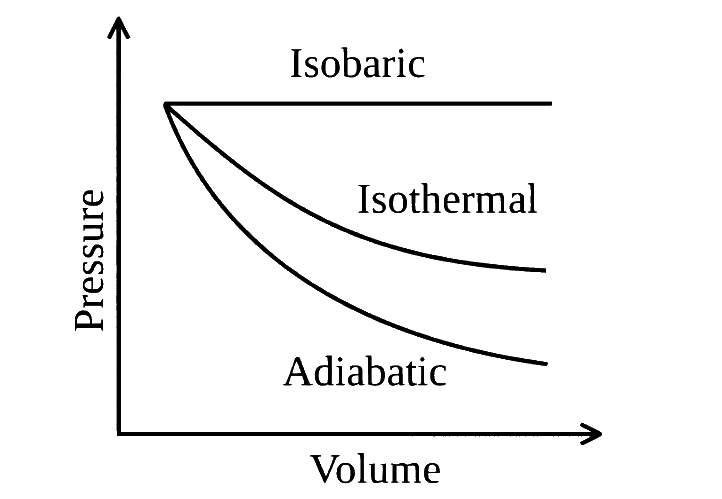
Assertion (A): With the increase in the pressure of an ideal gas, the volume falls off more rapidly in an isothermal process in comparison to the adiabatic process.
Reason (R): In isothermal process, PV = constant, while in adiabatic process PVγ = constant. Here γ is the ratio of specific heats, P is the pressure and V is the volume of the ideal gas. In the light of the above statements, choose the correct answer from the options given below:
Thermodynamic Processes · Types of processes: identify & compare
Given below are two statements. One is labelled as Assertion (A) and the other is labelled as Reason (R).
Assertion (A): In an insulated container, a gas is adiabatically shrunk to half of its initial volume. The temperature of the gas decreases.
Reason (R): Free expansion of an ideal gas is an irreversible and an adiabatic process. In the light of the above statements, choose the correct answer from the options given below:
Two cylinders A and B fitted with piston contain equal amount of an ideal diatomic gas at temperature T K. The piston of cylinder A is free to move while that of cylinder B is held fixed. The same amount of heat is given to the gas in each cylinder. If the rise of temperature of the gas in A is dTA, then the rise in temperature of the gas in B is (γ=CvCp)
The heat energy that must be supplied to 14 gram of nitrogen at room temperature to raise its temperature by 48∘C at constant pressure is (Molecular weight of nitrogen =28,R= gas constant, Cp=27R for diatomic gas)
Two cylinders A and B fitted with pistons contain equal amount of an ideal rigid diatomic gas at 303 K. The piston of cylinder A is free to move and that of cylinder B is held fixed. The same amount heat is given to the gas in each cylinder. If the rise in temperature of the gas in cylinder B is 49 K, then the rise in temperature of the gas in A is
A monoatomic ideal gas is heated at constant pressure. The percentage of total heat used in increasing the internal energy and that used for doing external work is A and B respectively. Then the ratio, A:B is
The temperature of 1 mole of an ideal monoatomic gas is increased by 50∘C at constant pressure. The total heat added and change in internal energy are E1 and E2, respectively. If E2E1=9x then the value of x is _________.
Numerical answer type. Work it out, then open the answer.
A monoatomic ideal gas is compressed adiabatically to (271) of its initial volume. If initial temperature of the gas is ' T ' K and final temperature is ' xT ' K, the value of ' x ' is
A diatomic gas (γ=57) is compressed adiabatically to volume 32V0, where V0 is its initial volume. The initial temperature of the gas is Ti in kelvin and the final temperature is xTi in kelvin. The value of x is
A monoatomic gas having γ=35 is stored in a thermally insulated container and the gas is suddenly compressed to (81)th of its initial volume. The ratio of final pressure and initial pressure is: (γ is the ratio of specific heats of the gas at constant pressure and at constant volume)
An ideal gas initially at 0∘C temperature, is compressed suddenly to one fourth of its volume. If the ratio of specific heat at constant pressure to that at constant volume is 3/2, the change in temperature due to the thermodynamic process is _________ K.
Numerical answer type. Work it out, then open the answer.
Thermodynamic Processes · Polytropic & other processes
A gas is kept in a container having walls which are thermally non-conducting. Initially the gas has a volume of 800 cm3 and temperature 27∘C. The change in temperature when the gas is adiabatically compressed to 200 cm3 is:
(Take γ=1.5;γ is the ratio of specific heats at constant pressure and at constant volume)
Thermodynamic Processes · Types of processes: identify & compare
Three samples X,Y, and Z of same gas have equal volumes and temperatures. The volume of each sample is doubled, the process being isothermal for X, adiabatic for Y and isobaric for Z. If the final pressures are equal for the three samples, the ratio of the initial pressures is ( γ=3/2)
Two gases A and B are filled at the same pressure in separate cylinders with movable pistons of radius rA and rB, respectively. On supplying an equal amount of heat to both the systems reversibly under constant pressure, the pistons of gas A and B are displaced by 16 cm and 9 cm, respectively. If the change in their internal energy is the same, then the ratio rBrA is equal to
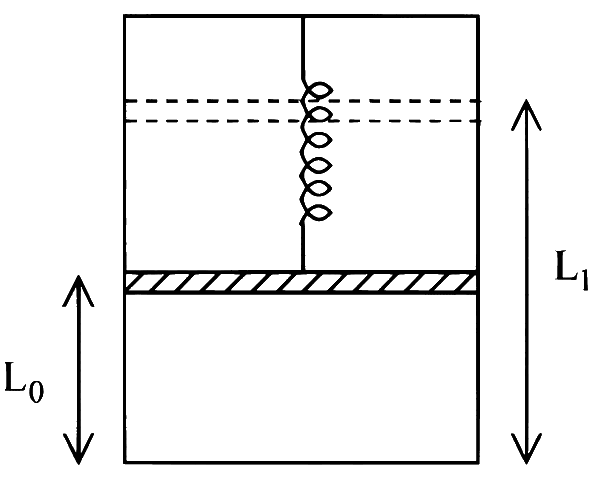
A piston of mass M is hung from a massless spring whose restoring force law goes as F=−kx3, where k is the spring constant of appropriate dimension. The piston separates the vertical chamber into two parts, where the bottom part is filled with ' n ' moles of an ideal gas. An external work is done on the gas isothermally (at a constant temperature T) with the help of a heating filament (with negligible volume) mounted in lower part of the chamber, so that the piston goes up from a height L0 to L1, the total energy delivered by the filament is:(Assume spring to be in its natural length before heating)
A monoatomic ideal gas, initially at temperature T1 is enclosed in a cylinder fitted with massless, frictionless piston. By releasing the piston suddenly, the gas is allowed to expand adiabatically to a temperature T2. If L1 and L2 are the lengths of the gas columns before and after expansion respectively, then (T2/T1) is given by
A polyatomic gas at pressure P, having volume ' V ' expands isothermally to a volume ' 3 V ' and then adiabatically to a volume ' 24 V '. The final pressure of gas is (for moderate temperature changes)
Thermodynamic Processes · Polytropic & other processes
A gas undergoes a change in which its pressure ' P ' and volume ' V ' are related as PVn= constant, where n is a constant. If the specific heat of the gas in this change is zero, then the value of n is ( γ= adiabatic ratio)
Thermodynamic Processes · Types of processes: identify & compare
In a thermodynamic system ' ΔU ' represents the increase in internal energy and ' W ' the work done by the system. Which of the following statement is true?
The internal energy of an ideal diatomic gas corresponding to volume ' V ' and pressure ' P ' is 2.5 PV. The gas expands from 1 litre to 2 litre at a constant pressure of 105 N/m2. The heat supplied to a gas is
A quantity of heat ' Q ' is supplied to monoatomic ideal gas which expands at constant pressure. The fraction of heat converted into work is [γ=CvCp=35]
Two cylinders A and B fitted with piston contain equal amount of an ideal diatomic as at temperature ' T ' K. The piston of cylinder A is free to move while that of B is held fixed. The same amount of heat is given to the gas in each cylinder. If the rise temperature of the gas in A is ' dTA ', then the rise in temperature of the gas in cylinder B is (γ=CvCp)
For an ideal gas, in an isobaric process, the ratio of heat supplied ' Q ' to the work done ' w ' by the system is ( γ= ratio of specific heat at constant pressure to that at constant volume)
The change in the internal energy of the mass of gas, when the volume changes from ' V ' to ' 2 V ' at constant pressure ' P ' is ( γ is the ratio of specific heat of gas at constant pressure to specific heat at constant volume)
The r.m.s. velocity of hydrogen at S.T.P. is ' u ' m/s. If the gas is heated at constant pressure till its volume becomes three times, then the final temperature of the gas and the r.m.s. speed are respectively
A fixed mass of gas at constant pressure occupies a volume ' V '. The gas undergoes a rise in temperature so that the r.m.s. velocity of the molecules is doubled. The new volume will be
0.08 kg air is heated at constant volume through 5∘C. The specific heat of air at constant volume is 0.17 kcal/kg∘C and J=4.18 joule/ cal. The change in its internal energy is approximately.
One mole of an ideal gas at an initial temperature of ' T ' K does ' 6R ' of work adiabatically. If the ratio of specific heats of this gas at constant pressure and at constant volume is 5/3, the final temperature of gas will be (R=8.31 J mole−1 K−1)
A sample of 1 mole gas at temperature T is adiabatically expanded to double its volume. If adiabatic constant for the gas is γ=23, then the work done by the gas in the process is:
During an adiabatic process, if the pressure of a gas is found to be proportional to the cube of its absolute temperature, then the ratio of CVCP for the gas is:
A sample of gas at temperature T is adiabatically expanded to double its volume. Adiabatic constant for the gas is γ=3/2. The work done by the gas in the process is:
During an adiabatic process, the pressure of a gas is found to be proportional to the cube of its absolute temperature. The ratio of CvCp for the gas is:
Two gases A and B having same initial state ( P,V,n,T ). Now gas A is compressed to 8V by isothermal process and other gas B is compressed to 8V by adiabatic process. The ratio of final pressure of gas A and B is (Both gases are monoatomic, γ=5/3)
Initial pressure and volume of a gas are ' P ' and ' V ' respectively. First its volume is expanded to ' 4 V ' by isothermal process and then again its volume is reduced to ' V ' by adiabatic process then its final pressure if (γ=23)
There are two samples A and B of a certain gas, which are initially at the same temperature and pressure. Both are compressed from volume v to 2v. Sample A is compressed isothermally while sample B is compressed adiabatically. The final pressure of A is
Thermodynamic Processes · Polytropic & other processes
In an adiabatic process for an ideal gas, the relation between the universal gas constant ' R ' and specific heat at constant volume ' Cv ' is R=0.4Cv. The pressure ' P ' of the gas is proportional to the temperature ' T ', of the gas as Tk. The value of constant ' K ' is
Thermodynamic Processes · Polytropic & other processes
A total of 48 J heat is given to one mole of helium kept in a cylinder. The temperature of helium increases by 2∘C. The work done by the gas is: Given, R=8.3 J K−1 mol−1.
Thermodynamic Processes · Polytropic & other processes
The pressure and volume of an ideal gas are related as PV23=K (Constant). The work done when the gas is taken from state A(P1,V1,T1) to state B(P2,V2,T2) is:
A monoatomic ideal gas, initially at temperature T1 is enclosed in a cylinder fitted with frictionless piston. The gas is allowed to expand adiabatically to a temperature T2 by releasing the piston suddenly. L1 and L2 are the lengths of the gas columns before and after the expansion respectively. The ratio T2/T1 is
Thermodynamic Processes · Polytropic & other processes
During an experiment, an ideal gas is found to obey an additional law VP2= constant. The gas is initially at temperature ' T ' and volume ' V '. What will be the temperature of the gas when it expands to a volume 2 V?
Thermodynamic Processes · Types of processes: identify & compare
In a thermodynamic system, ΔU represents the increases in its internal energy and dW is the work done by the system then correct statement out of the following is
dQ is the heat energy supplied to an ideal gas under isochoric conditions. If dU and dW denote the change in internal energy and the work done respectively then
The initial pressure and volume of an ideal gas are P0 and V0. The final pressure of the gas when the gas is suddenly compressed to volume 4V0 will be:
(Given γ = ratio of specific heats at constant pressure and at constant volume)
A gas is compressed at a constant pressure of 50 N/m2 from a volume of 10 m3 to a volume of 4 m3. Energy of 100 J is then added to the gas by heating. Its internal energy is
Heat energy of 735 J is given to a diatomic gas allowing the gas to expand at constant pressure. Each gas molecule rotates around an internal axis but do not oscillate. The increase in the internal energy of the gas will be:
A diatomic gas (γ=57) is compressed adiabatically to volume 32Vi where Vi is its initial volume. The initial temperature of the gas is Ti in Kelvin and the final temperature is 'xTi '. The value of 'x' is
A sample of gas at temperature T is adiabatically expanded to double its volume. The work done by the gas in the process is (CVCP=γ=23)(R= gas constant )
A gas at N.T.P. is suddenly compressed to (41)th of its original volume. The final pressure in (Given γ= ratio of sp. heats =23) atmosphere is ( P= original pressure)
A hypothetical gas expands adiabatically such that its volume changes from 8 litres to 27 litres. If the ratio of final pressure of the gas to initial pressure of the gas is 8116. Then the ratio of CvCp will be.
A monoatomic gas at pressure 'P', having volume 'V' expands isothermally to a volume '2V' and then adiabatically to a volume ' 16V'. The final pressure of the gas is (Take γ=5/3)
Consider two containers A and B containing monoatomic gases at the same Pressure (P), Volume (V) and Temperature (T). The gas in A is compressed isothermally to 81 of its original volume while the gas in B is compressed adiabatically to 81 of its original volume. The ratio of final pressure of gas in B to that of gas in A is
A monoatomic ideal gas initially at temperature 'T1 ' is enclosed in a cylinder fitted with massless, frictionless piston. By releasing the piston suddenly the gas is allowed to expand to adiabatically to a temperature 'T2 '. If 'L1 ' and 'L2' are the lengths of the gas columns before and after expansion respectively, then T1T2 is
Thermodynamic Processes · Types of processes: identify & compare
Starting with the same initial conditions, an ideal gas expands from volume V1 to V2 in three different ways. The work done by the gas is W1 if the process is purely isothermal, W2, if the process is purely adiabatic and W3 if the process is purely isobaric. Then, choose the correct option
Thermodynamic Processes · Types of processes: identify & compare
Given below are two statements:
Statement I: When μ amount of an ideal gas undergoes adiabatic change from state (P1, V1, T1) to state (P2, V2, T2), then work done is W=1−γμR(T2−T1), where γ=CvCp and R = universal gas constant. Statement II: In the above case, when work is done on the gas, the temperature of the gas would rise.
Choose the correct answer from the options given below:
7 mol of a certain monoatomic ideal gas undergoes a temperature increase of 40 K at constant pressure. The increase in the internal energy of the gas in this process is:
At a certain temperature, the degrees of freedom per molecule for gas is 8. The gas performs 150 J of work when it expands under constant pressure. The amount of heat absorbed by the gas will be _________ J.
Numerical answer type. Work it out, then open the answer.
A monoatomic gas (γ=35) initially at 27∘C having volume 'V' is suddenly compressed to one- eighth of its original volume (8V). After the compression its temperature becomes
A monoatomic gas at pressure P and volume V is suddenly compressed to one eighth of its original volume. The final pressure at constant entropy will be:
A sample of monoatomic gas is taken at initial pressure of 75 kPa. The volume of the gas is then compressed from 1200 cm3 to 150 cm3 adiabatically. In this process, the value of workdone on the gas will be:
The pressure P1 and density d1 of diatomic gas (γ=57) changes suddenly to P2(>P1) and d2 respectively during an adiabatic process. The temperature of the gas increases and becomes ________ times of its initial temperature. (given d1d2=32)
Numerical answer type. Work it out, then open the answer.
A certain amount of gas of volume V at 27∘C temperature and pressure 2×10⁷ Nm−2 expands isothermally until its volume gets doubled. Later it expands adiabatically until its volume gets redoubled. The final pressure of the gas will be (Use γ=1.5):
Thermodynamic Processes · Polytropic & other processes
An ideal gas follows a process described by the equation PV2=C from the initial (P1,V1,T1) to final (P2,V2,T2) thermodynamic states, where C is a constant. Then
Thermodynamic Processes · Polytropic & other processes
A monoatomic gas performs a work of 4Q where Q is the heat supplied to it. The molar heat capacity of the gas will be ______________ R during this transformation. Where R is the gas constant.
Numerical answer type. Work it out, then open the answer.
Thermodynamic Processes · Types of processes: identify & compare
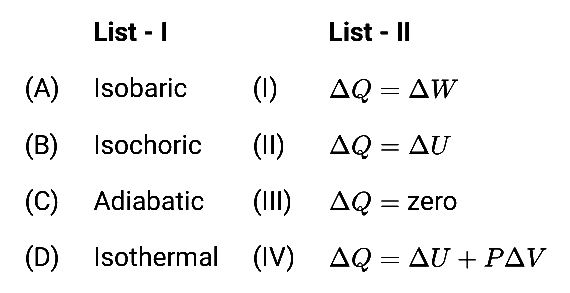
Which one of the following equations specifies an isobaric process? [Q= heat supplied ΔP,ΔV and ΔT are change in pressure, volume and temperature respectively]
A monoatomic gas is suddenly compressed to (1/8)th of its initial volume adiabatically. The ratio of the final pressure to initial pressure of the gas is (γ=5/3)
An ideal gas at pressure 'p' is adiabatically compressed so that its density becomes twice that of the initial. If γ=cvcp=57, then final pressure of the gas is
An ideal gas at 27∘C is compressed adiabatically to (8/27) of its original volume. If ratio of specific heats, γ=5/3 then the rise in temperature of the gas is
The relation obeyed by a perfect gas during an adiabatic process is PV3/2. The initial temperature of the gas is 'T'. When the gas is compressed to half of its Initial volume, the final temperature of the gas is
A monoatomic gas is suddenly compressed to (1/8)th of its initial volume adiabatically. The ratio of the final pressure to initial pressure of the gas is (γ=5/3)
One mole of an ideal gas expands adiabatically at constant pressure such that its temperature T∝V1. The value of γ for the gas is (γ=CvCp,V= Volume of the gas)
One mole of an ideal gas is taken through an adiabatic process where the temperature rises from 27∘ C to 37∘ C. If the ideal gas is composed of polyatomic molecule that has 4 vibrational modes, which of the following is true? [R = 8.314 J mol−1 K−1]
A sample of gas with γ = 1.5 is taken through an adiabatic process in which the volume is compressed from 1200 cm3 to 300 cm3. If the initial pressure is 200 kPa. The absolute value of the workdone by the gas in the process = _____________ J.
Numerical answer type. Work it out, then open the answer.
An ideal gas with pressure P, volume V and temperature T is expanded isothermally to a volume 2V and a final pressure Pi. The same gas is expanded adiabatically to a volume 2V, the final pressure is Pa. In terms of the ratio of the two specific heats for the gas 'γ', the ratio PaPi is
The initial pressure and volume of a gas is 'P' and 'V' respectively. First by isothermal process gas is expanded to volume '9V' and then by adiabatic process its volume is compressed to 'V' then its final pressure is (Ratio of specific heat at constant pressure to constant volume =23)
A monoatomic gas at pressure 'P' having volume 'V' expands isothermally to a volume 2V and then adiabatically to a volume 16V. The final pressure of the gas is (γ=35)
Thermodynamic Processes · Polytropic & other processes
1 mole of rigid diatomic gas performs a work of 5Q when heat Q is supplied to it. The molar heat capacity of the gas during this transformation is 8xR. The value of x is _________. [R = universal gas constant]
Numerical answer type. Work it out, then open the answer.
Thermodynamic Processes · Polytropic & other processes
The volume V of a given mass of monoatomic gas changes with temperature T according to the relation V=KT32. The workdone when temperature changes by 90K will be xR. The value of x is _________. [R = universal gas constant]
Numerical answer type. Work it out, then open the answer.
Thermodynamic Processes · Polytropic & other processes
In a certain thermodynamical process, the pressure of a gas depends on its volume as kV3. The work done when the temperature changes from 100∘ C to 300∘C will be ___________ nR, where n denotes number of moles of a gas.
Numerical answer type. Work it out, then open the answer.
A monoatomic ideal gas initially at temperature T1 is enclosed in a cylinder fitted with 8 frictionless piston. The gas is allowed to expand adiabatically to a temperature T2 by releasing the piston suddenly. L1 and L2 are the lengths of the gas columns before and after the expansion respectively. Then T1T2 is
A monoatomic ideal gas, initially at temperature T1 is enclosed in a cylinder fitted with a frictionless piston. The gas is allowed to expand adiabatically to a temperature T2 by releasing the piston suddenly. If l1 and l2 are the lengths of the gas column, before and after the expansion respectively, then the value of T2T1 will be:
Thermodynamic Processes · Types of processes: identify & compare
Two cylinders A and B of equal capacity are connected to each other via a stop cock. A contains an ideal gas at standard temperature and pressure. B is completely evacuated. The entire systems is thermally insulated. The stop cock is suddenly opened. The Process is:
To raise the temperature of a certain mass of gas by 50oC at a constant pressure, 160 calories of heat is required. When the same mass of gas is cooled by 100oC at constant volume, 240 calories of heat is released. How many degrees of freedom does each molecule of this gas have (assume gas to be ideal)?
In an adiabatic process, the density of a diatomic gas becomes 32 times its initial value. The final pressure of the gas is found to be n times the initial pressure. The value of n is:
A litre of dry air at STP expands adiabatically to a volume of 3 litres. If γ = 1.40, the work done by air is: (31.4 = 4.6555) [Take air to be an ideal gas]
An engine takes in 5 moles of air at 20oC and 1 atm, and compresses it adiabatically to 1/10th of the original volume. Assuming air to be a diatomic ideal gas made up of rigid molecules, the change in its internal energy during this process comes out to be X kJ. The value of X to the nearest integer is________.
Numerical answer type. Work it out, then open the answer.
A monoatomic gas of pressure p having volume V expands isothermally to a volume 2V and then adiabatically to a volume 16V. The final pressure of the gas is (ratio of specific heats =35
Thermodynamic Processes · Types of processes: identify & compare
Starting at temperature 300 K, one mole of an
ideal diatomic gas (γ = 1.4) is first compressed
adiabatically from volume V1 to V2 = 16V1. It is
then allowed to expand isobarically to volume 2V2. If all the processes are the quasi-static then the final temperature of the gas (in oK) is (to the nearest integer) _____.
Numerical answer type. Work it out, then open the answer.
Under an adiabatic process, the volume of an ideal gas gets doubled. Consequently the mean collision time between the gas molecule changes from τ1 to τ2. If CvCp=γ for this gas then a good estimate for τ1τ2 is given by:
Thermodynamic Processes · Polytropic & other processes
A rigid diatomic ideal gas undergoes an adiabatic process at room temperature. The relation between temperature and volume for this process is TVx = constant, then x is:
A diatomic gas with rigid molecules does 10 J of work when expanded at constant pressure. What would be the heat energy absorbed by the gas, in this process?
When heat Q is supplied to a diatomic gas of rigid molecules, at constant volume its temperature increases by ΔT. the heat required to produce the same change in temperature, at a constant pressure is:
n moles of an ideal gas with constant volume heat capcity CV undergo an isobaric expansion by certain volume. The ratio of the work done in the process, to the heat supplied is:
Half mole of an ideal monoatomic gas is heated at constant pressure of 1 atm from 20oC to 90oC. Work done by gas is close to – (Gas constant R = 8.31 J/mol.K)
Thermodynamic Processes · Polytropic & other processes
In a process, temperature and volume of one mole of an ideal monoatomic gas are varied according to the relation VT = K, where K is a constant. In this process the temperature of the gas is increased by ΔT. The amount of heat absorbed by gas is (R is gas constant):
One mole of an ideal monoatomic gas is compressed isothermally in a rigid vessel to double its pressure at room temperature, 27∘C. The work done on the gas will be:
Two moles of an ideal monatomic gas occupies a volume V at 27oC. The gas expands adiabatically to a volume 2 V. Calculate (a) the final temperature of the gas and (b) change in its internal energy.
Thermodynamic Processes · Types of processes: identify & compare
A gas is compressed isothermally to half its initial volume. The same gas is compressed separately through an adiabatic process until its volume is again reduced to half. Then
Thermodynamic Processes · Polytropic & other processes
An ideal gas undergoes a quasi static, reversible process in which its molar heat capacity C remains constant. If during this process the relation of pressure P and volume V is given by PVn= constant, then n is given by (Here Cp and Cv are molar specific heat at constant pressure and constant volume, respectively:
Thermodynamic Processes · Types of processes: identify & compare
Consider a spherical shell of radius R at temperature T. The black body radiation inside it can be considered as an ideal gas of photons with internal energy per unit volume u=VU∝T4 and pressure p=31(VU). If the shell now undergoes an adiabatic expansion the relation between T and R is:
Consider an ideal gas confined in an isolated closed chamber. As the gas undergoes an adiabatic expansion, the average time of collision between molecules increases as Vq, where V is the volume of the gas. The value of q is: (γ=CvCp)
A gas is compressed from a volume of 2 m3 to a volume of 1 m3 at a constant pressure of 100 N/m2. Then it is heated at constant volume by supplying 150 J of energy. As a result, the internal energy of the gas:
During an adiabatic compression, 830 J of work is done on 2 moles of a diatomic ideal gas to reduce its volume by 50%. The change in its temperature is nearly: (R = 8.3 JK−1 mol−1)
A monatomic gas at a pressure P, having a volume V expands isothermally to a volume 2V and then adiabatically to a volume 16V. The final pressure of the gas is (Take γ = 5/3)
The equation of state for a gas is given by PV = nRT + αV, where n is the number of moles and α is a positive constant. The initial temperature and pressure of one mole of the gas contained in a cylinder are To and Po respectively. The work done by the gas when its temperature doubles isobarically will be:
In the isothermal expansion of 10 g of gas from volume V to 2V the work done by the gas is 575 J. What is the root mean square speed of the molecules of the gas at that temperature?
An ideal gas at atmospheric pressure is adiabatically compressed so that its density becomes 32 times of its initial value. If the final pressure of gas is 128 atmospheres, the value of 'γ' of the gas is:
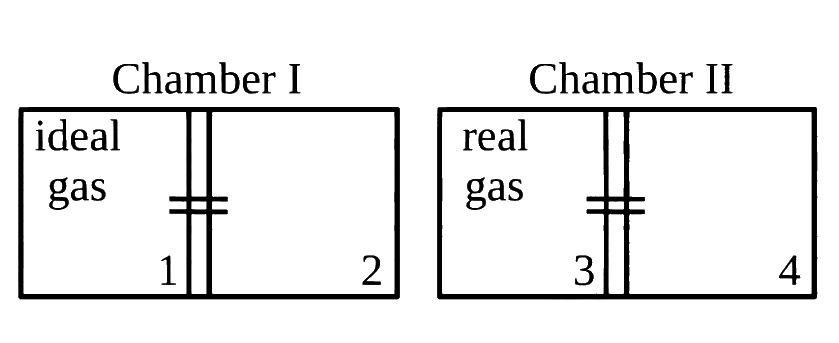
There are two identical chambers, completely thermally insulated from surroundings. Both chambers have a partition wall dividing the chambers in two compartments. Compartment 1 is filled with an ideal gas and Compartment 3 is filled with a real gas. Compartments 2 and 4 are vacuum. A small hole (orifice) is made in the partition walls and the gases are allowed to expand in vacuum. Statement - 1: No change in the temperature of the gas takes place when ideal gas expands in vacuum. However, the temperature of real gas goes down (cooling) when it expands in vacuum. Statement - 2: The internal energy of an ideal gas is only kinetic. The internal energy of a real gas is kinetic as well as potential.
A mass of diatomic gas (γ=1.4) at a pressure of 2 atmospheres is compressed adiabatically so that its temperature rises from 27oC to 927oC. The pressure of the gas in the final state is
Thermodynamic Processes · Types of processes: identify & compare
If ΔU and ΔW represent the increase in internal energy and work done by the system respectively in a thermodynamical process, which of the following is true?
The work of 146 kJ is performed in order to compress one kilo mole of gas adiabatically and in this process the temperature of the gas increases by 7∘C. The gas is (R=8.3 J mol−1 K−1)
One mole of an ideal gas at an initial temperature of T K does 6R joule of work adiabatically. If the ratio of specific heats of this gas at constant pressure and at constant volume is 5/3, the final temperature of gas will be
During an adiabatic process, the pressure of a gas is found to be proportional to the cube of its absolute temperature. The ratio Cp/CV for the gas is
Thermodynamic Processes · Types of processes: identify & compare
We consider a thermodynamic system. If ΔU represents the increase in its internal energy and W the work done by the system, which of the following statements is true?
If the ratio of specific heat of a gas at constant pressure to that at constant volume is γ, the change in internal energy of a mass of gas, when the volume changes from V to 2V at constant pressure P is
One mole of an ideal gas requires 207 J heat to rise the temperature by 10 K when heated at constant pressure. If the same gas is heated at constant volume to raise the temperature by the same 10 K, the heat required is