A capacitor of unknown capacitance is connected across a battery of ′V′ volt. The charge stored in it is ′Q′ C. When potential across the capacitor is reduced by ′V1′ volt, the charge stored in it becomes ′Q1′ C. The potential ′V′ is
Consider the earth to be a sphere, having charge Q. Let R,V and A be its radius, volume and area respectively. The capacitance of the earth is [ε0 = permittivity of free space]
The earth is assumed to be a charged conducting sphere having volume 'V' and surface area 'A'. The capacitance of the earth in free space is (ϵ0 = permittivity of free space)
A capacitor of unknown capacity is connected across a battery of V volt. The charge stored in it is Q coulomb. When potential across the capacitor is reduced by V1 volt, the charge stored in it becomes Q1 coulomb. The potential V is
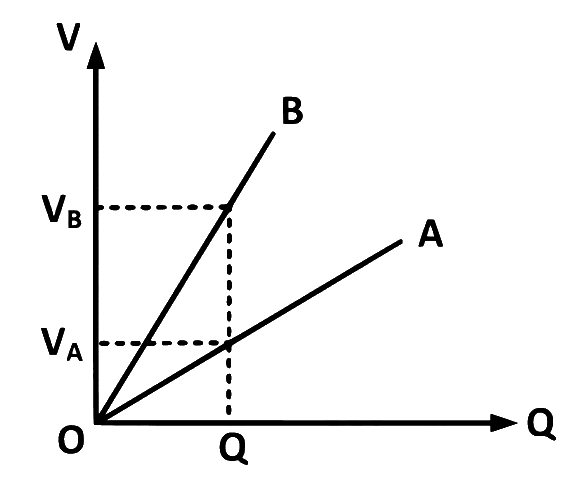
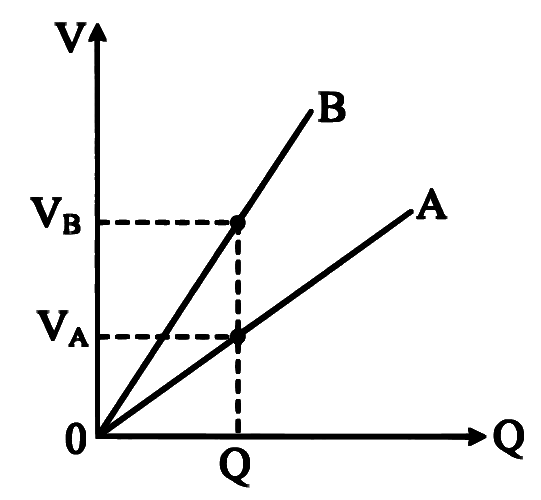
The graph shows the variation of voltage (v) across the plates of two parallel plate capacitos A and B versus increase of charge Q stored in them. Then
Given below are two statements: One is labeled as Assertion A and the other is labeled as Reason R.
Assertion A: Two metallic spheres are charged to the same potential. One of them is hollow and another is solid, and both have the same radii. Solid sphere will have lower charge than the hollow one.
Reason R: Capacitance of metallic spheres depends on the radii of spheres
In light of the above statements, choose the correct answer from the options given below.
Two spherical conductors of capacities 3μF and 2μF are charged to same potential having radii 3 cm and 2 cm respectively. If 'σ1 ' and 'σ2' represent surface density of charge on respective conductors then σ2σ1 is
A condenser of 2μF capacitance is charged steadily from 0 to 5 C. Which of the following graph represents correctly the variation of potential difference (V) across it's plates with respect to the charge (Q) on the condenser?
Capacitance of an isolated conducting sphere of radius R1 becomes n times when it is enclosed by a concentric conducting sphere of radius R2 connected to earth. The ratio of their radii (R1R2) is:
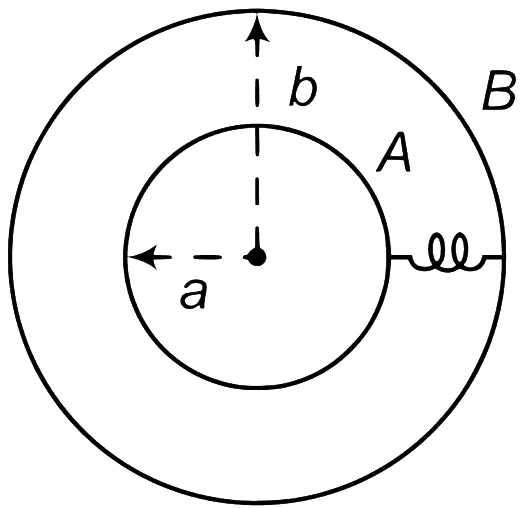
Two spherical conductors A and B of radii a and b (b>a) are placed concentrically in air. The two are connected by a copper wire as shown in figure. The equivalent capacitance of the system is
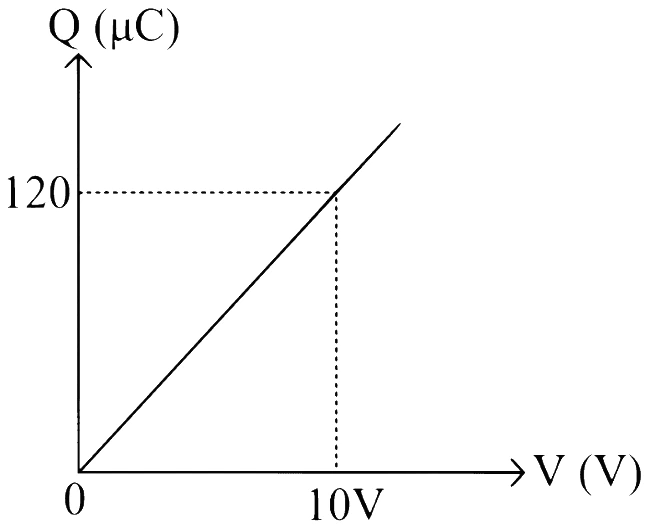
In figure, charge on the capacitor is plotted against potential difference across the capacitor. The capacitance and energy stored in the capacitor are respectively.
216 identical spherical drops of each having a positive charge of 10nC combine to form a big spherical drop. If the radius of each small drop is 3mm, then the capacitance and electric potential of the big drop are respectively
The capacitance of a spherical capacitor is 100pF. If the spacing between the two spheres is 1cm, then the radius of the inner sphere of the capacitor is
The radii of the inner and outer spheres of a spherical capacitor are 8cm and 9cm respectively. The outer sphere is earthed and the inner sphere is charged. If the space between the concentric spheres is filled with a liquid of dielectric constant 5, the capacitance of the capacitor is
Eight drops of mercury of equal radii and possessing equal charge combine to form a big drop. If the capacity of each drop is C, then capacity of the big drop is
The capacitance of an isolated sphere of radius r1 is increased by 5 times, when it is enclosed by an earthed concentric sphere of radius r2. The ratio of their radii r1:r2 is
If a capacitor of capacitance 100μF is charged at a steady rate of 100μC s−1, then the time taken to produce a potential difference of 100V between the capacitor plates is
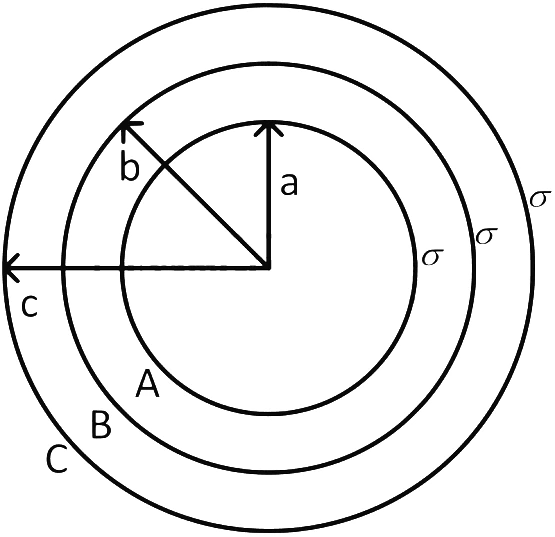
Three concentric metallic shells A, B and C of radii a, b and c (a<b<c) have surface charge densities +σ, −σ and +σ respectively. The potential of shell B is
A capacitor with capacitance C0 consists of two concentric spherical conductors. If the radii of the inner and the outer spherical conductors are halved, what is the new capacitance?
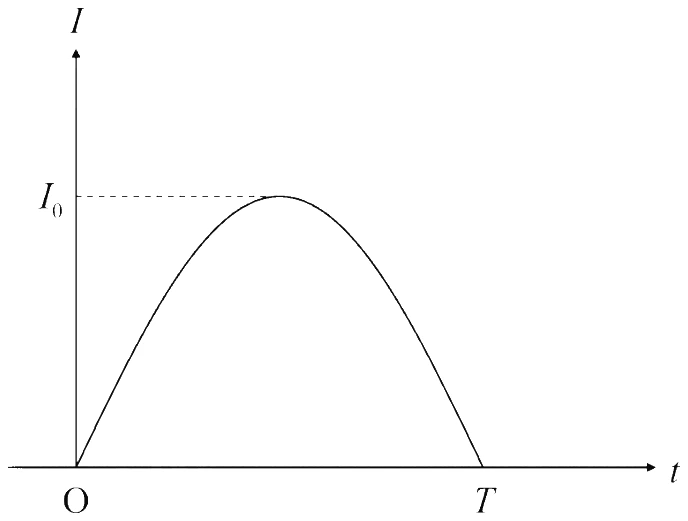
The figure on the right represents an idealized sinusoidal current flow between a cloud at a height of 1km and the earth during lightning discharge. Here I0=157kA, T=0.2ms and the breakdown electric field of air is 300kV/m. Then
More than one option can be correct. Tap every correct option, then tap Check.