Statement I: For a mechanical system of many particles total kinetic energy is the sum of kinetic energies of all the particles.
Statement II: The total kinetic energy can be the sum of kinetic energy of the center of mass w.r.t. the origin and the kinetic energy of all the particles w.r.t. the center of mass as the reference. In the light of the above statements, choose the correct answer from the options given below:
Two identical bodies A and B of equal masses have initial velocities v1=4i^ m/s and v2=4j^ m/s respectively. The body A has acceleration a1=6i^+6j^ m/s2 while the acceleration of the other body B is zero. The centre of mass of the two bodies moves in ______ path.
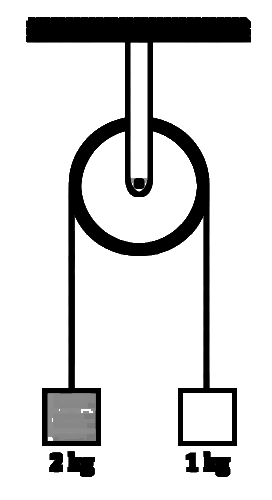
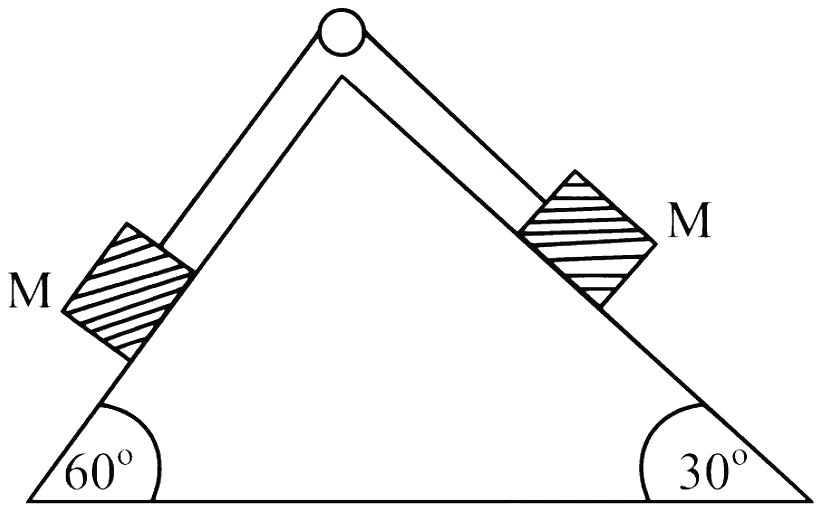
Two blocks of masses 2 kg and 1 kg respectively, are tied to the ends of a string which passes over a light frictionless pulley as shown in the figure below. The masses are held at rest at the same horizontal level and then released. The distance traversed by the centre of mass in 2 s is _______ m. (Take g=10 m/s2)
In projectile motion two particles of masses m1 and m2 have velocities V1, and V2 respectively at time t=0. Their velocities becomeV1′and V2′ at time 2 t while still moving in air. The value of [(m1V1′+m2V2′)−(m1V1+m2V2)] is ( g= acceleration due to gravity)
Two particles A and B initially at rest, move towards each other under mutual force of attraction. At an instance when the speed of A is v and speed of B is 3v, the speed of centre of mass is:
Given below are two statements: One is labelled as Assertion (A) and the other is labelled as Reason (R).
Assertion (A): When a fire cracker (rocket) explodes in mid air, its fragments fly in such a way that they continue moving in the same path, which the fire cracker would have followed, had it not exploded.
Reason (R): Explosion of cracker (rocket) occurs due to internal force only and no external force acts for this explosion.
In the light of the above statements, choose the most appropriate answer from the options given below
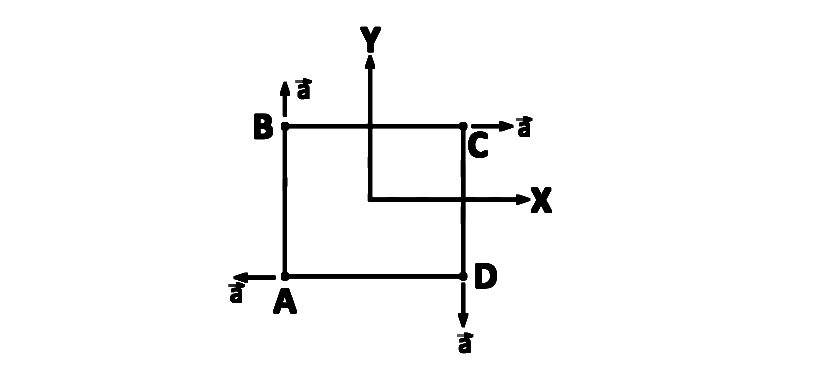
Four particles A, B, C and D with masses mA = m, mB = 2m, mC = 3m and mD = 4m are at the corners of a square. They have accelerations of equal magnitude with directions as shown. The acceleration of the centre of mass of the particles is:
Two spherical bodies of mass M and 5M and radii R and 2R are released in free space with initial separation between their centres equal to 12R. If they attract each other due to gravitational force only, then the distance covered by the smaller body before collision is:
A boy of mass 20 kg is standing on a 80 kg free to move long cart. There is negligible friction between cart and ground. Initially, the boy is standing 25 m from a wall. If he walks 10 m on the cart towards the wall, then the final distance of the boy from the wall will be
A projectile of mass M is fired so that the horizontal range is 4 km. At the highest point the projectile explodes in two parts of masses M/4 and 3M/4 respectively and the heavier part starts falling down vertically with zero initial speed. The horizontal range (distance from point of firing) of the lighter part is:
Two persons of masses 55 kg and 65 kg respectively, are at the opposite ends of a boat. The length of the boat is 3.0 m and weights 100 kg. The 55 kg man walks up to the 65 kg man and sits with him. If the boat is in still water the centre of mass of the system shifts by:
Two particles which are initially at rest, move towards each other under the action of their internal attraction. If their speeds are v and 2v at any instant, then the speed of centre of mass of the system will be:
A body A of mass M while falling vertically downwards under gravity breaks into two-parts; a body B of mass 31M and a body C of mass 32M. The center of mass of bodies B and C taken together shifts compared to that of body A towards
Two astronauts X and Y float in deep space far from external forces. Initially, they are at rest relative to one another. X throws a tool towards Y. Consider the two astronauts and the tool as one system. Which one of the following statements is correct?
Let there be an object having some chemicals in it. It starts moving with a uniform velocity v and a chemical reaction starts happening. In this case, which of the following statement/s is/are correct? 1. Chemical reactions happening in the system cannot change the velocity v of the center of mass of the object. 2. Chemical reactions happening in the system cannot change kinetic energy of the particles inside with respect to the center of mass of object. Select the correct answer using the code given below:
A particle of mass M=0.2kg is initially at rest in the xy-plane at a point (x=−l,y=−h), where l=10m and h=1m. The particle is accelerated at time t=0 with a constant acceleration a=10m s−2 along the positive x-direction. Its angular momentum and torque with respect to the origin, in SI units, are represented by L and τ respectively. i^, j^ and k^ are unit vectors along the positive x, y and z-directions, respectively. If k^=i^×j^ then which of the following statement(s) is(are) correct?
More than one option can be correct. Tap every correct option, then tap Check.
One end of a horizontal uniform beam of weight W and length L is hinged on a vertical wall at point O and its other end is supported by a light inextensible rope. The other end of the rope is fixed at point Q, at a height L above the hinge at point O. A block of weight αW is attached at the point P of the beam, as shown in the figure (not to scale). The rope can sustain a maximum tension of (22)W. Which of the following statement(s) is(are) correct?
More than one option can be correct. Tap every correct option, then tap Check.
Three bodies having masses 5kg, 4kg and 2kg is moving at the speed of 5m s−1, 4m s−1 and 2m s−1 respectively along X-axis. The magnitude of velocity of centre of mass is
A boy of mass m stands on one end of a wooden plank of length L and mass M. The plank is floating on water. If the boy walks from one end of the plank to the other end at a constant speed, the resulting displacement of the plank is given by
A bomb of mass 3.0kg explodes in air into two pieces of masses 2.0kg and 1.0kg. The smaller mass goes at a speed of 80m s−1. The total energy imparted to the two fragments is :
A stream of a liquid of density ρ flowing horizontally with speed v rushes out of a tube of radius r and hits a vertical wall nearly normally. Assuming that the liquid does not rebound from the wall, the force exerted on the wall by the impact of the liquid is given by
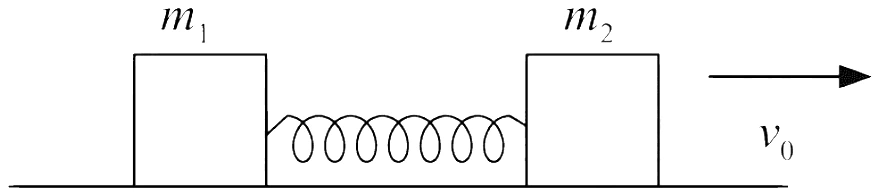
Two blocks of masses m1 and m2 are connected by a spring of spring constant k. The block of mass m2 is given a sharp impulse so that it acquires a velocity v0 towards right. Find the maximum elongation that the spring will suffer.
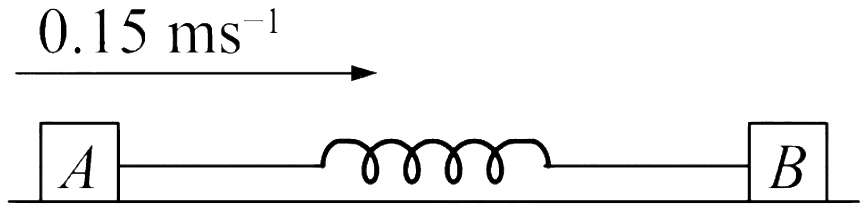
Two rectangular blocks A and B of masses 2kg and 3kg respectively are connected by a spring of spring constant 10.8N m−1 and are placed on a frictionless horizontal surface. The block A was given an initial velocity of 0.15m s−1 in the direction shown in the figure. The maximum compression of the spring during the motion is
A shell of mass 20kg at rest explodes into two fragments whose masses are in the ratio 2:3. The smaller fragment moves with a velocity of 6m s−1. The kinetic energy of the larger fragment is
Two spherical bodies of masses M and 5M and radii R and 2R respectively are released in free space with initial separation between their centres equal to 12R. If they attract each other due to gravitational force only, then the distance covered by the smaller body just before collision is
A bomb of mass 30kg at rest explodes into two pieces of masses 18kg and 12kg. The velocity of the 18kg mass is 6m s−1. The kinetic energy of the other mass is
A particle of mass m is projected with velocity v at an angle θ with the horizontal. At its highest point, it explodes into two pieces of equal mass, one of the piece continue to move on the original trajectory, then the velocity of second piece is
A man holding a rifle (mass of person and rifle together is 100kg) stands on a smooth surface and fires 10 shots horizontally in 5s. Each bullet has a mass 10g with a muzzle velocity of 800m s−1. The velocity which the rifle man attains after firing 10 shots will be
A body of mass 5m initially at rest explodes into 3 fragments with mass ratio 3:1:1. Two of fragments each of mass 'm' are found to move with a speed of 60m s−1 in mutually perpendicular directions. The velocity of third fragment is
A particle of mass 4m explodes into three pieces of masses m, m and 2m. The equal masses move along X-axis and Y-axis with velocities 4m s−1 and 6m s−1 respectively. The magnitude of the velocity of the heavier mass is
A bomb of mass 20kg at rest explodes into two pieces of masses 12kg and 8kg. If the velocity of 8kg mass is 6m s−1, then the kinetic energy of the other mass is:
Two particles which are initially at rest move towards each other under the action of their mutual attraction. If their speeds are v and 2v at any instant, then the speed of centre of mass of the system is
Three bodies A, B, and C of masses 2kg, 3kg, and 5kg respectively are projected simultaneously with the same speed from the roof of a tower. The body A is thrown vertically upwards, body B is thrown vertically downwards and body C is projected horizontally. The acceleration of the centre of mass of the system of three bodies is (Acceleration due to gravity =10m s−2)
Two particles A and B initially at rest move towards each other under a mutual force of attraction. At the instant, the speed of A is V and the speed of B is 2V, find the speed of centre of mass of the system, if the masses of A and B are in the ratio of 2:1
If three particles of masses 2m, m and 4m are moving in three mutually perpendicular directions with velocities 3m s−1, 4m s−1 and 3m s−1 respectively, then the magnitude of the velocity of the center of mass of the system of three particles is
A body which is initially at rest breaks into 2 pieces of masses 4M and 6M respectively, together having a total kinetic energy E. The piece with mass 4M, after breaking has a kinetic energy
A body A is projected with a velocity of 40m s−1 at an angle of 60∘ with the horizontal. At some other time, another body B is thrown vertically upwards with a velocity of 403m s−1 such that it collides body A at a height of 60m. If the velocity of centre of mass of the system of the two bodies after collision is 20m s−1, then the ratio of the masses of the bodies A and B is (Acceleration due to gravity =10m s−2)
A body of mass 2kg is moving towards north with a velocity of 20m s−1 and another body of mass 3kg is moving towards east with a velocity of 10m s−1. The magnitude of the velocity of the centre of mass of the system of the two bodies is
Two bodies of masses M and 4M initially at rest, start moving towards each other due to their mutual attraction. The velocity of their centre of mass when the first body attains a velocity v0 is
A block of mass 10kg moving with a speed of 5i^m s−1 on a frictionless horizontal surface suddenly explodes into two pieces. If one piece with mass 4kg moves with a speed of 10i^m s−1, then the velocity of the second piece is
If two bodies of masses 2kg and 3kg are moving at right angles with velocities 20m s−1 and 10m s−1 respectively, then the velocity of the centre of mass of the system of the two bodies is
A wooden plank of mass 90kg and length 3.3m is floating on still water. A girl of mass 20kg walks from one end to the other end of the plank. The distance through which the plank moves is
Two blocks of masses m and 2m are connected by a massless string which passes over a fixed frictionless pulley. If the system of blocks is released from rest, the speed of the centre of mass of the system of two blocks after a time of 5.4s is (acceleration due to gravity =10m s−2)
Two blocks of equal masses are tied with a light string passing over a massless pulley (assuming frictionless surfaces) acceleration of centre of mass of the two blocks is (g=10m s−2)
Two particles of masses 1g and 2g move towards each other with velocities 10m s−1 and 20m s−1 respectively. The velocity of the centre of mass of the system of the two particles is
A body P of mass 3kg at rest is dropped from a height of 250m from the ground. At the same moment another body Q of mass 2kg is thrown vertically upwards from the ground with a velocity of 50m s−1. Both the bodies travel along the same straight line in opposite directions. The velocity of body Q when the centre of mass of the system of the bodies P and Q reaches the maximum height is
Two bodies A and B of masses 2kg and 3kg respectively are moving along the same straight line such that the linear momentum of body A is greater than the linear momentum of body B. The velocity of centre of mass of the system of the two bodies when they are moving in the same direction is 9 times the velocity of centre of mass when they are moving in opposite directions. The ratio of the velocities of the bodies A and B is
A bomb of mass 'm' at rest explodes into three parts. If these three parts move horizontally with equal speeds in different directions, then the masses of the three parts can be
A body P of mass 1.5kg moving with a velocity of 10m s−1 makes a one-dimensional elastic collision with another body Q at rest. If the ratio of the velocities of the bodies P and Q after collision is 1:3, then the velocity of the centre of mass of the system of the two bodies is
Two blocks of masses in the ratio m:n are connected by a light inextensible string passing over a frictionless fixed pulley. If the system of the blocks is released from rest, then the acceleration of the centre of mass of the system of the blocks is
Three particles A, B and C of masses m, 2m and 3m are moving towards north, south and east respectively. If the velocities of the particles A, B and C are 6m s−1, 12m s−1 and 8m s−1 respectively, then the velocity of the centre of mass of the system of particles is
A bomb of mass 16kg explodes into two pieces of masses 4kg and 12kg. The velocity of the 12kg mass is 4m s−1. The kinetic energy of the second piece is
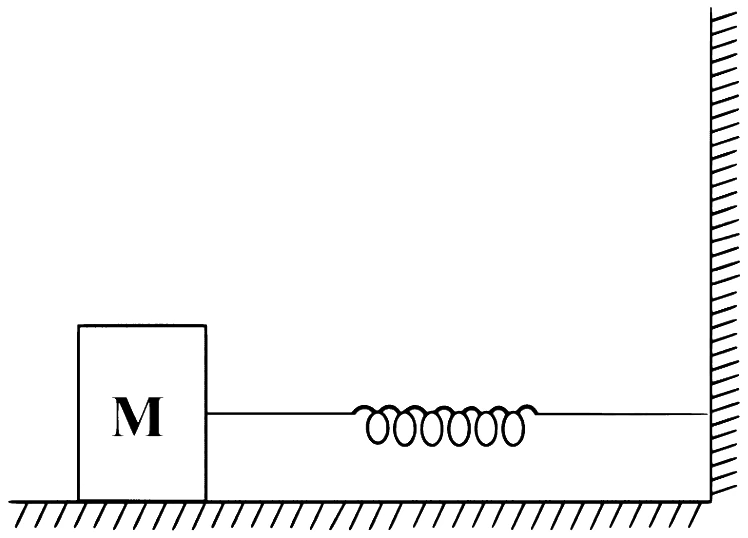
A block of mass M moving on a frictionless horizontal surface collides with a spring of spring constant K, as shown in the figure. If the spring compresses by a length L, then the maximum momentum of the block after the collision is
Two blocks of masses 2kg and 1kg are tied to the ends of a string which passes over a light frictionless pulley. The blocks are held at the same horizontal level and then released suddenly. The distance traversed by their centre of mass in 2s is
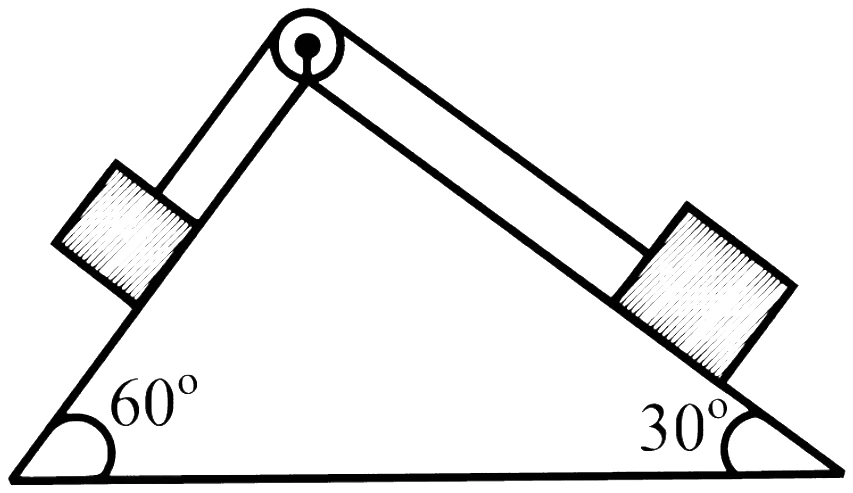
Two blocks of equal masses are tied to the ends of a light string. The string passes over a massless pulley fixed on frictionless surface as shown in the figure. The acceleration of the centre of mass of the blocks is (g = acceleration due to gravity)
Two blocks of equal masses are connected with a massless spring of spring constant 2500N m−2 and length 10cm at rest on the frictionless horizontal plane. If a constant horizontal force 10N is applied as shown in the figure, find the maximum distance between the blocks.
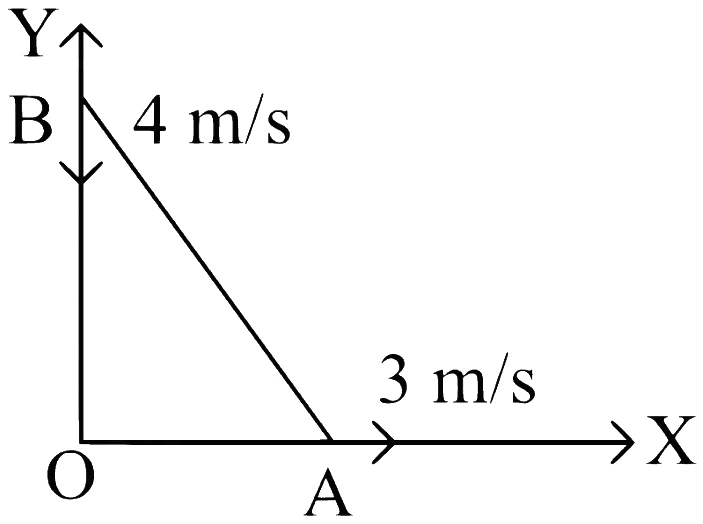
A uniform rod AB of length 1m and mass 4kg is sliding along two mutually perpendicular frictionless walls OX and OY. The velocity of the two ends of the rod A and B are 3m s−1 and 4m s−1 respectively, as shown in the figure. Then which of the following statement(s) is/are correct?
More than one option can be correct. Tap every correct option, then tap Check.
A particle of mass m is projected at a velocity u, making an angle θ with the horizontal (x-axis). If the angle of projection θ is varied keeping all other parameters same, then magnitude of angular momentum (L) at its maximum height about the point of projection varies with θ as,
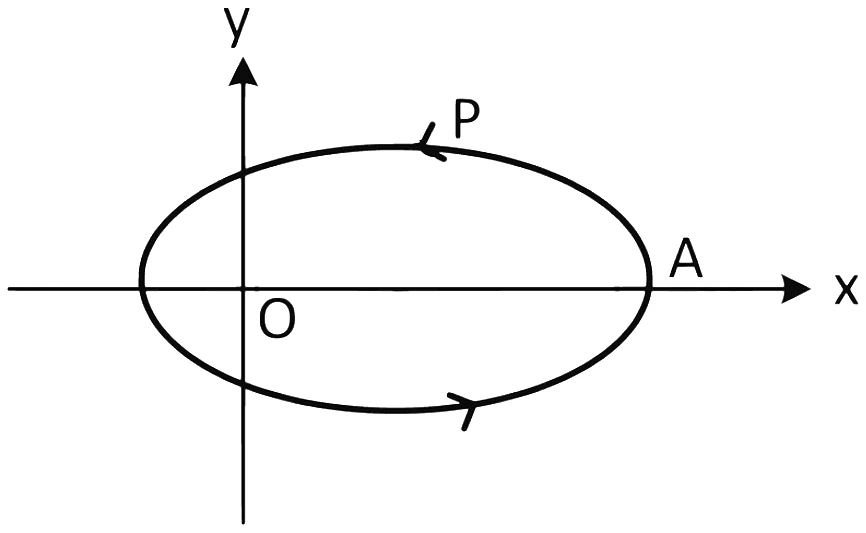
A particle is moving in an elliptical orbit as shown in figure. If p, L and r denote the linear momentum, angular momentum and position vector of the particle (from focus O) respectively at a point A, then the direction of α=p×L is along.
A body of mass m is thrown with velocity u from the origin of a co-ordinate axes at an angle θ with the horizon. The magnitude of the angular momentum of the particle about the origin at time t when it is at the maximum height of the trajectory is proportional to
A uniform thin rod of length L, mass m is lying on a smooth horizontal table. A horizontal impulse P is suddenly applied perpendicular to the rod at one end. The total energy of the rod after the impulse is
A solid spherical ball and a hollow spherical ball of two different materials of densities ρ1 and ρ2 respectively have same outer radii and same mass. What will be the ratio, the moment of inertia (about an axis passing through the centre) of the hollow sphere to that of the solid sphere?
Two particles A and B (both initially at rest) start moving towards each other under a mutual force of attraction. At the instant, when the speed of A is v and the speed of B is 2v, the speed of the centre of mass is
A spherical raindrop of initial mass M0 and initial radius R falls freely from rest. Let ρ be the constant density and r the radius at time t. Assume that the drop maintains its spherical shape. The drop loses mass at the rate dm/dt=−4πkρr2, where k is a constant. Define tc=kR. Select the correct statement(s)
More than one option can be correct. Tap every correct option, then tap Check.
A girl of mass 50kg jumps from the shore onto a stationary boat of equal mass floating on a still pond. She jumps back to the shore almost immediately. Her speed in both cases is 2m/s with respect to the shore. Consider her entire motion to be horizontal and in one dimension. Ignore friction and drag forces. The speed of the boat with respect to the shore after she jumps back is